A good book transports us to another land. Although I love fiction, I’m increasingly moved by the power of narrative nonfiction, especially biography. Through the eyes of another, we experience lands far away, without ever leaving our homes. In so doing, we learn about political and social events that may have passed us by. For instance, Chai Ling’s Heart for Freedom opened to me China around the time of Tiananmen Square.
So I offer you a review of two real-life accounts that will enlarge your borders. One that moved me profoundly is Where the Wind Leads, a gripping narrative of a Chinese family living in Vietnam who were forced to leave their business and their home to escape communist oppression. They commissioned an old boat and sought refuge with nearly 300 others, but neighboring countries squawked under the weight of so-called compassion fatigue. The refugees ended up imprisoned on a beach in Malaysia, forced to march from one part of the beach to another, until they were deposited into derelict fishing boats, taken to the middle of the ocean, and left to die.
The author is Vinh Chung, one of the family’s sons, who recounts the many miracles that eventually brought the family to safety and a new home in Arkansas. He’s a sensitive narrator who explains Asian customs and traditions while detailing his family’s coming to faith in the Creator God, as revealed through Jesus. Through his story he shows the value of family, community, elders, education, perseverance, hope and faith. He also reveals the ugly side of discrimination and racism. One to read, ponder and pass to friends and family.
The other book is Greg Valerio’s Making Trouble, how he fought out of poverty and meaninglessness while creating the first line of fairly traded jewellery in the UK. His story of exposing corruption reveals the dark side of capitalism, when profits are prized more than people or the environment. It’s a David-and-Goliath story of one who couldn’t close his mouth against the wrongs he witnessed – not only the oppression of the workers, but the rape of the land. His model of creating a pure line of jewellery – with completely traceable gold and diamonds – shows how one man with perseverance and vision can effect change.
The book recounts an important movement for social change, but the narrative slowly lost my attention through the discussions of the unions, trade shows and politics.
Are you reading memoir? If so, which one, and why?
Where the Wind Leads: A Refugee Family’s Miraculous Story of Loss, Rescue, and Redemption, Vinh Chung (Thomas Nelson, ISBN978-0849947561)
Making Trouble: Fighting for Fair Trade Jewellery, Greg Valerio (Lion, ISBN 978-0745956033)
Hearing God, I’m learning, is about heeding the nudges. Acting on those little prompts that pop into my mind, which I’m never completely sure are “just me” or are quite possibly the Lord. That sounds cheeky in and of itself, doesn’t it – I heard GOD. But that is the amazing mystery of the Lord on high communicating with his created ones.
Recently a fragment of a verse from Scripture made itself known to me, and I knew immediately that I should share it with a particular friend. The timing wasn’t convenient – it was after dinner, bath time for the kids, in the rush before the Vicar went to his church meeting. But in that moment I sensed that I should follow the nudge.
The phrase that flitted through my mind was, “I lift mine eyes to the hills; from whence does my help come? My help comes from the Lord, the Maker of heaven and earth.” Not being one of those people who can tell you chapter and verse when it comes to the Bible (and yes, the Vicar does have this uncanny ability), I didn’t know where it came from but guessed one of the Psalms. I looked it up online, and loved reading the whole chapter – Psalm 121 – as it continues in a wonderful vein, about how the Lord will not let our foot slip, and how he never slumbers or sleeps.
I texted my friend and she texted me back, saying my timing was perfect and sharing some other wonderful “coincidences” about her life, her children, and God, including: “How special peace feels…”
The Lord graciously used me to bring her comfort and the assurance of his love, but he’s not stingy with his blessings. I received by acting on that little nudge – not only receiving the love of my friend, but gaining confidence that in this instance the nudge was divinely inspired. I’ve been on this journey of hearing God for two decades now, and I certainly wouldn’t call myself an expert – I need these grace-filled experiences that teach me to open my ears and heart and obey.
The Lord – amazingly – uses his children for the meeting of his people’s needs. We are his hands and his feet to bring his love to his people.
How about you? Have you acted on those little nudges? If so, what happened?
Want to know why I write? Last week I explored those questions while continuing the Monday Blog Tour, which you can find on Anita Mathias’ blog. This week I’m hosting Cathy Le Feuvre. She’s one of “my” authors, for as you’ll read below, I’ve just commissioned her and Debbie Duncan to write a book, Life Lines, for Authentic Media. It’s a fab fictionalized account of two friends doing life together, of which Michele Guinness says, “Embedded in this wry, witty and revealingly frank correspondence is many a buried gem of wisdom on the basic, gritty issues of life that make us laugh and make us cry, and that we survive by sharing.” Look for it this autumn!
And now, over to Cathy.
Thanks to Amy for nominating me for the Monday Blog Tour. It’s been great getting to know Amy these past few months, since we first met in her home in North London over lunch and a very long chat. Amy is the editor for my latest book, which I’m co-authoring with Debbie Duncan…but more of that later!
As with the other Monday blog hoppers before me, I’ve been presented with a series of questions to answer. Just between us, this is a little strange for me. I’ve been a journalist for thirty odd years, off and on, so I’m usually the one asking the questions.
However … here goes!
What I am working on?
Right now? I’m researching and writing a new book for Lion Hudson publishers which is due to be completed by early autumn and is scheduled for publication next spring. It means I’m spending half my time in Victorian England.
It feels really strange seeing those words in print – ‘I’m researching and writing a book’ – because I think ever since I can remember I’ve had stories in my head and have been telling stories – to my teddies, my dollies, school mates in the dorm (I went to boarding school) and then various nieces, nephews, godchildren and anyone else who would listen. Ever since I can remember I’ve yearned to be a ‘writer’, an ‘author’, but secretly I was always a little scared to take that leap of faith. Although I don’t consider myself a natural crowd pleaser, I suppose I was always worried about whether I would cut the mustard. What would people think of my writing, my ‘ambition’? Would people think me arrogant? If I made my ‘dream life’ a reality would it all come crashing down? And then where would I be?
So, I became a journalist! Local newspapers, local radio then news and current affairs reporting and presenting in regional television and a career as a producer in network TV where I worked mostly in ‘religious’ broadcasting. Finally I found myself in PR and working for The Salvation Army UK church and charity organization – The Salvation Army also happens to be my church of choice. I was Head of Media in charge of a press office, reputation management and so much more.
I was writing. Every day. I wrote news stories and reports and TV and radio scripts. I wrote press releases and official business reports. I helped others to write. I learned to write with purpose. And in my ‘spare time’ I still scribbled my stories and poems, and scripts for church plays and presentations, and started and sometimes completed numerous stories, novels and books. I was shortlisted in a national Children’s Short Story competition and began to think “maybe I CAN DO THIS!”
To cut a long story short, finally, five years ago I took a deep breath and stepped out in faith and quit my full-time job. Within months of going freelance, I was commissioned by Lion Hudson publishers to produce a book about The Salvation Army in advance of the Christian movement’s 150th anniversary next year – 2015. I said ‘Yes!” Obviously.
Of course, I still work in PR, journalism, broadcasting and training to pay the bills but the creative writing has developed beyond my wildest dreams even if it doesn’t yet pay much. I’m learning to live on trust. Sometimes it’s touch-and-go at the end of the month, but God has been good. More writing projects/books are coming in and doors have opened for some paid work which keeps me afloat, is extraordinary interesting and has introduced me to new friends and opportunities. There’s a passage from the Bible which has popped up time and again over the past years and I live with the words in my heart – ‘For I know the plans I have for you,’ declares the Lord, ‘plans to prosper you and not to harm you, plans to give you hope and a future.’ (Jeremiah Ch 29 v 11 NIV)
In September 2013 my first book was published. William and Catherine, the love story of the founders of The Salvation Army told through their letters (Monarch books).
The second book is on the horizon. This autumn Debbie (Deborah) Duncan and I will publish a book called Life Lines – which is basically an online/email ‘conversation’ between two fictional friends, both Christians, both of a ‘certain age’, one married with family, one single. This started out as a fun project based on conversations Debbie and I had while commuting together into London. We live near each other at the moment so when travelling into work we often shared a vehicle to the station and took the train together into the city. We swapped life stories and laughed so much we decided to write something down in the form of a fictional story of friendship. And, thanks to Authentic Publishers and the magnificent Amy Boucher Pye we have a book which, we hope, will make people laugh but will also provide moments of reflection as we all think about why we do what we do, as Christians, women, and friends. Life Lines has been great fun to write and we’re very excited about its upcoming publication.
As I said at the start of this question, I’m currently researching and writing my next book for Lion. It’s the story of a scandalous and intriguing court case in Victorian England – a court case which highlighted an evil of the times and ultimately helped to change the course of history. It means I’m spending a good deal of my time in Victorian England and the Old Bailey. Fascinating!
Why do I write what I do?
WHY do I write? Because it’s my living and my passion. Simple!
I write every day – either for magazines (articles) or clients (ghost writing/press and media/reports/social media). I have also thoroughly enjoyed writing devotional material – Bible Reading Notes – for Scripture Union’s Closer to God series over the past three years which has also encouraged me to delve more deeply myself into God’s word.
Over the past three years I’ve also learned to build basic websites and I write (sometimes rather intermittently) on my own website and blog and daily on my own social media networks (various Facebook sites, and Twitter @CathyLeFeuvre). I also write articles for various online sites, like Hub Pages, which is good fun and keeps my tight writing skills up to spec.
How does my work differ from others in its genre?
The publication of William and Catherine was very special for this first-time author. Experiencing my first book launch last September, seeing my book in bookshops, and featured on online sales sites like Amazon, attending promotional events and actually signing copies and running events/evenings/afternoons where I talk about the Booths and how the book came about is a great honour. Next weekend (Sat May 31st – 10am) I’ll be speaking at the Bloxham Festival of Faith and Literature. What a buzz!
The fact that I’ve been first commissioned to write ‘serious’ historical-based narratives is great for me because it’s well within my skillset as a journalist. I love to research! I’m current loving my digging around into life in the under-belly of Victorian society!
But even with my ‘serious’ work I aim to make it ‘user friendly’ and to incorporate my creative writing skills whenever possible. William and Catherine is a biography of the founders of The Salvation Army, William and Catherine Booth. But the word ‘biography’ sometimes puts people off reading, so I wanted to come at it from a different perspective. I leave the very serious, theological stuff to others more learned than myself. As the full title of the book implies, I used the personal letters of William and Catherine Booth to build their story. The letters are held in trust in the British Library and I loved spending time in the library in London pouring over the hand-written notes and letters which they exchanged over nearly 40 years, from their first meeting until Catherine’s death in 1890. What a privilege to read their inner-most thoughts and to experience something of the deep love they shared for God and each other over a lifetime.
Alongside edited extracts from the Booth letters I also included historical narrative – explaining their lives and times, the background to what they are saying in the letters. But, in addition, I included ‘creative’ cameos, little stories in which I attempted to draw the reader into the Booth’s world. Many of these stories included information I’d gleaned through research, except it was presented from either William and Catherine’s or other perspectives. People have been kind enough to say that William and Catherine has helped them to get to know the founders of this great international Christian movement, which today impacts millions of lives across the world, as ‘real’ human beings. That’s what I wanted and I’m aiming for my next Lion book to incorporate similar elements – extracts from contemporaneous documents, historical narrative and explanation and ‘creative stories’ to help transport my readers back to 1885 and Victorian London.
I’m also still writing creative stories although finding time can be a challenge. I have a couple of full length children’s stories which I hope one day will also be out there in the world. Re-writing is a big thing with me and these are being re-written quite a lot at the moment! And, of course, there is Life Lines.
I don’t really have a master plan on what type of books/writing I want to be ‘known’ for but I don’t particularly want to get ‘pigeon-holed’. I know some ‘experts’ say one should become known for one particular ‘genre’ but now I’ve started (almost) full time writing I find the ideas come thick and fast and the opportunities for different kinds of writing just keep opening up. Those stories which have always been inside my head are now being allowed to have lives of their own.
How does my writing process work?
Sometimes I’m rather tied up with working for clients as part of the ‘day job’ but I always try to write something ‘creative’ every day even if it’s just some notes on my latest project or an online piece. I do try to ‘timetable’ my activities, to ensure that all essential work is completed on time. I even have a whiteboard! But ultimately when there’s a deadline looming or the creative juices are flowing I can, like most writers, spend many hours in front of the computer, with the obligatory short breaks. I think my longest stint was 18 hours before I had to lie down for a bit.
I work mostly from home and have my ‘office’ in my little ‘Spare ‘Oom’. It’s not always as tidy as I’d like it to be, especially when I have all my research laid out on the spare bed, so sometimes I set up on the kitchen table, from where I have a good window view to the gardens below. When I have a writing project to complete, I try not to get too distracted by squirrels, birds, social media and emails. I heard recently from an eminent pastor and theologian that one is 20% less efficient when ‘multi-tasking’ and certainly when completing William and Catherine I learned to switch off my email. Thus I avoided being suddenly distracted by an in-coming ‘ping’ on my computer which alerted me to a message and sucked the next hour out of my life when I should have been working. I check emails during ‘breaks’ and, as I learned to do during my fulltime journalism days, I try to prioritise my responses. However, I do sometimes listen online to music and to the radio (my ‘home station’ BBC Jersey is my favoured station of choice, along with BBC Radio 4) especially when I’m researching.
By Waddington. Reproduced by permission.
I find being outside helps to clear my thoughts … The rhythm of walking somehow helps me to sort out any writing issues. While stepping out I find I can see more clearly where the structure of my story needs to go or how a character might want to speak to my reader.
When working on a big writing project, I often find myself stopping to chat to God…I guess it’s praying…especially when the words won’t come or I get myself into a fix. When I was a child The Chronicles of Narnia were among my favourite books. You might have picked that up from the ‘Spare ‘Oom’ reference (Mr Tumnus/The Lion, the Witch and the Wardrobe). CS Lewis is one of my favourite writers. Many years ago I became aware of a quote attributed to him – “The world does not need more Christian literature. What it needs is more Christians writing good literature” – and this has lived with me and is part of my motivation. Not all my writing is ‘overtly Christian’ but I very much see my writing and would-be creativity as part of my faith life and I give it to God every day, for him to use.
So that’s me. Now, to continue the blog tour, of course I nominate my fabulous friend and writing partner Debbie Duncan.
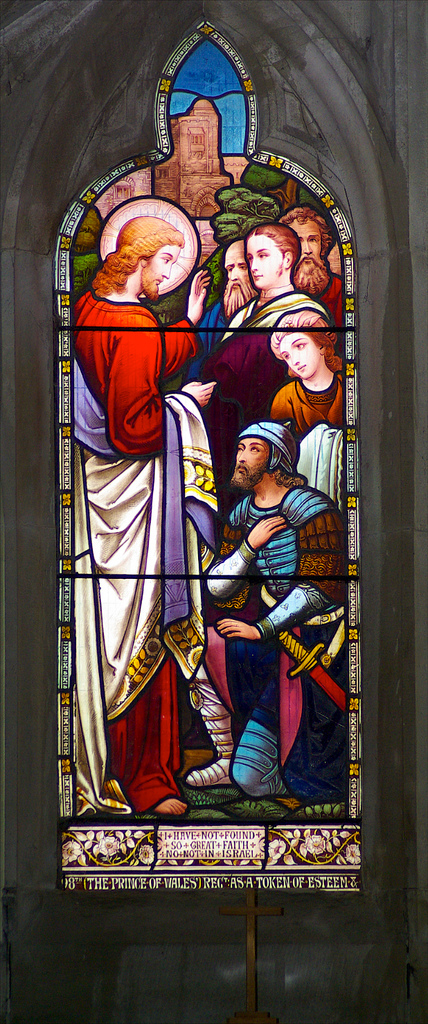
When Jesus had entered Capernaum, a centurion came to him, asking for help. “Lord,” he said, “my servant lies at home paralyzed, suffering terribly.” Jesus said to him, “Shall I come and heal him? The centurion replied, “Lord, I do not deserve to have you come under my roof. But just say the word, and my servant will be healed. For I myself am a man under authority, with soldiers under me. I tell this one, “Go,” and he goes; and that one, “Come,” and he comes. I say to my servant, “Do this,” and he does it.” When Jesus heard this, he was amazed and said to those following him, “Truly I tell you, I have not found anyone in Israel with such great faith…” Then Jesus said to the centurion, “Go! Let it be done just as you believed it would.” And his servant was healed at that very hour. Matthew 8:5–10, 13 (abridged)
Parish Church of St Michael, Mitcheltroy, Window. Credit: Keith Moseley, flickr
Following last week’s opener, Jesus continues to blow apart the people’s preconceptions as he exercises his authority, bringing healing to the Gentiles. When a Roman soldier asks for help, Jesus responds by asking if he should go to his house to heal the man. The soldier, however, wants to avoid Jesus becoming ceremonially unclean from entering a Gentile’s house. So the centurion applies the principles of faith and authority to the situation. As a man under authority who obeys the words of his superiors, and as one who has men serving under him, he believes that if Jesus just says the word, his servant will be healed.
And so it was. This miracle signals that the new kingdom is not limited to Jewish people but is available to Gentiles as well. It is also a stark warning to those in Israel who may have grown complacent in their status as the chosen people. Never, said Jesus, has he found someone of such great faith. Those listening must have felt stunned by this remark.
Do we take our faith for granted? How could you exercise faith this day? And how do you feel about being under authority?
For reflection: “I am not ashamed of the gospel, because it is the power of God that brings salvation to everyone who believes: first to the Jew, then to the Gentile” (Romans 1:5).
When people take the time to write to me about one of my Bible devotions, I read their letter with interest. More than once I’ve been called up over a suspect claim or a disputed point of theology. In fact, at one time I started to dread the letters coming through the door.
But then I wrote a set of notes on the theme of pilgrimage, which seemed to strike a chord, especially with people who were transplanted from their homes. I still receive a lovely card at Thanksgiving from one of the readers, which I find moving.
One letter in particular blows me away. This woman was writing about some notes I wrote for New Daylight on the miracles of Jesus, and the text was Matthew 8:23-27, where Jesus calms the storm.
As I wrote in the notes:
The storm was no ordinary storm. This is hinted at by the Greek word seismos, which usually means an earthquake, or literally, a “shaking” (RT France, Matthew, IVP, 1985, p. 161). A force from outside brought chaos; that is, a squall came upon the lake violently and suddenly. Jesus demonstrates his authority by calming it with a rebuke…. Jesus wants us to believe in his power to still the storms in our lives, whether created from outside or from within. Sometimes they appear suddenly, taking us by surprise and perhaps flattening our faith. As we turn to him in fear or faith, asking him to save us, he brings calm and peace, creating order from disorder.
Here’s her letter (spellings intact):
I am a Brit living in Christchurch, New Zealand. For many years I have used and appreciated the BRF New Daylight series & at the memorial service for the victims of the earthquake today [18 March 2011] we were urged by our bishop to tell our stories. I don’t expect you realise what you wrote on the day of the earthquake, I had been at a small prayer group in the morning & read out the passage for Tuesday 22nd Feb & we talked about it, & related it back to September 4th the day of the first quake.
Fifty minutes after leaving the group we were once again hit by a terrible earthquake & as I took refuge under a rack of clothes in the shop I was passing through, I cried out to the Lord, in fear, to protect & save me & my family. I remembered what I had just read to the group & tried to trust Jesus. The past three weeks have been difficult, & nothing is the same, but all our family are well & this has brought us closer to the Lord.
I was bowled over, to think that the words of the devotional, written probably a year previously, would be so used by God in a place far away.
The power of words and the Word. What words will you speak or write this day, that might bring hope, comfort, or peace?
On my last night in Spain a week or so ago, we went out to dinner at the local restaurant and enjoyed a feast of tapas. The plates kept coming, one after another, and the one that stunned me the most was the piping hot goat’s cheese, battered and deep fried. Oh. My. Word. Was I in Spain, or transported to the Minnesota State Fair, where I’d just been parceled out some of their famous cheese curds by a sweaty teenager? I tried not to be too greedy. I did try.
What hit me, however, was how at that dinner I was no longer the translator-in-a-foreign country, but the one needing help. When I ordered my drink, I asked for a Diet Coke, to which the waiter looked at me blankly. The Brit-married-to-a-South-African-living-in-Spain sitting across from me quickly explained to the waiter that I wanted a Coca-Cola Light.
Ah, so often I play that role, when Americans come to visit and I count out their “play money” at the till (US: cash register) or warn them not to admire someone’s pants. Or tell my children that when we’re in America they use erasers on their pencils… So when in Spain, I was jolted into humility. We’re all foreigners somewhere.
Foreigners and strangers, longing for home. Longing for a place where you don’t need to translate. Where you’re understood and known and accepted. Where you belong.
Today we’re starting a new devotional series, looking at the miracles of Jesus, via Matthew’s gospel. He’s on a mission to reveal the authority of Jesus. First he demonstrates that Jesus is the Son of God through his Sermon of the Mount, which left the crowds amazed. Then he moves from Jesus’ words to his actions, detailing in quick-fire succession miracle after miracle after miracle. Through these mind-blowing acts, Jesus takes authority over nature, sickness, sin, and demons, while pouring out his love and compassion on his people whom he calls “sheep without a shepherd” (Matthew 9:36). If the people were amazed at his teaching, imagine their reaction after witnessing sight restored or a leper cured.
Photo credit: Christ Healing the Sick, Washington Allston
Matthew’s account is concise; he leaves out details in the stories that other gospel writers fill in. With this brevity Matthew hammers home his message about the Son of God on earth who is ushering in God’s kingdom.
Jesus’ miracles tend to fall into three categories: those controlling nature, those eradicating sickness (and even death), and those casting out demons. But contrary to the expectations of the disciples, the teachers of the law, or his Jewish readers, Jesus extends his healing grace to the disaffected and outcast – even to the Gentiles. He stuns them with his words and his works and makes them wonder, ‘Who is this man?’
As I read through Matthew’s account of Jesus’ miracles, I was struck more than once by Jesus’ compassion. When he sees the suffering of the people, he immediately brings peace of body and soul. He then reinforces this with his call to peace, one he still issues: “Come to me, all you who are weary and burdened, and I will give you rest” (Matthew 11:28).
Yes, Jesus works miracles today. Physical healings are spectacular, but emotional healings can also be life-altering, bringing freedom, joy and fulfillment. Do we have the faith to believe that Jesus can and will work in our own hearts and lives? I pray we will encounter the stories of Jesus’ miracles with an attitude of expectancy, reverence and gratitude.
Be Clean
When Jesus came down from the mountainside, large crowds followed him. A man with leprosy came and knelt before him and said, “Lord, if you are willing, you can make me clean.” Jesus reached out his hand and touched the man. “I am willing,” he said. “Be clean!” Immediately he was cleansed of his leprosy. Then Jesus said to him, “See that you don’t tell anyone. But go, show yourself to the priest and offer the gift Moses commanded, as a testimony to them.” Matthew 8:1–4
The crowds were amazed by Jesus’ Sermon on the Mount, and now as he comes down the mountain, they will be bowled over by his works. This first miracle that Matthew recounts brings restoration to one who suffered from leprosy or another skin disease. In Jewish law, those so afflicted would be called “unclean” and would be banished from others to prevent further spreading of the disease. But the leprosy would continue to spread within the sufferers’ bodies, affecting limbs that would eventually fall off, until finally they would die.
So although the other miracles are called healings, this one is called a cleansing, for only Jesus could make the sufferer clean. Perhaps Matthew chose to recount this miracle first to show the Jewish people that Jesus is the fulfilment of the law (Mark and Luke first tell of Jesus driving out a demon in a man in Capernaum). After healing the man, Jesus tells him to show himself to the priest and offer the prescribed gift. By this he is signalling that one greater than Moses has come; he is ushering in a new order.
We could push this healing aside as not affecting us, but the spread of leprosy in a body is similar to the spread of sin in our lives. If we do not present ourselves to Jesus for cleansing, our sin will spread, separating us from each other and from God. Only Jesus can bring the cleansing that releases us into wholeness and makes us clean.
Prayer: Lord Jesus Christ, show me where sin may be lodging, that I may be cleansed by your healing hand.
As we head into summer, are you thinking about reading more novels? Here are two that I found satisfying. Both have protagonists who find their identity through staying within what they discerned were God’s boundary lines for their lives (see Psalm 16). Interestingly, both include women married to clergymen, though I hadn’t anticipated that…
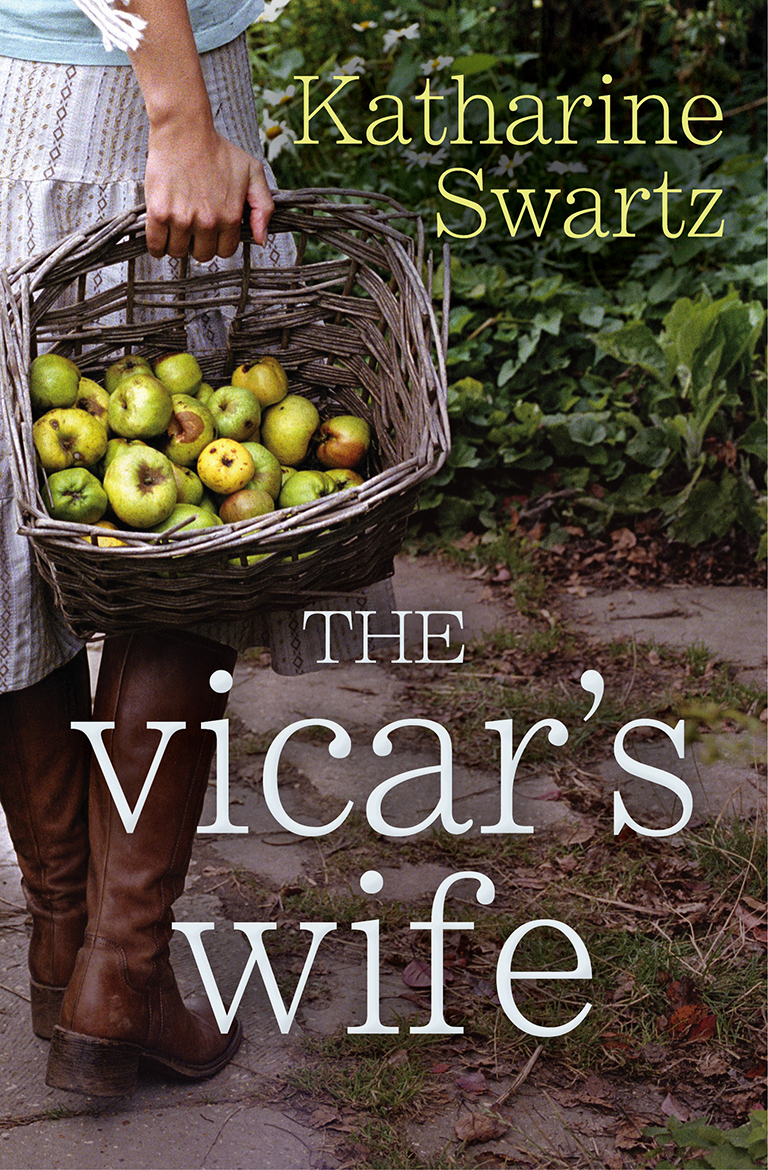
I was grabbed by The Vicar’s Wife, which of course ishardly surprising as like the title of the book I’m a VW; like the protagonist I moved from the States to the UK for my English husband; like her I’ve experienced the sense of loss, homelessness, culture shock… and the ways God can use those challenges to shape and mold me. Some of the scenes I felt I had lived, such as feeling like an outsider at the school gate, or the way adjusting to a new culture can seemingly sap all of one’s energy. But you don’t have to be a foreigner or a VW to enjoy this gentle story of two women separated by several decades and how they came to terms with the dramatic changes in their lives. It’s an enjoyable read, and I only wished the role of God and faith hadn’t been quite so buried.
All for a Song is mainly set in the Roaring Twenties, as remembered in the present day by an octogenarian trapped in her body after a stroke renders her speechless and mostly immobile. Dorothy Lynn Dunbar’s life as a young woman was set out for her – following her father’s untimely death, she would marry the young preacher who came to take his place. She loved Brent Logan, but she also yearned to see the world – and make her music. When she has the opportunity to sing for the groundbreaking evangelist Aimee Semple McPherson, she surprises everyone in her small rural town by following her dream. It’s a moving coming-of-age story, exploring how Dorothy Lynn finds her place in the world, and how she ultimately finds contentment and joy.
What are you reading?
The Vicar’s Wife, Katharine Swartz (Lion, ISBN978-1782640707)
All for a Song, Allison Pittman (Tyndale, ISBN978-1414366807)
We, the creatures of a creative God, are poised for creation and collaboration (and sorry about all those c’s). I was so struck by this last week I was in sunny Spain with an animated, gifted group of women as I led the retreat portion of the retreat/holiday at El Palmeral. We were looking at our identity in Christ, with each session having a hands-on component of prayer and/or creation.
One of the activities was to make a picture that represents different parts of our identity – what names does God call us? I laid out glitter glue, fabrics, beads, and colored papers, and said something like, “Off you go!” To which my friends seemed to look at me blankly, and one said she didn’t know where to start. I launched into a prayer asking God to release the works that were within us.
He did. As we reflected later, we realized that one thought would pop into our head, and we’d go with that, which then would lead us to another, and another. Step by step we formed the pictures. We created together in a group yet in silence, with instrumental hymns in the background that also in some cases sparked memories and thoughts.
I find the same experience happens when I write. I might come to the blank page with no idea what I’m going to say, but a hint of an idea will pop into my head, which I take and examine and knead and explore… leading to the next thought, and the next.
God the Creator, who made us to create with him. An awe-inspiring thought.
How about you? How do you find the creative process?
(With thanks to the creators of these pictures for permission to include here. Each picture has layers of meaning that I found incredibly moving.)
I did not tell you this at first because I was with you. John 16:4
PyelotBoy, about the time he went to school for the first time…
The first day I left PyelotBoy at nursery (UK; US: pre-school), I wondered how he would fare and if he would be lonely or afraid. My husband and I had tried to prepare him for the good things to come, such as new friends, engaging play, and increased independence. But I hadn’t prepared myself for the wrenching separation I felt as I realised that this was merely the start of a long journey of releasing my son. A few years on, we’re both back from a week away, and I try not to ply him with too many questions, so eager I am to hear all about his school trip.
I wonder if Jesus felt any of this sadness as he prepared his disciples to be apart from him. He knows of the trials that are ahead – not only for him but for them – so he warns them of things to come. Indeed, shortly after this conversation Jesus is arrested and brought before the high priest. He will no longer be with them physically, but he will give them an amazing life-changing gift – his very presence living in them through the indwelling of his Holy Spirit.
We never need to be far from Jesus, for he lives within us. his presence changes us, helping us to forgive the gossiping friend, to love the colleague we find difficult, to trust when we are feeling helpless and alone, to release our children into his care. In the words of the sixteenth-century monk, Brother Lawrence, we need only to pause and “practice the presence of God.” He is with us.
Prayer: Lord Jesus, I thank you that through you I live and move and have my being. Transform me, I pray.
 So I offer you a review of two real-life accounts that will enlarge your borders. One that moved me profoundly is Where the Wind Leads, a gripping narrative of a Chinese family living in Vietnam who were forced to leave their business and their home to escape communist oppression. They commissioned an old boat and sought refuge with nearly 300 others, but neighboring countries squawked under the weight of so-called compassion fatigue. The refugees ended up imprisoned on a beach in Malaysia, forced to march from one part of the beach to another, until they were deposited into derelict fishing boats, taken to the middle of the ocean, and left to die.
 The other book is Greg Valerio’s Making Trouble, how he fought out of poverty and meaninglessness while creating the first line of fairly traded jewellery in the UK. His story of exposing corruption reveals the dark side of capitalism, when profits are prized more than people or the environment. It’s a David-and-Goliath story of one who couldn’t close his mouth against the wrongs he witnessed – not only the oppression of the workers, but the rape of the land. His model of creating a pure line of jewellery – with completely traceable gold and diamonds – shows how one man with perseverance and vision can effect change.