Regular followers of this blog (love ya, Dad!) will note that I’ve been silent since Thanksgiving. Advent can be a shockingly busy time, which is ironic I know. Regular service here will resume in January, but here’s an Advent poem I recently came across, which I wrote in 1997. It’s admittedly on the twee side, but written with heartfelt devotion.
As an American in the UK, I’ve now spent a significant number of Thanksgivings out of my home country. It’s a day where I feel the cost of living here, being separated from family and friends. But we celebrate the day, and work hard to make memories for our children. They feel special for they get to miss school when all their friends have to go, and this time not for a scary medical appointment, but to go to St. Paul’s Cathedral for the annual Thanksgiving service, a quick lunch at Starbucks, and then home to prepare the food. And at the end of the day (we have to eat around 6pm because it’s just a normal day for many of our guests), we carve the turkey and sup together, enjoying our feast of food and good conversation.
But for many people, holidays such as Thanksgiving don’t hold the glossy-magazine image of loving family and friends surrounding a table heaving with tasty food. There might be material abundance but emotional scarcity. Feelings of loneliness and sadness. Seeing the chair that a loved one should be occupying, but which now sits empty. The family feud that hasn’t healed. The loss of job that weighs on the mind and heart.
When we feel pain and loss, it can be awfully hard to be thankful. And yet I’ve found that if I ask God to help me give thanks, he answers that plea. I feel a glimmer of hope; I experience a rush of love; I am overcome with peace.
Whatever your situation, may you know joy and love this Thanksgiving.
The recent typhoon that hit the Philippines has shocked and moved us. I watched as day by day the angry colors on the meteorological map of the BBC website move closer and closer toward the island where one of my dear friends has lived for decades. Knowing someone there makes the crisis more personable; it’s a land filled with people we’ve prayed for since she and her family moved there (she was one of my roommates at university, and one of my friends since junior-high school). I was relieved to hear via Facebook that my friend and her family were south of where the typhoon hit, and thus not in harm’s way. My heart goes out to all those who have been affected.
I wanted to put a human face to the Philippines, so below is an interview with Lynette Tillman (she has lived their since 1992). She also shared with me the incredibly moving story of fellow missionaries, who live in Tacloban, where the typhoon hit. They went back to their home before the typhoon arrived, feeling called to be an incarnational presence there even though they were putting themselves in danger. Don’t miss their story of floating inside their house on a mattress while the 235 mile winds blew out their windows. I love that cans of Dr. Pepper floated over to them to slake their thirst…
A Blonde in the Philippines
Typhoon Haiyan hit the Philippines on November 8, and went through the middle part of the country. Several small towns were hit, but the hardest hit city was Tacloban City. I have not been there since the typhoon hit, but the images are jarring. Whole subdivisions of cement houses have been flattened. In as much as I would like to go and help with the recovery, it is not yet time for that. Right now, what is needed is for experts to go in and clear the areas of debris (and, unfortunately, dead bodies), and to get the initial aid of food and water out to the survivors. I hope to go in a few months to help either with debriefing the survivors, or to help in the rebuilding.
Andy and Lynette Tillman
I felt a call to be a missionary since I was a young teenager. My husband, Andy, felt the same call. When we applied with a missionary-sending organization, we did not specify where we would like to go. At the time, however, there was a need in the Philippines as many missionaries were at retirement age. We have been involved in traditional church planting, and now reaching out to those of other religions (animism, Muslim, etc.).
Being blonde – with three blonde kids – in my country means we are always looked at, always noticed, usually stared at. One gets used to it. When I was newly married I received more attention; once I had children, much of the attention transferred to them. Now that my children are heading off to university in the USA, they are having to adjust to not being noticed so much!
Right now I have three jobs. I am a high-school science teacher at Faith Academy Mindanao. Faith Academy Mindanao is a small international school in Davao city in the southern Philippines. We have approximately 150 students, with 60 in the upper level (high school). We exist primarily to educate the children of missionaries, but also are the only international school in our city, so we have several children of business people as well. I teach freshman science (physical science) as well as chemistry and physics. Second, I run a guest house for workers who are reaching out into difficult areas in this country. We provide an inexpensive (US$3.50 per night) accommodation for these people, who come into the city for meetings, in transit, or just to get away and rest. We provide a venue for trainings, as well as member care for these hard-working missionaries. Third, I am the child safety officer at Faith Academy Mindanao. As we are in the two-thirds world, and generally educate foreign students, we are not adequately held accountable for reporting suspicion of child abuse. A group of like-minded mission organizations have banded together to hold each other accountable in this area. So I work to keep our campus (and community) safe for child and adult alike.
One of the dinners hosted by the Tillmans
Filipinos are some of the most hospitable, loving people in the world. Currently we are working with the unreached peoples in this area. It is heartbreaking to realize that although there are many in this country who call themselves believers, they do not share their faith. The rich culture of these unreached peoples will only be enhanced as they come to know Jesus as the Messiah.
We are now experiencing one of the costs of being a missionary in the Philippines – our eldest child, Marisa, is away at university in the USA. It is difficult to be so far away from her, especially as she struggles to find places where she feels comfortable spending holidays (such as the upcoming Thanksgiving break which she will spend with 3 different sets of people, as she does not feel that she should stay at any one of these places for more than a day or two), and when she is just not feeling well (she has had a fever and cold this recently, and it is difficult not being there to mother her). Another cost is that if we were in our home country, we would not be able to live off of our current salary. Monetarily it is difficult, and as we are looking at retirement age not too far off, we do not have the means to retire.
But there are so many joys. We are able to see the joy on the faces of people that are helped. We have seen many come to know Jesus. We have seen people fed, and clothed. An example is that in early December we will host a Christmas party with any local missionary who is reaching out to the unreached in our area. This annual event is such a joy. For several who attend, this is the only chance they have to freely celebrate Christmas. We are able to also give gifts to the children of the workers. A simple doll or other toy (which may be their only gift for Christmas) brings such joy to these children.
I hope you’ve been able to support the disaster-relief projects through prayer and finances – Tearfund or Compassion or World Vision are good organizations to give through. If you’d like more information on Lynette and Andy Tillman’s work in the Philippines, you can visit here.
One from the archives. I wrote this for Quiet Spaces
in 2008; it later appeared in Woman Alive and then in
Inspiring Women Every Day. And now for its final
resting place…
The incongruity of reading a murder mystery during a time set apart for communion with God was finally too much even for me. I packed up K Is for Killer in my duffel bag and vowed not to open the zipper.
I was at my favorite place of retreat, where I had met God previously. There I had decided against entering a marriage commitment; there I had received a fresh filling of God’s Spirit; there had I entered his presence in quiet and gentle ways. This time, however, I felt far from the Lord. I knew in my head that he was there even if I didn’t feel his presence, but my heart wasn’t so sure.
I had been silent for hours but was not truly quiet—the voices screaming inside drowned out any still, small voice of God. I was filled with pain and doubt. “Are you really speaking to me, God?” I cried out. “Is that really you I’m hearing, or is it just my heart? Or something else? I don’t want to anchor my life on what’s not real. Are you there? Can I hear you?”
Anguish had filled me for weeks. I had announced that I was leaving the Christian organization I was working for to join another Christian group in a different city, but my plans had fallen through. Bottomed out, more like it. The opportunities I was pursuing evaporated as the doors slammed in my face. The embarrassment of announcing my intentions and then not leaving was painful, but more devastating was my belief that God had directed the move.
I yearned for God, yet couldn’t bear to approach him. After a few weeks, however, I knew I needed a place of quiet in which to face the pain and to seek God’s solace. Having made arrangements with the retreat centre, I began my time alone with a mixture of fear and anticipation. Yet here I was reading the latest Sue Grafton novel. I came to my senses and lugged my Bible, journal, and a blanket down to the nearby pond for a change of scene. After gazing at the serene waters and the wildlife around it, I was finally able to pour out my pain, disappointment, and confusion to the Lord. In the silence and solitude he met me; God the Father, God the Son, and God the Holy Spirit surrounded and silenced me with his love and peace. Once again, my heart knew and believed.
It would take many years of growing in maturity before I would be more confident in discerning the still, small voice of God. But that day at the convent was a turning point in my relationship, for once again I was able to trust and receive assurance from him. It was only when I silenced the competing voices and offered up to the Lord my unrealized hopes and dreams that I was able to enter into a deep quiet and hear his voice.
The roar of the stillness
Why is the spiritual discipline of solitude and its close partner silence so difficult for us modern people? The answer is seemingly obvious—we have manifold possibilities with which to fill our lives, much of it via the online world and our smartphones. Technology surely contributes to the cacophony surrounding us, but a deeper answer resides in the condition of the human heart. Blaise Pascal was onto it back before Blackberries (in the 1600s) when he said that all our miseries derive from not being able to sit alone in a quiet room.
What do you hear? The Whispering Arch at the monastery at Clonmacnoise in the Republic of Ireland. According to legend, here the monks would listen to confessions; the confessor would stand at one end of the arch and the monk on the other side. Only the monk could hear the whispered sins.
Or Augustine of Hippo in his famous line from his Confessions puts it succinctly: “For you have formed us for yourself, and our hearts are restless until they find their rest in you.” The God-shaped vacuum inside of us cries out to be filled. If we don’t turn to God, we will look to something else, such as pulp fiction, food, wine, sex, shopping, or even the building of God’s kingdom. Turning down the volume of the outside noise and taking away the comfort-crutches leaves us on our own, naked before God. And for many, like me on that day in the convent, that is chilling.
Indeed, silence is frightening, Dallas Willard says in his fine book The Spirit of the Disciplines, “because it strips us as nothing else does, throwing us upon the stark realities of our life. It reminds us of death, which will cut us off from this world and leave only us and God.” He continues, “In solitude, we confront our own soul with its obscure forces and conflicts that escape our attention when we are interacting with others…. We can only survive solitude if we cling to Christ there.”
And that is what I found; when I finished falling, I landed on Christ. Never are there more welcoming arms; never is there a more solid foundation.
“Be still and know”
Many of us run from solitude and silence, but these disciplines are vital to a flourishing and robust spiritual life. Setting aside time in the day, week, month, and year to be alone with God will feed our souls as nothing else will. I hear you respond, “My schedule is already too full—I can’t possibly fit in another thing.” As a parent of young children, I can relate. At such stages of life—or, for example, if you’re caring for a sick loved one—an offsite retreat may be out of the question.
Richard Foster in his classic Celebration of Discipline speaks to this dilemma:
Solitude is more a state of mind and heart than it is a place…. If we possess inward solitude we do not fear being alone, for we know that we are not alone. Neither do we fear being with others, for they do not control us. In the midst of noise and confusion we are settled into a deep inner silence. Whether alone or among people, we always carry with us a portable sanctuary of the heart.
He recommends that we make the most of what he calls the “little solitudes” of the day, such as the early morning before the family awakes, during our morning cuppa, while in traffic or commuting, when we glimpse a tree or a flower. As he says, “These tiny snatches of time are often lost to us. What a pity! They can and should be redeemed.”
But maybe you are able to get away for a twenty-four hour (or longer) retreat for silence and solitude. I’ve always found the best settings to be those nestled in a lovely spot of nature, for there are fewer distractions and the surroundings themselves lead to worship of the Creator. The trees of the wood sing out in joy before the Lord; the sea roars and the fields rejoice. God’s handiwork is awe-inspiring and produces a grateful heart.
One of my strong petitions while on retreat (and not limited to then) is to enter into a deep silence so that I can hear the voice of the Lord and receive from him. I’m easily distracted and, like Martha while Jesus was visiting, “worried and upset about many things” (Luke 10.41). For me to release those niggles often takes a conscious effort in prayer, usually through writing out my meditations on a verse of Scripture or spending time praising the Lord in song. For example, in seeking quietness I might pray through a verse from Isaiah (30:15): “In repentance and rest is your salvation, in quietness and trust is your strength…” But sometimes what I need most is simply a nap – and that’s the most “spiritual” thing I can be doing.
Whether we’re able to get away for a couple of hours, a couple of days, or not at all, the practice of solitude and silence can bring us not only into communion with God, but into a newfound freedom. Through it we can be released from the need to fill our time with words, distractions, self-soothing behavior, or the pressing desire for the approval of others. For when Jesus says, “Come to me, all you who are weary and burdened, and I will give you rest,” we can believe and know that he is speaking to us.
As we meet with the God of the universe, the One who bids us call him Abba, we are changed into his likeness. His presence is beyond compare—far and above any murder mystery.
Ever notice how we feel envy at those just up a level from us, in our chosen field? So, for instance, I don’t feel jealous about Anne Graham Lotz’s publicity or multi-book contracts. She’s a planet away from where I think I could ever be as an author. But that new memoir doing the rounds by the woman living in Midwest of America? In unguarded moments I let myself wonder, could that have been me? Could I be the one living in the Midwest, the state in which I was born, close to my family of origin (taking part in family birthday celebrations and mother/sister shopping expeditions)? With my book jacket getting exposure and all those radio interviews and endorsements and reviews? With blogs and Facebook shares and retweets?
The view during a recent trip with treasured friends. How can I not give thanks?
But that’s not my life, my lot. And an author in the Midwest could look at me and say, Wow. She gets to lead a retreat in sunny Spain. She has stacks of free review books. She meets amazing authors. She lives in LONDON, after all. How cool is that? Castles and cathedrals and a multicultural city and the land of Mr Darcy.
Why aren’t we content? Why do we compare? Why do we let what is healthy get covered in an insidious green slime? Why do we let envy eat away at what is God’s gift for us? I don’t want to let this deadly sin reign in my life. And deadly this sin is – when I exercise it, I become a smaller person. Less interested in others. Not grateful for the manifold gifts God bestows on me. Not walking with God in wonder, practicing his presence, with him ushering in the Kingdom.
And so I choose to bless that author in the Midwest. I pray she will make connections with her readers and that God will be glorified. That she will add to the discussion of life and faith and what is true and good and beautiful.
And I will count my blessings. My family, here and across the ocean. My circles of friends. The words I get to write. The trips I get to take. The books I get to review. A front tooth presented to me by CutiePyeGirl yesterday, complete with a sloppy kiss. The surprise affirmation the Vicar-with-whom-I-sleep just received. The glimpses of Oxford Street I took in yesterday after my author meeting – the lights and activity and man-sized Lego Santa. The unbidden, “I love you” from PyelotBoy.
And with King David, I say
Lord, you’re my portion
You’re my cup
You make my lot secure.
And Lord, those boundary lines?
They’re in pleasant places.
Thank you.
I’m content.
I’m grateful.
I’m yours.
How bout you? What feelings are you letting reign today?
I returned home from our wonderful week in Northumberland, feeling spent from a summer and autumn filled with good things: Our family’s five weeks in the States. Leading a meaningful and sun-filled retreat in Spain. A trip to the States to play with my high-school friends at the lake where they filmed Dirty Dancing and to celebrate family birthdays. And most recently our jaunt up to the wilds of the Northeast of England, venturing into the rugged coast and atmospheric castles.
Photo by cod_gabriel as found on flickr
Although I knew I was facing a first-world problem of exhaustion from too much fun and travel, I was wiped out. And so I wasted more time than I like to admit early this week watching episode after episode of Scandal, a drama based in my former home of Washington, DC. The storylines gripped me and I loved seeing the beautiful buildings of my former stomping grounds. But watching so many episodes when I should have been spending my time with more fruitful pursuits – gardening or decluttering would have been more fulfilling – left me with another shame hangover.
Shame hangover – such a descriptive term, which Brené Brown employs in her acclaimed TED talks and book Daring Greatly. I spoke last week of my shame hangover related to my flapping mouth and unholy moments while at Holy Island, which many of you responded to with forgiving love and sometimes a knowing, “I’ve been there.”
Shame can stick to us like a new set of clothes, ones we don that can become sealed into our skin. So familiar they can become that we don’t know how to operate without them. And so like Eustace Scrubb in CS Lewis’ The Voyage of the Dawn Treader, we need to remove them with God’s help, in a sometimes painful manner. Eustace, you may recall, had been turned into a dragon through his dragony greed and selfishness. He meets a lion (Aslan), who asks him to undress. Eustace peels off a few layers of dragon – of selfishness and pride – but remains a dragon. The only way to undragon is for Aslan to bring about a deeper cure – one that sinks deep to his heart and hurts greatly, but brings about a new person.
I’ve been thinking lately about the old self and the new, for not only at our conversion do we shed our old self with its sinful practices and take on the new self. This process of putting on the new self is continual, as the apostle Paul writes to the church at Ephesus: “You were taught, with regard to your former way of life, to put off your old self, which is being corrupted by its deceitful desires; to be made new in the attitude of your minds; and to put on the new self, created to be like God in the true righteousness and holiness.” (4:22-24)
His verbs are active in the Greek – we put off our old self and put on the new. Our new clothes are no longer the rags of shame, but the royal robes of daughters and sons. Indeed, we are clothed with Jesus himself. But we don’t always wear our new robes. We slink back to the rags, perhaps through exhaustion or weariness. When we tire of the shame hangover, we can release it over to God, asking for forgiveness and for him to fill us with his Holy Spirit, that we might be empowered to live the forgiven life.
So as I get back to a structured routine, one not filled with countless episodes of spin-doctors, I come before God and ask him to help me wear his richly colored robes as I shed the ragged shame-inducing garments. Here’s to being forgiven!
I woke with a shame hangover. As thoughts of the previous day came rushing back to me, my face flushed with heat.
We were traveling on a budget – not uncommon for clergy and those doing so-called Christian work.* We were sharing lunch in a small coffee shop on Holy Island (Lindisfarne), having purchased some hot soup and drinks to supplement our sandwiches, which we (well, I) consumed with a tinge of shame. The quarters were crowded and we were verily on top of a couple who were enjoying their cream tea next to us.
They were decked out with the requisite waterproofs to protect against the fierce North Sea winds, which they now had mostly shed as they nursed their hot drinks. The woman delivered a string of comments and observations to her unsuspecting or long-suffering companion: “So do you think the gentleman at the hotel was in his seventies? Oh, look, they’re sitting out there in the cold. Oh, they have a dog. That must be why. It’s so windy out there. How’s your scone? I meant to tell you a story about Roger and Elspeth…”
Snatches of conversation drifted over, and I caught them unwillingly, wanting instead to focus on my family and my own lunch while feeling conspicuous, guessing that later over tea, we would be the subject of her conversation: “Oh, did you see that family at lunch? They brought their own sandwiches and ate them at the restaurant. I wonder if they don’t have much money. The little girl spilled her hot chocolate all over, didn’t she. Shame. They were British, but not the mother. She was American, I think. The boy refused to eat the roll they had brought. How old do you think the children were? I suppose primary school…”
Something about her continual chatting drained me, and I was eager to leave and experience the space of the island. Finally lunch consumed, spilled hot chocolate cleaned, we left to explore the Priory and the Scriptorium. We enjoyed the majestic ruins of the centuries-old Priory, trying to imagine the early Christians and their life in these fierce conditions. A few hours later, my husband’s drinks routine made a 4pm stop for tea essential. “I don’t want to go back to that same place,” I said. “We were all on top of each other.” And I felt some guilt for having brought our own food into their establishment earlier.
We found a coffee shop bulging with paraphernalia. Old newspaper articles covered the walls, along with fishing traps and cricket bats. The place was empty save for one woman in the corner, turned away from us.
Cakes and tea bought, we settled in the other corner. I had tucked away the exasperation at lunchtime, and now presented my family with my self-important observations: “Oh, I’m so glad we have space here. I felt so hemmed in at lunch. And that woman next to us. Goodness, she just kept going on and on, talking about so many people. Two hands, PyelotBoy; you’ll spill your tea. Her husband didn’t seem to get a word in edgewise. She just kept talking and talking…”
Rant off my chest, I turned to my tea. But I had missed a crucial piece of information that PyelotBoy had keenly observed as we entered the café: that our lone shared café dweller, now silent, was actually… that woman. Of all of the people on the island, we were together again.
He tried to tell me over our tea, and slowly the realization dawned. I had loudly disparaged of “that woman,” and with only us in the café, she couldn’t have helped but hear my cutting comments. The minutes ticked away slowly, shame creeping into my pores. PyelotBoy, in contrast, could hardly contain his glee at my gaffe – very funny from a ten-year-old’s point of view.
I suffered in silence, and eventually the woman got up, thanked the proprietor for a lovely cup of tea, and excused herself to the loo. I thought she’d never leave. I grabbed as a cover the English Heritage children’s activity sheet from the Priory, searching for anything to distract the attention off of me and my shameful act. Reading aloud from it, I used it to shield me from any accusing glance of the woman as she left the café.
I kept checking the reflection in the glass to see if she was leaving. Finally relief washed over me when she walked out, accompanied by PyelotBoy’s peal of laughter, “Mom, you said all of that in front of her! She heard you talk about her!”
“I know. I’m mortified. That was so terrible. I feel so bad! Guys, let me tell you what that was. That’s called gossiping. I gossiped about someone and she actually heard me. Please learn from my mistakes, for that was sooo wrong.”
“I love to gossip!” PyelotBoy said, in that preteen state of silliness, wanting to oppose his parents and wind them up but not fully ensconced yet in teen rebellion.
“But look at what gossip can do,” I said. “That woman must have heard me, and think of how I must’ve hurt her, with me saying how she talked and talked about everyone. Well, she’ll certainly have something to tell her husband now. Not good. I never should have said that.”
“We know what your sorry prayer is going to be tonight!” said my husband with a laugh.
“Yep, no question. I feel horrible.”
And that shame stayed wrapped around me, like a coat I couldn’t cast off, for the rest of the day and evening. I had modeled bad behavior to the kids. Here on Holy Island I was distinctly not holy. I could only hope that my kids would see the effect of shame. And sin. And the forgiveness God gives.
That constricting and leaden cloak remained until I took it off with God’s help. I poured out my heart before him, asking for forgiveness and expressing my sorrow over my caustic words. By Jesus dying on the cross, I could be free of the weight of the shame; it would now not seep into the very fabric of who I was. I no longer would be called Gossip, but Beloved.
Have your words caused you to stumble? How have you found relief?
*I don’t like to describe it as such for all work, whether in the general marketplace or that of ministry, can be done for the glory of God and therefore be termed Christian. And yes, although on a budget, I acknowledge that we spend a significant portion of our finances on travel as we love experiencing the world and opening up our children’s eyes.
The Lord is my publisher, I lack nothing.
He makes me lie in cozy studies,
he leads me beside quiet waters,
he refreshes my soul.
He guides me along the right paths
for his name’s sake.
Even though I walk
through the valley of rejection,
I will fear no evil,
for you are with me;
your commissions and reviews,
they comfort me.
You prepare a table before me
in the presence of my critics.
You anoint my hand with ink;
my cup overflows.
Surely your goodness and love will follow me
all the days of my life,
and I will dwell in the publishing house of the Lord
forever.
(Inspired by Jonathan Burnside)
PS Can you guess whose study that is? Pretty sure he wouldn’t have claimed this psalm as his own…
The irony isn’t lost on me, that to retreat next week I’m cramming as much as I can into this week. All the while wondering if I’ll get it all done, and if I do, whether I’ll be so washed out come Monday that I’ll not be good for anything.
Some of the lush fruits of the earth at El Palmeral.
The venue is the amazing El Palmeral near Elche in Spain, and our topic is Adventures in Prayer. I have the benefit of having led a similar retreat last year, but I also know that God will have something different and special for this year’s guests, and I want to be open to how he wants to move and work and reveal himself.
An image that came to me this morning as I woke early, things buzzing around my mind, has partly been inspired by a visit of Liz Babbs last spring. She came on the day of my daughter’s yeargroup’s assembly – a very big deal for a six-year-old. So Liz was a wonderful sport and joined in the audience with me, cheering along CutiePyeGirl as she said her sole line (“A ladybird! A red, spotted ladybird, sitting in the grass!”) and also latching onto the concept of the symmetrical butterfly. This image of the butterfly has been profound for Liz this summer, and she even found amazing butterfly-inspired gifts for the kids recently.
So when pondering and praying this morning, I had a butterfly come fluttering through my mind’s eye. I felt how butterflies reflect God’s glory, each side in synch with the other. So too is God in synch with us – gently leading us and coaxing us off the ground, that our wings might soar in the way he intended them to. All the while, we might be feeling fear and anxiety, but soon we leave the ground and experience the wind rushing around us through the freedom of flight.
The retreat preparations, launch of Chine Mbubaegbu’s fabulous book tomorrow night, and magazine deadlines, of course, are still on the menu. But I’m moving forward with my face aimed upward, looking to the sky, hoping to glimpse the wings of the wind to carry me onward.
“How much stuff does a person need?” The question keeps rolling through my mind, a massaged version of the title of Leo Tolstoy’s short story, “How Much Land Does a Man Need?” (in which the zinger at the end is, only six by six, for a casket). I’ve been pondering this question as I reenter life in Britain following a five-week holiday in the States.
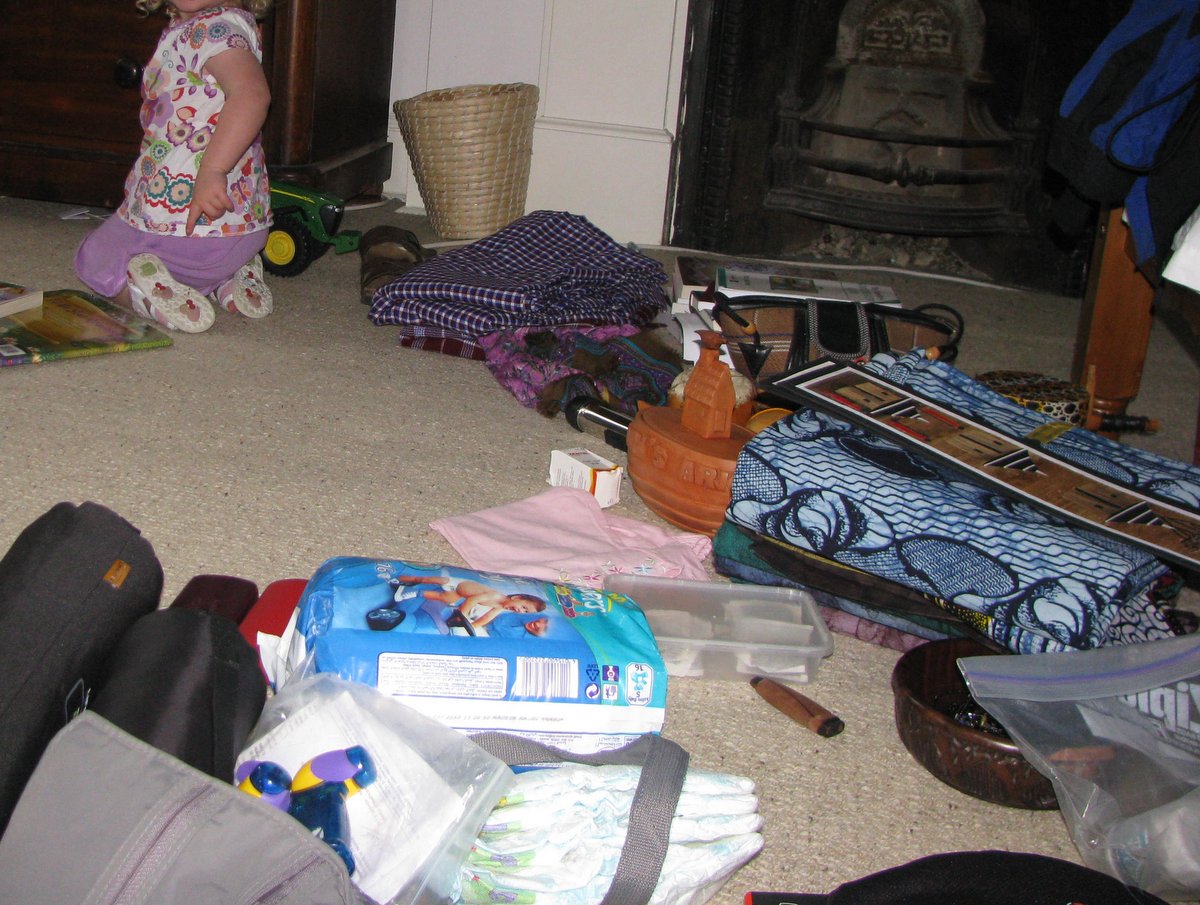
Unpacking after our trip to Tanzania in 2009. Some pretty cool stuff here – but it’s still stuff.
Admittedly, I amass stuff in the States. Things are generally cheaper and I have my favorite brands, even after a decade and a half of living here. So holidays (vacations) include consumerism: power shopping on my own; a relational trip to the Mall of America with my sister and mother; those stress-filled journeys to Target with excitable children. I gather my Tazo Chai tea bags (I know – seriously? bringing tea back to the UK?), Kashi cereal (although I’m weaning myself off of it), MBT shoes, and clothes for the kids in the next sizes up.
I sometimes think of how I appear an indulgent parent when my kids and I shop when Stateside, for we often choose birthday and Christmas presents together and I say yes more than no. Part of me enjoys being able to say yes, yes, yes to all those kid requests once or twice a year.
But all that stuff needs packing and transporting back home. This last trip we were verily bulging, at the weight limit with our suitcases and with our four carryons packed to the gills. After the long trip, we were home at last. Suitcases dumped on the floor to be unpacked; stuff to be sorted and divvied up and put away. I ignored it for two days and focused on the garden instead, telling myself that I needed to spend time in the sun to more quickly overcome jetlag when a big part of me couldn’t face all that stuff.
How much stuff does a person need? Could I give up my US power shopping trips and accept that I’ll pay more in the UK? Or even more radical, how about embracing a simpler life? Fewer clothes and possessions. Using up what we have. Being content.
When I read blogs and books about simplicity by someone like Pen Wilcock, the idea certainly appeals. Her publisher husband has given away thousands of books, something I would have a hard time doing.
Small steps, right? What one thing could you and I embrace to lead a more simple life?