Category: Christian life

  • How do we create?

    DSCN2915We, the creatures of a creative God, are poised for creation and collaboration (and sorry about all those c’s). I was so struck by this last week I was in sunny Spain with an animated, gifted group of women as I led the retreat portion of the retreat/holiday at El Palmeral. We were looking at our identity in Christ, with each session having a hands-on component of prayer and/or creation.

    DSCN2911One of the activities was to make a picture that represents different parts of our identity – what names does God call us? I laid out glitter glue, fabrics, beads, and colored papers, and said something like, “Off you go!” To which my friends seemed to look at me blankly, and one said she didn’t know where to start. I launched into a prayer asking God to release the works that were within us.

    DSCN2913He did. As we reflected later, we realized that one thought would pop into our head, and we’d go with that, which then would lead us to another, and another. Step by step we formed the pictures. We created together in a group yet in silence, with instrumental hymns in the background that also in some cases sparked memories and thoughts.

    DSCN2926I find the same experience happens when I write. I might come to the blank page with no idea what I’m going to say, but a hint of an idea will pop into my head, which I take and examine and knead and explore… leading to the next thought, and the next.

    God the Creator, who made us to create with him. An awe-inspiring thought.

    DSCN2912How about you? How do you find the creative process?

    (With thanks to the creators of these pictures for permission to include here. Each picture has layers of meaning that I found incredibly moving.)

  • A Holy Week Poem

    Holy Week. I feel busy this week. Too busy. But I offer this poem that I wrote some years ago to remind myself to stop and consider the grand story of redemption being played out this week.

    DSCN9808
    O Jesus of Nazareth,
    Thorns we twisted and turned
    Upon your head we placed,
    Crowning you King of the Jews.
     
    Upon you we spat;
    With a reed we struck your head.
    Kneeling in homage, we mocked,
    With our lips; with our hearts.
     
    Crucified, we crucified,
    Nailing you to the tree
    Watching you whither and bleed
    As darkness came over the land.
     
    From deep you cried out,
    Not at us, but to your Father:
    “My God, my God, my God—
    “Why have you forsaken me?”
     
    Those words cut to the depth of our soul
    Reverberating from within
    We watched you breathe your last,
    And the curtain was torn in two.
     
    From what we have seen and heard,
    Indeed, from what we have done,
    We echo the words of the centurion,
    That truly, the Son of God you are!
     
     © 1999 Amy Boucher Pye
  • Praying about the weather – yes or no?

    Rain. More rain. Here in the UK we’ve just had the wettest January since records started in 1910, and as I sit, I watch it rain even more. Communities are sodden in Somerset; in Devon, the tide has washed away the rail track.

    Our water stores are full. The drought of two years ago, with its hosepipe bans (hosepipe – as an American I find that word delightful and quirky) and fears of wildfires, seems a long time ago. As I took the train from London to Oxford last week I saw swollen rivers and sitting water. We’ve been drenched.

    After the rain - Holy Island  Causeway
    After the rain – Holy Island Causeway

    Even the tabloid newspaper, The Sun, has called for a prayer campaign to stop the rain, saying: “Lord, we’ve had enough.” They published a prayer to the patron saint of weather, St Medard, by Revd Sue Evans, Vicar of St Medard, Little Bytham, Linconshire:

    Heavenly Father, we are grateful for the gift of water, and in many parts of the world we know people suffer and die for lack of rain.

    But dear Lord – we’ve had enough. We ask you please that the rain may stop soon. We pray for all those people and animals suffering from floods.

    As St Medard needed protection from the rain, so now do many people from our land.

    For Jesus’ sake, Amen.

    Do you pray about the weather? Inspired by Agnes Sanford, a pioneer of the healing-prayer ministry, I do. When I edited Leanne Payne’s wonderful spiritual autobiography, Heaven’s Calling, I learned more about Agnes, for Leanne knew her well.

    Stirred to pray for the healing of the earth, Agnes moved from New England to California, to live on the San Andreas Fault and pray for its healing. She reveled in nature, marveling at a the genetic makeup of a seashell or speaking lovingly to a rattlesnake that lived in her back garden, but respected her boundaries. When once Leanne visited Agnes and they were praying in the garden, she remembered the rattlesnake story and said, “I am definitely not where you are in regards to your snake.” But Agnes put her at her ease, and they weren’t troubled by the rattlesnake – or the forest fire that was below them (about which Agnes prayed for rain, like Elijah, and it came!). These stories are all in Heaven’s Calling, page 252–57, which I highly recommend.

    I’m aware this might be outside your comfort zone! But if God is the Creator, and he made us to communicate with him, why wouldn’t he want us to pray for the healing of his earth?

    What do you think?

  • Stuff – how much do we need?

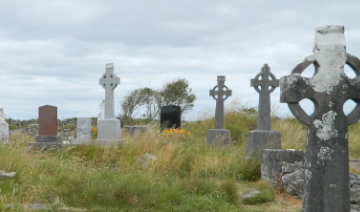
    Her headstone is black and unassuming, not what I expected. In life she prized beauty; on my editing trips she’d treat me to haircuts, pedicures, and fabulous new clothes. Her homes exuded warmth and style – and a bit of glitz. But now her space is just a small plot, next to her husband, in-laws, and son.

    I know she’s not confined to earth, for she’s dancing in her Father’s mansions, loving Beauty in his fullest form. But as I looked at her grave, I thought about her gorgeous possessions (which I hasten to add, she shared so generously with me and many), now dispersed or sold.

    DSCN2549We all get reduced to a grave or an urn in the end, so how much stuff do we need? We buy stuff; we pack it; we move it from one room to the next; we give it away; we disregard it; we treasure it. We can spend much of our energy worrying about our stuff or arranging for it to be cleaned, fixed, or disposed.

    I ponder Jesus’ admonition not to store up treasures on earth, where moths and rust will destroy and thieves will break in and steal, but to store up treasures in heaven (Matthew 6:19–21). I think about how through giving and relentless evangelism my beautiful author stored up more treasures in heaven than on earth, which is mind-boggling considering her financial worth. I look at my stuff: my purchases while in the States, schlepped back in bulging suitcases; my favorite books and clothes, some dog-eared and worn; the photos and heirlooms I would grab in a fire. And I ask myself, where am I storing up my treasures?

    How much stuff do you need?

  • Living intentionally – or trying to

    Recently I read a suicide note.

    Having seen plenty of movies, I was expecting drama or at least a nice piece of paper. But this was just a torn scrap with a few words jotted down. He was matter-of-fact in his note to my friend, saying that his girls needed money, as did his ex-wife; that he couldn’t take it anymore; that his neighbor had a key. Desperation and depression, fueled by a chemical imbalance after years of drug abuse, resulted in his final act of an overdose.

    Except that my friend received his letter in the afternoon, not the evening, as she was off from work for medical reasons. They went to his flat, broke down the door, and found him drugged but living. She wondered if he’d be angry to be found alive. He wasn’t; in fact, he later thanked her for caring – a first for him. He said he had written to her because he didn’t want his body to be found after a week, covered in flies.

    This was the same friend who a couple of months earlier had been told by an acquaintance, a doctor, to “get that mark on your face checked out.” He was the second medical friend who noticed it, which propelled her into actually making an appointment with her GP instead of delaying or brushing off the advice. She found out that she had pre-cancerous cells and underwent treatment. A few weeks later, she heard that this young doctor had died on a hiking adventure after falling into a ravine. His potentially life-saving advice to her turned out to be one of his final acts of service on this earth.

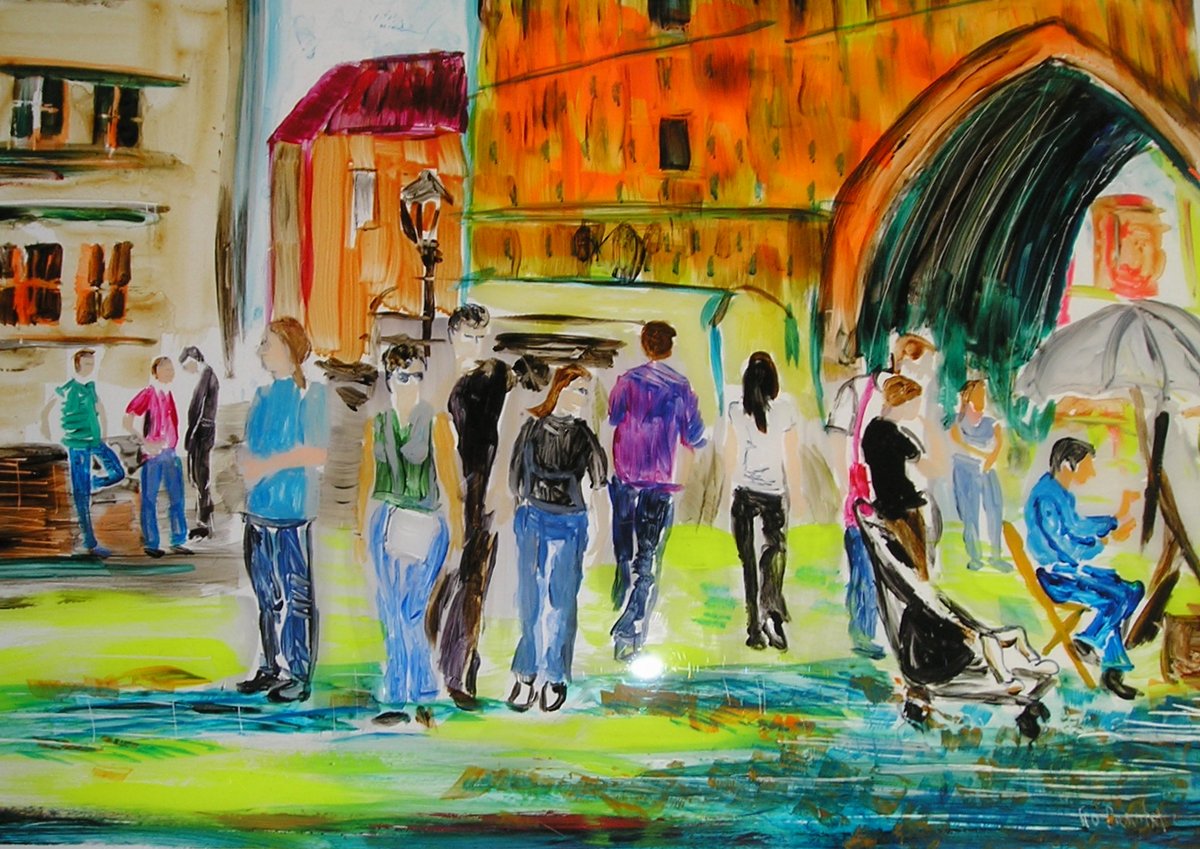
    Life in all its fullness. A painting by Leo Boucher. Reproduced by permission.
    Life in all its fullness. A painting by Leo Boucher. Reproduced by permission.

    Two men I’ve never met, and yet they made a profound impact on me. Why? Because I can easily get caught up in projects or tasks, and thus startling stories such as these remind me to value what really is important. For instance, some mornings I wake up early. Sometimes I can fall back to sleep, but usually I admit to myself that I won’t be able to, so I give in and get up. Recently on one such morning, I went into my study to do some writing. But PyelotBoy also woke early and joined me, eager just to sit and spend some time together. I battled internally but stayed with him on the couch, reminding myself to enjoy these sweet moments together.

    I wish I could say that morning was a grand success of communion with one whom I love, but throughout our half-hour together I kept thinking of the tasks I could and should be accomplishing. But although I didn’t succeed in shutting down the distracting thoughts that time, at least I stayed rooted to the couch, sitting with my son and chatting together. I didn’t shoo him away or give him some early iPad time to compensate for me wanting to get on with my next thing. Small victories, yes, but worth celebrating.

    Life. It’s worth living. Who is sitting on your couch today whom you can be present to and enjoy?

  • Avoiding danger – lessons from the past

    Something was coming toward our car. I held tightly to the steering wheel, trying to see what it was as the wipers cleared enough of a spot on the windshield for me to see through. Suddenly, “Bam!” I kept the car on track, praying silently as we drove on the motorway in the dark.

    “What was that?” asked CutiePyeGirl from the back seat.

    “I think it was a bucket or something,” I replied.

    “Why did you hit it?”

    “I… I had to. Can I tell you later?” I asked, wanting to concentrate, focusing all my energy on the road and wanting to get us safely to our destination. When after what felt like hours, but was actually only about twenty minutes, we arrived and I turned the car off, I breathed a sigh of relief. “Thank you, Lord,” I thought.

    IMG_1998I don’t like driving in the best of circumstances, but give me a British motorway with crazy drivers, in the dark, with rain and wind and the defogger blasting away, and I’m definitely out of my comfort zone. But as I thought about holding firm to the wheel last night, after the fact, I remembered in a flash being a new driver on a sunny day in Minnesota. I was driving with my dad and we had just passed our church on the busy Victoria Street. Seeing a mother duck and her ducklings starting to cross the road, I swerved.

    Alarmed, my dad grabbed the wheel and kept our car going straight. “Kill the ducks rather than hitting another car,” he said. We didn’t hit the cute creatures, but his advice was sound, and I’ve always remembered it. Perhaps his words so lodged in my subconscious that I remembered them last night, keeping going straight and not swerving into the next lane.

    Ever think about how little incidents of the past might have prepared you for something later in life, like staying on the straight and narrow path?

  • What fills your Ordinary Time?

    Why do so many people not like January? Something to do with grey days and dreariness, after all that excess?

    I’ve always loved January; it’s the month of my birthday and our wedding anniversary. And I love getting back into routine after the hyper-activities of December.

    DSCN9117

    I didn’t do so well last December. I felt like I was on an amusement-park ride, racing toward the finish as we hurled toward Christmas Eve. Cookies to bake; feasts to cook for; presents to buy; work to engage with. I crashed about 11pm on Christmas Eve, fighting shivers and a sore throat while trying to tidy up from one feast before the traditional English Christmas Day lunch the next. Next year – must do better.

    So the routine of January is one I embrace. An empty house on a Monday morning, me sitting in a sunny study, taking time to write or catch up on emails – what’s not to like? Okay, so my group-exercise classes – from which I disappeared for about, oh, eight years, but which now I’m again loving so much – are overly crowded with resolution-makers, but no doubt they will return to normality in a month or so.

    This time of getting back to routine is called, according to the liturgical calendars, Ordinary Time. We’re not feasting; we’re not fasting. But the term doesn’t imply that life is just ordinary – how could that be, when Christ himself dwells in and among us? Rather it comes from the Latin word ordinalis, which simply refers to numbers in a series. Our weeks are numbered. (With thanks to About.com for this definition.)

    If our weeks are numbered, how does that change how we live? How can we open our eyes to Christ’s presence in those whom we meet? Maybe I should spend less time with social networking and more time in creative pursuits. In activities that bring fruitfulness and love.

    How do you view January? Like it or loathe it? What joys and challenges fill your “ordinary time”?

  • New year; new word?

    Have you chosen a word for the year yet? This movement seems to be catching on, which doesn’t surprise me. It’s a simple but powerful idea (read my review of the book behind it here). One word is something we can remember and return to throughout the year. The word can inspire or encourage us; motivate and challenge us.

    Some of my friends have been choosing their words: outward, recharge, joy, abundance. Rich words that speak to the individual’s creativity and circumstances. But me? Although I’ve been mulling over ideas, nothing has struck me yet. The page is blank.

    I also like to choose a verse from Scripture for the year, and have been waiting to see if the Lord prompts one to me. Again, I’m not sure. One has come up two or three times, but it’s such an obvious verse that I’m questioning whether it’s actually the right one. Yep, I think I might be overthinking things…

    2014 newBut one beginning-of-the-year practice has borne fruit, as I’ve read through my 2013 spiritual journals and noted highlights from each month. My “word” for last year was flourish, and as I looked back over my journals – my conversations with God – I can see glimpses of growth, joy, peace, and contentment.

    I love reading through journals because they instantly transport me back to the sights and smells of the moment. I had forgotten how leveled I was in February with flu, which took weeks for me to recover from. Or the times of waiting – one issue was before me five long weeks, during which I had to let go or go crazy (I finally let go). The journals also brought alive again our five-week trip to the States this summer, including our epic road trip. I relived the enriching conversations with friends and family from whom we are usually separated by a large body of water.

    So as I wait for a word and a verse, I give thanks for God’s goodness in all the days of 2013. How about you? Have you chosen a word? Made resolutions? What do you hope for in 2014?

  • What’s your word? A book review for the new year

    Are you a list person? Do this; do that; scratch it off your list. Lists can focus the mind, but sometimes we create lists to foster (or manufacture) spiritual growth. Change this; read that; be that person. And yet we aren’t made to respond to such dictates, as if we were robots. Love, rather than guilt, is a better inducer of change.

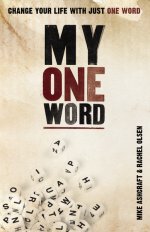
    9780310318774My One Word is a brilliant seemingly easy approach to spiritual growth, and a way to lose the lists and effect real change. Before God, choose one word for the year. The word will be “the lens through which you examine your heart and mind for an entire year” (p. 24). It will best reflect what you hope God will do in and through you. Say you choose trust. That’s the word you bring to mind when you receive the shattering news that you’ve lost your job. Or when you send off your teenage daughter on an overnight visit with her friend. Or when your grandson needs a medical procedure. Or when you move out of your comfort zone and visit the neighbour you suspect is hurting. Choosing one word becomes the way to change our outlook and behaviour, especially when we pray through it and seek it (or the principles behind it) in Scripture.

    When I first read this book last January, I loved the idea. After praying for a few weeks, a word reverberated through my being: flourish, with a verse to go along with it: Isaiah 55:10–11 (“As the rain and the snow come down from heaven, and do not return to it without watering the earth and making it bud and flourish, so that it yields seed for the sower and bread for the eater, so is my word that goes out from my mouth: It will not return to me empty, but will accomplish what I desire and achieve the purpose for which I sent it”). But I questioned that I got the word right. It seemed a bit cheeky to choose such a wonderful word. Yet I couldn’t get away from the idea that this was to be my word for the year.

    But I didn’t put into place the many helpful suggestions the authors give about how we can own our word and incorporate it into our daily lives – I didn’t slap it on my computer monitor, for instance, or stick it up on the fridge. After a month or so I forgot about it. And only when I was leafing through my stacks of review books did I realize I’d let this drop. So a few months later, I started to follow through on my earlier good intentions. And as I look back at 2013, I do see flourishing and growth: the joy of friendships. The love of family. Stretching and enriching work. Finally joining a gym and loving group exercise. The close presence of God through it all.

    What might your word be for the coming year? According to the authors, the ten most-chosen words are: trust, patience, love, discipline, focus, faith, surrender, peace, listen, and joy. All rich and wonderful words, but no doubt God will have just the right one for you.

    I invite you to read this encouraging and often moving book and to join me in choosing just one word. May God transform our hearts and minds through the work of his Spirit.


    My One Word: Change Your Life with Just One Word. Mike Ashcraft & Rachel Olsen (Zondervan, ISBN 978-0310318774)

  • “Prepare the way for the Lord” – an Advent poem

    Advent is all about waiting for the coming of the Lord. Well, it’s supposed to be. I’ve now cleanly disposed of any and all of my good intentions this year, having started Advent already behind. I was going to do less – fewer cookies and decorations, more time in prayer and meditation. Nope, that didn’t last.

    But God is with me. Even with my failed intentions and manic pace. In the early morning, when I wake, mind racing with my to-do list, I force myself off Facebook and emails and snatch a some moments to pray and read the Bible. I leave refreshed and hopeful. Reminded of God’s love and care.

    Jesus came to earth. He’s with us. That’s the message of the season – a message I’m going to try to hold within my heart this day.

    Zechariah as depicted by Michelangelo' on the  ceiling of the Sistine Chapel. Photo by Missional Volunteer as found on flickr.
    Zechariah as depicted by Michelangelo’ on the ceiling of the Sistine Chapel. Photo by Missional Volunteer as found on flickr.

    I leave you with a prose poem based on Zechariah’s song about his son, John. He who had been silent for months was filled with words that have remained for centuries.

     
    Prepare the way for the Lord
    He’s coming again
    To earth; to our hearts
    So that his people might know
    Salvation
    Lasting freedom
    The forgiveness of sins
    A clean slate
    Wrongs put right.
     
    Through God’s tender mercy
    The rising sun comes
    From heaven to earth
    Shining through darkness
    Illuminating our way.
     
    Even in the shadow of death
    He guides our feet
    Into the path of peace.
     
    Come, Lord Jesus.
    Come, Lord
    Come.
     

    Based on Luke 1:76-79; Zechariah’s song about his son John

    © 2013Amy Boucher Pye