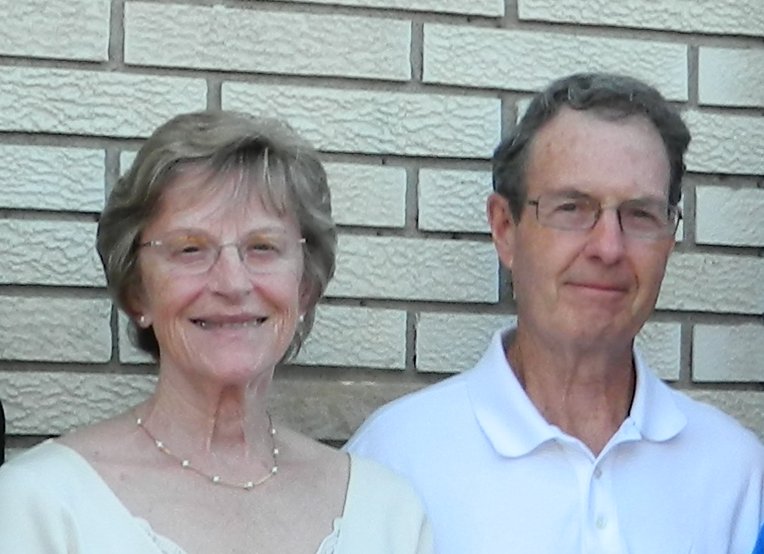
Today my parents celebrate their fiftieth wedding anniversary – five decades of loving each other and modeling that love to us in their quiet and understated way. I am so grateful for their commitment to each other and to us through the good and challenging times.
My mom and dad both grew up on farms in America’s Midwest, and both went to live in the Twin Cities of Minneapolis/St. Paul in the late fifties. My dad had left home when he was 17, for he wanted to be an artist. He worked hard to put himself through college, selling expensive cookware and sewing machines door to door and being a security guard during the night shift. My mom lived with a few other young women and was a good typist, so she got a job at Minnegasco (that sounds a funny name for a company now, doesn’t it?).
My dad became a different kind of artist, one who designed computer systems, than he might have thought as a child. Now that he has more time, he can pursue his visual art. Here’s a painting of my mother.
They met on a blind date that my dad’s friend Jerry arranged. At first my mom thought she had been paired with Jerry, but when my dad got into the back seat of the car with her she realized that he was her date. The evening must have gone well, for they went out for my dad’s birthday in October. After that my mom kept hoping he’d ask her out again so she could tell her work friends that she had a date for New Year’s Eve.
That first Christmas, my dad painted my mom a picture to give her as a present, and she gave him a sweater. How did she know his size? “I put my arms around him.”
They dated for three years before getting married, having such a long courtship because my dad had to do some national service, and wanted to get his degree and a job so that he could provide for his wife and any children they might have one day. Two years after they got married, they had my sister, then two years later me, then three years later my brother. Their family was complete.
But times haven’t always been easy for my parents, their love having to weather health-related storms. When my brother was three, he started to have seizures, which was terrifying for my parents to witness. Then he had such terrible stomach pains that he was operated on to see if he had an obstruction or cancer. He was diagnosed with Crohn’s disease, an inflammatory disease of the intestines, which is not common in children.
One of the favorite activities with Gramps is painting.A grandma and granddaughter.
My brother was in the hospital for over a month, and although as a six-year-old I didn’t know it at the time, he was near death. He looked like a starving child from a developing nation, for his stomach was extended and he was so thin. But after our parish priest came to the hospital and prayed over him, he eventually got well.
But his seizures continued, and he was diagnosed with epilepsy. The seizures were the worst when he was a teenager, as his hormones were wreaking havoc on his body and his medication seemed to have no effect. My parents learned what it meant to be sleep-deprived as they cared for my brother during the night, taking shifts while trying to get enough sleep for the next day as my dad went off to work and my mom cared for us three kids.
Their faith sustained them. As my dad said, “Through these great challenges, our faith has kept us strong and in love in our marriage. We’ve been able to forgive each other and live one day at a time, when it would be easy to hide from life. Eventually we got to the place of not even worrying – we would think, ‘Have we done everything we can?’ If the answer was yes, then we would give it all to the Lord and not even worry.
“My favorite bit of poetry goes like this: ‘But every desire we have for God, and every prayer, is like the stroke of a carpenter’s plane, wearing down the boards of our wooden-hearted incredulity. And when the boards are quite thin, we will see that God has been there all along, waiting for us to break through.” (From That Man is You by Louis Evely, translated by Edmond Bonin, Paulist Press, 1964.)
Mom and Dad, I love you and celebrate your marriage.
In my university years, I was friends with a man who was intellectually gifted. I enjoyed our times together, but deep down, I never really felt myself with him; I somehow felt I was lacking. Not that I would have ever even named this vague feeling of dis-ease, but I can see it looking back through the lens of time.
We often went on outings in the city where we lived. By mutual never-expressed agreement, neither of us was interested in the other romantically. This made for jaunts to restaurants or cultural happenings that were fun and generally easy. Until he would say something that felt like an underhanded critique.
Such as one day as we were browsing in one of the city’s fine bookstores. As we were exiting, he said, “You know, Amy, maybe one day you could run a bookstore.”
Startled by his pronouncement, I merely said, “You think?”
A selection of my books on writing. Some great ones in there; I especially recommend the one by Eudora Welty (One Writer’s Beginnings) and of course William Zinsser’s is a classic.
His comment stung, because I had a deep-seated desire to be writing the books, not selling them. So I saw his remark as a putdown. I hasten to say that having been in the publishing business for so many years, I have met many a fine bookseller, marked by enquiring minds and wisdom. Now I wouldn’t see his comment as derogatory, even though I still prefer to be part of the creating process.
And the creation of good books is what my career path has focused on. Mainly with me helping other people to write, rather than me being the one to do the writing. Only now – some twenty years later – am I in the process of writing a book that I hope will one day feature in a bookstore.
Another comment by another intelligent man whom I respect (and a writer himself) brought me low a few years ago. When I told him that I wanted to be a writer, he said, “That’s something you can aspire to later on.”
When he said that, I felt he was saying, some day you can try that. Later on, when you’ve learned more and become more wise. He is generous-hearted and probably meant nothing by the comment. But it wounded nonetheless.
But most days I write, and the working days I enjoy most are those penning one thing or another. Part of being a writer – at least for me, with fledgling confidence – is accepting the moniker and growing into it. Knowing that I am a writer because I write; not because I’ve clinched a magical three-book contract (although that would be nice too). God can change my name. Not just Amy, the editor. But Amy, the writer.
How about you? Is there some unaffirmed part of yourself that longs to be expressed? Have you had to grown into a new name?
He brought me out into a spacious place; he rescued me because he delighted in me. The Lord has dealt with me according to my righteousness; according to the cleanness of my hands he has rewarded me. For I have kept the ways of the Lord; I am not guilty of turning from my God. (Psalm 18:19–21 NIV)
Near the Kylemore Abbey in Connemara, County Galway, Ireland. A spacious place.
I don’t think I’m claustrophobic, but I can readily imagine David’s relief when the living Lord led him from his cramped hiding place in the rocks and crags out to a spacious place. I love being out in the wide world of creation, and especially by the side of an ocean or a lake. The pounding surf provides a rich backdrop to the vast waters that stretch as far as the eye can see. Or the placid glass-like surface of the lake emulates peace. As I gaze out, I find deep rest and contentment.
Maybe that oceanside or lakeside view is one you behold regularly, but for me it is more of a rare treat. I have to seek the Lord’s spacious place in the stuff of daily life, such as in my light and sunny study in our Victorian vicarage, the freedom I feel after meeting a deadline, or my joy at glimpsing a bubble floating up outside my window, courtesy of our kids playing below.
And of course the most spacious place is in knowing the love and affirmation of our heavenly Father. Taking some images from Scripture, we are his beautiful one (Song of Songs 2:13), a lily among thorns (Song of Songs 2:2), and the apple of his eye (Psalm 17:8). Or as Moses said in blessing the Israelites as they entered the Promised Land, “The eternal God is your refuge, and underneath are the everlasting arms” (Deuteronomy 33:27).
Whatever our circumstances, God will take us to a spacious place. As we look to him, we can leave behind the need to acquire more stuff, more deadlines or deals, or more friends on Facebook. He will comfort us in our grief and bind up our wounds. He reaches out through Jesus and says, “Come to me, all you who are weary and burdened, and I will give you rest” (Matthew 11:28).
Prayer: Father, I give you my fears, desires and dreams. Take me to your spacious place, that I might be set free to love and serve you.
Last Sunday I led the group for 11-12 year olds at our church. I have to admit that kids’ ministry has never felt like something I’ve been called to. Nothing against kids, of course. I love my two dearly. But I’ve always been so keen on discipleship for adults that I’ve bypassed the younger set.
But these budding nearly teens are a wonderful bunch. Filled with great questions and strong opinions. I have to check my church jargon at the door and remember to keep it real and authentic. And I come away glad to have been a part of their discussions.
So on Sunday we were looking at Acts 4, all about how the once-frightened Peter, who betrayed Jesus those three times, was now bold and winsome and filled with the Holy Spirit as he and John explained their actions to the religious leaders and defended the new thing God was doing. One of our activities was to explore some of the Scripture in rap form, courtesy of Scripture Union. We read the two raps aloud, jiving and moving to the beat. Then, to my surprise, we wrote our own.
Now I should stress that I didn’t think we’d have success in this exercise – group writing and all of that. I thought it would be beyond us. But lo and behold, we put down the first line, and then the next, and the next. And a rap was born. Okay, so it’s more of a lyrical poem than a rap, but here, for your reading pleasure, is the Lord’s Prayer rendered by us (best read aloud):
The Lord thundered from heaven; the voice of the Most High resounded. He shot his arrows and scattered the enemy, with great bolts of lightning he routed them. The valleys of the sea were exposed and the foundations of the earth laid bare at your rebuke, Lord, at the blast of breath from your nostrils. He reached down from on high and took hold of me; he drew me out of deep waters. He rescued me from my powerful enemy, from my foes, who were too strong for me. They confronted me in the day of my disaster, but the Lord was my support. (Psalm 18:13–18, TNIV)
For the last few Mondays we’ve been looking at Psalm 18. We continue by focusing today on God’s power and might, which continue to dominate David’s song of thanksgiving. Commentators believe that David here is alluding to previous acts of God. How God moved the waters from the sea probably refers to the parting of the Red Sea when the Israelites fled from Egypt (see Exodus 14) and when they crossed the Jordan River as they entered the Promised Land (see Joshua 3).
In referring to these acts of deliverance, David is saying that the God of his fathers – Abraham, Moses and Joshua – is his God too, and that he has saved him on an equally mighty scale. David makes the song personal when he tells how Yahweh reached down and rescued him from the deep waters that threatened to overwhelm him. His foes were too strong, but the saving God intervened.
As we pray through this Psalm this week, take a moment to wonder in the power of the Lord who loves us. Put yourself in David’s beaten, leathery shoes as you imagine him thinking back to God’s liberating rescue. Allow yourself to marvel at God’s mighty acts, like the moving and halting of waters in a sea or a flooded river to allow his chosen people a pathway to escape.
God is no less powerful today. As we cry out to him, he will lovingly send down a search-and-rescue team to scoop us out of the waters that threaten to overcome us.
Prayer: Lord Jesus, we sometimes forget your power, as did the disciples who cowered in the boat as the waters raged around them. But you calmed the storm in an instant. Help us to look to you to bring peace in the storms of our lives.
Karen Jones (Darton, Longman, Todd, ISBN 978-0232529203)
A couple of years ago I examined Christian fiction for Christian Marketplace, the then magazine of the trade. Before this article, I would read Christian novels here and there, forcing myself to pick them up with a hint of disdain. But reading twenty or so books in one go opened my eyes and rid me of any condescension. These books known as Christian fiction (those published expressly by Christian publishers, mostly coming out of the States) had matured. Characters felt real and authentic. Plot-lines no longer seemed false, such as last-chapter conversions. I found myself reading these books not only when I had to – for reviews – but now because I wanted to.
Gorgeous Grace, the first installment of Babe’s Bible, not only doesn’t fit my previous view about Christian fiction but in the first couple of pages explodes any stereotypes. In fact, I’m not sure if would have continued reading if I hadn’t seen a review by Jennifer Rees Larcombe, a Christian author I trust. For the book opens with a group of women enjoying an evening out, fueled with wine and flirting, and continues with scenes of, shall we say, a sexual nature.
Should so-called Christian books include sex, drinking, smoking, and the like? It’s an interesting question to consider. In the States, for instance, a debate has raged over what has been called censorship as a major conservative evangelical bookstore chain has refused to stock a book which refers to the author’s vagina. Those against claim they want their books “clean,” while those for say that it’s an anatomically correct way to refer to a woman’s private parts.
At first I wondered if the sex and stuff in this book was gratuitous – a way to draw in an unsuspecting reader. But having read further along, I saw that the author’s treatment is helpful, for it shows the consequences of sin, such as how adultery can rip apart families and communities and yet how God can bring healing.
You’re probably wondering what the novel is about! A modern-day woman is ordained in the Church of England and in her curacy finds herself amid a pastoral breakdown. Her outlet is to write fictional accounts of some of the women in the New Testament, including the woman caught in the act of adultery. As she writes, she finds the biblical story speaking into the real-life crisis – including the hurts from her own life that she had buried years ago.
Not everyone will agree with the author’s biblical treatment, but I enjoyed how she brought the days of Jesus alive and fleshed out some minor characters. I felt her writing was strongest, however, in the story of the curate and her friends.
What do you think – should fiction published by a Christian publisher pass a so-called clean test? Why or why not? Have you read Gorgeous Grace, or the second in the trilogy, Sister Acts? If so, what did you think?
(Note to my friends outside of the UK: I’m afraid these books aren’t readily available outside these isles… Sorry.)
‘I absolutely love encouraging women. It makes everything inside me sing.’
I recently chatted with Liz Curtis Higgs, the popular speaker and author who has written 30 books with more than 4 million copies in print. This engaging interview appeared in the June 2013 edition of Woman Alive, and is reprinted with their kind permission. (I get to interview quite a few writers for the Book Club I run in Woman Alive, and Liz must be one of the most gracious… Read on!)
I grew up in small-town America, the quintessential Good Girl. Then I turned sixteen, got my driver’s license, and strapped on my Bad Girl shoes. For me the 1970s were a blur of sex, drugs, booze, and rock’n’roll. In 1981 I met two Christian colleagues who hugged me regularly and loved me unconditionally. Little by little my heart softened toward God. Later I showed up at their church, determined to see if there were any others like those two: funny, loving, nonjudgmental, Bible-toting Christians. There were whole pews full of them. Then I heard God’s Word. And I knew why I’d come.
When I gave my heart to Christ a few weeks later, he gave it right back to me, good as new. The first verse I memorized will always be my favorite: “Therefore, if anyone is in Christ, he is a new creation; the old has gone, the new has come!” (2 Corinthians 5:17)
I have something in common with all of the Bad Girls of the Bible. Many of my readers say the same. Most sin has pride at its root—something I understand all too well—so it’s easy to relate to their struggles, their temptations, their failings.
The sinful woman of Luke 7:36-50, who bathed Christ’s feet with her tears, dried them with her hair, kissed them with her mouth, and anointed them with her perfume, is my favorite of the Bad Girls. I think it’s because she worships the Lord completely, without worrying what others think of her. That level of devotion is breathtaking. And convicting. Yet, it’s also inspiring.
I met my husband Bill at a wedding (you’ll be happy to know, not our own!). He worked as an engineer at the local Christian radio station, and I had my own show at a secular station in town. We began chatting after the ceremony, and I liked him immediately. Smart, kind, attentive, funny—all the things a woman might hope to find in a man. Of all the earthly blessings God has brought my way, my husband is at the very top of the list.
How do we keep our marriage strong? We spend as much time together as possible, yet nurture a few individual interests. Bill enjoys tinkering with his amateur radio equipment, I love going to the movies or getting lost in a novel. And we pray together, often.
Every Friday and Saturday, I’m likely to be speaking at a Christian women’s event. I love people, and mingle about from the moment I arrive until the last woman waves goodbye. Then I go home and collapse—though still with a smile on my face! Then I do the work of a writer in my Sunday through Thursday life, when I stay home and recharge and pour words onto the page instead of across a stage. I love those quiet, solitary hours, surrounded by my Scottish research books and translations of the Bible. Writing is how I’ve always expressed myself. Come Thursday evening, I’m ready to head out the door again, and eager to be with my sisters in Christ. It’s an odd, hybrid sort of life, but it seems to work.
For as far back as I can remember, I’ve loved the music, stories, and folklore of Scotland. But that affection grew much deeper in 1995, when God whispered three words in my heart that made little sense at the time: Scottish historical fiction. Pretty daunting, when I had yet to visit Scotland, was a so-so history student during my university days, and had never written a novel!
Less than a year later, my husband and I made our first of many trips to Scotland. I quickly found the setting for my first series of novels, nestled in bonny Dumfries and Galloway, then began collecting the research books that serve as the backbone for my stories.
Now I travel to Scotland annually, either to do research, visit friends, lead a tour group, speak in churches, or explore a new part of the country. I’ve had the joy of traveling to many foreign lands, but I’m still happiest when the plane touches down in Glasgow or Edinburgh.
I enjoy period films for the same reason I prefer historical novels: I love to be swept away to another time and place, to imagine how people lived and worked, how they dressed and dined, how they spent their days and nights. Every detail of every decade interests me—Elizabethan, Georgian, Victorian, Edwardian.
Favorite period films? A few I can watch again and again: Sense and Sensibility, Little Women, The Count of Monte Cristo, Emma, The King’s Speech, not to mention some of the marvelous BBC productions of recent years, including Bleak House, Cranfor, and Little Dorrit. Andyes, we are serious Downton Abbey fans at the Higgs house. The first season remains my favorite. Midway through the third season we almost bought “Free Bates” T-shirts. We’re still in mourning for you-know-who.
Woman Alive reader Ellen asked what’s my favorite part of a book to write. I could be cheeky and say the last word on the last page, but that’s actually not true. In a novel, things start getting really fun at about the halfway point, when the characters take over, and it’s my job simply to keep up with the drama and write it all down. With nonfiction, my favorite part is when I discover something in a biblical story that I’ve never noticed before. It’s like finding hidden treasure.
If we keep our eyes open and our hearts softened and our thoughts in tune with the One who made us, we will discover him constantly at work in our lives, day in and day out. A friend calls at just the right time. An unexpected check arrives when we need it most. A relative facing cancer gets a promising report from the doctor.
Luck and coincidence are not in God’s vocabulary, so they aren’t in mine either. Instead I look for blessings and…uh…opportunities for growth! (The optimist in me avoids the word “challenges,” though sometimes that’s the best description.)
Selkirk, Scottish Borders. A photo taken by Liz on one of her trips. @ Liz Curtis Higgs
One God-incidence that comes to mind happened in Scotland a dozen years ago. I was tramping about Glen Trool, snapping photos with my brand-new Canon. Suddenly my foot slipped, and gravity took over. Down I went, tumbling over some sharp rocks, my camera leading the way.
By the time I came to a stop, my lens was covered with dirt, my foot was pinned underneath me, and I was in a good deal of pain. I was also entirely alone. The Visitor Centre hadn’t opened for the season, and no one was anywhere in sight.
I called out for help, feeling more than a little foolish. But I had to do something.
Out of the blue appeared an older man with a shock of silvery hair and a sturdy build. “Och! What’s happened here, lass? Have ye taken a tumble?” He helped me to my feet, plucked the camera from my hands, deftly brushed off the dirt, and examined the lens with a practiced eye. “A scratch or two on the case. Nothing to fret about.” He made a minor adjustment, then handed the camera back to me. “Good as new.”
That’s when I noticed the professional-looking equipment draped around his neck. “Are you a…”
“Photographer,” he said with a nod, then cupped my elbow. “Come, let’s get you onto level ground.” Minutes later, he disappeared from view round a bend in the road.
Imagine, in that vast, empty glen, a man with camera know-how and strong arms showing up at the precise moment I was desperate for both. God at work, I’d say.
Challenges I face? Finding time to hang out with friends, to relax without feeling guilty, to keep up with my extended family scattered all over the U.S. I take on too much, sleep too little, fret too often. All the usual anthills of everyday life.
Joys in life? It isn’t the awards and the accolades, though of course, such things are a blessing. What I treasure most are the letters and emails and Facebook posts from readers or audience members who pour out their hearts to me and show me what God is teaching them. I absolutely love encouraging women. It makes everything inside me sing.
+ Liz has three upcoming UK speaking engagements: 20 June in Surrey; 25 June in Inverness and 2 July in Edinburgh. For more information see Liz’s website.
Smoke rose from his nostrils; consuming fire came from his mouth, burning coals blazed out of it. He parted the heavens and came down; dark clouds were under his feet. He mounted the cherubim and flew; he soared on the wings of the wind. He made darkness his covering, his canopy around him—the dark rain clouds of the sky. Out of the brightness of his presence clouds advanced, with hailstones and bolts of lightning. (Psalm 18:8–12, NIV)
As David tells of God’s deliverance, he uses powerful images to show how Yahweh manifests himself to his people. We see God’s anger at evil and sin through the smoke, consuming fire, and burning coals. Fire, and especially consuming fire, is a common metaphor in the Bible. It purifies and cleanses all that is not holy as it dispels the darkness. Like the fiery sun, it is the source of life.
Though holy to the core, God in his graciousness hides himself in the dark clouds, for his presence would overwhelm us. We who are sinful cannot stand before him unaided. Even hidden, his brightness shines through.
God’s holiness is an attribute we modern people often dismiss, ignore, or dilute. For instance, we may fail to name sin when it pervades our lives. It may be systemic evil, such as racism or classism, that we disregard. It may be our “harmless gossip” at church, school, or work. It may be a root of bitterness to which we cling. We so easily compromise, rationalize, and liberalize.
But God calls us to be holy as he is holy. And through his Holy Spirit he enables us to live a life of righteousness, truth, and love. As the apostle Paul wrote to the Galatians, “Those who belong to Christ Jesus have crucified the sinful nature with its passions and desires” (Galatians 5:24). He will give us the resources we need to be holy, to stand up for truth with a spirit of grace. And out of this will flow his life-affirming gifts: ‘the fruit of the Spirit is love, joy, peace, patience, kindness, goodness, faithfulness, gentleness, and self-control” (Galatians 5:22).
For prayer: “Therefore, since we are receiving a kingdom that cannot be shaken, let us be thankful, and so worship God acceptably with reverence and awe, for our ‘God is a consuming fire’ ” (Hebrews 12:28–29).
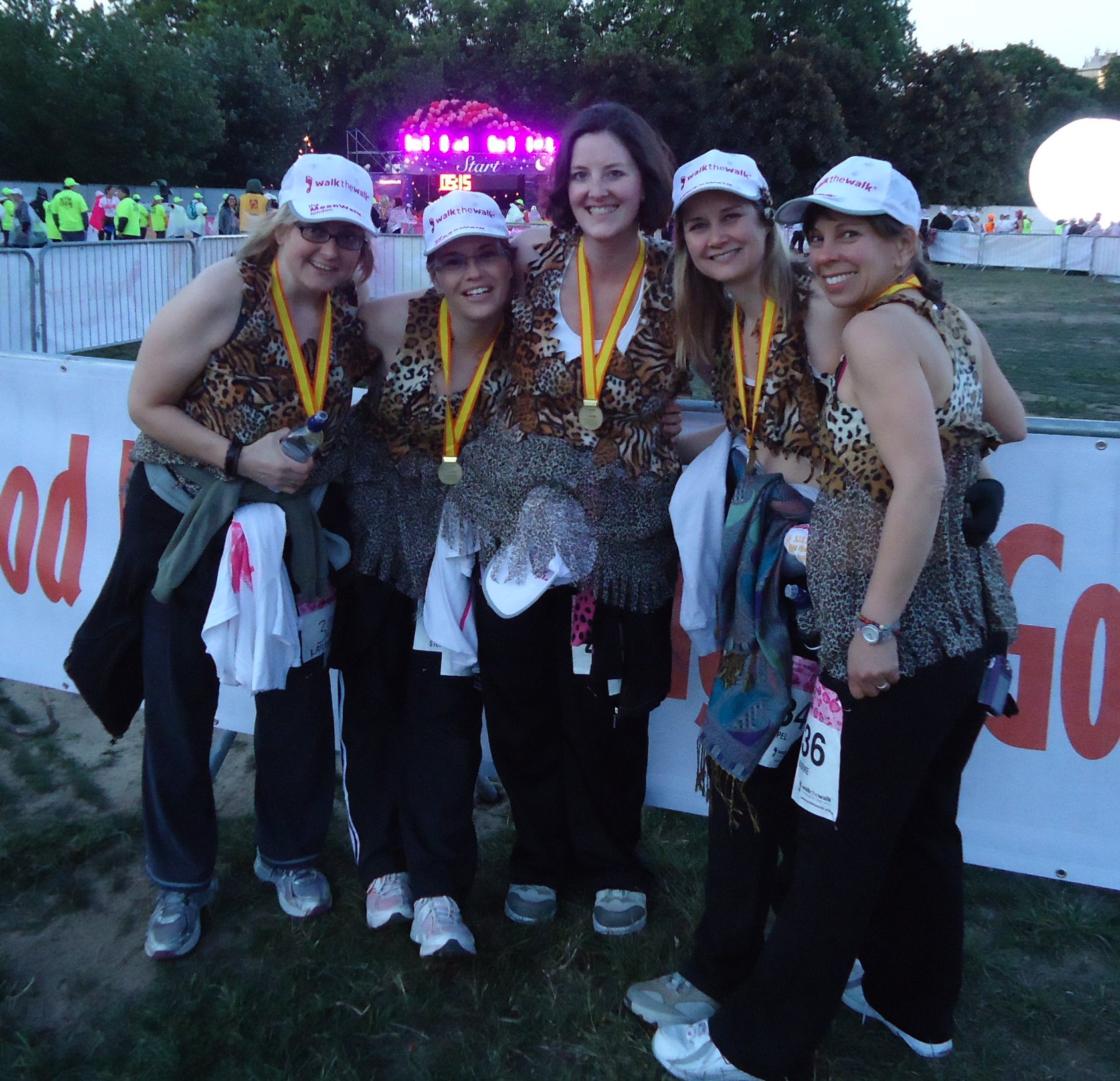
Some of the high-school friends after finishing the London MoonWalk in May 2011.
Some of my closest friendships were forged in the fire of grief. When I was nineteen, I arrived home late from a classical concert. Wondering why the light was on downstairs, I went down and was surprised to see my mom. Her eyes were red from crying and I immediately said, “Did Grandpa die?”
“No,” she said, “It’s Sue. She was killed in a car accident.”
In a flash, my world was changed forever. I started screaming out, “Why? Why? Why?” My mom tried to comfort me, but I was in shock. Coming to terms with why God would allow one of my closest high-school friends die so young, with so much life in front of her, would consume me in the days and years to come.
Why does God allow suffering? I haven’t found easy answers, and no doubt never will know fully this side of heaven. But as I queried theologians and wise friends in the faith, I saw that I had to go back to Genesis 3 and the Fall, when Adam and Eve followed the crafty serpent and disobeyed God. With this act, the world was altered and sin entered in. Now bad things would happen to good people. People would die in car accidents and from disease. Unjust rulers would steal from their subjects. Hurricanes and earthquakes would wipe out thousands. Our world is fractured.
But God hasn’t given us up for lost. In his most gracious act, he gave us his son to pay the price for that first act of sin and disobedience. He is ushering in a new kingdom and a new earth. He is redeeming what was lost.
The tragedy of the death of Sue Weavers that night in October 1986 was huge for me and my circle of high-school friends. In our grief we turned to each other, trying to make sense of the gaping hole in our lives. We met up, sometimes laughing and sometimes crying. Over the years the friendships have lasted. Indeed, one of us commented recently that her friend noticed a deep graciousness between us. Borne out of suffering and pain, no doubt.
Two summers ago our friendship witnessed a new level of grief – the pain of a mother whose son, at twenty, was killed in a car accident. It seems surreal that one of us can now say to her son’s friends that she knows what they are feeling. That she has endured the early loss of a friend and mate. That she prays they will find hope in God the Father, Son, and Holy Spirit. And that their friendships will last and deepen and bear the fruit that ours have in the years after Sue’s untimely death.
In this life we will have trouble – so said Jesus to his disciples (John 16:33). But as he says, in him we will have peace as well. I so wish Sue hadn’t died in Duluth, Minnesota, all those years ago. But I’m forever grateful for my circle of friends who would jump off Tower Bridge if I asked.
How about you? Can you think of some of your favorite friends? How have they made an impact in your life? Comment below – I’d love to hear.
I’ve long been fascinated by the subject of hearing God. In my twenties I edited Leanne Payne’s book on the subject, Listening Prayer. Engaging with her manuscript set me on a path of seeking God’s voice fervently. I felt awe the first time his whisper reverberated in my spirit: “I love you, beloved. You are mine.” But eventually my unbridled excitement that the God of the universe would actually speak to me led me to ignore the practice of testing what I was hearing (even though Leanne Payne counsels against this). For instance, I believed I heard God tell me to move cities to work with a Christian ministry, a place that conveniently was home to the man that I believed God was telling me to marry.
You can probably guess that none of that happened – the move or the marriage. My hopes and faith splattered when my plans came to naught. I didn’t know what to think or believe.
And yet I couldn’t give up listening to God. I tried, but I couldn’t cut the lifeline that had been giving me hope and love and affirmation – even though I had messed up in the interpretation. That major crash helped me to mature as I learned to wait before God, asking him to clarify and affirm what I was hearing – through the Bible, through his still, small voice, through trusted friends and family.
I still gobble up books on this topic, always learning something new about our mysterious relationship with our Creator. When I heard about Bill Hybels’, I was surprised. I thought of him as a high-powered pastor and founder of the massive Willow Creek empire. My husband, also a pastor, has enjoyed his books, but I haven’t read any closely. Yet when I picked up The Power of a Whisper, I didn’t want to put it down. He tells the story of how God’s whispers have changed the course of his life, including creating Willow, learning how to parent, aching for the poor and so on. God has continually shaped him through these sometimes gentle, sometimes persistent communications from above. This book has mellowed my perception of him as an author.
I thought his book could have been reduced by about a third – it started to feel a bit too long and unwieldy towards the end – but would recommend it as an introduction to hearing God. It’s especially suitable for any type-A guys in your life (I passed along my copy to the vicar with whom I sleep, and he’s loving it).
Other books on the topic? Leanne Payne’s, as I mention above, as well as Dallas Willard’s Hearing God and Joyce Huggett’s Listening to God.
 My mom and dad both grew up on farms in America’s Midwest, and both went to live in the Twin Cities of Minneapolis/St. Paul in the late fifties. My dad had left home when he was 17, for he wanted to be an artist. He worked hard to put himself through college, selling expensive cookware and sewing machines door to door and being a security guard during the night shift. My mom lived with a few other young women and was a good typist, so she got a job at Minnegasco (that sounds a funny name for a company now, doesn’t it?).