Advent is all about waiting for the coming of the Lord. Well, it’s supposed to be. I’ve now cleanly disposed of any and all of my good intentions this year, having started Advent already behind. I was going to do less – fewer cookies and decorations, more time in prayer and meditation. Nope, that didn’t last.
But God is with me. Even with my failed intentions and manic pace. In the early morning, when I wake, mind racing with my to-do list, I force myself off Facebook and emails and snatch a some moments to pray and read the Bible. I leave refreshed and hopeful. Reminded of God’s love and care.
Jesus came to earth. He’s with us. That’s the message of the season – a message I’m going to try to hold within my heart this day.
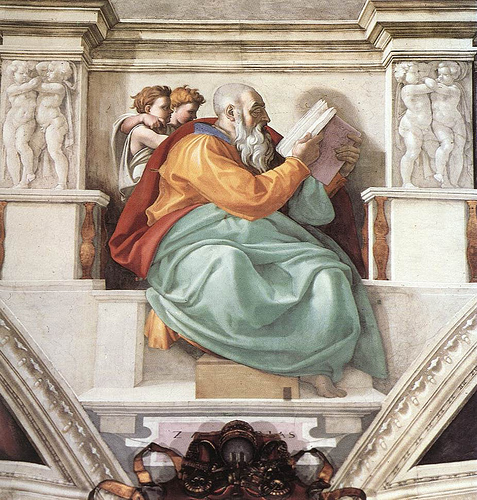
Zechariah as depicted by Michelangelo’ on the ceiling of the Sistine Chapel. Photo by Missional Volunteer as found on flickr.
I leave you with a prose poem based on Zechariah’s song about his son, John. He who had been silent for months was filled with words that have remained for centuries.
Prepare the way for the Lord
He’s coming again
To earth; to our hearts
So that his people might know
Salvation
Lasting freedom
The forgiveness of sins
A clean slate
Wrongs put right.
Through God’s tender mercy
The rising sun comes
From heaven to earth
Shining through darkness
Illuminating our way.
Even in the shadow of death
He guides our feet
Into the path of peace.
Come, Lord Jesus.
Come, Lord
Come.
Based on Luke 1:76-79; Zechariah’s song about his son John
Regular followers of this blog (love ya, Dad!) will note that I’ve been silent since Thanksgiving. Advent can be a shockingly busy time, which is ironic I know. Regular service here will resume in January, but here’s an Advent poem I recently came across, which I wrote in 1997. It’s admittedly on the twee side, but written with heartfelt devotion.
As an American in the UK, I’ve now spent a significant number of Thanksgivings out of my home country. It’s a day where I feel the cost of living here, being separated from family and friends. But we celebrate the day, and work hard to make memories for our children. They feel special for they get to miss school when all their friends have to go, and this time not for a scary medical appointment, but to go to St. Paul’s Cathedral for the annual Thanksgiving service, a quick lunch at Starbucks, and then home to prepare the food. And at the end of the day (we have to eat around 6pm because it’s just a normal day for many of our guests), we carve the turkey and sup together, enjoying our feast of food and good conversation.
But for many people, holidays such as Thanksgiving don’t hold the glossy-magazine image of loving family and friends surrounding a table heaving with tasty food. There might be material abundance but emotional scarcity. Feelings of loneliness and sadness. Seeing the chair that a loved one should be occupying, but which now sits empty. The family feud that hasn’t healed. The loss of job that weighs on the mind and heart.
When we feel pain and loss, it can be awfully hard to be thankful. And yet I’ve found that if I ask God to help me give thanks, he answers that plea. I feel a glimmer of hope; I experience a rush of love; I am overcome with peace.
Whatever your situation, may you know joy and love this Thanksgiving.
“…that at the name of Jesus every knee should bow, in heaven and on earth and under the earth, and every tongue acknowledge that Jesus Christ is Lord, to the glory of God the Father.” Philippians 2:10–11
As I looked around at the multicultural faces on London’s Tube recently, I stood in wonder for a moment at the great diversity of the people created by God. I noticed different colors of skin; some who were short and others tall; those who were old and those who were young; all at different stages of life. As I paused just before hearing that my desired station was closed because of a security alert, I breathed a prayer that this myriad of faces would one day reflect that of Jesus.
It’s mind-boggling to think that indeed, one day every knee will bow and every tongue proclaim that Jesus is Lord. We don’t know how God will bring about this proclamation; we aren’t the judge or arbiter for the souls of others. But we can do our part to spread the saving news of the gospel – that Jesus through his death and resurrection can make us free.
I’m generally not brave enough to speak to strangers on the Tube about Jesus, unless matters of faith come up naturally in conversation, but I do sometimes remember to pray for the people crammed into the carriages. And I’m gaining courage in sharing my faith with those in my community – at the school gate or among newcomers at church, for instance.
Jesus asks us to be his hands and feet. Whom might you meet this day?
Triune God, thank you for that Jesus came to earth to stand in our place. Help us and save us. Amen.
The recent typhoon that hit the Philippines has shocked and moved us. I watched as day by day the angry colors on the meteorological map of the BBC website move closer and closer toward the island where one of my dear friends has lived for decades. Knowing someone there makes the crisis more personable; it’s a land filled with people we’ve prayed for since she and her family moved there (she was one of my roommates at university, and one of my friends since junior-high school). I was relieved to hear via Facebook that my friend and her family were south of where the typhoon hit, and thus not in harm’s way. My heart goes out to all those who have been affected.
I wanted to put a human face to the Philippines, so below is an interview with Lynette Tillman (she has lived their since 1992). She also shared with me the incredibly moving story of fellow missionaries, who live in Tacloban, where the typhoon hit. They went back to their home before the typhoon arrived, feeling called to be an incarnational presence there even though they were putting themselves in danger. Don’t miss their story of floating inside their house on a mattress while the 235 mile winds blew out their windows. I love that cans of Dr. Pepper floated over to them to slake their thirst…
A Blonde in the Philippines
Typhoon Haiyan hit the Philippines on November 8, and went through the middle part of the country. Several small towns were hit, but the hardest hit city was Tacloban City. I have not been there since the typhoon hit, but the images are jarring. Whole subdivisions of cement houses have been flattened. In as much as I would like to go and help with the recovery, it is not yet time for that. Right now, what is needed is for experts to go in and clear the areas of debris (and, unfortunately, dead bodies), and to get the initial aid of food and water out to the survivors. I hope to go in a few months to help either with debriefing the survivors, or to help in the rebuilding.
Andy and Lynette Tillman
I felt a call to be a missionary since I was a young teenager. My husband, Andy, felt the same call. When we applied with a missionary-sending organization, we did not specify where we would like to go. At the time, however, there was a need in the Philippines as many missionaries were at retirement age. We have been involved in traditional church planting, and now reaching out to those of other religions (animism, Muslim, etc.).
Being blonde – with three blonde kids – in my country means we are always looked at, always noticed, usually stared at. One gets used to it. When I was newly married I received more attention; once I had children, much of the attention transferred to them. Now that my children are heading off to university in the USA, they are having to adjust to not being noticed so much!
Right now I have three jobs. I am a high-school science teacher at Faith Academy Mindanao. Faith Academy Mindanao is a small international school in Davao city in the southern Philippines. We have approximately 150 students, with 60 in the upper level (high school). We exist primarily to educate the children of missionaries, but also are the only international school in our city, so we have several children of business people as well. I teach freshman science (physical science) as well as chemistry and physics. Second, I run a guest house for workers who are reaching out into difficult areas in this country. We provide an inexpensive (US$3.50 per night) accommodation for these people, who come into the city for meetings, in transit, or just to get away and rest. We provide a venue for trainings, as well as member care for these hard-working missionaries. Third, I am the child safety officer at Faith Academy Mindanao. As we are in the two-thirds world, and generally educate foreign students, we are not adequately held accountable for reporting suspicion of child abuse. A group of like-minded mission organizations have banded together to hold each other accountable in this area. So I work to keep our campus (and community) safe for child and adult alike.
One of the dinners hosted by the Tillmans
Filipinos are some of the most hospitable, loving people in the world. Currently we are working with the unreached peoples in this area. It is heartbreaking to realize that although there are many in this country who call themselves believers, they do not share their faith. The rich culture of these unreached peoples will only be enhanced as they come to know Jesus as the Messiah.
We are now experiencing one of the costs of being a missionary in the Philippines – our eldest child, Marisa, is away at university in the USA. It is difficult to be so far away from her, especially as she struggles to find places where she feels comfortable spending holidays (such as the upcoming Thanksgiving break which she will spend with 3 different sets of people, as she does not feel that she should stay at any one of these places for more than a day or two), and when she is just not feeling well (she has had a fever and cold this recently, and it is difficult not being there to mother her). Another cost is that if we were in our home country, we would not be able to live off of our current salary. Monetarily it is difficult, and as we are looking at retirement age not too far off, we do not have the means to retire.
But there are so many joys. We are able to see the joy on the faces of people that are helped. We have seen many come to know Jesus. We have seen people fed, and clothed. An example is that in early December we will host a Christmas party with any local missionary who is reaching out to the unreached in our area. This annual event is such a joy. For several who attend, this is the only chance they have to freely celebrate Christmas. We are able to also give gifts to the children of the workers. A simple doll or other toy (which may be their only gift for Christmas) brings such joy to these children.
I hope you’ve been able to support the disaster-relief projects through prayer and finances – Tearfund or Compassion or World Vision are good organizations to give through. If you’d like more information on Lynette and Andy Tillman’s work in the Philippines, you can visit here.
“Therefore God exalted him to the highest place and gave him the name that is above every name…” Philippians 2:9
A year or so ago, CutiePyeGirl uttered “Jesus” as the world often does (or in this case, some of the pupils at her school). My shocked and strong reaction communicated unreservedly that we as Christians prize the name of Jesus. She had parroted another, not understanding what she was saying. Perhaps I responded too strongly, but when I heard her even unknowingly take the Lord’s name in vain, I felt like I had been punched in the stomach. After our discussion, she understood why Jesus is the name above every other name.
Jesus humbled himself completely by following his Father’s will that he should die on a cross; he was then exalted to the highest place in heaven and earth. And this is why his name is so precious. We’re saved by it. There’s power in it. To the Christian, even its mention brings peace, succor, love, and release.
Often when I can’t fall asleep, I’ll sing the name of Jesus in my head. This silent prayer stills my inner turmoil and gives me a sense of peace. Or I’ll pray the Jesus prayer: “Lord Jesus Christ, Son of the living God, have mercy on me, a sinner.”
How will you use the name of Jesus today?
Lord Jesus Christ, may our lips always bring you glory and praise. Forgive us when we malign you. Amen.
One from the archives. I wrote this for Quiet Spaces
in 2008; it later appeared in Woman Alive and then in
Inspiring Women Every Day. And now for its final
resting place…
The incongruity of reading a murder mystery during a time set apart for communion with God was finally too much even for me. I packed up K Is for Killer in my duffel bag and vowed not to open the zipper.
I was at my favorite place of retreat, where I had met God previously. There I had decided against entering a marriage commitment; there I had received a fresh filling of God’s Spirit; there had I entered his presence in quiet and gentle ways. This time, however, I felt far from the Lord. I knew in my head that he was there even if I didn’t feel his presence, but my heart wasn’t so sure.
I had been silent for hours but was not truly quiet—the voices screaming inside drowned out any still, small voice of God. I was filled with pain and doubt. “Are you really speaking to me, God?” I cried out. “Is that really you I’m hearing, or is it just my heart? Or something else? I don’t want to anchor my life on what’s not real. Are you there? Can I hear you?”
Anguish had filled me for weeks. I had announced that I was leaving the Christian organization I was working for to join another Christian group in a different city, but my plans had fallen through. Bottomed out, more like it. The opportunities I was pursuing evaporated as the doors slammed in my face. The embarrassment of announcing my intentions and then not leaving was painful, but more devastating was my belief that God had directed the move.
I yearned for God, yet couldn’t bear to approach him. After a few weeks, however, I knew I needed a place of quiet in which to face the pain and to seek God’s solace. Having made arrangements with the retreat centre, I began my time alone with a mixture of fear and anticipation. Yet here I was reading the latest Sue Grafton novel. I came to my senses and lugged my Bible, journal, and a blanket down to the nearby pond for a change of scene. After gazing at the serene waters and the wildlife around it, I was finally able to pour out my pain, disappointment, and confusion to the Lord. In the silence and solitude he met me; God the Father, God the Son, and God the Holy Spirit surrounded and silenced me with his love and peace. Once again, my heart knew and believed.
It would take many years of growing in maturity before I would be more confident in discerning the still, small voice of God. But that day at the convent was a turning point in my relationship, for once again I was able to trust and receive assurance from him. It was only when I silenced the competing voices and offered up to the Lord my unrealized hopes and dreams that I was able to enter into a deep quiet and hear his voice.
The roar of the stillness
Why is the spiritual discipline of solitude and its close partner silence so difficult for us modern people? The answer is seemingly obvious—we have manifold possibilities with which to fill our lives, much of it via the online world and our smartphones. Technology surely contributes to the cacophony surrounding us, but a deeper answer resides in the condition of the human heart. Blaise Pascal was onto it back before Blackberries (in the 1600s) when he said that all our miseries derive from not being able to sit alone in a quiet room.
What do you hear? The Whispering Arch at the monastery at Clonmacnoise in the Republic of Ireland. According to legend, here the monks would listen to confessions; the confessor would stand at one end of the arch and the monk on the other side. Only the monk could hear the whispered sins.
Or Augustine of Hippo in his famous line from his Confessions puts it succinctly: “For you have formed us for yourself, and our hearts are restless until they find their rest in you.” The God-shaped vacuum inside of us cries out to be filled. If we don’t turn to God, we will look to something else, such as pulp fiction, food, wine, sex, shopping, or even the building of God’s kingdom. Turning down the volume of the outside noise and taking away the comfort-crutches leaves us on our own, naked before God. And for many, like me on that day in the convent, that is chilling.
Indeed, silence is frightening, Dallas Willard says in his fine book The Spirit of the Disciplines, “because it strips us as nothing else does, throwing us upon the stark realities of our life. It reminds us of death, which will cut us off from this world and leave only us and God.” He continues, “In solitude, we confront our own soul with its obscure forces and conflicts that escape our attention when we are interacting with others…. We can only survive solitude if we cling to Christ there.”
And that is what I found; when I finished falling, I landed on Christ. Never are there more welcoming arms; never is there a more solid foundation.
“Be still and know”
Many of us run from solitude and silence, but these disciplines are vital to a flourishing and robust spiritual life. Setting aside time in the day, week, month, and year to be alone with God will feed our souls as nothing else will. I hear you respond, “My schedule is already too full—I can’t possibly fit in another thing.” As a parent of young children, I can relate. At such stages of life—or, for example, if you’re caring for a sick loved one—an offsite retreat may be out of the question.
Richard Foster in his classic Celebration of Discipline speaks to this dilemma:
Solitude is more a state of mind and heart than it is a place…. If we possess inward solitude we do not fear being alone, for we know that we are not alone. Neither do we fear being with others, for they do not control us. In the midst of noise and confusion we are settled into a deep inner silence. Whether alone or among people, we always carry with us a portable sanctuary of the heart.
He recommends that we make the most of what he calls the “little solitudes” of the day, such as the early morning before the family awakes, during our morning cuppa, while in traffic or commuting, when we glimpse a tree or a flower. As he says, “These tiny snatches of time are often lost to us. What a pity! They can and should be redeemed.”
But maybe you are able to get away for a twenty-four hour (or longer) retreat for silence and solitude. I’ve always found the best settings to be those nestled in a lovely spot of nature, for there are fewer distractions and the surroundings themselves lead to worship of the Creator. The trees of the wood sing out in joy before the Lord; the sea roars and the fields rejoice. God’s handiwork is awe-inspiring and produces a grateful heart.
One of my strong petitions while on retreat (and not limited to then) is to enter into a deep silence so that I can hear the voice of the Lord and receive from him. I’m easily distracted and, like Martha while Jesus was visiting, “worried and upset about many things” (Luke 10.41). For me to release those niggles often takes a conscious effort in prayer, usually through writing out my meditations on a verse of Scripture or spending time praising the Lord in song. For example, in seeking quietness I might pray through a verse from Isaiah (30:15): “In repentance and rest is your salvation, in quietness and trust is your strength…” But sometimes what I need most is simply a nap – and that’s the most “spiritual” thing I can be doing.
Whether we’re able to get away for a couple of hours, a couple of days, or not at all, the practice of solitude and silence can bring us not only into communion with God, but into a newfound freedom. Through it we can be released from the need to fill our time with words, distractions, self-soothing behavior, or the pressing desire for the approval of others. For when Jesus says, “Come to me, all you who are weary and burdened, and I will give you rest,” we can believe and know that he is speaking to us.
As we meet with the God of the universe, the One who bids us call him Abba, we are changed into his likeness. His presence is beyond compare—far and above any murder mystery.
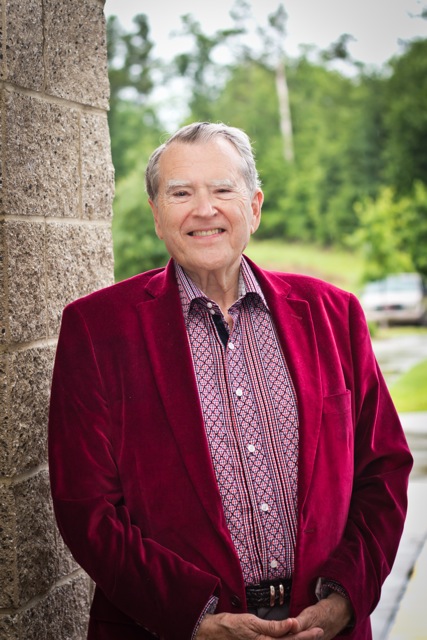
You may know that I run the Woman Alive Book Club. This month’s interview (reproduced here, uncut, with thanks to Woman Alive) is with the prolific writer, RT Kendall (author of over 50 books). He was the senior minister of Westminster Chapel in London for 25 years. He lives with his wife in Tennessee, and continues to preach, teach, and write.
I pray a lot about writing books and seek the leadership of the Holy Spirit in the entire process. I refuse to write until I am gripped. Some of my books were sermons. My book God Meant it for Good was a series of Sunday-night sermons on the life of Joseph from Genesis 37-50. They were originally typed from a tape recorder, then edited to make them more readable. The same is true of All’s Well that Ends Well (life of Jacob) and A Man After God’s Own Heart (life of David). But other books I type at my computer. Sometimes a publisher will ask for a particular subject, sometimes I will get inspired to write on a subject. I like to think that at the bottom of all this is the anointing of the Holy Spirit. But at the end of the day no matter how inspired I may feel if people don’t purchase the books they won’t get read!
Total Forgiveness has sold the most copies (also in 20 languages) of my books and I have received the most letters from people who read it. That book has apparently healed marriages, got family members speaking to each other. I could almost have a book made up of testimonies of readers.
There is not a pastor who does not have people say, “I know God forgives me but I cannot forgive myself.”Totally Forgiving Ourselves has set people free in a wonderful way, but I give God all the glory for this. It’s not me. I have had to do what I tell people to do – I had to forgive myself for not being the good parent I should have been when the children were growing up. I put my church and sermon preparation first thinking I was putting God first. I now believe if I had put my family first I would have preached just as well but I can’t get those years back. I have forgiven myself – I really have! And this has helped others to do the same.
I have been criticized for the title of my latest book – Totally Forgiving God – and I understand this. It sounds like God is guilty of something. But he is absolutely pure, just, and righteous. That said, he allows things to happen which he could have stopped (since he is omnipotent). We have to forgive him – set him free, let him off the hook – for the things he allowed to happen. The book is largely an exposition of the Book of Habakkuk and demonstrates how we must wait until the Last Day for God to clear his Name. I have received testimonies of people who said that book set them free.
We love Britain and would live there tomorrow if we could. It is too expensive. My best friends are in Britain; my happiest memories are in Britain. It was at Oxford I received my research degree; it was in London I was given an international platform. I would never have written a book had I been pastor elsewhere. So I am grateful to God for the privilege of having lived in England. Louise and I take every opportunity to visit when we can. The nostalgia is deep in us.
When I was young I identified with Joseph. Now that I am old I identify with Jacob. When I read about Jonah I say “I am Jonah” – the Jonah who went the opposite direction from what he was told to do; I am also the carnal Jonah who pouted from not being vindicated. My latest book to be published in the USA is on Elijah. I identify with him – a very self-centered man who took himself too seriously.
My book on David is called A Man After God’s Own Heart. I identify with him in many ways, especially in his days of preparation before he became King. But what I admire most about David was how he handled himself when in exile and let God do the vindicating.
Although I have not written a book on Paul – only preached from his letters – he is the one I look forward to talking with in heaven. I want to see what marks he will give me for how well I interpreted Romans, Galatians and all his Epistles. I will also ask him, “Did you write Hebrews?” (I think he did, but nobody agrees with me).
“Who, being in very nature God,did not consider equality with God something to be used to his own advantage; rather, he made himself nothing by taking the very nature of a servant, being made in human likeness. And being found in appearance as a man, he humbled himself by becoming obedient to death—even death on a cross!” Philippians 2:6–8
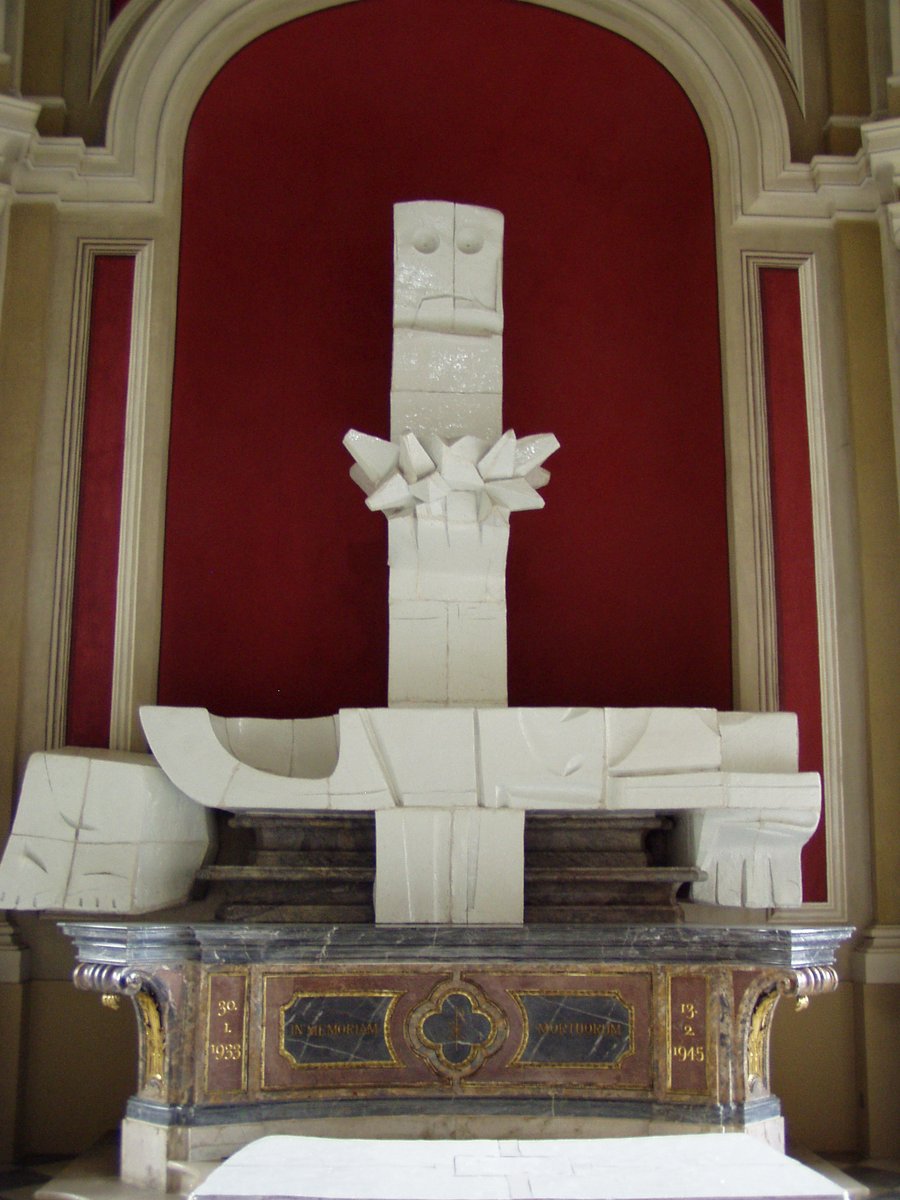
I love this modern sculpture of the human Jesus, held by his mother. From a cathedral in Germany – wish I took better notes back then! Think it was in Dresden.
We have come to one of the most well-known and well-loved passages from Paul’s letters, the humiliation and exaltation of Christ. Over the centuries, scholars have debated whether Paul based this part of his letter on an hymn of the early church. We can’t be sure, but we know that Paul longs that the church at Philippi would die to their own agendas and squabbles so that they could have the same mindset as Christ.
As Paul sits in chains, probably wondering if he’ll be executed, he emphasizes to the church at Philippi the saving and freeing work of Jesus. Though Jesus was of the same nature as God – they were of the same divine substance – he humbled himself and became a man. That Jesus became fully human while still being fully God meant that he could become a bridge between us and God; he lowered himself so that we could have union with God.
We’ll never be able to humble ourselves as much as Jesus did. But because he emptied himself, as we grow in his likeness, we too can grow in humility and servanthood. Our old self, marked by pride and ambition, recedes in the background as we increasingly exude gentleness and humility.
Ponder the deep sacrifice Jesus made in taking human form.
Lord Jesus Christ, you emptied yourself so that I might be free. May I share this freedom with others. Amen.
Ever notice how we feel envy at those just up a level from us, in our chosen field? So, for instance, I don’t feel jealous about Anne Graham Lotz’s publicity or multi-book contracts. She’s a planet away from where I think I could ever be as an author. But that new memoir doing the rounds by the woman living in Midwest of America? In unguarded moments I let myself wonder, could that have been me? Could I be the one living in the Midwest, the state in which I was born, close to my family of origin (taking part in family birthday celebrations and mother/sister shopping expeditions)? With my book jacket getting exposure and all those radio interviews and endorsements and reviews? With blogs and Facebook shares and retweets?
The view during a recent trip with treasured friends. How can I not give thanks?
But that’s not my life, my lot. And an author in the Midwest could look at me and say, Wow. She gets to lead a retreat in sunny Spain. She has stacks of free review books. She meets amazing authors. She lives in LONDON, after all. How cool is that? Castles and cathedrals and a multicultural city and the land of Mr Darcy.
Why aren’t we content? Why do we compare? Why do we let what is healthy get covered in an insidious green slime? Why do we let envy eat away at what is God’s gift for us? I don’t want to let this deadly sin reign in my life. And deadly this sin is – when I exercise it, I become a smaller person. Less interested in others. Not grateful for the manifold gifts God bestows on me. Not walking with God in wonder, practicing his presence, with him ushering in the Kingdom.
And so I choose to bless that author in the Midwest. I pray she will make connections with her readers and that God will be glorified. That she will add to the discussion of life and faith and what is true and good and beautiful.
And I will count my blessings. My family, here and across the ocean. My circles of friends. The words I get to write. The trips I get to take. The books I get to review. A front tooth presented to me by CutiePyeGirl yesterday, complete with a sloppy kiss. The surprise affirmation the Vicar-with-whom-I-sleep just received. The glimpses of Oxford Street I took in yesterday after my author meeting – the lights and activity and man-sized Lego Santa. The unbidden, “I love you” from PyelotBoy.
And with King David, I say
Lord, you’re my portion
You’re my cup
You make my lot secure.
And Lord, those boundary lines?
They’re in pleasant places.
Thank you.
I’m content.
I’m grateful.
I’m yours.
How bout you? What feelings are you letting reign today?