Bob Hartman has been working for over twenty years as a performance storyteller for children, using his dynamic and interactive style to entertain audiences. He’s also the author of over sixty books. He and his wife have two grown children and three grandchildren, and they split their time between the UK and the USA.
Part of the reason I’m a writer is CS Lewis’s Chronicles of Narnia. I know everyone says that! But when I was at elementary school, every Friday afternoon Mr McKee would lower the blinds in our hundred-year-old classroom and read to us. The gloomy schoolroom would be filled with his voice and a special kind of magic. And I thought, “Yes, this is amazing!” Those books have always been at the heart of things for me.
My brother used to love puppets. When he was 9, he asked me to write him a script. I jumped at the chance and soon we were putting on shows regularly. I was usually the narrator and Tim did the puppets. I soon learned firsthand what it was that made an audience laugh.
It’s so sad that very few in the UK know Madeleine L’Engle’s A Wrinkle in Time. It’s fantasy shot through with faith but not in an overt fashion. It was one of the first science-fiction books with a strong female lead. We enjoyed reading it to our kids.
Angels, Angels All Around is my favorite of the books I’ve written, for it was the first time I felt I succeeded in bringing an original idea to life. It’s a series of stories; some are moving and some are funny. I worked really hard on that book, and I was allowed to play. My editor kept saying, “You can do it better; you can do it better.” So I kept rewriting, and in the end I felt like that book came out.
Tapestry, one of my books for children, has flowed out of my reading of Tom Wright’s Surprised by Hope; I have a lot of admiration for his ability to make theology sensible. Tapestry seems to be meeting a need. I met a woman recently who works in a bookshop whose brother died, followed by a close friend. She said my book was honest but not sentimental, and for me that that made all the difference in the world.
Frederick Buechner’s Telling the Truth: The Gospel as Tragedy, Comedy and Fairy Tale is amazing. When I first read it I was studying for the ministry. Previously I had an English major, and then began doing theology. Telling the Truth said you could do both – telling stories was telling the truth. This was before the whole narrative theology movement. I felt like he was saying, “Oh you can do it! Yeah; go for it!” So I did.
I don’t go to the beach much but I enjoy reading literary fiction. Such as Gilead by Marilynne Robison. Or The Road by Cormac McCarthy. The Times called it the novel of the decade and I think that’s fair enough.
People in my book club hate it when I pick the books because I always pick the heavy, sad, angsty, violent ones…. You know, those featuring post-apocalyptic cannibals. They hate me when we’re reading but eventually they love the books. But everyone nearly quit when we did Flannery O’Connor; they couldn’t make heads or tales of the story. She has a gift of pouring grace into the reality of life. Still, not everyone quite gets it. One guy just got up and left, saying, “I’ve had it.”
A new devotional series, this one based in one of my favorite Old Testament books, from the prophet Isaiah (6:1-8).
In the year that King Uzziah died, I saw the Lord, high and exalted, seated on a throne… Isaiah 6:1
Photo: Creative Commons, David Jones. The Imperial Crown of Austria
As an American living in the UK, I’ve often harbored mixed feelings about the British royalty – after all, the colonists in the New World fought a war to be free of King George III. But living here for sixteen years, I’ve grown in respect and admiration for Queen Elizabeth II. She has exhibited seemingly tireless grace and diplomacy for over sixty years, which we rightly celebrated during her Jubilee in 2012.
King Uzziah was another faithful ruler, who wielded more power in his day than British royalty do today. But at the end of his life his pride ruined him. He decided that he wanted to involve himself in matters at the temple and burned incense at the altar (which was the job of the priests). The Lord struck him with leprosy and he died. This was the year Isaiah received his commission as a prophet, which we will be reading about in this seven-week series.
In contrast to the human king, Isaiah glimpses the true King who is seated on his throne of judgement. The people of Israel had been swayed by powerful King Uzziah and had, little by little, began to trust in him more than God. And so the Lord commissions a man – Isaiah – to bring his dual message of judgement and mercy to his people.
Whatever your view of royalty, today consider the mighty King of all Kings who never slumbers nor sleeps.
Prayer: King of Kings and Lord of Lords, we pay you homage. Reign in our lives today. Amen.
Gary Thomas is a bestselling author in Houston, Texas, where he is a Writer in Residence at Second Baptist Church. An avid runner who has completed eleven marathons, he is married and has three children.
I wrote Every Body Matters because I was struck by how often gluttony and sloth are addressed in the ancient devotional books, but rarely even mentioned from today’s pulpit. It’s also been a natural progression in my own walk with the Lord. As a young man, my metabolism and penchant for running hid a lot of food-based indulgence, but while it didn’t show physically, it was having spiritual consequences. The church should be in the forefront of addressing this issue, not struggling to catch up.
A man once came up to me and explained how his wife had decided to leave him. As she was packing up to move out the next day, she knocked over his copy of Sacred Marriage and saw the subtitle (What If God Designed Marriage to Make Us Holy More Than to Make Us Happy?). It intrigued her, so she started reading, then woke up her husband in the middle of the night and said she wanted to give it another try. The man had an 18-month-old girl and a 4-year-old boy. I was moved by how God could use a book subtitle, and a few chapters, to change the course of a marriage and to provide a more stable home life for these two kids.
I appreciate Francis De Sales for the way he makes spirituality so practical for laypeople; Brother Lawrence for renewing my desire to bask in God’s presence; Fenelon for his ability to communicate about the spiritual life; and Henry Drummond for applying his brilliant mind to unlock practical aspects of spiritual growth. Brother Lawrence’s Practicing the Presence of God is probably the easiest for people to read. I wrote Thirsting for God to introduce the writings of the Christian classics, so that’s another place to start.
I read some of my book’s reviews, because there are always things to learn, and because the reviews are usually encouraging more than discouraging. But then there are the crazy ones that seem so unfair—not that long ago, a man gave one of my books a poor rating saying, “I haven’t actually read it yet, but I flipped through it and I’m suspicious.” What’s the point of that? Some reviews point out blind spots (many said I’m harder on men in Sacred Marriage than women, which is true); others tell me more about the reviewer than anything else.
I love to read. I love to study. I love to write, and even re-write. And morning is my favorite time of the day. Put that together, and I can honestly say, though I’ve been actively writing/publishing for almost 20 years now, I have never suffered from significant “writer’s block.” Now, because of my duties as a teaching pastor, I don’t have all day to write like I used to; it’s compacted into a couple hours in the morning, but that’s enough if you’re faithful with it.
Susan Howatch is among my favorite novelists, though she isn’t writing too much these days. I lean toward literary fiction more than commercial fiction, but I also read a good bit of history. Because I’m an avid runner, I usually read a few running-related books every year as well.
Do you have a security blanket? CutiePyeGirl falls to sleep best when she has her Baby Elmo on her left and her sheepskin fleece on her right, the nightlight shining on the table nearby. Me, I’ve moved beyond soft toys to chocolate. When I’m stressed out – the kids are demanding or cranky and I’m tired and lacking patience – I can easily turn to a quick pick-me-up in the form of a mint chocolate biscuit.
Photo credit: Shimelle Laine, Creative Commons
Sometimes I grab one and don’t savor every sweet bite; I’m eating it without even noticing. How much better, of course, to find comfort from God. But chocolate can seem more accessible than our heavenly Father; its right here and while he can seem so far away.
How can I turn to God? How can I live in the present? How can I resist chocolate?
As I ponder these questions, I’ve been reading the book of Romans, thinking of how amazingly smart the Apostle Paul was. Parts of the letter seem dense and outside of my grasp; I have to chew them over, asking God through his Holy Spirit to reveal what he’d like me to grasp. And biblical commentaries are pretty great too.
Here’s what Romans 8:9–11 says: “You, however, are not controlled by the sinful nature but are in the Spirit, if indeed the Spirit of God lives in you. And if anyone does not have the Spirit of Christ, they do not belong to Christ. But if Christ is in you, then even though your body is subject to death because of sin, the Spirit gives life because of righteousness. And if the Spirit of him who raised Jesus from the dead is living in you, he who raised Christ from the dead will also give life to your mortal bodies because of his Spirit who lives in you.”
I believe Paul when he says that the Spirit of God lives in me. Thus I am not controlled by the sinful nature anymore but by the Spirit of God who lives in me. Christ in me gives life. Even though my body is subject to death because of sin, Christ gives life because of righteousness.
So if I’m not controlled by sinful desires but by the Spirit living in me, then why do I succumb to the momentary pleasures of a crunchy chocolate mint biscuit? On the grand scale, it’s the war between good and evil; the sinful nature and the redeemed nature. On a smaller scale, it’s my need to reshape my habits. To replace the compelling desire for that taste sensation with seeking the comfort God gives through his sweet words of love.
I wish I had an easy answer to spiritual success over mint chocolate biscuit bars: “Just do these five easy steps and you too will be free from enslavement to chocolate!” Is it ever so simple? I don’t think so.
But one simple exercise that I’m trying is to focus on part of a verse from Romans, as above: “The Spirit gives life because of righteousness.” Righteousness, meaning right living before God. His Spirit living in my mortal body, transforming me from the inside out. Asking him to reign in me – in my thoughts and actions – moment by moment, that I look to him and not to self-medication in the form of ingesting something sweet.
Do you love chocolate? Is it your go-to food when you’re stressed or sad? If so, how do you let righteousness reign?
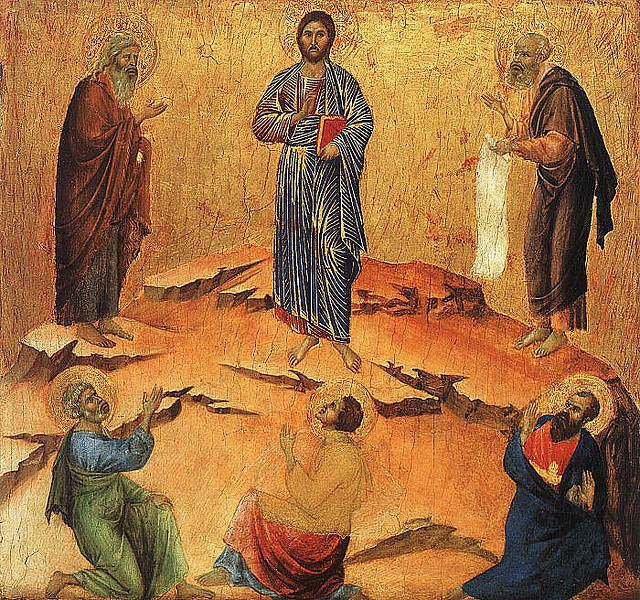
After six days Jesus took with him Peter, James and John the brother of James, and led them up a high mountain by themselves. There he was transfigured before them. His face shone like the sun, and his clothes became as white as the light. Just then there appeared before them Moses and Elijah, talking with Jesus… While he was still speaking, a bright cloud covered them, and a voice from the cloud said, “This is my Son, whom I love; with him I am well pleased. Listen to him!” When the disciples heard this, they fell facedown to the ground, terrified. But Jesus came and touched them. “Get up,” he said. “Don’t be afraid.” (Matthew 17:1–3, 6–8)
Photo: Creative Commons, carulmare. DUCCIO di Buoninsegna Transfiguration, 1308-11
During this series on Jesus’ miracles, we’ve seen Jesus healing the sick, raising the dead, overcoming nature, and exorcising demons. Our final miracle to consider today is the transfiguration, when the divine nature of Jesus is revealed. Whereas the other miracles are ones that Jesus performs, this one is performed on Jesus.
Jesus has taken his inner circle of disciples – those who would be future church leaders – up a mountain to pray. It’s as if the heavens open and the scales fall from their eyes as they glimpse Jesus as God the Son, with his face shining and his clothes as white as light. Then they hear God say that this is his beloved son, and that they should listen to him. As with all mortals who come in contact with the living God, they are terrified. But Jesus touches them, reassuring them. They are changed, but they are to fear not.
“Listen,” says God the Father. Are we listening to Jesus? Do we stop to pause and wait for his words and his directions, in things big and small? Have we aligned our lives in submission to his loving will?
As we do so, Jesus will work miracles in us. As God’s beloved Son he promises to bring reconciliation, healing, and restoration. May we enjoy the new kingdom that he is ushering in to its fullness, sharing his joy and peace with our families and those whom we meet.
For reflection: “For in him we live and move and have our being” (Acts 17:28).
The start of our local parade with the Stars and Stripes. Very moving.
Just back to the UK from my annual fortnight (US: two weeks) in America, visiting family. As CutiePyeGirl says, seeing grandparents and family only once or twice a year is not enough. I agree.
As I reflect on my time there, I offer a few observations.
Healthcare costs have skyrocketed.
People seem to be increasingly affected by health-care costs, whether in monthly insurance payments, co-payments, or deductibles. I’ve heard stories of someone having a heart attack but not calling an ambulance to save the $200 fee, for instance, or going to a clinic instead of the ER (UK: A&E) because it’s cheaper. The NHS is by no means perfect, but the care we’ve received (especially for PyelotBoy) has been reliable and thorough – and free at the point of use (but of course the bill is footed by high taxes).
Memorabilia from the Kellogg all-class reunion I attended while in Minnesota. Go Chargers!
Pope Francis rocks.
I’ve been impressed by the new head of the Catholic church, and my heart was “strangely warmed,” to employ a Methodist saying, when I saw him in the flesh at St. Peter’s Square with my parents and family. I attended my parents’ Catholic church when Stateside and appreciated the influence he’s already having at the local level.
Land of 10,00 lakes. More shoreline (90,000 miles) than California, Florida, and Hawaii combined.
Minnesotans are nice.
Okay, so not all Minnesotans are nice every moment of every day, but on the whole, nice they are. I had to readjust my social interactions, remembering, for instance, that while out on a walk around the lake, one does actually acknowledge the person walking toward you. Waiters are nice; department store clerks are (usually) nice; of course friends and family are nice. Leading me to…
Learning to cast.
Relationships are the best.
CutiePyeGirl feels the separation from her US family deeply (well, we all do, but she shows it most tangibly). Each night since returning home, she’s been tearful and almost inconsolable about being separated from grandparents, cousins and aunts and uncles. I conveyed to her what a lovely Englishwoman, who lives in America and has a daughter in England and a son in Hong Kong, said to me before I got married, that now I’d have one foot on each side of the Atlantic. Loving deeply means we grieve deeply when separated, but closing ourselves to grief means closing ourselves to love.
Some of the Fantabulous Friends.
I didn’t get to see as many friends as I would have liked to see, but I got to reconnect with my “Fantabulous Friends Forever,” those women with whom I went to high school and whom I’ve stayed close to for so many years. We’ve experienced heartbreak, sorrow, and drama along with experiencing joy, but our friendships have stayed strong through the seasons.
After all, what matters more than people (and the word of God)?
Great crowds came to him, bringing the lame, the blind, the crippled, the mute and many others, and laid them at his feet; and he healed them. The people were amazed when they saw the mute speaking, the crippled made well, the lame walking and the blind seeing. And they praised the God of Israel. Jesus called his disciples to him and said, “I have compassion for these people; they have already been with me three days and have nothing to eat. I do not want to send them away hungry, or they may collapse on the way.” His disciples answered, “Where could we get enough bread in this remote place to feed such a crowd?” “How many loaves do you have?” Jesus asked. “Seven,” they replied, “and a few small fish.” He told the crowd to sit down on the ground. Then he took the seven loaves and the fish, and when he had given thanks, he broke them and gave them to the disciples, and they in turn to the people. They all ate and were satisfied. Afterward the disciples picked up seven basketfuls of broken pieces that were left over. (Matthew 15:30–37)
Photo: Steve Cadman, Creative Commons. Stained glass by Helen Moloney in St Michael’s Creeslough (1971) by Liam McCormick, County Donegal
Jesus has been healing and teaching the crowds in Gentile territory. Seeing that they are tired and hungry, he’s moved with compassion. He wants to meet not only their spiritual needs, but their physical ones too. And although the disciples have already witnessed Jesus feeding the five thousand, they still wonder how Jesus will feed these four thousand men, plus women and children.
Jesus takes what the people give – seven small loaves and two fish – and makes it sufficient for all. He multiplies their meager offering into a feast that satisfies.
Note two things regarding this familiar miracle. First is that Jesus performs it in Gentile territory. Although he came first for the Jewish people, he also yearns that non-Jews would eat and be satisfied with his food.
The second is how Matthew indicates that this miracle hearkens to Jesus’ breaking of the bread during his last supper – Jesus takes, breaks the bread, gives thanks, and offers it to the disciples. They in turn offer it to the people. So too should we offer what we have to Jesus for distribution among his people. It might seem far too small or insignificant for the needs, but as we see here, Jesus has a way of multiplying our bread beyond our wildest imagination.
Prayer: Lord God, we lift before you the needs of hungry people today – in Haiti, South Sudan, the Holy Land. Where we have loaves and fish to offer, let us give that you may multiply.
When they came to the crowd, a man approached Jesus and knelt before him. “Lord, have mercy on my son,” he said. “He has seizures and is suffering greatly. He often falls into the fire or into the water. I brought him to your disciples, but they could not heal him.” “You unbelieving and perverse generation,” Jesus replied, “how long shall I stay with you? How long shall I put up with you? Bring the boy here to me.” Jesus rebuked the demon, and it came out of the boy, and he was healed from that moment. (Matthew 17:14–18)
A desperate father seeks the help of Jesus’ disciples but meets with frustration. We don’t know what the disciples were doing for the boy, but Jesus sees immediately their lack of faith. And this faithlessness is what Matthew wants to highlight in his gospel, for he again gives a sparse account in comparison with the other synoptic gospels.
I can feel this father’s pain, for it has been the burden of my own father (and mother). My brother has suffered from epilepsy since he was just three years old, and although my parents have sought healing from the Lord, my brother still has this disease. Why God heals at times and at other times does not is one of the biggest mysteries of our faith. I can only put it down to the fall of humanity, when our first parents chose their own way and thus sin, disease, and death entered the universe.
So in terms of my brother and this story, I believe that he is not demon-possessed but afflicted by our fallen nature. We ask God to heal and desire that he would do so. But when he does not we continue to ask him to increase our faith. And to give us the wisdom to know when to accept that healing may not come this side of heaven.
How about you? Have you pleaded with the Lord for something but your cries seemed to fall on deaf ears? May your trust in him continue to grow, and may he give you wisdom and understanding.
Prayer: Father God, we don’t always understand. Enlarge our grasp of your truth and your love, and give us your peace.
“Sometimes what we see as rejection is, in truth, sacrificial love.”
An interview with bestselling author Francine Rivers, who shares her heart for God and love for her readers. (Appeared originally in the June 2014 issue of Woman Alive.)
I thought being born into a Christian family and raised in the faith made me a Christian. It didn’t. Each person makes their own choice, and it took me years to surrender to Jesus – not until after I’d gone through college, married, had children and started a writing career. My husband Rick and I went to church, but came away dissatisfied and knowing there must be something more. We both had personal issues that brought us close to divorce several times. As a child, I’d asked Jesus to be my Savior. What I didn’t understand is I needed to surrender my life to Him and allow Him to be Lord of my life as well.
Studying the Bible changed our lives. Our hearts and minds opened to Christ. Rick and I both accepted Jesus as Savior and Lord and were baptized in May 1986. Since then, God has been changing our lives from the inside out. The Lord also healed our marriage – we recently celebrated our forty-fourth wedding anniversary.
From the time I was a child, I knew I would be a writer. On a dare from Rick, I decided to write a combination of my favourite genres and wrote a “western-gothic-romance.” Romance novels were booming in the general market, publishers were on the look-out for new writers. My first manuscript sold and was published. I was hooked! I followed with eight or nine more of what I call my B.C. (before Christ) books. They are all now out of print, are never to be reprinted, and are not recommended.
When I turned my life over to Jesus, I couldn’t write for three years. I tried, but nothing worked. I struggled against God because writing was my “identity.” It took that period of suffering writer’s block to bring me to my senses. God was trying to open my eyes to how writing had become an idol in my life. It was the place I ran to escape, the one area of my life where I thought I was in complete control. My priorities were all wrong and needed to be put right. God first, husband and children second and third, work. My love for writing and reading novels waned and my passion for reading and studying God’s Word grew.
Every year I go on a “pray, plot and play” retreat. There are eleven of us, all professional writers, one of whom is retired, in her nineties and no longer able to make the trip to Idaho. She is a mighty prayer warrior who served with her husband as a missionary in India. She remains an inspiration to us all. Our group always starts our daily session with a devotional presented by one of the members. We sing hymns. I can carry a tune, but three of our ladies have beautiful voices and could go on the road as professionals. I love to listen to the harmony; it’s a sweet taste of heaven. Our roundtable discussions and “twenty-question” plotting sessions have produced numerous published novels. We laugh a lot; cry together. We’re in constant contact through the year and support and encourage one another. All of us have faced or are facing major challenges: cancer, death of a spouse, children struggling with addictions, contracts and publishers, adopting children, moving from one state to another, caring for aging parents, writer’s block, loss of job, moving into a new publishing arena (online direct). We pray and pull together. We encourage and build up one another’s faith through whatever trials this life throws at us. And we keep writing stories to glorify our Lord and Savior, Jesus Christ.
A few years back, while in a writing competition, I saw the effect of the awards on a dear friend. She was happy I had received the award, but she longed for affirmation for her work. This writer had published far more novels than I had and is a wonderful writer. Seeing how hurt she was crushed me. Hence, I decided not to compete again. Why do we do it? We are one in Christ, and I don’t want anything to come in the way of that. And I don’t believe there is any such thing as a “best book” (unless it’s the Bible). If a novel or nonfiction work changes someone, encourages them, or opens their hearts to Christ, that is their best book of the year whether it sold ten copies or a million.
I don’t read reviews if I can avoid them. Good ones tend to stir pride and the bad ones crush the spirit, neither of which is good for my faith walk. Reviews are one person’s opinion. God is the one we want to please. I’m one of those people who would love to please everyone, so it’s better if I keep my audience to One. All I can do is put heart and soul into my work and leave what happens with it to Him.
I hope the stories I write will increase readers’ hunger and thirst for Jesus, and the characters will inspire them to be more like Him. It’s so easy to follow the ways of the world, to get sucked into following the herd rather than be among the flock. I want to encourage readers to trust in the Lord always and to remember only His Word is truth.
In Bridge to Haven, I wanted to explore how people can be bridges. Jesus is the ultimate bridge that takes us across the chasm over hell and into heaven to be in the presence of God. Each character in the novel plays a part as a bridge builder or bridge destroyer. Sometimes the characters begin as one and become the other.
The story started as an allegory about the character of God and Jesus, but how can anyone capture the immensity of God, His all-consuming love and passion for each of us? I certainly couldn’t. His love is so immense, cleansing, healing, restorative. It’s beyond human understanding. I dumped my first attempt and started over. In this rendition, two of the main characters, Zeke and Joshua, strive to be like Jesus, and often fail. The protagonist Abra represents those who turn away from the love offered, looking in all the wrong places for what they had from the beginning. It is a leap of faith to believe God’s grace is not earned, but freely given.
The Golden Years of Hollywood seemed to fit the story better than other eras. Many of the stars people idolized had miserable lives and tragic ends. I think of Marilyn Monroe in particular, who spent her life searching for love. James Dean, another Hollywood icon, died at 24 in a fiery car crash. Hollywood reeked of scandal; affairs, broken marriages, suicide, fortunes made and lost. It was also a time when girls believed all they had to do was show up in Hollywood to have all their dreams come true. Abra’s dream is to be loved, to be someone of importance. The challenge for me was interweaving the characters through World War II, the Korean War into the Cold War as well as a time of prosperity and showing how what happens in the world also impacts how we think, act and live. Only He is unchanging. Truth love and peace can’t be found anywhere else but in Him – in any era.
Children are deeply affected by early trauma. Abra focuses on the facts, believing she has been rejected by the only father she knew. She retaliates by rejecting him as well as the God he loves and serves. The seeds of bitterness and rebellion are planted at five, and Abra only sees through the eyes of a hurt child. This happens so often in life. What we see is only the surface. This was a theme in my two previous novels, Her Mother’s Hope and Her Daughter’s Dream. Sometimes what we see as rejection is, in truth, sacrificial love. It takes growing up and God’s intervention to bring truth, and for some that journey takes years and even deeper heartache before we fall to our knees and seek God’s perspective.
I was like Abra for many years. Despite the truth I was taught as a child, I took hold of a wrong view of God as a constant critical eye, a Being just waiting to condemn me to everlasting hell. When I turned to God, I felt like Paul when the scales fell away from his eyes. In a sense, I awakened and knew God loved me despite everything I had done and mistakenly believed. My stubborn pride had to be broken. There were always people around me who loved me and pointed the way to Jesus. That is true of everyone. God makes ambassadors and scatters them everywhere. When we open our hearts, usually out of desperation, God pours in His Holy Spirit and opens our eyes and ears to who He is and to those He has called to help us cross that bridge of faith God uses.
Before I started writing Redeeming Love, when I was still rather new at loving God with my whole heart, I got the idea to start using what I called a God Box – an inbox for God. I would write out prayers and put the papers into the God Box. This practice helped me to let go of the issues, to put them into God’s hands by physically putting them into the box. Every few months I would read the papers and marvel at how God had answered the prayers, often in unexpected ways.
What amazing things are our five grandchildren doing? Growing up! We have one grandson learning to drive and talking about joining the Air Force, another playing secondary-school basketball and winning spelling bees, and the youngest getting ready to enter kindergarten. One fourteen-year-old granddaughter is becoming a poised young woman and our eight-year-old granddaughter is one of two girls on a Christian basketball team and excelling in school. They’re all busy and happy and making their parents and grandparents proud (in a good way). The whole family was together at our place for Christmas Eve and the house was rocking!
“Trust in the Lord with all your heart; lean not on your own understanding. Acknowledge Him in all your ways, and He will make your path straight” (Proverbs 3:5-6). These are the Scriptures I go back to over and over again. The prince of the air has free run of this world, and he is the father of lies. Satan hates God and attacks Him by wounding and destroying His children. Even so, God reigns. Only God can take the worst we experience or bring on ourselves and use it to His good purpose in drawing us closer to Him as well as offering a light to others.
For me, trust has always been difficult. I trust and then I worry (doubt) and then, by submission and prayer, trust again. Our work is to believe and walk in faith one day at a time. And that is hard work at times. Some of us have to learn the hard way that life in this world is too painful to live any other way. Only in Christ do we have peace and a love that fills us up so much that we have a wellspring to pour out to others.
A Canaanite woman from that vicinity came to him, crying out, “Lord, Son of David, have mercy on me! My daughter is demon-possessed and suffering terribly.” Jesus did not answer a word. So his disciples came to him and urged him, “Send her away, for she keeps crying out after us.”He answered, “I was sent only to the lost sheep of Israel.” The woman came and knelt before him. “Lord, help me!” she said. He replied, “It is not right to take the children’s bread and toss it to the dogs.” “Yes it is, Lord,” she said. “Even the dogs eat the crumbs that fall from their master’s table.” Then Jesus said to her, “Woman, you have great faith! Your request is granted.” (Matthew 15:22–28)
Photo: Creative Commons, Waiting for the Word.
I struggle to understand why Jesus took so long to heal the poor woman’s daughter, and why he may have employed the Jewish derogatory term of “dogs” to describe the Gentiles. But as theologian Michael Green comments in The Message ofMatthew, we don’t know Jesus’ inflection or delivery of his words, for in the Greek, punctuation is inferred and not written. So Jesus could have been musing, asking the question if he was sent only to Israel. As Green says, “I believe this was a soliloquy of Jesus” (p. 172).
However we interpret it, we know that Jesus’ first mission is to save Israel. His actions here tell us, however, that he doesn’t limit his grace. As with the Roman centurion who sought healing for his servant, Jesus admires this woman’s faith and tenacity, and heals her daughter.
The early church would have been encouraged by this encounter, for it shows how amazed Jesus was by a Gentile’s faith. The story would have also served as a warning to those in Israel who were complacent in their privileged status. What Jesus yearns for, as we see here, is great faith.
Passages like this remind us that as much as we’d sometimes like to put Jesus into a neat and tidy box, we simply cannot. But we can follow the example of the Gentile woman, who was motivated by her maternal love and persevered in seeking healing for her daughter. And we can trust that God’s love and mercy is sufficient – whatever our ethnicity, race or tribe.
Prayer: Lord, thank you for the tenacity of this mother and your loving response. Help us to hold on to you, as you hold on to us. Amen.
 Part of the reason I’m a writer is CS Lewis’s Chronicles of Narnia. I know everyone says that! But when I was at elementary school, every Friday afternoon Mr McKee would lower the blinds in our hundred-year-old classroom and read to us. The gloomy schoolroom would be filled with his voice and a special kind of magic. And I thought, “Yes, this is amazing!” Those books have always been at the heart of things for me.