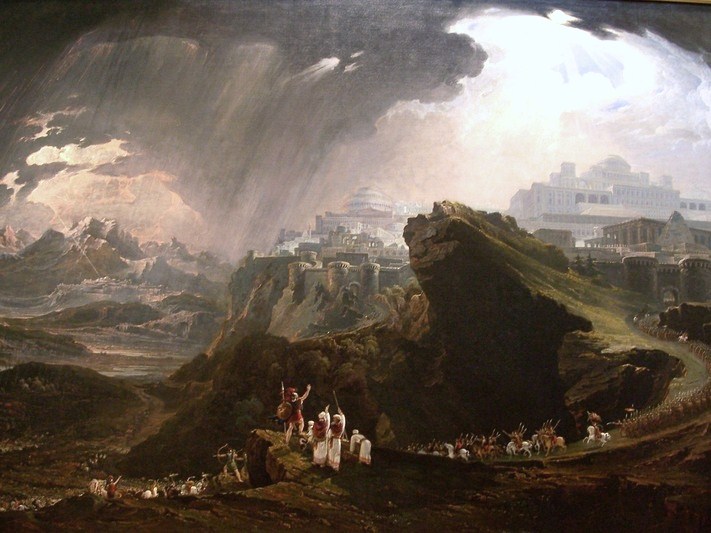
Joshua Commanding the Sun to Stand Still upon Gibeon by John Martin. Public domain.
“Be strong and courageous. Do not be afraid; do not be discouraged, for the Lord your God will be with you wherever you go.” Joshua 1
A church leader had these opening verses of Joshua impressed on him by the Lord as he settled into life in a new parish. Little did he know that he would be facing strife, assault, accusation, and anguish in what became a church divided. Sensing from the Lord that he needed to be strong and courageous, that he shouldn’t be afraid or discouraged, he kept on with the challenge of clarifying the core beliefs of the church. Later he acknowledged that he could have handled some things differently, with more loving grace, yet now he delights in a church transformed. Out of the ashes have come sprouts of new growth.
Joshua has a tough act to follow – as do church ministers when taking over the leadership of a church from one greatly admired. Moses has died and now Joshua faces the challenge of his lifetime, to lead his people to claim the land God had promised them. The Lord assures him that he will be with him, just as he was with Moses, and tells him repeatedly to be strong and courageous. Not to fear. To obey God’s commands. To meditate on the Book of the Law.
As we see with Joshua, the Lord promises never to leave us, but we have to step forward in faith. We might face challenges we never dreamed were possible, such as betrayal by our closest prayer partner or a whispering campaign that cuts us to the heart. Though we suffer, the Lord will not abandon us. With God’s indwelling Spirit, he brings comfort, peace and even the ability to forgive those who wrong us. And he will show us where we have sinned, lifting the lid of self-deception and convicting us to repent. May we rejoice in God’s mercy this day.
For reflection: Consider a church leader you know, perhaps your own. How might you encourage and uphold them today?
I first met Jennie at a book launch – you can read my gaffe of the American introducing herself in my book Finding Myself in Britain. I didn’t know then that I was meeting a wonderful woman who would become the editor to that book – one who had lived in the States for five years and so could speak both languages. And a consummate tea aficionado, who helped hone that chapter on tea. But she’s more than “just” an editor, of course; I picture her with a smile and a ready laugh. I love how she embraces life, thinking deeply about her faith, with joy oozing from her. I don’t think I could live with her – I couldn’t handle her tolerance for clutter, as you’ll see below – but I love counting her as one of my friends.
We first met at a Starbucks in central London. He’d seen my profile online, we’d exchanged a couple of emails and now we’d found a quick half hour after work to meet. Time was of the essence, especially for him; we had to make a decision fast. Sure, we were complete strangers but… could we live together?
No, this wasn’t speed dating on – er – speed. He had found my profile on a Christian flat-hunting (apartment hunting) website. I had listed the area I wanted to live in and the maximum price I could afford, he had found a flat that fit the bill and needed someone to share it with.
[A note for readers living outside of London: here it’s not a big deal for guys and girls to share flats/apartments. It is very common, and culturally totally appropriate. I’m aware that’s not the case in most other areas!]
So we met and tried to size each other up – what do you do for a living? Do you like to have friends over or go out to socialise? Do you smoke? Do you drink? How much do you care about tidiness/clutter? In other words, what does ‘home’ mean to you?
Our conceptions seemed compatible, and the flat, though a dark, damp, rather chilly basement, was in an incredible location right in the centre of London, so we moved in.
We’ve now lived in that flat for seven years. I’ve loved the location, loved (in the summer months) my ‘writing cave’ in one of the old coal cellars and loved the fact that, for the most part, my flatmate and I have passed like ships in the night (often literally, as I have been coming in from an event and heading to bed, just as he is adjusting his bow tie in the hall mirror and going out for the evening!).
But now it’s time to go our separate ways. He is being posted overseas for work, and I am flat-hunting again.
Now, of course, I’m seven years older, and my criteria have changed somewhat. Then I cared about location, price, and flatmates who didn’t smoke. Now in my 40s, those things are still factors, but given that I don’t want to have to move again any time soon, I definitely want this next place to feel like home.
So what does that mean now?
In no particular order, here are four things that I have come to value (or realise I value):
1) Clutter.
One reason my flatmate and I got on so well is that we both have a similar tolerance to clutter. The various tables and work surfaces were always strewn with newspapers, letters, books, empty tea mugs, Amazon packaging and various other oddments. We both had books double-stacked and DVDs in teetering piles on the bookcases. The kitchen worktops always held the dishes and utensils we most often used and… you get the picture – we liked clutter. Home to me is somewhere where I’ve got my stuff around me and it’s OK to leave it there for a day or more until I next need it.
Books, books, everywhere books.
2) Hospitality.
I want my home to be a place where people feel welcome and want to come to eat, to relax, to hang out or to stay. I wish I’d made the effort more often to invite people over here, but apart from a few dinners, a couple of parties and the occasional Life Group meeting it hasn’t happened very much.
Part of the difficulty is that I’m not a natural ‘gatherer’. It’s hard work getting people to come to anything I organise, especially spontaneous things with no real purpose. Perhaps this time I need to choose flat mates who naturally draw others to them – then I could do all the cooking and preparing while my flatmates drum up the crowd to share it with.
On the other hand, maybe I should live alone because I also value…
3) Alone time.
I loved those weekends, and occasional weeks, when I would get the house to myself. Even though we rarely saw each other, it was nice just to know that the house was empty, and would be when you came home. I could leave the washing up in the sink for days, eat things like fish without feeling guilty about the smell, and not trip over his shoes when going to the loo in the middle of the night!
Ah, little luxuries! Speaking of which, there’s one more that was never on my list before but is now right up at the top:
My writing cave.
4) Daylight.
This cold, dark, damp basement has been fine for most of these seven years, but for the last 18 months or so it’s been starting to get to me (particularly as I now work from home three days a week). I’m tired of having no idea what the weather is doing. I’m tired of always having to have lights on. I’d like to be able to see a sunset or hear the rain. I want to be able to curl up and read in the patch of sunlight falling across my chair. I want to not live in a cave!
Battersea Power Station, which I’ve grown to love dearly over these seven years.
This flat has been wonderful. I have loved being able to walk to St James’ Park or home from the West End, I’ve loved lying in bed listening to the chimes of Big Ben. My flatmate has been almost ideal, and we’ve survived seven years with barely a difference of opinion. He was a total hero when my ceiling fell down and had to be replaced while I was in hospital. He has borne being in the darker, damper, smellier room with fortitude, and his foibles have been odd but – I’m sure – no more annoying than mine.
God provided an amazing place that has been home for nearly a sixth of my life – the second longest I have lived anywhere. As I look for where – and with whom – He will take me next, I’ll be grateful for His provision whatever that looks like, but I’ll be seeking to add these little touches that make a house my home.
Jennie Pollock is a freelance writer and editor who says she’s a ‘book-loving, blog-writing, tea-drinking, London-adoring, cheerful, joyful, trying-to-be-more-prayerful, image-bearing child of God.’ She has an MA in Philosophy, a BEd in English and a commendation in tea-making from several former colleagues. Alongside her freelancing, she works part time as Director of Communications for Kings Church Kingston. You can find her online at jenniepollock.com.
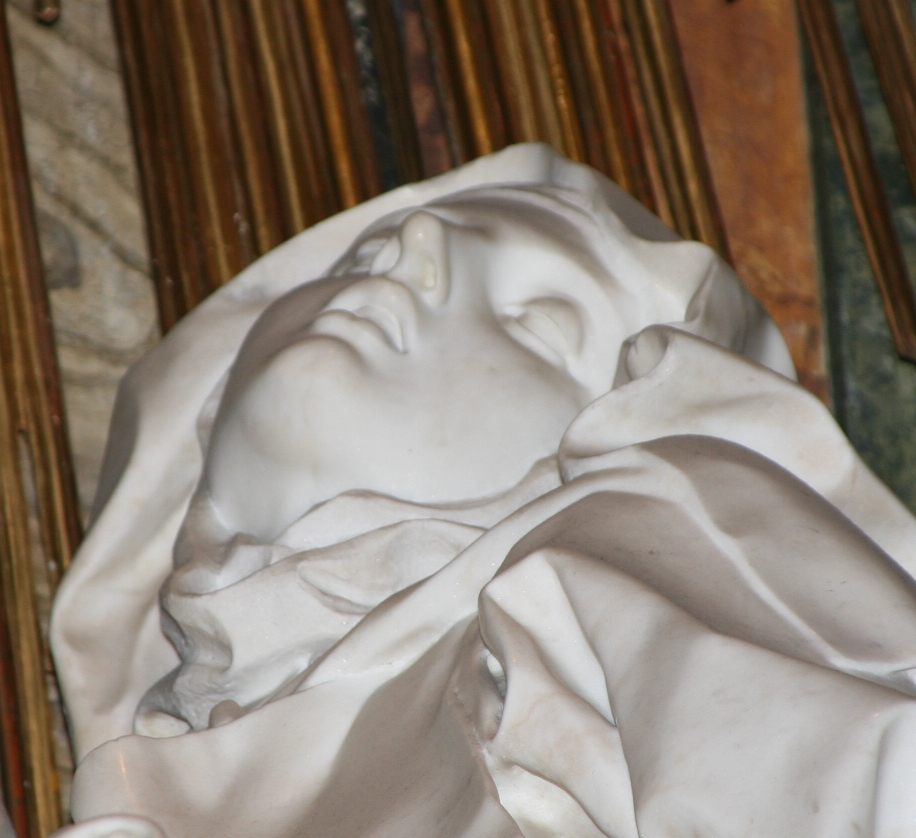
Bernini’s “Ecstasy of Teresa.” Photo: Nina Aldin Thune, flickr
Teresa of Avila gets a bad rap these days, for many people picture her in a state of rapture or levitating. Bernini’s statue in Rome, “The Ecstasy of Teresa,” beautiful though it is, reinforces that view. But visions, ecstasies, and locutions (her word for hearing God) make up only part of Teresa’s spiritual life and shouldn’t be the main focus, for they should act as markers or pointers to the transformation of her soul.
After all, her highest state of union, which she describes in the seventh mansions in The Interior Castle, considered her greatest work, is not rapture but spiritual marriage with the Trinity. She senses in an intellectual vision this union, with each member of the Trinity playing its own role, and her as the beloved. The “favors,” which is what Teresa called the divine revelations of visions and ecstasies, therefore empower the soul to live like Christ, empowered to go out and do good works. Plenty of which Teresa did.
She was deeply concerned for reform within the Carmelites, and set up the Discalced (or Barefoot) Carmelites in the response to the excesses she discerned – social hierarchies in the convents, gossip, wealth… She wanted them to return to the values of simplicity and poverty, and to empower her sisters she wanted to teach them mental prayer (in contrast to vocal prayer, which would be practiced in community). Later she convinced John of the Cross to join the movement (she was thirty years his senior, but for a time he became her confessor).
But this was the time of the Inquisition in Spain (the sixteenth century), for King Ferdinand and Queen Isabella had sought the unity of the country through the Catholic faith. Therefore anyone who didn’t convert – Muslims and Jewish people – were exiled, and those who did convert were assessed as to the purity of their beliefs. The Inquisition viewed mental prayer as dangerous and undermining the institutional church, and writing that promoted it was taken away to be considered and perhaps banned. Teresa’s own copy of The Book of Her Life, her autobiography, was taken and never returned to her. She wanted to teach her fellow nuns so her confessor encouraged her to write new works, which resulted in several books including The Interior Castle.
Her work as a reformer included a keen desire that the nuns under her care would be transformed through union with the triune God through prayer. The journey of love she recounts in The Interior Castle is one of journeying ever closer to God’s heart. May we too live in the mansions God has prepared for us, dwelling with him and enjoying his love.
This blog post comes from thinking I’ve been doing for an essay for the “History of Christian Mysticism to the Reformation” course I’m taking at Heythrop College, University of London. This term I’ve read some amazing and mind-boggling thoughts from people such as Augustine, Origen, Bernard of Clairvaux, Hadewijch, and Teresa and John of the Cross. It’s been fun, intense, hard, and stretching.
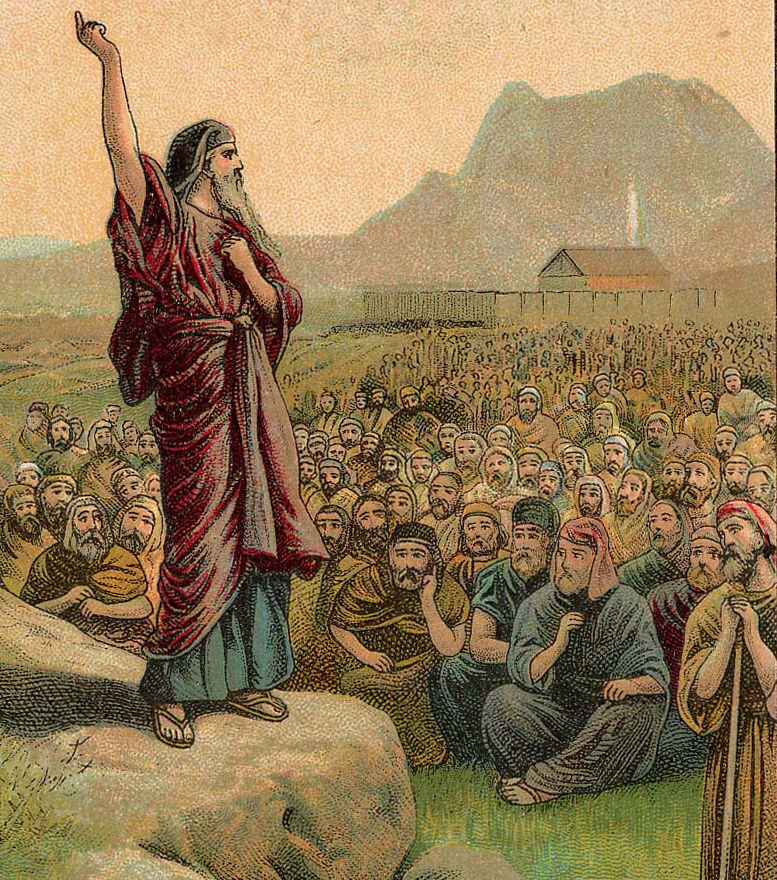
Moses Pleading with Israel, illustration from a Bible card published 1907 by the Providence Lithograph Company.
Then Moses went out and spoke these words to all Israel:“I am now a hundred and twenty years old and I am no longer able to lead you. The Lord has said to me, ‘You shall not cross the Jordan.’The Lord your God himself will crossover ahead of you. He will destroy these nations before you, and you will take possession of their land. Joshua also will cross over ahead of you, as the Lord said.And the Lord will do to them what he did to Sihon and Og, the kings of the Amorites, whom he destroyed along with their land.The Lord will deliver them to you, and you must do to them all that I have commanded you.Be strong and courageous. Do not be afraid or terrified because of them, for the Lord your God goes with you; he will never leave you nor forsake you.”
Then Moses summoned Joshua and said to him in the presence of all Israel, “Be strong and courageous, for you must go with this people into the land that the Lord swore to their ancestors to give them, and you must divide it among them as their inheritance.The Lord himself goes before you and will be with you; he will never leave you nor forsake you. Do not be afraid; do not be discouraged.” Deuteronomy 31:1–8
Some years ago, my daughter woke up complaining that her legs hurt and that she couldn’t walk. Witnessing her crawling around, fighting pain, struck fear in my heart. As it turns out, she had a common childhood ailment – irritable hip – that sorted itself out within a fortnight. My momentary fears that she would never walk again were thankfully unfounded.
But some of us do have children (or friends or family) who are paralyzed. Living in a fallen world, we face sickness and hardships, just as the Israelites met challenges as they entered Canaan – the land promised to Abram, as we read yesterday. Moses knows they fear what lies ahead, and seeks in his farewell address to calm their anxiety. Mainly he assures them that the Lord goes with them, and will never leave nor forsake them. Twice he tells him not to fear; twice he says to be strong and courageous. And not in their own strength, but because the Lord is with them.
Moses’ faith has been sharpened and strengthened over many decades, from his own wandering in exile after killing the Egyptian to witnessing God’s plagues against Pharaoh and their subsequent miraculous crossing of the Red Sea. He has grown from one who stammered and used his brother as his mouthpiece to a leader of mammoth stature. He has learned that with God he need not fear.
I don’t know what you’re facing today or this week; it might be a draining situation at work where you feel maligned and misunderstood. Or you weep for a child who has seemingly rejected God. Or you struggle with your marriage, or that you’re not married. Whatever faces you today, may you hear the words of centuries ago: Be not afraid nor discouraged, for the Lord your God is with you.
Prayer: Triune God, you travel with me throughout each day. May I know that you are before and behind me, on my right and on my left.
When I first met Jen Baker, I was struck by her passion – passion for God, life, and those at risk in society. She’s a pastor and a writer and a campaigner and a preacher, but I sensed that underneath the labels of what she does, she’s content in her identity as a child of God. I loved reading her contribution today, especially as I’m a fellow Midwesterner with German ancestors. The pioneer spirit is one I’m grateful for in those who settled America, but as Jen says, it doesn’t have to be limited to those who’ve moved country.
If Sting is an Englishman in New York, I’m a girl from Michigan… in London.
It all started when I was 14 years old. ‘It’ refers to an insatiable desire for anything European. If I saw a picture of the Eiffel Tower – I needed it. If I heard any European accent – was mesmerized by it. Feeling out of place became common place, and I knew I had been born for a country not my own.
The transition from one country to another is no small feat, as anyone in this club knows full well.
But my cost has been far less than others I have met – and this blog is dedicated to one of those most treasured heroes.
*
As an American I grew up learning about the pioneers, spending hours as a kid dreaming of what it would have been like to cross the country in a wagon, and at times wishing I too had lived in a little house on the prairie.
We pledged allegiance to the flag every day in school; acutely aware we were pledging allegiance to a country built on the blood and vision of those who had gone before us, enduring hardships we could never fully understand in our clean-cut, Midwestern worlds. They were real pioneers, and in my mind they were untouchable legends.
I had to move 4,000 miles away to understand one of these ‘legends’ lived amongst my own family.
My grandma leaving her hometown in Germany.
Elizabeth Doubler was a pioneer. She was also one of the bravest women I’ve ever met. Barely reaching 5 feet 2 inches tall, she carried an unspoken strength and steely determination which stood her far higher than her short stature. The year 1937 saw her waving good-bye to her parents in Neustadt, Germany, at the young age of 26, calmly assuring them she would return in a few short weeks.
She never touched German soil again.
On the ship with a couple she met there.
Arriving on the New York shores of America she journeyed west to Ohio, learning to speak English and securing a job as a nurse in a local hospital. Thankfully my grandfather had tonsillitis, or I may not be typing this today!
My grandparents on their wedding day.
Whilst she was falling in love and starting a family, those she left behind were falling apart and losing their families. One day her parents and brothers were at their dining room table having dinner, when there was a pounding on the door. Her parents hesitantly opened it, finding themselves eyeballing a gun held in the hands of Hitler’s soldiers.
Her brothers were ordered to pack within 15 minutes, and they ‘enlisted’ in the army that day, never to return home as they lost their lives at war. Post war, my great-grandparents one night were abruptly removed to a detention camp, while their German town suddenly became Polish. Upon their release, they returned home to find their dinner sitting on the table as they left it…rotted.
Elizabeth had two remaining brothers, one on each side of the wall, for 30 years. Her parents, ill from the camp, came to live with her, as did her sister. A few strands of family ties reunited, yet the ache of separation from her brothers would never leave her.
One of my favourite photos of my grandmother – I love the youthfulness and adventure in her smile. She was on her honeymoon here.
Her experience crossing the ocean was immensely different to mine. My grandmother’s family was destroyed, mine as intact as when I left. She had no communication; I have instant contact day or night.
Vastly different, yet strangely similar. There was always a beautiful, unspoken understanding between us – knowing the pain of separation, yet the joy of adventure.
If I’ve learned anything from my grandmother, I’ve learned to pioneer well.
All of us, in our own way, are pioneers – blazing a trail for those who will come behind.
We don’t need a house on the prairie to bear the name pioneer and we needn’t have crossed an ocean to leave a legacy of love.
We simply need to live well.
Me and my grandmother – the last time I saw her, and my last (treasured) photo with her.
Live, as my grandmother did, with conviction, faith, strength, determination, kindness, grace, and generosity. Those values carried with her created a home in America; and those values carried with me, are creating a home in England.
Intangibly linking hands and generations across a vast ocean of separation, as only true home is able to do.
Jen Baker is a Speaker, Author, Anti-Trafficking Director of the charity City Hearts and Associate Pastor of Hope City London. She is passionate about inspiring others and living life to the full. Since 1995 she has ministered within the United States, Africa and Europe. Her preaching challenges and unlocks personal potential within others, equipping them through revelation of the Father’s love and His designed purpose for each one of us. More information can be found at www.jenbaker.co.uk, including information on her books, Unlimited and Untangled.
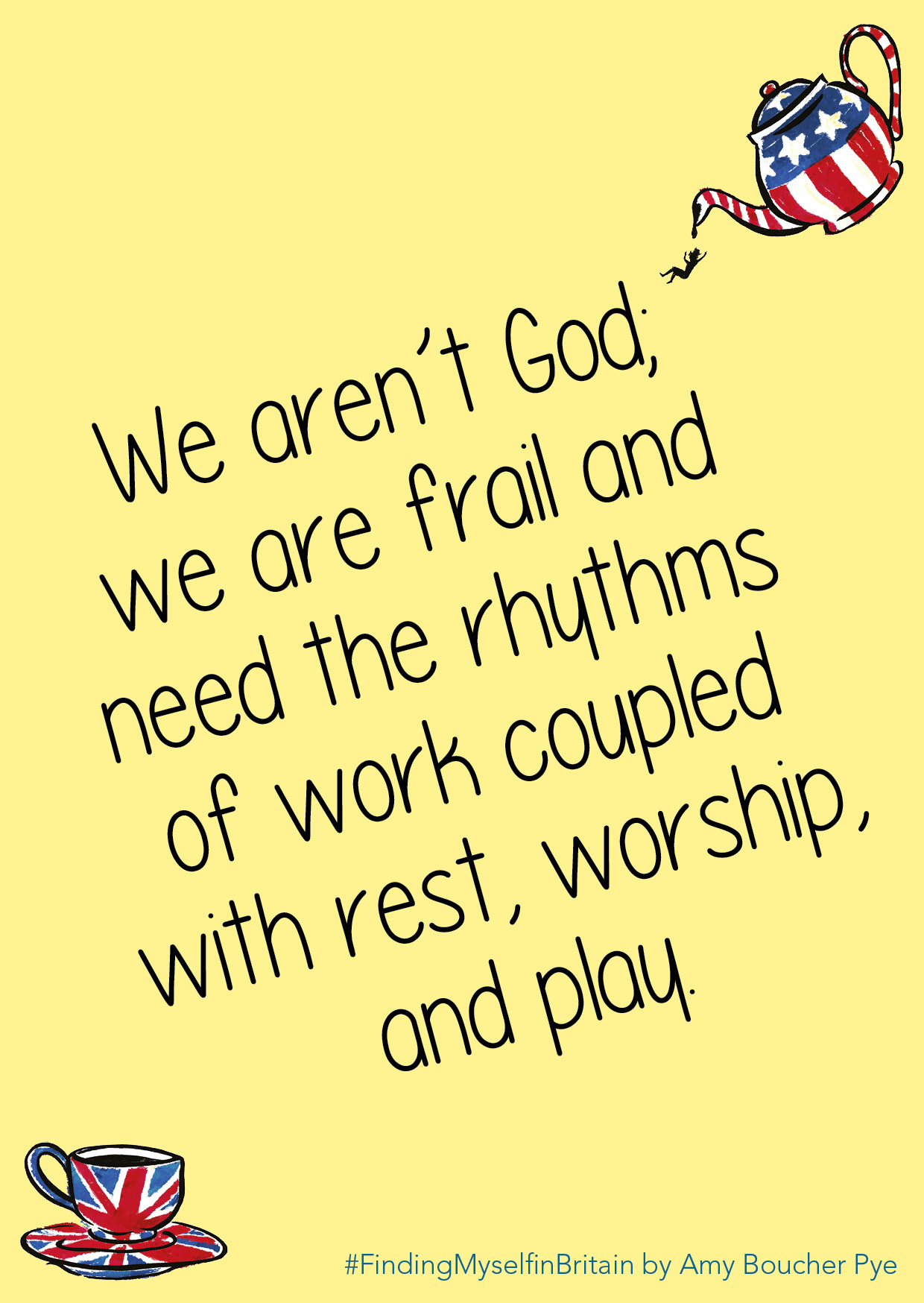
I need to take my own advice. This morning I read the words above from Finding Myself in Britain and reminded myself of the need for rest, worship, and play in contrast to work, work, work. I love the freelance life, but I can say “yes” to too many things, meaning that I have too many deadlines and the rhythms of life get out of whack. For instance, my daughter says, “No more writing books,” to me, as the family has borne the brunt of me writing, under pressure, the 2017 BRF Lent book (to be published this autumn). I enjoyed the process but haven’t spent enough time focusing on a healthy rhythm of life that includes rest, worship, and play.
What do you do to rest? A friend shared her mother’s adage that I’ve been pondering: “A change can bring about rest.” Just as we might need to break out of an exercise rut, with our bodies too accustomed to the same routine we do again and again, so our souls can receive an infusion of life when we embrace something new.
But the niggle I have with her mom’s phrase is that we’ll use it as an excuse not to embrace the meaning of rest, where we acknowledge that God is God and we are not and that we can switch off, slow down, not produce, and be still. For me, time on my own by a body of water brings about a deep sense of peace and rest as I hear the roar of the waves of the gentle lapping of the lake. Yet we can’t put all of our rest-eggs into a holiday basket, so we need to build into our lives regular, shorter, periods of rest. Oh – hey – how about a weekly Sabbath!?
A new devotional series! I welcome you to join me in exploring the most common phrase uttered on behalf of the triune God when angels, prophets or the Lord Jesus appeared to people: “Fear not…” It is not a surprising remark, for when people encounter the holiness of God, they fall down in fear and reverence. The sinfulness that they might have carefully pushed down to an overlooked compartment is exposed in a flash. But although the Lord wants to convict us of our sin, he does so as a loving father who gathers us in his arms. Fear not, he whispers, for I am with you. I will never leave or forsake you. Come and be clean, and live a life free of fear. I am with you, beloved; I love you.
We all harbor fears of some kind. When I originally wrote this set of devotionals (they appeared previously in Day by Day with God), I had before me the cares and concerns of family and friends. My daughter was been complaining that it hurts to walk. A close family member had just come out of the hospital after a heart-related blood clot (that thankfully went to her kidney and not to her brain). Another close to me who was seemingly fit and healthy (and only forty-seven) recently had a heart attack. I had friends who were facing surgery on a daughter after a freak accident, another whose father seemed to be losing the will to live, another whose husband had just left her for another woman, another who was escaping an abusive marriage but who was also enduring a long and protracted divorce… the list goes on. In each case, the Lord says to us, “Fear not. I am with you.”
Harboring fear can be like letting a wild animal into our house. It roams where we know not, crouching at the end of our beds in the middle of the night and popping up when we’re having our morning cuppa. If we’ve let fear camp in our rooms, we can find it difficult to make it leave. But with the power of the Holy Spirit, we can cleanse our homes and our hearts, asking God to dwell with us and to bring his peace, hope and love. When we feel fear taking over, we can cry out to God, perhaps simply through calling on the name of Jesus. As we put our concerns and fears into his outstretched hands, we will receive the peace that passes all understanding.
After this, the word of the Lord came to Abram in a vision: “Do not be afraid, Abram. I am your shield, your very great reward.” (Genesis 15)
Can you hear Abram’s tone of voice? The Lord appears and tells him not to fear, promising protection and provision. Abram replies in turn, perhaps with some indignation: “How? You’ve not given me the one thing I need – a child – so what can you possibly give me as a reward?”
Abram’s fear is speaking. I don’t think he means to lash out at the Creator of the universe, but he’s feeling sore and doubtful. The Lord had previously promised to make him into a great nation (Genesis 12:2–3), but Sarai remains barren and for an heir they have only a servant. Yet the Lord seeks to build Abram’s faith and assuage his fears: “See all of the stars? So will your offspring be.” Then God makes a covenant with him, not only that Abram will have countless descendants, but that they will (eventually) inhabit the Promised Land.
So too will the Lord meet us as our greatest points of need, whether it be for love, companionship, meaning, peace, beauty, or grace. We might think that the Lord will or should answer our prayers in a particular way – for that person to be our spouse; for a particular job; for a child; for our loved ones to succeed. Although God doesn’t always give us what we ask, eventually we can see his purposes and plans. Yet it might be four hundred years later, as with Abram.
I write this knowing that unanswered prayer can be a huge stumbling block to faith; it certainly was a hurdle I nearly tripped over. If you’re struggling in this area, I recommend Pete Greig’s God on Mute. And I pray for us all, that God will enlarge our imaginations to know his neverending love and kindness.
Prayer: Father God, you changed Abram and Sarai into Abraham and Sarah, the parents of many. We surrender to you our desires and fears, asking you to meet our needs.
I’ve found Mel Menzies to be an encourager with deep empathy for others, and a fellow lover of books (and a fellow introvert with whom I commiserate at conferences). She has weathered great tragedy with faith and grace, and shares the story of home from a seemingly normal day, when one phone call changed everything.
It is a wedding anniversary I’ll never forget. Twelve years of happy stepfamily life married to the man who had proved to be my best friend. Did we have celebrations planned? I can’t remember. That morning Paul was decorating our newly refurbished kitchen – all paid for by the advance on my book titled Stepfamilies. Perched on a ladder, he was right behind the kitchen door wielding a paintbrush doused in apple-white emulsion, when the phone rang.
Paul and me on our wedding day.
Naturally, I answered it. It was my eldest daughter ringing me from North Wales. Funny time of day to ring, I thought, given that it would cost more than her usual evening call. I don’t recall her exact words, only the context of her message and her tone of voice. She’d been to the doctor – a routine visit to the surgery. Only it wasn’t routine!
One of the doctors had been called out to an emergency. A sudden death. That of her younger sister. My daughter.
I was distraught! Paul heard my cry and came rushing in. My daughter – a reformed heroin addict for five years – had died alone in her house, leaving her baby crying in the cot. A single morphine tablet dropped into her drink at a BBQ the night before had caused her to vomit and asphyxiate.
Other phone calls followed. We prepared to make the six or seven hour journey north. Friends came to pray. Most had prayed for years for my daughter’s healing. One, a new Christian who attended the Nurture Group I led, found it hard to take: ‘How can you trust God when he delivers your daughter from a thirteen-year drug habit, rebuilds her life for five years, then allows her to die, leaving her baby motherless?’
I didn’t hesitate. It was as if God spoke through me, answering this woman with a truth she could only accept.
My daughter had sung in the church choir as a girl. Her rebellion, begun when her father left home, took her far from the life I had hoped for her. But even in the depths of her addiction, when she was begging for help to come clean, she professed a faith in God.
In the week before she died, she’d been on the phone to me several times, always in a state of stress.
‘They won’t leave me alone,’ she said. ‘They keep on and on at me.’
I didn’t know then who they were; nor what they were keeping on and on about. But suddenly, with this new Christian lady standing beside me, it all made sense.
If they had had their way, my daughter would have become an addict again, and a supplier of drugs in a part of the country where drugs were not available.
‘She would have been in hell,’ I told this lady. ‘And so would her child. God knew that. That’s why he took her home. To be with him.’
To this day I have never thought otherwise. Seeing my daughter’s body, I told the undertaker ‘that’s not my daughter in there’. Her spirit had departed – and I knew where. Throughout the post mortem and inquest, I never doubted. My daughter is at home. And as we all know, there’s no place like home. Her earthly father may have left but her heavenly father will never forsake her. She’s with him. Her child is now a lovely young adult. And one day we shall see her again. At home!
With Paul in the garden of our new home, three years ago.Our garden just after we moved in. The far side of the Bay (Torbay) is where Henry Francis Lyte wrote the hymn Abide with Me.
The story of Mel’s daughter’s life and death is available as an e-book. Written as fiction, to protect the identity of her grandchild, it is entitled A Painful Post Mortem. Profits from the print version raised funds for two charities: Tearfund and Care for the Family. Mel’s latest book, Time to Shine, is available in both paperback and e-book formats, and her second book in the series publishes in June.
Mel Menzies is the author of a number of books and numerous articles. She is an inspirational keynote speaker, who likes nothing better than interacting with an audience or running workshops. Family life is a priority and she and her husband care for two of their grandchildren twice a week. She is an active member of a large and lively Baptist Church, where she runs a Book Club. You can find her online at melmenzies.co.uk.
I’ve long admired Tanya Marlow’s “What I’m Into” posts. She humbly points to another blogger as the originator of these monthly missives about what they are reading, writing, watching, and doing. But I don’t know the other(s) so I’m going to point to her as my inspiration. Looking back over the month just gone provides a wonderful way to remember what I’ve been thinking and experiencing, hopefully with an attitude of thanks. And to share with you some fun finds.
This is a long post – I don’t recommend as spiritually healthy this level of activity without rest – so do skim and scroll down, and if you make it to the end, I have some recipe recommendations for you. Blonde brownies, no less.
Finding Myself in Britain
Hey y’all, I’m a published author. I say that not with gloating but with wonder, for my journey to publication – book publication, that is – was a long and arduous one. (I write about the stinging words batting me down here, and my tangled writing journey here.) I could see myself as a writer, but not so much as an author.
My publishing mentor has been wonderful in helping me make the transition. When I was redesigning my website, he said I needed to lose the “editor” from my bio and go with “author and speaker.” I did so with his encouragement, feeling some of that imposter syndrome. Then recently I looked at the bio on the back of my book and realized with a jolt that “editor” was there – and now that felt odd!
I have great joy in seeing Finding Myself in Britain reviewed and purchased, some of both happened in March. I gulped early in the month when I received an email from my publisher saying that the Church Times – the Church Times I say! – had reviewed my book. Holy Toledo, my heart was pounding as I read the review. I was humbled and amazed – here’s an excerpt from the 4 March 2016 edition:
“…Full of perceptive comments about the habits we fall into and the assumptions we make. Her tone is warm and self-deprecating,… A helpful reminder of what it is like to be a stranger in a foreign land, and an effortless read that will, no doubt, bring entertainment and comfort to many who have ever lived as expats.”
Some informative and fun blog posts on topics related to my book happened this month. Don’t miss my interview with visionary publisherSteve Mitchell. He has great advice for writers.
I love how I can blog about tea and it never fails to incite a response on Facebook. Here’s the post about CutiePyeGirl as she made her first cuppa, and here’s the Facebook discussion. What do you think about tea? Love it or loathe it?
I continue to adore the “There’s No Place Like Home” series. Wow; such a wealth of riches from people writing about what home means to them. Don’t miss this month’s contributions from Catherine Campbell, who writes about pondering what home means while way up in the skies, Amy Young, who writes about finding home while in transition, Claire Musters, who addresses the challenges of making a home when its in continual use for ministry matters, and Shaneen Clarke, who pens a love song for London. All of the posts in the series can be found here.
Reader Reviews
I love reading reviews and emails from readers, and was so touched when a fellow clergy spouse emailed me after reading my book. I won’t share from her email, but later she kindly posted a review online:
On reading Amy’s most enjoyable book at the beginning of this year, I came to chapter 10 and was challenged to have a party. You see, I, like Amy, have a January birthday, which can be a depressing month to celebrate in for various reasons, and I couldn’t remember the last time I’d invited friends to a tea party! I used some of the ideas Amy mentions, everything went really well, and everyone enjoyed themselves. So thank you Amy for being the trigger, through your book, to me having a very happy afternoon with my friends.
PS There are a lot of good things to read about in all the other chapters too! Eunice
I was chuffed when one of the readers of the Woman Alive book club posted this review in our Facebook group:
Whilst reading this book, I felt very much as though Amy was sat in a café talking to me. I laughed at the funny moments, like when she used an ancient tea bag for her new English boyfriend. There were hurtful moments too, such as when she was made fun of at a public dinner over the way she pronounced words.
Amy has confidently written down her heartfelt emotions before moving to Britain, and after. Culture shock arrives at unexpected moments, and so she shares her experiences and explores how to deal with these times.
Amy is a journalist who likes to study the background of a subject and unexpected stories weave cleverly through the book – this includes Harvest Festival, Thanksgiving and the Pilgrim Fathers. She writes pithily about Black Friday.
Living in a different culture can be extremely difficult, however hard one tries to ‘fit in’. At the end of her tether one day, Amy said to an American visitor: “All of life is Lent.” She then goes on to explain how through the years, she and Nicholas have created a life together of ‘old’ and ‘new’ where they can grow together. Amy points out how God ‘holds our hands to let us know he is with us, and helps us turn our aches and longings into the solid hope of heaven, giving us an eternal perspective’. Deep thoughts arising from deep longings.
I like the way this book is divided into logical sections for ease of reading. If you are: planning to live in another culture, marry someone from another country or even stay in your own culture but be in Christian service where you meet and greet peoples from all walks of life, then do read this book. You will feel encouraged. Carol Bye
And having reviews by people in the book trade humble me down to my socks. This one is from a former sales representative of STL, Tim Alban. It’s the first review he wrote after leaving STL in 2009!
Growing up near a US Air Force base, especially with a Grandmother who rented a house to service families who wanted to live off base, I’ve long had Americans as a part of my life. I have American friends, and like friends from other English speaking countries, I am fascinated by what we have in common and also what divides us.
My perception of Amy’s book was that it would be a Christian version of a Bill Bryson book but whilst there are certainly parallels there is much more to Finding Myself in Britain than that.
The first thing that struck me from Amy’s book was that even though, I have other friends who have transplanted themselves one way or another across the Atlantic, I had underestimated the practical and emotional upheaval involved; Amy writes openly and honestly about the depth of the decision making involved in her move to Great Britain, her decision to stay and her determination to make it work.
Amy is equally open about the benefits of her life as an Anglo-American – including writing about the her appreciation of our history and how she and her husband Nicholas make their respective cultures an everyday part of family life.
Another eye-opener for me was Amy’s glimpses into the demands, challenges and joys of vicarage life and the expectations sometimes placed on the spouses of the clergy.
Amy’s faith in God seasons her writing as does her do her descriptions of her church life; although I am not currently part of a church family, I appreciated reading about an Anglican church calendar I grew up with but had moved away from.
Finding Myself in Britain is a candid, entertaining, thought-provoking read and I am please to recommend it. Tim Alban
Devotional Writing
I was thrilled to have my second article published in Our Daily Bread in March – my first was published in February on one of the days I spend in Central London for my master’s. It felt surreal, as I was off social media for much of the day, to go online in the library at Heythrop College and open some lovely emails from readers around the world. Later I heard from my parents that they’d received several phone calls from people who were reading their daily devotional and were surprised to glimpse my name at the bottom – including our next door neighbors, from whom I took piano lessons for years, and my mom’s uncle in his 80s!
My second article looks at the theme from Hebrews 11 of strangers and foreigners, which I relate to my early experiences in the UK. I loved hearing from the daughter of one of my roommates when we were at Bethel University, who now is a mission partner in the Philippines. My friend’s daughter is now far from her tropical home while at Bethel, and she wrote of how one of her professors said that the Our Daily Bread reading (which I wrote) reminded him of her that day. We both thought it was amazing (“a really cool connection and awesome” in her words) that the words of her mom’s roommate while at Bethel were recommended to her by a Bethel prof!
The Living Cross: Exploring God’s Gift of Forgiveness and New Life
A sneak peek at a small part of the cover! Designed by the wonderful artist who designed Finding Myself in Britain, Vivian Hansen.
Writing my second book has been a big focus for me in 2016 thus far. I had to plan carefully to get the first draft finished, for time was more limited than I would have preferred. (See, writers, how using the passive tense I tried to move the responsibility right away from me?)
I’ve really enjoyed the writing, especially after a writing friend encouraged me to be present in the project. When I stepped back from the pressure, I remembered that I love writing Bible-based reflections (!). The theme of forgiveness is deep and rich, and I look forward to sharing the book with you later in the year. It’s the BRF Lent book for 2017.
By the grace of God and a lot of time writing (I even had sore wrists!), I finished the draft and sent it to the publisher on time. My editor gave me a seal of approval (thank you, Lord) as well as some changes to incorporate before I sent it off to my dozen or so early readers. I’ve heard from two so far, who have made some wonderful suggestions. And they’ve picked up some of the crazy mistakes I am prone to make, such as ‘lauded over’ instead of ‘lorded over’ and this query: ‘strife and amenity? do you mean enmity?’ Funny how I routinely get that kind of stuff wrong. Oh, and one Paul Sunday and another Cannan. Oops!
Jesus’ Last Words
I loved writing a month of Bible reading notes for Inspiring Women Every Day (CWR) for September 2016 on John 14-17, which is often known as the Last Discourse. It’s Jesus preparing his disciples for life after his death, and has some of my favorite bits in Scripture, such as him praying, “I in them and you in me.” Hearing from readers who enjoy this devotional or others makes me pleased and grateful.
Watercolor by Leo Boucher.
Lenten/Easter poetry
As part of my Lenten discipline I decided, rather on the spur of the moment, to write a Bible-based poem each day based in the gospel of John. I found it such a wonderful exercise, as writing the poems made me slow down and digest the words. I was touched by this message from a friend:
I am so enjoying your Lenten poems. Poetry may be your best gift. A great tragedy that poetry has waned as a literary art. What can be done to revive it?
I skipped ahead in the gospel to the events of Good Friday, so soon will be heading back to part of the Last Discourse to continue.
Also on the blog I finished up the Pilgrim devotional series, which I had run for 11 weeks, and look forward to figuring out what to feature next.
Speaking
I led my first quiet day for BRF (the Bible Reading Fellowship, publisher of my Lent book), and although it was a lot of work, I really enjoyed the day. We held it at our church, which turned out to be a wonderful venue, especially for those people who hadn’t been able to attend quiet days in the past when the venues weren’t accessible via public transport. We have Victoria Park right across the street so people could spread out during the quiet times, or they could find a nook to enjoy in the church or the vicarage garden. As one of the participants say, the bright sunshine was the icing on the cake for the day.
Photo: Ineke Huizing, flickr
The theme was living water, which I so enjoyed exploring from Creation to Moses to Jesus to Revelation. Putting together the prayer activities was fun too, such as people writing on a piece of acetate something they wanted to give to God, which then they’d see the water dissolve.
I penned a short poem during the day:
And I loved receiving comments from the participants, some of which were hugely moving as to how God worked in their lives. Praise him! One of the participants gave me permission to share this poem, which she wrote on the day. She said, “I don’t usually write like this so it’s come as a bit of a surprise.”
Two days after the quiet day I went down to the New Forest to speak at a women’s breakfast at Poulner Baptist Chapel on the theme, “There’s No Place Like Home.” What a wonderful group of women; I thoroughly enjoyed myself – especially as I got to have dinner with a dear friend the night before, and another lovely friend took me to the New Forest for the breakfast. She knows how much I hate to drive.
I had forgotten how I came in touch with Anne, the woman at the church who invited me to speak. She had written in to Woman Alive after buying a book that one of our readers had recommended. The content wasn’t exactly edifying, and I felt bad that I hadn’t done a better job of vetting the reviews. I apologized by way of sending her a copy of my book. We struck up a friendship and that’s how the invitation came about – God’s redemption at work!
The lovely original chapel – Poulner Baptist Chapel in the New Forest.
I’m looking forward to other upcoming speaking engagements, including the silver anniversary celebrations at Books Alive in Hove in June and being the keynote speaker (wow and wow) at the BRF/Woman Alive day in June – yahoo! It’s 25 June and more details are here if you’d like to join us. Please do! We have some fabulous speakers and Jennifer Rees Larcombe is heading up the prayer ministry team.
And of course I’m keenly anticipating leading the week’s retreat in Spain at El Palmeral, the place for a gorgeous retreat/holiday in Elche, near Alicante. The title is “Adventures with God,” including a trip to the beach, and some spaces are available for 25 to 29 April. Do come – it’s an amazing place for rest and renewal and fun.
The grounds include a labyrinth.
Master’s in Christian Spirituality
I’m loving the master’s I’m doing in Christian spirituality at Heythrop College, University of London. The lecturer, Eddie Howells, has been superb. He has a way of taking people’s contributions and synthesizing them while affirming the person. Such a gift. I will miss his lectures as I’ve now finished the lecture portion of both modules I’m taking from him.
This month I’ve been reading Teresa of Avila, John of the Cross, and Meister Eckhart, among others. The course is “History of Christian Mysticism to the Reformation,” so it’s been a whole lot of reading, from Augustine to Origen to Bernard of Clairvaux to the Beguines. I need to take some time to try to make some more links and ponder. The so-called apophatic, or negative, theology, I found challenging in particular. Writers such as Dionysius write in this fashion, where they state a negation (what God isn’t), followed by another negation, and so on. It starts to boggle the mind.
For my end-of-year essay for my Intro to Spirituality course I’ve chosen to write about John Cassian from the 400s. He wrote a couple of so-called conferences on prayer that I want to explore, which he wrote for the monks in his care. He was one of the first to emphasize unceasing prayer, so could be called a precursor to Brother Lawrence.
On study methods – I found out, after I’ve enjoyed two of the four modules, that I shouldn’t take notes with a laptop. Oh dear! Back to pen and paper next year. Looks like our brains process information differently.
I had a hard time selecting a book to highlight for the June Woman Alive book club, trying several and tossing them aside when I wasn’t gripped by their content or structure. I won’t mention which ones they were! I landed then on The Wired Soul by Tricia McCary Rhodes, reading it and enjoying it, before I realized that it wouldn’t be published for several months and thus I couldn’t feature it in June. Back to the drawing board. Then I remembered Land of Silence by Tessa Afshar, which gripped me from the beginning. It’s fiction set in the biblical times and I really enjoyed it – review coming in the June book club, along with an interview of author Claire Dunn.
I also finished The Girl from the Train by Irma Joubert, fiction based in Poland and South Africa around the time of World War 2. I’ve posted some questions for readers to discuss in the Woman Alive book club Facebook group if you’d like to join in.
As I was writing the June book club, I started to do the math and realized that July will mark 10 years of the book club! How fun to celebrate this anniversary of books and more books. I’m publishing reader reviews of what the book club has meant to them or a favorite book they’ve read, so if you’d like to contribute please do. Also I’ll be featuring an interview with the inimitable Michele Guinness on her novel Grace.
For my local book club we read and discussed The Husband’s Secret by Liane Moriaty. I enjoyed it after I was about a third of the way through, for the novel has so many characters that I couldn’t keep them all straight at first. I thought because of the many themes in the book we’d have lots to discuss, but our discussion didn’t take off as it often can. A fun book to read but not great to discuss? When finding some discussion questions for the evening I came across one book club that takes the task of preparation so seriously that she even prepared a power point!
We love that technology can keep us connected with people who move from London. Previously one of our members was in New York City – she’d join by Skype as her kids started to arrive home from school. Now we have a friend who has moved back to Japan, and she somehow amazingly manages to get up around 4.30am to join in.
I’m excited for the next one we’re reading, All the Light We Cannot See, which has won the Pulitzer Prize and has been super highly recommended to me.
In the Kitchen
Blonde brownies: We were seeing friends on Holy Saturday and I ran out of Ghirardelli brownie mix, and had to find something to make with the ingredients we had at home as I didn’t want to shop on Good Friday. Decided to make blonde brownies, but underestimated the time they’d need to cook. The recipe I used called for 20-25 minutes of baking; I had them in there about a half hour but later when I tried to cut them I realized they were still way underdone. I shoved them back into the oven for another 10 minutes. They were gooey but good.
I made another batch for the Easter Sunday tea party at church (that sounds so English), this time with the 4 eggs the recipe called for instead of the 3 I used the day before, and cooked them about 45-50 minutes so they were moist but not dripping. The 4 eggs made them more into a cake. Three eggs is definitely better. Here’s a similar recipe to what I used.
Homestyle Macaroni and Cheese: I had a hankering for mac-and-cheese, and didn’t want to pay the equivalent of $5 for a box of the Kraft fake stuff. So I made a batch with this recipe. I found it called for far too little pasta – the sauce was overflowing so I added almost twice as much pasta as it said. Not sure I’d make it again. Note for translation – 7 ounces is about 200 grams.
A friend made this lemon cream cake to celebrate her husband’s birthday – looks amazing.
At my local book club we enjoyed this Nigella recipe for flourless brownies. They were to die for.
A highlight from February
Having my parents visit for the half-term break was brilliant. The three of us went very early on Valentine’s Day to a self-service interview booth for me to be interviewed by BBC Radio Berkshire.
So tell me, please. What are you reading, thinking, learning, and enjoying?