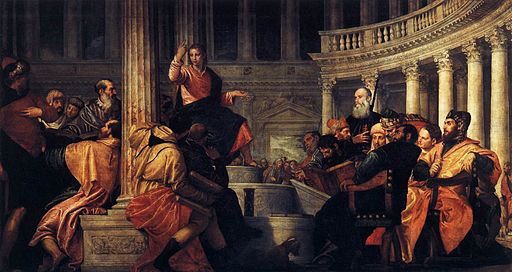
Museo del Prado, Veronese, Jesus among the Doctors, public domain
The people were all so amazed that they asked each other, “What is this? A new teaching – and with authority! He even gives orders to impure spirits and they obey him.” Mark 1:21–31 (NIV)
The gospels recount seven instances of Jesus performing miracles on the Sabbath – seven being a special number in the Bible to signify perfection and completeness. Over the next weeks we’ll explore several of these stories, which show how Jesus is Lord over the Sabbath.
Our first story comes in Mark, after Jesus calls his disciples to follow him. Jesus teaches in the synagogue, and the people are amazed at the authority of his words. When a demon-possessed man interrupts Jesus’ teaching, Jesus commands the demons to leave by the same authority with which he teaches. The Pharisees hadn’t yet realized that their power would be called into question, and that they should therefore oppose Jesus, so at this first instance of healing on the Sabbath none of his later opponents appear.
Then we see Jesus showing compassion on the mother-in-law of Simon and Andrew, healing her fever. The disciples sense that this man is special, taking him to her for release. She becomes so well that she can serve them.
These first stories of Jesus breaking the Sabbath rules – as interpreted by the teachers of the law – appear without fanfare. Jesus sees the needs of two hurting people and does what is necessary to bring them release and healing. He reveals his authority by who he is.
Our culture has moved away from a pharisaic temptation to be hidebound by a strict adherence to the Sabbath which could entail us overlooking the needs of others. Instead we might need to consider how we could strengthen our observance of the Sabbath, so that through our joyful celebrations we can be a witness to a hurting world. For although we don’t have the same power as Jesus, we can speak in his name and share his love.
For reflection: “He was pierced for our transgressions, he was crushed for our iniquities; the punishment that brought us peace was upon him, and by his wounds we are healed” (Isaiah 53:5).
What role can pride take in keeping us in a prison of unforgiveness? A friend who wished to remain unnamed shares vulnerably of how God encouraged her to escape this prison by choosing to forgive one close to her.
When I was in my mid-teens, my dad left my mum for another woman. I was devastated for my mum and myself.
The timing of my dad’s departure felt callous and calculating. He chose a time over the Christmas holidays when I was away at a friend’s house, and also after the recent death of my grandad (my mum’s dad) whom my mum was very close to, being an only child. I was angry with the lies my dad had told us about working late at work when really he was out with his girlfriend. As this happened when I was 14; this was already a time of huge emotional turmoil for me.
Over the years, my anger towards my dad over these painful events has exploded with huge vitriol at times, but, over the past two decades or so, God has brought powerful forgiveness and healing to our relationship. After about 5 years after my dad left, I started to hear God challenge me about my hatred and negative attitude towards Dad’s girlfriend. In my pain I had refused to have any contact with her. I think God spoke to me through a sermon about Holy Communion and making peace with those we have fallen out with. God asked me to love this woman with His love and not allow the pain of past hurts to block any chance of relationship with her.
I had to choose to lay down my angry and judgmental opinions of this lady I had avoided meeting and choose the more humble way. Being able to forgive her for stealing my dad from our family and causing us immense pain and loss started a new chapter in my relationship with her. I was being treated for depression at the time, which the professionals believed to be triggered partly by the separation of my parents.
Choosing to forgive didn’t mean I was instantly healed, nor that my relationship with my dad was repaired miraculously right then. Somehow God enabled me to move through my place of pain and show grace to C* where I’d previously only known hatred and resentment. Maybe I didn’t realise it straight away, but I had started on the path to freedom from my dark past which was negatively impacting my health in the present. In 1 Corinthians 4:3-5, Paul makes the point that he’s not in a position to judge others or himself; only God is able to judge our actions and he also says that he is the greatest of all sinners (1 Timothy 1:15), despite being considered one of the world’s most influential leaders in history.
The mistake I had made was to sit as judge over my dad and C’s choice to break off his marriage to my mum, despite the immense damage and upset my family and I had endured as a consequence. I let pride get in the way of humility until I was able to admit my own sins and allow God to forgive me for my pride, anger, bitterness and resentment towards Dad and his girlfriend. Rather than finding my identity in those negative feelings and hurts and letting the depression and pain define me, I had to surrender to God’s love and mercy for Dad and C, and in that be better able to receive God’s unconditional love, acceptance and new identity as His beloved.
In choosing forgiveness I’ve had to be courageous enough to revisit my feelings and thoughts about my dad’s leaving has affected me; I’ve had to tell him of the impact of his actions and release these to God to at the foot of the cross, firmly believing that “He has removed our sins as far from us as the east is from the west” (Psalm 103:12, NLT). Rather than beating myself up further about my mistakes, which I make from time to time, I have to choose to trust that “there is no condemnation for those in Christ Jesus” (Romans 8:1, NIV) and remember that “He does not punish us for all our sins; He does not deal harshly with us, as we deserve. For His unfailing love toward those who fear him is as great as the height of the heavens above the earth” (Psalm 103:10-11).
Photo: the High Cross, Ffald-y-Brenin, Wales. Source: high-cross.jpg/Clickasnap
I find comfort in this photo of the High Cross at Ffald-y-Brenin, for it’s a visual reminder to us all of what Jesus did for us at the cross, taking our sins and wounds on his shoulders, and casting them as far as possible away from us.
Even as I write this blog, I am wrestling with these issues of forgiveness for others who have deeply hurt me. God continues to show me where my anger is getting in the way of forgiveness, healing and a deeper sense of His love for those who have grieved me and myself. Thankfully, God’s grace is a constant source of comfort, despite my personal weaknesses and I know I’ll work through it with God’s help.
Is there someone in your life you need to forgive? Take a moment to quieten your heart before God and listen to what He says.
*C Dad’s girlfriend, named to maintain her anonymity.
“Everyone brings out the choice wine first and then the cheaper wine after the guests have had too much to drink; but you have saved the best till now.” John 2:1–12
For a giggle (but sometimes a horrified gasp), check out these wedding failures to see a host of videos in which the unexpected happens, such as tripping on high heels or other cringe-inducing accidents. Jesus saved the day in such a situation back when wedding feasts could have lasted a week. I love that his first miracle as marked in John’s gospel was to redeem a wedding from failure.
The story may be familiar – the host ran out of wine, which would have been a reprehensible oversight in ancient times when hospitality was prized. The feast had been occurring for some time; perhaps Jesus and his disciples were invited at the last minute – adding to the shortage of wine. He reveals himself as Lord over creation as he changes the water into wine. No cheap boxed wine either – this was the best vintage, in abundance. As the master of the banquet said with incredulity, “You’ve saved the best for now.”
I wanted to include this passage in our engagement with Sabbath and rest because so often we don’t connect a good party with as a means of practicing rest. We might have inherited a view of the Sabbath as a time of no smiles or loud laughter, thinking that our party behavior won’t fall in line with what is holy. But where do we get these ideas from? After all, Jesus knew how to feast and make merry. He wanted people to enjoy themselves, celebrating the beauty of two lives coming together as one.
In prayer, ask the Lord if there’s a party or other social gathering that you could plan or host. How could this occasion, set aside to celebrate and give thanks, lead to the worship of God? How could, as it’s blessing others, bring you blessing?
Prayer: Lord Jesus, help me to celebrate fully, losing my worries as I look to you as the Master of the Dance. May I bring you glory and praise. Amen.
We might hear of some grand acts of forgiveness – parents forgiving their child’s murderer, for instance – and think that our small acts don’t measure up. But daily life seems to be filled with the small stuff. Can we extend forgiveness in the daily, and if so, how? I love Carol Bostock’s story for all of its rootedness in the ordinary – even to the level of the sticky, congealed chocolate.
It was the day after my mother’s funeral. We had buried her in a woodland burial site after three traumatic months in intensive care following a failed liver transplant. It was very small group at the burial site and I had led the service.
A number of family members were staying in my father’s house for another couple of days. Everyone was tired, emotionally worn out, stressed, not quite knowing what a future without my mother looked like – what it would mean for my father, what it would mean for us all.
It was after lunch and my father had gone to lie down. We were all in that strange state of being in someone’s else’s home, not liking just to sit about talking and laughing as if it were ‘life as normal’ but looking for things to do that felt vaguely useful or helpful.
I can truthfully say that I no longer remember the start of the argument, what was said by whom. But suddenly, another family member and I were having a row. Tempers flared very suddenly. Flash points were hit. Harsh and unkind words were said. We both stalked off, seething.
I didn’t even have a place to go to and be mad. It was not my house and there were people, it seemed, in every room. Angry and frustrated I went into the garage. I kicked a box, very hard twice, replayed the row in my head over and over, thought of all the cutting, clever things I wished I had said. I was too full of anger and resentment to see how badly I had behaved.
Then, sudden and unexpected, came that unmistakeable heavy presence of the Lord.
“So now I suppose You want me to forgive him,” I said ungraciously and kicked the box again, even harder.
Very, very clearly, He answered. “Actually, I want you to clean out his car,” He said.
I stood for ten minutes or so in the dim garage, struggling. Then I went and got cloths, water, vacuum cleaner, cleaning products, polish, and a rubbish sack and set to. He owned a number of pets, all of which seemed to have shed hair and fur liberally over the car. A packet of chocolate somethings had melted into a gooey, congealed mess in one of the side pockets. The boot compartment was full of mud. It took me the best part of three hours to clean.
I don’t think I ever formally said to the Lord, “I forgive him and please will you forgive me”; neither did I ever formally ask the family member to forgive me. But I know that on that Saturday afternoon I was forgiven by Jesus for my wrong heart attitude, and I think that at that time and in that place for my family member, actions spoke louder than any words could have done.
♥♥♥
But when he was still a great way off, his father saw him and had compassion, and ran and fell on his neck and kissed him. Luke 15:20
When the Prodigal went home to his Father’s house, he never got the chance to say all of his carefully preplanned apology because the Father ran, fell on his neck and kissed him. The Father just wanted to get to the hugging and the kissing…
♥♥♥
Working full time at Beauty From Ashes, a Christian inner healing ministry, as a Prayer Minister, Conference Speaker and Retreat Leader, Carol Bostock is walking an unknown path since her husband of 38 years is in the last stages of cancer. Read more at Setting Up Signposts and receive updates at their Facebook page. You can also find out more about Beauty from Ashes, and contact Carol at carol@beautyfromashes.co.uk.
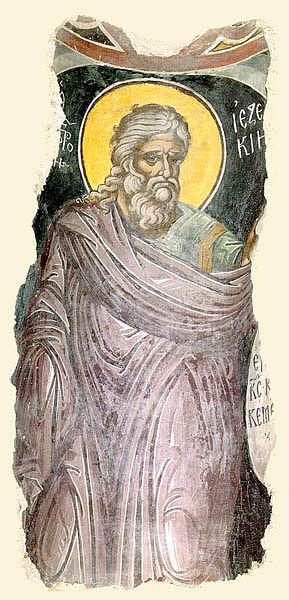
The prophet Ezekiel, Pantokrator monastery, Mt Athos, 1535/1536
“I gave them my Sabbaths as a sign between us, so they would know that I the Lord made them holy.” Ezekiel 20:1–44 (NIV)
We might read the Old Testament despairing that God’s people turn from him again and again. They follow the desires of their own hearts instead of aligning themselves with his plans; they lust after other gods, seeking fleeting pleasures; they lack the faith and belief that the Lord will follow through on his word.
This passage in Ezekiel outlines three generations of God’s people rebelling against him – those who lived in Egypt in the time of the exodus from Pharaoh, those who wandered in the desert with Moses, and their children. Each generation followed their own ways, turning from the Lord, and in each case, the Lord saves them – for the glory of his name amongst their neighbors. Ezekiel cites these generations as he speaks to the current generation of God’s people, asking them if they too will follow the detestable practices of their ancestors, or if they will turn to the Lord in purity and holiness.
The Lord through Ezekiel highlights again and again how the generations ignored the Sabbath. Instead of keeping the day holy and being an example to those around them, they acquiesced to the culture. No longer were they set apart, following the wisdom of God’s cycle of time and rest, as they blended in with those who followed pagan practices.
We too often fail the Lord, getting wrapped up in our lives and ignoring his gentle prompts and prods. But unlike the Israelites as a whole, we have the gift of the Holy Spirit living in us, helping us to repent and softening our hard hearts. If we ask the Lord to turn our minds, hearts and actions to him as we bring him glory, I believe that’s a prayer he delights to answer.
Prayer: Father, Son and Holy Spirit, I feel I fail you often. And yet you run toward me with open arms. Help me to love and serve you this day. Amen.
Stories about forgiveness in the media draw my interest. I can’t help reading them, and finding encouragement in the ways people manage to forgive others. The stories that hit the news garner attention because they so often surprise us – how could someone forgive a murderer, for instance? Read on…
I learned when writing The Living Cross: Exploring God’s Gift of Forgiveness and New Life that those offering forgiveness in extreme situations were often exercising a familiar muscle. They extended forgiveness in daily life over the seemingly small things we have to forgive daily – when a driver cuts us off in traffic, or when someone close to us betrays us, or when a family member puts their needs before ours. In forgiving someone who had done a great wrong to them, they were continuing to live in the manner in which they’d been accustomed. Many also cited a supernatural infusion of grace that they attributed to God.
Below are two news stories of forgiveness for your encouragement. I pray you’ll never need to forgive on the scale that would attract this kind of attention. But we can take encouragement to forgive in the more mundane situations of life. And of course, to ask forgiveness when we do wrong – I sent out an email along those lines this very morning!
Adam Miller was caught up in a shooting at a lawnmover plant in Kansas in February 2016. He was shot four times at close range, but amazingly, the bullets only hit soft flesh. He said, “I had an obvious hand of protection when it was going toward my chest. I don’t know how to describe it other than that.”
When lying in his hospital bed, recovering, he thought about what had happened, and the perpetrator.
“I can’t say that I immediately forgave him. Maybe it came a couple of days later,” he said. “There was no hatred toward him. There was sorrow, and he must have been in so much pain.
“I just come to the conclusion that for all the things I’ve done in my life, God has forgiven me. So why can’t I forgive someone else?”
Cliff and Wilma Derksen’s daughter was killed on a cold night in Winnipeg. Thirty-two years passed before the man accused of her murder would be brought to trial again – had they waited for justice to forgive, they would have lost years of their lives to waiting and perhaps the prison of bitterness.
One night after their daughter had been missing for several months, a man came to visit them. He introduced himself, saying, “I’m the parent of a murdered child, too. I’ve come to tell you what to expect.”
He shared with them all of the things he’d lost to his daughter’s murder – not only her but his relationships, work, and even his daughter’s memory. He told the Derksens, “It will destroy you.”
They saw how a darkness could swallow them, taking away all that they loved and treasured. After the man left, “We kind of looked at each other and said, ‘We have to stop this,’” Cliff said. “We have to forgive.”
They both made a decision that night to forgive, with Cliff saying, “I don’t believe the person who did this had loving parents or a circle of friends who thought the world of him or he wouldn’t have done a deed like this.” Wilma added, “I can’t say at this point I forgive the person But we have all done something dreadful in our lives or we have the urge to.”
When people in the public heard what they said, many were angry. Some thought they didn’t care for their daughter, and others questioned what it meant to forgive.
Cliff said, “We said we were going to forgive and we didn’t know how to talk about it, and we really didn’t know what it meant ourselves. Our big thing was just we were going to forgive whoever it was. We just were going to forgive. We didn’t know how or where or when this was going to happen, it was sort of a north star we put out there.”
“There was an article three or four months later saying 80 per cent of Canadians didn’t agree with us and would be upset with us because forgiveness meant letting the murderer go free and condoning murder,” Wilma said 32 years later. “That wasn’t what this was about at all. It really was about escaping the aftermath of murder.”
“Like a bridge over troubled water…” We used to sing that Simon & Garfunkel song at church when I was growing up, not having heard of the rumored meanings behind it – drugs in some format, not God. But the Lord is our bridge, not only when the waters are troubled and murky, but when they are crystal clear and gurgling along.
My dad’s watercolor shows a Minneapolis bridge – the 10th Avenue Bridge – with the city skyline behind.
“If you call the Sabbath a delight and the Lord’s holy day honorable … then you will find your joy in the Lord.” Isaiah 58 (NIV)
So let’s get this right when we think about fasts and feasts – the Lord doesn’t want the too-holy-by-half fast, but rather the full-on-celebratory-party feast. Is this the picture many in the culture have of God and his followers? Is this how we in the church see it?
Too often as Christians we don’t do celebrating well. I love how the writer Dallas Willard lauds this often overlooked discipline in his book The Spirit of the Disciplines, saying that although we will face many troubles in our lives, “Holy delight and joy is the great antidote to despair and is a wellspring of genuine gratitude” (San Francisco: Harper & Row, 1988, p. 179). As we learn to celebrate – mindfully putting aside any disappointments and troubles – the Lord turns our mourning into dancing. We begin to be able to thank God for his many blessings.
Why not read through Isaiah 58 again, this time with the lens of the Lord as the giver of abundance and not as a miserly holder of scarcity. How do you then view the too-pious fast of his people, and how do you think God felt in response? How does this reading influence your views about keeping the Sabbath? Can you now see it as a means of finding “your joy in the Lord,” or riding “on the heights,” or feasting on your inheritance?
Those who fast and feast with pure hearts find their satisfaction in the Lord, and as we see, he makes them into a well-watered garden. As you picture such a garden, ask God through his Holy Spirit to show you your heart as a garden, and where you and Jesus may need to pull a few weeds together, or where you can delight in some shade as you take in the sight and sound of the gurgling water feature.
Prayer: Father God, we don’t always stop to give thanks or spend time in wonder. Help us this summer to slow down and enjoy your goodness and gifts. Amen.
Forgiveness – what about those of us who see ourselves as “good”? We don’t have a gripping conversion story to share of how God saved us miraculously. Or do we? Join Sharon Garlough Brown, author of the amazing Sensible Shoes novels, to explore this question.
“But the one to whom little is forgiven, loves little.” (Luke 7:47)
Ten years ago those words leapt off the page and pierced my heart with surgical precision. I had read the text from Luke 7:38-50 many times over the years, but that day the text read me.
Let’s remind ourselves of the scene. One day Simon the Pharisee, a religious leader with an upstanding, righteous reputation in the community, hosts a dinner party. The guests recline around a table, probably in an open courtyard, and Jesus is there at Simon’s invitation.
While they’re eating, a woman enters the courtyard, a woman who is also well-known in the community. She’s a woman with a reputation, but not as an upstanding citizen. This woman is a “that kind of woman,” the kind of woman who doesn’t belong at respectable dinner parties hosted by respectable men.
But this woman is determined. She’s heard that Jesus is at the party, and she’s on a mission. So she perseveres past the whispers and the sneers, past the judgmental and scathing looks, past the raised eyebrows, past the pointing and accusing fingers in order to come to Jesus.
Peter Paul Rubens and Anthony van Dyck. A woman washes Christ’s feet in the house of Simon the Pharisee, circa 1615. Saint Petersburg, Hermitage Museum.
And as Simon the host watches in disgust, his respectable dinner party deteriorates into a spectacle. This woman, probably a prostitute, kneels at Jesus’ feet, weeping, and shamelessly offers the tools of her trade—her perfume, her hair, her kisses—she offers them to Jesus in devotion and gratitude. And Jesus receives the offering! He does not scold her for unbinding her hair, which was forbidden for a woman to do in public. (Only loose women did such things.) He does not object to her wiping his feet with that hair. He lets her touch him, kiss him, and express the sort of intimacy that no doubt had some guests around the table flushing with embarrassment or anger. What she does is scandalous.
Simon is deeply offended. In Simon’s mind, the whole incident calls into question Jesus’ reputation, too. “If this man really were a prophet,” Simon says to himself, “he would know who and what kind of woman this is who is touching him, that she is a sinner.”
And that’s when Jesus speaks. “Simon,” he says. “I have something to say to you.”
Jesus, a master storyteller, crafts a personal parable for Simon. Seeing right into Simon’s proud, judgmental, condemning, shriveled heart, Jesus offers a simple story about two debtors. One debtor owes an extravagant amount of money, the other owes a more reasonable sum. But neither one of the debtors is able to pay the debt. So the creditor, being a generous man, forgives both of them. Neither one has to pay what they owe.
Jesus asks Simon, which debtor do you think will be more grateful? Which one will love the creditor more?
With a shrug in his voice, Simon says, “I suppose the one who had the greater debt.”
“You’re right,” Jesus says. And then he goes on to point out all of the ways Simon has failed to show any common courtesy to a house guest and contrasts that with all of the ways the unnamed woman has lavished her love and devotion upon him. Jesus sums it all up this way: the one who has been forgiven much, loves much. It’s not that Simon doesn’t need to be forgiven as much as the woman. It’s that Simon doesn’t recognize the depth of his need.
That’s when the Spirit opened my eyes and broke my heart that day. What I saw was that I had more in common with Simon than with the woman. And I didn’t want to be like Simon. I wanted to be like the grateful, sinful woman. In fact, I had spent years envying conversion stories of so-called “sinners.”
Photo: Suzanne Schroeter, flickr
I had a pretty boring testimony, I thought. I’d been the “good girl” who had grown up in church, who never felt the rescue from sin was that big a deal because I didn’t think I had strayed very far to begin with. Sure, I knew I couldn’t pay the debt of my sin, but I still didn’t see my debt as very large, especially when compared to some other people’s debts.
So I prayed, asking God to enlarge my heart with love and gratitude for Jesus. I just didn’t realize that the process of enlargement would include an ongoing revelation of the depths of my sin: my self-centeredness, self-righteousness, self-absorption, self-sufficiency, self-protection, my critical spirit, my desire for control (all were symptoms of pride, with self as center).
I had no idea the process of enlarging my heart with love and gratitude for Jesus would include the ongoing revelation of all the ways I failed to love God with all of my heart, soul, mind, and strength. All the ways I failed to love others with his love.
I had no idea the process of enlarging my heart with love and gratitude for Jesus would include a daily revelation of my sinful action, my inaction, and my impure motives even when the outward appearance of love looked pretty good to others. The Holy Spirit’s surgical work was painful and penetrating.
Essentially, I was converted from seeing myself as a fairly decent person into seeing myself as a prostitute who had given herself over to false gods. I’d spent a lifetime worshiping at the altars of false gods—culturally acceptable and encouraged altars like pursuing reputation, honor, success, comfort, and achievement as ways to gain meaning, security, and significance in life.
When Pharisees begin to see themselves as sinners, it is a gift. It’s a gift to see the enormity of a debt which absolutely cannot be paid apart from the lavish and extravagant grace of God.
It’s a gift to see the depths of our sin, because then we see more clearly the breathtaking beauty and love of our Savior who poured out his life in a fragrant offering and sacrifice to God for us.
It’s easy to see and name the outward manifestations of sin. It’s easy to identify behavior that is not Christ-like. But we need the Spirit’s help to perceive the inner disposition of sin. We need God’s penetrating light to shine in the dark places, to reveal the heart issues, the deeply rooted patterns of resisting conformity to Christ, like anger, envy, pride, lust, greed, craving honor and recognition, and so much more.
And when we see it, when we see that sin is not behavior that can be modified but cancer that needs a radical remedy, by the grace of God, we might find ourselves falling at the feet of Jesus, weeping with gratitude, filled with love. Because that debt has been paid in full through the cross of Jesus Christ. Go in peace, Jesus says to sinners like me. Go in peace. Your sins have been forgiven. Your debt has been paid in full.
The one who has been forgiven much, loves much.
The ones who are aware of their need for forgiveness, their poverty of spirit, are the ones who will be enlarged to love God and to be kind and tenderhearted toward others, forgiving as we’ve been forgiven, with extravagant love, generosity, and compassion.
Thanks be to God.
Sharon Garlough Brown is an author, retreat speaker, and spiritual director. A graduate of Princeton Theological Seminary, Sharon has served on the pastoral staff of congregations in Scotland, Oklahoma, England, and most recently in West Michigan, where she co-pastored Redeemer Covenant Church with her husband, Jack, for many years. Her spiritual formation novels, Sensible Shoes, Two Steps Forward, and Barefoot, follow the journey of characters who are learning to rest in the love of God. Her fourth novel in the Sensible Shoes series, An Extra Mile, will be released by InterVarsity Press in February, 2018.
 What role can pride take in keeping us in a prison of unforgiveness? A friend who wished to remain unnamed shares vulnerably of how God encouraged her to escape this prison by choosing to forgive one close to her.
 Choosing to forgive didn’t mean I was instantly healed, nor that my relationship with my dad was repaired miraculously right then. Somehow God enabled me to move through my place of pain and show grace to C* where I’d previously only known hatred and resentment. Maybe I didn’t realise it straight away, but I had started on the path to freedom from my dark past which was negatively impacting my health in the present. In

 I stood for ten minutes or so in the dim garage, struggling. Then I went and got cloths, water, vacuum cleaner, cleaning products, polish, and a rubbish sack and set to. He owned a number of pets, all of which seemed to have shed hair and fur liberally over the car. A packet of chocolate somethings had melted into a gooey, congealed mess in one of the side pockets. The boot compartment was full of mud. It took me the best part of three hours to clean.
 Working full time at Beauty From Ashes, a Christian inner healing ministry, as a Prayer Minister, Conference Speaker and Retreat Leader, Carol Bostock is walking an unknown path since her husband of 38 years is in the last stages of cancer. Read more at
 Adam Miller was caught up in a shooting at a lawnmover plant in Kansas in February 2016. He was shot four times at close range, but amazingly, the bullets only hit soft flesh. He said, “I had an obvious hand of protection when it was going toward my chest. I don’t know how to describe it other than that.”
 Cliff and Wilma Derksen’s daughter was killed on a cold night in Winnipeg. Thirty-two years passed before the man accused of her murder would be brought to trial again – had they waited for justice to forgive, they would have lost years of their lives to waiting and perhaps the prison of bitterness.



 Sharon Garlough Brown