“In those days, at that time,” declares the Lord, “the people of Israel and the people of Judah together will go in tears to seek the Lord their God. They will ask the way to Zion and turn their faces towards it. They will come and bind themselves to the Lord in an everlasting covenant that will not be forgotten.” Jeremiah 50:4–5
Rembrandt van Rijn, Jeremiah Lamenting the Destruction of Jerusalem, c. 1630
These few lines of prophecy about the Israelites come in the midst of a greater warning from the prophet Jeremiah to the people of Babylon. At this time, the Israelites had split into the northern and southern kingdoms, and thus lived in a state of disunity. Jeremiah is known as the weeping prophet because his words from the Lord often speak of impending destruction.
The prophecy here tells of God’s people who have turned away from him. No longer are they eager to follow his laws and decrees. A series of corrupt kings has added to the debauchery. But Jeremiah heralds a time when the people of both kingdoms will bow their knees and return to the Lord. With tears they will seek the way of Zion.
We might find the book of Jeremiah depressing, but verses such as these – tucked away in the midst of prophecies of doom – bring hope. Our pilgrimages are often filled with wrong or missed turnings, whether through sins of omission or commission. But when we seek the Lord, he will extend to us his everlasting covenant.
The Lord doesn’t demand that we come to him with weeping before he will forgive us. But tears of remorse are often a sign of true repentance. Sometimes when I’m having to discipline my children, I see them move from being somewhat sorry to being deeply so – perhaps because of the stronger consequences I have to enact. Eventually, they show true sorrow over the infraction. What will it take for us to repent?
Prayer: “Have mercy on me, O God, according to your unfailing love; according to your great compassion blot out my transgressions. Wash away all my iniquity and cleanse me from my sin” (Psalm 51:1–2).
Hear my prayer, Lord, listen to my cry for help; do not be deaf to my weeping. I dwell with you as a foreigner, a stranger, as all my ancestors were. Look away from me, that I may enjoy life again before I depart and am no more. Psalm 39:12–13
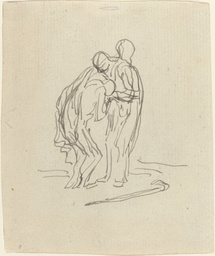
Honoré Daumier (French, 1808 – 1879), The Prodigal Son, pen and black ink with wash on laid paper, Rosenwald Collection
This song, probably from King David, expresses repentance. Stricken with illness, David feels silence from God and pleads that the Lord will bridge the distance that has become a wedge between them. The silence makes him feel like a foreigner and a stranger from God. Bereft, he seeks that their relationship be restored.
From the point of view of pilgrimage, this psalm echoes the theme of dislocation. The Hebrew words that David uses for “foreigner” and “stranger” broaden our understanding of this sense of not being at home (which I’m indebted to The NIV Application Commentary for illuminating). The Hebrew word for foreigner refers to someone who was not an Israelite but who inhabited the Promised Land, although without full rights. They may have been someone such as a servant or employee of an Israelite family. Another meaning of the word describes anyone not living in their native land – and thus this term could be applied to the Israelites themselves as they travelled to Canaan.
Thus to be a stranger and a foreigner meant living with tenuous rights. The landowner could become fickle and throw them out. Their ability to prosper is limited. And this is how the psalmist feels – he knows that his sin has rebuked his standing as a favored son. Now he is on the outside, looking in. He is as the prodigal son, tending the pigs and yearning for his father’s embrace.
Because we are sinful, our journeys entail times of separation from God due to our wrongdoing. But as with David and the prodigal son, when we repent, God in his mercy closes the gap. He runs toward us, embraces us, puts on the prized coat over our pig-slopped clothes and rejoices that we are home.
For reflection: “Let’s have a feast and celebrate. For this son of mine was dead and is alive again; he was lost and is found” (Luke 15:23–24).
“Look,” said Naomi, “your sister-in-law is going back to her people and her gods. Go back with her.” But Ruth replied, “Don’t urge me to leave you or to turn back from you. Where you go I will go, and where you stay I will stay. Your people will be my people and your God my God. Where you die I will die, and there I will be buried. May the Lord deal with me, be it ever so severely, if even death separates you and me.” Ruth 1:15–17
Some eighteen years ago, a verse from the book of Ruth was impressed on my mind as my new husband and I approached the town where he would be a curate: “Your people will be my people and your God my God.” The thought was daunting, for I was not long in the UK and was still getting used to the ways of my new countrypeople. As we entered the high street, these words reverberated within me. So much so that I wondered if living there would entail a cost.
Our time there was cut short, for tensions within the parish meant that the vicar was signed off on stress-related sick leave. My husband was left adrift. I began to consider whether I really did want “these people” to be “my people,” for I had witnessed behavior that left me sad and disquieted. But I knew that whatever their actions, these were still “my people,” for I too had the propensity for similarly uncharitable thoughts and deeds.
In the book of Ruth, we see a daughter-in-law so committed to her dead husband’s mother that she is willing to forsake her country and move with Naomi back to Bethlehem. Ruth becomes a pilgrim, serving her mother-in-law with grace and selflessness. For many, the story is familiar – Naomi finds a relative who agrees to marry Ruth, thus redeeming her under the law so that she can carry on the family line. Ruth and Naomi’s needs for protection, care and love are met.
All over the world, God’s people are our people. Who will he send on your path today?
Prayer: Lord, open my eyes and my heart to embrace your children.
“The approach to Mount Sinai” by David Roberts – Bonhams. (Public domain)
Now Moses said to Hobab son of Reuel the Midianite, Moses’ father-in-law, “We are setting out for the place about which the Lord said, ‘I will give it to you.’ Come with us and we will treat you well, for the Lord has promised good things to Israel.” He answered, “No, I will not go; I am going back to my own land and my own people.” But Moses said, “Please do not leave us. You know where we should camp in the wilderness, and you can be our eyes. If you come with us, we will share with you whatever good things the Lord gives us.” So they set out from the mountain of the Lord… (Numbers 10:29–32)
Hobab was Moses’ brother-in-law, tied through marriage. Moses appeals to him to join them as the Israelites leave Mount Siani for Canaan. Hobab first says no, for he wants to return to his people. But Moses pleads with him, knowing he’ll be an asset in the wilderness. The biblical account doesn’t tell us what made Hobab change his mind and join Moses. Was it a conviction from God that this was the right way forward? Pity or compassion for Moses? A puffed-up desire to be a hero?
We don’t know. It could be a combination of the above, for we often have mixed reasons in undertaking new ventures. And even though our hearts may not be clean and pure, God still uses us. He changes our sometimes divided heart, cleansing the black and gunge and making us clean.
When I’m out walking in the park by our home in north London, often I’m in my own world. One day, however, I heard another American accent. After walking past I felt the nudge to talk to her, but I resisted. As I continued my circuit the feeling remained. Finally I struck up a conversation and learned that the woman was newly transplanted, having come from Iowa, the state right next to my native Minnesota, and had been feeling lonely and disconnected. Our conversation brought her encouragement, and I was grateful that I had heeded God’s nudge to reach outside my comfort zone and share his love.
On a much larger scale, Hobab changed his plans radically as he said yes to Moses. Moses was then able to follow God in the wilderness through the ark, complemented by Hobab’s hands-on experience. A good partnership resulted. As you reflect on Moses and Hobab, consider how God might want to mold you this day and this week. How might 2016 shape up as you hear and heed his voice?
Prayer: Lord, make my heart my heart soft and help me heed your nudges. Amen.
New year; new devotional series! Welcome as we delve into what it means to be a pilgrim, which is part of our calling as disciples of Christ. As pilgrims we live within the tension of “already, but not yet,” for although we have our redemption through Jesus’ sacrificial death on the cross, we do not yet inhabit our heavenly bodies. The reminders of our fallen nature surround us – the unrest of disaffected youth, spats between siblings, our own pride and arrogance. And yet… We see glimpses of God’s glory every day: An awe-inspiring sunset. A grieving parent who reaches out to the friends of her dead son. A smile between strangers.
Living within the tension of being redeemed from our sins yet still sinful reminds us of our pilgrim status. We are always journeying to either life or death, the new self or the old self. God through his Son and Spirit reaches out to us, calling us to be empowered by his grace, truth and love. Our journey involves responding, stepping forth each day as we claim our status as God’s beloved and God’s pilgrim.
Scripture is filled with examples of pilgrims. Often the heroes of our faith embarked on a physical journey, leaving the familiar to follow God’s call. One example in the Old Testament is the Israelites’ exile and journey to the Promised Land – and all the wandering in between. Before that was Abram who was called to leave his people and his place. In the New Testament, Jesus himself exemplifies the life of the pilgrim, not least through being born just after his traveling parents found shelter in a cave.
We’ll explore the concept of pilgrimage through some of the biblical characters who were living in a state of “already but not yet.” Although pilgrimage is usually the act of going to a special or holy place, sometimes it involves setting off across the world to an unknown destination. Perhaps, even, never to return to one’s original home. And ultimately we as Christians are all journeying to that home that will set the gold standard for what home means – heaven.
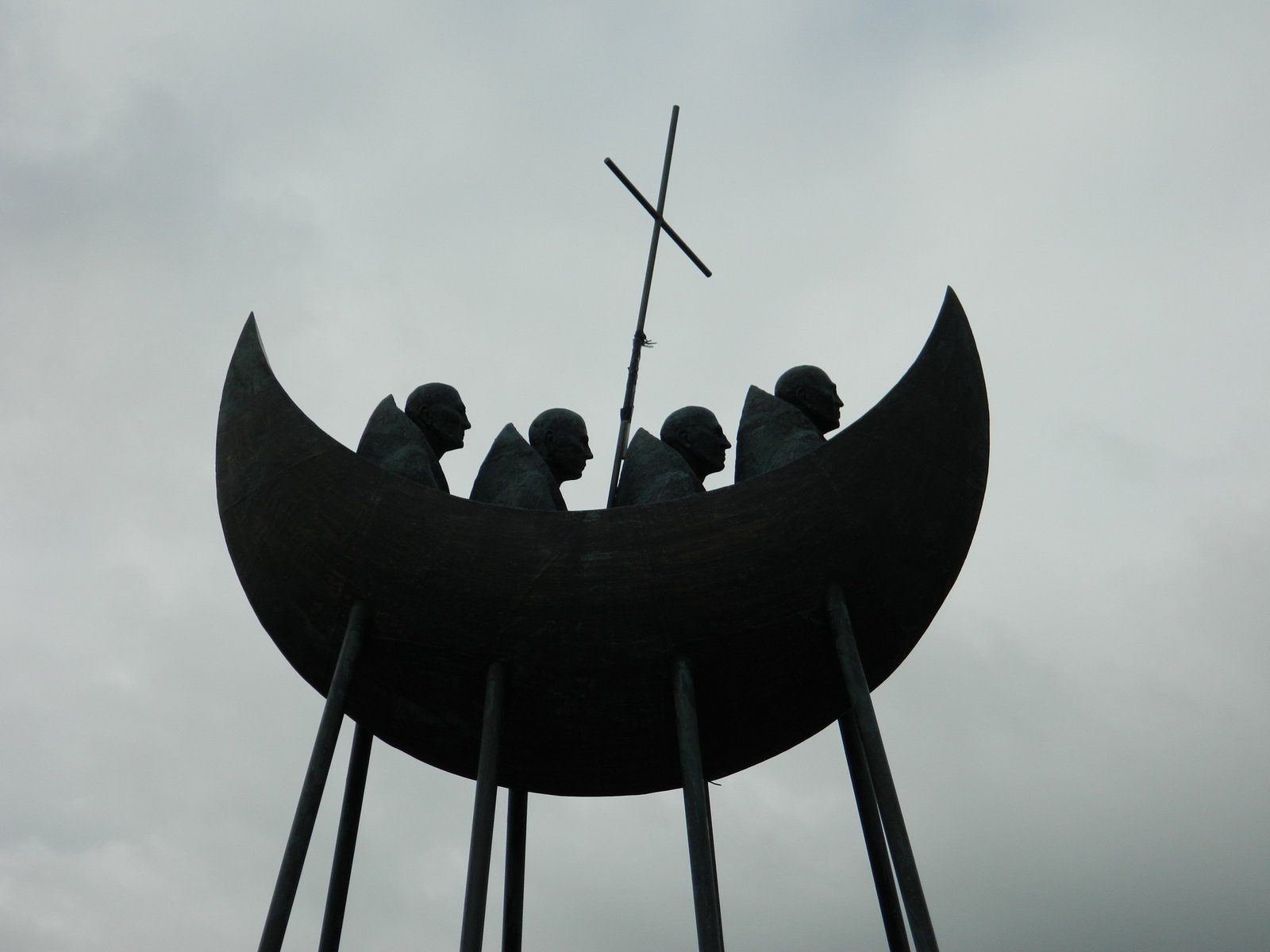
Craggy rocks and rugged landscape – the West Coast of Ireland amazes with its beauty. Yes, I’d be a pilgrim there!
The Lord had said to Abram, “Go from your country, your people and your father’s household to the land I will show you. I will make you into a great nation, and I will bless you; I will make your name great, and you will be a blessing. I will bless those who bless you, and whoever curses you I will curse; and all peoples on earth will be blessed through you.” So Abram went, as the Lord had told him… (Genesis 12:1–4).
This week’s text is one of the early instances in the Bible of God’s covenants with his people. God gives Abram and Sarai a big task. Namely, to renounce their ties to their families, land, and inheritance, while trusting that God will bless them.
Humanly, what God is asking seems incredible, especially as we learn in Genesis 11:30 that Sarai is barren. Thus for Abram and Sarai, becoming pilgrims entails a huge amount of faith. For not only does Abram not have an heir, but by leaving his family he will be leaving behind his earthly inheritance. He won’t be caring for elderly parents or passing on the household goods to the next generation. And from the point of view of his new countrypeople, his identity will be that of foreigner and stranger.
Reading on in Genesis, we see that Abraham and Sarah heed God’s call, and in turn God fulfills his promise to make Abraham’s name great and to give him as many descendants as there are stars. God’s blessings more than overcome the sacrifices he required of Abraham and Sarah. But he did ask them to step out in faith.
God might not be asking us to leave our home and land. But even if we stay in the village or city in which we were born, he seeks in us a pliable heart; a willingness to follow him. Whether we stay or go, we can live the paradox highlighted by Jim Elliot, the missionary murdered in 1956, in his journal:
“He is no fool who gives what he cannot keep to gain what he cannot lose.”
For reflection: “Let us hold unswervingly to the hope we profess, for he who promised is faithful” (Hebrews 10:23).
“…and they will call him Immanuel” (which means “God with us”). When Joseph woke up, he did what the angel of the Lord had commanded him and took Mary home as his wife. But he had no union with her until she gave birth to a son. And he gave him the name Jesus (Matthew 1:23b–25).
What’s in a name? In biblical times, a name would often connote characteristics that the parents believed the child would embody. Along these lines, God through his angel told Joseph to name his son Jesus, which means “Yahweh saves,” and as we saw recently, what Jesus saves his people from is their sins. I don’t think Joseph had any idea of how Jesus would do this, but he welcomed it from a distance.
Matthew’s account gives Jesus two other names or titles – Messiah and Immanuel. Messiah is the Hebrew word for one anointed for a specific task (with Christ being the Greek rendering of this word). Matthew uses this term to signal to his Jewish audience that this is the coming Savior, for whom they have been waiting for generations to bring about God’s promised deliverance.
And Immanuel means God with us – God himself has taken human form in Jesus. God is with us because Jesus saves us from our sins, for sin is what separates us from God. Once Jesus rescues us from this fallen state, we enjoy Immanuel, God with us.
Jesus the anointed one. Jesus who saves. Jesus, God with us. What’s in a name? Simply, the whole gospel message.
Prayer: Lord Jesus, we welcome you this Christmas day! You are the anointed one, the God who lives with us, the one who saves. As we praise and worship you this day, fill us with your presence and your love. And help us to reach out to a world aching to hear your message of good news.
All this took place to fulfill what the Lord had said through the prophet: “The virgin will conceive and give birth to a son…” (Matthew 1:23)
Matthew’s concise account highlights the miracle of the virgin birth, which was foretold by the prophet Isaiah (7:14). God through his Holy Spirit overshadows Mary and conceives in her Jesus, who is both divine and human. It’s a mind-boggling concept of the Trinity at work: God, the creator of the universe, descends through his Holy Spirit to his creation in the person of Jesus, one who is God yet man, and thus one of the created. Being divine, Jesus can fulfill the meaning of his given name – Yahweh saves. Being human, Jesus can relate to us completely. Utterly brilliant.
But God doesn’t stop there, for following Jesus’ birth, death, and resurrection is Pentecost, when he pours out his Holy Spirit on his people. As the Holy Spirit overshadowed Mary and thus brought about the indwelling of Jesus, we too can host Jesus. Of course not physically, but Christ living in us will transform us, cleansing us and bringing forth the gifts and the fruits of the Spirit (including wisdom, understanding, knowledge, right judgment and love; joy, peace, gentleness, faith, and self-control). What better gifts this Christmas season?
Jesus dwelling in us, which is made possible through the incarnation, is echoed in Scripture. Jesus refers to it, such as when instructing his disciples before he dies: “…I am in my Father, and you are in me, and I am in you” (John 14:20) or his final prayer for them: “I in them and you in me” (John 17:23). The Apostle Paul reflects this new reality in his letters, such as “Christ in you the hope of glory” (Colossians 1:27) or “I have been crucified with Christ and I no longer live, but Christ lives in me” (Galatians 2:20).
Celebrating the incarnation is a wonderful opportunity to reflect on the reality of Jesus dwelling in us, and to rejoice.
Prayer: “I pray that out of his glorious riches he may strengthen you with power through his Spirit in your inner being, so that Christ may dwell in your hearts through faith” (Ephesians 3:16–17).
But after he had considered this, an angel of the Lord appeared to him in a dream and said, “Joseph son of David, do not be afraid to take Mary home as your wife, because what is conceived in her is from the Holy Spirit. She will give birth to a son, and you are to give him the name Jesus, because he will save his people from their sins” (Matthew 1:20–21).
After Joseph learned that Mary was pregnant, he despaired over the future. No doubt she told him about the child’s divine origins, but how was he to believe her? Such a story was inconceivable. So as we saw last week, Joseph chose the best of the unwelcome options – divorce. God, however, had different plans.
Joseph awakes from his dream and instantly knows the truth of Mary’s pregnancy. The night before his hopes for marriage had been shattered, but in the light of day he sees a whole new reality shaping up, including him being the legal father of one who will become the Savior to his people. Surely Joseph wakes up a changed man; no longer despairing, he embraces a new life.
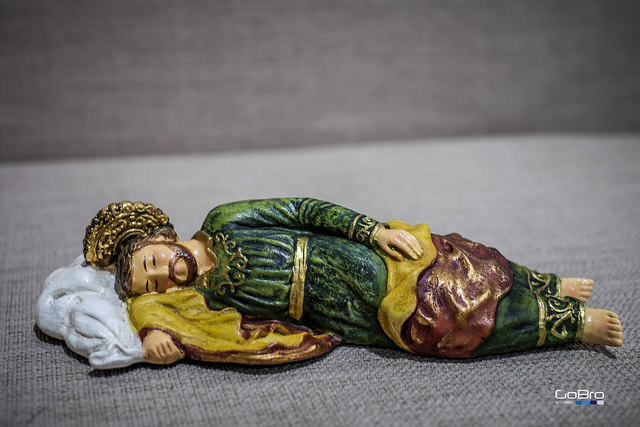
When the angel called Joseph “son of David,” this was to establish Jesus’ divine lineage. (Incidentally, Joseph is the only one named thus in the New Testament other than Jesus himself.) Along this line, the angel also instructed Joseph to name Jesus, for that entails him formally acknowledging Jesus as his son, and thus a son of David. Joseph may not be the biological father of Jesus, but his role as earthly father is vital.
God speaking to his children hasn’t changed from biblical times – he still breaks through, whether through a dream, an insight gleaned from the Bible, wisdom from friends, our time of prayer, or through other means. How is God reaching out to you, when you might be finishing up work or school, buying last-minute presents, preparing food, reading Christmas missives, or generally being stressed? As you go forth, know that God will speak, even in the midst of all of this.
Prayer: Father, I am busy with many things. Help me to choose what is best.
This is how the birth of Jesus the Messiah came about: his mother Mary was pledged to be married to Joseph, but before they came together, she was found to be pregnant through the Holy Spirit. Because Joseph her husband was a righteous man and did not want to expose her to public disgrace, he had in mind to divorce her quietly (Matthew 1:18–19).
The betrothal had taken place, and Mary and Joseph were pledged to one another in marriage. But it didn’t turn out as they had planned, for before they “came together” (Matthew’s way of implying sexual relations), Joseph learned that Mary was expecting a child. At this time, she was probably four months pregnant, having spent time with her relative Elizabeth, who herself was expecting her son John the Baptist (as we learn in Luke’s account).
Courting and marriage were different in biblical times. Back then, young men and women would be betrothed to each other for about a year before they entered into marriage. The betrothal would involve exchanging gifts and signing a prenuptial agreement, which would give the man rights over the woman. To break these legal ties entailed divorce. This, then, is what Joseph faced.
Imagine what Joseph was feeling – shocked, angry, hurt, disappointed, indignant, deflated. His plans for spending his life with Mary were shattered. In an instant, everything changed. What was he to do?
He could marry her, but that would condone her sin of adultery, leaving him impure before God. He could demand a public divorce, but that would humiliate her publicly and perhaps even cause her death by stoning. He settled on a third option, a private divorce, which would ensure his holiness before God while safeguarding her life.
Your day may be filled with preparations for the feast of Christmas. Stop for a moment, however, put yourself in Joseph’s shoes and forget what comes next in the story. With Joseph, every cell cries out in anguish. Why? Why did she? Why me? Why, God? Oh, why?
For reflection: “As the heavens are higher than the earth, so are my ways higher than your ways and my thoughts than your thoughts” (Isaiah 55:9).
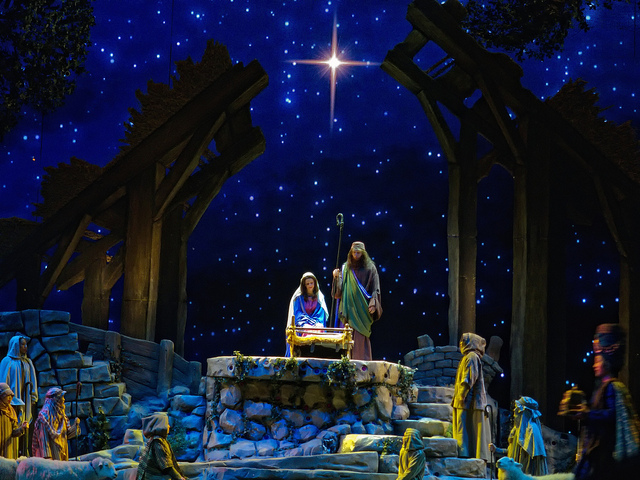
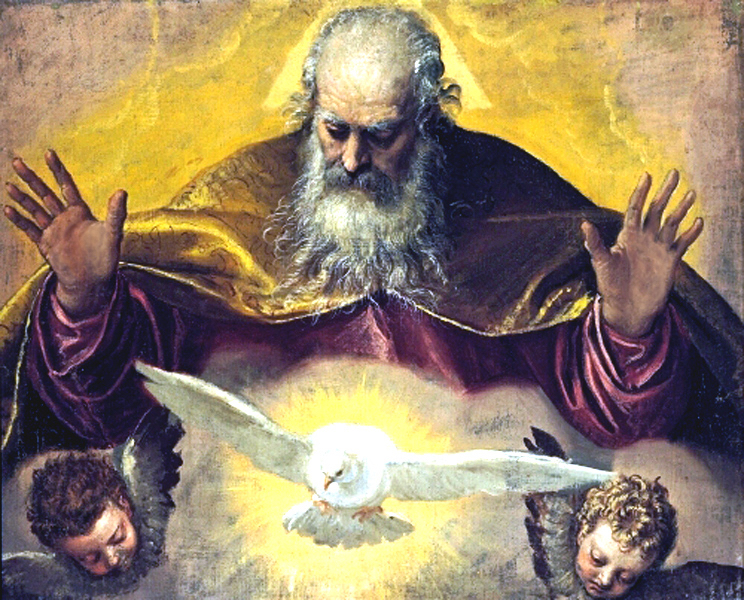
Photo: Waiting on the Word, God the Father, Flickr
…Matthan the father of Jacob, and Jacob the father of Joseph, the husband of Mary, and Mary was the mother of Jesus who is called the Messiah. (Matthew 1:15b–17, NIV)
What a difference a bit of grammar can make (so says Michael J. Wilkins in TheNIV Application Commentary: Matthew [Zondervan, 2004]). Throughout the genealogy we looked at last week, Matthew used the Greek verb gennao in the active voice, such as “Abraham fathered Isaac.” After forty instances of the active verb, he turns to the passive when describing Mary and Jesus – in the NIV, Joseph was the husband of Mary, “of whom was born Jesus…” Matthew’s readers would have noticed this shift, for it implies what many grammarians “call a divine passive, where God is the assumed agent of the action” (p. 63).
When I trained to be an editor, my teachers drummed into me always to use the active voice. But sometimes, as we see here, the passive is quite simply divine. In a simple shift of language, Matthew points to God at work. Watch out, he says, for what comes next is something new and completely different.
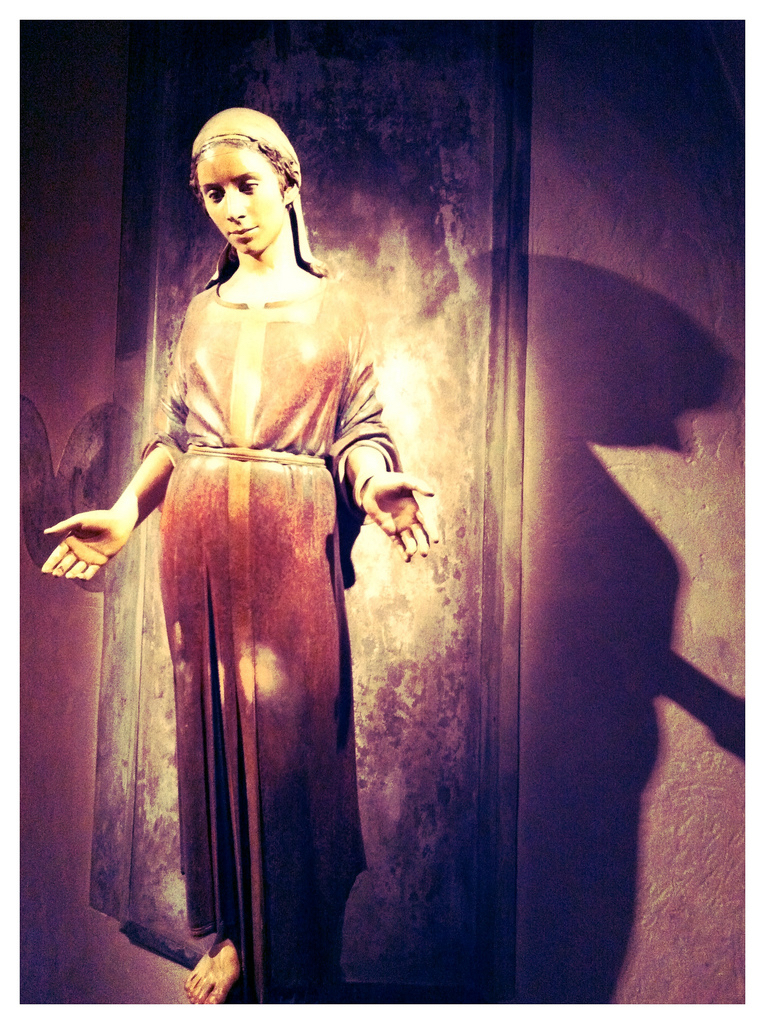
When it comes to his people, God is always the divine initiator. Mary responded to him, saying yes to God working literally in her body – “what is conceived in her is from the Holy Spirit” (v.20). Luke’s gospel records her humble and willing response when the angel announces that she will conceive a child through the “power of the Most High” (Luke 1:35): “I am the Lord’s servant… may it be to me according to your word” (v.38). Mary’s receptivity changed the world.
How does God want to break through to us? He may not want us to change the world, but rather parts of our world. Perhaps he is opening a new opportunity for service, or inviting us to mentor someone, or prompting us to extinguish anger and repair a broken relationship. Whatever it is, as we are still and listen for his voice, we will hear his words of love and guidance. May we be as Mary, responding with open hands and a receptive heart.
For reflection: The angel Gabriel to Mary: “For no word from God will ever fail” (Luke 1:37).