Category: “There’s No Place Like Home”

  • Home: A Place to Be by Rachel Hauck

    No Place Like HomeI got to know Rachel Hauck through social media after reading and loving her books – yes, I was one of those fan stalker types. She’s an amazing novelist who creates worlds you just don’t want to leave, whether in the sultry South of America or in Hessenberg, her fictional-but-real Kingdom. But her books aren’t mere escapism; they uplift and encourage with messages of hope based in her Christian faith. Rachel, as you’ll see in this engaging blog, has a huge heart, and I’m so thrilled she joins us today. (And if you’re not familiar with Cheetos – huge loss, in my view – they are a wonderful cheesy-but-crunchy snack food.)

    Hauck_3049_WBP-1Thanks Amy for having me on your blog! I love your book Finding Myself In Britain and how you’ve made “home” in the UK.

    Home is a precious word. It’s defined by so many things. The cliché, “Home is where your heart is,” rings true to me. And it’s a cliché because it’s true.

    As a kid, my family moved around a few times but even when we were in a new place, we were home. Because my parents made home a place of peace and rest.

    When we moved, Dad, Mom, my brothers and sister were with me. The same argument I had with my older brother in Kentucky was the same argument I had with him in Florida. Even those bumpy moments are part of constructing home in our hearts, right. They are intense at the time but later we laugh at them. Hopefully.

    My parents were good at setting the tone of our home. I love lighting and my mom always had this balance of warm light. It was more than light, it was the emotion of the home.

    Me as a baby with my older brother! We loved potato chips!
    Me as a baby with my older brother! We loved potato chips!

    Our home was welcoming. Never once did I dread going inside. I learned to be content in the place where I loved and was loved.

    Off to college, I carried that sentiment with me. Living in a large sorority house part of the time, I found “home” with my friends, with my roommate, with the common bond of college sisterhood. We laughed. A lot. Laughter is a key component of “home” in my mind.

    ​My dad with two of his brothers in 1980! Back in the day! My grandmother had a home in the Shawnee State Forest in southern Ohio. What memories we all have of that place! Dig my Uncle Dave's plaid pants!
    ​My dad with two of his brothers in 1980! Back in the day! My grandmother had a home in the Shawnee State Forest in southern Ohio. What memories we all have of that place! Dig my Uncle Dave’s plaid pants!

    After college, I hit the road with my professional job. Home became a shared house in central Florida with a co-worker. But home also became the hotels I lived in 70 percent of the year.

    I brought home with me in my heart. All the things I loved about “home” growing up and in college. Even ordering a pizza and watching a sitcom alone in my hotel room was “home” to me. Or sharing the evening with one of my co-workers.

    Home also meant exploring my surroundings, discovering the community I was launched into for one, two or three weeks.

    Upstate New York reminded me of my grandparent’s home in Ohio. A snowfall took me back to my childhood, to playing in the cold snow only to run home to a warm cozy place with soup on the stove.

    Again with my older brother. Probably the '90s. Clowning around at his home. It's blurry but so defines our relationship!
    Again with my older brother. Probably the ’90s. Clowning around at his home. It’s blurry but so defines our relationship!

    Australia taught me people are the same all over the world. We want to raise our families in a good, safe place. Have a good job and good friends.

    Venezuela allowed me to use all my years of high school and college Spanish! But in some places, it reminded me of south Florida where I’d lived in my early teens.

    All the while, each place, each trip, each house I visited wrote the story of “home” on my heart.

    One year my company sent me to Ireland two weeks before Thanksgiving. I was sure to be home in plenty of time to share the holiday with my family. As the weekend rolled around, my boss called to tell me I was not leaving and had to stay a few more days. Not the news I wanted to hear. I wanted to see my family, sure, but there might have been a guy I wanted to see more. (Wink!)

    That evening, our Irish distributor, a kind, fatherly man, invited me to his home for Friday night fish and chips. Their home was cozy and welcoming — just like my parents home! — and we watched a movie and laughed, told stories. That night refreshed me for the for the days ahead and eased my disappointment of “life interrupted.” And, I still made it home in time for Thanksgiving. And yep, I saw my guy.

    I love this one! My parents sitting out on the back deck one summer evening after dinner. They built the house. :) Love their matching plaid shirts! This is probably the middle '80s. But this shows so much who they are and the kind of home they made.
    I love this one! My parents sitting out on the back deck one summer evening after dinner. They built the house. 🙂 Love their matching plaid shirts! This is probably the middle ’80s. But this shows so much who they are and the kind of home they made.

    I married that guy a couple of years later and all those “home” moments helped me create my own atmosphere when we set up house together. I wanted a place people could come and just be. “Take your hat off and stay awhile.”

    When my youngest brother married, we had the whole family at the house one afternoon and my young nephews were running around with Cheeto fingers. You know, orange and sticky from eating out of the Cheeto bag.

    It was no skin off my nose because what’s the use in getting upset when anything they trashed could be cleaned? And why care more about my stuff than my nephews?

    Later, my middle brother commented, “You didn’t get riled by them getting Cheetos crumbs all over the place. You just rolled with it. Not many people would do that.”

    I want people to feel at home! Now, come on, I wouldn’t let the boys purposefully trash the place but they were just having fun, laughing, being… boys. At Aunt Rachel’s house. Do you know they make paint now that is easy to clean? I could clean Cheeto finger prints from the wall easily enough. But I could not change their memory of me if I’d yelled at them.

    My nieces and nephew. He was one of the "Cheeto" culprits! Though he's a young man here. He's in college now!
    My nieces and nephew. He was one of the “Cheeto” culprits! He’s in college now!

    All of these moments and events go into the stories I write. My own growing up experiences with my parents and siblings, cousins, aunts and uncles. My life as a sorority girl on a large university campus. My days living on the road in hotels and out of suitcases, making friends with those I met along the way.

    When I sit down to create a world, like Brighton Kingdom and the Grand Duchy of Hessenberg in the Royal Wedding Series, I remember Ireland, or Australia. Or the six hours I was in London on my way to Israel.

    When I create characters, the memories of the people I’ve met over the last 30 years, begin to form faces and voices in my head. Just one thing, or one event remembered can help me define a character.

    I think home is a slice of heaven on earth. The place where one can just “be.”

    Christmas in 2013 with my husband, one of our "adopted daughters" and our sweet dog Lola. I like to say home and family is whoever fits into your heart!
    Christmas in 2013 with my husband, one of our “adopted daughters” and our sweet dog Lola. I like to say home and family is whoever fits into your heart!

    I know not every home is peaceful, safe or comfortable. We all have varied memories of our childhood homes. Or our married homes. My husband often comments he must have grown up in a different house than is sister. They have such different perspectives.

    But our experiences, good or bad, can be stored safely away in the heart of Jesus who makes all things new. He is home to us all. Peace. Safely. Comfort.

    That’s why I try to write a little bit of Jesus into my stories. Because no matter what worlds and characters I create, Jesus is the “home” in the midst of it all.

    WeddingChapelRachel Hauck is a USA Today best-selling and award-winning author. Her latest novel, The Wedding Chapel, was named to Booklist 2015 Top Ten Inspirational Novels.

    A graduate of Ohio State University with a degree in journalism, Rachel worked in the corporate software world before planting her backside in an uncomfortable chair to write full-time in 2004. She serves on the Executive Board for American Christian Fiction Writers and leads worship at their annual conference. She is a mentor and book therapist at My Book Therapy, and conference speaker.

    Rachel lives in central Florida with her husband and pets, and writes from her two-story tower in an exceedingly more comfy chair. She is a huge Buckeyes football fan.

  • The Meaning of Home by Katharine Swartz

    No Place Like HomeI first heard of Katie Swartz from my then-fiancé who said excitedly, “A North American couple is joining Ridley, coming over on the QE2!” They arrived in Cambridge, where Nicholas was studying to become a vicar, a few months before we got married and I moved there as well. Life was new and different for us all, and Katie and I didn’t get to know each other terribly well – as she said in a joint interview for Woman Alive, she was “working four jobs and then pregnant and terribly nauseous.” She and her husband went on to have four more children after their first was born in Cambridge, when they lived in a flat with a narrow, round staircase separating the bedroom from the loo (a nightmare for a pregnant woman). Since then, the family has lived in the UK and back in the States and now in the UK again, and Katie all the while has been writing loads of wonderful novels. I love her Tales from Goswell series, the first of which, The Vicar’s Wife, intertwines a modern-day American-moved-to-England with a Victorian vicar’s wife.

    Her addition to the “There’s No Place Like Home” series had me in tears.

    After Amy asked me to contribute to her blog, I have been reflecting on what home means to me, and I realized that it has changed over the last few months. A little over four years ago my husband and I, along with our four children, moved from New York City to a small village in England’s Lake District, and what I felt was my ideal home: a two-hundred-year-old vicarage with eight bedrooms and plenty of space to practice Christian hospitality, a walled garden perfect for the vegetable plot I’d been longing for, and a warm and friendly village community I was eager to be a part of. I truly felt I’d come home.

    St Bees in Cumbria, where the Swartz's lived for four years.
    St Bees in Cumbria, the Swartz’s home for four years.

    For four years we enjoyed that home, entertaining often, planting a garden, and becoming valued members of our community. Looking back, I wonder if I was a bit smug about it all—I had everything I’d wanted. Then, quite suddenly, the school where my husband served as chaplain closed, his position was cut, and we were forced to move in a matter of months. That perfect home was taken away from us—making me reassess what really comprises a home.

    We now live in rented accommodation in a village where I am slowly getting to know the residents, and my husband has a new job as a teacher—one he is very thankful for, but not the kind of position he ever expected to have. Everything feels very temporary and fragile—made more so by the fact that as the same time as all of this was happening, my dear father was diagnosed with terminal cancer. He is now in its last stages.

    This all might sound rather grim, but there is a magnificent silver lining to it—and that is, as a Christian, I realize now more than ever that home is not a beautiful vicarage or a temporary house or even the prospect of having your family all around you, as we will this Christmas, my father’s last. For the Christian, home is heaven.

    It hasn’t been easy to give up the things I have enjoyed and desired—the lovely house, the cooking range we saved up for, the walled garden I spent many hours on. Beyond those material things, I have missed the community we were part of and the church where we served. I dislike having my life feel temporary and uncertain, and yet it has all been such a valuable lesson to me, because isn’t all of life uncertain?

    The Bible tells us this world is fleeting. Over the last few months I have been reminded of the parable of the rich fool who stored his crops in big barns, only to have his life taken away from him that very night, and I have wondered if I had been doing the same.

    In the Western world it is so easy and tempting to yearn after material goods. For the Christian this might not be a flashy sports car or something similar, but merely a comfortable home, a place to raise your family and offer hospitality—none of those are bad things to desire. But I am constantly asking myself: where is my heart? Where is my hope?

    Katharine's parents.
    Katharine’s parents.

    As my world has crumbled and changed, I have the deep and abiding joy that it is with Christ, in heaven, where God promises: ‘Never again will they hunger; never again will they thirst. The sun will not beat upon them, nor any scorching heat. For the Lamb at the center of the throne will be their shepherd; he will lead them to springs of living water. And God will wipe away every tear from their eyes.’ (Revelation 7:16-17)

    This Christmas, as you enjoy the many blessings of the season that God has granted you, I encourage you to reflect on the true meaning of Advent in looking forward to Christ’s return, and the hope of heaven that believers may all hold onto now.

    Katharine Swartz

    After spending three years as a diehard New Yorker, and four years in the Lake District, Katharine Swartz now lives in the Cotswolds with her husband, their five children, and a golden retriever. She writes women’s fiction as well as contemporary romance under the name Kate Hewitt, and whatever the genre she enjoys delivering a compelling and intensely emotional story. Her latest is The Lost Garden.

  • Home Is Where The Heart Is by Simon Lawton

    No Place Like Home

    I met Simon Lawton when he and his wife Julia invited me to come speak to women at their amazing church in Newcastle last spring. Their church was growing and a Bingo hall was declining, so they swapped premises – fantastic! I love their vision for reaching their community with the good news of Jesus.

    Home is where the heart is and where we belong. But what happens if, as you grow up, you don’t really have that sense of belonging. I was adopted into a Christian home and spent my early years feeling like I didn’t belong. I felt disconnected from my parents and my siblings through no fault of theirs. I had an itch that I couldn’t adequately scratch and a sense that there was a home and a family elsewhere.

    IMG_2490When I was 16 I received limited information from my adopted parents concerning my background. I had always felt like there was something missing from my life. I wanted to know, like most adopted children, where I’d come from and where my roots were. I discovered that my biological mother was from the very town that I had grown up in (Leicester) and that my father was from Omaha, Nebraska. He was an US Airforce engineer based in Leicestershire during the early 60s. At the time I was simply happy to rest in this knowledge and get on with my life.

    I decided in 1989 that it was time I found my biological mother and this we achieved with the help of social services. It was an incredibly emotional moment when I met her for the first time. I’d found my own flesh and blood and also someone whom I discovered had the same interests as me. I felt like for the first time that I belonged.

    IMG_2259It was not until 2001 that God clearly directed me to look for my father. I had been thinking about it for some years and had a deep longing in my heart to find him. I was at a pastor’s conference in Toronto and received an incredibly accurate personal prophecy, part of which emphasised how important it was for me to know who my father was. Amazing!

    On my return home I started searching on the internet and within a few weeks I was calling this guy whom I thought was my Dad on the phone. What do you say to this man thousands of miles away when he answers his phone? I simply said, ‘Were you at Bruntingthorpe airbase in Leicestershire in the early 1960’s?’ He replied ‘Yes’ and I paused for a moment and then said, ‘I think I’m your son!’ He was absolutely delighted and told me he had always thought there was someone out there.

    In that moment I discovered a whole family, including two great half brothers, in the USA that I had no idea existed previously. I finally felt that I belonged and had a home. They are wonderful people and when Julia and I visited the USA for the first time they threw the most fantastic party in Omaha for us. I felt like the prodigal son returning home. They remain very special to me and we very much keep in touch.

    IMG_2252Whilst in Omaha I discovered lots of information on my new family. My great grandparents are of Syrian descent from a place called Beth Latiya. I later discovered that it is the headquarters for the terrorist organisation Hamas! Wow! Further, I also discovered that my ancestors had been immigrants through Ellis Island and that whilst those US immigration guys changed the spelling of my family name to ‘Koory,’ the original name was spelt ‘Khouri.’ I was stunned to also discover that in Syrian the name ‘Khouri’ means ‘priest!’

    This knowledge simply blew me away….to think that one of my early ancestors was a priest and here I was hundreds of years later, serving God as a priest (pastor). I was even more amazed to discover from the Syrian family historian that the family tree goes back to Solomon. Incredible!

    God has been so gracious to me. He created me in my mother’s womb and set me in a wonderful Christian home where I was able to find Christ for myself and have that sense of belonging. He allowed me the privilege of discovering my family background and then he allowed me the even greater privilege of serving Him in His home – the church. I remain completely in His debt.

    “Even the sparrow has found a home, and the swallow a nest for herself, where she may have her young— a place near your altar, Lord Almighty, my King and my God.” (Psalm 84:3)

    The Dream Centre, where Simon is a pastor. I love the story how their church swapped places with a dying bingo hall in Newcastle. Hooray for God's message of love and grace!
    The Dream Centre, where Simon is a pastor. I love the story how their church swapped places with a dying bingo hall in Newcastle. Hooray for God’s message of love and grace!

    Simon Lawton was born and bred in Leicester. He left school at 16 and worked in retailing until God called him into ministry in 1985. He’s an adopted Geordie, Pastor, Husband, Father, Grandpa and Leicester City fan. He’s currently writing his first book and blogs regularly. 

  • Heading Home by Debbie Duncan

    No Place Like HomeToday’s installment in the “There’s No Place Like Home” series is Debbie Duncan, lovely author I had the privilege of working with at Authentic Media with the release of her co-authored book Life Lines, a brilliant fictionalized-but-based-in-reality look at friendship. She’s a minister’s wife and nurse who has taught at the Florence Nightingale School of Nursing, King’s College London. She and Malcolm have four teenage children and live in Buckinghamshire, UK.

    Am I a turtle without his shell?

    We have a natural affinity to the past; something captivates us when we hear where are from or when we learn about our ancestors. Certainly the television programme, “Who do you think you are” has been a huge success, facilitating an increase in people looking into their own genealogy. I have managed to get back to 1600 in my family tree, uncovering a pirate called Foxy Ned, a lady of the manor who ran off with the groomsman and a diamond scandal. My family have many roots in many countries and I cannot on good authority say where I am from, although I do claim to be Scottish as Scotland is where I spent my formative years. Home, however, is a different matter.

    IMG_2909Home is where I feel safe, surrounded by those I love. At the moment we are based in Buckinghamshire, having lived in the same house for more than five years, which is a record for us. Three of my children are presently away from home at university. When my oldest daughter, Anna, went, she had a box of decorations for her room. It was really important to her that this box was packed and went with her. In fact she packed it before she packed any clothes or books. On her first evening in her new halls the box was un-packed and she strung up her lights and hung up her photos.

    Susan Clayton, an environmental psychologist says, “For many people, their home is part of their self-definition.” They have bought in to this concept of home, paying for a mortgage or spending money renovating and decorating buildings. Walls are covered with photos and pictures of where we have been and shelves are covered with souvenirs from past adventures. I have to confess I have the odd smattering of tartan throughout the house.

    “Where are you from” is an important question but “where do you call home?” should be the question we ask. And if we think that “home is where the heart is” then home is where we are right now. For the moment for us that’s in Chalfont St Peter, where I have come to love the community. For instance, when we experienced tragic loss earlier this year I had a strong desire to stay at home – I didn’t want to leave. I wanted to feel safe and secure surrounded by people I know.

    I am made even more aware of how much I value this place I call home as I have been involved in a pilot project in a nearby town as an outreach nurse for the homeless. They live in a hostel where they are supported by a variety of care givers and staff. They may not have a physical space that they have decorated but they have a place of safety where people care for them. Some of the clients have talked about how they feel exposed not having their own place – a little like a turtle without his shell.

    IMG_2818
    The Duncans

    As Christians our natural trajectory should be towards our real home. This place I live in is a temporary measure but like a turtle without a shell maybe this keeps me focused, awaiting the day when I am made whole and complete. The money I spend on my surroundings means where I live looks comfortable and may reflect some of my identity but that is only truly revealed when I am in my real home.

    Home is where we are right now, but for those who believe in Jesus it is also only a temporary state. I am not defined by the pirates and diamond dealers of my past or whether I am English or Scottish. I am defined by being part of God’s kingdom, heading towards my final destination of my real home.

    Reepicheep, the valiant talking mouse in CS Lewis’ book The Last Battle, stood on the shore at the end of the story and said, “I have come home at last! This is my real country. I belong here. This is the land I have been looking for all my life.” He may not have been a turtle, but he found his shell.

  • The Home of my Heart by Adrianne Fitzpatrick

    No Place Like Home“There’s no place like home” – even for expats like me and Adrianne Fitzpatrick, whom I’m pleased to introduce today. Adrianne is a writer and publisher of Books to Treasure, a small independent press producing quality children’s literature, whom I met through the Association of Christian Writers. I love her passion and commitment to all things books. Her contribution to our series on finding home struck a chord in me, for I too cling to the identity of the land of my birth.

    When I was four years old, my parents decided to move from New Zealand to Australia (the land of my father’s birth). Even at that tender age, the prospect devastated me. I was, apparently, in love with a boy who was all of six or seven, and I begged him to ask his mother if I could live them instead! Alas, it was not to be; and a few weeks shy of my fifth birthday, I found myself on foreign soil. I was not impressed. To add insult to injury, in New Zealand I would have started school on my birthday (which was in June). In Australia I was required to wait until the following January, when the new academic year began. This was not a good beginning!

    Adrianne in 1994 rediscovering her New Zealand roots.
    Adrianne in 1994 rediscovering her New Zealand roots.

    I clung desperately to my New Zealand heritage as I grew up. When I felt Australian pronunciations beginning to impinge on the way I talked, I would ask my mother how to say things the New Zealand way. I steadfastly refused to become Australian. As an adult I would still claim my NZ birthright even while acknowledging my Australian upbringing with its cultural influences. Yet despite all that, I never felt any urge to return to New Zealand, even when I was old enough to make that choice. In spite of myself, Australia had become home.

    I moved around so much, both as a child and later as wife to a minister, that I became adept at feeling at home wherever I was. (In fifty-odd years I’ve moved thirty-two times. I’ve been in my current house for six and a half years. That’s a record for me!) One thing that struck me after I became a Christian in my teens was the feeling of community that greeted me whenever I went to a new church, whether as part of the ministry team or as a visitor on holiday. One would expect that in your home church, but for me it was always a welcome surprise – and eventually something to look forward to – when going somewhere new. It gave me a sense of continuity, a sense of home, that I appreciated in the midst of so much change and uncertainty.

    Back in Australia - Blue Mountains
    Back in Australia – Blue Mountains

    However, I can’t blame all the moves in my life on other people, because I was the one who chose to come to the UK. I grew up on a diet of British books and, to a lesser extent, British television. My mother’s family are British, with my English grandfather being seconded to the New Zealand navy after the First World War. My great-grandfather, so family history goes, was a shepherd at Stonehenge. I had a longing to see this country, although I never expected to live here. Yet when I arrived here in 2003, I knew immediately that I had come home.

    Finding beauty in the UK - Tintern Abbey
    Finding beauty in the UK – Tintern Abbey

    Twelve years later I can still say that the UK is the home of my heart. That’s not to say life has been without its challenges: family, health, finances, even friendships have all suffered at various points. But there has also been healing, restoration and reconciliation on emotional, physical and spiritual levels. God has truly brought me home – at least until he calls me to my permanent home.

  • The Hunger for Home by Os Guinness

    “There’s No Place Like Home”

    The first guest-blogger in our Friday series, “There’s No Place Like Home,” is a giant of this generation who has profoundly influenced not only my thinking but who I am. In my twenties I had the great privilege of working for the renowned social critic Os Guinness in Washington, DC, on several projects, including the Trinity Forum, an outreach to business leaders.

    The nation’s capital was a new home for both of us, respectively, for he and his wife and son had arrived from England a couple of years before I went to DC to study for a semester during university. I interned with him at the Williamsburg Charter Foundation, a bicentennial celebration of the US Constitution, and ended up staying there for ten years! I never would have dreamed those years in DC that eventually I would make my home in his country – but even England wasn’t his first home, as he was born in China, the son of medical missionaries.

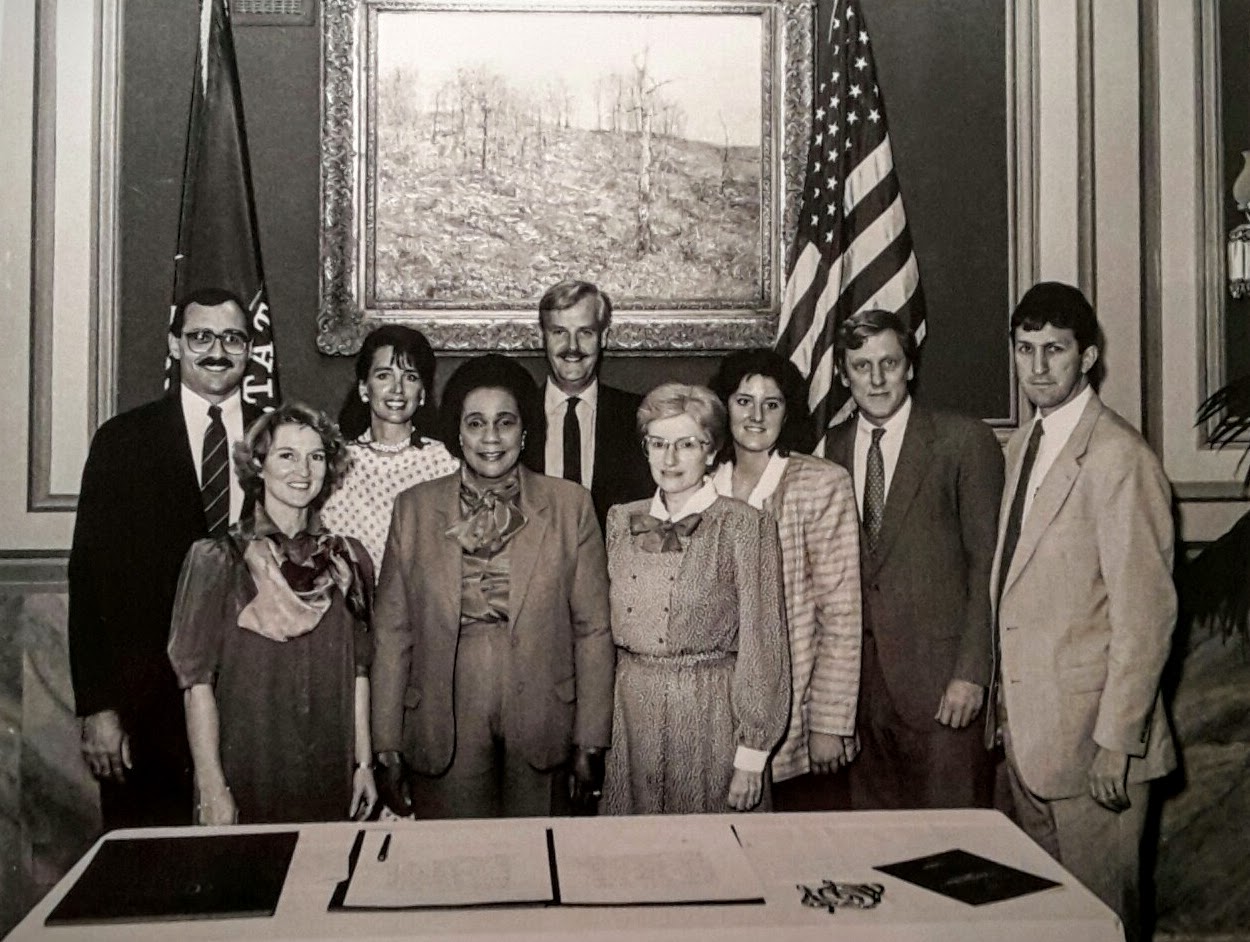
    The Williamsburg Charter Foundation team, with Coretta Scott King. In the front row, left to right, Sharon Brown, CSK, Lila Williamson; in the back row, John Seel, Jenny Guinness, Os Guinness, me (where was I looking?), Bob Kramer, and Tom McWhertor.

    He’s kindly granted me permission to post the excerpt below, which addresses our longing for home and comes from his seminal look at America and its crisis of cultural authority at the end of the “American Century,” The American Hour: A Time of Reckoning and the Once and Future Role of Faith (New York: Free Press, 1993). I worked with Os when he wrote the book, and I cut my copyediting teeth on this amazing 450-page analysis of the crisis of moral authority and his vision for the role of religion in public life. Though his book is more than twenty years old, his writing zings with truth and prescience. It’s available online, here for the US and here for the UK.

    His chapter on homelessness, “The Hunger for Home,” reveals one of the cancers that slowly destroys the certainties of meaning and belonging in modern life (and is aimed specifically at America, although it translates to other Western countries as well). Through the weeks of this series on longing for home, we’ll examine the ways that people have found their home – and Homemaker. But first, to lay the groundwork for what we’re up against through the problem of homelessness, is Os:

    Homelessness results from the gradual eating away of the certainties of meaning and belonging in the lives of countless Americans. Nothing is more naturally human than the drive toward meaning and belonging, and thus toward order. Sense of some kind, stability of some sort—these are the prerequisites for a tolerable human life. Without some underlying order, philosophically as well as socially, the dark demons of absurdity and anomie come menacingly close and threaten to destroy the fragile defenses of individual character and of human civilization itself. Cruel religious theodicies and totalitarian political terror bear witness to the same point: Human beings have such a need to feel at home with themselves and their universe that they even prefer tyranny to chaos, paternal authoritarianism to fratricidal factionalism.

    In one sense, homelessness is a defining feature of all humanness east of Eden and is certainly not new in the United States. But a special sense of homelessness has always been present in a nation shaped by immigration, mobility, and westward expansion. One German visitor called it the “strange unrest” of Americans, and H. G. Wells commented on the “headlong hurry” of Americans.[1] George Santayana commented in the 1920s on the “moral emptiness of a settlement where men and women and even houses are moved about, and no one, almost, lives where he was born and believes what he was taught.” Denis Brogan spoke in the 1940s of “American nomadism” as the expression of American civilization. John Steinbeck, in his Travels with Charley, wrote that he saw something in the eyes of his neighbor that he was to find everywhere in the nation—“A burning desire to go, to move, to get underway, any place from here. They spoke quietly of how they wanted to go someday, to move about, free and unanchored, not toward something, but away from something.”[2]

    No Place Like HomeSuch restless mobility, combined with a will to technique, has left Americans with what George Grant described as “a conquering attitude to place.” Even our cities, he said, have become “encampments on the road to economic mastery.”[3] At the more everyday level, IBM was popularly known as “I’ve been moved” and advertisers routinely teed off the pervasive sense of lost home. In the 1980s, Mazda sold automobiles under the doubly contradictory byline: “Who says there’s no place like home? We built the MPV based on a very strong foundation. The home… It’s engineering based on human feelings.”

    But while the problem of homelessness is not new in America, the present moment represents a serious exacerbation because the traditional American counterbalances have disintegrated with the crisis of cultural authority. Both faith and the family, the two deepest structures of meaning and belonging an the strongest counterweights to threatened anomie, have been sucked into the whirlpool.

    In normal times, the search for meaning and belonging is a hidden process that is natural and unconscious. That such a search has become conscious, deliberate, and a point of open anxiety is itself a symptom of anomie and homelessness. Nothing demonstrates the problem more clearly than the place and profitability of psychologism in America. As Peter Berger wrote in 1967, “If Freud had not existed, he would have had to be invented.”[4] But the predicament also shows up clearly in very different areas. For example, the recurring vogue for nostalgia (literally “homesickness”) in societies losing touch with their past, the potent hunger for “roots” in nations rooted in rootlessness, and the insatiable appetite for myths in cultures parched by reductionism. “Loss of the past,” wrote Simone Weil about France, “is the supreme human tragedy, and we have thrown ours away just like a child picking off the petals of a rose.”[5]

    With heaven evacuated, history severed, families strung out if not disintegrating, and faith unreal, homelessness has become an ever-present menace to modern Americans. Can there fail to be consequences? Being deprived of justice and freedom is bad enough for humans, but being disinherited from the certainties and assurances of home may prove even more so.

    [1] See Allan Nevins, ed., America Through British Eyes (Oxford: Oxford University Press, 1948), p. 496.

    [2] John Steinbeck, Travels with Charley, (New York: Viking Press, 1962), p. 93.

    [3] George M. Grant, Technology and Empire (Toronto: House of Anasi, 1969), p. 17.

    [4] Peter L. Berger, Facing Up to Modernity (New York: Basic Books, 1977), p. 32.

    [5] Simone Weil, The Need for Roots (London: Routledge and Kegan Paul, 1952), p 114.

  • “There’s No Place Like Home” – A New Series

    No Place Like HomeWhen Nicholas and I first married, and I moved to the UK, we decided to call wherever we were living “home.” We knew that words bind up reality, so we wanted to embrace with our lingo the new truth in our lives. This would prove harder for me, of course, being the one to leave family, friends, wide highways, and good plumbing, and if we were having a spat we wanted to curtail any reckless words such as, “I want to go home!” For I was at home.

    But though we were intentional, early on in our life in the UK I often felt homeless, partly because we knew we’d only live for a few months at Ridley Hall in Cambridge where Nicholas was training for ordained ministry. Then his first curacy descended into upheaval not long after we arrived when the vicar was signed off sick, so the question of whether we’d stay or go seemed to cling to us, keeping us from settling. We moved after only two years, to another curacy, which again felt transient as we stayed there another two years for Nicholas to finish his apprenticeship period. Home was where we lived, but rooted we were not. Only when we landed in our first vicarage, having our first child a month later, were we able to settle in and breathe.

    Embracing a concept of home – though we took a few years to reach this place physically – helped us to create a space for loving, thriving, and resting. A place to be; a place to relax; a place to create; a place to welcome others. For Nicholas this sense of home was redemptive, for he had moved around so much in his life, such as going to boarding school at the age of eight, and later, when he went to theological college (US: seminary) in his thirties, selling his flat and therefore in a sense being homeless during that three-year period (and finding being booted out of college during the summer holidays particularly hard).

    So home is something we’ve tried to foster, and the addition of children has been a wonderful blessing and joy to vicarage life. This drafty Victorian spacious place with its high ceilings, sinks with their single faucets (UK: basins with taps) in several of the bedrooms, and condensation-forming sash windows has provided the backdrop to their lives. But of course home means so much more than the physical structure; it’s the people and the customs and rituals that we practice throughout the seasons that bring meaning and fulfillment.

    FMIB Quotes 1 & 2_Proof 2 jpeg

    I’m delighted to kick off this series, “There’s No Place Like Home,” which will run at least through the Spring of next year, as I’ve had a humbling and wonderful response from fellow writers and makers-of-home. The blog posts will appear on Fridays, all exploring different aspects of home. Next week we look at the crisis of homelessness from the renowned thinker Os Guinness, and in the weeks following we will experience so many riches including novelists Rachel Hauck, Sharon Brown, and Katharine Swartz; bloggers Ben Irwin, Tanya Marlow, Amy Young, and Tania Vaughan; and authors addressing issues in the Christian life such as Cathy Madavan, Bev Murrill, Sheridan Voysey, Penelope Swithinbank, and Catherine Campbell. As a VW (vicar’s wife), I don’t think of myself only with that label, but no doubt being married to pastors and ministers will inform the thoughts of Amy Robinson, Debbie Duncan, and Claire Musters. And this is only a taste of the glories to come! Yes, I’m excited!

    To launch the series, I’m delighted to give away two copies of Finding Myself in Britain, including recipe cards – and I won’t limit the giveaway to the UK either, so wherever you live, please enter. To do so, share in the comments what home means to you. You can wax lyrical or jot down a word or two. I’ll choose the winners on 27 November – yes, otherwise known as Black Friday. It will be lovely to give away my book-baby on that day of consuming.

    Is it true for you that “There’s No Place Like Home”?

  • Longing for Home

    FMIB Quotes 1 & 2_Proof 2 jpegA recurring theme in Finding Myself in Britain is the longing for home. What is home? How do we find or create it? What do we define as home?

    When Nicholas and I first married, we agreed to call the place where we were living “home.” Not only did this help us in the biblical injunction of “leaving and cleaving,” (leaving one’s family of origin as a new family is created) but it aided us emotionally. If someone asked me, a newcomer to the UK, when I was “going home,” I’d say, “I am home! But I have a trip to the States planned in…” The words we use can help us define our emotions – we sometimes have to educate our feelings.

    Home is a lovely concept – I think of my parents’ home in Minnesota, which although isn’t my home any longer does feel like home, with its lack of clutter and ultra clean space to feel comfortable in while chatting to my family, or the screened-in porch in which to sit and watch the passing deer and wild turkeys (yes in the suburbs of St. Paul!). Or I think of the top floor of a house in Philadelphia where dear friends lived while studying at Westminster Theological Seminary, where I spent many a Thanksgiving. It was only two rooms – and the dishes were washed in the bathtub – but the rafters reverberated with refrains of songs and laughter. Or I remember the historic (for America) house I worked out of for many years and the lovely family who dwelled there, complete with my favorite black lab/golden retriever. On this side of the Atlantic, I picture the homes of dear friends and the meals shared around their tables.

    I could continue in my list, but these places are personal and won’t evoke the feelings of home in you that they do in me. But a common theme of these places where I’ve felt at home lies in the people who make them homey – their welcome, love, grace, and open hearts. They who follow the Master Homemaker bring his kingdom to earth in the homes they create here.

    Where do you find home?