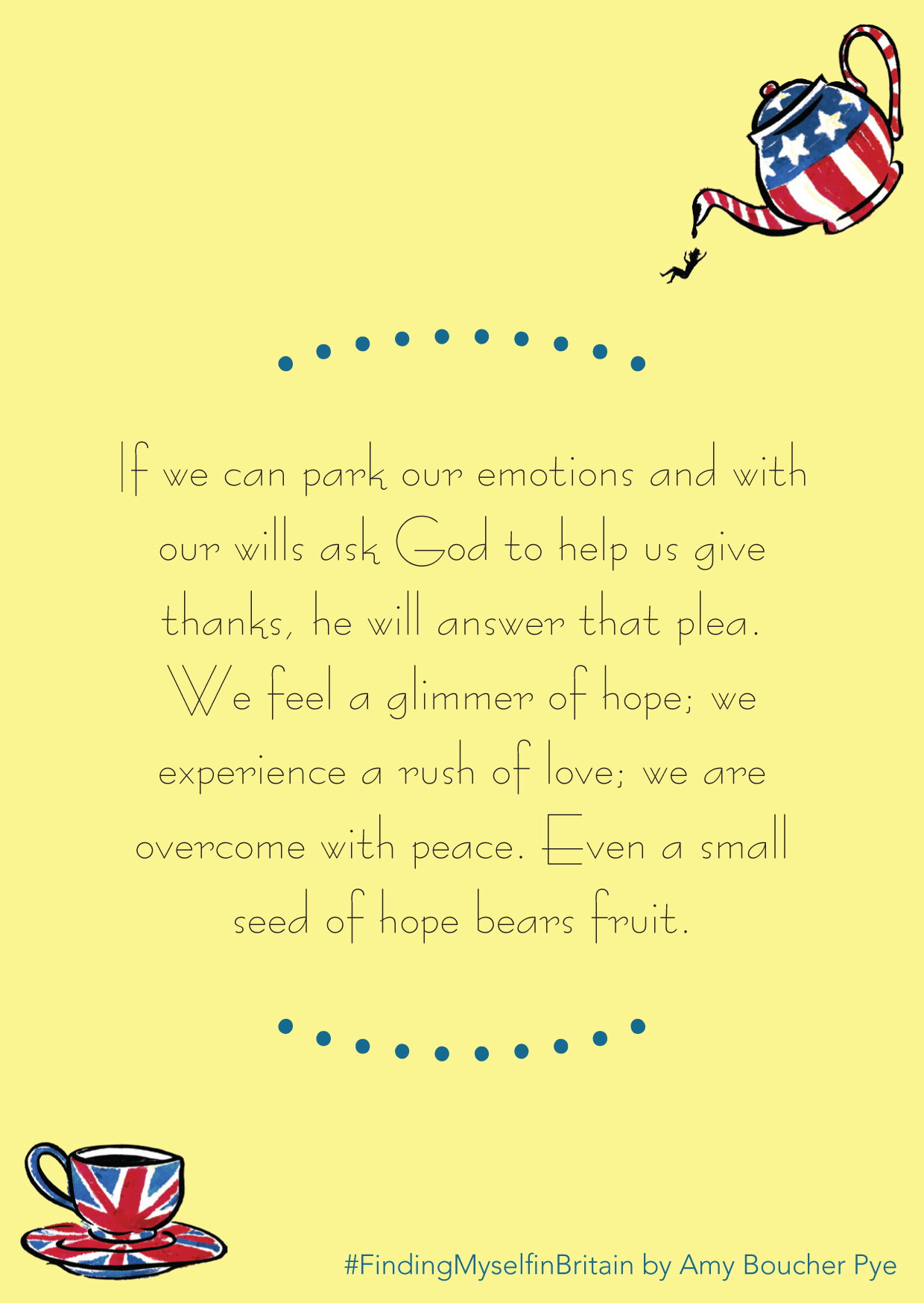
This morning we find ourselves in Britain after an historic vote. You can probably guess which way I voted! Whatever our views, God remains with us. He’ll never leave.
I share a drawing by my daughter, sent to me this morning by her teacher, on what it means to be British. He says he has no idea where her inspiration comes from! The boy is wearing England football kit and sings the national anthem, and the sandwiches include black pudding. I don’t think she has anything to represent Wales or Northern Ireland though.
May we be united. May we be marked by love. May we remember that God will never leave us.
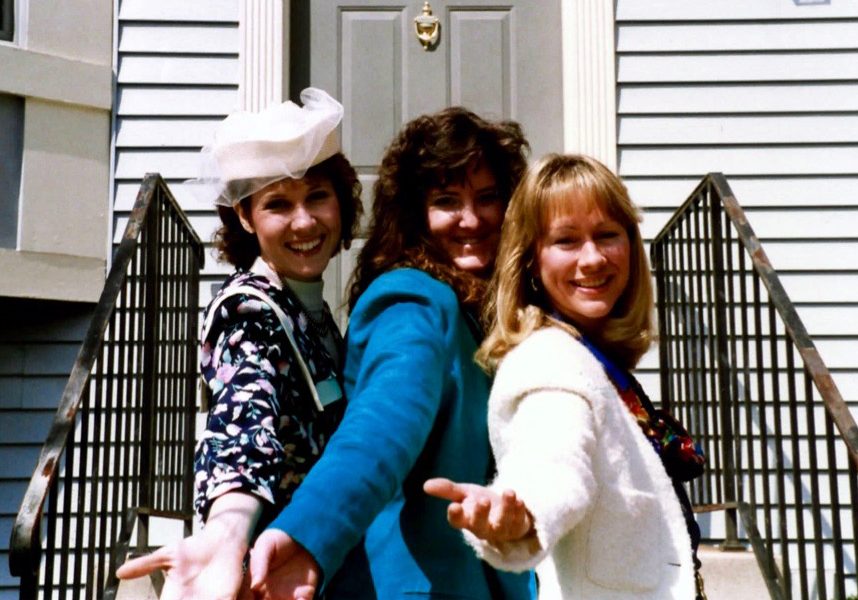
Me in the middle in 1991 with big hair, and with the special women with whom I lived.
Twenty-five years ago – what were you doing? I was in my twenties and living in Virginia with two wonderful women as I faced a turning point in my life, although I didn’t know it at the time. Having just broken off an engagement to be married, I felt the shattering of my hopes for marriage and a family.
The pain of the broken dreams opened up a bigger question: Who am I? Why was I trying to find my identity in things outside of God, such as romantic relationships, my work, friendships, or even my involvement in church? The question propelled me on an adventure with God as I started to hear the still, small voice of the Lord and the words of the Bible came alive. God the Trinity was awakening me through his word; the Word in me was coming alive.
Those were amazing years of growth as each morning I was eager to awaken early to read the Bible and pray. I was taking the Scriptures and eating them, as in Jeremiah 15:16. And the words – the Word – tasted sweet, as sweet as honey. The words were my food and sustenance; the power of the Word to sustain me.
Those years provided a necessary foundation to my life with God, but of course the story doesn’t end there. The Word continues to work in my life, as I found myself in Britain.
In 1991, I never would have dreamed that I’d make a home in Britain. That’d I’d be a vicar’s wife – I probably didn’t even know what a vicar was! Or that my two amazing children would speak with English accents and a regular part of my day would involve beseeching them not to drop their t’s. That I’d learn about cricket and what the majority of people in the world call football. And how to make a proper cup of tea.
In 1991, I was working for the deep thinker and also deeply humorous man, Os Guinness. Later when I was engaged to Nicholas, Os warned me that in my move to England the little things might all add up to a big thing – such as with language and words. And he was right. At first I would flail around in my conversations, knowing that it wasn’t a “parking lot” but not remembering that it’s a “car park,” or not knowing what nappies were. For a person who worked with words, I was humbled to feel misunderstood and to misunderstand.
But God the Word was with me through Jesus dwelling within and the Holy Spirit’s gentle comfort, and I got through those early days of feeling numb and silenced. What were challenges, such as not communicating easily, became the means of relying more intensely on God. As he met me, my faith grew.
I started to understand a theme of the kingdom of God – that in losing ourselves, we find ourselves. Just as I’ve found myself in Britain. And I mean that in both senses of the word – finding myself here geographically and also finding who I am in terms of my identity in Christ.
For here I’ve found myself as a citizen of heaven and a citizen of the world. I’ve deepened in my vocation as a writer and editor – one who loves words and the Word and who shares them with others.
Life with God is an adventure. His Word in us calms us, showers us with love, and calls forth in us our buried dreams. May we share his words with those whom we meet.
In closing, some questions to ponder.
Are you willing to lose your life to find it?
When in your life did times of sacrifice bring great gifts and growth?
How have the power of words – those written, those spoken, and ultimately the Word – shaped your life and your faith?
This is part of a talk I gave at the 25th anniversary celebrations for the Books Alive bookshop in Hove on 17 June. The theme of losing yourself to find it is a major one in my book Finding Myself in Britain: Our Search for Faith, Home & True Identity, which you can find here.
What a joy to welcome Philippa Linton to the “There’s No Place Like Home” series today. We worked together at HarperCollins at the turn of the millennium, and lost touch with each other until last year’s Woman Alive/BRF women’s day in Woking where I was speaking. What a delight when up walked Philippa – the years disappeared and in a flash I was transported back to our lunches in the canteen and trying to figure out if we could sell any of the rights to our books to foreign publishers. Her contribution today is poignant and moving, as she acknowledges life’s shadows.
My childhood home was a suburban, Victorian house with a large, beautiful garden and a menagerie of various animals including an excitable border collie, an imperious ginger cat and a rabble of cute guinea pigs. (The imperious ginger cat also liked to visit various other homes along our street, much to our amusement.) I had a happy family. Home was safe and secure: it was also a place where I could shut out the rest of the world.
A favourite beauty spot near home, Emmetts Garden in Kent.
During my final year at university, a post-graduate acquaintance invited me and a small group of friends to take part in a set of informal psychological exercises. In one of these exercises we had to draw a house, which if I remember rightly, was meant to symbolise our childhood. We weren’t supposed to think too long about this, simply go with our instincts and put down on paper the first impression that came into our heads. It was meant to be fun, but with a purpose: our artistic self-expression would reveal deep and meaningful things about our inner lives. I drew an eerie, desolate house with shuttered windows on a moonlit night.
The friend who had set us the task peered at my picture. ‘Hmm’, he said, ‘there’s a mystery to you!’
It was an odd image for someone who came from a loving, stable background and who still loved her family home, but I didn’t see anything sinister in it. I think that drawing reflected some subconscious ambivalence about my childhood, about the insecurities and shadows that fall across even the happiest childhoods.
Geraniums on my mother’s window sill.
My shadow was my adoption: much as I loved my family, I would sometimes wonder, ‘who am I and where do these genes come from?’ Yet at the same time I’ve always celebrated being adopted, a ‘chosen child’. For me that mixture of positivity and darkness, that dance of sunlight and shadow, is part of my adoption story and indeed an essential part of life. When I hit my mid-thirties, I decided to trace my birth mother and it turned out to be one of the best decisions I ever made. Consequently I gained a family in Northern Ireland, in addition to my large adoptive family in England.
The concept of ‘home’ is less a location for me than it is a feeling, a place where you are completely accepted, where you can relax, kick off your shoes, and be yourself. The current place where I live is like that. Four years ago the tragic death of a close housemate prompted my decision to leave the house where I’d been a co-tenant for 26 years. Obviously I couldn’t afford the rent on my own, but I didn’t have the emotional capacity to advertise for a replacement either: I was grieving the loss of my friend and my heart wasn’t in it. Enter a married couple from my church who offered me a room in their house as their lodger. This financial arrangement was a God-send, given that the private rents in my area have almost doubled in the past few years. My friends’ kind offer and hospitality was timely: by that point, I was more than ready to leave that house, I had already let go, emotionally.
At Mount Stewart gardens in Northern Ireland.
The New Testament describes the people of God as ‘sojourners and exiles’ (1 Peter 2:11). The spiritual life is often about pushing forward to new horizons and adventures, and not making ourselves too comfortable in worldly systems. Besides, life throws curve-balls: we all have to face change and loss, it’s part and parcel of our pilgrimage on this earth.
I am blessed to have a home: I may not own it, but I have an emotional stake in it, and I have a roof over my head, a warm, comfy bed to sleep in and a garden to relax in. Best of all, I have friends and companions to share the ups and downs of life with.
All of us long for security. All of us long to come home, whatever form and shape ‘home’ may take. Jesus said: “There is plenty of room for you in my Father’s home. If that weren’t so, would I have told you that I’m on my way to get a room ready for you? And if I’m on my way to get your room ready, I’ll come back and get you so you can live where I live.” (John 14: 2-3, The Message)
There is a place for us. We all matter, and there is a place for us.
Philippa’s day job is working for the education & learning department at the United Reformed Church in London. She is also a Reader (lay minister) in the Church of England. She likes J.R.R. Tolkien, C.S. Lewis, early 20th century feminism, and cats.
It’s an honor to invite Cindy to the blog today, especially because she’s a reader who got in touch after reading Finding Myself in Britain. She could relate to the theme of finding and making a home, as you’ll see below. She asks in her post the profound question: Can we ever really go home?
“There’s no place like home.” I agree with those iconic words spoken by Dorothy in The Wizard of Oz, but where is home and can we ever go back? I never gave the notion much thought until I experienced “going back home” first hand.
Twelve years ago, my husband was fortunate to be offered the choice of two different positions with his company; one was in Manchester, England, and the other in Pennsylvania. Although I knew these were wonderful opportunities for our family, I was apprehensive about moving, especially overseas. I had never lived anywhere outside of New York, where I had grown up, and Michigan, where I was living at the time, and hardly ever traveled abroad. I had the normal concerns. How would the move affect my children? Would we fit in and be accepted in a new city or new culture?
At the time, my step-father was battling stage 4 stomach cancer and moving to Pennsylvania would have put us closer to our family in New York where I could visit and help with his care. But I knew how much my husband wanted to work overseas. He understood my dilemma and left the final decision to me. On a visit to New York I spoke with my parents and they both agreed that we should make the decision based on what we wanted and not to let my step-father’s illness make the decision for us. In fact, my parents urged us to accept the position in England.
On our long car ride back home to Michigan, after that New York visit, I put my head in my lap and asked God to give me a sign to help me make this difficult decision. I prayed for a bit and as I lifted my head from my lap and looked out the car window a truck was passing by. On the side of that truck in huge bold letters was the word ENGLAND. As silly as it may seem I took that as my sign from God and we made the decision to accept the position in England.
Me and my family on a trip to London.
As it turned out my step-father passed away three months later on the day we were flying to England to search for a home and school for our children. I will never know if he knew he wouldn’t be around much longer and he didn’t want us to miss out on this great opportunity, but I felt a huge relief that I had made the right decision.
All of my fears about living in England were for naught. I felt oddly at home living there. My children were warmly welcomed at their school and made some great friends. I also made great friendships with four British women that I am still in touch with ten years later.
After two very short years living in England, my husband was transferred back to the States, and I didn’t want to move back. I was enjoying submerging myself in a new culture and hoping to deepen my new friendships. The only thing that brought me comfort was the fact that we were moving back home. Back to the same town in Michigan that we came from. Everything would be familiar and I would be with my good friends once again.
On a ramble with my children, Melissa and Patrick, in the Lake District.
And this is when the question, can we go back home, was answered for me. I had had these amazing experiences I was excited to share but my friends weren’t excited to hear about them. They couldn’t relate to my stories or to me because they hadn’t had the same experiences. What I didn’t realize was that over the course of two short years everyone I knew in Michigan had moved on with their lives. I was no longer a part of things and we couldn’t just pick up where we left off. I tried to re-establish old relationships but didn’t feel accepted and didn’t understand why. These were friends who cried when they found out I was moving to England, so why weren’t they excited that I was back? I fell into a deep depression and finally I realized I had to move on as well. I needed to establish new friendships and stop trying to regain old friendships.
Eileen, Kathryn, me and Doranne on a visit back to England – my wonderful British friends.
While reading Amy’s book, Finding Myself in Britain, I came across a quote from Karl Dahlfred that made me think hard and realize that maybe my former friends weren’t the only ones that had changed. Maybe living overseas had changed me as well. I couldn’t place all the blame on them. Maybe I couldn’t relate to them any more than they could relate to me.
Over the years since we have returned I have established new friendships and rarely tell stories about life overseas anymore. I’ve come to realize that home isn’t a country, city, or neighborhood. It’s not a physical place or even being around former friends. Home is where you are surrounded by those you feel most comfortable with at any given time no matter where you are. Now I feel a sense of being “at home” when I am with my family, current friends, or when I have the fortunate opportunity to visit my friends in England.
Dorothy was right: There is no place like home. You just have to know where to find it.
Cindy Galiziowas born and raised in a small town in New York and worked in New York City in the world of finance for 12 years before relocating to Michigan with her husband. Shortly after the move she had two children and decided to be a stay at home mom. When her children were 9 and 10 her husband’s job relocated the family just outside of Manchester, England for two years and Cindy embraced and fully immersed herself in the new culture. On her move back across the pond her career as a “professional volunteer” began. She loves helping others in need and admits that selfishly she receives more from volunteering than the people that she helps. Cindy and her husband just recently became empty nesters and are excitedly anticipating the next phase of life.
June. I find this time of year poignant, for sometimes the ache of separation from loved ones in the States feels exacerbated in the summer. My social-media feeds burst with photos of graduations, picnics, and the last days of school. And sunshine.
The contrast can seem strong, for my kids have another six weeks of school so there’s no counting down the days for them. And although I probably now ascribe to an all-year view of education in terms of continuity and learning, I also remember the long summers I enjoyed in Minnesota. So long that I even had the opportunity to get bored. Something that my kids, as we cram in family holidays and a trip to Minnesota with Christian camps, have hardly the chance to do.
But if I was in America now, no doubt I would have a long list of things I missed from June in the UK, such as long evenings, Wimbledon on the BBC (no adverts!), perfect Pimms, weather that can change from sunshine to rain to sunshine to rain again (as it has today), and never being overheated.
And I’m reminded again of how through giving thanks, our outlook can change. The above quotation actually comes from the chapter in Finding Myself in Britain on Harvest and Thanksgiving, but it can easily apply to the good ole summertime as well. For as I made my list of just a few things to give thanks for here on this island, my mood lifted and I look forward in hope.
What do you most like about June? What would you miss if you lived in a different country?
Bex Lewis gives us a wonderfully varied look at home, reflecting the mobile nature of our society today. I love her reflections. And I love that I don’t really know where I first met her, because we were online friends before we met in person. But there’s not a difference in our engaging, whether online or in person, which is a point she embodies. She sees the positive points of online life and also, in her book Raising Children in a Digital Age, helps adults think critically.
So, currently I’m on a train from Winchester back to Manchester, places that have very different notions of ‘home’ for me – a place with a deep sense of belonging, and a place full of the adventures of a new life. The immediate thought goes to geography – as a ‘Southern Softie’ who grew up on the south coast of England, twenty minutes above Brighton, I have spent an unexpected amount of time ‘north of Watford’ in the last decade!
‘Home is where you put your hat’ is the famous saying, but for me, there are different kinds of home, and it’s not all about geographical location. In Sussex, where I grew up, one of my oldest friends is still there and there are flashes of memory when I return, but my parents have left. They now live somewhere that I wouldn’t refer to as ‘home’ because I didn’t grow up there, although it’s lovely to see my parents, and go somewhere quiet for ‘time out’. Each new home has offered new adventures, new possibilities, and some sadnesses as things are left behind.
The home where I grew up in Sussex.
Winchester was the first place I got to experience living independently, and is somewhere that I have lived on and off since 1994, and most of my longest and deepest friendships originated there. Durham offered the first opportunity to buy my own home – and I was very keen to make the house a home, with the paintbrushes, the comfortable (if second-hand) furniture, getting to know my neighbours, and offering a hospitable welcome to friends. When I was faced with redundancy from that role, I knew I didn’t want to stay, and sat down with a friend to consider where I might want my new home to be – as home is so much more than a place to live and work – both Winchester and Manchester were on the list – one a lot more affordable than the other in terms of being able to afford my own home. Thankfully, the right opportunity came up in Manchester, and I have now called that city ‘home’ since September (despite actually officially living in Stockport, but, you know, it’s part of ‘greater Manchester’!). There is a running joke amongst my family and friends that they have to put my address in in pencil, because I’ve moved so often over the last twenty years … but hopefully this time is going to be for a good few years!
Having my 40th at a lovely friend’s home in Winchester with loads of family and friends to celebrate.At home in Durham.
In my PhD I used Benedict Anderson’s notion of an ‘imagined community’. In the Second World War the British people were fighting together for the imagined community of their nation:
It is imagined because the members of even the smallest nation will never know most of their fellow-members, meet them, of even hear of them, yet in the minds of Anderson questions what ‘makes people love and die for nations, as well as hate and kill in their name’.[1]
I’ve always been fascinated about what gives people a sense of identity, a sense of belonging, and within that, what makes people feel ‘at home’. Dictionary.com has an interesting range of definitions for ‘home’: a house, apartment, or other shelter that is the usual residence of a person, family, or household; the place in which one’s domestic affections are centered; an institution for the homeless, sick, etc.: a nursing home; the dwelling place or retreat of an animal; the place or region where something is native or most common; any place of residence or refuge: a heavenly home; a person’s native place or own country; (in games) the destination or goal; a principal base of operations or activities: The new stadium will be the home of the local football team.
I am fascinated that these definition include the use ‘a heavenly home’ as an example, which reminds me of 2 Corinthians 5:1For we know that if the earthly tent we live in is destroyed, we have a building from God, an eternal house in heaven, not built by human hands, something that I heard at a Billy Graham event at which I made my own ‘personal decision’ that I wanted to live in one of the heavenly mansions, though now it appears to be more about having a heavenly body – without the trials and tribulations of our human bodies.
Meantime, whilst living on earth, I have found it important to seek to be part of the local community – starting with getting to know my neighbours well (I posted a photo/brief personal bio through each of their doors as I started moving in). Those who know me will not be surprised to heard that I also consider my ‘digital community’ to be key, and that this a place I certainly feel very at home. Facebook in particular has allowed re-connection with old friends and re-participation in their lives, whilst getting to know new friends (often before meeting them in person). Social media has helped me with all of my big moves, including private Facebook groups for those in the area for practical queries, and those who care and want to pray for those decisions being made, and Twitter which allows a quick build-up of new personal and professional networks around interest-areas, and Freecycle to get rid of (and occasionally collect) stuff as I decluttered over my three years in Durham!
Getting the keys to my new place in Manchester.Arriving to this empty space – rather dispiriting!But it can feel like home quickly.
In writing Raising Children in a Digital Age, particularly whilst writing about bullying, it became clear that many see ‘home’ as a place of safety, one that was challenged by the global nature of digital technology. No longer could one ‘shut the door’ and shut the world out (could we ever truly do this), and we could live our ‘private’ lives as we wanted (have our lives ever truly been private – if we look back in history, it’s only for around 200 years that this has been an expectation). New technology is challenging our understanding of participation in life – and with the media focusing on so many of the negative aspects, it can be hard to remember the positive aspects – the opportunities to connect, to maintain relationships, and to use the opportunities provided for positive, rather than negative, purposes.
Finding home amongst my online community.
For me, home is where relationships are, whether that is offline or online, places that I can feel comfortable to ‘put my feet up’, whether that is literally, or in a place – such as church housegroups – where one can open up and share lives with others. Let’s make them spaces where people feel welcome, where they feel comfortable – and if you’re in my house – comfortable enough to make your own tea-and-coffee, as I don’t drink them and typically forget to offer them!
Tonight I’ll be back under my own roof, in the house that I am seeking to turn into a home – using the colours that I love, displaying objects that have associated memories, a place I can be hospitable … and where tomorrow I’ll be able to put my feet up on the new sofa!
Dr Bex Lewisis passionate about helping people engage with the digital world in a positive way, where she has 19+ years of experience. Trained as a mass communications historian, writing the original history of Keep Calm and Carry On, she is Senior Lecturer in Digital Marketing at Manchester Metropolitan University, and Visiting Research Fellow at St John’s College, Durham University, with a particular interest in digital culture, and how this affects the third sector, especially faith organisations, voluntary organisations, and government behavioural campaigns. She is Director of social media consultancy Digital Fingerprint, and is author of ‘Raising Children in a Digital Age’ (Lion Hudson, 2014), which has been featured on The One Show, BBC News, Steve Wright in the Afternoon, and in the Daily Telegraph, The Church Times, and in many other publications.
[1] Anderson, B., Imagined Communities: Reflections on the Origin and Spread of Nationalism, 1991, p.6 (emphasis in the original)
I’m delighted to welcome Sheridan Voysey to the blog today, sharing some thoughts on home that he originally gave on BBC Radio 2’s Pause for Thought. Sheridan is a wonderful writer and speaker, whom I’ve been delighted to come to know along with his wife Merryn since they moved to the UK from their native Australia. He invites you to ask yourself, “Where is ‘home’ for you—that place where you feel you most belong? Is it the house where you grew up? Your current home? Is it just being with your loved ones, wherever you are, or is it something else entirely?”
When I visited my hometown of Brisbane, Australia, I had an eerie experience. One night I drove to Kangaroo Point—a cliff top that provides a stunning view of the city—and as I sat there watching the cars rush by on Riverside Drive and the city’s lights shimmer on the Brisbane River, I realised I could see the spots where some of my significant life events took place.
In front of me was the bustling city, where I’d come as a teenager to buy records and feel grown up. To my right was the Story Bridge, which my dad had driven me across each day to my very first job. To the left was Southbank, the park where Merryn and I had our first date. The first flat I rented was up the river and to the left—it was a converted storeroom with a cockroach problem, but I felt so free and independent living there. And to the right of that was the first radio station I worked at.
As I sat reliving these memories I was struck by something: even with all these experiences, Brisbane didn’t feel like ‘home’ for me. And it never had.
The theme of finding home is a significant one as in some ways I’ve been searching for home for some time. It wasn’t until Merryn and I moved to Sydney that I truly felt at home. In Sydney long-held dreams came true, the beauty of Sydney Harbour captured my soul, I was doing work that mattered, and its cosmopolitan feel meant I didn’t have to like football and beer to fit in! I could be myself in Sydney.
Home is a place of belonging. It’s where you can be yourself and be loved for it. In this sense friends and family are ‘home’ for me, particularly Merryn. Her acceptance means home is wherever we are together. And God is ‘home’ for me. I can feel a sense of home praying in a hotel far away because wherever he is, home is.
But home is also a place of becoming. It’s a place that challenges us to grow and share our God-given gifts with the world. This is what Sydney gave me that Brisbane didn’t. This is what Oxford gives me now.
So this is what I’ve learnt along my search: Home is a place of belonging and becoming—where you can be who you truly are, and become who you’re truly meant to be.
It’s lovely welcoming Jo Swinney to the blog today, and especially to have her write about home. When I was commissioning books for Authentic Media, we met up and bandied about ideas for her to write, and one of them was a book about home. I was delighted to learn recently that she’s placed that book with Hodder, and that it will be coming out next summer. Here’s a taster to whet your appetite.
As someone who has lived in more than 25 houses, five countries and three continents, the concept of home has been a perplexing one for me. There have been times I’ve felt so rootless the most inane of all openers at social gatherings – ‘Where are you from?’ – has been enough to conjure embarrassing tears. As humans, we have a fundamental need for a safe place, a place we belong, where we can be ourselves, a place from which we can offer hospitality.
With my family as a child.
When I was a small child, I understood home to be wherever my parents were. I was fortunate to have a mother and father who were unequivocally pleased by my arrival and whose love was unchanging from place to place. As my three siblings joined us, our unit only became stronger.
When we moved to Portugal when I was five, I missed England at first. I missed my best friend Joey, I missed the sweet shop, I missed the park and I missed our church where my dad had been a curate. I felt important in that church. Everyone knew me, and in Portugal no one did. Home was my family, but it was also England – and I wasn’t there.
At thirteen I went to boarding school, and I was dreadfully homesick. By then home was Portugal, although culturally I was a strange hybrid of different influences. Living in community in a field study centre, the first A Rocha project, I brushed up against people from all over the world. My faith was a huge part of who I was and as I entered the first episode of the depression that would be a regular, unwelcome feature of life from then on, I looked to God to be my shelter, my refuge, my rock. But I was still homesick.
First day of boarding school.
The next few years were a kaleidoscope of people and places – a crazy, colourful adventure that left me spinning. For a while I gave up on the notion of home altogether, preferring to think of myself as a global citizen on a footloose amble towards heaven, where I assumed I’d finally feel settled. I felt a bit smug about this, and quietly judged the less spiritual who tied themselves to mortgages and joined local government.
Our lovely wood-burning stove.
I don’t see things that way anymore. I’ve come to recognise home as a God-given idea. My home these days is this house I live in, a house with a wood-burning stove and an apple tree in the garden. It is my husband and my little girls. It is my secure place in the eternal love of the Trinity. It is the memories of all the places I have spent time and carry with me, and it is in this body and this self which is being formed in the image of Christ, albeit excruciatingly slowly.
So where’s home? Home is here. Home is now. Wherever I am, I choose to make it home.
Jo Swinney is a writer, editor and speaker. She is currently working on her fifth book – an exploration of the meaning of home, due to be published by Hodder & Stoughton in June 2017. She blogs at www.joswinney.com.
I first met Betty Ringeisen at a prayer conference, and we connected on so many levels. We’ve stayed in touch over the years, and I was pleased to write for her Kingdom Life Now venture. She writes about a different aspect of finding home – the Divine Romance.
When I was a teenager, Danielle Steel was one of the top selling romance novelists. My girlfriends and I devoured her books like a bucket of Boardwalk Fries. Steel was the 80’s version of Nicholas Sparks. Each book offered an escape into the world of romance. As teenagers, my girlfriends and I craved a good love story.
Things haven’t changed much in the last 30 years. I still love a good romantic story.
Last week my daughter and I attended a mother/daughter sleepover. Basically, it was a bunch of girls (of all ages) eating junk food and watching chick-flicks all night. Pride and Prejudice was the crowd favorite. Every girl in the room went crazy as Mr. Darcy strode across the meadow at dawn to pledge his undying love for Elizabeth. As the two lovers met I couldn’t helping feeling like they had found their home.
Mr. Darcy and Elizabeth Bennet by C. E. Brock (1895). “She is tolerable, but not handsome enough to tempt me.” Public domain.
When we think of home we often think of a building or structure where we live. However, the Hebrew word for home has a much deeper meaning. The word is often used to mean everything on which one depends. In other words, home means everything.
All of us, whether we’re willing to admit it or not, long to be someone’s everything. We long for someone to desire us so much they say words that are reminiscent of Mr. Darcy’s words to Elizabeth. “I would have to tell you, you have bewitched me body and soul and I love, I love, I love you. I never wish to be parted from you from this day forth.”
Most of us fail to realize the desire for a home was planted in our hearts by our Creator. From the moment we were conceived our own love story was already written. Listen to these romantic words:
“You know me inside and out, you know every bone in my body; You know exactly how I was made, bit by bit, how I was sculpted from nothing into something. Like an open book, you watched me grow from conception to birth; all the stages of my life were spread out before you, The days of my life all prepared before I’d even lived one day” (Psalm 139:13-16, The Message).
We all long to be known. To be loved. To be invited into our own romantic love story. We want to be invited…home.
“From childhood on, something or Someone has called us on a journey of the heart. It is a journey full of intimacy, adventure, and beauty. But like any fairy tale it is also fraught with more than a little danger. To ignore this whispered call is to become one of the living dead who carry on their lives divorced from their most intimate selves, their heart. The Sacred Romance calls to us in our fondest memories, our greatest loves, our noblest achievements, even our deepest hurts. The reward is worth the risk. God Himself longs for us, if we are but willing . . . (The Sacred Romance, John Eldridge and Brent Curtis).
Most of us fail to see God’s longing for us. His constant pursuit of us. And yet, He’s always been there… Seeking us… Initiating a relationship with us. He draws us into intimacy with Him and invites us to love Him in response to His great love for us. George Eldon Ladd writes, “God is seeking out sinners and inviting them to submit themselves to His reign that He might be their Father.”
When Adam and Eve took the bite of the forbidden fruit they disconnected from their Father, and their communion with Him was broken. Desperately, they ran and hid from their Father, but He pursued them. Not as an angry Father looking to punish His naughty children for misbehaving, but as a Father who never stopped loving and caring for His son and daughter. His desire was to reclaim them as His own. To bring them…home.
Thousands of years later, His desire is the same… to reclaim each of us and bring us home.
By Zerovina (Own work), Creative Commons
In the Scriptures, it is clear God has a persistent pursuing love for His people. He is madly, deeply, and truly in love with each of us. He will do everything and anything within His power to win our hearts, to draw us to Him, and to get us to the point of surrendering to His amazing love for us.
Imagine the early morning sun rising on the horizon. You look and see Him striding across the meadow towards you. As He stands in front of you He confesses, “I would have to tell you, you have bewitched me body and soul and I love, I love, I love you. I never wish to be parted from you from this day forth.”
God has invited you into a love story. Are you willing to take the risk? Are you willing to accept His invitation? Are you willing to come home?
Betty Ringeisenis a writer, experienced conference speaker, and Bible teacher. Her greatest passion is to help others discover their God given identity. Betty believes every person has a destiny carved out for them and she equips others to meet their highest potential. She lives in the Northern Virginia area with her husband, Donny, and their four children. She home schools her children, loves to bake with chocolate, and runs marathons in her spare time. To view some of Betty’s past articles go to: www.thekingdomlifenow.com
I love this series, “There’s No Place Like Home,” because of the many rich contributions from thoughtful, deep writers. There’s more to come in the following weeks and months, but I wanted to break in today with a post inspired by the community here in Spain which feels like a home away from home.
The chapel at El Palmeral.
We gather for morning prayer in the outdoor chapel, letting the words of the Celtic prayers move us into communicating with God. We’re accompanied by the strains of Anna Raine singing through parts of the liturgy. It’s a favorite part of my week here at El Palmeral in Spain.
But the closing song of our time of prayer always provokes emotion in me, for the music and words make me long for home. Here’s the blessing of which I speak, as found on the Northumbria Community website:
Blessing
May the peace of the Lord Christ go with you,
wherever He may send you.
May He guide you through the wilderness,
protect you through the storm.
May He bring you home rejoicing
at the wonders He has shown you.
May He bring you home rejoicing
once again into our doors.
I get choked up at the going out and coming back, for it makes me remember that I’m sent. Not only am I sent from my parent’s home into the world, but I’m sent from the States to the UK. I’m sent this week from London to Elche to lead this retreat. I’ll be sent in May to Glasgow and Gloucestershire. We’re sent out, and then we return home.
Home rejoicing, as the words say. Home, thankful for the work the Lord has done in and through us when we’ve been away. Home to rest and relax and recuperate and renew. Home to work.
And I guess the song hooks into my emotions because I think of leaving the friends here – new friends and old – and yet I look forward to going back to see my family. (This is intensified because during the last singing of the verse on the last day, we grasp hands and look at each person, bestowing the blessing on them with eye contact and smiles.) And I think of all the friends and family I don’t get to see on a regular basis, because our homes are hundreds or thousands of miles apart. And the longing returns to be reunited.
And of course the largest longing of all is to be with God and loved ones in the kingdom of heaven. The kingdom that can be here and now; the kingdom to come.
May we love and bless and be at home this day.
Detail from the large mural depicting Jacob’s ladder on the back wall of the chapel.

 Those years provided a necessary foundation to my life with God, but of course the story doesn’t end there. The Word continues to work in my life, as I found myself in Britain.
 I started to understand a theme of the kingdom of God – that in losing ourselves, we find ourselves. Just as I’ve found myself in Britain. And I mean that in both senses of the word – finding myself here geographically and also finding who I am in terms of my identity in Christ.