
In honor of Thanksgiving, here is an excerpt from Finding Myself in Britain with a look at some of the history behind the holiday. For us in England today, it’s just another normal day as unusually we aren’t attending the service at St. Paul’s Cathedral today – the kids have missed too much school lately. Happy turkey day, everyone! I hope it’s a day of giving thanks, wherever you are.
For a long time I didn’t realize that the British celebration of Harvest underpins the American celebration of Thanksgiving. The Pilgrim fathers and mothers observed days of fasting and days of feasting, one of the latter at Harvest, through which the modern Thanksgiving holiday was born.
Devout in their faith, the Pilgrims left England in 1608 for Amsterdam in search of religious freedom. They lived there twelve years before the foreign culture wore them down and they decided to head for the New World. Their journey on the Mayflower, however, was desperate. The ship they travelled on was designed to carry cargo, not passengers. And the cabin where they slept was intended for thirty people, not eighty. Their food rotted and became infested with insects; they nearly drowned when the ship’s main beam cracked; they endured ridicule from the sailors. They pressed on through their five-month journey across the Atlantic – though admittedly they didn’t have much choice. New World or bust.
When they arrived in what is now Massachusetts, the Pilgrims faced a new set of challenges: a new land called for the planting of food and the building of places to live. But in all things they gave thanks, observing a full day of Sabbath each week. After surviving their first harsh winter, they hosted a three-day feast that we now name as the first Thanksgiving. During this celebration, they gave thanks for their food, for seven houses built, for a peace treaty with the Native Americans, and most importantly for the freedom to worship God. The women cooked, the men played games, and they all shared stories and returned thanks to the Lord. Sound familiar? The women cook and the men watch football. They invited the Native Americans who helped them acclimatize to this strange new world to join them at their table.
This is the account I’ve always heard, but lately some contest it. I’ve learned that we base this vaunted holiday on what might be a lot of lore, for we only have a 115-word account from that first Thanksgiving. The pilgrim Edward Winslow wrote a letter to England after the feast, including this brief description (and note the “u” in labours hadn’t got lost yet):
Our Harvest being gotten in, our Governor sent four men on fowling; that so we might, after a more special manner, rejoice together, after we had gathered the fruit of our labours. They four, in one day, killed as much fowl as, with a little help besides, served the Company almost a week. At which time, amongst other recreations, we exercised our Arms; many of the Indians coming amongst us. And amongst the rest, their greatest King, Massasoyt, with some ninety men; whom, for three days, we entertained and feasted. And they went out, and killed five deer: which they brought to the Plantation; and bestowed on our Governor, and upon the Captain, and others.
Slim historical evidence notwithstanding, the tradition grew, if not every year at first. And probably turkey wasn’t the centrepiece during that first celebration, but goose or duck. Later during the Revolutionary War, George Washington and his army stopped on their way to Valley Forge in bitter weather to mark the occasion. The practice then became solidified when in 1863 President Abraham Lincoln declared that the last Thursday in November would be a national day of Thanksgiving. Then in 1941 a joint resolution of both houses of Congress decreed, and President Franklin Delano Roosevelt signed into law, the bill establishing that the fourth Thursday of November shall now and always be Thanksgiving.
From Finding Myself in Britain (Authentic Media, 2015). Reprinted with permission. You can buy copies from good bookshops, Eden.co.uk (where it’s 25% off) and Amazon.co.uk and Amazon.com. (In the States it’s only available from Amazon.)
 There’s no place like home. And there’s no lack of creativity among God’s people.

 When I moved to Peacehaven I was in the middle of a major crisis of faith. I had stopped believing in the existence of God – somewhat unhelpful when you are the parish evangelist at a lively church. Not wanting to live a lie, I moved away from London and ministry. I found a live-in post in Peacehaven. I may still not have had my own home but I had found the geographical place where I felt at home. However, given it coincided with losing my faith in God I was plunged into a time of great spiritual darkness. I had found a physical sense of home but had lost any sense of spiritual home.
 Lynda Alsford is a sea-loving, cat-loving GP administrator, who writes in her spare time. She has written two books:
  It’s full of sentimental clutter, pebbles from the beach, photographs and craft creations from the children’s tiny days.
 It’s an old home of memories; both joys and sadnesses. I left this house on my Dad’s arm to marry my love and the neighbours took photographs as we climbed into a Rolls Royce with ribbons.
 Home is day-to-day stuff. Routine, familiarity, predictability. It doesn’t work for everyone, but it works for me.
 Helen Murray lives in Derbyshire with her husband, two daughters and her mum.


 Andrea Gardiner is a medical missionary in Ecuador. She tells her adventures in Guinea Pig For Breakfast. She works for Project Ecuador
 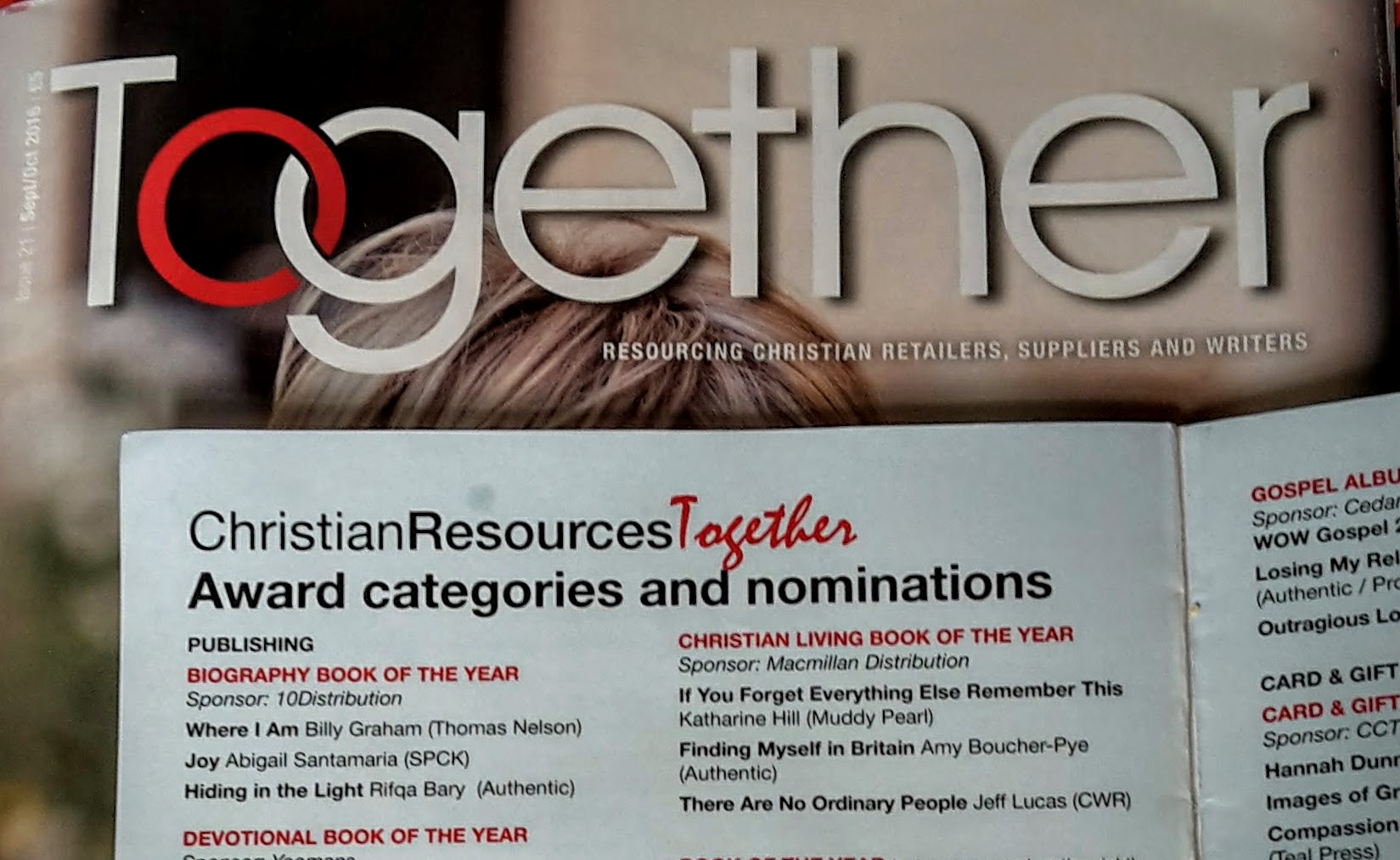 Last week I sat in a darkened room, heart pounding. The setting was familiar, for I had attended the Christian Resources Together gathering many a year previously in an editorial capacity, sometimes thrilled when “my” authors would win awards in the various categories, and sometimes gutted when they were passed over. Last week, however, I wasn’t an editor but an author. And my Finding Myself in Britain: Our Search for Faith, Home & True Identity was up for the Christian living book of the year.

 And then to the design and cover art and copyedit (with a few tears by me over British style – yep, really) and boom, it was time to think about marketing and sales. With the market changing so much and the UK losing probably 150 Christian bookshops over the past five years or so, the author can’t expect the publisher to be their only means of spreading the word about books. I had a wonderful marketing team headed up by Kate Beaton. My publisher was so fantastic with the campaign, not only, for instance, providing point-of-sale materials to bookshops but creating bookmarks and laminated recipe cards as well as giving me a huge sign for the book for my speaking engagements.
 It’s been an amazing journey and as I look back over the past year my heart fills with gratitude to God and to all those who have helped with the publishing and distribution and the getting-the-books-into-people’s-hands. And of course to those of you who have read it! I love how readers become friends as we share in finding ourselves wherever God has placed us.
 In the lower sixth form she came home alternate weekends, and in the upper sixth form, one weekend a month. She left school at nineteen and spent the next three years at a specialist college for disabled students, away all term time. As the time approached for her to leave college I gave God a “shopping list” of what I wanted for her forever home. It had to be in our town – I didn’t want her sent far away. It had to be a small home – she wouldn’t cope in a large environment with lots of residents. And it had to be with young people of her own age. I knew I was asking the impossible – no such facility existed in our town. And then God did the impossible – a fantastic care company moved into town, bought a six-bedroom house and turned it into a small care home for young disabled people. Our daughter was the first person to move in.
 os Bayes has 8 published and 4 self-published books, as well as some 3 dozen magazine articles. She is the mother of 3 daughters, one of whom has multiple complex disabilities, and she currently works for
 After about two weeks’ work I arrived at the house one morning and it was breathing! Not literally, of course, but, with the sun streaming in to all the space I had cleared, I seemed to have set the house free from a crushing weight that had been choking it. What a poignant moment – I longed to share the sense of joy and freedom with my mother- and father-in-law who had not experienced their lovely spacious home like this for many years. There were still enough furnishings in place for the taste and character of the previous occupants to be evident. I felt like an archaeologist rediscovering a long-lost place of wonder when the people I most wanted to share it with were not there.

 Jane
Jane 

 Dave Faulkner is a Methodist minister in Surrey. He is married with two children. He enjoys digital photography and creative writing. His latest blog project is at

 The joys and flaws of my new city and my new house, along with our increasing awareness of our need for help, offer regular reminders that my home, my citizenship, is not finally here. I can live with my family like resident aliens, offering and receiving hospitality, raising my children, serving those around me, and hopefully living as a pointer to the God who, in spite of all appearances, rewards those who seek him (11:6).
 Peter Edman, an editor, is a quality assurance manager with American Bible Society, where he also manages the product line for trauma healing programs now active for adults and children in more than 80 countries and 150 languages worldwide. He lives with his wife and five children in the Germantown neighborhood of Philadelphia. You can reach him at