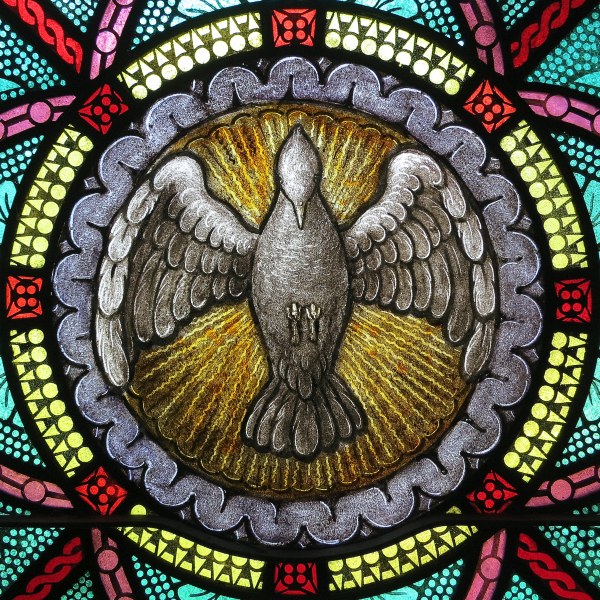
Holy Spirit stained glass window, All Saints Catholic Church, St. Peters, MO, USA
…Walk by the Spirit, and you will not gratify the desires of the flesh. For the flesh desires what is contrary to the Spirit, and the Spirit what is contrary to the flesh. They are in conflict with each other, so that you are not to do whatever you want. Galatians 5:15–21
Paul, true to the tradition of his times, lists a catalog of vices and virtues as he argues for the Galatians to live fueled by the Spirit, not ruled by the flesh. The acts of the flesh that he lists in this week’s reading, and the fruit of the Spirit we read next week, would vary according to the group of Christians he’s addressing. The Galatians were split by infighting as they tried to determine who to follow – Paul or the so-called Judaizers, who wanted to impose their under-the-law practices, such as circumcision. Realizing this context helps us from making these lists an exhaustive catalog.
But the Bible speaks today, and with the context in mind, we can ask the Lord to show us where we are living by the flesh instead of the Spirit. Churches and households at odds with each other don’t bear the fruit of love.
The angry words that flew in a church I heard about left many hurt, outraged, and in pain. Those in lay leadership opposed the minister, and didn’t hold back in their public criticism, calling him deluded and other names. New to church leadership, he admitted that he could have approached the conflict differently. But yet the vicious words and attacks on his character left him reeling.
How can you support your church leaders? You might not agree with all of their decisions, but they need your love and encouragement. Perhaps you could write a note thanking them for something specific you’ve gained from their ministry. You could drop off a bag of food or goodies. If they have young children, you could offer to babysit so they can have a night off.
How will you be led by the Spirit today?
Prayer: Triune God, help me to put to death the acts of the flesh, that I might live led by your Spirit. Glorify your name through me I pray. Amen.
For the entire law is fulfilled in keeping this one command: “Love your neighbor as yourself.” (Galatians 5:7–14)
In the text we’re reading this week, Paul doesn’t shy away from strong language. If it doesn’t put you off your cereal or sandwich, think through exactly what he’s saying in verse 12. Yes, this is no dry treatise, but rather a passionate missive to win the hearts and minds of a community of believers being led astray. Their fruit would wither on the vine as they embraced, step by step, a false gospel.
Paul yearns that the Galatians would live in the freedom that Christ earned for them. They are free from, and free to. Free from the law (but as we said last week, when living by the Spirit, we’ll yet live according to the law); free to love and serve.
Living in step with the Spirit means following the nudges we might sense from God throughout the day. Instead of walking past the acquaintance on the street, pretending we don’t glimpse them, we stop and chat. And hear of their tooth pain and family brokenness, and we pray for them, there and then at the street corner. That’s following the greatest commandment – loving our neighbor as ourselves – out of a loving obedience to God’s whispers. All the while being grateful that we can hear God and share his neverending love.
Other times it’s harder to love our neighbors as ourselves. Perhaps that neighbor is actually our husband, with whom we are annoyed for some earthy and mundane reason. When we put aside our frustration and repent of our harsh words, loudly spoken, we show love and humility. (And how did you guess, I’m writing about myself and my own struggles!)
How might loving your neighbor take shape for you today? Anticipate how God will work through you.
Prayer: Lord God, we confess that we often fail to love as you love. Help us overcome our selfishness as we reflect your attractive love. Amen.
It is for freedom that Christ has set us free. Stand firm, then, and do not let yourselves be burdened again by a yoke of slavery. Galatians 5:1–6
When we think of the fruit of the Spirit, often we will think of this list as found in Paul’s letter to the Galatians. Many a sermon has been preached outlining the fruit, and no doubt, fruit has been borne from those sermons. But we benefit from reading the text within its context. That is, from seeing Paul’s letters for what they are – other people’s mail. What can we learn about the group of Christians he’s addressing? Why is Paul so passionate?
This idea isn’t original to me; it’s been a theme of biblical commentators throughout the centuries. But one modern author has opened my eyes to reading Paul’s letters especially with the recipient in mind: Conrad Gempf in his How to Like Paul Again (Authentic, 2013). I may have edited the book, but when I picked it back up recently I was struck again by how much we gain by gathering knowledge about the Galatians (and Corinthians, Philemon and so on). Knowing the biblical context – learning about the people receiving Paul’s mail – can save us from making poor applications to our lives.
The Galatians had fallen prey to some false teachers who came after Paul. They were trying to convince the new church that Paul wasn’t authoritative, and that to be true worshippers – bearers of fruit – men should undergo circumcision. No, says Paul. You’ve been set free from the law; what matters now is “faith expressing itself through love.”
As New Testament Christians, do we put ourselves under the law? We need to train ourselves in righteousness – through the practice of spiritual disciplines, for example – but we should also experience the freedom and joy that Christ brings. When we live by the Spirit, I’m guessing we’ll abide by the law anyway – but with a different motivator. What do you think?
Prayer: Father God, you loved us so much that you gave your only Son to die for us. Help us to live in your freedom and joy this day. Amen.
I’ve had a bit of a break from posting devotional thoughts, but am delighted to share this one on the fruits of the Spirit. As it’s Lent, the season of preparing for Easter (why should you observe Lent?), it seems appropriate to focus on how God can bring forth fruit in our lives. Thank you for joining me!
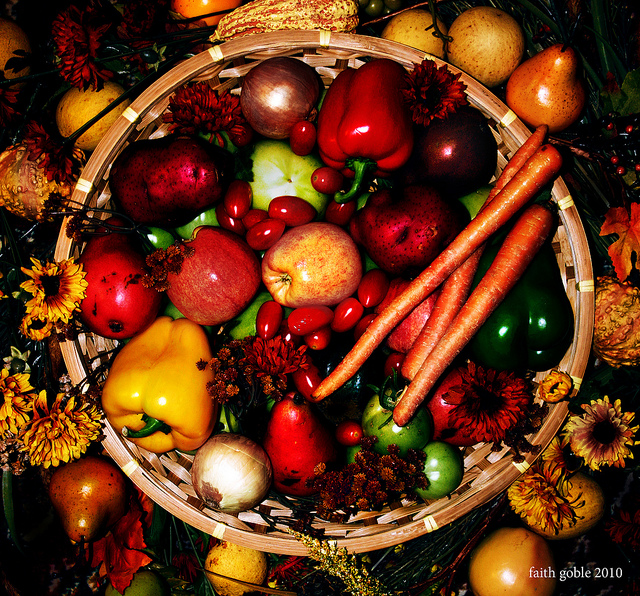
When I lived in Virginia, the church I attended held their yearly retreat in the Shenandoah mountains each September. The weekend was always a special time of fun and growth in the Lord – we’d have a speaker who would teach and stretch us, but we’d also enjoy long walks, side-splitting entertainment, and deep conversations. But an abiding memory from those weekends was seeing and enjoying fruit of various kinds. As it was apple season, we’d feast on crunchy Virginia apples and enjoy apple cider. The spiritual fruits we’d glimpse would also enrich us – the love between friends and family, the serving of others, the joy and goodness in evidence.
During this several-month series, we’ll be looking at the fruit of the Spirit according to the letters of the apostle Paul. I hope as you read Paul’s letters, you’ll sense his love and concern for each of the churches he’s addressing. Try to imagine those to whom he’s writing, each facing different situations and challenges. I’ve roughly ordered the readings according to when he wrote the letters (though probably we should have started with Galatians, but 1 Corinthians 13, the ‘love’ chapter, is a wonderful place to start).
The fruit of the Spirit as appearing in Galatians 5 is what we usually think of when we hear the term. But Paul wasn’t making it an authoritative list of what is birthed in and through us as we live as the new creations in Christ. The naming of vices and virtues, as we will see, was then a common practice. So we should bear that in mind, not making the Galatians passage the cast-iron nine-fold list of the fruit of the Spirit.
Anyway, it’s clear from Paul’s writing that love is the main and most prized fruit, which binds the others together. Love is what motivates Paul when he writes to the new Christians, whether from chains in jail or from his travels among the churches. Love is the reason God created us, and sent his Son to redeem us. Love is what fills and overflows from us as the Spirit lives in us, enabling us to be God’s light in a darkened land.
May we love as we are loved.
By Rob Hille (own work) [CC0]
Love is patient, love is kind. It does not envy, it does not boast, it is not proud. It does not dishonour others, it is not self-seeking, it is not easily angered, it keeps no record of wrongs… It always protects, always trusts, always hopes, always perseveres. Love never fails. 1 Corinthians 13
This chapter in Paul’s letter to the Corinthians is probably one of the most famous in the Bible, alongside Psalm 23. It’s read at weddings (yes, I read it once) and arranged decoratively and hung on a wall. But Paul addressed it to the Corinthian church, not to lovestruck couples. If we look at the two chapters on either side of chapter 13, we see his concern about how they are conducting themselves in worship, and specifically in regard to spiritual gifts. The most important thing is love – not being the star prophet or interpreter of a word of knowledge.
As Paul says, the greatest of faith, hope, and love is love. And that’s what will remain. It’s also the best and most powerful fruit we can grow. I find that the longer I travel the Christian walk, the more love I receive and the more love I am able to give out. A few years ago, this came home to me during the final session of a retreat I was leading in Spain. As I looked across the room at the diverse group of women, I was struck by the charism of love I had for each one of them. I was no longer a scared, unemotional, closed person, but one who loved and was loved. Each day as I don my new clothes of the new creation, God does his work of regeneration, changing me from the inside out.
How do you receive and share love? Who are the difficult ones in your life to whom you find it hard to extend love? (The relative, the friend who betrayed you, your neighbor?) As you read through this familiar chapter again, ask God to show you one person to whom you can show the love that always protects, trusts, hopes and perseveres.
To consider: ‘No one has ever seen God, but if we love one another, God lives in union with us, and his love is made perfect in us’ (1 John 4:12).
Throw off your old sinful nature and your former way of life . . . . Put on your new nature, created to be like God—truly righteous and holy (Ephesians 4:22-24)
I once was treated to a makeover in which a generous friend not only bought me gorgeous clothes, but arranged for a swanky haircut and new makeup. Giggling and thanking her, I swished around my stylish tresses. My friend knew I had recently made some life changes so that I could better follow Christ and wanted to celebrate by helping me feel beautiful not only on the inside but on the outside too. It was a truly special moment. I knew that those who follow Jesus don’t need a makeover to reveal God’s presence to others, but my friend’s gesture gave me a visual reminder that when we submit our lives to Him our lives are transformed.
“Christ with me, Christ before me, Christ behind me, Christ within me, Christ beneath me, Christ above me, Christ at my right, Christ at my left . . .” These hymn lyrics, written by the fifth-century Celtic Christian St. Patrick, echo in my mind when I read Matthew’s account of Jesus’s birth. They feel like a warm embrace, reminding me that I’m never alone.
Advent is a time of waiting and welcome. Waiting for the coming King, not only to celebrate his coming as a baby but for him to come again. Welcoming as we make room for him in our lives, a laughable thought for many as we juggle carol services, baking tasks, shopping for gifts… But some days we need snow days, like many in the UK have experienced, to make us slow down and ponder what this season is all about.
I am delighted to share another acrostic poem, following yesterday’s offering. This one is by another Amy, she a gifted storyteller and writer (Amy Robinson). You can view her wonderful poem that is a Christian take on the Santa story, inspired by the famous poem by Clement C. Moore, on her Facebook page – don’t miss it!
Here’s Amy’s acrostic poem as inspired by Mary’s song of praise to God, known as the Magnificat. Mary visits Elizabeth who is also pregnant, and when Elizabeth praises her for her great faith, Mary responds with her wonderful song. You can read the whole story in Luke 1.
My soul magnifies the Lord,
And my spirit rejoices in my saviour!
Generations will call me blessed,
Naming God as holy and mighty.
In strength he has scattered the proud,
Fed the hungry and left the rich empty.
Israel will see his mercy again.
Children of Israel, you know what he promised our fathers,
Abraham and his offspring for ever?
This is happening now.
How do you mark the season leading up to Christmas? It can be a mad and crazy time of parties, shopping, church services and baking. So much so, that we lose the reason for the season, to use that slightly cringey American phrase.
One Advent, in my quest to consider the season’s true meaning, I followed a Bible reading plan that moved from the Old Testament to the New as it revealed God’s greatest gift, his Son Jesus. As I played around with the biblical text, moving words here and there, some poems emerged. If you like to write, maybe you could do something similar this year for an Advent practice. Of course, you may not like writing at all – in which case, I trust you’ll find just the right thing to keep the gift of Jesus before you.
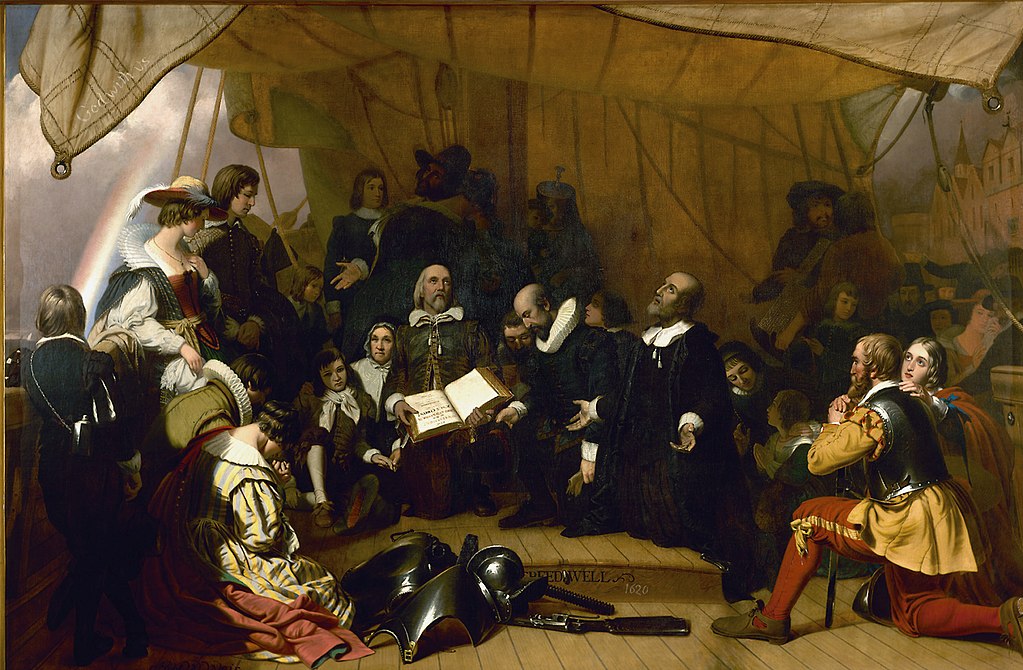
Embarkation of the Pilgrims, by Robert W. Weir; photograph courtesy Architect of the Capitol
So then, just as you received Christ Jesus as Lord, continue to live your lives in him, rooted and built up in him, strengthened in the faith as you were taught, and overflowing with thankfulness. Colossians 2:6–7 (NIV)
The Pilgrims, devout in their faith, left England in 1608 for Amsterdam in search of religious freedom. They lived there twelve years before the foreign culture wore them down and they decided to head for the New World. Their journey on the Mayflower was desperate. The ship was designed for carrying cargo, not passengers. And the cabin where they slept was intended for thirty people, not eighty. Their food rotted and was infested with insects; they nearly drowned when the ship’s main beam cracked; they endured ridicule from the sailors.
When they arrived in the New World, the Pilgrims still faced challenges – building dwelling places, growing food, caring for the sick and dying. But in all things they gave thanks, and observed a full day of Sabbath each week. And they decided to have a Thanksgiving feast. During this three-day celebration, they gave thanks for their food, seven houses built, a peace treaty with the Native Americans and most importantly the freedom to worship God. The women cooked, the men played games and they all shared stories and gave thanks.
And so the heritage of Americans, who for one holiday at least eschew commercialism and come together on this day to enjoy good food and one another. Many Christians keep up the tradition of sharing stories of thankfulness around the table. And with the telling and the listening, they become strengthened in their faith, as we see in the Apostle Paul’s letter to the Colossians.
The challenges we face will differ from those of the Pilgrims. But we can follow their example of devotion to God, taking risks, reaching out to different people and taking time to celebrate and give thanks. We may not be eating turkey today, but we all can take a moment to “give thanks to the Lord for he is good” (Psalm 107:1).
For reflection: “When he was at the table with them, he took bread, gave thanks, broke it and began to give it to them” (Luke 24:30).
How lovely is your dwelling place, Lord Almighty! My soul yearns, even faints, for the courts of the Lord; my heart and my flesh cry out for the living God. Even the sparrow has found a home, and the swallow a nest for herself, where she may have her young – a place near your altar, Lord Almighty, my King and my God. Blessed are those who dwell in your house; they are ever praising you. Blessed are those whose strength is in you, whose hearts are set on pilgrimage. Psalm 84:1–5 (NIV)
Living as an American in the UK, for me high days and holy days bring not only joy but a corresponding ache as I’m away from family and friends. But I experience the most profound longing on Thanksgiving, which this year is next week on Thursday. I feel the loss of the nation gathered to feast around a table heaving with turkey, stuffing and gravy and of enjoying the friendship and lively conversation that ensues. Of course I understand why my now-countrypeople don’t celebrate this holiday – after all, the Pilgrims were giving thanks for escaping religious persecution in England. And such is the friendship between the countries now that we attend a service at St Paul’s Cathedral each year. And yet the longing remains.
Living today, I enjoy a mobility never imagined by the Pilgrims. My seven-hour airplane ride is a blip compared with their five-month journey across the choppy Atlantic in 1620. After they survived their first harsh winter, they invited the Native Americans who had helped them acclimate to join in a three-day feast of Thanksgiving. And so the tradition began, being solidified when in 1863 President Abraham Lincoln declared a national day of Thanksgiving each November.
Psalm 84 reflects the greater ache that all pilgrims harbor – for sweet fellowship with God. Our experiences of love, community, belonging, and celebration are rooted in his character. And our longings for these experiences are a harbinger of what is to come when we are reunited with God in heaven.
For reflection: “He anointed us, set his seal of ownership on us, and put his Spirit in our hearts as a deposit, guaranteeing what is to come” (2 Corinthians 1:21-22).
I write about these longings and how I found God, and myself, in Britain in Finding Myself in Britain: Our Search for Faith, Home & True Identity.




 Read:
Read:  “Christ with me, Christ before me, Christ behind me, Christ within me, Christ beneath me, Christ above me, Christ at my right, Christ at my left . . .” These hymn lyrics, written by the fifth-century Celtic Christian St. Patrick, echo in my mind when I read Matthew’s account of Jesus’s birth. They feel like a warm embrace, reminding me that I’m never alone.
 Advent is a time of waiting and welcome. Waiting for the coming King, not only to celebrate his coming as a baby but for him to come again. Welcoming as we make room for him in our lives, a laughable thought for many as we juggle carol services, baking tasks, shopping for gifts… But some days we need snow days, like many in the UK have experienced, to make us slow down and ponder what this season is all about.