Category: Christian life

  • The Wailing Wall (including The Secret Life of Bees)

    After the horrible news of terrorism in Paris and Beirut, I thought it fitting to put a link to an article I wrote on the Wailing Wall. Lord, have mercy.

    The wall we used as our wailing wall in Spain.
    The wall we used as our wailing wall in Spain.

    Do you feel the need to weep and mourn at times? That you need a safe place to let out your heartbreak, angst, and disappointment? The Western Wall – known commonly as the Wailing Wall – in Jerusalem has served as such a space over the centuries. It’s a surviving remnant of God’s Temple and was the spot closest to the Holy of Holies – that place where God’s presence dwelled. Jewish pilgrims who journey there pour out their hearts and prayers to the Lord.

    I thought about the Wailing Wall recently as I led a book club retreat in sunny Spain. With palm trees, cacti, and citrus trees in the background, we met around the pool, chatting through the books I had selected for the week and engaging with related spiritual exercises. The setting was idyllic, fostering deep conversation about the books we’d read, one of them being The Secret Life of Bees by Sue Monk Kidd.

    Perhaps you’ve read it or seen the film adaptation. Set in the American South during the sixties, it features the protagonist, Lily, a white girl on the cusp of growing up. With her nanny Rosaleen, she escapes her abusive father in the quest to find out more about her mother, who died when she was four years old. They end up in a house the color of Pepto-Bismol where a group of black sisters keep bees and observe religious practices based on a black Madonna.

    Parenthetically, I should mention that I’m not recommending the theology as expressed in the novel – it’s not Trinitarian and deifies a folk legend based on Mary. But as Christians we can and should engage with what we read critically, weighing up what we agree with and what we don’t – a bit like my book club did as we discussed the novel by the pool.

    Read the rest at The Kingdom Life Now magazine.

  • Longing for Home

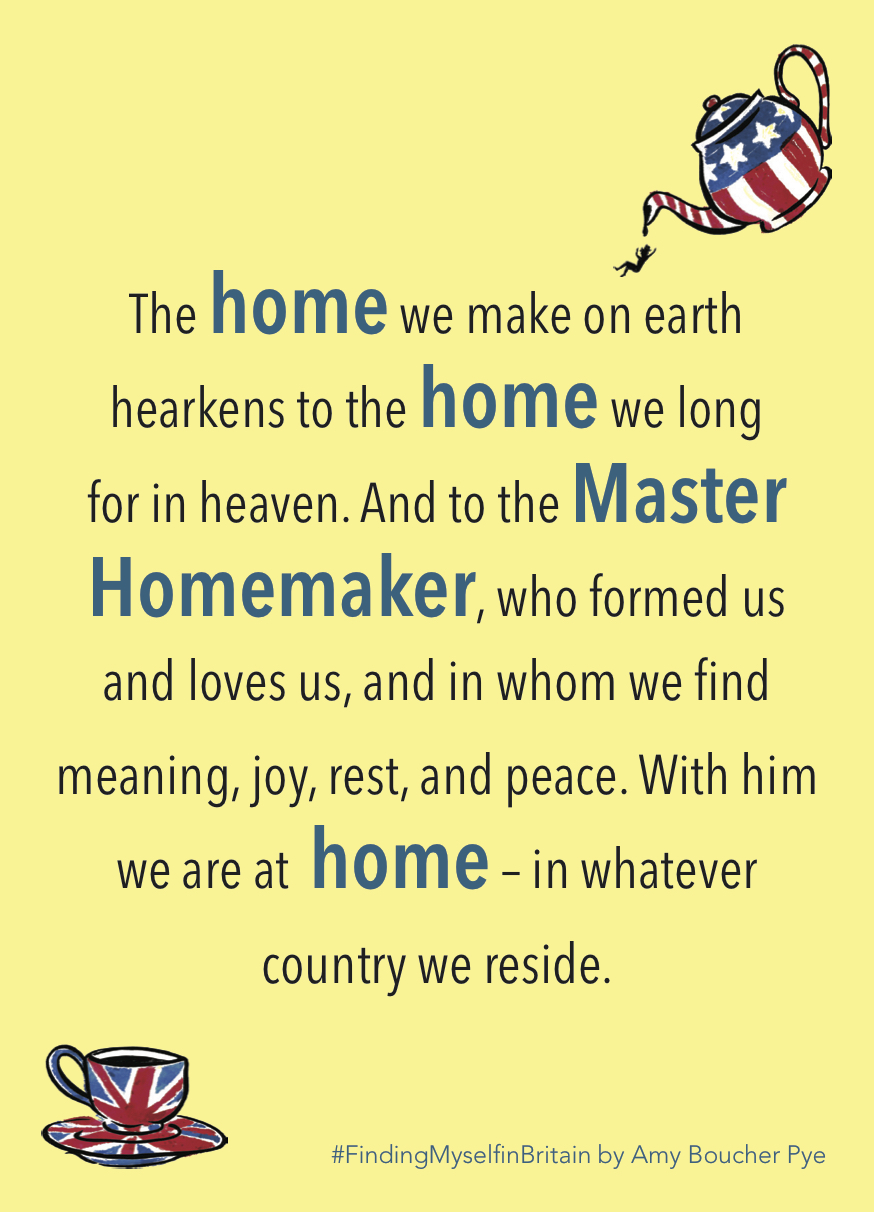
    FMIB Quotes 1 & 2_Proof 2 jpegA recurring theme in Finding Myself in Britain is the longing for home. What is home? How do we find or create it? What do we define as home?

    When Nicholas and I first married, we agreed to call the place where we were living “home.” Not only did this help us in the biblical injunction of “leaving and cleaving,” (leaving one’s family of origin as a new family is created) but it aided us emotionally. If someone asked me, a newcomer to the UK, when I was “going home,” I’d say, “I am home! But I have a trip to the States planned in…” The words we use can help us define our emotions – we sometimes have to educate our feelings.

    Home is a lovely concept – I think of my parents’ home in Minnesota, which although isn’t my home any longer does feel like home, with its lack of clutter and ultra clean space to feel comfortable in while chatting to my family, or the screened-in porch in which to sit and watch the passing deer and wild turkeys (yes in the suburbs of St. Paul!). Or I think of the top floor of a house in Philadelphia where dear friends lived while studying at Westminster Theological Seminary, where I spent many a Thanksgiving. It was only two rooms – and the dishes were washed in the bathtub – but the rafters reverberated with refrains of songs and laughter. Or I remember the historic (for America) house I worked out of for many years and the lovely family who dwelled there, complete with my favorite black lab/golden retriever. On this side of the Atlantic, I picture the homes of dear friends and the meals shared around their tables.

    I could continue in my list, but these places are personal and won’t evoke the feelings of home in you that they do in me. But a common theme of these places where I’ve felt at home lies in the people who make them homey – their welcome, love, grace, and open hearts. They who follow the Master Homemaker bring his kingdom to earth in the homes they create here.

    Where do you find home?

  • Losing our lives to find them – Sermon on Matthew 10

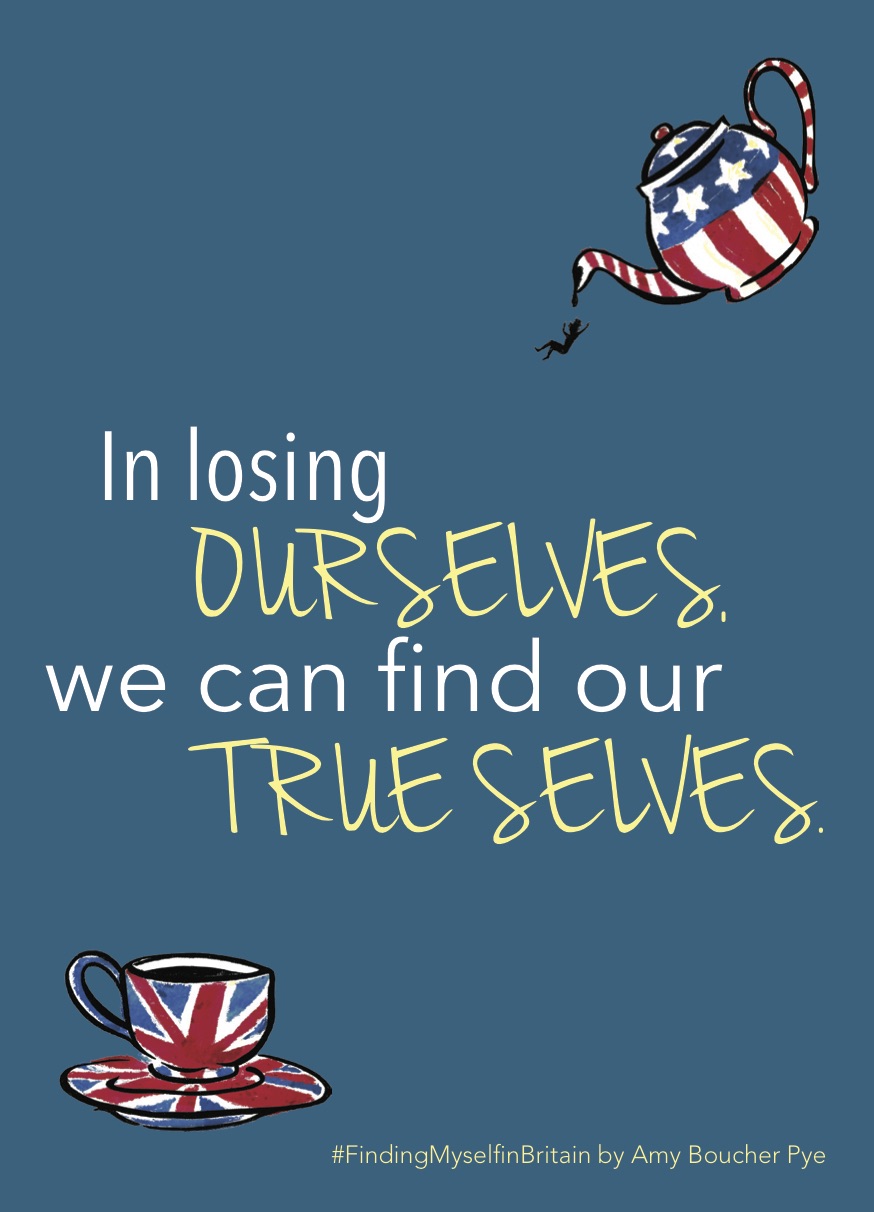
    FMIB Quotes 1

    How we find our lives when we lose them… the subject of the sermon I gave at our church at the book launch on Sunday, 27 September. Have a listen; I’d love to hear what you think.

  • Strengthening our Vision: How my son’s eye challenges made us stronger

    The sticker is actually a bit creepy considering that the clown's eyes are crossed out.
    The sticker is actually a bit creepy considering that the clown’s eyes are crossed out.

    A simple sticker, but when I saw it, the memories came rushing back. I had unearthed from the loft (US: attic) a bunch of mailing envelopes to send out my book in, which CutiePyeGirl found intriguing. In the midst of them she found this little sticker and presented it to me with a flourish. When I saw it, there in my mind’s eye was PyelotBoy, three and four years old, walking out of the Royal Free Hospital, having survived another eye appointment. Our consultant was amazing, but the drops hurt him, and my heart always tugged at those meetings about his eyes.

    PyelotBoy has faced some physical challenges, including his eyesight. One of my dear friends – who herself had a squint (US: lazy eye) and two surgeries in her childhood to correct it – reluctantly approached me when PyelotBoy was about two years old, asking when we were going to get his squint looked at. She didn’t want to interfere, but she knew more than we did that it needed attending to. I had noticed it, of course, but just thought it was an eye that sometimes turned in, an affliction that appears in both my maternal and paternal families. I’m so grateful for her gentle question, however, as we got an appointment right away and found out that his squint very much needed attending to. The weak eye, if not strengthened, would lose its ability to see. (Spiritual application alert!) He would also eventually need surgery to move the muscles around in both eyes to straighten them out and have them working right.

    So much for us as new parents to take in during those appointments. Our fantastic consultant we got originally through what was then called St Luke’s Hospital for the Clergy, an organization that provides healthcare for clergy and their families to which medical people (often Christians) donate their services. We didn’t need to be pushy advocates for PyelotBoy because Miss Davey went out of her way to give him the best treatment available. (And I learned throughout the years why she’s called “Miss” Davey – for me as an American I thought it odd, and would rather call her Dr Davey. But the Miss signifies that she’s a surgeon, so is actually a higher designation than Dr. Interesting!)

    The things one finds squirreled away in the loft!
    The things one finds squirreled away in the loft!

    We had years of appointments and years of those stickers. Years of PyelotBoy reading first the charts of pictures of familiar objects (and yes, a teapot featured) and then letters when he had learned them. Years of PyelotBoy wearing a patch over his strong eye for hours in order to strengthen the weak eye. The enduring for him and us of his eye surgery, which Miss Davey performed so well – she even gave me a hug in the operating theatre after the anaethitist put him to sleep, for I promptly burst into tears at the sight.

    So when I saw that sticker, so many memories came flooding back and I felt tender and grateful. Sad that PyelotBoy had to endure those trials, but proud of him for the way he met them, one by one, with courage. Like his eye, which was strengthened over the years, he’s stronger and more resilient in character.

    How have you been strengthened through trials?

    Note: Posted with PyelotBoy’s permission.

  • Finding Myself in Britain – School Days

    PyelotBoy graduating from primary school.
    PyelotBoy graduating from primary school.

    GCSEs? A Levels? Ofsted? Kids in uniform and starting at the age of four? These were some of the foreign-sounding words and concepts to me as an American with kids in British schools. In fact, there were enough differences that I’ve included a chapter in Finding Myself in Britain (coming soon!) on the topic. But I didn’t include anything about secondary school, because when I was writing I had scant experience with it. Now that PyelotBoy has launched from primary to secondary, however, I am forming a few impressions.

    The main one has to do with his growing independence. Whereas I can clearly picture the setting of the kids’ primary school, with its familiar and friendly teachers and staff, PyelotBoy’s secondary school is much more hazy. I haven’t yet met any of his tutors; nor can I picture him very well in the dining hall or in one of his classes. Besides the first day of school when I dropped him off – with him eager and antsy to get out of the car – he’s made his way to and from school on his own. He’s making new friends and becoming more responsible.

    This independence is right and what I desire, and yet so very poignant. As pictures of him as a toddler and young boy flash across my screen saver, I sigh and smile. We parents have such a short time with our kids – I know the days (and nights) can feel long but the years go by quickly, in that well-known saying.

    And so as PyelotBoy launches into year 7 and secondary school, I breathe a prayer and give thanks for the young man he is becoming.

    If you’re a parent or aunt/uncle or caregiver with a child who has made it through secondary school, what advice would you give?

  • Some Gleanings from a Christian Publishing/Retailing/Suppliers Gathering

    I’m back from two wonderful but intense days at Christian Resources Together, a gathering for people in the Christian publishing, supplying, and retailing industry – and yes, that includes content creators such as writers. I’ve been in the Christian resources biz for over twenty years, nearly 18 of those in the UK. So for me it’s a rare time to see, greet, and hug familiar faces from the past (a few mates were playing STL Bingo during the award ceremony, which hints at their affection and humor, and will only mean anything for those in my industry).

    This year was special because I moved officially from “publisher” to “author.” I’ve loved being an editor, launching all of those wonderful Christian books out into the world to be ambassadors for God’s good news. And I grateful now to be one of those authors too, with her baby arriving in the world. For Finding Myself in Britain was shipped directly from the printer to the conference centre, as the official launch doesn’t arrive until the first of October. In fact, my publisher, Steve Mitchell, saw it first there. For me, the feeling was surreal to walk into my room in Swanwick and to see my book there on the bed, complete with chocolate for the participants to savor and enjoy.

    Fuzzy photo of The Book greeting me. Surreal! Wonderful! Yes, a ghastly bedspread!
    Fuzzy photo of The Book greeting me. Surreal! Wonderful! Yes, a ghastly bedspread!

    I was captivated by Bishop John Pritchard’s talk in particular. Here are some of his quotes, worth pondering:

    “God doesn’t know how to be absent.”

    I agree, but many people feel the absence of God when they go through tough times. Do you find this a challenging or encouraging statement, or somewhere in between?

    “In the Bible, water is always dangerous to the Jewish mind.”

    I never knew this, and want to do some biblical investigation. What about Proverbs 25:25, “Like cold water to a weary soul is good news from a distant land”?

    “Pray, but not as though God is an outsider. He’s here.”

    Yes, I love this, and sense the influence of Tom Wright.

    I also learned that Thomas Hardy became disgusted at the reaction to his novels so he gave up writing them and turned to writing a poem a day. Many are pedestrian, but some are brilliant. Hmm; maybe I should try to write a poem every day. I did that during Advent last year, and loved it. I learned other things too, but those nuggets seem worth sharing.

    Lawrie Stenhouse, Authentic Media's fab sales guy.
    Lawrie Stenhouse, Authentic Media’s fab sales guy.

    I came away exhausted but encouraged. What heartened me the most was the family-like atmosphere, with the organizers Mandy and Steve Briars called the “grandparents” of the group. How wonderful that we can laugh together and enjoy one another’s company, especially when times in the Christian resources business have been so tough.

    If you went to CRT, what were your impressions?

  • The Kingdom of God is like…

    …a handwritten letter

    20150812_114311-2Every Sunday without fail, my mom will pause to write letters to her two sisters (and when her mother was alive, to her). And they to her. They used to pen their letters by hand but now write by computer – but they print them out and mail them each week. For part of the joy is in the ritual: addressing the envelopes, applying the stamp, putting the letters in the post. And receiving “real mail” each week. Indeed, so regular is the practice that the postal people worry when they don’t see the two letters appearing on Wednesday or Thursday with the daily assortment of bills and junk mail.

    Whenever I visit my parents, I read the weekly letters. My Aunt Carole’s are filled with her wit and quips (she the youngest of four); my Aunt Judy’s drip with wisdom and observations of life on the farm (she the eldest). I don’t know what my mom – middle child – puts in hers, as of course her letters aren’t lying on the kitchen counter for me to read like my aunts’ are.

    These letters remind me of the Kingdom of God. They may not ooze with emotional declarations, for… [read the rest at Accidental Devotional here]

  • Books and Friends – An Interview with Debbie Duncan and Cathy LeFeuvre

    Here’s an interview that ran in Woman Alive previously from when I chatted with two great friends – Deborah Duncan and Cathy LeFeuvre, who bonded during the morning commute. Their friendship inspired a fictionalized account of two friends who become a life line to each other. Life Lines is published by Authentic Media.
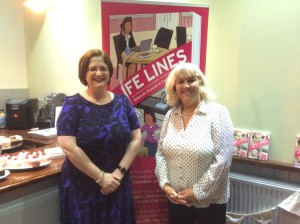
    Debbie and Cathy-1During our journeys to work together, we talked about not only the day-to-day stuff, but we also began to chat about things that had happened in the past. We laughed – a lot – about some of the ridiculous things that had occurred in both our lives. We started a private blog where we shared more stories and became more creative, making up stories as well. Suddenly, we found we had 20,000 words, some fantastically funny anecdotes which also had some kernels of depth, and we had created these two fictional friends – Louise and Esther. We had the foundation for our book.

    Although many of the stories were birthed in our imagination, some are based on reality. Believe it or not, the very first story in the book – where Esther writes to Louise about the previous evening’s most hideous ‘Christian Singles Night’ is based on a real evening, with lots of embellishments, of course.

    And there is another story in the book where Louise attends a church event (not at her church) and attempts to get one of the leaders to talk to a woman who obviously wants to know more about the Gospel. When she approaches a male leader to ask if he will speak to the woman, he looks at Louise and says ‘You’re a woman…!’ Implying that he, as a man, is ill equipped to talk to a female about Jesus. That, unfortunately and bizarrely, is also based on a true incident.

    A key to a really great friendship is shared experiences and often shared values. Even if you’re separated by geography, it’s important to keep in touch. That’s why sometimes, even if we haven’t seen our great friends for a while, we just pick up where we left off.

    Women talk. That’s a reality! We talk to each other about lots of things that are happening to us, and we share confidences and troubles, fears and joys. Sometimes there are things that women can only share with other women, without being misconstrued or misunderstood. It doesn’t mean we don’t share with the men in our lives, but most women will recognize the importance of female friends. Louise and Esther are two such friends!

    Admittedly some of their confidences are rather over-egged and exaggerated for literary effect, but at the heart of Life Lines is the truth that when one has a friend or friends with whom you can truly share, some of the bad stuff we encounter in life doesn’t appear so awful after all.

    Being a good friend involves accountability. Sometimes it’s only your closest friends who can tell you just how irrationally you may be behaving. In Life Lines, when Louise begins to behave irrationally over the matter of some fair trade chocolate eggs, it’s up to Esther to tell her just how mad her behaviour is, but in such a way that Lou doesn’t fly off the handle but sees just how hilariously weird she has become.

    They say a problem shared is a problem halved – well that’s true. In the case of Esther and Louise (and Debbie and Cathy) a problem laughed over also helps a great deal. Sharing things that happen to us helps to put situations into perspective; it helps us to see the big picture outside of the small hurts and gossip that unfortunately pervades even in church. And when wonderful things happen, it’s fantastic to have someone with whom to celebrate.

    True friendship is not a competition. Some friends may feel possessive, which can be difficult. At times, friendship is one sided, with one friend having to do all the hard work. If we’re losing friends, then maybe we’re the one who always expects our friends to contact us.

    Being a friend means being sensitive to the needs of others. In Life Lines there’s the story of Sue who asks Esther if she can borrow her unused wedding dress – unused because Esther has just been dumped! That (fictional) story, and others, reveals how best not to do friendship, and how not to become so obsessed with your own world that you forget that others around you are hurting. That blinkered type of friendship, when it is all about you and not the other person, is probably not a friendship at all.

    Social media can help us be a better friend – by staying in touch. It’s very easy to send messages and have conversations that way. But remember, no amount of social media status updates can replace face to face meetings. Or phone calls where we hear each other’s voices.

    Even though one of us is married and the other is not, we have so much in common. It’s great to have a friend whom we can unburden to at times, and encouragement is a very important part of our friendship. Laughter is often the way we handle this – seeing the funny side of a situation sometimes is a great help. We also pray together, which is fantastic encouragement. For we’re both Christian women seeking to find God’s will for our lives.

    Of course, being married and being a mother brings a whole host of responsibilities and being a single also has its challenges but ultimately we believe God has a purpose for each one of us outside of our personal relationships or status. God does not define us by our marital status, even if church and the world sometimes does. We try to encourage each other to be the person God wants us to be … for ourselves.

    Ultimately, true friends will remain close – no matter what is happening in their lives!

  • The Bible: God’s Word for Life, Love, and Change

    Photo: Savio Sebastian, flickr
    Photo: Savio Sebastian, flickr

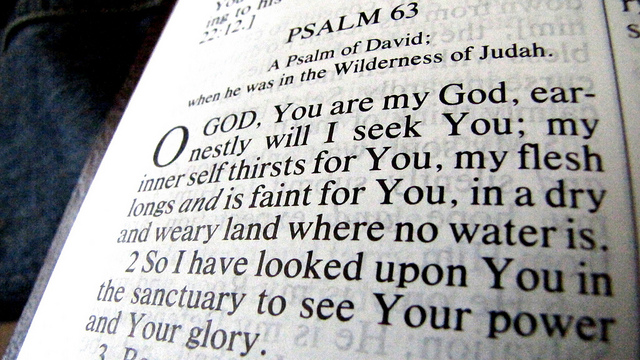
    Today I have an article on Sacred Reading over at the Kingdom Life Now magazine. Here’s a taste.

    Recently I led an exercise of meditative reading of the Bible. Four times I read the passage of Isaiah 43:1-8 with instructions to the women with a different emphasis in engaging with the text each time. About a month later, I was humbled to hear from one woman about how God spoke to her through the exercise. She said how she and her husband had been to Brunei in Southeast Asia a couple of weeks before the conference in Somerset, England, to visit their daughter and family (including three young grandchildren), who have lived there for the last seven years. While there, she learned that her son-in-law decided to apply for teaching jobs in Belgium, Singapore, and Oman. With Belgium being far closer to home, she and her husband were hoping this would be their final destination. She said,

    When you read Isaiah to us the only sentences that I heard were verses 5 and 6, where it says, “I will bring your children from the East and your daughters from far-off lands.” How relevant to me were those words and I held onto them as a promise to me from God – that He was telling me that my son-in-law would get the job and my family would come close. I was so convinced that I told others what God was saying. So imagine the great joy when we heard on that he had been offered the job in Belgium and they were to start in September! No more 17 hour flight to see them! God truly had gathered my children from the East and my daughter from a far-off land.

    She said that although before my talk she had never heard of lectio divina – a Latin phrase for the act of sacred reading – but now she had come across it several times.

    Change Agent

    This ancient practice of a slow, contemplative praying of the Scriptures moves what can be a merely rational process deep into one’s heart, for as we chew over a piece of Scripture, it sinks into our being. We begin to slow down, receive, and make a personal response. Continue reading.

  • “Consider your death” – Ash Wednesday reflections

    8617719091_25b9ef118a_z“Whenever the journey to Easter begins, it must always begin right here: at the contemplation of my death, in the cold conviction that I shall die.” (Walter Wangerin, Reliving the Passion, p 21)

    Sobering words for the beginning of Lent. Even more sobering as I consider the deaths of two people, one whom I’ve never met and one who has played a considerable influence in my life. The one I’ve never met is the 26-year-old nephew of a friend. Newly married, he collapsed recently and is near death. My heart breaks for this family I’ve never met; for the bride at the beginning of their married life, with so much to look forward to, who now may feel like her plans are crumbling into dust. Where tears will replace a warm embrace. I cry out to the God of hope.

    The other person near death is Leanne Payne, an amazing woman who was active in healing prayer, and for whom I edited Listening Prayer and her spiritual autobiography, Heaven’s Calling. She poured love and care into my life, calling forth in me a language to communicate with God as she helped me to find the vocabulary in which to speak and listen to my Creator, my Friend. Our early morning phone calls (she would routinely wake at 4 am for her time of prayer, and my 7 am phone call would be well into her day) would fill me with laughter and hope as we would talk through not only her writing but my hopes, dreams, and relationships. She helped me grow up in Christ, and the debt I owe her is massive.

    So I ponder with Walt Wangerin death at the start of Lent. The coming death of two people; the death of our Lord for us; my own death. As this gifted writer says at the end of today’s reading, “When we genuinely remember the death we deserve to die, we will be moved to remember the death the Lord in fact did die…. We will yearn to hear the Gospel story again and again, ever seeing therein our death in his, and rejoicing that we will therefore know a rising like his as well.” (p 22)