Author: Amy Boucher Pye

  • Devotional of the week: Psalm 18:4–7

    Deadly cords and snares

    The cords of death entangled me; the torrents of destruction overwhelmed me. The cords of the grave coiled around me; the snares of death confronted me. In my distress I called to the Lord; I cried to my God for help. From his temple he heard my voice; my cry came before him, into his ears. The earth trembled and quaked, and the foundations of the mountains shook; they trembled because he was angry. Psalm 18:4–7 (NIV)

    As David continues his song of thanksgiving, he recounts how God has saved him. His imagery is gripping: death, destruction, and the grave. He speaks of the ensnaring cords that circle him, trap him and knock him to his knees. The torrents of destruction spark images of floods of rushing, swirling, deadly water.
    freeimage-4136724-web
    © Akarelias | Dreamstime Stock Photos & Stock Free Images

    But he calls to the Lord for help and his voice is not ignored. Yahweh in his heavenly abode hears the cry of the oppressed. He who is all-powerful and all-holy makes the earth tremble through his anger at injustice.

    The Lord wants to save us from any binding cords. They may be the pain of a friend’s betrayal; disease that wastes the body and taxes the mind; the depression that feels like a suffocating cloak. Or they may be the fear of failure; a crippling lack of self-confidence; an addiction to comfort eating, shopping, sex or other self-soothing behavior.

    In our fallen world there aren’t always easy answers to the litany of the snares of death. But our God is the champion of his people, whether or not the cords are of our making. He’s not locked away in a distance palace, but when we cry out, as David did, our voice reaches his ears.

    And he responds. Sometimes he shakes the earth with his anger, like Jesus raging against those selling cattle and exchanging money in the temple. Or he is a rock in turbulent times, as we saw last week. Or he sends healing, like that heralded by the prophets Isaiah and Jeremiah (see Isaiah 58:8 or Jeremiah 33:6) or that enacted by Jesus as he healed the lepers or the hemorrhaging woman.

    Like David, we can cry out to God, for he hears us and will free us from our cords of death.


    Prayer: Lord, the waters are rushing over me. Come and rescue me; hear my cry.

  • What do you get when you mix a retreat and a holiday? A holi-treat…

    When I think of retreat centers, the images that come to mind are draughty convents with sparse rooms and stodgy food. Places to meet God, but not necessarily somewhere that allows you to relax fully or feel pampered. But recently I enjoyed a week’s retreat at El Palmeral in Spain, which blew away any preconceptions of a retreat entailing suffering for the Lord. It was more of a “holi-treat,” a delightful fusion of a retreat and a holiday (or maybe even a “holy-treat”!). We certainly encountered God, but we also soaked up the Mediterranean sun, splashed in the pool, feasted on glorious Spanish cuisine, and even hooted with laugher during a group film night. (The Blues Brothers – after all, they were on a mission from God.) I hasten to add that the introverts were free to escape to their room or to a quiet place in the grounds for their needed space.

    pool day (2)DSCN6131DSCN6090-001DSCN6154

    Our focus for the week was “Adventures in Prayer,” so we engaged with different types of communication with God – confession, listening prayer, practicing the presence of God, and walking the labyrinth among others. I may have been leading the retreat, but I gained so much, not only from the guests, but from the Lord as I received peace, love, affirmation and direction during the times of individual reflection.

    One of the unexpected gifts was the rhythm of Celtic Daily Prayer (as produced by the Northumbria Community) in the morning and evening, led by our hosts, Julie and Mike Jowett. I loved meeting in the outdoor chapel, sitting before the simple table with its cross, candles and intricate lace tablecloth. Praying the lilting words and listening to the sung liturgy was rich and meaningful. I especially appreciated the added aspect of community that the Prayer Pot afforded. Each morning we’d select three slips out of the pot, which was filled with the names of those who had journeyed with Palm Grove Community as a volunteer or a guest. We’d pray for them, trusting that God knew their needs. Interestingly, some of the names kept being selected again and again. Julie said that when that happened, they would contact the person to see if they needed prayer for something specific. More often than not, the timing was amazing with something significant going on in their lives – as we experienced several times during our week.

    The beauty of the Mediterranean surroundings fed my soul too. I came downstairs on the first morning, camera in hand, eager to capture the some of the interesting plants in the grounds. As I left, I heard Julie say to Mike, “Look, they’ve bloomed! We have three blooms!”

    I didn’t know what they were speaking about, and went off wandering in the garden to take some photos. I especially enjoyed snapping close-ups of the date and olive trees as I marvelled at the interesting patterns in the cacti and other vegetation. But I was most taken with the gorgeous flowers on the tall cacti trees, and shot them from many different angles. DSCN6103

    Later I showed Julie the photos. When we came to the cacti, she said, “You know those flowers only last a day!”

    I was stunned. What an image of God’s extravagance – that he would create such a thing of beauty that remains only for a day, on a plant that might flower just once a year. As I pondered this bountiful yet fleeting gift, I thought how it reminds us to live in the present moment. Not to squander the majesty or wonder or delight of what surrounds us, but to stop and be fully present. And to give thanks to the One who created the beauty, who is our source and life.

    Now when I think of retreats, El Palmeral comes to mind. I think of warming sunshine and the sparkling water of the pool. Swimming in the morning before the activities of the day. The neighbour’s cats coming over to be fed. The rustic outdoor chapel for worship and communion. The well-stocked library for intellectual stimulation. The dry air that warms the bones of a chilled dweller of the UK. The garden sporting its labyrinth and rendition of Golgotha. And not only the physical features, but the love and community that El Palmeral exudes in the warmth of the welcome and the feeling of acceptance it offers. The bonding through the sharing of good food and drink – the tasty Mediterranean dinners with the space for meaningful conversation. And above all, the setting which affords a deep communion with God.

    The perfect place for a holi-treat.


    I’m leading my “Adventures in Prayer” retreat again: 16-20 September 2013. Click here  for more details, and for information about the retreats by such stellar speakers as Adrian and Bridget Plass and Jeff and Kay Lucas (currently taking place).

    I’ve adapted this post from an article that appeared in Woman Alive, April 2013.

  • Jesus loves the little children…

    Tanzania
    The view from our Land Rover.
    Looks like we’ll wait a bit…

    We were driving along a dirt road in Tanzania, making our way from the lush game parks to dusty Dodoma, the political capital. It was the dry season, so the roads were passable, although filled with potholes bigger than a small child. Our hotel had packed us some lunches in nifty boxes – breaded meats, packets of nuts, and the sweet small bananas I had never tasted from a Western supermarket. With adult-sized lunches packed for our two small children, we had the equivalent of one lunch leftover.

    After an hour or so of the bumpy journey, our driver saw a clump of children by the side of the road and asked if we could give the excess food to them. “Why yes,” we exclaimed, embarrassed that we hadn’t thought of it ourselves. We slowed and I opened my window, motioning to a little boy. I pointed to the box and asked him if he’d like it, knowing that he wouldn’t understand English but not knowing how to communicate except through words and motions. Then I asked if I could take his photograph, showing him my camera.

    Tanzania 2
    The boy holding our leftovers from lunch.
    What was he thinking?

    How I wished I could have understood what he was saying, and to hear what his life was like, a little Maasai boy perhaps owning only the clothes on his back. Jesus loves him as much as he loves my boy, who has more shirts than he can wear and more food than he can eat.

    Jesus loves the privileged; Jesus loves the poor. His love for us is so all-encompassing and overwhelming that we may struggle to comprehend it. But look at how Jesus shows his love as recorded in the Bible. For instance, one day people were bringing their children to Jesus, asking him to bless them. But the disciples got angry and rebuked the parents. Jesus was indignant, however, saying to the disciples: “Let the little children come to me, and do not hinder them, for the kingdom of God belongs to such as these” (Mark 10:14). He gathered the children in his arms and blessed them.

    In one simple action, Jesus shatters the cultural expectations. For children were then ranked even lower than slaves – they had no status and were often pushed aside as weak. In fact, people often simply threw away unwanted children at birth. Unseemly types would seek out these disposed-of babies and raise them for their own purposes – as gladiators or prostitutes. Or they would disfigure them so that the children would be more heart-rending and lucrative beggars. But to Jesus children were no longer outcasts or distractions, but vitally important members of the kingdom of God.

    IMG_1122
    Close bonds between mother and offspring. How much more does God, our parent, love us.

    People are worth everything to God. He made us and delights in us. He showers us with love – the love of a father and a mother. He leads us with cords of human kindness; with ties of love. He delights in us, quieting us with his love and rejoicing over us with singing.

    Which children can you love today? Or grown-up children?


  • Two novels with a difference

    With summer coming, it seems time to delve into a good read. Here are two novels, but with a difference.

     The Sky Beneath My Feet, Lisa Samson (Nelson, ISBN 978-1595545459)

    A few years ago, I featured Embrace Me by Lisa Samson in the Woman Alive book club. I rave about her writing when given the chance; she’s one of my favourite Christian novelists. She fills her stories with real characters who could be living next door to you – such as the protagonist of The Sky Beneath My Feet: Beth, the wife of a pastor at a huge church. She’s a mother with teenaged sons and a wife whose husband experiences a sort of midlife crisis, where he retreats to the shed in the back garden to get in touch with God. How Beth deals with this absent husband/father/pastor makes up the novel’s storyline.

    The author manages to weave searching themes into the story: community, intimacy, envy, identity, love and commitment. For instance, in terms of identity, who are we, and who are we made to be? When we marry, do we morph into a different person – one our younger self might not recognise? What is intimacy in marriage, and how can we stop killing our marriages with “the death of a thousand cuts”(nagging)?

    One to read slowly and to ponder. And to enjoy for the author’s evocative use of language: “Like whisky in a sauce, Jed’s wrath will burn away quick enough” (page 53).


    Wings of Glass, Gina Holmes (Tyndale, ISBN 978-1414366418)

    Wings of Glass is another novel dealing with real-life issues. This one exposes the lies, fear and pain of an abusive marriage. As I read it, I thought back a few years to the pain of witnessing a friend who endured a long, protracted divorce from an abusive husband. And I thought about how that could have been me too; one of my relationships in my twenties, in particular, could have turned out nasty.

    Every couple’s story is different, but similar themes often emerge. Wings of Glass recounts how Penny fell prey to the charms of Trent when she was just 18. She marries him, delighted to leave her parents’ home, but doesn’t reckon on his verbal and physical abuse. Only the impending birth of their child after 10 years of marriage, and the help of some newfound friends, can make her face the reality of her husband’s brutality.
    It’s a gritty novel, but is marked with the hope of change as rooted in the Gospel. I agree with Liz Curtis Higgs, who says on the cover: “… so real that it reads like a memoir”. One to read prayerfully, asking God if there’s a woman near you who might be suffering in silence, and who might need a friend.

    Have you read either book or books by these authors? If so, what do you think?


    Join the Woman Alive Book Club, including our Facebook group. Giveaways, great discussion, interesting viewpoints. (This review originally appeared in the May 2013 print issue of Woman Alive.)


  • Devotional of the week: Psalm 18:1-3

    Rock

    My rock and refuge

    I love you, Lord, my strength. The Lord is my rock, my fortress and my deliverer; my God is my rock, in whom I take refuge, my shield and the horn of my salvation, my stronghold. I called to the Lord, who is worthy of praise, and I have been saved from my enemies. Psalm 18:1–3 (NIV)


    This psalm begins with an impassioned cri de coeur – I love you, Lord! David’s adoration and thanksgiving pours out in an intimate declaration. These are the words of lovers, of parents and children, of closest friends. And they are the words of an earthly king spoken to the heavenly King who rescued him from his enemies.

    David employs seven metaphors to describe the saving nature of God: Yahweh is his rock, fortress, deliverer, refuge, shield, horn of salvation and stronghold. These images relate to the military battles David fought throughout his life and to how God provided him with physical safety as he hid from his pursuers, swords drawn and ready to strike. In danger, he called to the Lord for help.

    We may not need to take cover in mountain hideaways, but God wants to be our rock – our firm foundation. With him the building of our lives will withstand powerful and dangerous storms. Indeed, as Paul said to the Ephesians, we have been “built on the foundation of the apostles and prophets, with Christ Jesus himself as the chief cornerstone. In him the whole building is joined together and rises to become a holy temple in the Lord” (2:20–21).

    And God yearns to be our stronghold and fortress. In David’s time a fortress was a remote rocky spot that was used as a place of refuge. Its very isolation provided a safe haven. Today too the unchanging God outstretches his arms and welcomes us to take shade in his presence. As Jesus says in Matthew 11:28, “Come to me, all you who are weary and burdened, and I will give you rest.”

    A rock to build our lives on. A fortress for protection. Delivery, safety, refuge and strength. All attributes of the God who loves us and draws us to himself.


    Prayer: Lord, help me build my life on your foundation. Shield me this day from those who would oppress me. Hide me in the shadows of your wings. I love you!


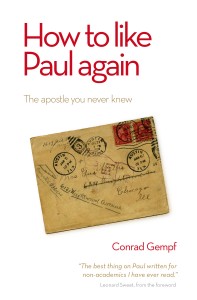
  • Why I bought “How to Like Paul Again” by Conrad Gempf

    An Inside Look at a Publisher’s Decision-Making

    9781780780610

    I didn’t think we at Authentic Media would get to buy this book. Although I had been Conrad Gempf’s commissioning (US: acquisitions) editor when I was working at the other end of the alphabet, time had elapsed and I had been out of the publishing game for a few years. Then Authentic approached me to work with them parttime, and I found myself agreeing, yet kicking and screaming inwardly, thinking that commissioning would distract me from my writing. I committed to a three-month gig and here I am, over a year and a half later and humbled by how much I love the marriage of writing and editing.

    I was especially chuffed (US: thrilled) when the first book I acquired was Conrad’s. He’s a brilliant writer; witty yet deep. One of the unusual academics who writes for a popular audience, seamlessly weaving in references to Clark “Superman” Kent or Nieuport 27s (a World War I plane) or John Deere tractors. All while persuading us to like the apostle Paul better, or to understand why Jesus asked so many questions. One of his defining passions is to open up the Bible to his students at London School of Theology and to his readers. He’s quirky and not everyone will love his humor. But those who do often become diehard fans.

    I was sad when I learned that Conrad was in advanced talks with another publisher about his book on Paul. For when I was at the Publisher-at-the-End-of-the-Alphabet, he and I had talked about this being our next book. Then my job was eliminated… and the book got put on hold. After a couple of years, Conrad restarted discussions with other publishers, and when we met up was nearly signing a contract. Out of integrity, but secretly crestfallen, I stayed out of the picture. Until surprisingly How To Like Paul Again came back to me after all. Another example of change being the only constant in publishing.

    Why did we buy? Because today so many people don’t like the apostle Paul. They think he’s legalistic and cranky and anti-women. They pre-judge him, assuming they aren’t going to like his letters or what he has to say. But Conrad, in his inimitable style, gives us the tools to read Paul’s letters. We start to look at the greater context, such as the letter’s recipient, and begin to tease out why Paul was, say, pushing for freedom in the case of the Galatians or for tightening up the rules for the Corinthians.

    Conrad-Gempf-2

    As an author, Conrad is wry and he’s playful, but he wants us to engage in serious work as students of the Bible. You might literally laugh out loud, but you’ll also pick up the Bible to see if what Conrad says is there, actually is there. (Like Galatians 5:12. Seriously? Did you realize Paul actually said that?)

    What I love especially about Conrad’s writing is that when I read his stuff, I feel like he’s with us in the flesh, sharing a meal in our dining room and helping us lose our misconceptions about Paul. His prose shouts with his unique, funny, profound, make-me-laugh voice. No one else will have that voice, of course. But as we’re all made in God’s image, the voice we exercise will be beautiful in its own right.

    And that’s why I bought this book. But what about you? Think you’ll buy it?

    (Want to know more? Click here for some two-minute trailers.)

    © 2013 Amy Boucher Pye. This blog post has been adapted from an article that appeared in the Spring 2013 edition of Christian Writer

  • God shows up

    “It’s a hungry monster,” I said.

    But my resistance was futile, and having relinquished my fears, I am penning my first blog post. I promise to feed the monster regularly – at least three times a week – with posts, including stories and anecdotes of how God shows up in our lives regularly. I love it when he does that.

    I have a long-distance friend with whom I enjoy a slap-up meal when we meet up. We talk of books, love, literacy, disability, travels… give us a Jamie Oliver restaurant and we can chat into the night.

    DSCN4626-001

    Recently I emailed her about a book-related issue, and as I started to sign off, I had the sudden thought that I should ask her about men. Such as if any of that vast mass of humanity had come to his senses yet and asked her out. As a spiritual rule I try to be sensitive and not bring up, again and again, what can be painful subjects. To the infertile couple: “Any news?” To the hoping singleton: “Any men?” It’s just not helpful, is it.

    So with some fear and trepidation, I asked about the man situation, keeping it short and light. She wrote back the next day with delight, saying that yes indeed there was a guy and things were cool and exciting and…

    And I sat back and thought, “Wow God. Your Spirit prompted me there, didn’t it?” I acted on a little thought, stepping out in faith, which resulted in my friend and I sharing a new layer of intimacy. Delighting in the wonder of young love when possibilities seem unlimited and quirks are charming. Giving thanks for prayers answered.

    What nudges are you sensing today?