Have you ever gone on a dream shopping trip? Like one of those televised free-for-alls where someone can keep whatever they grab in thirty minutes? Well, I’ve not been on one of those – thankfully, I think, for I can only imagine the specter of my consumerist heart going mad. But a few years ago I got to go on an even better trip to the mall.
“Let’s go shopping!” Lulu said.
“Okay!” I responded, with a surge of joy and nervousness. My friend was a generation older than I, and in a different stratosphere financially. I sensed this wouldn’t be any ordinary shopping trip, but an amazing experience of grace and beauty.
I had recently given birth to our second child and wasn’t feeling good about my body. The weight hadn’t magically melted after my daughter appeared; nor was it shifting in the months that followed. I felt I didn’t deserve the nice clothes Lulu might buy for me – I was lumpy, not svelte. Somehow I believed that gorgeous clothes should only be enjoyed when we are at our goal weight. Not when we’re way over.
But Lulu wanted me to feel beautiful, extra pounds or not. She decided I needed some stunning business suits and dress clothes, with no cost spared. So we camped out in the fitting room of a high-class department store with a special salesperson at our beck and call. This woman dashed from one rack of clothes to another, finding the right sizes of sparkly shirts and well-cut trousers.
As I glimpsed the expensive tags I started to worry. How, I wondered out loud, could she spend so much money on me when I wasn’t slim and trim? Lulu shushed me in a loving but firm manner. “Amy, I want you to look and feel good. Let me do this for you. Besides, when your size changes, you can always find a tailor.”
Grace incarnate. Did I deserve the clothes? No. But do I feel good when wearing them? You bet I do (although for some I now need a tailor). What a gift, this lavish splurge on clothes. What an example of love and acceptance.
I’m still not at the perfect weight, and my daughter is well into her primary school years. But instead of hating my body, I try to remember that God has formed me and created me. He doesn’t want me to look down at myself with despair, but to turn to him in praise and out to other people with love.
He’s always sending his loving words to us, saying that he’s chosen us and not rejected us. That he is with us when we pass through the waters – they will not sweep over us. That we are precious and honored in in his sight.
When I look to the Lord for love and affirmation, I gain a sense of well being – whatever the number on the scale. How about you?
This article originally appeared in Woman Alive in January 2014, and I presented its contents at All That We Are, the Woman Alive/BRF retreat at the Christian Resources Exhibition in May 2013. The next Woman Alive/BRF day will be 6 June 2015 in Woking. Join us!
“I hate my life.”
“Why am I so stupid?”
“Will I ever have a boyfriend?”
Sentiments like that – and a lot worse – used to fill my journals in my teens and early twenties. Angst, fear, bitterness – I would let rip in my personal diary, not realizing the damage I inflicted as I wallowed in my pain.
Then in my mid-twenties I edited Leanne Payne’s Listening Prayer: Learning to Hear God’s Voice and Keep a Prayer Journal. She gave me the tools to turn my former depository of self-hatred into a spiritual treasure trove of love and affirmation. I threw away my old journals and dedicated my new, floral ring-binder to be a place for conversation with God. At the time I was also learning to receive God’s love and forgiveness; I would take my angst and pain to Jesus on the cross, confess any sins, then wait to receive God’s love and release. My new spiritual journal echoed these practices of sloughing off the old self and embracing the new. I was a new creation!
Twenty years later, I can’t imagine not keeping a spiritual journal. It’s the place where I am most open and free with God, telling him my deepest dreams, longings and fears. Here I praise and adore him; here I confess my wrongs and how sorry I am; here I intercede for those known to me; here I ask him to lead and guide and help me. And, importantly, here I stop the chatter and silence myself, poised to hear his still, small voice. Here he calls me his beloved.
Previous incarnations of spiritual journals – I used to love the girly flowery books.
Although I can’t imagine life without a spiritual journal, I know this practice isn’t for everyone – my husband, for instance. I don’t want to inflict guilt on those for whom it’s a chore or a shame-inducing exercise. Not everyone likes to write; we need to find what fits our personalities best. But if you like words and want to dedicate yourself to this practice in the new year, here are some tips for keeping a spiritual journal.
Practicalities
A pretty pattern used to adorn my journal, but now I type into a special file on my laptop. I open a new file each day, organized in monthly folders, categorized by year. You might prefer the tactile feeling of ink on paper, especially in a wonderful leather-jacketed journal. Experiment with different formats until you find what suits you.
Privacy
One of my most important pieces of advice is guard your privacy. Find someone who will agree to destroy – without reading them – your journals when you die or are incapacitated. We hold ourselves back from being unvarnished with God when we think someone might stumble on our secrets. If we’re constantly looking over our shoulders, wondering what our audience thinks of us, we curtail the freedom God wants us to enjoy. We will share the treasures mined from our journals through our personal ministries, whatever those may be, but we’ll be handing out the jewels as gifts rather than letting thieves steal and destroy. Keep your treasure chest closed and locked.
Content
What shall we put into our journals? You will find your own best practice. Leanne Payne outlines six areas, including God’s word, praise and thanksgiving, intercession, petition, forgiveness. Or a simple format is ACTS: adoration, confession, thanksgiving, supplication. Let’s explore these four areas.
Adoration
Taking the time to praise God lifts us out of ourselves and our concerns. Praising God can change our outlook – we can become infused with joy and peace as we echo King David’s psalms or think about a special hymn or song. When we feel dry spiritually, praising God might be more of an act of the will than of our feelings.
Confession
I was raised Roman Catholic, so I don’t find confession foreign. But we don’t need to confess to a priest (although some find that helpful); we can tell the Lord what we’ve done or those things we’ve left undone. As I said above, we can take them to the cross and there receive forgiveness. I find that writing out my sins forces me to be specific.
Thanksgiving
Having a special thanksgiving section gives us a rich record of God’s goodness. Naming what we’re thankful for can change our whole outlook and demeanor, as Ann Voskamp details in One Thousand Gifts. She started a gratitude journal, writing down 1000 things she appreciated. It opened her eyes to the mercies she might have otherwise missed: a bumblebee perched on a lavender flower; the sound of the breeze in the trees; the smile of a child.
Supplication
God our heavenly Father wants us to ask of him. He invites us to bring to him our supplications – our requests – whether for ourselves or for others. Just as a good parent longs to hear what’s on their child’s heart, so the Lord invites us to approach him with our needs – whether big or small. We can set goals with him. We can share our dreams and see him cup them safely in his hand.
I don’t write my journals by hand anymore…
My practice
I try to incorporate ACTS into my devotions. Most often I will read through a book of the Bible, focusing on a chapter each day. As I chew it over, a verse or two usually pops out and I sense the Holy Spirit leading. Those verses I write out so that they can sink into my being. I turn them into a prayer, speaking them back to the Lord with different words. That leads to me express what’s on my heart, whether praise of God’s goodness and faithfulness; a buried longing; hurts and irritations I need release from; prayers of thanks.
And then I stop and wait for God’s still, small voice. I wait for any words of love and affirmation; of direction and leading. Some days, all I seem to need to hear is, “I love you.”
Benefits
So why keep a prayer journal? Three reasons in closing:
It’s a safe outlet for our feelings.
Here we can be totally honest and give to God any bitterness, shame, fear or pain. We can receive God’s love with feeling awkward or self-conscious.
It becomes a spiritual treasure trove.
Once a year, usually around New Year’s, I reread my year of journals and note down the “spiritual highlights.” This exercise reveals what I’ve been most struggling with or rejoicing over throughout the year. I see where God has answered prayer and which requests I’m still holding before him. I see his direction, love and leading.
It’s a tactile record of daily life.
Our journals provide an amazing snapshot of what’s going on, not only our inner life but the daily stuff of life – which friend is hurting or parent ailing or child succeeding. When we reread journals from years ago, we can smell the frying bacon or hear the sand washing up on shore. Long-hidden memories come flooding back.
Might you consider keeping a spiritual journal? If so, let me close with a prayer:
Father God, thank you that you’ve created us and spoken life into us. That you long to converse with us. Help us to find just the right mode of communication, that we might implement a spiritual practice to aid our growth in maturity and love for you. May we put aside the rags of the old self and embrace the royal robes you have created just for us as children of the King. Amen.
“To them God has chosen to make known among the Gentiles the glorious riches of this mystery, which is Christ in you, the hope of glory. We proclaim him, admonishing and teaching everyone with all wisdom, so that we may present everyone fully mature in Christ.” (Colossians 1)
One of our American friends has feared flying, but that didn’t keep her from visiting the UK. She did, however, drink some wine on the way over (she who normally abstains from alcohol). Believing that God can free us from such fears, I offered to pray with her before their return home. We began to pray, and after a while I wondered if I was praying the right way (whatever that is). Just then the words flashed into my mind, “Christ in you, the hope of glory.”
That was the key to deeper prayer, where we claimed her identity in Christ and where she sloughed off layers of fear that had been rooted in her heart. As we prayed, we rejoiced and gave thanks, and I looked forward to hearing how her flight home would go. The next day I got a quick email that said “the flight was fine – better than fine – in fact” and that she “made it through and didn’t self-medicate at all!”
The phrase that came to me in prayer makes up a profound part of Paul’s letter to the Colossians. He writes to address a heresy, and in doing so he proclaims Christ as the image of God, the creator, the head of the church and the reconciler, among other titles. He wants the Colossians to hold tight to their faith in Christ, to know his indwelling and to become fully mature in him.
Memorizing Scripture may not be your favorite thing, but perhaps this devotional series of considering Christ’s indwelling could plant one phrase indelibly in your mind, “Christ in you, the hope of glory.” I trust the Lord will quicken those words when you need a touch of his caress, a reminder of his love, a gift of his grace. May you remain in him as he remains in you.
For reflection: “Now to him who is able to do immeasurably more than all we ask or imagine, according to his power that is at work within us, to him be glory in the church and in Christ Jesus throughout all generations, for ever and ever!” (Ephesians 3:20–21)
I pray that out of his glorious riches he may strengthen you with power through his Spirit in your inner being, so that Christ may dwell in your hearts through faith. And I pray that you, being rooted and established in love, may have power, together with all the Lord’s people, to grasp how wide and long and high and deep is the love of Christ… (Ephesians 3:14–21)
By Wingchi Poon CC BY-SA 3.0This week’s text comes from another of Paul’s letters, but unlike some that he wrote to address a specific heresy, this one speaks more generally about God’s purposes. Paul might have intended it not only for the Ephesians but for several other churches as well.
Some people label Paul as harsh or dogmatic, but in this passage we see him welling up with emotion over the amazing riches that we receive in Christ, which come through our dwelling in him. As Christ lives in us we are rooted and established in his love, and the Spirit at work in us gives us the power to comprehend this love.
Indeed, love is our beginning and ending. As we grasp how deep and wide and long and high is Christ’s love, we are permeated with it and it starts to seep out of our very pores. Or to use a metaphor we’ve employed before, Christ’s love bubbles within and pours out of us like living water, bringing life and grace and truth.
Love flowing from within helps us see others as God has created them. It gives us strength to answer a small child’s repeated question of “Why”? It helps us make time to visit the housebound person who is smelly and cantankerous. It gives us a gracious response when we are interrupted from our current project as we remember that people are more important than things or achievements.
Charles Wesley in his famous hymn states it better than I could: “Love divine, all loves excelling, joy of heaven, to earth come down; fix in us thy humble dwelling; all thy faithful mercies crown! Jesus thou art all compassion, pure, unbounded love thou art; visit us with thy salvation; enter every trembling heart.”
Prayer: Lord Jesus Christ, show us this day how wide and long and high and deep is your love. Root and establish us in your love as you dwell in us, that others too might grasp this saving love. Amen.
I have been crucified with Christ and I no longer live, but Christ lives in me. The life I now live in the body, I live by faith in the Son of God, who loved me and gave himself for me (Galatians 2:20)
I used to have Scripture memory cards, and this week’s verse was one of the first we memorized. It still rolls off my tongue as easily as the Hail Mary, which I learned as a youngster. (Yes, my background was varied with my Roman Catholic upbringing and my conservative Protestant university.)
But knowing something by heart and living it out are not always the same thing. Rather more often than I like to admit, my “old self” rears its ugly head and I’m not a good advertisement for Christ. Recently I heard myself snip at my husband during the frantic rush to get our kids to school on time. “You’re going to shower and shave?” I asked heatedly, as if the world would stop at this mad idea. So much for the fruits of the Spirit such as gentleness.
We sin, we apologize and ask for forgiveness, we turn from the old self and affirm that Christ lives within. Sometimes we have to come repeatedly to the Lord and our loved ones (or others) as we repent from our sins. It is Christ living in us who gives us the power to do so. And it is Christ living in us who will reduce the frequency of our outbursts.
Paul here was writing to the Galatians, and especially to what were known as Judaizers – Jewish Christians who argued that some of the ceremonial practices from the Old Testament were still binding after Christ. Throughout this letter Paul stresses the freedom that comes with Jesus, which we receive through grace and faith, not works. As we allow our old self to be crucified with Christ, through faith we put on the new; that is, Christ living in us. And he leads us into all freedom, even freedom from snipping at one’s husband.
Prayer: Lord, I have been crucified with you and I no longer live, but you live in me. Today help me to live in faith by you, because you love me and gave yourself for me.
I’m continuing to write a daily poem based on my Advent reading – an old bookmark from NavPress called “Christ in Christmas.” So baffled was I by one of the readings that I even sent an email to a NavPress editor to check that it wasn’t a typo, but he graciously set me straight, helping me to see the interpretation.
My reading this morning is apt as I rest, fighting some kind of lurgy that’s traveling around among small children and adults. It helps me to remember that the Lord carries us close to his heart, tenderly caring for us. I know many who are struggling with flu and colds – this one’s for you too.
“Therefore go and make disciples of all nations, baptizing them in the name of the Father and of the Son and of the Holy Spirit, and teaching them to obey everything I have commanded you. And surely I am with you always, to the very end of the age” (Matthew 28:19-20).
Photo: Chris Yarzab, flickr
The last verses of the gospel of Matthew bring another promise of incarnational truth – that Jesus will be with us until the end of time. He who was named Immanuel – God with us – at the beginning of Matthew’s account (1:23) will never leave us.
The command that comes just before this promise has been called the “Great Commission.” Through it we are exhorted to spread Jesus’ good news, making disciples as we baptize and teach them his rules for abundant living.
How are you at making “disciples of all nations”? I find it a challenge, especially when confronted with some of the evangelistic methods that used to be popular. I could never ask a stranger in the street where they would be if they died tonight. Nor could I knock on doors and pass out tracts. Perhaps the fact that these were “methods” with a goal of conversion was a part of the problem, although I’m sure the Lord has worked through them just the same.
The Great Commission is followed immediately by the promise that Jesus will always be with us, so I can’t help thinking that the two are closely related. We will be winsome in introducing people to Christ when we live in constant communion with him. Relationships are the key, not methods and goals.
This makes me think of the time I did talk to a stranger in the park. I could hear that she was a fellow American as I breezed by, then felt God’s Spirit prompt me to go back and say hello. I didn’t want to, and kept walking. The urge was strong, however, so finally I went back. Turns out she was lonely and I was able to show Christ’s hospitality to her that day. And she was from nearby Iowa (which is right next to my home state of Minnesota). Jesus in us is a transforming presence.
Prayer: Lord, open my eyes to the appointments you are making for me throughout the day, whether while in the queue at the market, the school gates or during the commute to work. Help me be your vessel of love and grace.
Advent is a time of waiting. Advent is a time of baking (for me, at least).
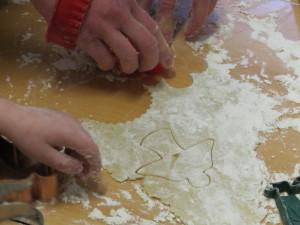
This month’s Woman Alive features my article, “Love on a Plate,” which shares this American’s love of Christmas cookies with a British audience. I’ve already seen photos of some wonderful cookies that readers have made (posted on our Facebook group); love the upside-down gingerbread people that turn into reindeers!
As a bit of background, Christmas cookies remain popular in America, having been introduced by European settlers – German, Dutch, Swedish and Norwegian in particular. Americans without English roots don’t eat Christmas pudding, cake or mince pies; instead we enjoy Christmas cookies and candies.
In the article I promised more cookie recipes. Here you go!
Peanut (or almond) Blossoms
1 ¾ cup (220g) flour
½ teaspoon salt
1 teaspoon baking soda
½ cup lard (or butter)
½ cup peanut (or almond) butter
1 egg
2 tablespoons milk
1 teaspoon vanilla
½ cup (100g) sugar
½ cup (100g) brown sugar
1 package of chocolate stars or milk buttons or Hershey’s kisses
Sift together flour, salt, and soda. Cream together butter/lard, peanut butter, egg, milk, vanilla, sugars. Chill. When chilled, shape into balls and roll in sugar. Place on an ungreased baking sheet and bake for 8-10 minutes at 375F/190C/gas mark 5. Remove from oven and press in chocolate.
Oatmeal Toffee (or M&M) cookies
1 cup (250 g) butter
2 cups packed light brown sugar
2 eggs
2 teaspoon vanilla
1 ¾ cup flour
1 teaspoon baking soda
1 teaspoon cinnamon
½ teaspoon salt
3 cups oats
1 ¾ cups toffee bits or M&Ms or raisins or chocolate chips or mixture above
1 cup coconut flakes (optional)
Heat oven to 375F/190C/gas mark 5. Lightly grease cookie sheet (or use magic liners from Lakeland). Beat butter, brown sugar, eggs and vanilla until blended. Add flour, baking soda, cinnamon and salt and beat.
Stir in oats and other ingredients as desired. Drop dough by rounded teaspoons onto cookie sheet and bake 8 to 10 minutes.
Lemon-Poppy Seed Cookies
1 cup butter (about 250 g)
1 cup granulated sugar (about 250 g)
1 egg
1 teaspoon vanilla
2 teaspoon poppy seeds (I use more)
1 teaspoon finely shredded lemon peel
¼ teaspoon salt
2 cups flour
Beat butter for 30 seconds. Add sugar and beat until combined. Beat in egg and vanilla. Then add in poppy seed, lemon peel, salt and flour. Chill for an hour or two.
Shape into 1-inch balls. Cook on ungreased cookie sheet for 8-10 minutes in a 375F/190/gas mark 5 oven.
Frost with lemon juice/icing sugar for an extra pop of lemon. Yum.
Gingerbread People
2¼ cups plain flour
2 teaspoon cinnamon
2 teaspoon ginger
1 teaspoon baking powder*
½ teaspoon salt
¼ teaspoon cloves
¼ teaspoon nutmeg
¾ cup of butter (roughly 180g)
½ cup packed light brown sugar
½ cup dark molasses
1 egg
Combine flour through nutmeg. Beat butter and brown sugar in a large bowl until light and fluffy. Beat in molasses and egg. Gradually add flour mixture; beat until well blended. Shape dough into 3 discs. Wrap well in cling film and refrigerate for an hour.
Preheat oven to 350F/180C/gas mark 4-5. Work with one disc at a time. Roll out on floury surface. Cut into gingerbread shapes.
Bake 10-12 minutes. Cool on wire rack.
Ice with butter frosting or icing sugar frosting.
* This refers to American baking powder. I’m told you can substitute ¼ teaspoon baking powder plus ½ teaspoon cream of tartar for every teaspoon of baking powder.
Chocolate Crinkles
3 eggs
½ cups granulated sugar
4 oz (225 g) 70% chocolate, melted
½ cup cooking oil (this seems too much to me)
2 teaspoon baking powder*
2 teaspoon vanilla
2 cups flour
Beat eggs, sugar, chocolate, oil, baking powder and vanilla. Beat in flour. Cover and chill for an hour or two.
Shape dough into balls. Roll in icing sugar. Bake on ungreased cookie sheet for 8 to 10 minutes at 375F/190C/gas mark 5.
* This refers to American baking powder. I’m told you can substitute ¼ teaspoon baking powder plus ½ teaspoon cream of tartar for every teaspoon of baking powder.
Almond Logs (or Bursts)
An adapted recipe from my grandmother, Nellie Wiese Mohni, whose parents moved from Germany to Iowa in the late 1800s.
1 cup (about 250g) of butter
2 teaspoons vanilla extract
2 teaspoons almond essence
¾ cup (150g) sugar
1 egg
3 cups (375g) flour
1 teaspoon nutmeg
¼ teaspoon salt
Cream the first three ingredients; add sugar and blend in the egg. Stir in the rest of the ingredients. Roll in ½ inch logs about 3 inches long (or however you want to make them; I generally form them into small balls). Bake at 350F/175C for 8-10 minutes on a greased pan (I never grease the pan, but just use those magic liners from Lakeland).
Frosting
1/3 cup (75g) butter
1 teaspoon vanilla
2 teaspoons almond essence
2 cups (250g) icing sugar (powdered sugar)
2 tablespoons milk
Mix above together; frost when cool and sprinkle top with nutmeg.
Try to share with your loved ones; makes about 36.
Dark Chocolate Truffles
1/3 cup heavy whipping cream
12 oz semisweet chocolate, divided (I use best 70% chocolate – fairly traded!)
2 tablespoon Grand Marnier (or other liqueur such as Amaretto or Kahlua)
Powdered sugar
Cocoa powder (if desired)
Pour cream in a heavy bottomed saucepan. Bring to a boil over high heat and immediately reduce heat. Add 6 oz of the chocolate, broken into small pieces. Stir constantly until chocolate is melted. Remove from heat and stir in Grand Marnier. Transfer to a mixing bowl and refrigerate for 2 hours or until firm.
Using a melon baller or teaspoon dipped in hot water, scoop 1 inch balls out of the truffle mixture onto a plate (I just formed them into balls myself). Dust with confectioners’ sugar, shape into balls, and place on wax paper. Freeze for at least 1 hour.
Melt the remaining chocolate in a double boiler, stirring occasionally. Set aside. If you wish to dust with cocoa (I didn’t), cover the bottom of a small shallow baking pan with cocoa powder. Remove truffles from freezer and dip in melted chocolate, one at a time, coating all sides. Drop coated truffles into cocoa powder. Gently shake pan to coat.
Place truffles in a single layer in a covered container and refrigerate. Serve at room temperature and try not to eat them all in one sitting.
 Have you ever gone on a dream shopping trip? Like one of those televised free-for-alls where someone can keep whatever they grab in thirty minutes? Well, I’ve not been on one of those – thankfully, I think, for I can only imagine the specter of my consumerist heart going mad. But a few years ago I got to go on an even better trip to the mall.
 This article originally appeared in Woman Alive in January 2014, and I presented its contents at All That We Are, the Woman Alive/BRF retreat at the Christian Resources Exhibition in May 2013. The next Woman Alive/BRF day will be 6 June 2015 in Woking. Join us!



 I used to have Scripture memory cards, and this week’s verse was one of the first we memorized. It still rolls off my tongue as easily as the Hail Mary, which I learned as a youngster. (Yes, my background was varied with my Roman Catholic upbringing and my conservative Protestant university.)


 This month’s Woman Alive features my article, “Love on a Plate,” which shares this American’s love of Christmas cookies with a British audience. I’ve already seen photos of some wonderful cookies that readers have made (posted on our Facebook group); love the upside-down gingerbread people that turn into reindeers!

 Chocolate Crinkles