Author: Amy Boucher Pye

  • Giving Thanks – Prayers for Thanksgiving

    FMIB Quotes 3 FinalHappy Thanksgiving!

    I love this holiday – a non-commercialized time to stop and breathe and give thanks. A time to join with family and friends to feast and laugh and sing and share. A time to enjoy and spread the joy.

    But we live in an imperfect world, and someone’s chair may be empty at our Thanksgiving table. Or we’re separated from the ones we really want to be with. Or we’re not even in the country that’s celebrating this holiday – that’s me today (Tonight I’ll be at my master’s class talking about gender and Christian spirituality!).

    May the Lord fill in the gaps, shining his light into the places of pain and longing and giving us his peace.

    May we breathe in his light and love.

    May we give thanks – whichever country we’re living in.

  • Behind the Scenes: Interview with Vivian Hansen, Cover Designer for Finding Myself in Britain (Part 2)

    teapot JPEG

    The gifts I’ve received in the publishing process for Finding Myself in Britain have been breathtaking. Such as how the cover came about – I share the story of finding our designer, Vivian Hansen, in part one of this series. Only when I received Vivian’s email as she responded to my questions did I learn that she and I share our Christian faith – and a love of travel. How amazing to connect with this talented young artist! Read to the bottom of the post to see how to get in contact with her (especially if you’re involved in publishing) and to see more of her varied art – she works with oils, watercolors, sketching with pencil and others. In her words:

    I have been drawing as long as I can remember. When I was a child, I wrote and illustrated many stories, always loving how people would react and engage with the little worlds I created. I later enjoyed it as a kind of escape, much like reading a book. But to be honest, it wasn’t until I was about 17 that I realized I had a particular talent in art. I had a deep wanderlust throughout my youth (fueled by the mountains of books I lived inside of), which eventually led me to leave my tiny country town in southern Mississippi and go to live with a family in Ireland. It didn’t take long for the art professor there to find me drawing, and he invited me into his art class – the first I’d ever been in. He taught me the basics, and I delved into a whole universe that had been waiting for me. By the time I graduated, my mind was set on pursuing a creative career. It has been a long and winding road, but I am very thankful to have had the opportunity to study illustration.

    I was finishing up my last bit of art school when I found the contest for your book cover design. A friend of mine told me about the site, so I took a look around. Contest sites typically have a shady reputation in the professional art community for taking advantage of artists, and even reputable sites like 99Designs should be approached with caution. But as soon as I read the brief for Finding Myself in Britain, I had a rush of ideas. I picked up a pencil and started sketching. It’s a big risk to spend a great deal of time and effort on work that may not be fruitful, so I approached it with the idea of using it as a creative exercise. The brief was inspiring for me as a traveler, a bibliophile, a Christian, and a designer who likes a good challenge. It was clear that you were looking for something different, so I was happy to oblige!

    I was really surprised and delighted to learn that I’d won the contest! I called my mom right away and told some of my classmates, including the one who had introduced me to the site. I’ve had my work published in small things before, but this was going to be the most widely published work of mine to date. Most of all, I was so grateful for the opportunity to use my God-given talents on a faith based project. What a joy it is to use the talent and opportunity I’ve been blessed with to do the Lord’s work! I hope to contribute again to Christian publishing and continue to be a vessel for His work.

    vivian_hansen_findingmyselfinbritain_sketches1My first thoughts when I started sketching were about focusing on a more conceptual design than a decorative one. Book covers featuring original artwork in a clever way stand out in a sea of stock images, so I knew I wanted a strong image with meaning. At first I considered what it feels like to be “different” while in another country and how I might represent that in a unique way. I ended up with a drawing of a sunflower growing from a rose bush; the flower clearly isn’t native to that plot, but it stands out in a bright, bold, happy way. Other ideas centered around place. One that I was fond of featured lots of different shapes and styles of windows you might see around the world, with a little cartoon Amy perched happily in a window resembling a stone church.

    In the end, I was most drawn to a very simple but iconic image of a teapot with an American flag motif pouring Amy into a teacup decorated with the British flag. I think it presents the idea of instant immersion, maybe even culture shock, but in a funny, positive way (especially with help of the bright, playful colors). I hope it will draw readers in enough for them to read the back and discover what it’s all about – and from there, I’m sure they’ll be hooked!

    teacupLiterature and travel are still a big part of my life. I’m a big dreamer and adventurer, and it directly affects and inspires my work. I graduated at the end of summer and started making plans for my next journey, which has brought me to Spain. I travel cheaply by flying stand-by and finding unique accommodation; this time, I’m working part-time at the front desk of a hostel in Madrid in exchange for room and partial board. It’s an amazing way to get to know a place in a real way. After two months of travel, I’ll return to the U.S. for Thanksgiving and then pack my bags again for Costa Rica, where I’ll be visiting my boyfriend’s family for the first time. Each place I visit is full of treasures for the eye as well as stories to take with me. I have lived in Ireland, Japan, France, and now for a while in Spain, and each place leaves a huge mark on me. I change and grow a bit each time and share my own stories, culture, and experiences with the people I meet.

    By the start of 2016 I hope to start campaigning for greater amounts of freelance work. Where will I be? I have no idea. That’s the beauty of it. I’m at a peculiar time in my life that allows for these opportunities and, while I look forward to someday building my own family and having a place I call home, for now I am thankful for the chance to see the world and share it with others through my stories and art works.

    How can people connect with me? When I am based in the U.S., I open up my Etsy shop to sell prints of my work and occasionally original art work and other handmade things, and in early 2016 I will launch a Kickstarter campaign to get my children’s book published. I also have my website, a Facebook page and an Instagram account where I post things I’m working on currently, including my travel drawings. The best thing about being an artist is simply sharing my work with others, so I am glad for any platform I can use to connect with people!

    A Christmas card designed by Vivian. Check out her process on her website - fascinating.
    A Christmas card created by Vivian. Check out her process on her website – fascinating.
    I love the variety in her art.
    I love the variety in her art.
    Art in motion - watercolors at Lower Yellowstone Falls.
    Art in motion – watercolors at Lower Yellowstone Falls.
    Wonderfully fabulous Valentine's Day card.
    Wonderfully fabulous Valentine’s Day card.
  • Advent devotional – A Savior for All

    By Artfuldodger2013b (Own work) [CC BY-SA 3.0 (http://creativecommons.org/licenses/by-sa/3.0)]
    By Artfuldodger2013b (Own work) [CC BY-SA 3.0 (http://creativecommons.org/licenses/by-sa/3.0)]

    Advent comes next week, ready or not. So it’s timely to delve into some of Matthew’s crisp account of the story of Jesus’s birth, the lesser-recounted version (in contrast to Luke’s). Matthew’s gospel has long been the first in the New Testament canon, and it forms a bridge between the Hebrew Bible and the New Testament. In the first two chapters alone Matthew hearkens back to the prophets four time, showing how Jesus is the fulfillment of their prophecies, the longed-for Messiah. He also begins his account with a genealogy that shows clearly how Jesus is God’s anointed one.

    As we read Matthew’s account of Jesus’ birth, we see it through Joseph’s eyes, instead of Mary’s (as in Luke’s). God asked a lot of Joseph, and this humble man overcame his incredulity to become the earthly father of the Son of God. Quite often today Joseph gets pushed aside or even left out of the Christmas story, but as we will see, he plays a vital role.

    May the Light of the world break through any darkness you may be experiencing; may he dispel any gloom as he brings joy, peace, and rejoicing. And may we move forward in a sometimes cloudy world as we glow with his resplendent light.

    This is the genealogy of Jesus the Messiah the son of David, the son of Abraham: Abraham was the father of Isaac, Isaac the father of Jacob, Jacob the father of Judah and his brothers, Judah the father of Perez and Zerah, whose mother was Tamar, Perez the father of Hezron, Hezron the father of Ram, Ram the father of Amminadab, Amminadab the father of Nahshon, Nahshon the father of Salmon, Salmon the father of Boaz, whose mother was Rahab, Boaz the father of Obed, whose mother was Ruth, Obed the father of Jesse, and Jesse the father of King David. David was the father of Solomon, whose mother had been Uriah’s wife… (Matthew 1:1–6, NIV)

    Did your eyes glaze over at this genealogy? So often when reading the Bible we skip over these unfamiliar names. Nahshon? Amminadab? Who are they to me?

    But treasures are buried in the list (unearthed here with the help of biblical commentators), which the original readers would have understood. For instance, unlike most ancient genealogists, Matthew includes women: as well as Mary, Jesus’ mother, he names Tamar, Rahab, Ruth and Bathsheba (Uriah’s wife). He purposefully includes outcasts (Rahab was a Gentile prostitute), those wronged by men (Tamar had to trick her father-in-law so he would fulfil his legal obligation for her to marry his son) or those of the “wrong religion” (as a Moabite, Ruth would have been excluded from the synagogue).

    With this, Matthew implies that although Jesus comes from royal stock (via King David), his roots and very DNA are in those who are marginalised and wronged. As Messiah, he is anointed to save those high in society – and those not. Including these so-called questionable women may also be Matthew’s way of preparing his readers for the unusual circumstances of Jesus’ birth, including that he was born to an unmarried woman.

    The way Jesus comes to earth blows apart our preconceptions of how the King of the World should make himself known to his people. He may be high and mighty, but he is also lowly and humble.

    Prayer: Lord Jesus Christ, as we prepare to celebrate your coming, open our eyes to those at the margins of society.

  • The Home of my Heart by Adrianne Fitzpatrick

    No Place Like Home“There’s no place like home” – even for expats like me and Adrianne Fitzpatrick, whom I’m pleased to introduce today. Adrianne is a writer and publisher of Books to Treasure, a small independent press producing quality children’s literature, whom I met through the Association of Christian Writers. I love her passion and commitment to all things books. Her contribution to our series on finding home struck a chord in me, for I too cling to the identity of the land of my birth.

    When I was four years old, my parents decided to move from New Zealand to Australia (the land of my father’s birth). Even at that tender age, the prospect devastated me. I was, apparently, in love with a boy who was all of six or seven, and I begged him to ask his mother if I could live them instead! Alas, it was not to be; and a few weeks shy of my fifth birthday, I found myself on foreign soil. I was not impressed. To add insult to injury, in New Zealand I would have started school on my birthday (which was in June). In Australia I was required to wait until the following January, when the new academic year began. This was not a good beginning!

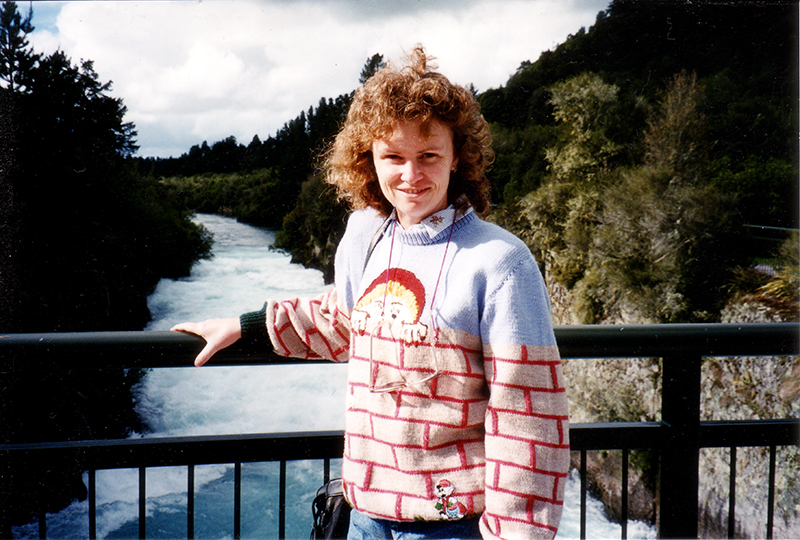
    Adrianne in 1994 rediscovering her New Zealand roots.
    Adrianne in 1994 rediscovering her New Zealand roots.

    I clung desperately to my New Zealand heritage as I grew up. When I felt Australian pronunciations beginning to impinge on the way I talked, I would ask my mother how to say things the New Zealand way. I steadfastly refused to become Australian. As an adult I would still claim my NZ birthright even while acknowledging my Australian upbringing with its cultural influences. Yet despite all that, I never felt any urge to return to New Zealand, even when I was old enough to make that choice. In spite of myself, Australia had become home.

    I moved around so much, both as a child and later as wife to a minister, that I became adept at feeling at home wherever I was. (In fifty-odd years I’ve moved thirty-two times. I’ve been in my current house for six and a half years. That’s a record for me!) One thing that struck me after I became a Christian in my teens was the feeling of community that greeted me whenever I went to a new church, whether as part of the ministry team or as a visitor on holiday. One would expect that in your home church, but for me it was always a welcome surprise – and eventually something to look forward to – when going somewhere new. It gave me a sense of continuity, a sense of home, that I appreciated in the midst of so much change and uncertainty.

    Back in Australia - Blue Mountains
    Back in Australia – Blue Mountains

    However, I can’t blame all the moves in my life on other people, because I was the one who chose to come to the UK. I grew up on a diet of British books and, to a lesser extent, British television. My mother’s family are British, with my English grandfather being seconded to the New Zealand navy after the First World War. My great-grandfather, so family history goes, was a shepherd at Stonehenge. I had a longing to see this country, although I never expected to live here. Yet when I arrived here in 2003, I knew immediately that I had come home.

    Finding beauty in the UK - Tintern Abbey
    Finding beauty in the UK – Tintern Abbey

    Twelve years later I can still say that the UK is the home of my heart. That’s not to say life has been without its challenges: family, health, finances, even friendships have all suffered at various points. But there has also been healing, restoration and reconciliation on emotional, physical and spiritual levels. God has truly brought me home – at least until he calls me to my permanent home.

  • Review: How to Be an Alien by George Mikes

    imagesAt the end of an introduction to spirituality class at Heythrop College, one of my new friends slid me this little volume – a book published in 1946 which immediately captured my imagination, not least for the story that she recounted as she gave it to me. She said:

    My German grandfather was a career German naval engineering officer, sunk by the British in the First World War, fished out of the Med and bunged in a rather uncomfortable camp in the desert outside Alexandria for the rest of the war. At the end of the Second World War he ended up in the bag again but by this time he was an admiral so was despatched to a stately home in Cumbria which was the destination for high ranking officers. If they gave their word that they would not escape that was accepted, so they were free to roam around the fells all day and return to a good supper in congenial surroundings in the evening. I think only one broke their word, featured, I believe, in the film “The One that Got Away”.

    Meanwhile in Germany, British soldiers had commandeered the family home and Mum and her sisters had to move in with family elsewhere. The soldiers were always charming and friendly to the girls though. The upshot was that my grandfather believed that the British were an honourable people so at the end of the war when Germany was destroyed, most men were dead and my grandmother was going shopping with a wheelbarrow to carry all the inflated money, my mother set off to England to work as an au pair. Only one person was ever unkind to her as a German – a nurse whose fiancé was killed – and someone gave her How to Be an Alien to help her understand life over here. It obviously worked – she trained as a nurse at St Thomas’, then became a district midwife on a bike delivering babies in Surrey, then married my father and has lived here ever since.

    I sat on the Tube home while galloping through How to Be an Alien and thinking of this young woman, new to the UK and living in a completely changed world while knowing she’d need to make this country her home. It made for poignant reading.

    Of course, it being a humorous book, I wasn’t sure how much of the preface to the 24th impression was irony (not something I am known to grasp) and how serious the author was being as he rued the success of this book. He says:

    This was to be a book of defiance… [I was] going to tell the English where to get off… I thought I was brave and outspoken and expected either to go unnoticed or to face a storm. But no storm came… all they said, was: ‘quite amusing’ (p.8).

    So much of How to Be an Alien I could relate to. His chapter, “Introduction,” is not an introduction to the book but includes this observation: “The aim of introduction is to conceal a person’s identity.” Ah yes, the art of not giving one’s name, as I observe in my chapter “What’s in a Name” in Finding Myself in Britain. We both each devote a chapter to the weather – how can you not, this being Britain – and I should observe his instruction: “You must never contradict anybody when discussing the weather” (p. 22). Indeed.

    teacupI unwittingly followed his lead in writing a chapter about tea, but I wasn’t so rude in my opening as he is: “The trouble with tea is that originally it was quite a good drink” (p. 26). He has many instructions for how to receive tea magnanimously, even at 5am.

    In sum, a lovely little volume, some of which seems quaint after all of these years, but much of which still rings true. And how wonderful to have been given it by a daughter of a foreigner-turned-friend.

    How to Be an Alien, George Mikes, Penguin, ISBN 9780140025149

  • Devotional of the week: Tempted (7 in Luke 4 series)

    Photo: Jean Fortunet, via Wikimedia Commons
    Photo: Jean Fortunet, via Wikimedia Commons

    When the devil had finished tempting Jesus, he left him until the next opportunity came. Luke 4:13

    Many Christians observe the season of Lent by abstaining from something, whether some kind of food, drink, or leisure activity. Fewer Christians observe the upcoming season of Advent as a time of fasting, although traditionally that was the understanding of it – you fasted before the twelve days of feasting for the Christmas season.

    Whether Lent or Advent, some Christians ridicule these efforts of fasting, saying that we live in grace and shouldn’t turn to empty rituals. But many find fasting a helpful spiritual discipline to draw them closer to God, relying on him instead of looking to physical or emotional comforts.

    Jesus had endured forty days on his own, without food or companionship. Having withstood Satan’s temptations, he is released from being Satan’s target – until the next time. We don’t know how long Jesus is given before the evil one brings about another attack. But we know that even Jesus was granted rest from the battle.

    As we come to the end of our series on Luke 4 together, take a few moments to consider what has struck you about Jesus’ temptations. I come away inspired to memorize more Scripture, that I might immediately have to hand God’s word.

    May God bless us richly, and keep us from temptation and trial.

    Prayer: Father, Son and Holy Spirit, we pray that you will spur us on to love and good works. May we don your armor, that when we do battle we may enjoy your help and employ your tools. Amen.

  • The Wailing Wall (including The Secret Life of Bees)

    After the horrible news of terrorism in Paris and Beirut, I thought it fitting to put a link to an article I wrote on the Wailing Wall. Lord, have mercy.

    The wall we used as our wailing wall in Spain.
    The wall we used as our wailing wall in Spain.

    Do you feel the need to weep and mourn at times? That you need a safe place to let out your heartbreak, angst, and disappointment? The Western Wall – known commonly as the Wailing Wall – in Jerusalem has served as such a space over the centuries. It’s a surviving remnant of God’s Temple and was the spot closest to the Holy of Holies – that place where God’s presence dwelled. Jewish pilgrims who journey there pour out their hearts and prayers to the Lord.

    I thought about the Wailing Wall recently as I led a book club retreat in sunny Spain. With palm trees, cacti, and citrus trees in the background, we met around the pool, chatting through the books I had selected for the week and engaging with related spiritual exercises. The setting was idyllic, fostering deep conversation about the books we’d read, one of them being The Secret Life of Bees by Sue Monk Kidd.

    Perhaps you’ve read it or seen the film adaptation. Set in the American South during the sixties, it features the protagonist, Lily, a white girl on the cusp of growing up. With her nanny Rosaleen, she escapes her abusive father in the quest to find out more about her mother, who died when she was four years old. They end up in a house the color of Pepto-Bismol where a group of black sisters keep bees and observe religious practices based on a black Madonna.

    Parenthetically, I should mention that I’m not recommending the theology as expressed in the novel – it’s not Trinitarian and deifies a folk legend based on Mary. But as Christians we can and should engage with what we read critically, weighing up what we agree with and what we don’t – a bit like my book club did as we discussed the novel by the pool.

    Read the rest at The Kingdom Life Now magazine.

  • The Hunger for Home by Os Guinness

    “There’s No Place Like Home”

    The first guest-blogger in our Friday series, “There’s No Place Like Home,” is a giant of this generation who has profoundly influenced not only my thinking but who I am. In my twenties I had the great privilege of working for the renowned social critic Os Guinness in Washington, DC, on several projects, including the Trinity Forum, an outreach to business leaders.

    The nation’s capital was a new home for both of us, respectively, for he and his wife and son had arrived from England a couple of years before I went to DC to study for a semester during university. I interned with him at the Williamsburg Charter Foundation, a bicentennial celebration of the US Constitution, and ended up staying there for ten years! I never would have dreamed those years in DC that eventually I would make my home in his country – but even England wasn’t his first home, as he was born in China, the son of medical missionaries.
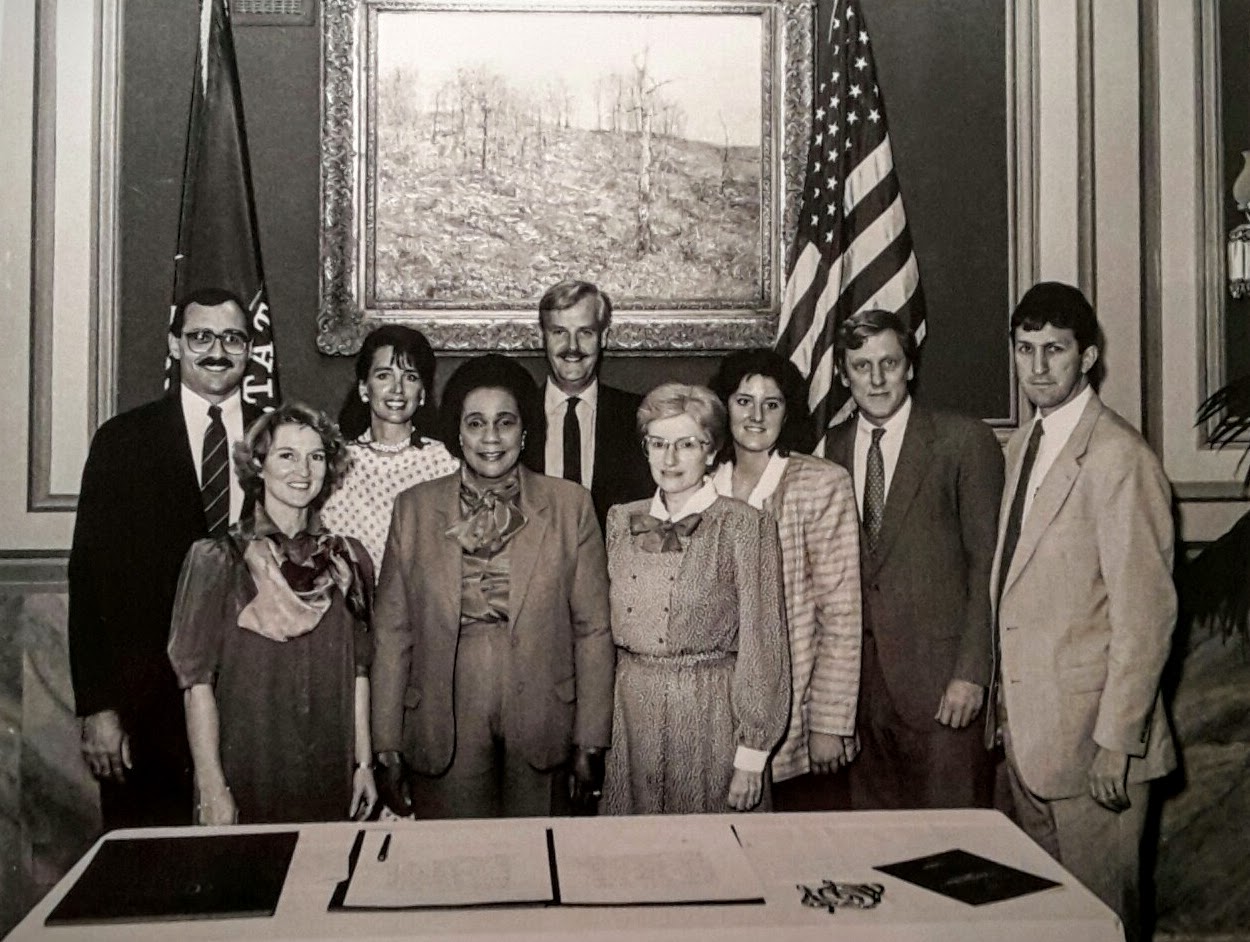
    The Williamsburg Charter Foundation team, with Coretta Scott King. In the front row, left to right, Sharon Brown, CSK, Lila Williamson; in the back row, John Seel, Jenny Guinness, Os Guinness, me (where was I looking?), Bob Kramer, and Tom McWhertor.

    He’s kindly granted me permission to post the excerpt below, which addresses our longing for home and comes from his seminal look at America and its crisis of cultural authority at the end of the “American Century,” The American Hour: A Time of Reckoning and the Once and Future Role of Faith (New York: Free Press, 1993). I worked with Os when he wrote the book, and I cut my copyediting teeth on this amazing 450-page analysis of the crisis of moral authority and his vision for the role of religion in public life. Though his book is more than twenty years old, his writing zings with truth and prescience. It’s available online, here for the US and here for the UK.

    His chapter on homelessness, “The Hunger for Home,” reveals one of the cancers that slowly destroys the certainties of meaning and belonging in modern life (and is aimed specifically at America, although it translates to other Western countries as well). Through the weeks of this series on longing for home, we’ll examine the ways that people have found their home – and Homemaker. But first, to lay the groundwork for what we’re up against through the problem of homelessness, is Os:

    Homelessness results from the gradual eating away of the certainties of meaning and belonging in the lives of countless Americans. Nothing is more naturally human than the drive toward meaning and belonging, and thus toward order. Sense of some kind, stability of some sort—these are the prerequisites for a tolerable human life. Without some underlying order, philosophically as well as socially, the dark demons of absurdity and anomie come menacingly close and threaten to destroy the fragile defenses of individual character and of human civilization itself. Cruel religious theodicies and totalitarian political terror bear witness to the same point: Human beings have such a need to feel at home with themselves and their universe that they even prefer tyranny to chaos, paternal authoritarianism to fratricidal factionalism.

    In one sense, homelessness is a defining feature of all humanness east of Eden and is certainly not new in the United States. But a special sense of homelessness has always been present in a nation shaped by immigration, mobility, and westward expansion. One German visitor called it the “strange unrest” of Americans, and H. G. Wells commented on the “headlong hurry” of Americans.[1] George Santayana commented in the 1920s on the “moral emptiness of a settlement where men and women and even houses are moved about, and no one, almost, lives where he was born and believes what he was taught.” Denis Brogan spoke in the 1940s of “American nomadism” as the expression of American civilization. John Steinbeck, in his Travels with Charley, wrote that he saw something in the eyes of his neighbor that he was to find everywhere in the nation—“A burning desire to go, to move, to get underway, any place from here. They spoke quietly of how they wanted to go someday, to move about, free and unanchored, not toward something, but away from something.”[2]

    No Place Like HomeSuch restless mobility, combined with a will to technique, has left Americans with what George Grant described as “a conquering attitude to place.” Even our cities, he said, have become “encampments on the road to economic mastery.”[3] At the more everyday level, IBM was popularly known as “I’ve been moved” and advertisers routinely teed off the pervasive sense of lost home. In the 1980s, Mazda sold automobiles under the doubly contradictory byline: “Who says there’s no place like home? We built the MPV based on a very strong foundation. The home… It’s engineering based on human feelings.”

    But while the problem of homelessness is not new in America, the present moment represents a serious exacerbation because the traditional American counterbalances have disintegrated with the crisis of cultural authority. Both faith and the family, the two deepest structures of meaning and belonging an the strongest counterweights to threatened anomie, have been sucked into the whirlpool.

    In normal times, the search for meaning and belonging is a hidden process that is natural and unconscious. That such a search has become conscious, deliberate, and a point of open anxiety is itself a symptom of anomie and homelessness. Nothing demonstrates the problem more clearly than the place and profitability of psychologism in America. As Peter Berger wrote in 1967, “If Freud had not existed, he would have had to be invented.”[4] But the predicament also shows up clearly in very different areas. For example, the recurring vogue for nostalgia (literally “homesickness”) in societies losing touch with their past, the potent hunger for “roots” in nations rooted in rootlessness, and the insatiable appetite for myths in cultures parched by reductionism. “Loss of the past,” wrote Simone Weil about France, “is the supreme human tragedy, and we have thrown ours away just like a child picking off the petals of a rose.”[5]

    With heaven evacuated, history severed, families strung out if not disintegrating, and faith unreal, homelessness has become an ever-present menace to modern Americans. Can there fail to be consequences? Being deprived of justice and freedom is bad enough for humans, but being disinherited from the certainties and assurances of home may prove even more so.

    [1] See Allan Nevins, ed., America Through British Eyes (Oxford: Oxford University Press, 1948), p. 496.

    [2] John Steinbeck, Travels with Charley, (New York: Viking Press, 1962), p. 93.

    [3] George M. Grant, Technology and Empire (Toronto: House of Anasi, 1969), p. 17.

    [4] Peter L. Berger, Facing Up to Modernity (New York: Basic Books, 1977), p. 32.

    [5] Simone Weil, The Need for Roots (London: Routledge and Kegan Paul, 1952), p 114.

  • Interview by Tanya Marlow on Finding Myself in Britain

    Today Tanya Marlow, a wonderful person – writer, thinker, feeler, Bible-delver, and one who suffers from a severe form of ME – has interviewed me on her blog, “Thorns and Gold.” She asked probing questions that I answered while partly wondering if I was sharing too much! I so appreciate her on many levels. She’s also hosting a giveaway of Finding Myself in Britain via her blog – instructions at the end.


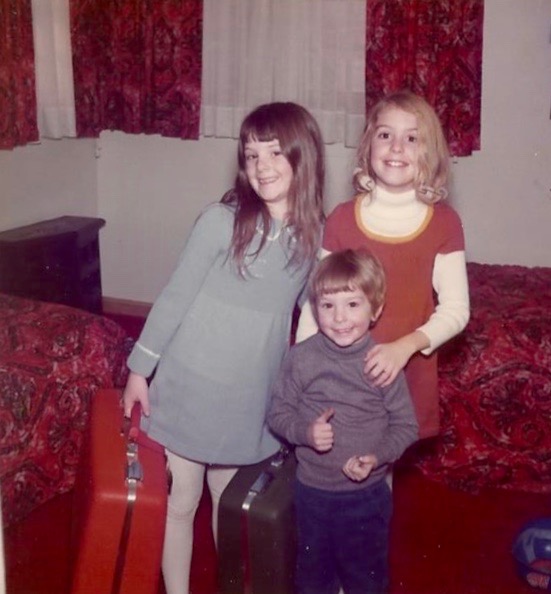
    Me with my sister and brother. The traveling bug seems to be planted early!
    Me with my sister and brother. The traveling bug seems to be planted early!

    Hi, Amy – tell us a bit about you!

    Hi! Well, I’m married to an English vicar and we live in a lovely but draughty vicarage with our two wonderful kids. I’m a writer and speaker with a long history in editing; I love writing devotional thoughts and running the Woman Alive book club.

    I grew up in Minnesota – the land of 10,000 lakes and hearty people who survive the shockingly cold winters. I’ve now lived longer outside than inside of Minnesota, however, for when I was at university I went to Washington, DC, for a studies program – and ended up staying 10 years! When there, working with a wonderful Englishman-in-America, Os Guinness, I met a visiting Englishman who was studying abroad as he trained to be a vicar. We fell in love and married and I moved to the UK nearly two decades ago – a mind-boggling amount of time.

    Something you might be surprised to know is that I’m a (lapsed) aerobics teacher. I love going to the gym and enjoying group exercise with my friends.

    Read the rest of the interview at Tanya’s blog here.

  • We Will Remember

    DSCN3987Last year we remembered the 100th anniversary of the start to World War 1 – the war that was to end all wars. London became a focal point as the art installation at the Tower of London slowly caught the public attention and eventually their heart as poppy by poppy was planted, turning into a sea of red. One for each life lost, eventually the last of the 888,246 ceramic flowers was planted a year ago today on Remembrance Day (Armistice Day, or in the States, Veteran’s Day).

    As I tell in Finding Myself in Britain, we visited the Tower on that Remembrance Sunday – we and a few thousand others. Though we only gazed at the sea of red for a short time, jostled by the crowds, the sight moved us. Not least because 152 of those poppies stood for men whose names appear on the two war memorials in our church.

    DSCN3988Nicholas and PyelotBoy, lovers of history both, dug up information about these men on the memorials, scouring websites about ancestry and that of the Commonwealth War Graves Commission for clues. What were the backgrounds and interests of these men? How did they die? Our intrepid researchers even took a field trip to the London Metropolitan Archives to search out the original church documents and revel in such items as the 1920 invoice for our church’s north transept stained-glass window, entitled “Saints in Glory,” installed to commemorate the fallen soldiers, sailors, and airmen.

    On Remembrance Sunday, both last year and this year, at our church a group of people young and old read out the 152 names, while members of the congregation placed a poppy for each person at the foot of the cross. Direct descendants of the men on the memorial were invited to the service – some came from Sussex, Kent, and even Australia – as well as the occupants of the homes where the men lived before going to war.

    All this research brought home the personal nature of the sacrifice of these men. No longer were they just statistics of those who died, but fathers, brothers, sons, husbands; writers and bricklayers, police constables and trainee architects, dentists and regulars in the military; two men who died in the same German prison camp; at least three sets of brothers. The youngest man was aged 17, the eldest 48.
    DSCN4015I told the story last year of one of the men, who captured my imagination. Frederick Goodyear, who was born locally in North Finchley and who died at the age of 30 in France. I had included his story in my book in an early draft, but alas, it got chopped at the cutting table as it changed the flow and tone too much. Still, a fascinating thing to enter into his life – a dreamer who would have been better suited to the academy than as life as a soldier.

    We will remember.