The first chunk of John 3 is filled with truth and life and seeming mysteries and contradictions: How can an adult be born again? How are we born of the Spirit? Why did God send his Son to die? Why do those doing evil seek darkness over the light?
For those who have ears to hear, Jesus gives the answers.
Ouch, I commented, when a friend shared a poem by the British poet Brian Bilston, “America is a Gun.” (It’s posted on his public Facebook page here.) My reaction was visceral, for guns bring forth so many emotions from Americans. I’ve shot a gun before – at a target, mind – but that fact might shock some of my British friends. Yet having lived away from the States for so many years, hearing the news reports of shooting after shooting, I now wonder why we can’t get some laws passed to stop the senseless deaths. And I know that some of my American gun-supporting friends and relatives won’t agree with that statement.
But when I read Brian’s poem yesterday morning, I didn’t know the background about Jeb Bush’s tweet, showing his monogrammed gun with the statement, “America.” That’s what’s behind the poem, and as Brian said on his Facebook page:
I LOVE America – and all the Americans I’ve met. This was written in response to Jeb Bush’s gun tweet… These are crass symbols, many of which were posted on Twitter last night – in humour – by nationals from those countries in response to Jed Bush’s America tweet. I can understand how this might be misinterpreted without that background.
A writer and poet heard my Ouch and it niggled her all day. She wrote this lovely poem in response, for which I’m profoundly grateful:
What is America to you? And/or, what is your home country?
Keren Dibbens-Wyatt is a Christian mystic, writer and contemplative-creative with a passion for prayer and the edification of women. She longs to draw others into deeper relationships with the Lord through all she does. Keren suffers with M.E. and struggle with much of life, due to very limited energy and mobility – but God is always in this with her. Keren lives in Tunbridge Wells, Kent, in the U.K. You can connect with Keren at her website: http://www.kerendibbenswyatt.com.
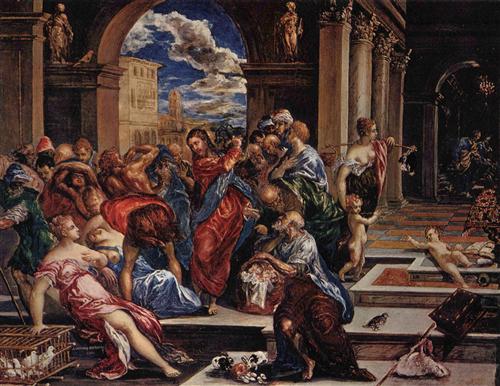
El Greco, Christ driving the traders from the temple (public domain)
As we see in today’s reading, Jesus called for true worship of his Father. We can picture the ruckus he must have caused among the people in Jerusalem, with all the gossip and discussion afterward – not only of driving out the merchants, but in his cryptic remark about raising the temple in three day. We with hindsight know what he means, but try to place yourself back in the temple, imagining the confusion and intrigue his words would have caused.
Therefore, I urge you, brothers and sisters, in view of God’s mercy, to offer your bodies as a living sacrifice, holy and pleasing to God – this is your true and proper worship. Do not conform to the pattern of this world, but be transformed by the renewing of your mind. Then you will be able to test and approve what God’s will is – his good, pleasing and perfect will (Romans 12:1–2).
In writing to the Romans, the Apostle Paul delivers a lot of theology in the first eleven chapters – salvation, justification, righteousness, freedom. Then he pens a big “therefore.” What does all of it mean? Listen up, he seems to say, this is how to live it out.
We think about his “therefore” this week as we consider the internal transformation of a pilgrim that results in changes to our behavior. Paul tells the Romans to start with offering their bodies to God. No longer do they make animal sacrifices, for the new covenant brought forth by Jesus supersedes that. Rather, now they give themselves as a living sacrifice. And God will not reject them as he would previously an imperfect dove or bull.
Then Paul says not to conform. Living in a caustic world, we can easily sink to the level of the prevailing culture as we give in to gossip, angry thoughts, bitter recriminations. But God through his indwelling Spirit can change the pattern of our thoughts as we submit to him. Perhaps we can call to mind that the Lord dwells within through a hourly alarm on our phone. Or each time we relieve ourselves. Or when we are about to blast out a series of unhelpful or hurtful words. For when we are transformed, then we will understand how God wants us to live. We’ll learn his “good, pleasing and perfect will.”
For reflection: “So whether you eat or drink or whatever you do, do it all for the glory of God” (1 Corinthians 10:31).
I wonder how the disciples felt when they watched Jesus turn water into wine for a great wedding celebration. So much symbolism, especially as we think about the wedding of the Lamb, the Lover and Beloved, God and the church. The wine poured out is his blood, shed for our redemption.
May you know the love of the Bridegroom this day, as you consider his loving sacrifice.
I’m delighted to welcome Penelope Swithinbank to the “There’s No Place Like Home” series. I knew of Penelope before I knew her, for she and her husband arrived at my former home church in Virginia shortly after I moved to her native England. They now run a gorgeous-looking retreat centre that I long to visit in the beautiful English countryside. We most often “see” each other online now, and I so appreciate Penelope’s wise and gracious insights. Her post had me smiling and tearing up.
“Shrimp for supper,” I announced to my hungry husband. “Same recipe as that one I tried in the States last week.” I think he started salivating. We had visited our American grandsons in America, and I’d found a new recipe which we’d loved: skewered shrimp. Now I wanted to recreate it in Wiltshire, and had eagerly pounced on a packet of shrimp I’d spotted when shopping.
Time to cook; I’d soaked the bamboo skewers in preparation and slit open the defrosted packet. Out tumbled tiny, tiny pathetic pink things. Not the large succulence I was expecting; these were miniscule. Lots of them to be sure, but far too small to be threaded on to skewers.
And then I remembered – we are two nations divided by a common language. What England calls prawns are what America calls shrimp, and they are huge in the States and tiny in the UK. I should have looked for ‘jumbo prawns’ or ‘tiger prawns’ in England. At least I had remembered that zucchini are courgettes and summer squash merely the yellow ones.
We ate shrimp and courgette risotto for supper. It was edible (just) but not what was expected, and a poor substitute.
Same word but different meanings. And I had forgotten my translation skills. The years we spent living in the States should have reminded me of the need for interpretation. I used to dread using some word in a sermon that might be perfectly normal and acceptable in English, but have an entirely different and unsuitable meaning for my American congregation.
“Let’s make a list of differences,” Patti exclaimed enthusiastically, as we told each other about trunks and boots, pavements and sidewalks, bonnets and hoods. A gloriously correct Southern Lady, Patti found paper and pen and drew a line down the centre (center!) of the page. She wrote at the top of the left hand column: “English” and listed trunk and sidewalk and hood. Her pen hesitated at the top of the righthand column and she turned back to me. “So what do YOU speak?” she asked, bewildered.
Two nations divided by a common language, said George Bernard Shaw.
And then there’s “home.” Where is it? What is it?
American granny.
When we lived in Virginia, despite the fact that we were ‘having a blast,’ and following the Lord’s calling to minister there, I often had moments of overwhelming grief. I would wander into my elder daughter’s bedroom and stand there sobbing, knowing that she was thousands of miles away in the UK at university and that my son, also in England, was now married and would never join us to live in the States.
It wasn’t place I was missing, but people, family. When we were all together, whether in England or Virginia, that was ‘home.’ Eating together, laughing, sharing memories, sharing griefs and joys. Enjoying one another’s company.
And now, with family both sides of the Atlantic (the younger daughter married a Virginian!) I have one foot each side of the Pond. Where is ‘home?’ And whichever side of the Pond I find myself, half of me is missing what, or rather who, is on the other side. I miss the company of my family.
English granny.
Cue a sermon illustration, of course. My preacherly mind wonders which one to pursue – the language of heaven, the homeliness of heaven (oops, homey-ness for American readers) …
But it’s people, family, relationship, which impacts most, I think. Home, for me, is both America and England. I want to live in both, at the same time, holding all those I love around me forever. I could happily live in either – or both. Wherever my family is. I long for their company. But two-thirds live in London and a third in Virginia. When I’m in one place, I long for the other.
And what about heaven? Do I long to live there too? With my church family, with the communion of saints, with the Lord forever. Do I long for the company of heaven? Com pane: with bread, eating and sharing in the feast that will be ours in heaven.
“And then there will be one huge family reunion with the Master. So reassure one another with these words.” (1 Thessalonians 4:17–18. The Message)
Bet the prawns – or shrimp – are larger there, as well.
Penelope Swithinbank is the Director of Ministry for Ministries by Design. She is an ordained Anglican priest and a trained Spiritual Director. She is married to Kim and they run the Vine at Mays Farm, a Christian retreat centre in Wiltshire. Penelope and Kim have 3 grown and married children and 6 grandchildren. She loves reading, the theatre, walking the dog and looking after her grandchildren on both sides of the Atlantic.
Questions and answers. The questions – who was this? The answers – he knew their name. He saw who they were at their essence. So does he with us today. He calls us by name. He knows us.
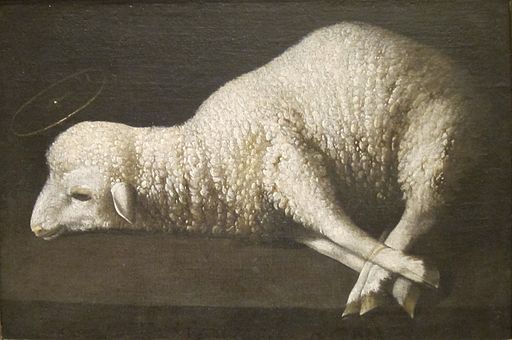
“Look and see!” says John the Baptist. He who had been given a special grace of seeing the unseen called those around him to open their eyes and see. To know that this Jesus was God’s Chosen One, the Lamb of God who would take away the sins of the world.
Have mercy on us, Lord, as we come before you during this season of Lent, pondering the gift and mystery of your coming and saving us.
Today’s poem comes from the point of view of John the Baptist.
James Fraser and some of the people he introduced to Christ.
Then Peter spoke up, “We have left everything to follow you!” “Truly I tell you,” Jesus replied, “no one who has left home or brothers or sisters or mother or father or children or fields for me and the gospel will fail to receive a hundred times as much in this present age: homes, brothers, sisters, mothers, children and fields – along with persecutions – and in the age to come eternal life.” (Mark 10:28–30)
Our text comes just after the rich man asks Jesus how to enter the kingdom. Jesus’ words to him are stark: sell his possessions, give to the poor, and follow him. The disciples are amazed. Then Jesus gives the assurance above – those who renounce family members and livelihoods and who endure ill-treatment will receive a hundredfold of blessings.
This passage makes me think of missionaries of old, who would leave their home for a far-flung country never to return, or to come back decades later to a few remaining relatives whom they might not recognize. James Fraser (1886–1938) was such a pilgrim. He gave up what would have been a budding career as an engineer – or a concert pianist – to live among the remote tribal people in China. What he relinquished was great, but what he gained was everlasting. For through his dependence on God as expressed through a disciplined program of prayer (shared with his prayer partners at home), he witnessed many Lisu Chinese people come to faith.
God might not be asking us to be mission partners in a remote village. But what he seeks in us, as with the young rich man, is a heart willing to eschew the things that may have become an idol to us – even our family members or our homes or our work. Can we say yes to Jesus as he asks us to follow him, trusting that we will receive a hundred times as much of what we say no to?
For reflection: “Now to him who is able to do immeasurably more than all we ask or imagine, according to his power that is at work within us, to him be glory in the church and in Christ Jesus throughout all generations, for ever and ever! (Ephesians 3:20–21).
 The first chunk of John 3 is filled with truth and life and seeming mysteries and contradictions: How can an adult be born again? How are we born of the Spirit? Why did God send his Son to die? Why do those doing evil seek darkness over the light?