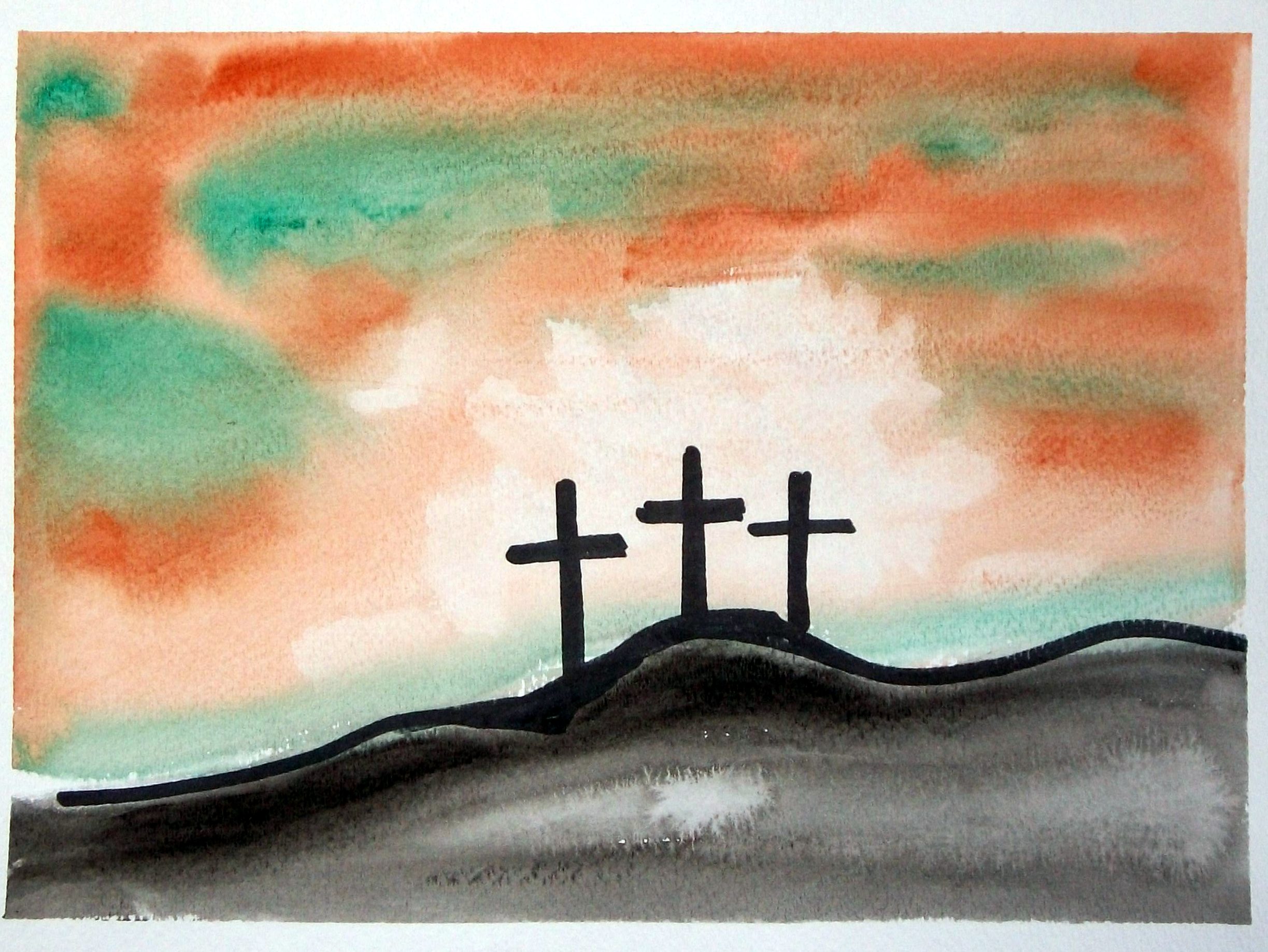
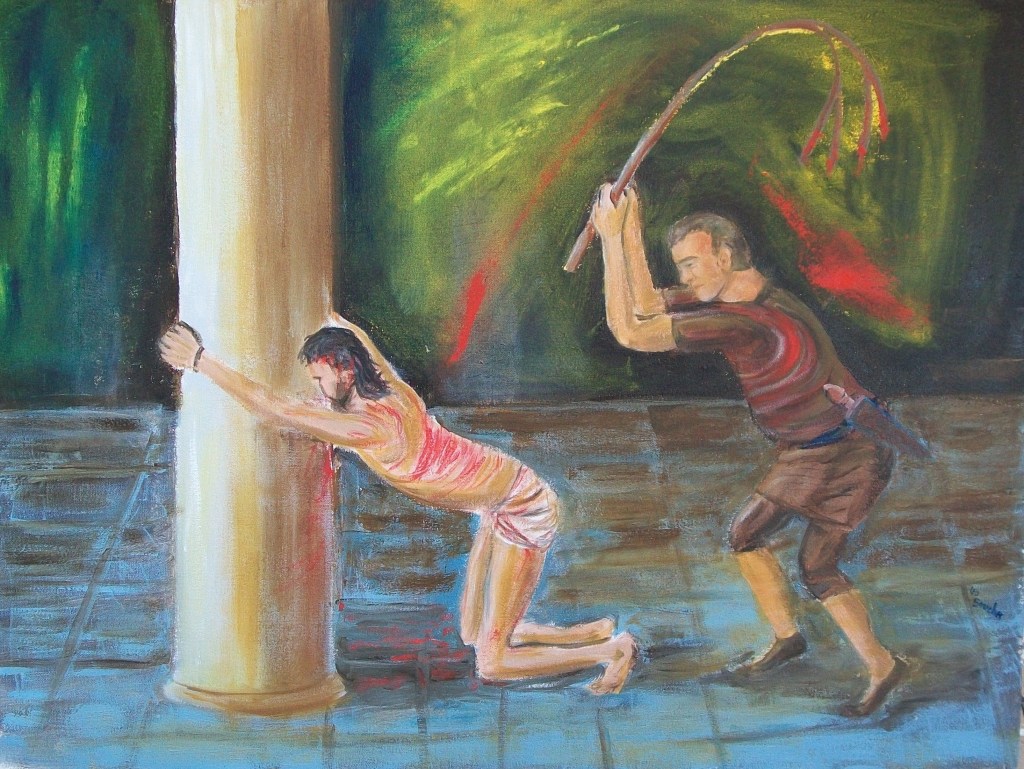
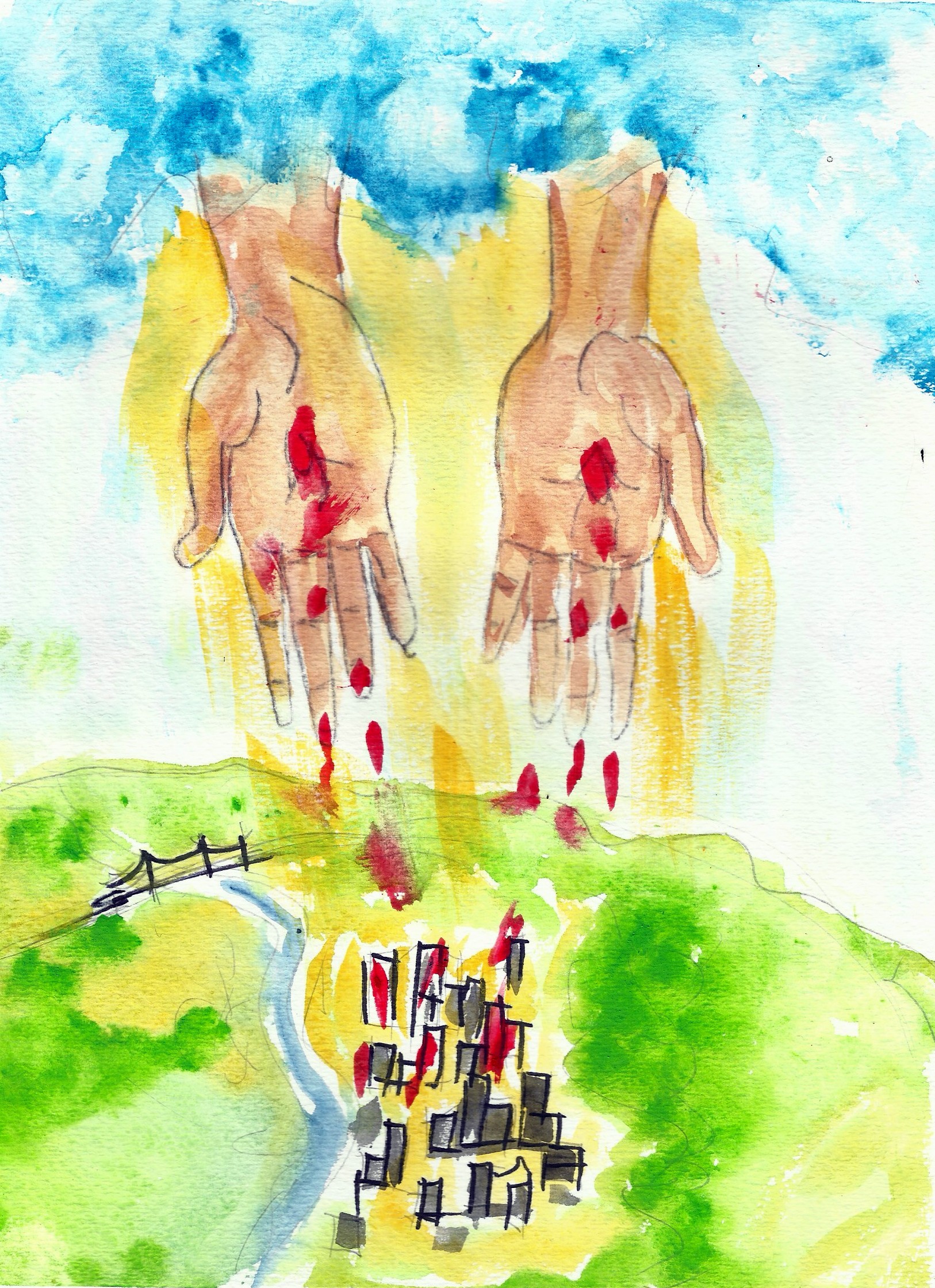
By Leo Boucher. Used with permission; all rights reserved.
Tomorrow, on Maundy Thursday, we start in earnest the journey to Jesus’ death and resurrection. We’ll remember his last supper with his disciples. His talk with the disciples when he promises the Holy Spirit, the Advocate, who will come to them. His time of praying in the Garden of Gethsemane.
His betrayal.
His carrying of the cross.
His beating by the Roman soldier.
His body nailed to the cross.
His death.
Lord Jesus, thank you for the cross. Thank you for your love poured out. We worship and adore you. Fill us by your Holy Spirit as you increase our gratitude and love.
Be devoted to one another in love. Honor one another above yourselves. Never be lacking in zeal, but keep your spiritual fervor, serving the Lord. Be joyful in hope, patient in affliction, faithful in prayer. Share with the Lord’s people who are in need. Practice hospitality. Romans 12:9–21 (NIV)
When my husband and I were first married, we had some dear friends around for dinner. When I popped to the kitchen to grab the green beans, my husband served Steve some sparkling water. Well, he thought he was pouring sparkling water, for that’s what the bottle said, but when I walked back into the room I exclaimed, “That’s the radiator water!” Our car was old and we needed to carry water with us to top up the radiator; somehow the bottle for the car had made it to the dining-room table. Steve said with a smile, “I see you are heeding Paul’s exhortation to practice hospitality! You may need more practice!”
We all need practice at living well, don’t we (and I hasten
to add that the water we served was clean, although not sparkling). Paul’s
instructions in just these few verses are those we can hold close to our heart
as we seek to live godly lives. He tells us to love each other, honoring our neighbors
above ourselves; to serve the Lord with enthusiasm and passion; to keep our joy
strong and to pray faithfully; to open our homes and share with those who are
in need; to bless, rejoice, mourn, be humble, and to live peacefully with
everyone.
I wonder how our cultures would change if we could implement even a small percentage of these commands. Truly the world would then know we are Christians through our love in action.
Might you choose one or two of Paul’s instructions to practice
today? Perhaps, too, you might be inspired to memorize this passage.
Prayer: Lord God, you give us the resources we need to live well, including these practical instructions. May I take them to heart today, that I might live for your glory.
By Leo Boucher. Used with permission; all rights reserved
As we draw near to Holy Week, when we remember Jesus’
passion – his death and resurrection – I offer you this painting by my father
for you to ponder and consider.
What strikes you in it?
What can you do today to get your heart ready to remember?
Do not conform to the pattern of this world, but be transformed by the renewing of your mind. Then you will be able to test and approve what God’s will is – his good, pleasing and perfect will. Romans 12:1–8 (NIV)
In chapter 12 we reach another of Paul’s pivotal words – “therefore”
– and this one is grand for it signifies a change from him exploring the great
theological concepts we’ve seen in this letter to their practical implications.
What does it mean, then, for us as Christians to be sinners saved by grace? How
then shall we live?
To please God we offer our bodies as living sacrifices, and we are not to conform to the world but be transformed by the renewing of our minds. We may know this passage well, but do we fully understand it? One interpretation of offering our bodies has to do with the sacrifices required in the Old Testament. Now with Jesus taking away the curse of our sins, we can present ourselves as living sacrifices in the place of the dead animals once offered up. Part of our humble sacrifice can be made through Paul’s exhortation in verses 3 and following – don’t think more highly of yourself than you ought, and remember that the body has many members who all need each other.
And our transformation begins through the renewing of our minds, for our thoughts and our beliefs shape our behavior. As God’s Spirit lives within us, he ushers in changes to the way we think and approach the world. For example, whereas before we may have been defined by fear or anger, now we can feel comfort and peace. Of course, transformation is a life-long process, and we won’t feel perfect peace all of the time. But moment by moment, bit by bit, the Lord works in our minds, hearts, and souls. As we center our thoughts on him, we are changed.
Prayer: Lord Jesus, mold me and shape me; make me anew. Renew my mind, that I might bring you glory.
By Leo Boucher. Used with permission; all rights reserved.
We’re nearly halfway through the season of Lent. By now –
day 22 of 47, if you include Sundays – we might start to grow weary. We might have
fallen behind in any Lent reading that we embraced on Ash Wednesday, the guilt
piling up each day as we wonder how long this season will go on. We might just
be tired.
I love this painting of my dad’s – it’s one I’ve framed and
have near my desk, so I can pause to look at it. I see Jesus in the desert,
being tempted by Satan, enduring every hardship conceivable that humans might
experience. The desert is a lonely place; a place of noxious wild animals; a
place of burning heat in the day and chilling cold at night.
Jesus made it through his forty days in the desert, and afterwards,
he was hungry. We might not be fasting or observing Lent, but we can remember how
Jesus endured these trials on our behalf. He is with us in the desert.
Oh, the depth of the riches of the wisdom and knowledge of God! How unsearchable his judgments, and his paths beyond tracing out! “Who has known the mind of the Lord?” Romans 11:33–36 (NIV)
This learned and wise apostle shows his humility in this
doxology as he concludes his teaching on how Jews and Gentiles are one in
Christ. He quotes from the prophet Isaiah when he poses the questions of who
can know the mind of God or be his counsellor (Isaiah 40:13), and note the
questions he poses in this passage, for they are rhetorical. No one can know
God’s mind – and yet, the Lord has revealed himself through Christ Jesus.
Through him we see an embodiment of God’s wisdom.
I love the writing of Dallas Willard, who was a philosopher
and one concerned deeply with spiritual formation before he died a few years
ago. When giving a talk at a church or at a conference, he would ask audiences
who was the smartest man in the world. People would trot out answers such as
Albert Einstein or other known thinkers, and Dallas would eventually say, “But
why aren’t you saying Jesus?” Dallas wanted to change people’s thinking and
help them to realize that Jesus was and is the smartest person ever, and that
he continues to be our teacher as he dwells within us.
We can become wise through the study of God’s word and world,
and through the indwelling of the Holy Spirit. For the Lord has created us to
think and to exercise our discernment, and he will lead us into all wisdom.
Whether or not we have a university degree doesn’t matter when we know that we
have the best and smartest teacher ever giving us individual tutorials!
Prayer: Father, Son and Holy Spirit, thank you that you teach me how to live. Help me to exercise my mind, that I would think Christianly about the world and my place in it.
By Leo Boucher. Used with permission; all rights reserved.
I love this painting, for it makes me think of home, as the subject is my mom reading. My dad titled it, “Beauty and the Book,” which is apt.
My mom celebrated a birthday recently, and although I wasn’t able to be in Minnesota to celebrate it with her, my daughter and I called and sang a boisterous version of “Happy Birthday” – not very in tune (at least on my part), but it was heartfelt.
How do you celebrate those near to you? And, related to the picture, what are you reading?
For there is no difference between Jew and Gentile – the same Lord is Lord of all and richly blesses all who call on him, for, “Everyone who calls on the name of the Lord will be saved.” Romans 10.1–17 (NIV)
I wonder how Paul felt when he came against his people’s unbelief of Jesus as the Messiah. He could understand their reluctance – after all, he had been united with them in disbelief previously – and yet now that he knows the riches of Jesus as the Savior he must yearn for them to understand and believe. He writes to the predominately Gentile church, which had Jewish believers too, to remind them that all are one in Christ. There is no dividing wall; no division between them any longer (see Ephesians 2:14). As he says in the letter to the church at Colossae, “Here there is no Gentile or Jew, circumcised or uncircumcised, barbarian, Scythian, slave or free, but Christ is all, and is in all” (Colossians 3:11).
Today in the body of Christ we don’t have the divisions of Jew or Gentile, but we face different issues that divide. For instance, as an American living in Britain, I often am flummoxed when I come across statements of class divisions in society or even in the church. They stand out to me as foreign, and I find them difficult and sad. Whereas in America, many people point out the problems of racial disunity as a sort of besetting sin. Whether we are influenced by class or race or another issue in the country in which we live, we can work together for unity as we cling to Paul’s words that the “same Lord is Lord of all” (v. 12).
How could Christ working through you help you to dismantle
any dividing walls in your church or community?
For reflection: “Therefore, as God’s chosen people, holy and dearly loved, clothe yourselves with compassion, kindness, humility, gentleness and patience… And over all these virtues put on love, which binds them all together in perfect unity” (Colossians 3:12, 14).
By Leo Boucher. Used with permission; all rights reserved.
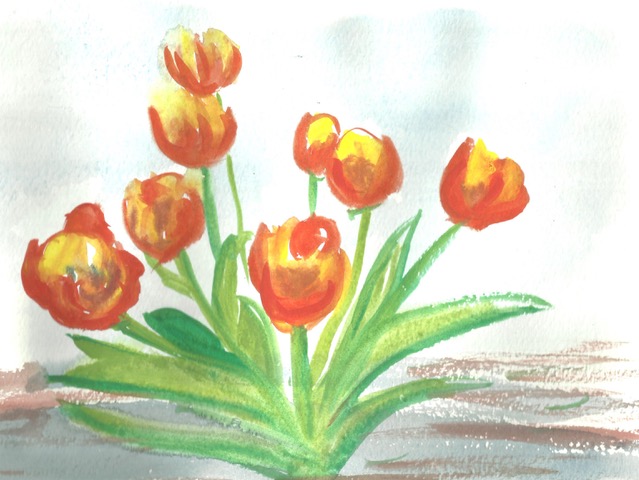
Here in London we enjoyed a few days of “Fool’s Spring” with its shockingly warm temperatures – shockingly, because the summer-like weather felt distinctly odd in February. This week Storm Gareth has brought wind and rain, and a reminder that damp cold can sink into one’s bones.
But Spring is definitely on the way, and I’m delighting in daffodils
on my kitchen table and blowing the breeze outside of my study window. The
yearly cycle of new life sprouting out of a seemingly dead ground brings me
hope and good cheer.
In which areas of your life do you wish for Spring?