By Leo Boucher. Used with permission; all rights reserved.
This week we’re observing Watercolor Wednesday on Thursday, because hey, who knows what day it is anymore! I clearly don’t.
I thought we could use some simple beauty for today’s image. Two flowers with their bright colors on a blue background, reminding us to take a few moments to breathe in as we remember that God loves us and the world so much that he made glorious flowers for us to enjoy.
The Spring flowers this year feel particularly stunning, I think because we might feel beauty-starved from our lockdown-homes or essential places of business. We hear the news; we feel the news; we yearn for beauty and grace.
Take a moment now to pause and ponder the wonder of the God of the universe creating delicate flowers for you to enjoy. May you know his peace, joy, and wonder today.
I thought you might enjoy reading the haiku poems my daughter wrote yesterday as part of her English homework. I love how they express so many emotions in so few words.
Here we are at home Forty-seven days and more Wishing we were out
Stuck at home all day Isolated, alone, sad Apocalyptic
Overwhelmed with work Constantly behind and bored Wishing this was done
Missing friendly laughs Contacting only through screens Wishing you were here
People needing masks Some dying alone, afraid Waiting for the end
Going for a walk Lovely sounds all around me Fresh airs renews me
PJs all we wear Goodbye summer holidays Missing family
By Leo Boucher. Used with permission; all rights reserved.
We’re in the Easter season – Eastertide, as it’s known in Anglican circles, when for 50 days after Easter Sunday we continue to celebrate the risen Jesus. We should be sipping bubbly and embracing our loved ones.
But with the pandemic sinking into us more deeply as the days go by, it doesn’t feel very celebratory, does it. Makes me think of the wonderful Rob Lacey, who wanted to call the story of his healing from cancer, “Halle-blinkin’-luia.” (He was healed, but he later died.) We might have to celebrate through gritted teeth and the strength of our wills.
Perhaps this year celebrating just means breathing out our laments and praying with the Psalms as we hold on to our faith.
Wherever you are in the spectrum of celebrating, or feeling ever so weary from it all, I pray that you will have some moments of peace, joy, and love this day.
In response to a tweet wondering should she read this book, my review from Woman Alive, August 2016. (Great decluttering exercise during lockdown!)
You may know that the Woman Alive book club has an interactive presence on Facebook. At the request of readers there, I chose a fiction and nonfiction book for us to discuss, which I would then feature in the magazine. For the novel, we read The Girl from the Train (not to be confused with the wildly popular The Girl on the Train).
I’m glad I chose the novel for our discussion, not least because it took me awhile to get into the story (I knew I had to persevere!). It recounts the life of Gretl, a German girl with some Jewish ancestry who was caught in the events of the Second World War. The story follows her and her protector Jakob through their lives in Poland and eventually South Africa, weaving in themes of identity, faith, family, racism, the relationships between Christian denominations, home and love.
As readers we appreciated the window into life in South Africa. As Kathryn Price said, “I hadn’t known about the children ‘exported’ to South Africa, and found that very interesting. We don’t often hear about white South Africans, it’s usually just the apartheid situation, and it was interesting that it felt unbalanced.” Anne Shakeshaft agreed, saying, “I had no idea that South Africans had adopted German orphans.” She found it interesting “to read of the prejudice against Germans, Jews and Communists as well as other faith denominations” and found the book enjoyable but heart-wrenching in places.
The view of identity was strong for Caroline Seal, for she supports various missionary families and has thus read about “MKs (missionary kids) or TCKs (third culture kids).” She says of Gretz, “She constantly has to hide parts of who she is … you can see how she wants people to accept her so is a bit of a chameleon doing things that will please people… TCKs are also trying to get things right in the culture they live in and in their passport culture.”
Chris Vickery anticipated the ending, wishing it would have come sooner in the sense of us seeing the life of the protagonists together. I agree – why can’t more novels examine what life looks after the romance survives the hurdles? I’d love to read what “happily ever after” looks like.
I appreciated Julia Wilson’s full review of the novel, which touches on themes of belonging, one’s roots, friendship, how stress can be rooted deep within, and symbolism such as names and fire.
We live in unprecedented times. You may feel you have more space
to engage with God or you might feel overwhelmed. Perhaps you feel both eager
to meet with God and then flat-out tired and listless in the same day.
If you have some time and energy, consider journeying with Abraham and Sarah over a two-week period through my free ebook.* These founders of our faith lived with uncertainty and change as they left their home and their family and community to follow God’s call. We can find hope in God through walking with them.
Each day you are invited to consider part of their story out
of Genesis, followed by some reflections and an interactive prayer exercise.
I hope and pray God will meet you in amazing and comforting
ways as we celebrate Easter and rejoice in God breaking the power of death and
sin through his Son’s sacrifice on the cross and resurrection.
God is with you in these hard and good times!
*Free ebbok when you sign up to my monthly mailing list. You of course will be able to cancel the mailing list if you wish later.
On this Good Friday (why is it good?), I share with you some thoughts that I gave at church on a Good Friday past. May you find meaning in your remembering this day.
Mark 15:33–41 (NIV)
At noon, darkness came over the whole land until three in the afternoon. And at three in the afternoon Jesus cried out in a loud voice, “Eloi, Eloi, lema sabachthani?” (which means “My God, my God, why have you forsaken me?”).
When some of those standing near heard this, they said, “Listen, he’s calling Elijah.”
Someone ran, filled a sponge with wine vinegar, put it on a staff, and offered it to Jesus to drink. “Now leave him alone. Let’s see if Elijah comes to take him down,” he said.
With a loud cry, Jesus breathed his last.
The curtain of the temple was torn in two from top to bottom. And when the centurion, who stood there in front of Jesus, saw how he died, he said, “Surely this man was the Son of God!”
Some women were watching from a distance. Among them were Mary Magdalene, Mary the mother of James the younger and of Joseph, and Salome. In Galilee these women had followed him and cared for his needs. Many other women who had come up with him to Jerusalem were also there.
Luke 23:44–49 (NIV)
It was now about noon, and darkness came over the whole land until three in the afternoon, for the sun stopped shining. And the curtain of the temple was torn in two. Jesus called out with a loud voice, “Father, into your hands I commit my spirit.” When he had said this, he breathed his last.
The centurion, seeing what had happened, praised God and said, “Surely this was a righteous man.” When all the people who had gathered to witness this sight saw what took place, they beat their breasts and went away. But all those who knew him, including the women who had followed him from Galilee, stood at a distance, watching these things.
Women, at the time of Jesus,
in the ancient Near East
didn’t have the same standing as men.
They couldn’t even touch the Torah, the Scriptures,
or read it for themselves.
They were taught by their fathers or husbands.
A woman couldn’t serve at a banquet where men were eating—
that was a task for a manservant.
But Jesus valued women.
He went against the cultural practices of the day
because he prized them.
He loved them.
He taught them.

He told Martha of Bethany that her sister Mary
had chosen the one thing necessary—
to sit at his feet and receive from him.
to be his disciple.
 Many women loved and served Jesus.
 Not least his mother
 who as we hear in John’s gospel was there at the cross
 standing next to the beloved disciple, John.

 Even in his hour of pain Jesus loves her, and
 makes sure that she, who was probably a widow,
 would be cared for by John.
 And John would gain a mother as well.

 In Luke and Mark’s account of the cross,
 women watch him die on the barbaric cross;
 this instrument of torture.

 They who have loved the Lord,
 serving him and listening to him,
 following him,
 stand by him.

 As his disciples.

 They braved the potential danger
 and stood by at a distance.

 What danger?
 Friends and families of criminals—
 which is what Jesus was named to be—
 could have been persecuted.
 Not only ridiculed, and
 spit at, just like Jesus was,
 but given the same punishment as he on the cross.

 But these women couldn’t leave him,
 for they loved him.
 They watched from a distance.
 Seeing him suffer.
 Could we too watch our Lord on the cross?


 Think of the women standing there.
 In Mark’s account, we hear of
 Mary Magdalene,
 Mary the mother of James the Younger and of Joseph,
 and of Salome.

 Mary Magdalene is often seen as a prostitute
 but nowhere in the Bible is she named as one.
 She appears in the gospels 14 times—
 she was important to Jesus.
 He cast from her seven demons.

 She, who was literally out of her mind
 with demon possession
 was returned to her right mind by Jesus.
 And now, during his hour of need,
 she stands and keeps watch.

 We don’t know much about Mary,
 the mother of James the Younger and Joseph.
 She may have been the wife of Cleopas,
 a disciple of Jesus or Alphaeus.
 Maybe she was a sister to Mary, Jesus’ aunt.

 We do know that she followed Jesus,
 ministering to him and his disciples in material things,
 so she had a certain amount of wealth.

 She too stood at the cross and watched.
 Later she went to the tomb with spices to anoint his body
 and was told by angels that Jesus was not there.
 She was a faithful follower.

 Along with the two Marys was Salome.
 She was the wife of Zebedee, a fisherman,
 and the mother of James and John,
 two disciples of Jesus.
 Earlier she asked Jesus if her sons
 could sit in places of honor in the kingdom of God.
 A mistaken question.

 But she continued to follow Jesus
 and now she too watches from a distance.
 and later she too would bring spices to Jesus’ tomb
 to anoint his body.
Can we put ourselves in the place of these women? They had been given value by Jesus. He saw them. He loved them. He saved at least one of them from a life of destruction, of being an outcast.
And now, their teacher and lord was nailed to a cross. They must have been scared and afraid, numb. Questioning why…
Even though Jesus had said that he would die and rise again.
Hearing his words of prediction was one thing, but seeing it happen in front of them, another.
And yet they did not leave. They served through their act of presence. Through simply being with Jesus in his darkest hour. They loved him, even from a distance.
How about you? How about me?
Can we risk the taunts of those who do not understand our faith in Jesus? Can we stand together with those who also love Jesus, to show how we love him?
How can we stand with Jesus today? How can we love him? How can we serve?
How can we see him suffer dying on the cross, dying to release us from our sin and shame. dying to give us new life— life in the kingdom.
Can we, like the women, stand and watch? Can we, like the women, receive his love?
Lord Jesus Christ, You died to save me. You allowed yourself to be spit upon. Mocked. Lied about. You didn’t open your mouth.
And women who loved you watched you die. Perhaps they huddled together as you took your last breath and the curtain tore in two. They loved you from a distance. They did not leave you.
May I too be one who stands with you. May I love you, and serve you. May I overflow with love for you, Knowing that you have saved me from a meaningless life.
On this holy day, when we remember your death, Lord Jesus, May I be encouraged by the example of these women. Those not always valued by those in authority But those whom you loved.
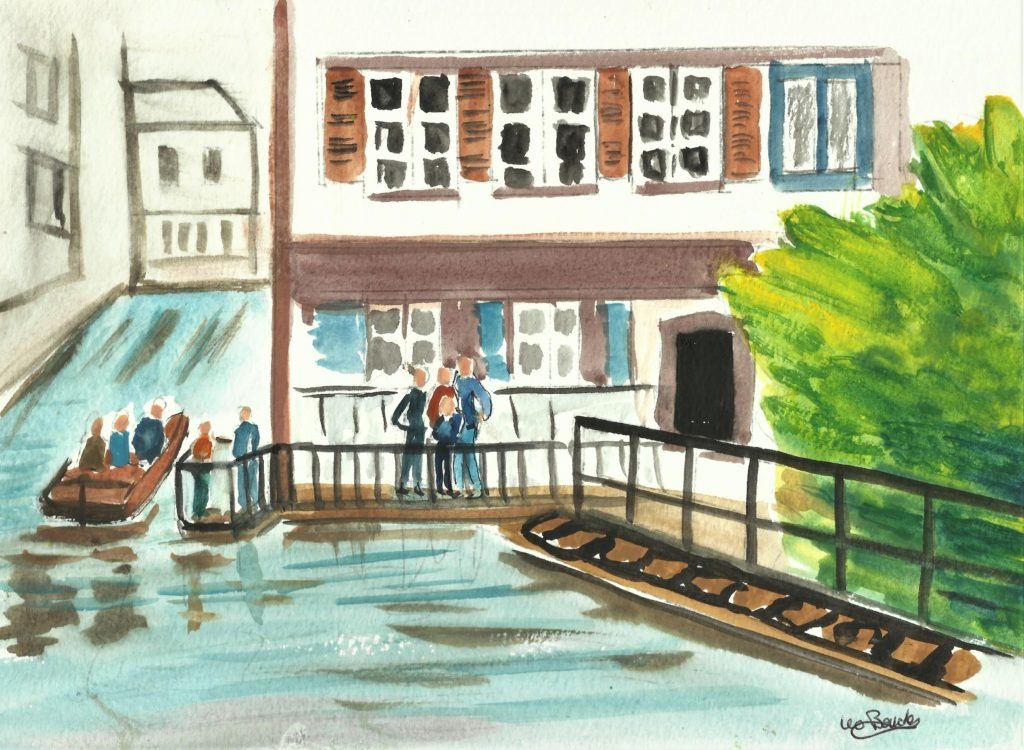
Seeing people grouped together now, such as in this painting by my dad, seems to stem from a different time. It feels poignant and removed from our experience today. I wonder how life will be different when we come out of lockdown?
How are you doing? Are you missing any gatherings in particular?
[By Leo Boucher. Used with permission; all rights reserved. Picture is of a snapshot from Rudesheim in Germany, a city my parents visited when they took a trip down the Rhine river.]
I find this recent painting that my dad created so evocative. It captures those weeks in Minnesota that seemingly go on a long time – when the snow has melted but the signs of Spring feel far off. Brown is the color of the ground and perhaps of the soul, as things can feel lifeless and perhaps hopeless.
Maybe you feel a bit brown these days, as the stay-inside orders and all that is behind them affect you with some small – or huge – griefs. Yet the stream with its color and life brings hope to the scene, just as God’s living water brings life and grace as it cleanses and renews us.
May you, during these uncertain times, receive the gift of
God’s living water.
By Leo Boucher. Used with permission; all rights reserved.
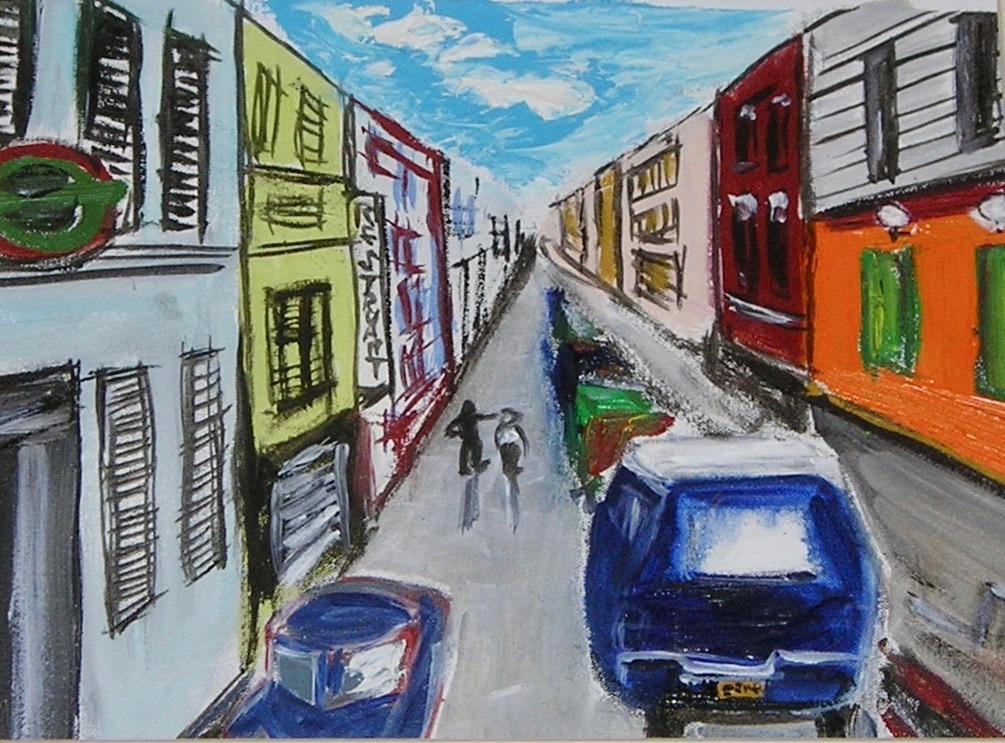
As the coronavirus pandemic continues to build in so many countries, city streets are becoming increasingly deserted. What I like about this painting by my dad, which is a look down a Roman street, is the contrast between the bright colors of the buildings with the lone figures on the street. Let’s say they are self-isolating and are out for their one spot of exercise that day. What lies behind all those colorful buildings? What stories could be told?
What stories are you hearing from behind closed doors? How can I pray for you at this time of fear and anxiety? May you know the peace that passes beyond any city walls; may the peace of Christ be yours this day.
By Leo Boucher. Used with permission; all rights reserved.
One of the best things about immersing myself in a writing project is how much I learn in the midst of the research. Lately I’ve been working on a short book for small groups on the prayers of Jesus for Lent next year. There are seven recorded prayers of Jesus, and we look at six of them. One, you may recall, is the prayer that Jesus prays at the grave of Lazarus. It’s a prayer of thanksgiving – of faith – and not of petition. Jesus thanks the Father for always hearing him.
Sometimes we simply don’t have enough faith to know that God has heard our prayer, but we can ask him to give us the faith to believe. At other times, we need faith even to pray.
Whatever our needs, I believe we can approach our loving God, who hears our prayers. I hope you believe that too.
I hope you enjoy this painting that my dad created for me, for some talks I will be doing on Mary, Martha, and Lazarus! Isn’t it wonderful?