Tag: There’s No Place Like Home

  • Heading Home by Debbie Duncan

    No Place Like HomeToday’s installment in the “There’s No Place Like Home” series is Debbie Duncan, lovely author I had the privilege of working with at Authentic Media with the release of her co-authored book Life Lines, a brilliant fictionalized-but-based-in-reality look at friendship. She’s a minister’s wife and nurse who has taught at the Florence Nightingale School of Nursing, King’s College London. She and Malcolm have four teenage children and live in Buckinghamshire, UK.

    Am I a turtle without his shell?

    We have a natural affinity to the past; something captivates us when we hear where are from or when we learn about our ancestors. Certainly the television programme, “Who do you think you are” has been a huge success, facilitating an increase in people looking into their own genealogy. I have managed to get back to 1600 in my family tree, uncovering a pirate called Foxy Ned, a lady of the manor who ran off with the groomsman and a diamond scandal. My family have many roots in many countries and I cannot on good authority say where I am from, although I do claim to be Scottish as Scotland is where I spent my formative years. Home, however, is a different matter.

    IMG_2909Home is where I feel safe, surrounded by those I love. At the moment we are based in Buckinghamshire, having lived in the same house for more than five years, which is a record for us. Three of my children are presently away from home at university. When my oldest daughter, Anna, went, she had a box of decorations for her room. It was really important to her that this box was packed and went with her. In fact she packed it before she packed any clothes or books. On her first evening in her new halls the box was un-packed and she strung up her lights and hung up her photos.

    Susan Clayton, an environmental psychologist says, “For many people, their home is part of their self-definition.” They have bought in to this concept of home, paying for a mortgage or spending money renovating and decorating buildings. Walls are covered with photos and pictures of where we have been and shelves are covered with souvenirs from past adventures. I have to confess I have the odd smattering of tartan throughout the house.

    “Where are you from” is an important question but “where do you call home?” should be the question we ask. And if we think that “home is where the heart is” then home is where we are right now. For the moment for us that’s in Chalfont St Peter, where I have come to love the community. For instance, when we experienced tragic loss earlier this year I had a strong desire to stay at home – I didn’t want to leave. I wanted to feel safe and secure surrounded by people I know.

    I am made even more aware of how much I value this place I call home as I have been involved in a pilot project in a nearby town as an outreach nurse for the homeless. They live in a hostel where they are supported by a variety of care givers and staff. They may not have a physical space that they have decorated but they have a place of safety where people care for them. Some of the clients have talked about how they feel exposed not having their own place – a little like a turtle without his shell.

    IMG_2818
    The Duncans

    As Christians our natural trajectory should be towards our real home. This place I live in is a temporary measure but like a turtle without a shell maybe this keeps me focused, awaiting the day when I am made whole and complete. The money I spend on my surroundings means where I live looks comfortable and may reflect some of my identity but that is only truly revealed when I am in my real home.

    Home is where we are right now, but for those who believe in Jesus it is also only a temporary state. I am not defined by the pirates and diamond dealers of my past or whether I am English or Scottish. I am defined by being part of God’s kingdom, heading towards my final destination of my real home.

    Reepicheep, the valiant talking mouse in CS Lewis’ book The Last Battle, stood on the shore at the end of the story and said, “I have come home at last! This is my real country. I belong here. This is the land I have been looking for all my life.” He may not have been a turtle, but he found his shell.
  • The Home of my Heart by Adrianne Fitzpatrick

    No Place Like Home“There’s no place like home” – even for expats like me and Adrianne Fitzpatrick, whom I’m pleased to introduce today. Adrianne is a writer and publisher of Books to Treasure, a small independent press producing quality children’s literature, whom I met through the Association of Christian Writers. I love her passion and commitment to all things books. Her contribution to our series on finding home struck a chord in me, for I too cling to the identity of the land of my birth.

    When I was four years old, my parents decided to move from New Zealand to Australia (the land of my father’s birth). Even at that tender age, the prospect devastated me. I was, apparently, in love with a boy who was all of six or seven, and I begged him to ask his mother if I could live them instead! Alas, it was not to be; and a few weeks shy of my fifth birthday, I found myself on foreign soil. I was not impressed. To add insult to injury, in New Zealand I would have started school on my birthday (which was in June). In Australia I was required to wait until the following January, when the new academic year began. This was not a good beginning!

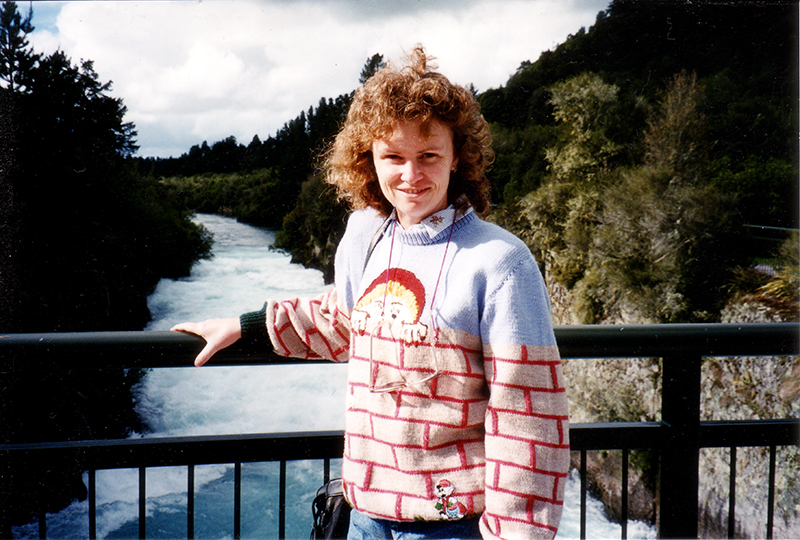
    Adrianne in 1994 rediscovering her New Zealand roots.
    Adrianne in 1994 rediscovering her New Zealand roots.

    I clung desperately to my New Zealand heritage as I grew up. When I felt Australian pronunciations beginning to impinge on the way I talked, I would ask my mother how to say things the New Zealand way. I steadfastly refused to become Australian. As an adult I would still claim my NZ birthright even while acknowledging my Australian upbringing with its cultural influences. Yet despite all that, I never felt any urge to return to New Zealand, even when I was old enough to make that choice. In spite of myself, Australia had become home.

    I moved around so much, both as a child and later as wife to a minister, that I became adept at feeling at home wherever I was. (In fifty-odd years I’ve moved thirty-two times. I’ve been in my current house for six and a half years. That’s a record for me!) One thing that struck me after I became a Christian in my teens was the feeling of community that greeted me whenever I went to a new church, whether as part of the ministry team or as a visitor on holiday. One would expect that in your home church, but for me it was always a welcome surprise – and eventually something to look forward to – when going somewhere new. It gave me a sense of continuity, a sense of home, that I appreciated in the midst of so much change and uncertainty.

    Back in Australia - Blue Mountains
    Back in Australia – Blue Mountains

    However, I can’t blame all the moves in my life on other people, because I was the one who chose to come to the UK. I grew up on a diet of British books and, to a lesser extent, British television. My mother’s family are British, with my English grandfather being seconded to the New Zealand navy after the First World War. My great-grandfather, so family history goes, was a shepherd at Stonehenge. I had a longing to see this country, although I never expected to live here. Yet when I arrived here in 2003, I knew immediately that I had come home.

    Finding beauty in the UK - Tintern Abbey
    Finding beauty in the UK – Tintern Abbey

    Twelve years later I can still say that the UK is the home of my heart. That’s not to say life has been without its challenges: family, health, finances, even friendships have all suffered at various points. But there has also been healing, restoration and reconciliation on emotional, physical and spiritual levels. God has truly brought me home – at least until he calls me to my permanent home.

  • The Hunger for Home by Os Guinness

    “There’s No Place Like Home”

    The first guest-blogger in our Friday series, “There’s No Place Like Home,” is a giant of this generation who has profoundly influenced not only my thinking but who I am. In my twenties I had the great privilege of working for the renowned social critic Os Guinness in Washington, DC, on several projects, including the Trinity Forum, an outreach to business leaders.

    The nation’s capital was a new home for both of us, respectively, for he and his wife and son had arrived from England a couple of years before I went to DC to study for a semester during university. I interned with him at the Williamsburg Charter Foundation, a bicentennial celebration of the US Constitution, and ended up staying there for ten years! I never would have dreamed those years in DC that eventually I would make my home in his country – but even England wasn’t his first home, as he was born in China, the son of medical missionaries.

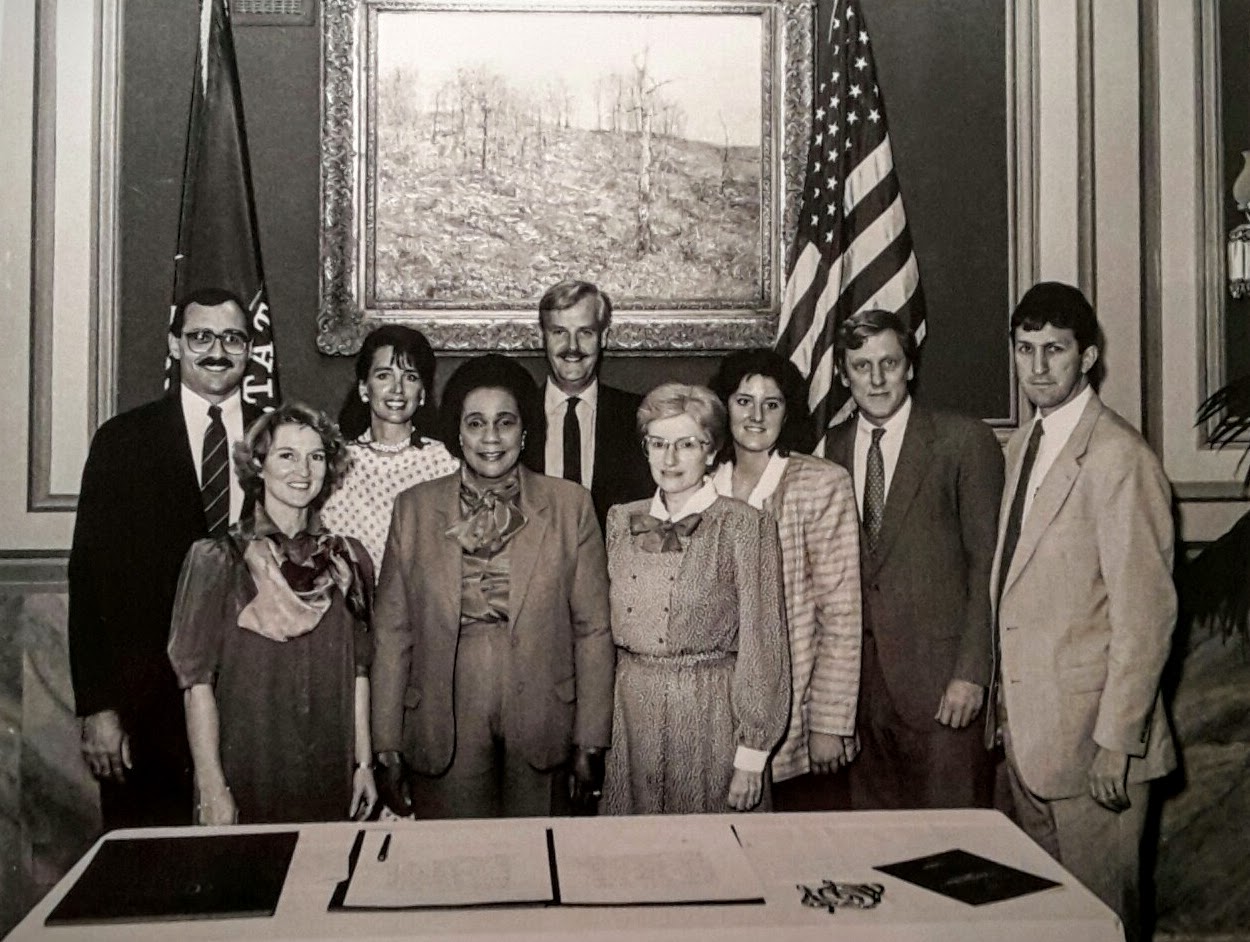
    The Williamsburg Charter Foundation team, with Coretta Scott King. In the front row, left to right, Sharon Brown, CSK, Lila Williamson; in the back row, John Seel, Jenny Guinness, Os Guinness, me (where was I looking?), Bob Kramer, and Tom McWhertor.

    He’s kindly granted me permission to post the excerpt below, which addresses our longing for home and comes from his seminal look at America and its crisis of cultural authority at the end of the “American Century,” The American Hour: A Time of Reckoning and the Once and Future Role of Faith (New York: Free Press, 1993). I worked with Os when he wrote the book, and I cut my copyediting teeth on this amazing 450-page analysis of the crisis of moral authority and his vision for the role of religion in public life. Though his book is more than twenty years old, his writing zings with truth and prescience. It’s available online, here for the US and here for the UK.

    His chapter on homelessness, “The Hunger for Home,” reveals one of the cancers that slowly destroys the certainties of meaning and belonging in modern life (and is aimed specifically at America, although it translates to other Western countries as well). Through the weeks of this series on longing for home, we’ll examine the ways that people have found their home – and Homemaker. But first, to lay the groundwork for what we’re up against through the problem of homelessness, is Os:

    Homelessness results from the gradual eating away of the certainties of meaning and belonging in the lives of countless Americans. Nothing is more naturally human than the drive toward meaning and belonging, and thus toward order. Sense of some kind, stability of some sort—these are the prerequisites for a tolerable human life. Without some underlying order, philosophically as well as socially, the dark demons of absurdity and anomie come menacingly close and threaten to destroy the fragile defenses of individual character and of human civilization itself. Cruel religious theodicies and totalitarian political terror bear witness to the same point: Human beings have such a need to feel at home with themselves and their universe that they even prefer tyranny to chaos, paternal authoritarianism to fratricidal factionalism.

    In one sense, homelessness is a defining feature of all humanness east of Eden and is certainly not new in the United States. But a special sense of homelessness has always been present in a nation shaped by immigration, mobility, and westward expansion. One German visitor called it the “strange unrest” of Americans, and H. G. Wells commented on the “headlong hurry” of Americans.[1] George Santayana commented in the 1920s on the “moral emptiness of a settlement where men and women and even houses are moved about, and no one, almost, lives where he was born and believes what he was taught.” Denis Brogan spoke in the 1940s of “American nomadism” as the expression of American civilization. John Steinbeck, in his Travels with Charley, wrote that he saw something in the eyes of his neighbor that he was to find everywhere in the nation—“A burning desire to go, to move, to get underway, any place from here. They spoke quietly of how they wanted to go someday, to move about, free and unanchored, not toward something, but away from something.”[2]

    No Place Like HomeSuch restless mobility, combined with a will to technique, has left Americans with what George Grant described as “a conquering attitude to place.” Even our cities, he said, have become “encampments on the road to economic mastery.”[3] At the more everyday level, IBM was popularly known as “I’ve been moved” and advertisers routinely teed off the pervasive sense of lost home. In the 1980s, Mazda sold automobiles under the doubly contradictory byline: “Who says there’s no place like home? We built the MPV based on a very strong foundation. The home… It’s engineering based on human feelings.”

    But while the problem of homelessness is not new in America, the present moment represents a serious exacerbation because the traditional American counterbalances have disintegrated with the crisis of cultural authority. Both faith and the family, the two deepest structures of meaning and belonging an the strongest counterweights to threatened anomie, have been sucked into the whirlpool.

    In normal times, the search for meaning and belonging is a hidden process that is natural and unconscious. That such a search has become conscious, deliberate, and a point of open anxiety is itself a symptom of anomie and homelessness. Nothing demonstrates the problem more clearly than the place and profitability of psychologism in America. As Peter Berger wrote in 1967, “If Freud had not existed, he would have had to be invented.”[4] But the predicament also shows up clearly in very different areas. For example, the recurring vogue for nostalgia (literally “homesickness”) in societies losing touch with their past, the potent hunger for “roots” in nations rooted in rootlessness, and the insatiable appetite for myths in cultures parched by reductionism. “Loss of the past,” wrote Simone Weil about France, “is the supreme human tragedy, and we have thrown ours away just like a child picking off the petals of a rose.”[5]

    With heaven evacuated, history severed, families strung out if not disintegrating, and faith unreal, homelessness has become an ever-present menace to modern Americans. Can there fail to be consequences? Being deprived of justice and freedom is bad enough for humans, but being disinherited from the certainties and assurances of home may prove even more so.

    [1] See Allan Nevins, ed., America Through British Eyes (Oxford: Oxford University Press, 1948), p. 496.

    [2] John Steinbeck, Travels with Charley, (New York: Viking Press, 1962), p. 93.

    [3] George M. Grant, Technology and Empire (Toronto: House of Anasi, 1969), p. 17.

    [4] Peter L. Berger, Facing Up to Modernity (New York: Basic Books, 1977), p. 32.

    [5] Simone Weil, The Need for Roots (London: Routledge and Kegan Paul, 1952), p 114.

  • “There’s No Place Like Home” – A New Series

    No Place Like HomeWhen Nicholas and I first married, and I moved to the UK, we decided to call wherever we were living “home.” We knew that words bind up reality, so we wanted to embrace with our lingo the new truth in our lives. This would prove harder for me, of course, being the one to leave family, friends, wide highways, and good plumbing, and if we were having a spat we wanted to curtail any reckless words such as, “I want to go home!” For I was at home.

    But though we were intentional, early on in our life in the UK I often felt homeless, partly because we knew we’d only live for a few months at Ridley Hall in Cambridge where Nicholas was training for ordained ministry. Then his first curacy descended into upheaval not long after we arrived when the vicar was signed off sick, so the question of whether we’d stay or go seemed to cling to us, keeping us from settling. We moved after only two years, to another curacy, which again felt transient as we stayed there another two years for Nicholas to finish his apprenticeship period. Home was where we lived, but rooted we were not. Only when we landed in our first vicarage, having our first child a month later, were we able to settle in and breathe.

    Embracing a concept of home – though we took a few years to reach this place physically – helped us to create a space for loving, thriving, and resting. A place to be; a place to relax; a place to create; a place to welcome others. For Nicholas this sense of home was redemptive, for he had moved around so much in his life, such as going to boarding school at the age of eight, and later, when he went to theological college (US: seminary) in his thirties, selling his flat and therefore in a sense being homeless during that three-year period (and finding being booted out of college during the summer holidays particularly hard).

    So home is something we’ve tried to foster, and the addition of children has been a wonderful blessing and joy to vicarage life. This drafty Victorian spacious place with its high ceilings, sinks with their single faucets (UK: basins with taps) in several of the bedrooms, and condensation-forming sash windows has provided the backdrop to their lives. But of course home means so much more than the physical structure; it’s the people and the customs and rituals that we practice throughout the seasons that bring meaning and fulfillment.

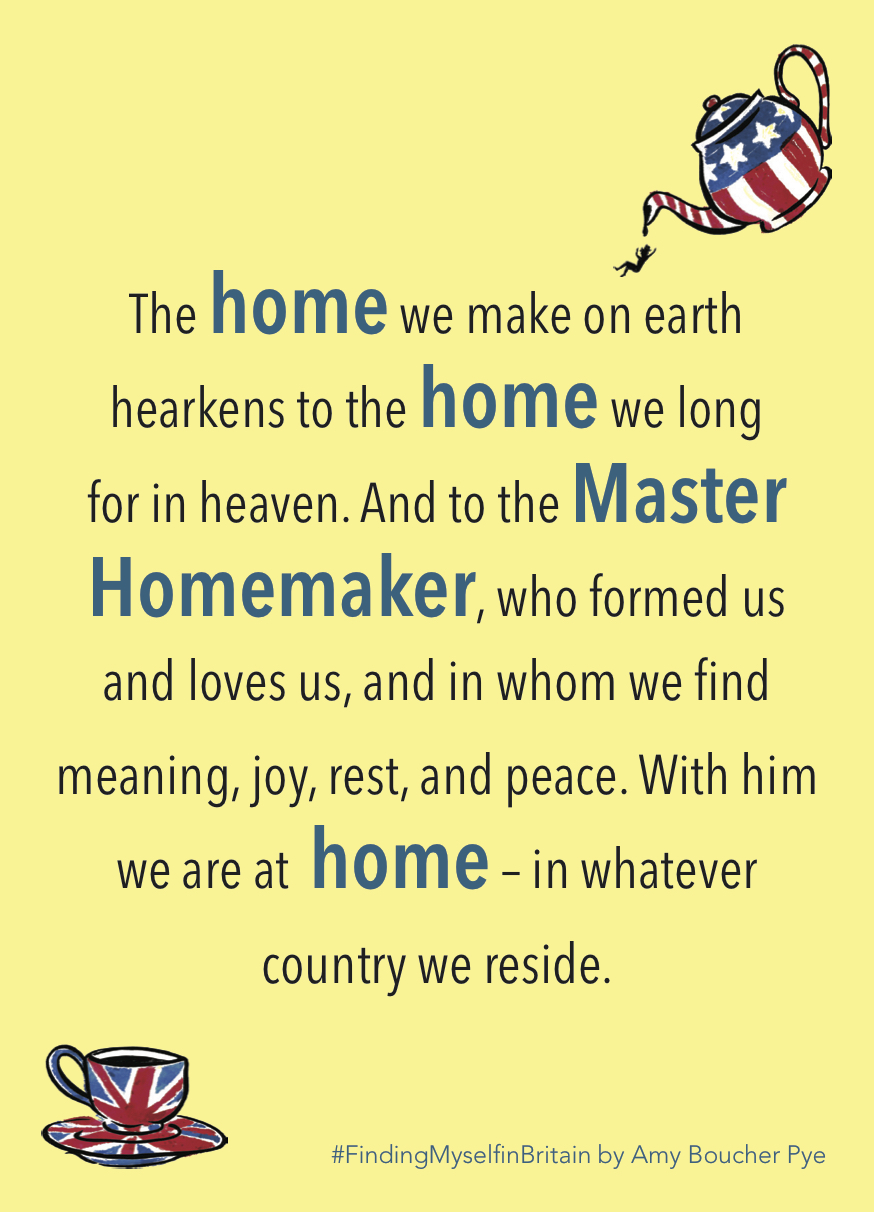
    FMIB Quotes 1 & 2_Proof 2 jpeg

    I’m delighted to kick off this series, “There’s No Place Like Home,” which will run at least through the Spring of next year, as I’ve had a humbling and wonderful response from fellow writers and makers-of-home. The blog posts will appear on Fridays, all exploring different aspects of home. Next week we look at the crisis of homelessness from the renowned thinker Os Guinness, and in the weeks following we will experience so many riches including novelists Rachel Hauck, Sharon Brown, and Katharine Swartz; bloggers Ben Irwin, Tanya Marlow, Amy Young, and Tania Vaughan; and authors addressing issues in the Christian life such as Cathy Madavan, Bev Murrill, Sheridan Voysey, Penelope Swithinbank, and Catherine Campbell. As a VW (vicar’s wife), I don’t think of myself only with that label, but no doubt being married to pastors and ministers will inform the thoughts of Amy Robinson, Debbie Duncan, and Claire Musters. And this is only a taste of the glories to come! Yes, I’m excited!

    To launch the series, I’m delighted to give away two copies of Finding Myself in Britain, including recipe cards – and I won’t limit the giveaway to the UK either, so wherever you live, please enter. To do so, share in the comments what home means to you. You can wax lyrical or jot down a word or two. I’ll choose the winners on 27 November – yes, otherwise known as Black Friday. It will be lovely to give away my book-baby on that day of consuming.

    Is it true for you that “There’s No Place Like Home”?