Today Tanya Marlow, a wonderful person – writer, thinker, feeler, Bible-delver, and one who suffers from a severe form of ME – has interviewed me on her blog, “Thorns and Gold.” She asked probing questions that I answered while partly wondering if I was sharing too much! I so appreciate her on many levels. She’s also hosting a giveaway of Finding Myself in Britain via her blog – instructions at the end.
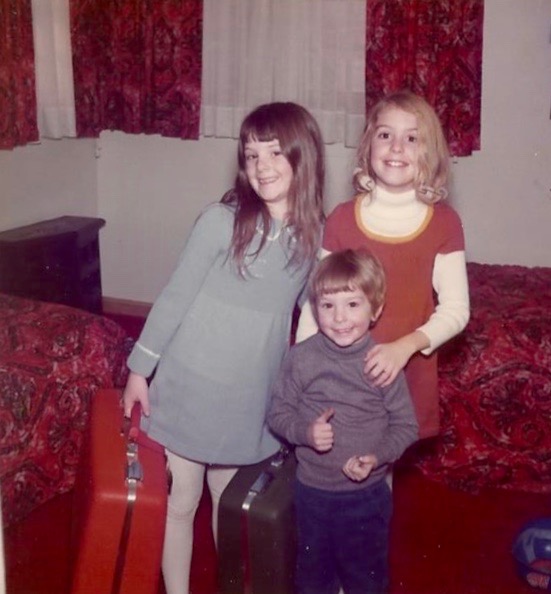
Me with my sister and brother. The traveling bug seems to be planted early!
Hi, Amy – tell us a bit about you!
Hi! Well, I’m married to an English vicar and we live in a lovely but draughty vicarage with our two wonderful kids. I’m a writer and speaker with a long history in editing; I love writing devotional thoughts and running the Woman Alive book club.
I grew up in Minnesota – the land of 10,000 lakes and hearty people who survive the shockingly cold winters. I’ve now lived longer outside than inside of Minnesota, however, for when I was at university I went to Washington, DC, for a studies program – and ended up staying 10 years! When there, working with a wonderful Englishman-in-America, Os Guinness, I met a visiting Englishman who was studying abroad as he trained to be a vicar. We fell in love and married and I moved to the UK nearly two decades ago – a mind-boggling amount of time.
Something you might be surprised to know is that I’m a (lapsed) aerobics teacher. I love going to the gym and enjoying group exercise with my friends.
Read the rest of the interview at Tanya’s blog here.
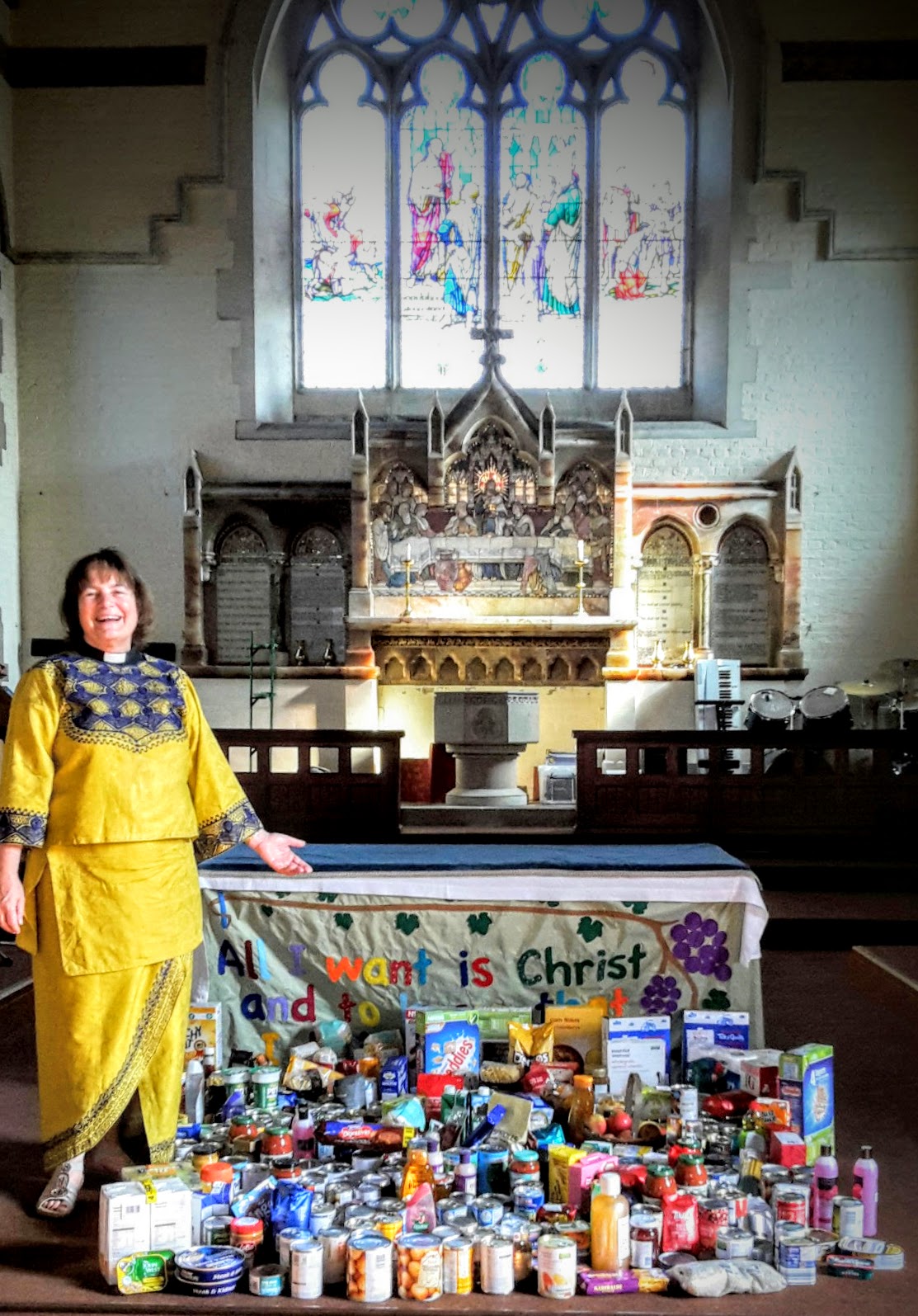
Revd Mavis Crispin, our associate rector, with the Harvest gifts.
“Tell her about the flower wars,” she said to her fiancé.
He paused, looking thoughtful, and shared the antics related to flowers and the church.
A big wedding took place in a church in Jersey, and a local group – which had won awards at the Chelsea Flower Show – arranged the flowers. They created gorgeous displays of white lilies and roses; flowers eminently suitable for a wedding. When the former head of the Women’s Institute (WI) entered the church, she determined that the lilies and roses should stay for the following week – even though fourteen different individuals and groups were already planning their arrangements, because the following week was none other than Harvest, one of the big festivals in the church calendar.
But the former head of the WI was not actually in charge of the flowers, and in handing down this edict, was stepping on toes. Feelings were hurt as the words flew between various parties, with the rector getting roped into sorting through the mess. He ended up spending an hour every day that week before Harvest with pastoral visits and phone calls as he tried to mop up the pieces and satisfy the warring factions.
A compromise was reached, but it was less than satisfactory. The lilies and roses stayed, but wilted after a week of war. The amateur flower-arrangers added bits and bobs to the wedding scene, trying to make it more harvesty. It was, admitted one, “A mess.”
Harvest wasn’t a festival I was familiar with before coming to the UK, and it took me many years to realize the obvious – in the States, we celebrate Thanksgiving as the adapted Harvest celebration (after all, the Pilgrims were stopping to feast and give thanks for the harvest).
We celebrated our Harvest festival a few weeks ago in church, and as you can see in the photograph, we received a bounty of food to pass along to our local food bank, whose stores had been depleted.
But writer Tanya Marlow wonders if we’ve got it wrong when it comes to celebrating Harvest. Have we started off with good intentions – such as the former WI leader in Jersey – but what results is less than satisfactory, or worse? In a wonderfully provocative piece for the Christianity magazine blog, she says:
I wonder if in our Western schools and churches, Harvest Festival should be a festival of repentance, not thanksgiving. We should be weeping for the gluttonous plenty we have while workers around the world die in unsafe factories making our bargain clothes, and children are deprived of schooling because they are growing crops for our under-priced food.
Read her piece; what do you think? Or what about the idea of author Marion Stroud, who recently died and must be enjoying the biggest Harvest ever:
Why don’t we, though, think in spiritual terms about the church and the harvest, in terms of what we’ve seen God bring to fruition and what seeds we want to plant in the coming year?
Finding Myself in Britain contains a chapter that looks at Harvest and Thanksgiving, as well as some of my favorite recipes for the Thanksgiving feast.
“In 2010, I gained a baby, and lost the ability to walk more than twenty metres.” So begins Tanya Marlow in this thought-provoking look at the book of Ruth. She interweaves her story of life with myalgic encephalomyelitis (ME – or chronic fatigue syndrome, as it’s commonly known Stateside) with that of two women from centuries past – Naomi and Ruth.
When we look at this biblical account, usually we focus on Ruth – the young widow who commits to her mother-in-law, making her home in a foreign land, such the depth of her love. We skip over the bitter old woman, Naomi, who is reeling from loss and is definitely disappointed with God. But Tanya explores – gently – how we mirror Naomi, and yet how God showers us with his love. (And she doesn’t miss out on gleaning encouragements from Ruth’s story either.)
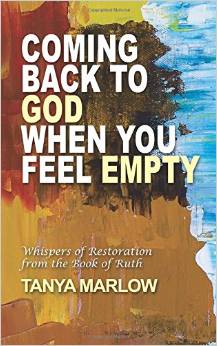
Coming Back to God When You Feel Empty is a short but satisfying read, currently free when you sign up to Tanya’s website. Read it for the poetic language; read it for the insights this story from old can shine into our lives today; read it for the emphasis on prayer and a God who loves us.
Coming Back to God When You Feel Empty: Whispers of Restoration from the Book of Ruth by Tanya Marlow (CreateSpace, 2015).