By Leo Boucher. Used with permission; all rights reserved.
Soon I will go to Spain, to the lovely El Palmeral, where I’ll be leading a retreat when we delve into the book of Colossians. Such a lot to explore in just 95 verses! The incomparable Christ, living in Christ, living for Christ.
I’m sharing this painting of my dad’s today as I think about Spain, for I love the colors he uses. Although the Mediterranean climate means for a lot of brown, when I think of Spain I think in color – the vibrant bougainvillea and other flowers, the glimpses of glory painted in the sky as the sun sets. And as this painting shows, time to sit by some water and reflect and converse, enjoying God’s glories and each other.
If you can’t make it to a led retreat at El Palmeral, you could enjoy what they call a time-out retreat. You craft the time as you wish, such as the daily Celtic prayer in the outdoor chapel. Those who go, want to come back!
Then the angel said to me, “Write this: Blessed are those who are invited to the wedding supper of the Lamb!” Revelation 19:1–9 (NIV)
Think of all of the planning that can go into a wedding. Months or even years before the big event, special clothes are purchased, the venues secured, the ceremony planned, the feasting arranged. In fact, so fully can people get caught up with the wedding plans that they forget to focus on what follows – a covenant life together.
In our final devotional on Sabbath and rest, we turn to the revelation received by the aging disciple John on the island of Patmos. The vision John sees nears its climax as the angel of the Lord pulls back the curtain and reveals the great preparations in heaven for the wedding of the Lamb. God’s plans and years of redeeming actions come together in the union between bridegroom and bride, that is, between the true and living God and we his people, his church.
Blessed are we who are invited to this feast. As we seek to be like the wise virgins, keeping oil in our lamp while we wait for the bridegroom (Matthew 25:1–13), we prepare ourselves in the finest linen, as created out of our acts of mercy and love.
As you reflect on the meaning of Sabbath, rest and celebration, take some time in prayer, asking God through his Holy Spirit to bring alive this passage from Revelation. Hear the cries of “Hallelujah!” ringing forth from the great multitude in heaven – those saints from ages gone by and the loved ones who have just died. Hear too the roar of the rushing waters and peals of thunder as the cries resound, “Our God reigns!” See the fine linen, bright and clean, as you feel the everlasting love of the One who is the beginning and the end and everything in between. Come, Lord Jesus.
For reflection: “The Spirit and the bride say, “Come!” And let the one who hears say, “Come!” Let … the one who wishes take the free gift of the water of life” (Revelation 22:17).
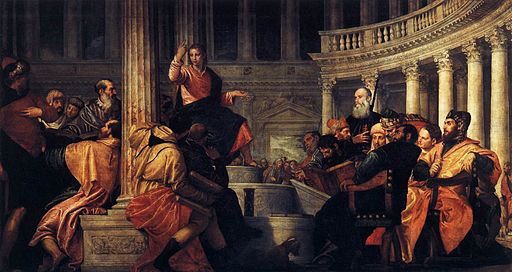
Museo del Prado, Veronese, Jesus among the Doctors, public domain
The people were all so amazed that they asked each other, “What is this? A new teaching – and with authority! He even gives orders to impure spirits and they obey him.” Mark 1:21–31 (NIV)
The gospels recount seven instances of Jesus performing miracles on the Sabbath – seven being a special number in the Bible to signify perfection and completeness. Over the next weeks we’ll explore several of these stories, which show how Jesus is Lord over the Sabbath.
Our first story comes in Mark, after Jesus calls his disciples to follow him. Jesus teaches in the synagogue, and the people are amazed at the authority of his words. When a demon-possessed man interrupts Jesus’ teaching, Jesus commands the demons to leave by the same authority with which he teaches. The Pharisees hadn’t yet realized that their power would be called into question, and that they should therefore oppose Jesus, so at this first instance of healing on the Sabbath none of his later opponents appear.
Then we see Jesus showing compassion on the mother-in-law of Simon and Andrew, healing her fever. The disciples sense that this man is special, taking him to her for release. She becomes so well that she can serve them.
These first stories of Jesus breaking the Sabbath rules – as interpreted by the teachers of the law – appear without fanfare. Jesus sees the needs of two hurting people and does what is necessary to bring them release and healing. He reveals his authority by who he is.
Our culture has moved away from a pharisaic temptation to be hidebound by a strict adherence to the Sabbath which could entail us overlooking the needs of others. Instead we might need to consider how we could strengthen our observance of the Sabbath, so that through our joyful celebrations we can be a witness to a hurting world. For although we don’t have the same power as Jesus, we can speak in his name and share his love.
For reflection: “He was pierced for our transgressions, he was crushed for our iniquities; the punishment that brought us peace was upon him, and by his wounds we are healed” (Isaiah 53:5).
“Everyone brings out the choice wine first and then the cheaper wine after the guests have had too much to drink; but you have saved the best till now.” John 2:1–12
For a giggle (but sometimes a horrified gasp), check out these wedding failures to see a host of videos in which the unexpected happens, such as tripping on high heels or other cringe-inducing accidents. Jesus saved the day in such a situation back when wedding feasts could have lasted a week. I love that his first miracle as marked in John’s gospel was to redeem a wedding from failure.
The story may be familiar – the host ran out of wine, which would have been a reprehensible oversight in ancient times when hospitality was prized. The feast had been occurring for some time; perhaps Jesus and his disciples were invited at the last minute – adding to the shortage of wine. He reveals himself as Lord over creation as he changes the water into wine. No cheap boxed wine either – this was the best vintage, in abundance. As the master of the banquet said with incredulity, “You’ve saved the best for now.”
I wanted to include this passage in our engagement with Sabbath and rest because so often we don’t connect a good party with as a means of practicing rest. We might have inherited a view of the Sabbath as a time of no smiles or loud laughter, thinking that our party behavior won’t fall in line with what is holy. But where do we get these ideas from? After all, Jesus knew how to feast and make merry. He wanted people to enjoy themselves, celebrating the beauty of two lives coming together as one.
In prayer, ask the Lord if there’s a party or other social gathering that you could plan or host. How could this occasion, set aside to celebrate and give thanks, lead to the worship of God? How could, as it’s blessing others, bring you blessing?
Prayer: Lord Jesus, help me to celebrate fully, losing my worries as I look to you as the Master of the Dance. May I bring you glory and praise. Amen.
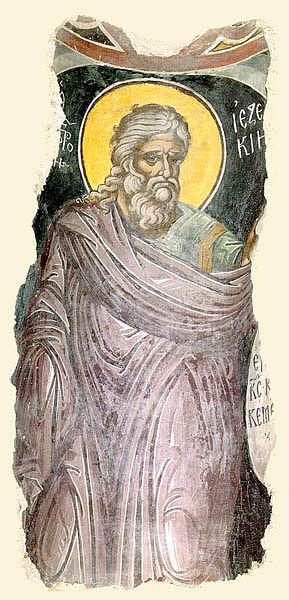
The prophet Ezekiel, Pantokrator monastery, Mt Athos, 1535/1536
“I gave them my Sabbaths as a sign between us, so they would know that I the Lord made them holy.” Ezekiel 20:1–44 (NIV)
We might read the Old Testament despairing that God’s people turn from him again and again. They follow the desires of their own hearts instead of aligning themselves with his plans; they lust after other gods, seeking fleeting pleasures; they lack the faith and belief that the Lord will follow through on his word.
This passage in Ezekiel outlines three generations of God’s people rebelling against him – those who lived in Egypt in the time of the exodus from Pharaoh, those who wandered in the desert with Moses, and their children. Each generation followed their own ways, turning from the Lord, and in each case, the Lord saves them – for the glory of his name amongst their neighbors. Ezekiel cites these generations as he speaks to the current generation of God’s people, asking them if they too will follow the detestable practices of their ancestors, or if they will turn to the Lord in purity and holiness.
The Lord through Ezekiel highlights again and again how the generations ignored the Sabbath. Instead of keeping the day holy and being an example to those around them, they acquiesced to the culture. No longer were they set apart, following the wisdom of God’s cycle of time and rest, as they blended in with those who followed pagan practices.
We too often fail the Lord, getting wrapped up in our lives and ignoring his gentle prompts and prods. But unlike the Israelites as a whole, we have the gift of the Holy Spirit living in us, helping us to repent and softening our hard hearts. If we ask the Lord to turn our minds, hearts and actions to him as we bring him glory, I believe that’s a prayer he delights to answer.
Prayer: Father, Son and Holy Spirit, I feel I fail you often. And yet you run toward me with open arms. Help me to love and serve you this day. Amen.
“In repentance and rest is your salvation, in quietness and trust is your strength.” Isaiah 30:1–18 (NIV)
In the passage from Isaiah that we’re looking at this week, the Israelites, rather than seeking the protection and help of God, the Creator, look to the created as they seek help from the Egyptians. But the prophet Isaiah speaks God’s word to them, naming this travesty. Whereas the shade of the Lord would provide relief from the burning Middle-Eastern sun, the Egyptians’ shade will be fleeting.
I love the imagery in verses 13–14, how Isaiah tells them that the consequences of their sin will be as a shattering collapse, like a leaning wall whose center of gravity shifts in a moment and comes crashing down, leaving dust. This will be all that remains if they do not turn back to the Lord. For as they repent and rest, they will find salvation. Turning to him in quietness and trust, they will gain strength.
Several decades ago, I chose this verse as my special verse of the year. I was prone to overworking and overdoing, relying on my own strength, not on God, and not making time to rest in him. I needed the regular reminder of the Isaiah’s words that as I turned from my self-sufficient ways and trusted in the Lord, I would find the way forward. That as I quelled my need for activity, with the underlying drive that I could make a difference if I achieved, I would find strength that was not rooted in self, but in God.
These many years later, I can see how God has changed me, although the propensity to take on too much is one I’m currently struggling with as I finish off my MA studies. I certainly don’t always exist in a perfect state of rest, but God’s peace defines me more than the restless activity of the past, when I couldn’t listen to a sermon without jostling my foot back and forth throughout.
Repentance, rest, quietness and trust. Let’s embrace them today.
Reflection: Why not write out this verse and carry it around this week, meditating on it when you are feeling stressed or when you wait for the kettle to boil?
“Be still, and know that I am God; I will be exalted among the nations, I will be exalted in the earth.” Psalm 46 (NIV)
When we face trials of many kinds, often our temptation is to talk. To ask advice of those around us; to process the meaning of the situation before us; to wonder and lament and perhaps complain a bit. We need to feel we are seen and heard.
Our loving Lord always sees us and hears us. He welcomes us to converse with him and others when we find ourselves in tough (and happy) situations. But as we see in the psalm we are reading today, at times God also tells us to cease on the chattering front and to be still. Biblical commentators believe the “Be still” in verse 10 probably means “Enough!” The Lord will speak and we must listen.
For the Lord is God and we are not. He made us and formed us, and has the power to still the marauding nations and to make the wars to cease. He can and does intervene in our lives, supremely through his Word, Jesus Christ, coming to earth to bear our sins. And through his Holy Spirit, who lives in and through us, bringing us comfort, healing, affirmation, and love.
The next time you face a trial, why not stop and be still? Wait on the Lord, putting your hand on your heart as you acknowledge that Another lives inside you. As you ask for peace to flow like a river, know that the Lord is your refuge and strength, the One who is ever-present and who will never leave you. As you wait in the silence, open your heart and mind to hear the gentle words the Holy Spirit may impart to you. You might want to jot them down, so that you can chew them over and test them out.
Lord, when it feels the mountains are shifting around me, I need your reassurance that all will be well. Send me, I pray, the peace that passes all understanding. Amen.
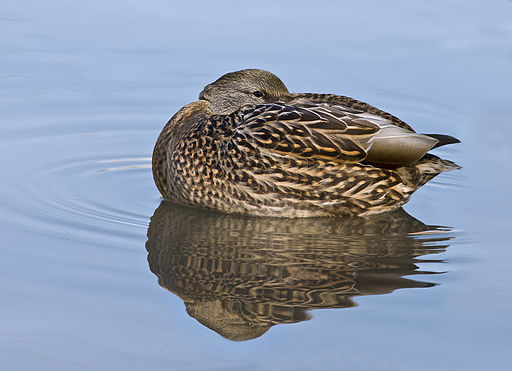
A lovely local path for me is next to a brook. An oasis of peace in a suburban area.
He guides me along the right paths for his name’s sake. Psalm 23 (NIV)
Have you noticed that sometimes we put a huge amount of effort and energy into a project, but it never moves past the planning stage? While other times something just barrels into existence, without much of our insight or care? A Christian writer friend noted this principle as she reviewed the past year. Seven projects that she had cultivated had all fallen flat, but three were birthed without much advocacy from her.
I thought about this Christian writer as I read through Psalm 23 recently, for I realized that God’s guiding us along the right paths can mean that we spin fewer plates. If we trust him and his word, including his admonition to take a Sabbath rest, we trust that he’ll lead us the right way for the other six days, whether through our paid employment, volunteer work, caring for children or grandchildren or loving our neighbors.
Another Christian writer friend faces a change in her working circumstances as one of her regular sources of income comes to an end. Can she trust the Lord to lead her by the quiet waters as she considers the way forward, knowing that the true refreshment to her soul lies only in him? And that he will be faithful and will lead her to the right projects for his glory and praise – and her well-being?
We all face the challenge of which words we’ll believe – the quiet whisper of the Good Shepherd as he beckons us to follow him, or the fear that can bubble up in our soul, or the skeptical views that colleagues or family members might cast our way when we announce our purposes and plans. May we hear and heed the still, small voice today.
Prayer: Lord Jesus Christ, I want to believe that you will lead and guide me, but sometimes I struggle. Give me faith and help me to believe. Amen.
Remember the Sabbath day by keeping it holy. Six days you shall labor and do all your work, but the seventh day is a sabbath to the Lord your God. Exodus 20:8–11 (NIV)
God gave Moses the law as his best plan for his people – not only to bring himself glory, but for the good of his children. That is, he designed his commandments for our benefit. After the first three commands to honor the Lord God above all else, he moves to the fourth – to keep the Sabbath holy.
The Lord here writes in stone the principle that he has embodied from right back at creation – that six days are for work (work being good and coming before the fall of humanity), and the seventh day for rest. He rested, and he wants his people to follow his lead. He wants them to remember his deeds and set apart the day as holy.
The fourth commandment sheds more light on the Sabbath principle, designating that all observe it – daughters and sons, servants and free, citizens and foreigners. To take the day off requires preparation, just as the people in the desert had to gather extra manna on the day before. The Lord wants his people to learn how to plan ahead, so that later they can reap the rewards.
In the West, we’ve largely lost the culture of keeping Sunday special. Shops are open, enticing us to browse and buy, and children’s activities encroach more and more, meaning that parents have to decide between, say, their child going to a birthday party or attending church. To observe the day – to fill it with soul-feeding activities – requires us to stand against the cultural winds. We might need to find a creative approach to celebrating Sabbath, including taking off a day other than Sunday (which is especially true for those who work on a Sunday, such as ministers or health-care professionals).
How can you plan for this week’s Sabbath?
Prayer: Lord God, help me to understand how you designed this command from so many years ago for my flourishing. Amen.
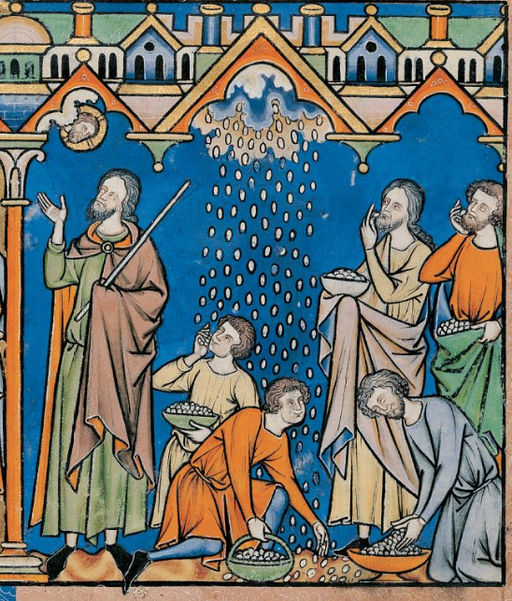
Manna reigning from heaven on the Israelites, circa 1250, Maciejowski Bible
“Bear in mind that the Lord has given you the Sabbath; that is why on the sixth day he gives you bread for two days.” Exodus 16:1–30 (NIV)
The Lord God rescued his people from slavery in Egypt with dramatic measures as he sent down the plagues on the hard-hearted Pharaoh and he parted the Red Sea for the Israelites to escape the Egyptian army. But the people of God had a short memory, for as they wandered in the desert, fueled by hunger, they began to despair, saying, “Oh, if only we had stayed in Egypt.”
The Lord, not tiring of their complaints, devises a solution – he sends quails and sweet-tasting bread from heaven to feed them. Their only work is to gather the riches set before them, enough daily bread for the day. And for the celebration of the Sabbath, the Lord instructs them to gather on the sixth day enough for two days.
We see in the Lord’s provision and instruction his love for his people. Not only is he establishing a seven-day week (some biblical commentators believe the Egyptians held to a ten-day week), but he provides a day of rest for all classes of society – including the servants and slaves. He knows their limitations and provide them with a way of living that will help them to thrive. But do they listen? No – some gather too much during the week, and the bread turns moldy. Others go out on the seventh day, looking for food but not finding any.
How are we like the Israelites? Do we understand how God gives us not only bread to eat but meat to feast on? Do we stop and rest, acknowledging that he is God and we are not? May today we ask Jesus, the living bread, to fill us with his sustenance and help us order our lives according to God’s wisdom and plans.
For reflection: Read through the story again, this time imagining you are a slave girl in the story. How does the shift in perspective shed light on the narrative?