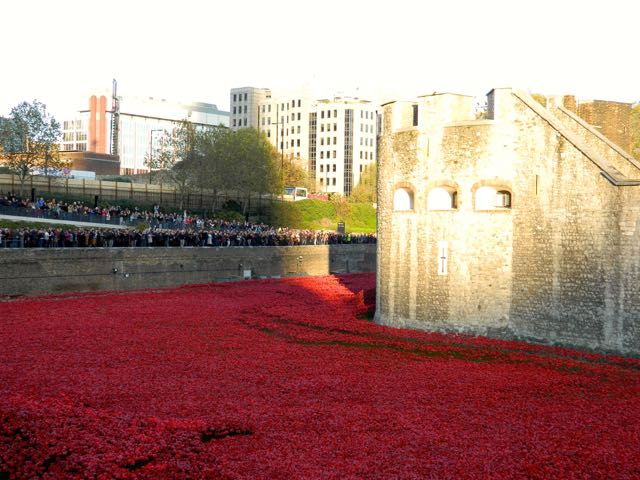
 We traipsed to the Tower of London on Sunday – Remembrance Sunday – to see the nearly 900,000 handmade poppies that have been planted to commemorate the start of the First World War. Although we were jostled by the crowds, we were moved by the beauty and pain of the sea of red. Each poppy a life.
NicTheVic and PyelotBoy, along with Charlotte, our wonderful intern at church, have spent a lot of time researching the over 150 men whose names are listed on our two war memorials at church. These were men with connections to Finchley, who died in World War I. The higher the rank of the man, the more information the researchers were able to glean (which usually correlated to their social class).
On this Remembrance Day (Veteran′s Day in the States), as we stop to consider the sacrifice of the people who gave their lives that we might live, I include information as found by the researchers above on one of the soldiers, Frederick Goodyear. Sounds like a man who wouldn’t have chosen to serve if not for the war – he sounds like a creative type; a dreamer. Mr Goodyear, we will remember.
Name: Frederick Goodyear
Rank: Second Lieutenant
Date of Death: 23 May 1917
Age: 30
Regiment: Essex Regiment 2nd Battalion
Cemetery: Aubigny Communal Cemetery Extension which is approximately 15 kms north-west of Arras. From March 1916 to the Armistice, Aubigny was held by Commonwealth troops.
Additional Information: Son of Frederick and Anne Maria Goodyear. B.A., Brasenose College, Oxford Served 1915-17. Died at 1st Canadian Casualty Clearing Station of wounds received in action at Fampoux on 12th May 1917.
 Frederick Goodyear was born on the 5th March 1887 at Fallow Comer, North Finchley. His father owned a prosperous coal business and took an active part in public life. Frederick had a sister Edith, later curator at University College London, and a brother, Geoffrey, who served in the Yeomanry, later in the Machine Gun Corps, and who survived the war.
Frederick was educated privately, first by Miss Shoults of Finchley and later at Christ’s College, Finchley. In 1902 he passed on to University College School, where he remained till 1905. His School record lists a great number of achievements and prizes, spanning Chess, Literature, Cricket, Cadet Corps and the Sciences. He was also gifted in languages, speaking and writing French, German, Welsh, Latin and Greek in his adult life in addition to English.
His Housemaster wrote of him:
His striking appearance and incisive manner arrested attention. His interests were literary and artistic, rather than academic…Essentially an eclectic, he found it difficult to concentrate on subjects that bored him… Frederick Goodyear was not a boy who readily followed the crowd. No Housemaster could have had a more capable and loyal House-captain.
In March 1905, Frederick received the Senior Classical Scholarship at Brasenose College, Oxford. He matriculated the following autumn, and his tutors acknowledged him as the ablest man to enter the college in their time. His friend F.W. Leith-Ross, who wrote the biographical foreword of Frederick Goodyear – Letters and Remains in 1920, and recalled:
He could never be persuaded that his reading should be directed into the narrow channels prescribed by the Examining Body, and throughout his time he browsed at large on whatever aspect of literature, art, or philosophy pleased his fancy.
Upon leaving Oxford, Frederick reported cricket for ‘The Field’, as well as contributing essays and other writings to various publications. In 1913, he lived in Paris for some months, writing a long autobiographical novel. Early in 1914 he left journalism and took up the post of temporary Assistant Master at Charterhouse, a public school in Surrey. Upon leaving this post, he agreed to write a series of books on British sports. However, he soon realised that he did not wish to do so and accepted a post with the Oxford University Press in Bombay, primarily to escape his contract.
Within months of his arrival in India, the fighting in Europe broke out, and rapidly spread. Frederick resigned his post as soon as it was possible and sailed back to England in January 1915. He had felt it his duty to enlist with the Artists’ Rifles and did so within days of returning home. His temperament was not particularly conducive to military discipline making a commission difficult to obtain. He did, however, secure a transfer to the Meteorological Service of the Royal Engineers in September 1915, with the rank of Corporal.
For the next year, he remained behind the lines and spent a great deal of time studying the flora and fauna of France and Flanders, as well as his supposed objects of study. In the summer of 1916 he was sent back to England, in order to go through the Cadet course and obtain a commission in the Essex Regiment. On 16th March 1917 he left once more for France.
 A few weeks after his return, his battalion went into action near Arras and on the 12th May, during an attack on Fampoux, a shell hit his dugout and he was buried. Though found, his left leg was so damaged that it required amputation. Letters he wrote at this time are clear and cheerful, describing the incident and answering his correspondents’ questions about migratory birds. However, his right leg also required amputation on 22nd May and Frederick died from the effects of shock on his weakened state in the early hours of that morning.
Frederick was a highly committed Christian and his letters are full, not only of news and birdwatching, but of his theological reflections and commentaries on church goings-on. Though in one letter of 1905 he describes himself as ‘as close to atheist as anything else’ and believes that religion will die out leaving only philosophy; by 1911 he writes ‘I am really a Christian’. In letters to his sister he reflects on half-hearted Christianity, Nietzsche’s attitude to religion and the transformation of Indian converts to Christianity.
 Last year we remembered the 100th anniversary of the start to World War 1 – the war that was to end all wars. London became a focal point as the art installation at the Tower of London slowly caught the public attention and eventually their heart as poppy by poppy was planted, turning into a sea of red. One for each life lost, eventually the last of the 888,246 ceramic flowers was planted a year ago today on Remembrance Day (Armistice Day, or in the States, Veteran’s Day).
 Nicholas and PyelotBoy, lovers of history both, dug up information about these men on the memorials, scouring websites about ancestry and that of the Commonwealth War Graves Commission for clues. What were the backgrounds and interests of these men? How did they die? Our intrepid researchers even took a field trip to the London Metropolitan Archives to search out the original church documents and revel in such items as the 1920 invoice for our church’s north transept stained-glass window, entitled “Saints in Glory,” installed to commemorate the fallen soldiers, sailors, and airmen.
 I told the story last year of one of the men, who captured my imagination. Frederick Goodyear, who was born locally in North Finchley and who died at the age of 30 in France. I had included his story in my book in an early draft, but alas, it got chopped at the cutting table as it changed the flow and tone too much. Still, a fascinating thing to enter into his life – a dreamer who would have been better suited to the academy than as life as a soldier.