Whoever has ears, let them hear what the Spirit says to the churches. To the one who is victorious, I will give some of the hidden manna. I will also give that person a white stone with a new name written on it, known only to the one who receives it. (Revelation 2:17)
Photo credit: “White Stone” by Anna, Flickr
A couple of women I know have changed their given names. One suffered sexual abuse, and by changing her name she was cutting painful ties. Another didn’t want to be defined by her name’s meaning, which was “bitter.” Instead she wanted to be known by a name that denotes “grace.”
Our passage comes from the letters of Jesus, as revealed to the aging disciple John. Jesus says to the church at Pergamum that he will give them a white stone with a new name on it, known only to the recipient. Several meanings of this white stone have been put forward, as summarised by Craig Keener in the NIV Application Commentary (pp. 126–27). One is that in the ancient world, people used pebbles for admission to events; in this case, for a messianic banquet. Another is that in some ancient courtrooms, the jurors would cast a white stone for acquittal and black for conviction. (Thus Jesus would be the judge over what the Pergamum Christians were suffering.) Or the white stone could symbolize purity and eternal life, or a new name signifying a new identity.
The symbolic possibilities are rich. Applying the promise to our own lives hearkens to the promises we examined in Isaiah 62. Our new name might be one that we publicize as we embrace our new, redeemed self. Or it might be one that we keep hidden, the name that we hear when we call to the Lord and listen for his affirming words of love.
We are no longer bound to the old way of life. As we live out of our new selves, may we reflect the attributes of the One who created us, who made us for himself.
For reflection: “Let us rejoice and be glad and give him glory! For the wedding of the Lamb has come, and his bride has made herself ready” (Revelation 9:17).
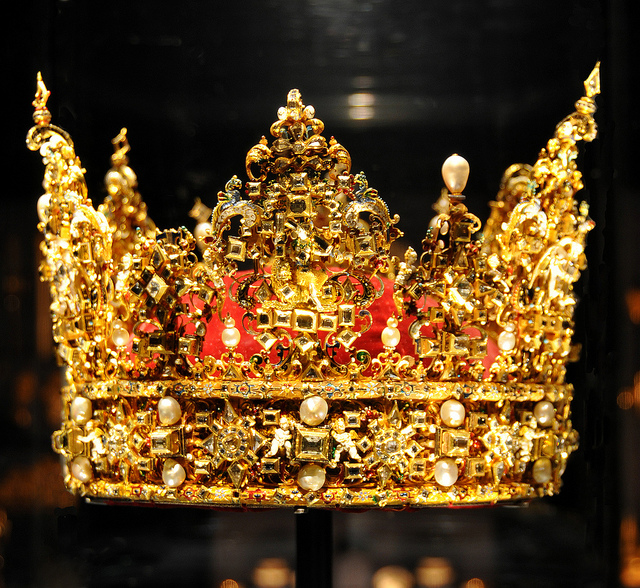
“The nations will see your vindication, and all kings your glory; you will be called by a new name that the mouth of the Lord will bestow. You will be a crown of splendor in the Lord’s hand, a royal diadem in the hand of your God. No longer will they call you Deserted, or name your land Desolate. But you will be called Hephzibah,and your land Beulah; for the Lord will take delight in you, and your land will be married. As a young man marries a young woman, so will your Builder marry you; as a bridegroom rejoices over his bride, so will your God rejoice over you” (Isaiah 62:2–5 NIV).
Photo credit: found on flickr by archer11.
We might feel uncomfortable applying the language of the prophet Isaiah to our lives, and men in particular might struggle to call themselves a royal diadem or the bride of Christ. But as CS Lewis said, God is so masculine that we are all feminine in response to him. And so male or female, we can ask God to reveal how his loving words from centuries ago can speak into our spirits and souls today.
Being a crown of splendor in the Lord’s hand makes me think of Jesus on the cross, wearing his crown of thorns. He who could take the place of the righteous king yet endured pain for our sakes. So that we too can be sons and daughters of the King, wearing a jewel-encrusted crown as bestowed by our heavenly Father.
No longer do we have to endure desolate lives of emptiness. For God reassures his people that he dwells with us and delights in us. He who has created us – the Builder – who has set our foundations into place, will rejoice over us even as a bridegroom on his wedding day.
Living out of the new self entails embracing our identity as the beloved. Our new name reflects joy, rejoicing, delight, and love. What name could you claim today?
For reflection: “‘Come, I will show you the bride, the wife of the Lamb’… It shone with the glory of God, and its brilliance was like that of a very precious jewel, like a jasper, clear as crystal” (Revelation 21:9, 11).
I returned home from our wonderful week in Northumberland, feeling spent from a summer and autumn filled with good things: Our family’s five weeks in the States. Leading a meaningful and sun-filled retreat in Spain. A trip to the States to play with my high-school friends at the lake where they filmed Dirty Dancing and to celebrate family birthdays. And most recently our jaunt up to the wilds of the Northeast of England, venturing into the rugged coast and atmospheric castles.
Photo by cod_gabriel as found on flickr
Although I knew I was facing a first-world problem of exhaustion from too much fun and travel, I was wiped out. And so I wasted more time than I like to admit early this week watching episode after episode of Scandal, a drama based in my former home of Washington, DC. The storylines gripped me and I loved seeing the beautiful buildings of my former stomping grounds. But watching so many episodes when I should have been spending my time with more fruitful pursuits – gardening or decluttering would have been more fulfilling – left me with another shame hangover.
Shame hangover – such a descriptive term, which Brené Brown employs in her acclaimed TED talks and book Daring Greatly. I spoke last week of my shame hangover related to my flapping mouth and unholy moments while at Holy Island, which many of you responded to with forgiving love and sometimes a knowing, “I’ve been there.”
Shame can stick to us like a new set of clothes, ones we don that can become sealed into our skin. So familiar they can become that we don’t know how to operate without them. And so like Eustace Scrubb in CS Lewis’ The Voyage of the Dawn Treader, we need to remove them with God’s help, in a sometimes painful manner. Eustace, you may recall, had been turned into a dragon through his dragony greed and selfishness. He meets a lion (Aslan), who asks him to undress. Eustace peels off a few layers of dragon – of selfishness and pride – but remains a dragon. The only way to undragon is for Aslan to bring about a deeper cure – one that sinks deep to his heart and hurts greatly, but brings about a new person.
I’ve been thinking lately about the old self and the new, for not only at our conversion do we shed our old self with its sinful practices and take on the new self. This process of putting on the new self is continual, as the apostle Paul writes to the church at Ephesus: “You were taught, with regard to your former way of life, to put off your old self, which is being corrupted by its deceitful desires; to be made new in the attitude of your minds; and to put on the new self, created to be like God in the true righteousness and holiness.” (4:22-24)
His verbs are active in the Greek – we put off our old self and put on the new. Our new clothes are no longer the rags of shame, but the royal robes of daughters and sons. Indeed, we are clothed with Jesus himself. But we don’t always wear our new robes. We slink back to the rags, perhaps through exhaustion or weariness. When we tire of the shame hangover, we can release it over to God, asking for forgiveness and for him to fill us with his Holy Spirit, that we might be empowered to live the forgiven life.
So as I get back to a structured routine, one not filled with countless episodes of spin-doctors, I come before God and ask him to help me wear his richly colored robes as I shed the ragged shame-inducing garments. Here’s to being forgiven!