Tag: miracles of Jesus

  • Weekly devotional: “My Son, whom I love” (13 in Jesus’ miracles series)

    After six days Jesus took with him Peter, James and John the brother of James, and led them up a high mountain by themselves. There he was transfigured before them. His face shone like the sun, and his clothes became as white as the light. Just then there appeared before them Moses and Elijah, talking with Jesus… While he was still speaking, a bright cloud covered them, and a voice from the cloud said, “This is my Son, whom I love; with him I am well pleased. Listen to him!” When the disciples heard this, they fell facedown to the ground, terrified. But Jesus came and touched them. “Get up,” he said. “Don’t be afraid.” (Matthew 17:1–3, 6–8)
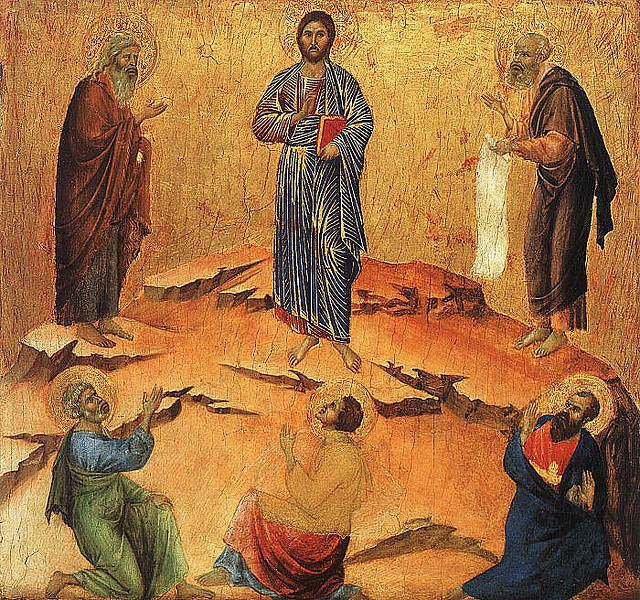
    Photo: Creative Commons, carulmare. DUCCIO di Buoninsegna Transfiguration, 1308-11
    Photo: Creative Commons, carulmare. DUCCIO di Buoninsegna Transfiguration, 1308-11

    During this series on Jesus’ miracles, we’ve seen Jesus healing the sick, raising the dead, overcoming nature, and exorcising demons. Our final miracle to consider today is the transfiguration, when the divine nature of Jesus is revealed. Whereas the other miracles are ones that Jesus performs, this one is performed on Jesus.

    Jesus has taken his inner circle of disciples – those who would be future church leaders – up a mountain to pray. It’s as if the heavens open and the scales fall from their eyes as they glimpse Jesus as God the Son, with his face shining and his clothes as white as light. Then they hear God say that this is his beloved son, and that they should listen to him. As with all mortals who come in contact with the living God, they are terrified. But Jesus touches them, reassuring them. They are changed, but they are to fear not.

    “Listen,” says God the Father. Are we listening to Jesus? Do we stop to pause and wait for his words and his directions, in things big and small? Have we aligned our lives in submission to his loving will?

    As we do so, Jesus will work miracles in us. As God’s beloved Son he promises to bring reconciliation, healing, and restoration. May we enjoy the new kingdom that he is ushering in to its fullness, sharing his joy and peace with our families and those whom we meet.

    For reflection: “For in him we live and move and have our being” (Acts 17:28).

  • Weekly devotional: How many loaves have you? (12 in Jesus’ miracles series)

    Great crowds came to him, bringing the lame, the blind, the crippled, the mute and many others, and laid them at his feet; and he healed them. The people were amazed when they saw the mute speaking, the crippled made well, the lame walking and the blind seeing. And they praised the God of Israel. Jesus called his disciples to him and said, “I have compassion for these people; they have already been with me three days and have nothing to eat. I do not want to send them away hungry, or they may collapse on the way.” His disciples answered, “Where could we get enough bread in this remote place to feed such a crowd?” “How many loaves do you have?” Jesus asked. “Seven,” they replied, “and a few small fish.” He told the crowd to sit down on the ground. Then he took the seven loaves and the fish, and when he had given thanks, he broke them and gave them to the disciples, and they in turn to the people. They all ate and were satisfied. Afterward the disciples picked up seven basketfuls of broken pieces that were left over. (Matthew 15:30–37)

    Photo: Steve Cadman, Creative Commons. Stained glass by Helen Moloney in St Michael's Creeslough (1971) by Liam McCormick, County Donegal
    Photo: Steve Cadman, Creative Commons. Stained glass by Helen Moloney in St Michael’s Creeslough (1971) by Liam McCormick, County Donegal

    Jesus has been healing and teaching the crowds in Gentile territory. Seeing that they are tired and hungry, he’s moved with compassion. He wants to meet not only their spiritual needs, but their physical ones too. And although the disciples have already witnessed Jesus feeding the five thousand, they still wonder how Jesus will feed these four thousand men, plus women and children.

    Jesus takes what the people give – seven small loaves and two fish – and makes it sufficient for all. He multiplies their meager offering into a feast that satisfies.

    Note two things regarding this familiar miracle. First is that Jesus performs it in Gentile territory. Although he came first for the Jewish people, he also yearns that non-Jews would eat and be satisfied with his food.

    The second is how Matthew indicates that this miracle hearkens to Jesus’ breaking of the bread during his last supper – Jesus takes, breaks the bread, gives thanks, and offers it to the disciples. They in turn offer it to the people. So too should we offer what we have to Jesus for distribution among his people. It might seem far too small or insignificant for the needs, but as we see here, Jesus has a way of multiplying our bread beyond our wildest imagination.

    Prayer: Lord God, we lift before you the needs of hungry people today – in Haiti, South Sudan, the Holy Land. Where we have loaves and fish to offer, let us give that you may multiply.

  • Weekly devotional: ‘I believe; help my unbelief’ (11 in Jesus’ miracles series)

    When they came to the crowd, a man approached Jesus and knelt before him. “Lord, have mercy on my son,” he said. “He has seizures and is suffering greatly. He often falls into the fire or into the water. I brought him to your disciples, but they could not heal him.” “You unbelieving and perverse generation,” Jesus replied, “how long shall I stay with you? How long shall I put up with you? Bring the boy here to me.” Jesus rebuked the demon, and it came out of the boy, and he was healed from that moment. (Matthew 17:14–18)

    IMG_0020A desperate father seeks the help of Jesus’ disciples but meets with frustration. We don’t know what the disciples were doing for the boy, but Jesus sees immediately their lack of faith. And this faithlessness is what Matthew wants to highlight in his gospel, for he again gives a sparse account in comparison with the other synoptic gospels.

    I can feel this father’s pain, for it has been the burden of my own father (and mother). My brother has suffered from epilepsy since he was just three years old, and although my parents have sought healing from the Lord, my brother still has this disease. Why God heals at times and at other times does not is one of the biggest mysteries of our faith. I can only put it down to the fall of humanity, when our first parents chose their own way and thus sin, disease, and death entered the universe.

    So in terms of my brother and this story, I believe that he is not demon-possessed but afflicted by our fallen nature. We ask God to heal and desire that he would do so. But when he does not we continue to ask him to increase our faith. And to give us the wisdom to know when to accept that healing may not come this side of heaven.

    How about you? Have you pleaded with the Lord for something but your cries seemed to fall on deaf ears? May your trust in him continue to grow, and may he give you wisdom and understanding.

    Prayer: Father God, we don’t always understand. Enlarge our grasp of your truth and your love, and give us your peace.

  • Weekly devotional: Water walking (9 in Jesus’ miracles series)

    Shortly before dawn Jesus went out to them, walking on the lake. When the disciples saw him walking on the lake, they were terrified. “It’s a ghost,” they said, and cried out in fear. But Jesus immediately said to them: “Take courage! It is I. Don’t be afraid.” “Lord, if it’s you,” Peter replied, “tell me to come to you on the water.” “Come,” he said. Then Peter got down out of the boat, walked on the water and came toward Jesus. But when he saw the wind, he was afraid and, beginning to sink, cried out, “Lord, save me!” Immediately Jesus reached out his hand and caught him. (Matthew 14:25–31)

    Painting by Amédée Varint; Creative Commons
    Painting by Amédée Varint; Creative Commons

    Having just fed a hungry crowd of five thousand after a day of teaching, Jesus was exhausted. He sent the disciples to find shelter on the other side of the lake while he went to pray. But the disciples encounter a squall and spend much of the night trying to cross the lake. Whereas Jesus was in the boat when a storm arose previously, this time they are on their own. But by now they know that Jesus is interceding for them, and will come to them.

    And he does so in a miraculous way, walking on the water. The disciples are depleted from the day’s ministry and a night of slapping on the waves; in their exhaustion they wonder if they’ve seen an apparition. But Jesus reassures them, and his “It is I” could hearken back to Yahweh’s statement of “I am” from the Hebrew scriptures.

    Then Peter asks to walk to Jesus. Jesus commands him to come, and – amazingly – he does. Only when he takes his eyes off Jesus does he realize that this isn’t normal. Then he starts to sinks, but knows immediately to cry out to Jesus for help.

    The feeding of the multitude and the amazing aqua balancing act bring forth a unified response from the disciples: “Truly you are the Son of God” (v. 33). Likewise, may we give him the authority and rule in our lives, turning to him when we are exhausted or sinking – or when we are flying high.

    Prayer: “I do believe; help me overcome my unbelief!” (Mark 9:24)

  • Weekly devotional: Mercy, not sacrifice (8 in Jesus’ miracles series)

    Going on from that place, he went into their synagogue, and a man with a shriveled hand was there. Looking for a reason to accuse Jesus, they asked him, “Is it lawful to heal on the Sabbath?” He said to them, “If any of you has a sheep and it falls into a pit on the Sabbath, will you not take hold of it and lift it out? How much more valuable is a human being than a sheep! Therefore it is lawful to do good on the Sabbath.” Then he said to the man, “Stretch out your hand.” So he stretched it out and it was completely restored, just as sound as the other. But the Pharisees went out and plotted how they might kill Jesus. (Matthew 12:9–14)

    800px-Christ_heals_tne_man_with_paralysed_handAs we move through Matthew’s gospel during this series on the miracles of Jesus, the clash between the Pharisees and Jesus intensifies. His claims and acts of authority incense the Pharisees. Seeking to trap him, they ask him about healing on the Sabbath and present to him a man with a withered hand. But Jesus again detects their secret thoughts. When he asks about a sheep falling into a pit, he refers to a long debate that the Pharisees were having about what was lawful on the Sabbath.

    Jesus shows how he is more concerned with mercy than empty ritual, and with human beings over animals. With one command he tells the man to stretch out his hand. The man had been a pawn of the Pharisees, but Jesus makes all things new.

    Of course, the Pharisees aren’t overjoyed. Instead of rejoicing that the man can now use his arm, they plot to kill Jesus. They were probably remembering how God restored Moses’ arm with one command (Exodus 4:6–7), realizing that Jesus with this action was claiming his Messiahship.

    Who are we most like in today’s passage? Jesus, blowing preconceptions and healing (and no, I’m not encouraging a Messiah-complex)? The man, argued over and yet restored? Or the experts in the law, who couldn’t overcome their prejudice to see the new work of God?

    For reflection: “‘I desire mercy, not sacrifice.’For I have not come to call the righteous, but sinners” (Matthew 9:13).

  • Weekly devotional: A plentiful harvest (7 in Jesus’ miracles series)

    5733184848_405ac30c9f_zJesus went through all the towns and villages, teaching in their synagogues, proclaiming the good news of the kingdom and healing every disease and sickness. When he saw the crowds, he had compassion on them, because they were harassed and helpless, like sheep without a shepherd. Then he said to his disciples, “The harvest is plentiful but the workers are few. Ask the Lord of the harvest, therefore, to send out workers into his harvest field.” (Matthew 9:35–38)

    This week in our text we aren’t focusing on one particular miracle, as in past weeks, but rather we’ll look at one of the broad statements about Jesus’ ministry. As we see in Matthew’s gospel, he has come to teach, proclaim, and heal, his ministry fueled by his great compassion on the crowds who clamor to hear him speak and to receive his healing touch. The word in the Greek for compassion indicates a deep feeling in the gut, so strongly does Jesus feel for his people.

    Jesus longs to be their shepherd, a common picture in the Old Testament of God to his people. In doing so Jesus will provide protection and sustenance, meeting their voiced and unvoiced needs. He then changes the metaphor to another familiar one from the Hebrew Scriptures, telling his disciples that the harvest is ripe but more workers are needed.

    What is our role? One is prayer – “ask the Lord of the harvest.” So often we put prayer low on our list of priorities, sometimes by default due to the busyness of life. But for some amazing and mysterious reason, God wants to hear us cry out to him, and he acts on those prayers. As Lord Alfred Tennyson said, “More things are wrought by prayer than this world dreams of.”

    What would intentional prayer look like for you this week? Is someone coming to mind even as you read this, for whom you should pray and perhaps fast? Maybe you could turn on a timer to signal the hours, then pause for a moment and pray for that person. God delights in the cries of his people, however we choose to make them.

    For reflection: “Preach the Gospel always, and if necessary, use words.” St. Francis of Assisi

  • Weekly devotional: Hope for the desperate (6 in Jesus’ miracles series)

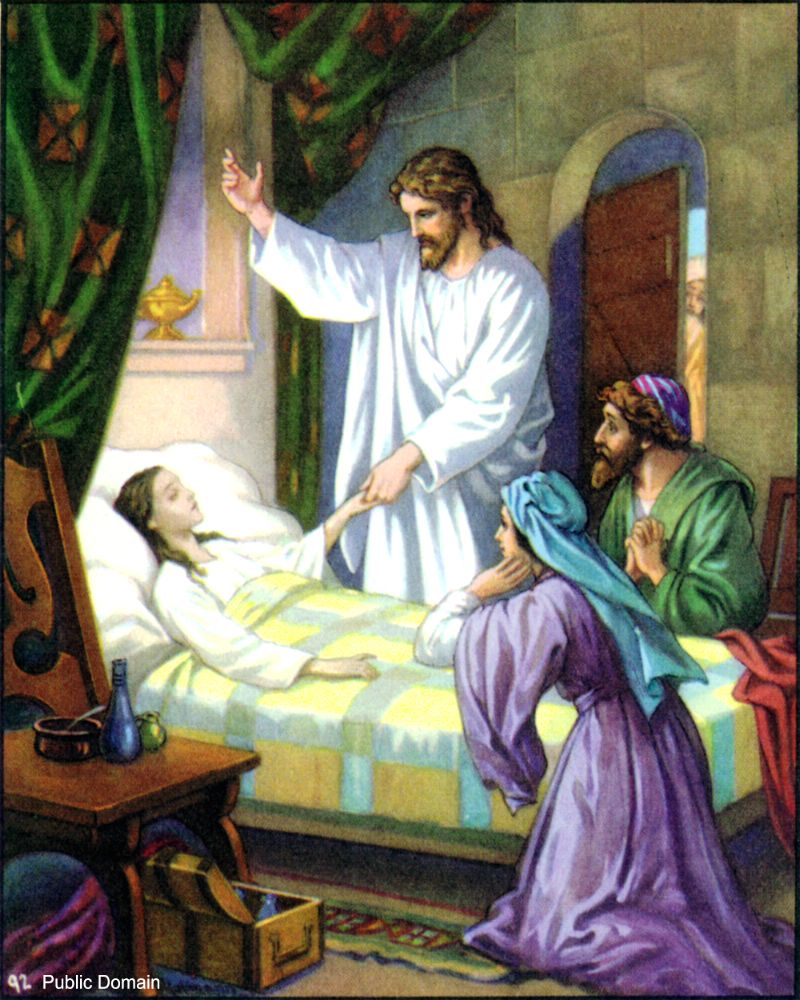
    A synagogue leader came and knelt before him and said, “My daughter has just died. But come and put your hand on her, and she will live.” Jesus got up and went with him, and so did his disciples. Just then a woman who had been subject to bleeding for twelve years came up behind him and touched the edge of his cloak. She said to herself, “If I only touch his cloak, I will be healed.” Jesus turned and saw her. “Take heart, daughter,” he said, “your faith has healed you.” And the woman was healed from that moment. When Jesus entered the synagogue leader’s house and saw the noisy crowd and people playing pipes, he said, “Go away. The girl is not dead but asleep.” But they laughed at him. After the crowd had been put outside, he went in and took the girl by the hand, and she got up (Matthew 9:18–25).

    Photo: pcstratman on flickr
    Photo: pcstratman on flickr

    Utterly desperate, a leader in the synagogue approaches Jesus for help because his daughter has died. Jesus agrees to go to his house, and as they do so a woman touches the hem of Jesus’ cloak, believing that her nonstop bleeding will stop. Jesus responds with compassion: the woman is healed; the girl was only asleep.

    Both situations were desperate. Jarius has tried everything but his daughter still died. But he holds out hope that this miracle man can save her. So too the woman who has been bleeding for a dozen years. That’s twelve years of being an outcast from her community, for the bleeding made her unclean. She had tried every type of medical cure available, to no avail.

    Jesus has compassion on those at the margins of society. He doesn’t penalize them for coming to him as a last resort but responds quickly and powerfully. His actions signal a new kingdom, one in which grace upon grace is poured on God’s children – all of God’s children, whether women, little girls, the blind or leprous, or the elite of society. May we enter into this grace this day.

    Prayer: Lord Jesus, help me to see those who might feel ostracized or lonely, and let me be your agent of love and grace.

  • Weekly devotional: Forgiveness of sins (5 in Jesus’ miracles series)

    Photo: edenpictures on flickr
    Photo: edenpictures on flickr

    Jesus stepped into a boat, crossed over and came to his own town. Some men brought to him a paralyzed man, lying on a mat. When Jesus saw their faith, he said to the man, “Take heart, son; your sins are forgiven.” At this, some of the teachers of the law said to themselves, “This fellow is blaspheming!” Knowing their thoughts, Jesus said, “Why do you entertain evil thoughts in your hearts? Which is easier: to say, “Your sins are forgiven,” or to say, “Get up and walk”? But I want you to know that the Son of Man has authority on earth to forgive sins.” So he said to the paralyzed man, “Get up, take your mat and go home.” Then the man got up and went home. (Matthew 9:1–7)

     News of Jesus’ healing was spreading, so concerned friends of a paralyzed man decide to take him to Jesus for healing. Matthew doesn’t tell us about the extraordinary measures the friends took to get the man to Jesus – lowering him through a hole in the roof – for he wants to focus on the conversation between Jesus and the teachers of the law.

    Jesus tells the man that his sins are forgiven, and this immediately sets off alarm bells in the scribes and experts in Judaism. Forgiving sins can only be done by God, they know, which is why they accuse Jesus of blasphemy. Jesus, however, knowing their unspoken evil thoughts, responds. He knows that they believe that people won’t be healed unless their sins are forgiven. A way to show them his power as the Son of Man is to heal the paralyzed man – and to forgive his sins.

    Receiving forgiveness can bring about healing, sometimes even physical, but that doesn’t mean that people who are struggling with disease or deformity are riddled with unconfessed sin. We’ll only fully be free when we enter the land of no more tears or crying or death. Until then, may we continue to present ourselves to Jesus, confessing our sins and receiving his cleansing forgiveness.

    Prayer: Lord Jesus, what friends that man had to care for him so deeply. Show me this day how I can show love to my friends.

  • Weekly devotional: Even the demons believe (4 in Jesus’ miracles series)

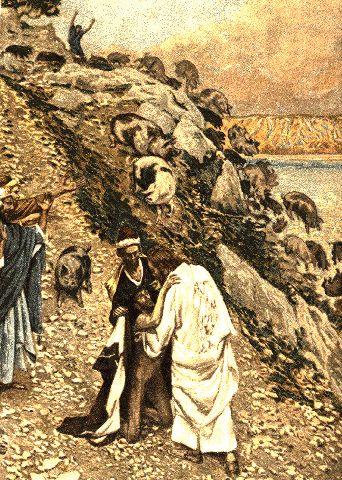
    When he arrived at the other side in the region of the Gadarenes, two demon-possessed men coming from the tombs met him. They were so violent that no one could pass that way. “What do you want with us, Son of God?” they shouted. “Have you come here to torture us before the appointed time?” Some distance from them a large herd of pigs was feeding. The demons begged Jesus, “If you drive us out, send us into the herd of pigs.” He said to them, “Go!” So they came out and went into the pigs, and the whole herd rushed down the steep bank into the lake and died in the water. (Matthew 8:28–32)

    swineSickness, blindness, stormy lakes, and now demons. Jesus and his friends arrive in a Gentile area, which is why a herd of pigs was grazing. Again Matthew cuts out excess details as he points squarely to Jesus’ action of release instead of giving a lot of background information about the possessed men.

    The demons knew immediately who they were encountering – the Son of God. They recognized his authority, and pleaded to be released into the pigs (two thousand, according to Mark’s gospel). He tells them to go, and they do so dramatically, sacrificing the pigs in the process. The Jewish people with Jesus wouldn’t have been bothered by this loss, for they so disliked pigs that they would have put them in the same category as the demons. The Gentiles, however, were troubled and asked Jesus to leave. As one commentator says pointedly, “all down the ages the world has been refusing Jesus because it prefers the pigs” (quoted in NIV Application Commentary: Matthew, p. 354).

    We can feel bad for the squashed pigs, but if we focus too much on them we’ll miss the point of the story – the authority of the Messiah over demons, and freedom and restoration for troubled men. Also, we can ponder that Jesus allowed the demons to transfer to the pigs because it wasn’t the appointed time. We don’t know why he didn’t eradicate the evil then, but we know that one day he will.

    Prayer: Lord Jesus Christ, Son of the living God, have mercy on me, a sinner.

  • Weekly devotional: Lord of the wind and the waves (3 in Jesus’ miracles series)

    Then he got into the boat and his disciples followed him. Suddenly a furious storm came up on the lake, so that the waves swept over the boat. But Jesus was sleeping. The disciples went and woke him, saying, “Lord, save us! We’re going to drown!” He replied, “You of little faith, why are you so afraid?” Then he got up and rebuked the winds and the waves, and it was completely calm. The men were amazed and asked, “What kind of man is this? Even the winds and the waves obey him!” Matthew 8:23–27

    1024px-Jan_Luyken's_Jesus_9._The_Storm_at_Sea._Phillip_Medhurst_CollectionIn his account, Matthew shows that Jesus is not only Lord over disease and demons, but over nature too. He is Immanuel, God with us, who rebukes the storm over the seas just as God in the Old Testament made the waters calm – see for instance, Psalm 104:7 (“at your rebuke the waters fled”) or Isaiah 50:2 (“by a mere rebuke I dry up the sea”). At his mere word the seas obey, causing the frightened disciples to wonder just who is in the boat with them. They had witnessed him healing the previously incurable diseases, but they hadn’t reckoned on him controlling nature. Being familiar with the references in the Old Testament mentioned above, they would have realized immediately the weight of Jesus’ actions.

    The storm was no ordinary storm. This is hinted at by the Greek word seismos, which usually means an earthquake, or literally, a “shaking” (RT France, Matthew, IVP, 1985, p. 161). A force from outside brought chaos; that is, a squall came upon the lake violently and suddenly. Jesus demonstrates his authority by calming it with a rebuke.

    Jesus wants us to believe in his power to still the storms in our lives, whether created from outside or from within. Sometimes they appear suddenly, taking us by surprise and perhaps flattening our faith. As we turn to him in fear or faith, asking him to save us, he brings calm and peace, creating order from disorder.

    Prayer: Lord, I confess that when I see the waves leaping at my boat, I react with fear. Come and save me, and increase my faith in your goodness and grace.