Tag: lectio divina

  • Prayerful reading of John 1

    Join me for a mini-retreat, with time to pause, reflect on Scriputre, and experience God? Here’s my latest prayer practice (of 7 minutes) that I sent out with my monthly newsletter, perfect for this season of Advent.

    We’ll be engaging with some lectio divina (prayerful reading) of the first part of John’s gospel (John 1:1–5, 9, 14, NIV). During the Advent season, it’s beneficial and meaningful to ponder Jesus, the true light who has come into the world.

    Feel free to pause the video at any point as you ponder and reflect with God.

    Receive my monthly newsletter, including giveaways and prayer exercises.

  • “Learning to Trust Ancient Ways of Praying” by Kathleen McAnear Smith: 7 Ways to Pray blog series

    I’m humbled by Kathleen’s wonderful post about how she’s come to pray with the ancient practices I outline in my book, 7 Ways to Pray. When writing I prayed so much that it would be a means of introducing some of these time-tested practices to people who might not only not have heard of them, but were suspicious of them. What a gift that God has used my book in her life in this way! Whether you’ve prayed in some of these ways for years or are not sure about them, I believe you’ll appreciate hearing more from her.

    My particular Christian denomination used to pride itself on not—no, never—using set prayers. We wouldn’t touch traditional, handed-down-through-the-centuries prayers with anything but disdain. We were smug about it; superiorly smug in our thinking that prayer was just something you did off the top of your head. We were sure we knew all anyone needed to know about prayer.

    Due to travel and relocating overseas I eventually changed denominations, but I happily managed to carry some of that attitude with me. Not for me were the stuffy old ways of prayer, I thought. I’ve had to work hard at staying closed-minded about the beautiful traditions of the ancient church, but denominational prejudice reigned well into my fifties.

    That all changed on an unmentionable birthday when I blessed myself with attending a workshop on prayer. Truthfully, I didn’t pay much attention to the topic, I just wanted to hear the speaker, Amy Boucher Pye. She started the morning with an introduction to the concept of lectio divina. “Lectio what?” I said, remembering childhood teaching about the repetition of words that would put you to sleep. It turned out that not only did I stay awake, but as Amy introduced this new-to-me way of prayer something was coming alive in my spirit. I even acknowledged quietly to myself that often I had used Scripture to prove a point in discussion, just not considered the Word as a basis of praying.

    Deciding to learn more, I attended one of Amy’s online retreats on lament. This was the year I lost a very precious relative and I was beside myself trying to figure out how to pray. Amy’s teaching on lament became art form powerfully pulling me closer to the King of Kings.  She draws you in to the world, the history, and the creativity of prayer. In her book, 7 Ways to Pray Amy introduces the ancient ways in a way that intrigues and you just want to know more and experience more. I was astounded that God really did know what to do with my grief, my anger.

    Yet, as I read this 7 Ways to Pray, I wondered “How can I trust these forms of prayer? What really is a lectio divina? Examen? Who is Ignatius? Won’t I just get bogged down in dark ages faith?” I pondered all this even as I was beginning to see changes in my prayer life. I needed assurance that while I had been taught to disregard tradition from the early days of my childhood, I was heading in a direction that pleased God. It’s hard to stand on tradition when you don’t believe in it.

    In 7 Ways to Pray Amy faces these issues head on with clear guidance as to what prayer does in your life. Amy writes that prayer is meant to bring you closer to Jesus, and that when we pray, we see the “collaboration” and “uniting of our desires with the Holy Spirit”. This seems to be the test of a good prayer. In learning these ancient ways of prayer, you notice if you are coming closer to Jesus.

    As you look at each chapter you are invited to see what draws you closer to your Lord. Creativity? Understanding of the Word of God? As someone who has never journeyed this way before, I found Amy’s writing to be a trusted friend as she shares her own experience of stepping into the ways of saints past who inspire the future. She writes to clarify, to enable the journey of others, not cloak in unrelatable mystery. I suggest you take 7 Ways to Pray and use it as a workbook. This is not a book to sit on a shelf. It’s to be used actively. Get your pencil, get your highlighters out and take note of what sparks your imagination. Write in the margins. Stick tabs on paragraphs that jump out at you. Have a go with one chapter, then the prayer in a next chapter. You will meet prayers that have been developed over the ages right down to this this age and see what happens.

    While “top-of-your-head prayers” will always pop into daily life, I’m glad I’ve given myself the gift not only of the book 7 Ways to Pray, but the time in which to explore the ancient ways of prayer that Amy has made accessible even to a know-it-all like me.

    Kathleen McAnear Smith just launched her website Global Grandmas. She is using what she learned in 7 Ways to Pray to enjoy the adventure of praying for her grandchildren as well as the wider family. Her book Beyond Broken Families encourages prayer for healing 21st century family life. This past year she was appointed as a Director of Families in Global Transition.

    Order 7 Ways to Pray here, including in the US, UK, and Australia. You’ll also find lots of resources for small groups – videos and a leader’s guide – here.
  • ‘Under a Wing and From a Prayer” by Juliet Mitchell: 7 Ways to Pray blog series

    Welcome back to the 7 Ways to Pray blog series! I welcome Juliet Mitchell, who shares a beautiful picture of being safe and secure under God’s wings – whatever happens. Enjoy!

    In 2019 my husband and I decided on a joint 50th birthday journey to New Zealand to visit my brother and cousins. My husband suggested that we take not only our daughter who has learning difficulties but my elderly father too, so that he could see his son. What a journey! We were kept safe despite a near car collision and a landslide that demolished the road we travelled on just an hour before we arrived.

    The prayer practice I used then, and have since reading some of Amy’s book, is lectio divina. This is a 4-step practice of choosing a Bible passage to read, meditating on the passage or a word from the passage, praying asking the Holy Spirit to speak and lastly, listening to hear what the Holy Spirit has to say to us from God’s word. The passage I had dwelt on was from psalm 91:

    ‘He will cover you with His feathers, under His wings you will find refuge.’ Psalm 91:4

    The Lord had shown me in a picture that even the tiniest feather from one of His mighty wings was enough to keep me safe. Enough to cover me, for His wings were huge, immense and powerful. To be in awe of! We were safe.

    Fast-forward a year later to March 2020 and our lands and nations were facing a new threat as well as restriction on life. Nobody was able to make plans to travel to see distant family, certainly not with vulnerable and elderly family members. The Lord knew Coronavirus was coming, and I believe He had enabled our journey the year before. An opportunity to let each other know we loved one another. 

    Our second trip, just recently taken, saw us fly to Spain to visit elderly and poorly family we’d not seen for nearly three years. Again, I was reminded of:

    ‘Under His wings you will find refuge.’ (Psalm 91:4)

    We were kept safe. We flew home a day before the region we were staying in closed to UK travelers, due to the advancing nature of the Omicron variant of Coronavirus. An opportunity again to let those we love know just that. 

    Perhaps I received this picture from this scripture for these two occasions as the Lord in His tender mercy kept safe our family. However, as I dwell again in prayer in this verse, I feel I should stay right beneath even the tiniest feather of His huge wings. Under a wing that more than covers me and those He has given me to love. 

    Juliet Mitchell is a wife and parent-carer who enjoys writing poems and short stories, usually to entertain her daughter. You can find her on Facebook.

    Order 7 Ways to Pray here, including in the US, UK, and Australia. You’ll also find lots of resources for small groups – videos and a leader’s guide – here.
  • Abiding in the Vine: Praying with John 15

    How can we pray with Scripture, trusting that God will meet us through his word? One time-tested practice, about which I write in 7 Ways to Pray, is lectio divina. That’s a bit of jargon but it’s simply Latin for sacred reading (or prayerful reading). It’s a four-step process that helps us to slow down and engage with the text prayerfully. The four steps are:

    • reading
    • reflecting
    • responding
    • resting

    Join me in engaging with a favorite passage out of John 15 in this way of praying. Last week I spoke at Bethel University, my alma mater, and during the talk gave plenty of time for people to try out the four steps. Now you can too – take a mini-retreat, brew a cuppa, and know that God longs to meet with you!

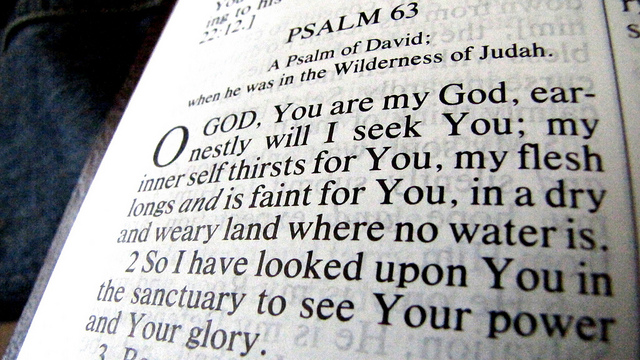
  • The Bible: God’s Word for Life, Love, and Change

    Photo: Savio Sebastian, flickr
    Photo: Savio Sebastian, flickr

    Today I have an article on Sacred Reading over at the Kingdom Life Now magazine. Here’s a taste.

    Recently I led an exercise of meditative reading of the Bible. Four times I read the passage of Isaiah 43:1-8 with instructions to the women with a different emphasis in engaging with the text each time. About a month later, I was humbled to hear from one woman about how God spoke to her through the exercise. She said how she and her husband had been to Brunei in Southeast Asia a couple of weeks before the conference in Somerset, England, to visit their daughter and family (including three young grandchildren), who have lived there for the last seven years. While there, she learned that her son-in-law decided to apply for teaching jobs in Belgium, Singapore, and Oman. With Belgium being far closer to home, she and her husband were hoping this would be their final destination. She said,

    When you read Isaiah to us the only sentences that I heard were verses 5 and 6, where it says, “I will bring your children from the East and your daughters from far-off lands.” How relevant to me were those words and I held onto them as a promise to me from God – that He was telling me that my son-in-law would get the job and my family would come close. I was so convinced that I told others what God was saying. So imagine the great joy when we heard on that he had been offered the job in Belgium and they were to start in September! No more 17 hour flight to see them! God truly had gathered my children from the East and my daughter from a far-off land.

    She said that although before my talk she had never heard of lectio divina – a Latin phrase for the act of sacred reading – but now she had come across it several times.

    Change Agent

    This ancient practice of a slow, contemplative praying of the Scriptures moves what can be a merely rational process deep into one’s heart, for as we chew over a piece of Scripture, it sinks into our being. We begin to slow down, receive, and make a personal response. Continue reading.

  • Review of a fab novel about spiritual formation

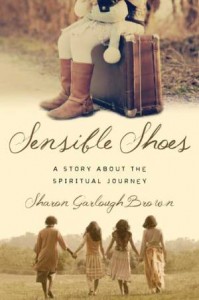
    Sensible Shoes: A Story about the Spiritual Journey

    by Sharon Garlough Brown (IVP, 978-0830843053)

    Some books come with a buzz. I don’t mean that reading them will cause an altered reality, but that people become so gripped and changed by these books that they want to share them with others – resulting in a buzz. Sensible Shoes is such a novel. I first heard of it on social networks, for Kathy Lee Gifford recommended it on one of the influential US talk shows. Intrigued that a book about the spiritual journey would receive such a big mention, I got myself a copy. From the promotional material I thought it was a how-to book about the spiritual disciplines, so I was pleasantly surprised when I found it was a novel.

    9780830843053The story charts the journey of four unlikely friends who bond through a spiritual formation course. Each woman is running from wounds of the past. Through their friendship and their engagement with spiritual practices such as lectio divina, praying with the labyrinth and imaginative prayer (Ignatian practices), they find peace. They also move into the adventures of a life partnering with God.

    I could relate to each of the women’s struggles as those I’ve addressed in my own journey of faith. Such as Hannah, who tries to prove her worth to God by serving others unswervingly, to the point of exhaustion and ignoring her own needs. Or Mara, who, feeling rejected, turns to food for comfort. Or Meg, who battles a critical voice in her head. Or Charissa, who seeks perfection and loves a controlled environment.

    One point that the author makes is that God often uses the irritants in our lives to wake us up to the issues we should face. As one of the spiritual directors says: “Remember, Charissa – the things that annoy, irritate, and disappoint us have just as much power to reveal the truth about ourselves as anything else. Learn to linger with what provokes you. You may just find the Spirit of God moving there” (p. 80). The prayer of examen, in which we look back at our day in the presence of God, can help us as we bring to mind those things or people that made our blood pressure rise. We can ask God to show us why we lost our temper – was it something physical like we were tired or hungry? Or something deeper, such as one of the deadly sins – pride, envy, anger and so on. When we’re transparent before God, he can bring his healing touch, filling the places that are yearning for love and affirmation. And he can lead us to repent, or spur us on to love our neighbor.

    And Sensible Shoes? Although they could have called it something with a bit more zing, it’s a book I’ll keep recommending.