“The nations will see your vindication, and all kings your glory; you will be called by a new name that the mouth of the Lord will bestow. You will be a crown of splendor in the Lord’s hand, a royal diadem in the hand of your God. No longer will they call you Deserted, or name your land Desolate. But you will be called Hephzibah,and your land Beulah; for the Lord will take delight in you, and your land will be married. As a young man marries a young woman, so will your Builder marry you; as a bridegroom rejoices over his bride, so will your God rejoice over you” (Isaiah 62:2–5 NIV).
Photo credit: found on flickr by archer11.
We might feel uncomfortable applying the language of the prophet Isaiah to our lives, and men in particular might struggle to call themselves a royal diadem or the bride of Christ. But as CS Lewis said, God is so masculine that we are all feminine in response to him. And so male or female, we can ask God to reveal how his loving words from centuries ago can speak into our spirits and souls today.
Being a crown of splendor in the Lord’s hand makes me think of Jesus on the cross, wearing his crown of thorns. He who could take the place of the righteous king yet endured pain for our sakes. So that we too can be sons and daughters of the King, wearing a jewel-encrusted crown as bestowed by our heavenly Father.
No longer do we have to endure desolate lives of emptiness. For God reassures his people that he dwells with us and delights in us. He who has created us – the Builder – who has set our foundations into place, will rejoice over us even as a bridegroom on his wedding day.
Living out of the new self entails embracing our identity as the beloved. Our new name reflects joy, rejoicing, delight, and love. What name could you claim today?
For reflection: “‘Come, I will show you the bride, the wife of the Lamb’… It shone with the glory of God, and its brilliance was like that of a very precious jewel, like a jasper, clear as crystal” (Revelation 21:9, 11).
I returned home from our wonderful week in Northumberland, feeling spent from a summer and autumn filled with good things: Our family’s five weeks in the States. Leading a meaningful and sun-filled retreat in Spain. A trip to the States to play with my high-school friends at the lake where they filmed Dirty Dancing and to celebrate family birthdays. And most recently our jaunt up to the wilds of the Northeast of England, venturing into the rugged coast and atmospheric castles.
Photo by cod_gabriel as found on flickr
Although I knew I was facing a first-world problem of exhaustion from too much fun and travel, I was wiped out. And so I wasted more time than I like to admit early this week watching episode after episode of Scandal, a drama based in my former home of Washington, DC. The storylines gripped me and I loved seeing the beautiful buildings of my former stomping grounds. But watching so many episodes when I should have been spending my time with more fruitful pursuits – gardening or decluttering would have been more fulfilling – left me with another shame hangover.
Shame hangover – such a descriptive term, which Brené Brown employs in her acclaimed TED talks and book Daring Greatly. I spoke last week of my shame hangover related to my flapping mouth and unholy moments while at Holy Island, which many of you responded to with forgiving love and sometimes a knowing, “I’ve been there.”
Shame can stick to us like a new set of clothes, ones we don that can become sealed into our skin. So familiar they can become that we don’t know how to operate without them. And so like Eustace Scrubb in CS Lewis’ The Voyage of the Dawn Treader, we need to remove them with God’s help, in a sometimes painful manner. Eustace, you may recall, had been turned into a dragon through his dragony greed and selfishness. He meets a lion (Aslan), who asks him to undress. Eustace peels off a few layers of dragon – of selfishness and pride – but remains a dragon. The only way to undragon is for Aslan to bring about a deeper cure – one that sinks deep to his heart and hurts greatly, but brings about a new person.
I’ve been thinking lately about the old self and the new, for not only at our conversion do we shed our old self with its sinful practices and take on the new self. This process of putting on the new self is continual, as the apostle Paul writes to the church at Ephesus: “You were taught, with regard to your former way of life, to put off your old self, which is being corrupted by its deceitful desires; to be made new in the attitude of your minds; and to put on the new self, created to be like God in the true righteousness and holiness.” (4:22-24)
His verbs are active in the Greek – we put off our old self and put on the new. Our new clothes are no longer the rags of shame, but the royal robes of daughters and sons. Indeed, we are clothed with Jesus himself. But we don’t always wear our new robes. We slink back to the rags, perhaps through exhaustion or weariness. When we tire of the shame hangover, we can release it over to God, asking for forgiveness and for him to fill us with his Holy Spirit, that we might be empowered to live the forgiven life.
So as I get back to a structured routine, one not filled with countless episodes of spin-doctors, I come before God and ask him to help me wear his richly colored robes as I shed the ragged shame-inducing garments. Here’s to being forgiven!
My niece is turning 20 soon, that wonderful decade of exploring identity, building relationships, entering into the world of independence and adulthood. It can be a time of searching and experimentation; a time of solidifying who we are. My smart and hard-working niece has known since she was 10 that she wanted to pursue a career in medicine, but when I was in college, I was a bit lost about what I wanted to do with my life. I knew I like words and writing. And I had enjoyed my dad’s computing, when as kids he would bring home a console and plug it into the phone for it to speak to the mainframe at Pillsbury, where he worked.
Which way to turn? The way ahead, or that little cobbled trail to the right?
So when I was wondering what to pursue at college, he encouraged me to be a technical writer. I signed up for some computer courses – Basic, Pascal, Fortran, and Cobol. I did okay at first, but when I got to Fortran I started to struggle. I went to see my professor when I was flailing around with the latest assignment. His words brought instant clarity: “You know Amy, I don’t think that writing code is something you really want to be doing in your free time.”
He was right, and I felt relief in dropping the computer-science minor. But I don’t regret the classes in Cobol or even my political-science major that I later embraced. I find it funny that I studied poli sci, for I’m not a news junky or a politico (as my husband, who has these proclivities, will fully attest). But God used and redeemed my choices of studies at college – my political-science major meant that I went to Washington, DC, for a semester, which turned into ten years of amazing, challenging, eye-opening experiences. My internship including working for a fabulous British Christian writer. Who knew I would later live in Britain, writing and working in Christian publishing?
So to those such as my niece who are moving into the next stage of life, I offer you blessings from a fellow pilgrim. Whether you have your path charted out or whether you aren’t sure which way to turn, may you feel freedom in taking the next step. May you feel the Father’s hand in yours, never constricting but always encouraging. May you experience joy in the journey.
If you’re well past your twenties, let me ask you this: How did your experiences of that decade shape your life?
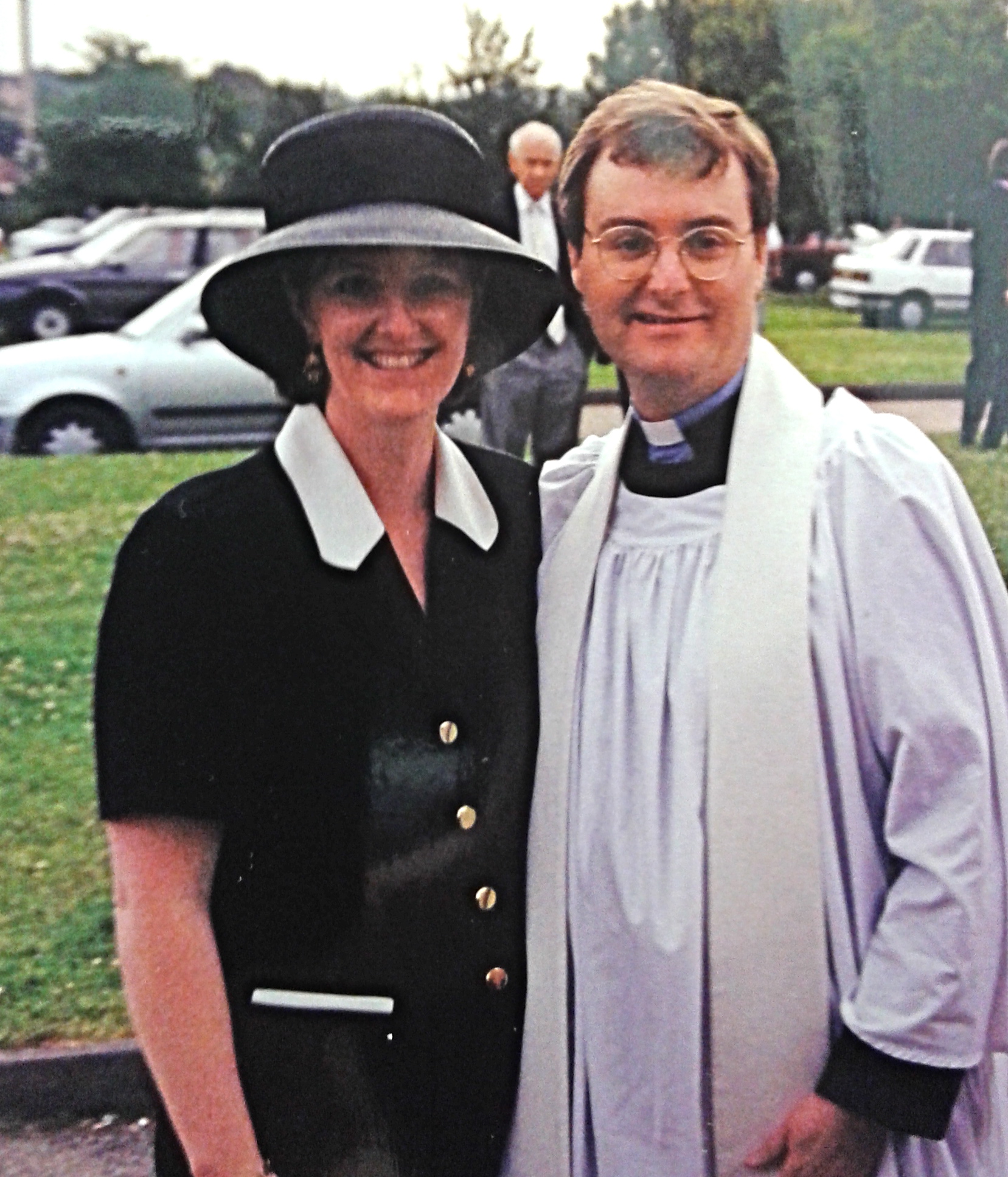
Nicholas’s priesting, which happens a year after being ordained a deacon (who knew it was so complicated?). I know, the hat; what was I thinking? Nice photobomb too.
Today my husband has been ordained a minister in the Church of England for 15 years. I remember the occasion so clearly as I sat in the cavernous Guildford Cathedral with his family and witnessed him making his promises to love, hono(u)r, and serve God and God’s people. As we drove back to Cambridge, I was keenly aware of him wearing his dog collar for the first time when we stopped at a rest stop – I felt like he was broadcasting, “Hey, I’m one of those crazy Christians!”
While Nicholas went on the pre-ordination retreat, I had stayed with some of his friends in Guildford and prepared for the post-ordination meal. This was my first experience of putting on a party for his friends and the church. I remember making salads; this lovely broccoli one was probably quite foreign to Brits then (at that time salads hadn’t reached the level of acceptance as they have now on these shores). A woman from his church, surveying the heaping buffet table, said what a good vicar’s wife I would make. Oh, how I cringed at that. I had hosted the party as a gift of love for my new husband, not out of duty or expectation. Couldn’t she see that?
I’ve learned many a thing through the years of sleeping with the vicar (or curate). Like gently elbow him if he’s snoring and he’ll turn over. Here are two things I offer from my experience as a VW (vicar’s wife) to other clergy spouses. If you’re part of a church, perhaps these points will help you see the minister and spouse (if applicable) in a new light.
Our first home in Surrey.
Be yourself
One of the first people I ever met in Britain was a lovely American who was married to a Brit who was also a vicar. She was originally from Wisconsin (I come from the next-door state, Minnesota). Ah the wealth of advice and love she showered me with. We shared great laughter too.
She told me how on her husband’s induction to his first church as vicar, she wore a T-shirt under her coat emblazoned with the slogan, “I don’t bake cakes!” She had a strong sense of self and was cheerfully and playfully taking on any hidden assumptions from her husband’s new flock.
Now I do bake cakes, and in particular I’m happy to whip up a batch of my famous brownies for church events. In typical convenience-oriented American style, I serve up the amazing Ghirardelli brownies. Yes, from a mix. One of my friends at church was rather crushed to realize I hadn’t made them from scratch!
But there are lots of ministries at the church I don’t feel called to. I believe that if I step into those roles out of sheer duty, I’ll deprive someone else of fulfilling their calling to serve (and I’ll probably have a stonking attitude). Of course there’s a balance here, and we need to pitch in at times when we don’t feel called when the need is great. And sometimes God calls us into areas we might previously have eschewed. For me, children’s ministry is one of those. I find the prospect daunting and deenergizing, as much as I love my kids. But our church needed leaders so I agreed and now find the times I lead the pre-teen group to be filled with joy and good discussion and fulfillment. I’m a better discipler than teacher-of-the-young, which illustrates my heading for this section, “Be yourself.”
Embrace your instant community
When a publishing colleague heard I was marrying Nicholas, he said from his previous experience as a pastor, “You’ll always have community.” Now that that can be a good thing but sometimes a harmful thing too. Yet his comment brought light and clarity to me as I approached the quick succession of churches that Nicholas had roles with in the first half-dozen years of his ordained life (two curacies and then his first vicarship, where we remain nine years later). My friend’s advice echoed the words from the book of Ruth that reverberated through my mind as we drove to Surrey for Nicholas’s first curacy: “Where you go I will go, and where you stay I will stay. Your people will be my people and your God my God” (Ruth 1:16, NIV). These were now my people – warts and all. And I was their people too – warts and all.
In my years as a VW I’ve witnessed episodes of the downside of community: backbiting, gossip, slander… It hasn’t been pretty at times and it can be excruciating to watch from the sidelines, feeling that all I can do is pray (which yes, I know is actually the biggest thing). Or having to gently disappoint people if they have expectations of me (which doesn’t happen often in our multicultural church in London). In Surrey during Nicholas’s first curacy I was working at HarperCollins. I was puzzled when one of the older ladies said to me during the refreshments after church, “I’m so looking forward to seeing you on Thursday!”
“I’m sorry; what do you mean?” I asked, trying to cover up my confusion.
“Nicholas is coming to our over-50s group.”
“Oh, I didn’t know,” I replied. “I work in London during the week so I’m not able to come.”
This photo of a church in the Costwolds illustrates how the church community can be at times. Sometimes with dark clouds; sometimes with fluffy ones; sometimes both at the same time.
Although there can be negatives, community has its upside too, such as my friend’s comment about the instant nature of the potential for relationships in a church. In each of the three churches where my husband has served, I’ve asked God to give me some friends. In Surrey my closest friends were of non-English nationality (not that I sought this out): Scottish, South African, and Irish. In Harrow, Nicholas and I were blessed to have friendships blossom with the two clergy couples and another couple in the church who are now mission partners in Moldova. Here in north London I enjoy a wealth of friends, especially with my female peers. These are the true riches that God bestows on his people.
Unsolicited advice
If you’re part of a church, here’s a bit of advice of how to love your clergy/clergy family (as applies).
Love them as individuals. They will fail at times and soar at others. Love makes it all better and easier.
Hold your criticism of the preacher’s sermon until during the week, and not right after the service when comments can feel more bruising.
If your minister is married, don’t assume the spouse knows everything going on in the church. If the minister is doing the job in the right way, the spouse won’t know the confidences.
Celebrate your church leader when appropriate. They need praise too.
Pray for them. As Alfred, Lord Tennyson, said, “More things are wrought by prayer than the world dreams of.”
And how about you? What advice would you give if you’re part of a clergy setup? If not, what have you observed if you’re part of a church?
In my university years, I was friends with a man who was intellectually gifted. I enjoyed our times together, but deep down, I never really felt myself with him; I somehow felt I was lacking. Not that I would have ever even named this vague feeling of dis-ease, but I can see it looking back through the lens of time.
We often went on outings in the city where we lived. By mutual never-expressed agreement, neither of us was interested in the other romantically. This made for jaunts to restaurants or cultural happenings that were fun and generally easy. Until he would say something that felt like an underhanded critique.
Such as one day as we were browsing in one of the city’s fine bookstores. As we were exiting, he said, “You know, Amy, maybe one day you could run a bookstore.”
Startled by his pronouncement, I merely said, “You think?”
A selection of my books on writing. Some great ones in there; I especially recommend the one by Eudora Welty (One Writer’s Beginnings) and of course William Zinsser’s is a classic.
His comment stung, because I had a deep-seated desire to be writing the books, not selling them. So I saw his remark as a putdown. I hasten to say that having been in the publishing business for so many years, I have met many a fine bookseller, marked by enquiring minds and wisdom. Now I wouldn’t see his comment as derogatory, even though I still prefer to be part of the creating process.
And the creation of good books is what my career path has focused on. Mainly with me helping other people to write, rather than me being the one to do the writing. Only now – some twenty years later – am I in the process of writing a book that I hope will one day feature in a bookstore.
Another comment by another intelligent man whom I respect (and a writer himself) brought me low a few years ago. When I told him that I wanted to be a writer, he said, “That’s something you can aspire to later on.”
When he said that, I felt he was saying, some day you can try that. Later on, when you’ve learned more and become more wise. He is generous-hearted and probably meant nothing by the comment. But it wounded nonetheless.
But most days I write, and the working days I enjoy most are those penning one thing or another. Part of being a writer – at least for me, with fledgling confidence – is accepting the moniker and growing into it. Knowing that I am a writer because I write; not because I’ve clinched a magical three-book contract (although that would be nice too). God can change my name. Not just Amy, the editor. But Amy, the writer.
How about you? Is there some unaffirmed part of yourself that longs to be expressed? Have you had to grown into a new name?