“Do you really think you’re a writer?” In my journey of stepping in to being a writer, having been an editor for decades, I would sometimes hear this question in my head – through self-doubt, or through how I interpret criticism, or perhaps even from the evil one. My path to becoming a writer has been long, for only after many years as an editor did I venture into writing – and then with fear. And yet being an author forms part of my identity – as well as being an editor, and more importantly as God’s beloved, a wife, mother, daughter, sister, aunt, friend…
Here Satan starts his series of temptations by questioning Jesus’s identity, saying, “If you are the Son of God, then…” He’s asking Jesus to prove who – and whose – he is, even though I’m guessing the devil already knew the answer.
How different are the words of God the Father. After Jesus was baptized by John the Baptist, a voice from heaven says that this is God’s son whom he loves (Matthew 3:17). And later, when Jesus and two of his disciples are praying on a mountain and Jesus radiates God’s glory (the transfiguration), similarly a voice says, “This is my Son, whom I have chosen; listen to him” (Luke 9:34). God’s words affirm Jesus’ core identity, while Satan’s seek to undermine it.
Might there be parts of your identity that you have yet to accept?
Prayer: Heavenly Father, thank you for your words of love and that we are your children. May we never waver from our central identity as your beloved. Amen.
I didn’t know that the fairy tale would be so hard. After all, my dreams had come true – I had finally found my prince, a man who loved the Lord and loved me. The courtship and engagement whirled past in a rush of plans and excitement. I knew I’d have to quit my job and leave America to join him in his native Britain, where he was studying to become a minister, but I figured, how hard would that be?
Turns out, harder than I could have guessed. After the flight and drive from Heathrow, with me recovering from the flattening case of flu I caught while on honeymoon, we made it to our tiny student accommodation in Cambridge (called “The White House,” no less). I excitedly unpacked my bulky desktop computer, wanting to connect with people back in the States (this was before the ubiquity of smartphones or even wireless internet). But after I pressed the power button, I heard a whoosh. In an instant, my Macintosh died, the victim of different power supplies and me not switching a button at the back between 110 and 220 voltage. I collapsed into floods of tears.
Losing my computer started off me on a tough transition into my life in the UK. I was with the man I loved, living in a charming part of England with the boats floating down the River Cam, evensong at King’s College under the famous fan-vaulting ceiling, and a daily market with the fruit-and-veg sellers calling me “love.” But I felt rocked at the center of my being.
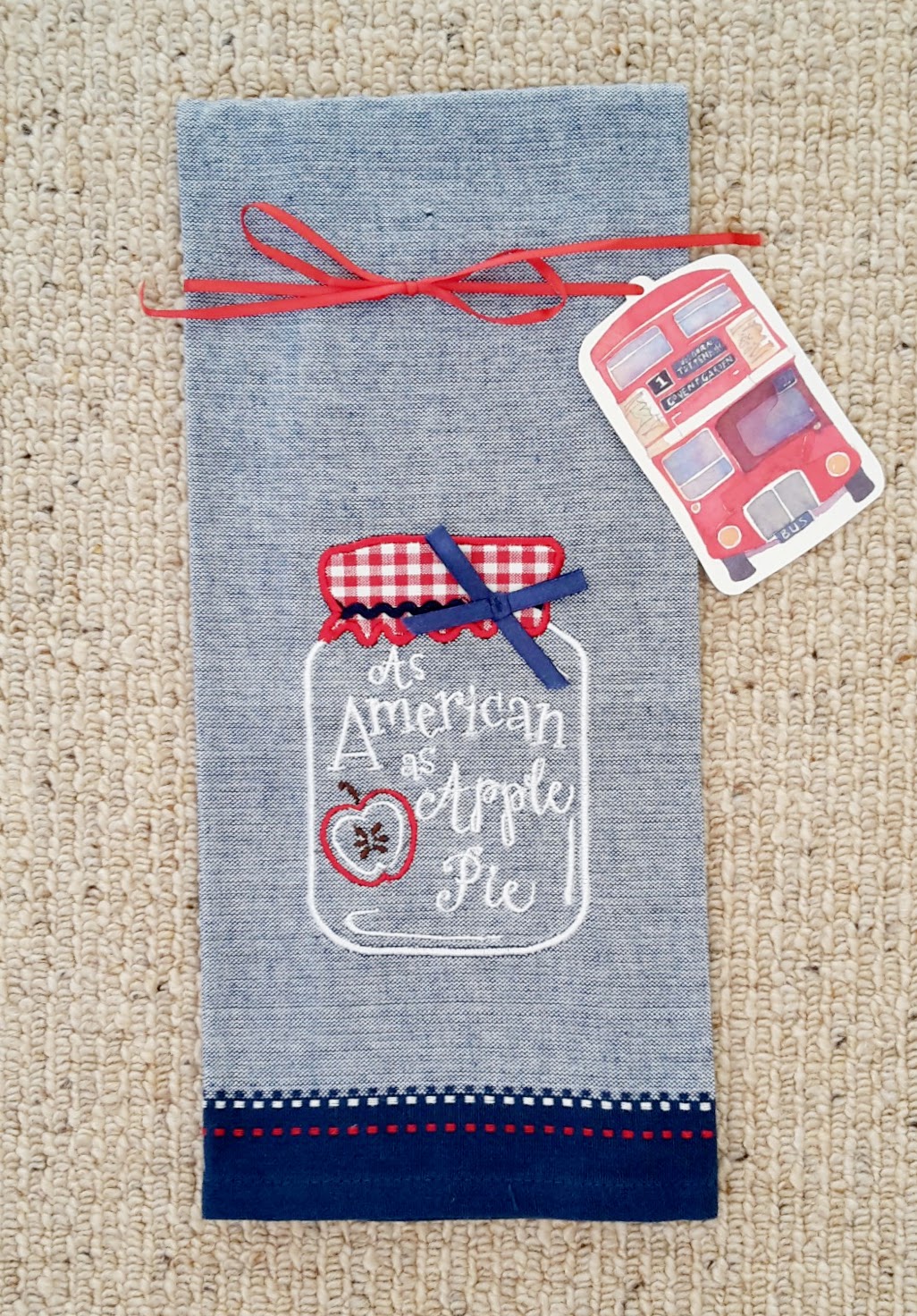
“I had no idea apple pie was considered ‘quintessentially’ American until I lived there and heard this phrase! I was thought it was very English!” So said Jennie Pollock, my editor of Finding Myself in Britain, who gave me the pictured fabulous tea towel as a “baby shower” gift for my book-baby at the book launch. Americans claim apple pie as one of their core symbols, along with Mom and Uncle Sam and blue jeans. I suppose this grew out of the nation being formed by immigrants – apple seeds were brought over to the colonies by the English settlers in the 1600s. But Jennie is right – actually the first recipe for apple pie, according to this interesting post, was published in an English cookbook in 1381 and called for raisins, pears, and figs in addition to apples.
Americans are happy to be associated with symbols such as the American flag, the freedom-loving eagle, and apple pie. But what about the people on this small island? That becomes much more complicated – as British as…? What comes to mind? I can think of traits for individual countries: As Scottish as kilts and thistles and William Wallace. As Welsh as daffodils and amazing singers and St David. As Irish as a craic and shamrocks and potatoes. As English as – what? From a tourist approach people would say Big Ben and the Houses of Parliament and a stiff upper lip.
What do you say? What are Americans like? Britons? If you’re Scottish/Welsh/Irish/English, do you agree or disagree with those I listed for your country? And if you hail from another country, what are your country’s symbols?
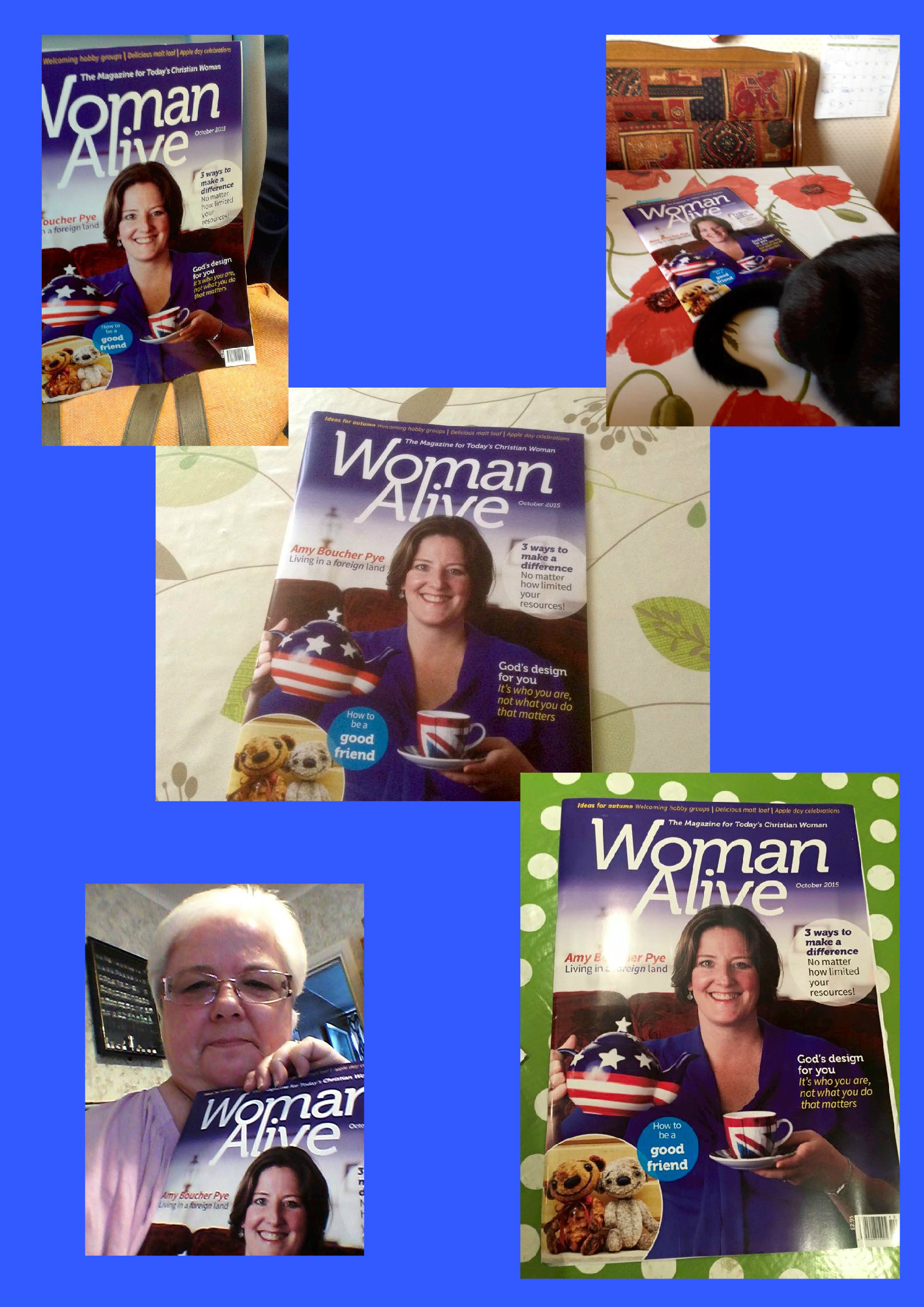
A surreal feeling washed over me when I glimpsed the cover of the October Woman Alive – there under the new logo was me in my living room, pouring a cup of tea out of a Yankee Doodle teapot, sporting a big smile. I knew the cover was happening, but the shock of actually seeing my photo there felt like a jolt. For I’m not your usual “cover girl” material – no size zero here. And yet it’s wonderful to have real people smiling out from the front of a glossy magazine.
I was so moved that people posted their photos of Woman Alive on social media! Such fun!
We know our worth is not in our looks, and that God loves us no matter if we’re gussied up in evening wear or clad in our gym clothes after a workout. But do we believe that we’re worth the cover of a magazine? Even writing this post feels indulgent, like I should be apologizing. Instead, I’m going to give thanks that indeed, I’m a woman who is alive, who is made in God’s image, and who wants to love as she’s loved. To extend grace and peace and hope. And to be forgiven for when I fail.
I never guessed before I moved to the UK those many years ago that I’d ever be pictured on a magazine pouring a cup of tea. Tea was something that I bought on my trip to London when I was 21, which I kept in a decorative Jackson’s of Piccadilly canister but never drank. Nor that I’d write a whole chapter about tea in my soon-to-be published book, Finding Myself in Britain. How fun to live our adventures with God.
Over to you – if you were to be pictured on the cover of a magazine, what would you fancy you’d be doing in the photo? And why? How does God surprise you?
We, the creatures of a creative God, are poised for creation and collaboration (and sorry about all those c’s). I was so struck by this last week I was in sunny Spain with an animated, gifted group of women as I led the retreat portion of the retreat/holiday at El Palmeral. We were looking at our identity in Christ, with each session having a hands-on component of prayer and/or creation.
One of the activities was to make a picture that represents different parts of our identity – what names does God call us? I laid out glitter glue, fabrics, beads, and colored papers, and said something like, “Off you go!” To which my friends seemed to look at me blankly, and one said she didn’t know where to start. I launched into a prayer asking God to release the works that were within us.
He did. As we reflected later, we realized that one thought would pop into our head, and we’d go with that, which then would lead us to another, and another. Step by step we formed the pictures. We created together in a group yet in silence, with instrumental hymns in the background that also in some cases sparked memories and thoughts.
I find the same experience happens when I write. I might come to the blank page with no idea what I’m going to say, but a hint of an idea will pop into my head, which I take and examine and knead and explore… leading to the next thought, and the next.
God the Creator, who made us to create with him. An awe-inspiring thought.
How about you? How do you find the creative process?
(With thanks to the creators of these pictures for permission to include here. Each picture has layers of meaning that I found incredibly moving.)
Remember the words I spoke to you: ‘No servant is greater than his master.’ John 15:20
A house fit for a queen. Osborne House on the Isle of Wight.
My son has had a fascination with the British monarchy over the years, and I’ve learned much about kings and queens as we’ve visited royal palaces and read biographies. I simply cannot imagine one of these exalted persons lowering themselves to the level of a servant. And yet this is what Jesus – the King of Kings – did when during the Last Supper he washed the feet of his disciples. He, the Teacher and Lord, got dirty in the service of others. So too must we: “I have set you an example that you should do as I have done for you. I tell you the truth, no servant is greater than his master” (John 13:15-16).
Now as Jesus talks about persecution, he hearkens back to his words about the servant/master relationship. We must serve one other, and because servants aren’t greater than their masters, we must expect to be treated with spite or taunting, as he did. We will not be exempt from suffering, for his Father did not spare him. But as we will see in an upcoming reading, God will send his Spirit to us – the Advocate and Counselor – who will fill us with his presence and speak on our behalf.
We may not be a member of the British royal family, but we are daughters and sons of the King. Though we may suffer, our adoption into his family is secure.
Prayer: Our Lord God and King, reign in our hearts today, that we might love and serve you.
As it is, you do not belong to the world, but I have chosen you out of the world. John 15:19
Photo: Ian Mackenzie, Flickr
I have two passports – one from America, the land of my birth, and one from Britain, my adopted country. I will always have divided loyalties, whether in which sports team to support or which lingo to speak. But my most important citizenship is my heavenly one, to which Jesus refers here. For he has chosen us out of the world, and we do not belong to it.
What does it mean to be a citizen of heaven? To be “in the world but not of it”? Christians throughout the ages have interpreted this question differently. Some remove themselves completely from the world. Others so accommodate it that they lose their Christian distinctiveness. Many struggle somewhere between the two poles, seeking to keep in tension engaging the world on the one hand while being a transforming force in it on the other.
As we keep our sights fixed on God’s promises of his heavenly city, we will see our struggles and travails with his eternal perspective. He can pull us back when we are too engaged with worldly things, such as watching a dodgy television program. He can shed wisdom on the challenges we face, reminding us that he will never leave nor forsake us. He will strengthen and undergird us, helping us to be his witnesses in a world hungry for grace.
Heavenly Father, as aliens and strangers on earth we long for a heavenly country. Help us to live by faith.
Whoever has ears, let them hear what the Spirit says to the churches. To the one who is victorious, I will give some of the hidden manna. I will also give that person a white stone with a new name written on it, known only to the one who receives it. (Revelation 2:17)
Photo credit: “White Stone” by Anna, Flickr
A couple of women I know have changed their given names. One suffered sexual abuse, and by changing her name she was cutting painful ties. Another didn’t want to be defined by her name’s meaning, which was “bitter.” Instead she wanted to be known by a name that denotes “grace.”
Our passage comes from the letters of Jesus, as revealed to the aging disciple John. Jesus says to the church at Pergamum that he will give them a white stone with a new name on it, known only to the recipient. Several meanings of this white stone have been put forward, as summarised by Craig Keener in the NIV Application Commentary (pp. 126–27). One is that in the ancient world, people used pebbles for admission to events; in this case, for a messianic banquet. Another is that in some ancient courtrooms, the jurors would cast a white stone for acquittal and black for conviction. (Thus Jesus would be the judge over what the Pergamum Christians were suffering.) Or the white stone could symbolize purity and eternal life, or a new name signifying a new identity.
The symbolic possibilities are rich. Applying the promise to our own lives hearkens to the promises we examined in Isaiah 62. Our new name might be one that we publicize as we embrace our new, redeemed self. Or it might be one that we keep hidden, the name that we hear when we call to the Lord and listen for his affirming words of love.
We are no longer bound to the old way of life. As we live out of our new selves, may we reflect the attributes of the One who created us, who made us for himself.
For reflection: “Let us rejoice and be glad and give him glory! For the wedding of the Lamb has come, and his bride has made herself ready” (Revelation 9:17).
I was warned. Before I married my Englishman, my boss – who was, conveniently, an Englishman living in America – told me that the little differences between the two countries would jar me at first. He was right, and I found that no where more true than with language.
Photo credit: UK & USA Flags – Dot Matrix by gavjof on flickr
I knew that the Brits and Yanks employed different terms, especially for things like cars: bonnets were quaint headpieces adorning Jane Austen’s characters; a boot was just that, something to wear on your foot, especially when living out West; and that thing hanging off the back of the car? I had no clue. In my first year in the UK when I tried to explain that a woman’s muffler was falling off her Range Rover, I stuttered and stammered (but actually no, I didn’t stammer, because I didn’t know that word either), knowing I wasn’t saying the correct word (and being slightly uncomfortable anyway, thinking I was probably breaking social convention to speak to a stranger). Finally I took her back to her car and pointed, and she exclaimed, “Ah, the exhaust!”
And I knew that pronunciation would be different, as I outlined last week. Although imagine my surprise when one of Nicholas’s theological college (US: seminary) students invited us to lunch, and they asked me to say the name of a certain spice. One that starts with an o and ends with an o. Got it? Yes, I naively said, “Oregano,” (oh REG ah no) to which the party erupted in laughter. My host explained that Brits tend to pronounce each syllable of a word, which is why they would say, “oh rey gahn no.”
So I knew I’d struggle with dustbin carts and, back then, the name for a pay phone (call box? pay box?), trousers and pants, chips and crisps and biscuits and crackers, but what I didn’t know was the hidden meaning of language. Yes, what Brits really mean behind their polite words or ironic remarks. You may have seen the graph that has been widely circulated on social media sites, reportedly developed by a Dutch company trying to do business in the UK. The one that has a column for what the British say, “That’s not bad”; a column for what the British mean, “That’s good”; and a column for what foreigners understand the British to mean, “That’s poor.” No wonder we foreigners get our knickers in a twist (US: can you figure it out?).
I didn’t have the luxury of such a graph when I first moved here, so learned by making mistakes. My husband and I soon differentiated between a British “nice” and an American one – how nice was that person or meal or gift really? (We don’t often use that term anymore, which is just as well when there are far superior descriptors.) But it took a bolshey (US: in-your-face) literary agent to inform me, when I was a commissioning (US: acquisitions) editor at HarperCollins, that Brits and Americans mean different things when I said that I thought her client’s proposal was “quite good.” (She dropped any social niceties when she educated me, and no, I didn’t progress that proposal.) At least my boss didn’t expect me to pronounce schedule in the British way, and he did helpfully point out that the handwritten PS at the bottom of the letter, which I would most likely disregard, was actually the most important thing to the author.
So tell me, British friends and family, what is behind this lack of saying it like it is? Does it all come down to class – not offending those above or below? A natural reticence? Social custom based on…? I’d love to hear what you think, and any experiences you’ve had of saying something and being completely misunderstood. And what you think of those colonists who prefer to speak unvarnished (Just to mix things up, I now work for an Australian company!).
Lately PyelotBoy has been critiquing my pronunciation – “correcting” it to the British equivalent. Now I know some Americans who have lived in the UK for a long time have no problem with acquiring a mid-Atlantic accent. Some simply can’t help it. Some aspire to it, seeing it as a step up in terms of class (Received Pronunciation, of course).
Photo credit: AndreaMBC on Flickr
Not me. I was happy to lose some of my nasal Midwestern inflection when I moved to Washington, DC when in my twenties, but a decade later I had come to terms with my identity, so changing how I spoke felt like a step too far. And yet, when I first moved to the UK I was painfully conscious about opening my mouth. Any foray into a shop would label me as other – as foreign – as soon as I uttered a word. So I would keep shtum (US: stay silent) if I could, and would wait for the look of pity or surprise when I asked for my change or said thank you.
But my many years of living in the UK, especially my years in multicultural London, have cured me, thankfully, of this self-conscious standing outside of myself. In London, I’m just one of many accents, and frankly, not terribly interesting at that. In my church of 170 people or so, we have 20 nationalities representing the continents of Africa, the Americas, Asia, and Europe. A taste of heaven!
Sometimes when I’m outside of London, however, the reality of being a Yank in Britain comes back to me in a rush. I spent some time writing in Eastbourne a few years ago, reveling in the quiet of a friend’s house and generally speaking to no one but my family by phone. The sole person I talked to was in the grocery store (UK: supermarket), and sure enough, the bloke asked me where I was from and how long I was visiting. Or when I visited a friend in Carlisle and we ordered pizza, the delivery person queried me about my accent.
In some parts, I guess, I’m still an anomaly. But in my own home I thought I would not face questions or ridicule. Think again.
What about you? Has your accent morphed over the years? For an amusing question-and-answer column in the Guardian about a New Yorker seeking to acquire a Southern English accent, see here. My advice? Don’t even try.