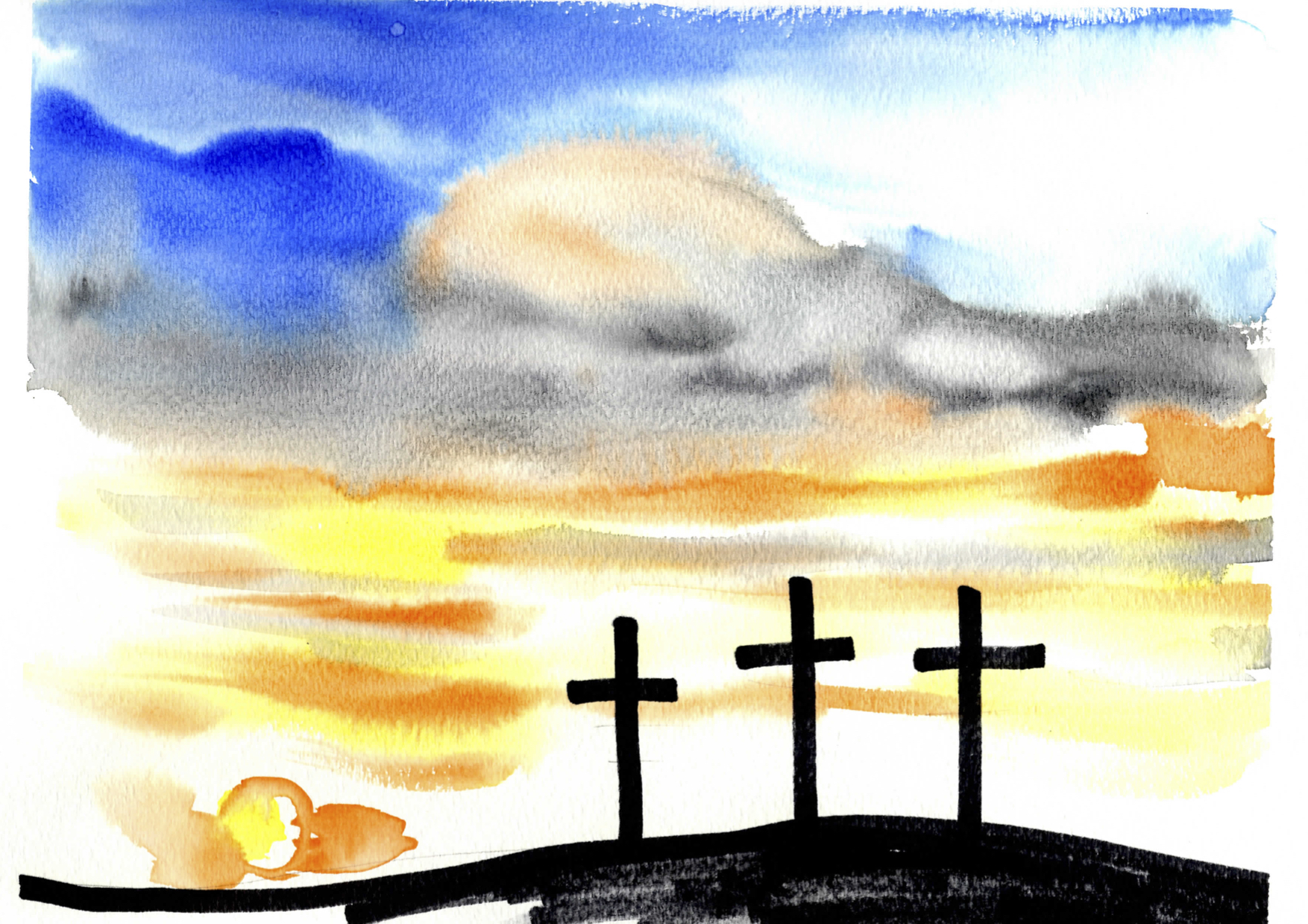
By Leo Boucher. Used with permission; all rights reserved.
Many Christians view today as the most wonderful and most awful day—the day we remember the Man who was God who died on the cross that we might live free.
I invite you to spend a few moments pondering and praying, sharing with God your feelings about how his Son came to earth as a baby, lived and healed and loved, and then carried his cross and there was nailed where he breathed his last. Where he welcomed one next to him to life eternal. Where he uttered his last words in a life-giving prayer.
2 He grew up before him like a tender shoot, and like a root out of dry ground. He had no beauty or majesty to attract us to him, nothing in his appearance that we should desire him. 3 He was despised and rejected by mankind, a man of suffering, and familiar with pain. Like one from whom people hide their faces he was despised, and we held him in low esteem.
4 Surely he took up our pain and bore our suffering, yet we considered him punished by God, stricken by him, and afflicted. 5 But he was pierced for our transgressions, he was crushed for our iniquities; the punishment that brought us peace was on him, and by his wounds we are healed. Isaiah 53:2–5 (NIV)
On this Good Friday (why is it good?), I share with you some thoughts that I gave at church on a Good Friday past. May you find meaning in your remembering this day.
Mark 15:33–41 (NIV)
At noon, darkness came over the whole land until three in the afternoon. And at three in the afternoon Jesus cried out in a loud voice, “Eloi, Eloi, lema sabachthani?” (which means “My God, my God, why have you forsaken me?”).
When some of those standing near heard this, they said, “Listen, he’s calling Elijah.”
Someone ran, filled a sponge with wine vinegar, put it on a staff, and offered it to Jesus to drink. “Now leave him alone. Let’s see if Elijah comes to take him down,” he said.
With a loud cry, Jesus breathed his last.
The curtain of the temple was torn in two from top to bottom. And when the centurion, who stood there in front of Jesus, saw how he died, he said, “Surely this man was the Son of God!”
Some women were watching from a distance. Among them were Mary Magdalene, Mary the mother of James the younger and of Joseph, and Salome. In Galilee these women had followed him and cared for his needs. Many other women who had come up with him to Jerusalem were also there.
Luke 23:44–49 (NIV)
It was now about noon, and darkness came over the whole land until three in the afternoon, for the sun stopped shining. And the curtain of the temple was torn in two. Jesus called out with a loud voice, “Father, into your hands I commit my spirit.” When he had said this, he breathed his last.
The centurion, seeing what had happened, praised God and said, “Surely this was a righteous man.” When all the people who had gathered to witness this sight saw what took place, they beat their breasts and went away. But all those who knew him, including the women who had followed him from Galilee, stood at a distance, watching these things.
Women, at the time of Jesus,
in the ancient Near East
didn’t have the same standing as men.
They couldn’t even touch the Torah, the Scriptures,
or read it for themselves.
They were taught by their fathers or husbands.
A woman couldn’t serve at a banquet where men were eating—
that was a task for a manservant.
But Jesus valued women.
He went against the cultural practices of the day
because he prized them.
He loved them.
He taught them.

He told Martha of Bethany that her sister Mary
had chosen the one thing necessary—
to sit at his feet and receive from him.
to be his disciple.
 Many women loved and served Jesus.
 Not least his mother
 who as we hear in John’s gospel was there at the cross
 standing next to the beloved disciple, John.

 Even in his hour of pain Jesus loves her, and
 makes sure that she, who was probably a widow,
 would be cared for by John.
 And John would gain a mother as well.

 In Luke and Mark’s account of the cross,
 women watch him die on the barbaric cross;
 this instrument of torture.

 They who have loved the Lord,
 serving him and listening to him,
 following him,
 stand by him.

 As his disciples.

 They braved the potential danger
 and stood by at a distance.

 What danger?
 Friends and families of criminals—
 which is what Jesus was named to be—
 could have been persecuted.
 Not only ridiculed, and
 spit at, just like Jesus was,
 but given the same punishment as he on the cross.

 But these women couldn’t leave him,
 for they loved him.
 They watched from a distance.
 Seeing him suffer.
 Could we too watch our Lord on the cross?


 Think of the women standing there.
 In Mark’s account, we hear of
 Mary Magdalene,
 Mary the mother of James the Younger and of Joseph,
 and of Salome.

 Mary Magdalene is often seen as a prostitute
 but nowhere in the Bible is she named as one.
 She appears in the gospels 14 times—
 she was important to Jesus.
 He cast from her seven demons.

 She, who was literally out of her mind
 with demon possession
 was returned to her right mind by Jesus.
 And now, during his hour of need,
 she stands and keeps watch.

 We don’t know much about Mary,
 the mother of James the Younger and Joseph.
 She may have been the wife of Cleopas,
 a disciple of Jesus or Alphaeus.
 Maybe she was a sister to Mary, Jesus’ aunt.

 We do know that she followed Jesus,
 ministering to him and his disciples in material things,
 so she had a certain amount of wealth.

 She too stood at the cross and watched.
 Later she went to the tomb with spices to anoint his body
 and was told by angels that Jesus was not there.
 She was a faithful follower.

 Along with the two Marys was Salome.
 She was the wife of Zebedee, a fisherman,
 and the mother of James and John,
 two disciples of Jesus.
 Earlier she asked Jesus if her sons
 could sit in places of honor in the kingdom of God.
 A mistaken question.

 But she continued to follow Jesus
 and now she too watches from a distance.
 and later she too would bring spices to Jesus’ tomb
 to anoint his body.
Can we put ourselves in the place of these women? They had been given value by Jesus. He saw them. He loved them. He saved at least one of them from a life of destruction, of being an outcast.
And now, their teacher and lord was nailed to a cross. They must have been scared and afraid, numb. Questioning why…
Even though Jesus had said that he would die and rise again.
Hearing his words of prediction was one thing, but seeing it happen in front of them, another.
And yet they did not leave. They served through their act of presence. Through simply being with Jesus in his darkest hour. They loved him, even from a distance.
How about you? How about me?
Can we risk the taunts of those who do not understand our faith in Jesus? Can we stand together with those who also love Jesus, to show how we love him?
How can we stand with Jesus today? How can we love him? How can we serve?
How can we see him suffer dying on the cross, dying to release us from our sin and shame. dying to give us new life— life in the kingdom.
Can we, like the women, stand and watch? Can we, like the women, receive his love?
Lord Jesus Christ, You died to save me. You allowed yourself to be spit upon. Mocked. Lied about. You didn’t open your mouth.
And women who loved you watched you die. Perhaps they huddled together as you took your last breath and the curtain tore in two. They loved you from a distance. They did not leave you.
May I too be one who stands with you. May I love you, and serve you. May I overflow with love for you, Knowing that you have saved me from a meaningless life.
On this holy day, when we remember your death, Lord Jesus, May I be encouraged by the example of these women. Those not always valued by those in authority But those whom you loved.
Today, Good Friday, defines Forgiveness Fridays. On this holy day, we remember the death of our Savior, Jesus Christ. By his death he imparted to us forgiveness. We receive and give forgiveness because of this saving act.
Some poems and watercolors to consider on this day. My prayer for you is that God’s love poured out through his Son on the cross will envelop you through the Holy Spirit.
My dad’s rendition of the scourging at the pillar. By Leo Boucher.
On this most holy of days, I have to go straight to the crucifixion of Jesus and come back later to the wonderful Last Discourse. For on this day we remember the biggest sacrifice our Lord could have made – giving his very life that we might have new life. The story unrolls like a boulder gathering speed as it slams down a hill. At the end, we lay stunned and bruised, wondering what just happened.
![A watercolor rendition of Jesus carrying his cross with 2 soldiers helping him, with splotches of red and blue surrounding the three figures.]](https://amyboucherpye.com/wp-content/uploads/2022/04/JesusPicksUpHisCross-2.jpg)

 Today, Good Friday, defines Forgiveness Fridays. On this holy day, we remember the death of our Savior, Jesus Christ. By his death he imparted to us forgiveness. We receive and give forgiveness because of this saving act.