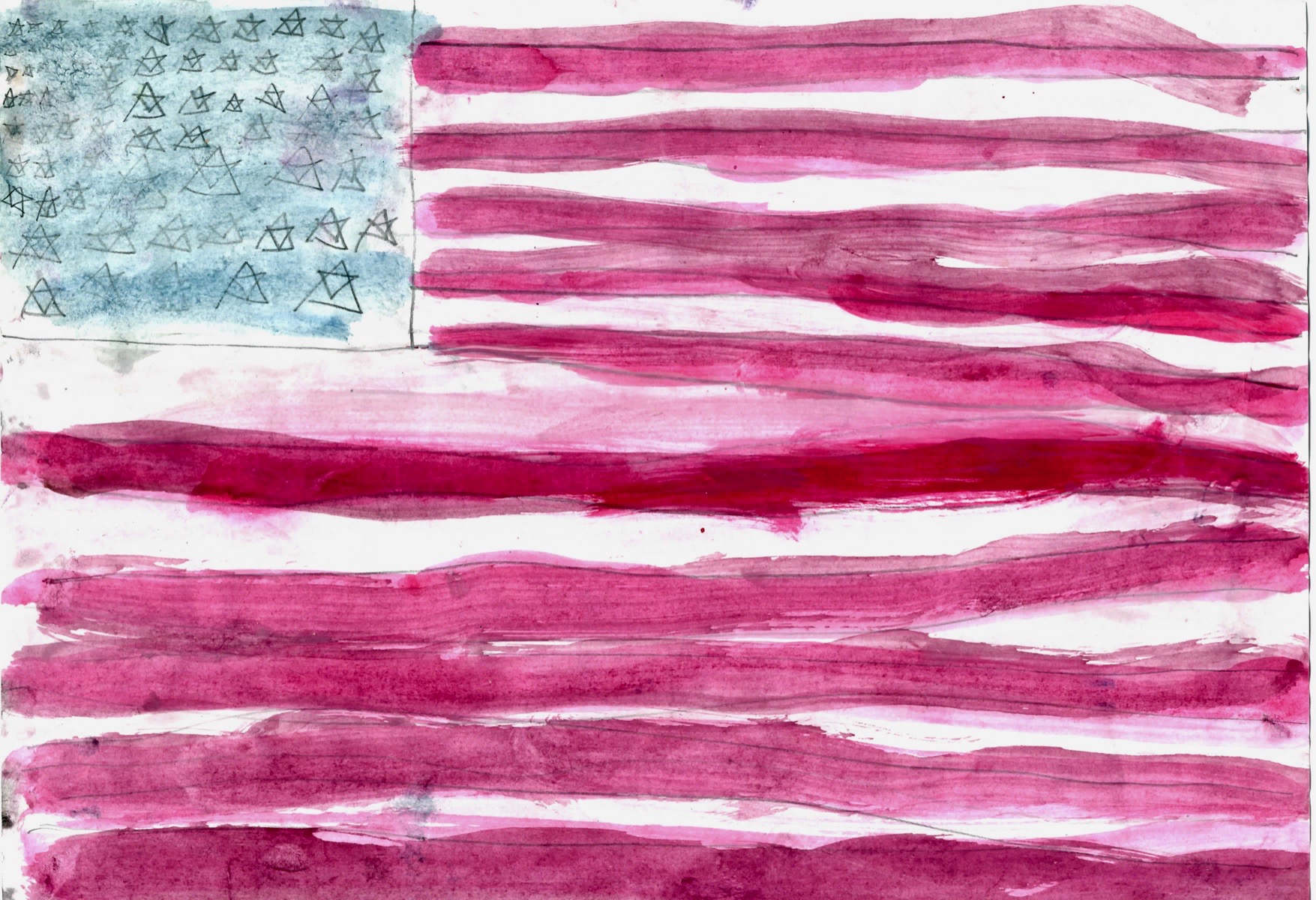
By CutiePyeGirl from a few years ago – perfect for Watercolor Wednesday!
Happy Independence Day! The day has a multitude of meanings for me, not least as the day I felt called away from my county of birth, as I wrote in Finding Myself in Britain:
When Nicholas and I contemplated marriage, we each went on a quiet retreat to pray and seek God’s guidance about the potential union. I finished my time away on the Fourth of July, later joining the throngs celebrating Independence Day with fireworks, food, and friends on the Mall in Washington, DC. But that morning I was in rural Maryland, reading about Abraham, the stranger who lived in a foreign country. The text of Hebrews 11 came alive in an amazing yet disconcerting way, for I felt that I, too, was being called to a new land.
As Nicholas was studying to be a Church of England vicar, I knew that in melding our lives together, I would need to be the one to leave behind my life in the States. But until that retreat, I hadn’t considered the deeper implications of what such a move might entail. I hadn’t noticed before that Abraham was obedient in going to this new place: “By faith Abraham, when called to go to a place he would later receive as his inheritance, obeyed and went, even though he did not know where he was going” (Hebrews 11:8). In the flush of the first stages of romantic love, it didn’t seem a hardship to be obedient to a move to a foreign land – especially such an exciting and olde worlde place dripping with history as Britain. I was blissfully unaware of the costs involved, and that my obedience would need to come later in accepting, with grace and without bitterness or complaining, what I had signed up to.
Like Abraham, I didn’t know where we were going; Cambridge was the first stop, but that would be for only a short time while Nicholas finished up his studies before ordination. I didn’t know then that I would be moving four times in five years, and thus would be a wanderer like Abraham. This moving brought upheavals and uprootedness, but over time God answered my pleas for belonging, a few friends, and even a fabulous job.
But on that Independence Day what struck me deeply was that I was leaving my earthly citizenship behind – instead I’d be a foreigner and stranger and would need to claim my heavenly citizenship. Like the heroes of faith listed in Hebrews 11, I would be looking for a country of my own; a “better one – a heavenly one.” I would have my American passport, and eventually a British one too, but my heavenly passport would denote my defining identity.
From Finding Myself in Britain (Authentic Media, 2015). Available in the UK from Christian bookshops, or online from Eden and Amazon. Available Stateside from Amazon.
The interview of Prince Harry and Meghan Markle after they got engaged captured me, the memories flooding back of my engagement to my own English prince (using that term loosely). We too recounted our love story, clasping our hands and sharing with smiles the thrill of how we met, eager to share the details that were crystalized in our minds. In those early heady days, me moving to England felt like an adventure of grand proportions – especially because of the safety net my fiancé and I constructed of us planning to live in England some five to seven years and then heading over the Atlantic. Two decades later, however, we’re still here!
Our experiences haven’t been all spring sunshine and roses, for at times the rain has soaked us and the whipping wind has chilled us….
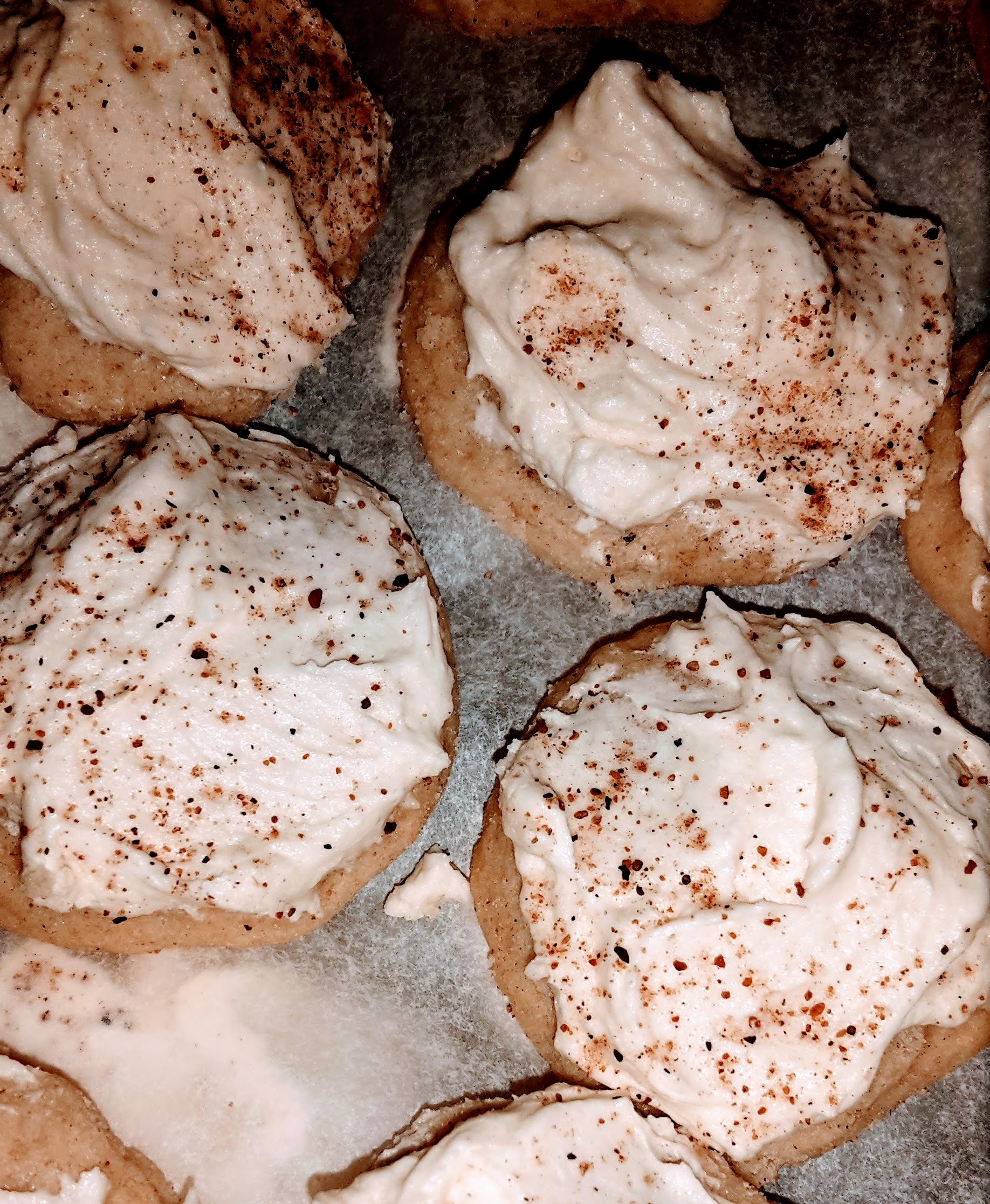
Today I’m pleased to take part in the Eden.co.uk Advent blog series. Click on over to find the recipe for these beauties – the Pye Family Favourite Christmas cookie, and hear how we balance preparing for the birth of Christ with practical preparations.
In honor of Thanksgiving, here is an excerpt from Finding Myself in Britain with a look at some of the history behind the holiday. For us in England today, it’s just another normal day as unusually we aren’t attending the service at St. Paul’s Cathedral today – the kids have missed too much school lately. Happy turkey day, everyone! I hope it’s a day of giving thanks, wherever you are.
For a long time I didn’t realize that the British celebration of Harvest underpins the American celebration of Thanksgiving. The Pilgrim fathers and mothers observed days of fasting and days of feasting, one of the latter at Harvest, through which the modern Thanksgiving holiday was born.
Devout in their faith, the Pilgrims left England in 1608 for Amsterdam in search of religious freedom. They lived there twelve years before the foreign culture wore them down and they decided to head for the New World. Their journey on the Mayflower, however, was desperate. The ship they travelled on was designed to carry cargo, not passengers. And the cabin where they slept was intended for thirty people, not eighty. Their food rotted and became infested with insects; they nearly drowned when the ship’s main beam cracked; they endured ridicule from the sailors. They pressed on through their five-month journey across the Atlantic – though admittedly they didn’t have much choice. New World or bust.
When they arrived in what is now Massachusetts, the Pilgrims faced a new set of challenges: a new land called for the planting of food and the building of places to live. But in all things they gave thanks, observing a full day of Sabbath each week. After surviving their first harsh winter, they hosted a three-day feast that we now name as the first Thanksgiving. During this celebration, they gave thanks for their food, for seven houses built, for a peace treaty with the Native Americans, and most importantly for the freedom to worship God. The women cooked, the men played games, and they all shared stories and returned thanks to the Lord. Sound familiar? The women cook and the men watch football. They invited the Native Americans who helped them acclimatize to this strange new world to join them at their table.
This is the account I’ve always heard, but lately some contest it. I’ve learned that we base this vaunted holiday on what might be a lot of lore, for we only have a 115-word account from that first Thanksgiving. The pilgrim Edward Winslow wrote a letter to England after the feast, including this brief description (and note the “u” in labours hadn’t got lost yet):
Our Harvest being gotten in, our Governor sent four men on fowling; that so we might, after a more special manner, rejoice together, after we had gathered the fruit of our labours. They four, in one day, killed as much fowl as, with a little help besides, served the Company almost a week. At which time, amongst other recreations, we exercised our Arms; many of the Indians coming amongst us. And amongst the rest, their greatest King, Massasoyt, with some ninety men; whom, for three days, we entertained and feasted. And they went out, and killed five deer: which they brought to the Plantation; and bestowed on our Governor, and upon the Captain, and others.
Slim historical evidence notwithstanding, the tradition grew, if not every year at first. And probably turkey wasn’t the centrepiece during that first celebration, but goose or duck. Later during the Revolutionary War, George Washington and his army stopped on their way to Valley Forge in bitter weather to mark the occasion. The practice then became solidified when in 1863 President Abraham Lincoln declared that the last Thursday in November would be a national day of Thanksgiving. Then in 1941 a joint resolution of both houses of Congress decreed, and President Franklin Delano Roosevelt signed into law, the bill establishing that the fourth Thursday of November shall now and always be Thanksgiving.
From Finding Myself in Britain (Authentic Media, 2015). Reprinted with permission. You can buy copies from good bookshops, Eden.co.uk (where it’s 25% off) and Amazon.co.uk and Amazon.com. (In the States it’s only available from Amazon.)
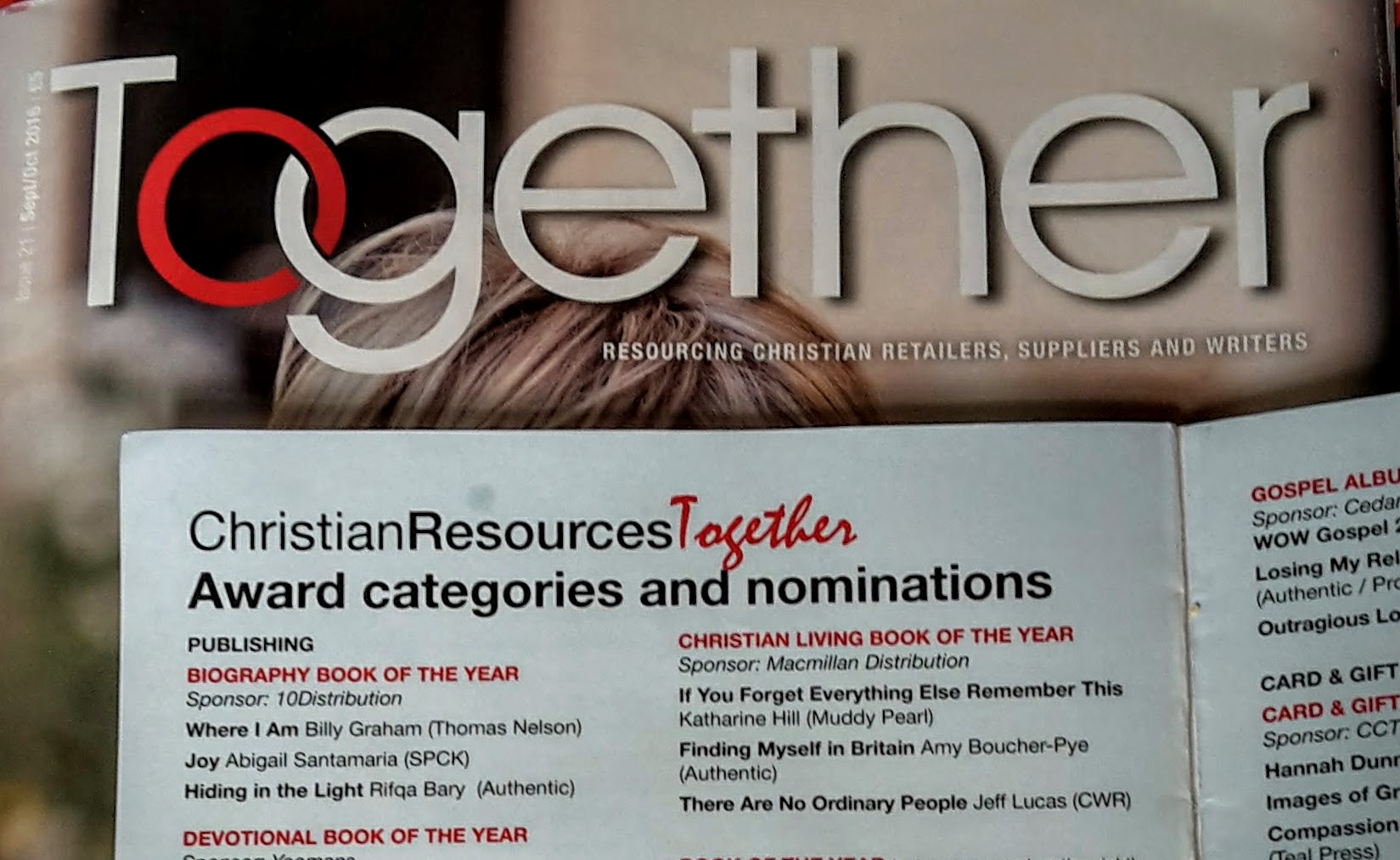
Last week I sat in a darkened room, heart pounding. The setting was familiar, for I had attended the Christian Resources Together gathering many a year previously in an editorial capacity, sometimes thrilled when “my” authors would win awards in the various categories, and sometimes gutted when they were passed over. Last week, however, I wasn’t an editor but an author. And my Finding Myself in Britain: Our Search for Faith, Home & True Identity was up for the Christian living book of the year.
Alexandra McDonald from Macmillan Distribution presented the award, and as she announced the three shortlisted books I feared those next to me could hear my heart beating. “And the nominees are… There Are no Ordinary People by Jeff Lucas, published by CWR,” she said, and I thought, Jeff, Jeff, he’s an amazing, fantastic author and speaker. I will smile when they call his name. She continued, “Finding Myself in Britain by Amy Boucher Pye, published by Authentic Media, which you received last year.” Oh, I thought, she remembered how each participant found a book in their room! She continued, “And Katharine Hill, If You Forget Everything Else Remember This, published by Muddy Pearl.” Ah, I thought, another strong contender – Katharine’s work with Care for the Family is so important, and Muddy Pearl is a great little publisher.
And the winner is…
As we waited, both Rachael Franklin next to me from Authentic and I noticed that Alexandra looked like she was mouthing, “Finding…” I thought in the split second, Could it be? Could my book really have won? Oh Lord I can hardly believe it…
“Finding Myself in Britain by Amy Boucher Pye, published by Authentic Media!”
Donna Harris, who runs Authentic Media, grabbed my hand and up we went to receive the award. She said a few words, and I tried to garble out my thanks. With so much adrenaline pumping, and the lights so bright, I was not terribly articulate – I have empathy for Gwyneth!
With Donna Harris, I am here amazed and stunned and grateful.
What I wanted to share was how Steve Mitchell and the folks at Authentic Media were the only ones willing to take me on as an author. I had a fantastic US agent who had shopped around an idea for my first book to 16 publishers – but 15 said no. And Steve and the team said yes, and thankfully he and I soon said “goodbye” to my original proposal. With his many years of retailing experience, he advised me to write a through-the-year account of life in Britain as an American. A sort of Michele Guinness-meets-Bill Bryson. My marching orders complete, I set about writing it.
Most of the Authentic team, current and previous.
The writing and rewriting wasn’t all smooth sailing. I would draft a chapter and send it to Steve (by the way, not an editorial practice I necessarily recommend because of flow and voice, but with our tight timeframe and the trust we’d built previously it worked for us). He read them and give me loads of feedback, such as, “Hey, I feel like you’re trying to import Minnesota to England. I know you miss it, but…”
When he and I finished going through the chapters, I sent it to about ten beta reviewers, three of whom were writers/editors. I’ve written elsewhere about my hide-under-my-duvet response after the first thirteen-page response! But my reviewers were so right in their comments, and I was thrilled that one of the reviewers became my editor, Jennie Pollock. She helped me sift through not only the editorial feedback, but she pushed me to find my voice and go deeper. That she’s a lovely Englishwoman who spent several years in the States only added to the experience.
And then to the design and cover art and copyedit (with a few tears by me over British style – yep, really) and boom, it was time to think about marketing and sales. With the market changing so much and the UK losing probably 150 Christian bookshops over the past five years or so, the author can’t expect the publisher to be their only means of spreading the word about books. I had a wonderful marketing team headed up by Kate Beaton. My publisher was so fantastic with the campaign, not only, for instance, providing point-of-sale materials to bookshops but creating bookmarks and laminated recipe cards as well as giving me a huge sign for the book for my speaking engagements.
For a real joy over the last year was getting to speak at events at bookshops; I loved meeting people around the country and hearing a few of their stories. Ali Caesar at Quench in Wokingham hosted the first launch, with the next-door coffee shop, The Grange, filled with people chortling over the US/UK quiz she arranged. I was so grateful to go to Streatham and Marlborough and Hove and up to Glasgow on these jaunts.
With one of the best reps in the business, Lawrie Stenhouse.
It’s been an amazing journey and as I look back over the past year my heart fills with gratitude to God and to all those who have helped with the publishing and distribution and the getting-the-books-into-people’s-hands. And of course to those of you who have read it! I love how readers become friends as we share in finding ourselves wherever God has placed us.
I love hearing from readers of Finding Myself in Britain; it’s a privilege and a joy to hear the stories they share. Such as Karen Morton, who got in touch with me recently. She embraced a new adventure at 70, marrying an Englishman and moving to the Lake District! I loved hearing of her art project to engage with people in her village – just brilliant how she has used her creativity and artistic gifts to give back to the community, and make new friends. She opened her email to me saying, “I feel like I have a new friend!” I feel the same, as I introduce her to you. Don’t miss her amazing portraits, toward the bottom of the interview.
This is me with my husband, fellow artist, Lou Morton.
I came to live in England three years ago – a new love and a new life – at the age of 70! It’s never too late to start over! I met my husband, a fellow artist, when I was here on a painting trip in 2011. I would never have imagined that I would have a whole new country just a few years later.
I had the experience of saying good-bye to my house and property in the Colorado mountains and walking away from most of my “stuff”, chanting all the while, “It’s just stuff… it’s just stuff… it’s just stuff.” I already lived a distance from my two daughters and grandchildren so things are not that different. They love visiting me here. Now I feel like a four-year-old with my nose pressed against the window, delighting in every new thing I see.
Playing my dulcimer at the local pub with other local musicians:
I’ve had so many surprises here, such as it stays green! Having grown up in Michigan and spent the last 30 years in the mountains of Colorado where there was snow on the ground 9 months of the year, I was delighted to find that it rarely snows here. Furthermore, the grass stays green even in winter, making the rolling hills of the Lake District where I live now very beautiful all year, even with grey skies. I’ve even learned to love the many colors of grey that contrast so nicely with the green. I’m also surprised at how long it stays light in the summertime, and how dark the winter is – never having realized how far north these islands are.
Another surprise was how warmly I’m received as an American. As soon as I open my mouth it’s obvious, of course! For the first time in my life, I have an accent! But whether it’s someone I meet in a shop or people I meet in the village, their eyes seem to light up when they learn my nationality.
I play the hammered dulcimer and was surprised to discover many opportunities to play it, joining in with local musicians. I’m learning lots of new songs – the English, Scottish and Irish folk songs sound particularly good on this instrument.
Maybe it’s my age, but learning to drive on the left (as opposed to “wrong”) side of the road has been a challenge to me. I was dismayed to learn that I had to take both a written and a practical driving test to get a British driver’s license. (My American license was good for only one year after becoming a resident.) I took some lessons from a very brave driving instructor in the village. At first I had a hard time figuring out where the left side of the car was and kept running up on the curb or cutting corners! Learning to shift with my left hand was a challenge too. The roads are so narrow and instead of a nice shoulder, you have stone walls or hedges inches away from your left-hand mirror. But I’m quite at home behind the wheel now.
Being interested in linguistics, I have kept an on-going lexicon of words and phrases that are different – 17 pages long so far. When I first arrived I told my husband I was going on a walk to explore the village. He said, “Fine, but make sure you stay on the pavement.” Why, I wondered, not knowing that is what they call sidewalks. I thought he wanted me to walk down the middle of the streets!
People kept asking me if I was alright. Even people I didn’t know, like shop keepers. Did I look faint or ill? Then I figured out it was just their way of saying, “How ya doing?”
There are some very funny expressions too, like “She’s all fur coat and no knickers!”
I nearly drove off the road when at a construction area there was a large sign saying, “Cats’ eyes removed.” Why would anyone do that?! Found out that is what they call lane reflectors.
People’s eyes widened in surprise when I said that the uniform of many old men where I came from was a cowboy hat, jeans and suspenders. “Suspenders” are what they call garter belts here! Quite a funny image, actually!
Last year, in an effort to get to know people in my village here in the Lake District, I gave myself the goal of painting one hundred 12 X 12 inches oil paint portraits of neighbors. The response was delightful. I ended up with 123 such portraits. Each person agreed to sit for me for 2 hours. I was convinced to turn it into a book with a brief write-up about each person. I had an exhibition of all 123 paintings in the village hall the day after Boxing Day and people could then take their portraits home. Now I’m working on a sequel: “100 Dogs of Holme”. What fun! People love talking about their dogs.
Here I am doing a portrait demo for the children at the local primary school as part of my “Faces of Holme” book. This is the head teacher, Angela Anderson.This is my portrait of our vicar, Graham Burrows.Some of the accumulated portraits on the wall of my studio.
I’m interviewing each dog for the parallel book to the one I wrote of the people in the village, with a little write-up about the dog to go with each portrait. Their responses have been hilarious. Dogs seem to bring out humor in people as they view their lives from the point of view of their dogs. Some of my questions are: “What is your heritage and how did you come to live with this pack? What is your occupation? What is the worst trouble you have been in? Do you know any tricks? What do your people not know about you? What is your advice to young pups?”
The question about the worst trouble they’ve been in has the funniest answers. A large golden retriever managed to get himself totally inside of a dead sheep while his elderly owners had him out on a beach walk far from home. Then there is the standard poodle who ate a £20 note! It was the daughter’s first pay from her first job so it was important to them. They waited 2 days and out it came! They put on rubber gloves, washed it off and sent it away and got a new note! The dogs’ occupations have included, among others, director of security for a garage, lady-in-waiting, children’s entertainer, interior decorator, therapist, building supervisor, personal trainer, ball player, gardener’s helper and psychiatric nurse!
This is the guy who got inside the dead sheep!
I have found that the church is the warm, beating heart of the village. Whenever I “put myself in God’s way” there I feel a peacefulness and serenity that helps me know I made the right decision in changing my life to live here. Unfamiliar hymns and slight differences in familiar prayers make me stop and pay attention and thoughtfully prepared sermons allow me to really reflect on the messages. The warmth of friendship I feel there is comforting as well.
I would tell people making a major change like this to try to stop looking over their shoulders to think about what they left behind. Instead, live in the present and try to see the world with new eyes. And start writing your book right now!
I love Independence Day, although I haven’t celebrated one in the States for many years now. And certainly my children (who are in school today) have never had that opportunity to experience the parades, sparklers, picnics, and amazing fireworks. It’s a wonderful community holiday that brings people together.
We are celebrating today though! Having fruit pizza and a BBQ, and actually watching Andy Murray hopefully going through the next round at Wimbledon. I’ve also had the pleasure of writing a blog for Eden.co.uk, a wonderful online retailer who is selling my book at 25% off just now. You can read more about the significance of this holiday in the life of me and Nicholas. We both were led to the story of Abraham, with me sensing the call to be a foreigner in a strange land (as in Hebrews 11:8).
The gorgeous Anna working magic with all the radio controls. Loved being on Premier Christian Radio this morning.
I also got to be interviewed on Premier Christian Radio’s Woman to Woman show, which is a favorite show of mine. Maria Rodrigues was away today, so Anna Cookson interviewed me – you can here our fun and fabulous conversation here, with my segment starting at 40.35. And yes, we somehow managed to talk about tea, along with hamburgers and hot dogs and fireworks.On air I promised the recipe to fruit pizza! It’s very easy and tasty too. One from the Fourth of July summertime BBQ meal I included in Finding Myself in Britain.
Fruit Pizza
Serves 8
1 sheet puff pastry
1–2 280 g tubs cream (soft) cheese
2 tablespoons runny honey
Fruit to decorate
Bake the puff pastry according to the directions (I always make the pizza in a rectangular shape). When it cools, stir together the cream cheese and honey, experimenting with how much you prefer of each. You can also add powdered (icing) sugar if you’d like it sweeter, but I never do. Top the puff pastry with the cheese/honey mixture, and add sliced fruits to decorate. You won’t be surprised to learn that on the Fourth of July I make an American flag using strawberries and blueberries. Add some kiwis, cherries, raspberries – use your imagination and get creative.
This morning we find ourselves in Britain after an historic vote. You can probably guess which way I voted! Whatever our views, God remains with us. He’ll never leave.
I share a drawing by my daughter, sent to me this morning by her teacher, on what it means to be British. He says he has no idea where her inspiration comes from! The boy is wearing England football kit and sings the national anthem, and the sandwiches include black pudding. I don’t think she has anything to represent Wales or Northern Ireland though.
May we be united. May we be marked by love. May we remember that God will never leave us.
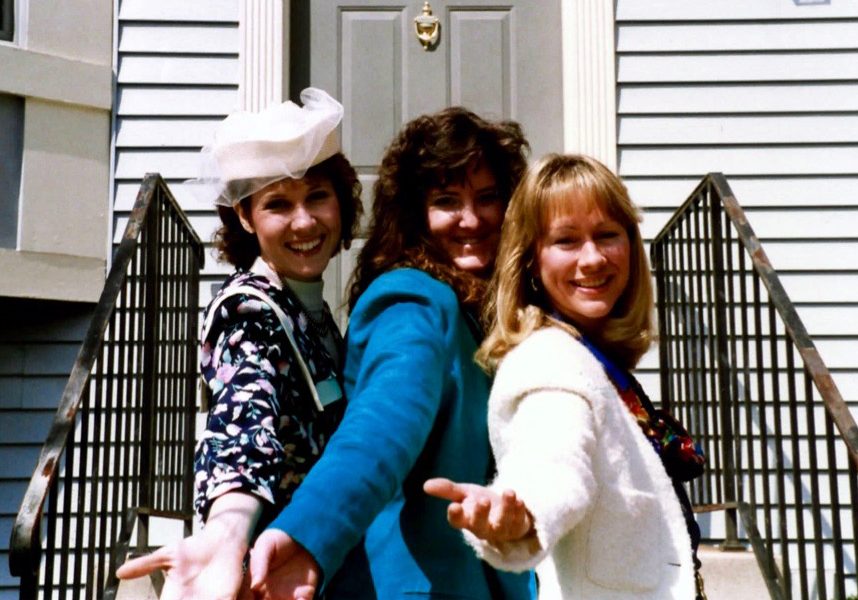
Me in the middle in 1991 with big hair, and with the special women with whom I lived.
Twenty-five years ago – what were you doing? I was in my twenties and living in Virginia with two wonderful women as I faced a turning point in my life, although I didn’t know it at the time. Having just broken off an engagement to be married, I felt the shattering of my hopes for marriage and a family.
The pain of the broken dreams opened up a bigger question: Who am I? Why was I trying to find my identity in things outside of God, such as romantic relationships, my work, friendships, or even my involvement in church? The question propelled me on an adventure with God as I started to hear the still, small voice of the Lord and the words of the Bible came alive. God the Trinity was awakening me through his word; the Word in me was coming alive.
Those were amazing years of growth as each morning I was eager to awaken early to read the Bible and pray. I was taking the Scriptures and eating them, as in Jeremiah 15:16. And the words – the Word – tasted sweet, as sweet as honey. The words were my food and sustenance; the power of the Word to sustain me.
Those years provided a necessary foundation to my life with God, but of course the story doesn’t end there. The Word continues to work in my life, as I found myself in Britain.
In 1991, I never would have dreamed that I’d make a home in Britain. That’d I’d be a vicar’s wife – I probably didn’t even know what a vicar was! Or that my two amazing children would speak with English accents and a regular part of my day would involve beseeching them not to drop their t’s. That I’d learn about cricket and what the majority of people in the world call football. And how to make a proper cup of tea.
In 1991, I was working for the deep thinker and also deeply humorous man, Os Guinness. Later when I was engaged to Nicholas, Os warned me that in my move to England the little things might all add up to a big thing – such as with language and words. And he was right. At first I would flail around in my conversations, knowing that it wasn’t a “parking lot” but not remembering that it’s a “car park,” or not knowing what nappies were. For a person who worked with words, I was humbled to feel misunderstood and to misunderstand.
But God the Word was with me through Jesus dwelling within and the Holy Spirit’s gentle comfort, and I got through those early days of feeling numb and silenced. What were challenges, such as not communicating easily, became the means of relying more intensely on God. As he met me, my faith grew.
I started to understand a theme of the kingdom of God – that in losing ourselves, we find ourselves. Just as I’ve found myself in Britain. And I mean that in both senses of the word – finding myself here geographically and also finding who I am in terms of my identity in Christ.
For here I’ve found myself as a citizen of heaven and a citizen of the world. I’ve deepened in my vocation as a writer and editor – one who loves words and the Word and who shares them with others.
Life with God is an adventure. His Word in us calms us, showers us with love, and calls forth in us our buried dreams. May we share his words with those whom we meet.
In closing, some questions to ponder.
Are you willing to lose your life to find it?
When in your life did times of sacrifice bring great gifts and growth?
How have the power of words – those written, those spoken, and ultimately the Word – shaped your life and your faith?
This is part of a talk I gave at the 25th anniversary celebrations for the Books Alive bookshop in Hove on 17 June. The theme of losing yourself to find it is a major one in my book Finding Myself in Britain: Our Search for Faith, Home & True Identity, which you can find here.
June. I find this time of year poignant, for sometimes the ache of separation from loved ones in the States feels exacerbated in the summer. My social-media feeds burst with photos of graduations, picnics, and the last days of school. And sunshine.
The contrast can seem strong, for my kids have another six weeks of school so there’s no counting down the days for them. And although I probably now ascribe to an all-year view of education in terms of continuity and learning, I also remember the long summers I enjoyed in Minnesota. So long that I even had the opportunity to get bored. Something that my kids, as we cram in family holidays and a trip to Minnesota with Christian camps, have hardly the chance to do.
But if I was in America now, no doubt I would have a long list of things I missed from June in the UK, such as long evenings, Wimbledon on the BBC (no adverts!), perfect Pimms, weather that can change from sunshine to rain to sunshine to rain again (as it has today), and never being overheated.
And I’m reminded again of how through giving thanks, our outlook can change. The above quotation actually comes from the chapter in Finding Myself in Britain on Harvest and Thanksgiving, but it can easily apply to the good ole summertime as well. For as I made my list of just a few things to give thanks for here on this island, my mood lifted and I look forward in hope.
What do you most like about June? What would you miss if you lived in a different country?

 Today I’m pleased to take part in the Eden.co.uk Advent blog series.
 From Finding Myself in Britain (Authentic Media, 2015). Reprinted with permission. You can buy copies from good bookshops,
  Last week I sat in a darkened room, heart pounding. The setting was familiar, for I had attended the Christian Resources Together gathering many a year previously in an editorial capacity, sometimes thrilled when “my” authors would win awards in the various categories, and sometimes gutted when they were passed over. Last week, however, I wasn’t an editor but an author. And my Finding Myself in Britain: Our Search for Faith, Home & True Identity was up for the Christian living book of the year.

 And then to the design and cover art and copyedit (with a few tears by me over British style – yep, really) and boom, it was time to think about marketing and sales. With the market changing so much and the UK losing probably 150 Christian bookshops over the past five years or so, the author can’t expect the publisher to be their only means of spreading the word about books. I had a wonderful marketing team headed up by Kate Beaton. My publisher was so fantastic with the campaign, not only, for instance, providing point-of-sale materials to bookshops but creating bookmarks and laminated recipe cards as well as giving me a huge sign for the book for my speaking engagements.
 It’s been an amazing journey and as I look back over the past year my heart fills with gratitude to God and to all those who have helped with the publishing and distribution and the getting-the-books-into-people’s-hands. And of course to those of you who have read it! I love how readers become friends as we share in finding ourselves wherever God has placed us.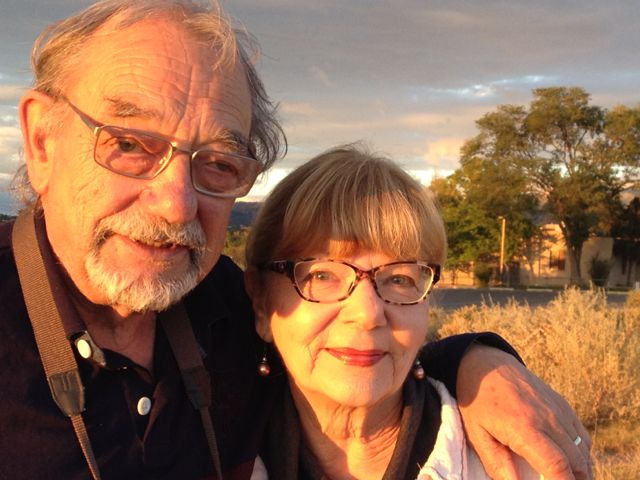


 Those years provided a necessary foundation to my life with God, but of course the story doesn’t end there. The Word continues to work in my life, as I found myself in Britain.
 I started to understand a theme of the kingdom of God – that in losing ourselves, we find ourselves. Just as I’ve found myself in Britain. And I mean that in both senses of the word – finding myself here geographically and also finding who I am in terms of my identity in Christ.