Happy new year! The prayer of examen is simply looking back to move forward with God. You might want to take some time this month to consider a few questions as we launch into the new year. I found these somewhere last year and engaged with them – I’m sorry that I didn’t note where that was!
Three questions to consider: 1. What have the storms of 2022 picked up and blown away for you? 2. How has 2022 anchored you more firmly? 3. What fresh roots have you discovered in the noise of this past season?
I’ve got such a treat for you with Alison’s wonderful ponderings about prayer and life and shifting an outlook through a simple practice. I’ve written about the way of praying that is the examen, but Alison’s pared-down approach is one that I could incorporate into my life. Her vivid descriptions will capture your imagination; enjoy!
Sitting down to pray has always been a struggle for me, the world full of so many distractions, but what I longed for was a deepening faith, to be able to be still with God and increase my ability to love one another, (especially the ones I don’t even like!). I knew it was only prayer that could help me, so I spent many years searching out a way for me to pray that might open and grow my heart.
For me prayer has become my opportunity to actively participate in the universe by communicating with God. I notice something and as a continual action pass it over to God, whom I trust will bear witness and hold whatever it is I’ve past on in prayer. Perhaps I’ve noticed that the sky looks unbelievably beautiful this morning and how it gives the perfect backdrop for the starlings with their synchronised swooping and diving of the autumnal murmuration. Or I notice a lady in a green scarf who limps in the supermarket queue and looks like she’s having a difficult day, though I truly have no idea. Or maybe I’m just wowed by the welcome I receive when I went attend to a new church. Small things, things that might seem inconsequential in the scale of the whole of the universe, a beautiful smile, a voice choked with tears, a friend’s snazzy new jumper, but everything, everything matters.
I’ve noticed that the more I take notice of the world around me, the more aware I am of what I am blind to. My biases and prejudices; my lack of knowledge and understanding of so much that limits my world view. And whilst this way of praying has illuminated my own inability to grasp and understand so much, paradoxically I feel myself actively being drawn deeper in my relationship to God and the universe. For me, praying this way feels like it’s embedded in my being and part of who I am; no longer is it just a twice daily activity.
It all started with the Examen; I say Examen, but with a simplistic adaption. At the time my life was already complicated, and I wanted – needed – to be able to commit to a method of pray that I could stick with. I discovered that early morning worked for me to sit alone with a lit candle, in a space where I could reflect on my previous day. I used three headings to guide my self-reflection:
Consolation; what was wonderful,
Desolation, what wasn’t wonderful,
What else I noticed.
For each heading I would write without hesitation the mundane, the wow, the bitter.
At the time life was particularly bitter and I really needed to hold onto God as a source of strength. I’d write in a journal, splurging out across the pages what I found to be mundane, wow or the disappointments of my previous day. I noticed how easily I found it to repeatedly rant on about the same old ‘stuff.’ And I began to see things that I take for granted: a loving supportive family, the therapeutic nature of sharing laughter, the astonishing emerald colour of the grass this morning scattered with blobs of shimmering diamond drops of dew. Lately I often find myself being irreverent to the questions; my pencil easily and eagerly covers several pages in a very short time.
Praying this way in all humility feels like I’m emptying myself out before God. The action of prayer seems to unearth hints and whispers of my true self. The bad crazy bits and so much else that I’d much rather edit out all get included in my prayers. And I’ve noticed that the more I pray this way, my self-acceptance of both my limitations and my gifts grows. There may yet be simmerings of peace.
As a way of praying, I’ve found it’s highly addictive!
Alison Robertsis a wife, mum, grandmother, priest, spiritual director, dog owner and general lover of wild colour, people and places, who especially loves swimming in the sea in North Devon.
Order 7 Ways to Pray here for more ways to encounter God.Sign up for Amy’s monthly newsletter, including a prayer practice.
I first met Jeff Crosby in Singapore at LittWorld, a wonderful gathering for writers, publishers, and graphic designers from around the world. As we shared a jetlagged breakfast together, I soon realized here was a thoughtful and articulate person – a quiet leader with gravitas. I love how he shares how what he once saw as a stumbling block in his life has become a pathway to God. Please take a few moments to read and ponder his words:
I have always marveled at people for whom eloquent and impassioned prayer rolls off the tip of the tongue and out of their hearts with great ease and authenticity. Spontaneous. Joyful. Heart-felt. Genuine.
I’ve long wanted to be among those people.
Though I believe deeply in the importance and the efficacy of prayer, I have never been among that crowd. Instead, I am more often than not tongue-tied, like a singer on the stage who forgets the first lines of a song he’s known all his life and has to start all over again, cheeks blushing, heart chagrined.
But as I have grown older, I’ve accepted my tongue-tied prayer life, like my introverted temperament, as something of a gift and I’ve found life-giving pathways around it that have fostered intimacy with God, and helpful self-reflection.
In her book 7 Ways to Pray, the author Amy Boucher Pye writes instructively to people like me when she introduces the concept of the prayer of examen, originally formulated by St. Ignatius of Loyola (1491-1556), the founder of the Jesuit order. She has carried a specific practice of examen in her family (in her case, on vacations) , in which she, her husband and teenage children daily reflect on the joys and the irritations of their days away from home. “I realized recently that these highlights and lowlights can morph into prayer that helps me understand how I’m relating to God,” she writes. “As I pay attention in my life and look back, with his help, to name the things that brought me joy or frustrated me, I can understand how I’m moving toward or away from him.”
The practice of examen at the end of my days has been a gateway to prayer. In quiet on a walk through the natural world or sitting at my writer’s desk, I reflect on the consolations (what was life-giving) and the desolations (what was life-depleting) in the day I am drawing to a close, and out of that reflection I form a prayer of thanks for the presence of God in the midst of it all. I often carry prompting questions written by friends at the Fall Creek Abbey, Beth and David Booram, such as:
Where am I experiencing an emerging desire?
Where might I be carrying a misplaced expectation of God, others, life, or myself?
What in my life is giving me joy? What is giving me sorrow?
As I consider those prompting questions, I am invited to recognize, reflect, and respond in prayer to the God who loves me unconditionally.
The prayer of examen has been, for me, one of the life-giving avenues for a tongue-tied pray-er. And there are others.
Throughout the global health pandemic, I have prayed the Book of Psalms daily, guided by the devotional reflections of Dane Ortlund, a pastor and writer, through the book In the Lord I Take Refuge. If the examen helps me pay attention to what is stirring in my own soul and my sense of God’s presence (or absence), praying the Psalms helps me realize that there is nothing I am facing that has not been faced by those people of faith who have gone before me. Praying the Psalms “foster[s] communion with God amid all the ups and downs of daily life in this fallen world,” Ortlund writes.
I have found that to be true.
The prayer of examen and daily praying the Psalms have given this tongue-tied, praying believer sacred pathways to communion with God. And I am thankful.
Jeff Crosby is the president and CEO of ECPA, the trade association of Christian publishing in North America. He is the author of The Language of the Soul: Meeting God in the Longings of Our Hearts, to be published by Broadleaf Books in May of 2023.
Order 7 Ways to Prayhere for more ways to encounter God, including lots of resources for small groups.
How can we look back with God in order to move forwards? Penelope Swithinbank shares from her years of spiritual direction how she helped someone recalibrate her decision-making process as she discerned her movements towards and away from God through the prayer of examen. I love the hands-on nature of Penelope’s exploration of this prayer practice, which can enrich our lives.
Laura twisted her fingers and heaved a deep sigh.
‘I really don’t know what to do,’ she said. ‘I think my job’s about to be made redundant; my parents aren’t well and maybe I should move closer to them, but I love my job, my church and my home here. How do I know what God’s plans are for me? What if I step out of His plans?’
As her spiritual director/counsellor, I felt God nudging me to give Laura a challenge. I suggested to her that for the next month, four whole weeks, she should ask herself two questions last thing at night.
First, a question of consolation. ‘What am I thankful for today?’ ‘Where have I known true joy today?’ Or, ‘Where did I see God at work?’
And then a question of desolation. ‘Where did I fail God today?’ ‘Where was I not at peace today?’ ‘When or where was I not content, not filled with God’s Spirit?’
I suggested Laura jot down her answers to the questions, just briefly, so that in a month’s time she’d notice any patterns, anything important, anything that the Lord wanted to point out or suggest to her.
These two questions are the basis of the ‘Examen of Conscience,’ a centuries-old way of praying that helps us detect God’s Presence in our lives and discern where He is leading and guiding us. It was used by Ignatius of Loyola, (16th C) who recommended praying it daily – and then twice a day, so that people keep short accounts with God.
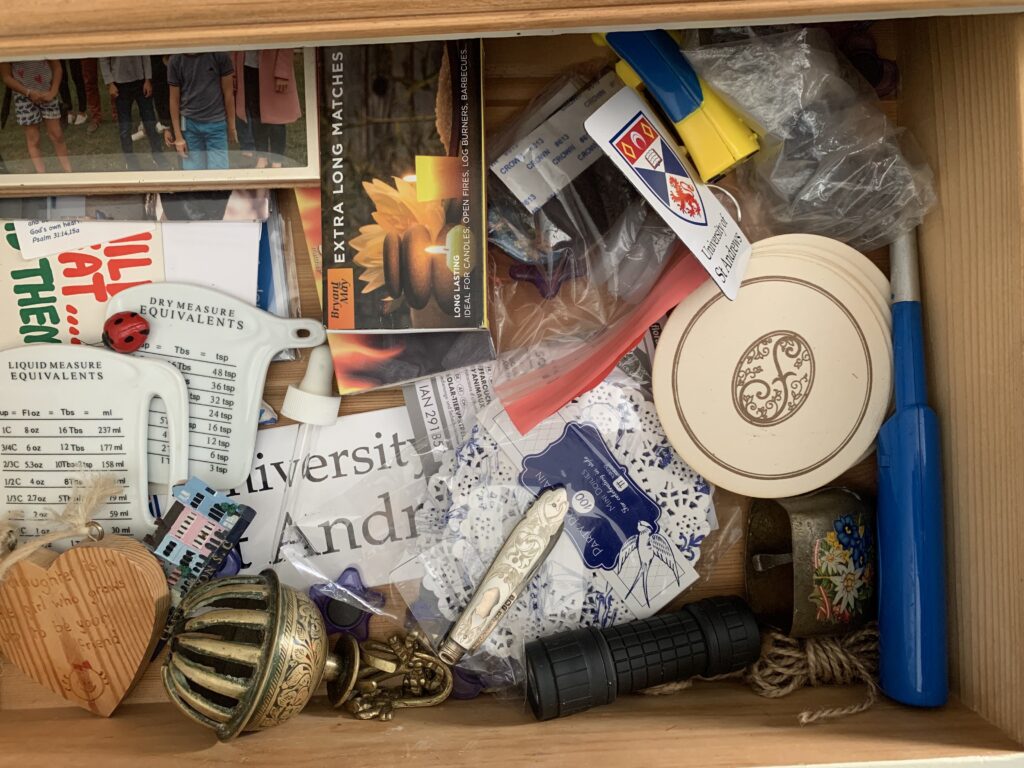
Dennis Hamm describes it as ‘rummaging for God’ and says it’s like ‘going through a drawer full of stuff, feeling around, looking for something that you are sure must be there.’
It’s a rummaging back through the day, knowing that God was there, and we want to discover and be reminded of just where and how He was with us. A prayerfully going backwards through your day, with God’s help, to discern what’s most important – the things of God.
We want to hear His voice today, not close our ears, (i) and the Examen is one way to help us to do that. While the traditional name is The Examen of Conscience, which sounds as though you’re just looking for moral failures, the word ‘conscience’ probably had a deeper meaning of ‘consciousness,’ of being alive and acknowledging it mindfully. And of being grateful for the many gifts and blessings of the past twenty-four hours. Who doesn’t like getting gifts – but how often do we give thanks for God’s gifts each day?
Laura agreed to the challenge – and was very excited to try it. She even bought a lovely new journal for her daily Examen night prayer. Not everyone writes down what happens during the Examen, but I wanted Laura specifically to look for patterns and rhythms as she talked with God. I suggested that she begin each time by inviting the Lord to come and be with her and speak to her; then to ask herself the two questions and talk with Him about her answers, and finally to invite the Lord into what might lie ahead for the following twenty-four hours. (ii)
A month later, a peaceful Laura reported back. Her earlier worried questions had receded, because she had discovered something far more important than the specific whats and wheres and hows.
‘God’s plan is for me to be more like Christ in my everyday life,’ she explained. ‘Where I live or what job I do is secondary. Important but secondary. And going to sleep having rummaged around and put it all to rest, and then invited God into the following day, has not only led to extraordinary peace but a much better night’s sleep! I’m going to be making some important decisions in the next few weeks but now they’re based on a relationship with God and not on my fears and worries. And that’s made a huge difference to my everyday life.’
(i) Come and kneel before this Creator-God, come and bow before the mighty God, our majestic maker! For we are those he cares for, and he is the God we worship. So drop everything else and listen to his voice! For this is what he’s saying: “Today, when I speak, don’t even think about turning a deaf ear to me” (Ps 95: 6-9, TPT)
(ii) The five steps of the traditional Examen.
Penelope Swithinbank is an experienced pilgrimage/retreat leader, conference speaker and Spiritual Counsellor. She has had an international ministry, including churches in America and the UK, and her most special memory is of opening the US Senate in prayer and being guest chaplain for a day. Penelope is an avid walker and spends a lot of her time stomping in the hills and valleys near her home outside Bath.
She is the author of three books, Women by Design and Walking Back to Happiness; her third, Scent of Water, a devotional for times of spiritual bewilderment and grief, has just been published. She is a wife, mother and grandmother and says of the 6 grandchildren that they are so wonderful she should have had them first. www.penelopeswithinbank.com
Order 7 Ways to Prayhere, including in the US, UK, and Australia. The seventh way to pray is the examen, so you can explore this life-giving prayer practice further. You’ll also find lots of resources for small groups – videos and a leader’s guide – here.