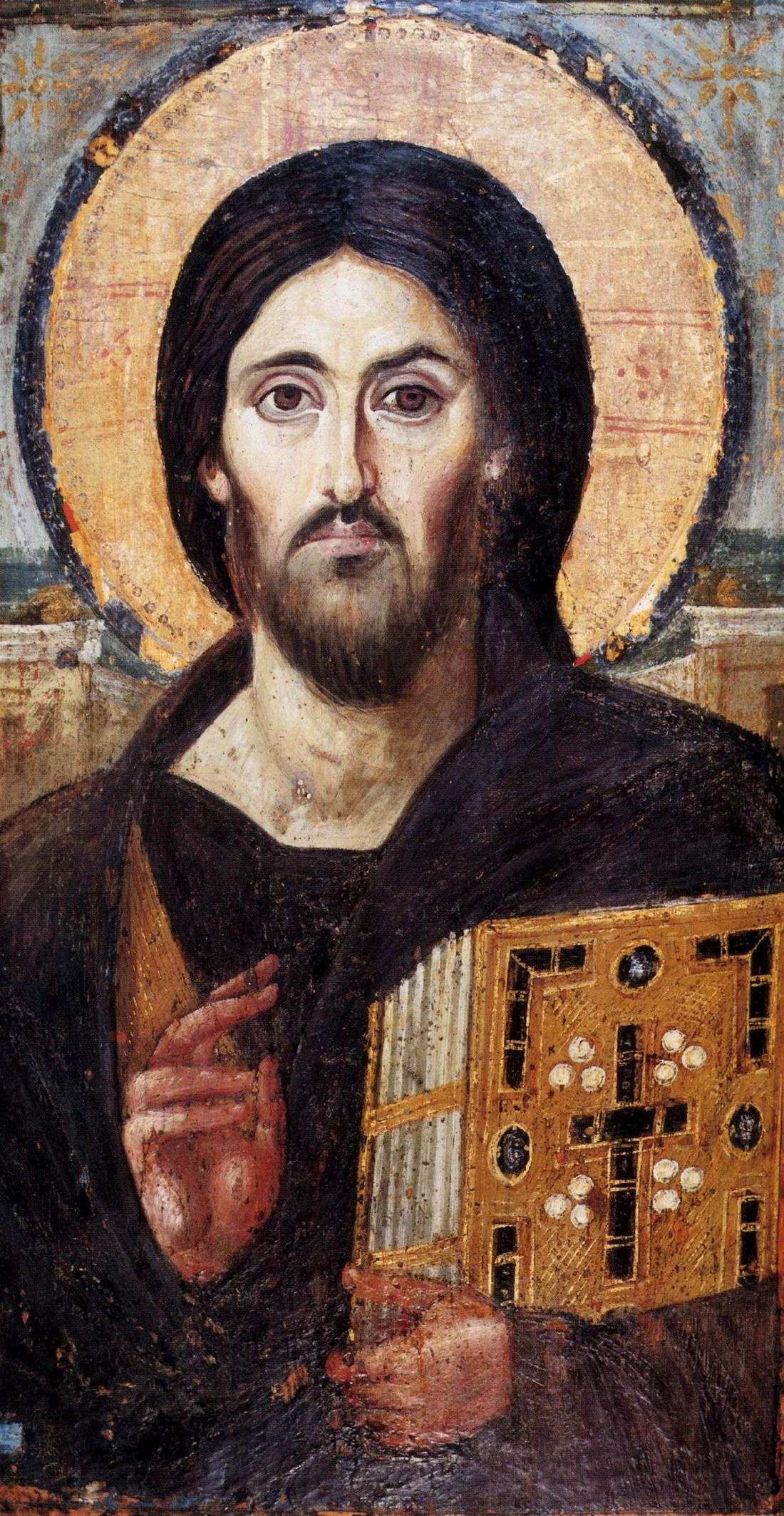
The oldest surviving panel icon of Christ Pantocrator, encaustic on panel, c. 6th century.
Although I hope to come to you soon, I am writing you these instructions so that, if I am delayed, you will know how people ought to conduct themselves in God’s household, which is the church of the living God, the pillar and foundation of the truth. Beyond all question, the mystery from which true godliness springs is great: He appeared in the flesh, was vindicated by the Spirit, was seen by angels, was preached among the nations, was believed on in the world, was taken up in glory (1 Timothy 3:14–16).
As Paul moves from his opening remarks to addressing the false teaching that had been abounding in the church at Ephesus, he doesn’t want to lose sight of Jesus. Theologians differ in their views over the form and structure of the hymn of praise in verse 16, but the content is clear – the second person of the Trinity shapes our faith and practice. We may not fully understand the mystery of God becoming man and returning to heaven, but we know that through his dwelling in us we can bear the fruit of goodness and godliness.
Take a moment to consider the words of the ancient song, such as Jesus appearing in the flesh. As the opening of John’s gospel puts it, “The Word became flesh and made his dwelling among us. We have seen his glory, the glory of the one and only Son, who came from the Father, full of grace and truth” (John 1:14). Our God through Jesus is fully acquainted with the feelings we experience, such as joy and grief.
The rest of the hymn also reflects his dual nature of God and man. For instance, as a man he has been preached amongst the nations and believed by millions around the world. In terms of him being God, angels have seen him and he was taken from earth into heaven.
How does Jesus being both divine and human affect you?
For reflection: “The true light that gives light to everyone was coming into the world… Yet to all who did receive him, to those who believed in his name, he gave the right to become children of God” (John 1:9, 12).
I urge, then, first of all, that petitions, prayers, intercession and thanksgiving be made for all people – for kings and all those in authority, that we may live peaceful and quiet lives in all godliness and holiness. This is good, and pleases God our Savior, who wants all people to be saved and to come to a knowledge of the truth. For there is one God and one mediator between God and mankind, the man Christ Jesus, who gave himself as a ransom for all people (1 Timothy 2:1–6).
In September 2015, Queen Elizabeth II surpassed Queen Victoria to be the longest reigning monarch of the United Kingdom. As an American who is now also her subject, I’ve harbored mixed feelings and views about the monarchy over the years. But I am humbled by the Queen, who has served her country tirelessly as part of her duty and calling. It’s an hono(u)r to pray for her and her reign.
We might feel jolted by Paul’s command to Timothy to pray for rulers and kings, coming so soon in this letter of instructions for Timothy. But Paul yearns that the gospel would be proclaimed and accepted, and he knows that a just and ordered society will better foster its message as one that people can hear and heed than when they dwell in a culture of corruption. Note too the various ways Paul wants the church to pray – through petition, prayer, intercession, and thanksgiving – for he knows that God hears our prayers.
We might find it difficult to pray for our rulers, especially if we find their policies differing from what we hold to. But prayer is something constructive that we can engage with, as we ask God to help shape our societies to be places where people can thrive in freedom and faith. Perhaps you could join with others from your neighborhood or church, once a month or once a term, to pray for your local and national leaders. We trust that God hears us, and responds.
Prayer: Lord God, you are the ultimate Ruler, just and fair. We give you thanks for those in authority over us, praying that they would embody values of wisdom, justice and mercy.
Even though I was once a blasphemer and a persecutor and a violent man, I was shown mercy because I acted in ignorance and unbelief. The grace of our Lord was poured out on me abundantly, along with the faith and love that are in Christ Jesus. Here is a trustworthy saying that deserves full acceptance: Christ Jesus came into the world to save sinners – of whom I am the worst. But for that very reason I was shown mercy so that in me, the worst of sinners, Christ Jesus might display his immense patience as an example for those who would believe in him and receive eternal life. Now to the King eternal, immortal, invisible, the only God, be honor and glory for ever and ever. Amen (1 Timothy 1:13–17).
The apostle Paul could have written the original “triumph over tragedy” story – the killer who was blinded by the light, transformed, and changed, and then sent to love the ones he had persecuted. Though his life was not one of smooth sailing, he never forgot who he had been, and who – and Whose – he now was. As he says to Timothy, he was once a violent slayer of God’s reputation. But now he was redeemed and renewed; one whom God promised eternal life because of his great mercy and love.
His reference about being the sinner-made-new shows the power of narrative and testimony, for as his life reflects, God can effect lasting change. He’s no longer a blasphemer or persecutor, but one filled with faith and love, and he cannot contain his worship for the God who saved him (v 17).
Whether our history reflects stories of betrayal and heartbreak or those of love and acceptance, we can join Paul in his song of praise for the One who deserves our honor and reverence.
For reflection: “But thanks be to God that, though you used to be slaves to sin, you have come to obey from your heart the pattern of teaching that has now claimed your allegiance. You have been set free from sin and have become slaves to righteousness” (Romans 6:17–18).
Painting by Blaffer Foundation Collection, Houston, TX, Public Domain
Time for a new devotional series! For the next few months, I will be sharing weekly thoughts based on 1 and 2 Timothy. We’ll explore how the Apostle Paul sometimes gets a bad rap as being misogynistic, harsh, and didactic. But perhaps he’s seen this way when people forget that we’re only reading half of the conversation, as Conrad Gempf points out in How to Like Paul Again. If we don’t consider the bigger picture, we might be confused as to why Paul would tell one church that they needed to tighten up (the Corinthians) whereas he tells another they should loosen up (the Galatians). When we delve more deeply into the clues in the letters and those in the book of Acts, we may grow to understand Paul’s heart and hopes not only for the gospel, but for the growth and flourishing of those in the early church.
In his letters to Timothy, Paul writes to a younger man whom he has mentored. In his first letter he knows that Timothy faces the effect of false teachers who are leading people astray. Such is the level of his concern that he uses strong language to encourage Timothy to root out the heresy and lead the people into the ways of truth and life. He instructs him about church life and how the leaders should live, and how they should treat the widows in their midst.
1 Timothy also contains a controversial passage where Paul forbids women to speak in church (2:11–15). I haven’t included it in our daily readings, partly because our space is limited – in contrast to the doctorate dissertations, articles, and books written on it. But I also don’t want to impose my view on you in your daily engagement with the Bible.
As we’ll see, Paul wrote his second letter to Timothy after his letter to Titus, when he was still concerned about the influence of false teachers. By the time of this final letter, that crisis seems to have passed, but Paul faces execution in Rome at the hands of Nero. His letter to the man he mentored, whom he now sees as an equal, contains his last words. He sums up the charge he leaves Timothy with as he embraces his final homecoming.
I pray our journey into these pastoral letters will enrich, challenge, and encourage you.
As I urged you when I went into Macedonia, stay there in Ephesus so that you may command certain people not to teach false doctrines any longer or to devote themselves to myths and endless genealogies. Such things promote controversial speculations rather than advancing God’s work – which is by faith. The goal of this command is love, which comes from a pure heart and a good conscience and a sincere faith. Some have departed from these and have turned to meaningless talk. They want to be teachers of the law, but they do not know what they are talking about or what they so confidently affirm (1 Timothy 1:3–7).
False doctrines, myths, and endless genealogies – the apostle Paul instructed Timothy to stay where he is so that he can speak against the teachers who, as Paul’s says clearly, don’t know what they’re talking about. Paul doesn’t mince his words when naming the truth about others spreading falsehoods, but neither is he overly concerned with rules for rules sake. What he’s most keen to stress is love, which he says is the goal of the life of faith.
I wonder what Paul would say to Christians today. Have we, on the one hand, become too worked up over naming false teaching? Or on the other, have we embraced myths and thus utter meaningless talk? Or do we land somewhere in between? No doubt we all veer one way or another at times, and therefore we need a dose not only of humility but of the indwelling of the Holy Spirit to keep us walking in step with God.
We can ask the Lord to make love our goal, helping us keep a pure heart, a good conscience, and a sincere faith. As he molds us, he may gently reveal the stances we grasp too strongly or the areas in our lives in which we need to tighten up. His correction is soaked in love, not condemnation, making it all the easier to welcome and receive.
Prayer: Purify my heart, Lord, and cleanse my conscience, that my works might bring you glory and spread your love.
…Clothe yourselves with compassion, kindness, humility, gentleness and patience. Bear with each other and forgive one another if any of you has a grievance against someone. Forgive as the Lord forgave you. And over all these virtues put on love, which binds them all together in perfect unity. (Colossians 3:1–17)
We come to the end of our exploration of the fruit of the Spirit, as we reach one of my favorite passages from Paul’s letters. Lately I’ve been considering it from various angles through James Bryan Smith’s fine Hidden in Christ. He shows how this chunk of Scripture is foundational for our life in Christ as he examines it through single words: chosen, forgive, walk, beloved, clothes, thankful…
We see in this passage another list of vices and virtues, similar to what we explored in Galatians. Paul employs this device of using the contrasting lists, which was common to ancient Greece, but he roots it in the believer’s life in Christ. That is, transformation comes through Christ living in us. We are changed as we put on these clothes of Christ – compassion, kindness, humility, gentleness and patience, and crowned again by the greatest, love.
And again we see Paul’s theme of the old self and the new. As we die to our old nature, whether riddled with anger, selfishness, sexual sin or other, we embrace the new. We practice the spiritual disciplines – living as new creations means we embrace change and are always growing and learning and becoming more like Jesus.
We’re all at different points in our journey of discipleship. A friend of mine said that recently she was nearly hit by a car, and she was more surprised that she didn’t utter a long list of swear words in response than not actually being hit. That’s change. Another friend suffers from ME and although bedridden, emits the fragrance of Christ through her intermittent online communications.
You too can play, “Spot the fruit.” Today and this week, train yourself to notice the fruit you see exhibited in those you meet, online or in person. If appropriate, encourage them. After all, we’re all in this together.
Prayer: Lord Jesus, as you inhabit me, help me to bear fruit. I want to be more gracious and kind; compassionate and loving. Let me live from the new self. Amen.
…bearing fruit in every good work, growing in the knowledge of God, being strengthened with all power according to his glorious might so that you may have great endurance and patience, and giving joyful thanks… (Colossians 1:9–14)
Paul probably penned the letter to the church at Colossae from prison in Rome, although scholars don’t agree on this point. He didn’t actually plant the church in Colossae – the convert Epaphras did. Paul wrote the letter to these unknown Christians, however, after Epaphras travelled to Rome to be with Paul to seek advice about the Colossians falling prey to false teaching.
Paul seeks to refute the heresy by holding up the supremacy of Christ; in Colossians 1:15–20 he includes what may be an early Christian hymn (“The Son is the image of the invisible God…”). He and Epaphras pray earnestly for the church, that they would hold fast to the gospel. He says that as they receive from God, they will be able to live in a way that pleases him, noting four ways in particular: bearing fruit in every good work; growing in knowledge; being strengthened for endurance and patience; giving joyful thanks.
These four marks of godly living reflect God’s radical renewal in our lives – he’s the one who makes us to bear fruit, to grow in understanding, to have the ability to endure, and even to give thanks. We can’t magically generate these qualities, but they emerge within us through the work of the Holy Spirit. As we die to our old self, we put on the qualities of the new.
During our time of thinking about the fruit of the Spirit, have you stopped to consider an actual piece of fruit? After all, some perfectly ripe fruit – organically grown – bursts with flavor and goodness. Not only does it bring us energy and nutrients, it also brings us pleasure. Think about how your good works, birthing succulent fruit, bring joy to your Creator.
Prayer: Lord Jesus, may I always be connected to you – the vine – that I may bear fruit that lasts. Amen.
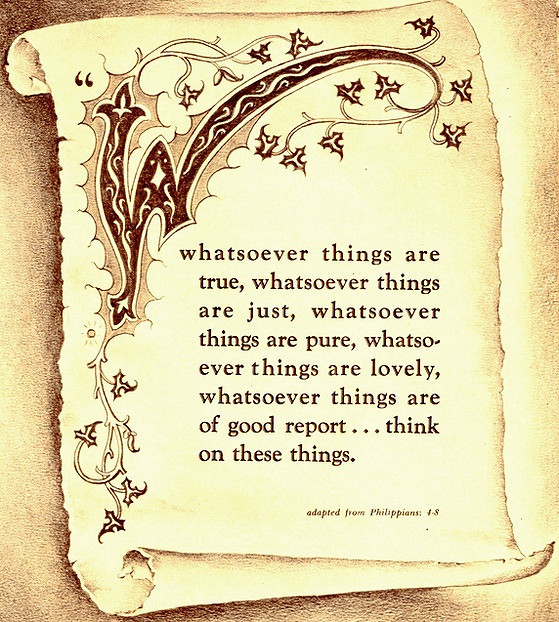
Finally, brothers and sisters, whatever is true, whatever is noble, whatever is right, whatever is pure, whatever is lovely, whatever is admirable—if anything is excellent or praiseworthy—think about such things. (Philippians 4:1–9)
As Paul reaches the end of his letter, this series of standalone statements feels like he’s trying to remember everything he wants to share with them: you two women, stop fighting (perhaps their disagreement was part of the bigger issue of disunity); rejoice in the Lord; be anxious about nothing; wrap yourselves in peace; think on what is good and lovely and excellent; put my teaching into practice.
The sense of fruit in this passage comes in verse 17, when Paul says he yearns for more of the spiritual benefits to be credited to their account. As they fulfill the staccato-like statements that he lists in quick succession, they will bear fruit.
Bearing fruit takes the training of our minds, hearts and bodies. Sometimes we need to flee the pack-like mentality, even if it feels difficult. Once I was faced with this when my book club chose to read 50 Shades of Grey (I had left early; in their defense, they said it was a joke). Although I didn’t want to appear narrow minded, I said I wanted to heed the injunction, “whatever is good, lovely, pure and so on, think on these things,” and so would pass on that book. I didn’t want my imagination filled with the book’s degrading sexual acts and attitudes, even if that meant appearing strict to my friends.
The verses above are good ones to set to memory, which we can then call to mind in times of quiet or anxiety. I find when I’m unable to sleep, especially if my mind is racing all over the place, I recite some passages of Scripture. It’s a way of setting God’s truth into our hearts and minds.
What pure and noble things can you think on today?
Prayer: Lord, you are good, pure, true, noble, right, lovely, admirable, excellent, and praiseworthy. We worship you. Amen.
…this is my prayer: that your love may abound more and more in knowledge and depth of insight, so that you may be able to discern what is best and may be pure and blameless for the day of Christ, filled with the fruit of righteousness that comes through Jesus Christ. (Philippians 1:1–11)
The apostle Paul probably wrote the letter to the Philippians either from prison in Rome or Ephesus. He’s sharing his love and appreciation for their partnership in the gospel, but he’s also, as with his letter to the Galatians, warning them against false teachers (the Judaizers we spoke of last week). He packs a lot into his opening paragraphs, signaling what he wants to communicate.
Read through verses 9 to 11 again, Paul’s prayer of intercession. He’s concerned about the unity of the church, and the love he speaks of here probably refers to the love between fellow believers. This love, imbued with the wisdom that comes from God, sets them apart and makes them holy – filled with the fruit of righteousness bestowed by God through his Son.
A couple of years ago I was asked to speak on the topic of restoring confidence in the church. At first I struggled with the subject. Although I knew that although the church is God’s bride and chosen vessel for bringing about his kingdom, I also had heard many stories of brokenness, disunity, and pain related to the church. And yet when I asked for stories of the church being a light and a help on social media, I heard of so much redemption. People experiencing health difficulties or relational breakdowns, and the church stepping in with help and love. The same comment was repeated, “I don’t know how I would have survived without my church.”
Those acts of love in action are Christians bearing the fruit of righteousness. Whether it’s driving someone to a hospital appointment or taking the time to sit and cry with them in their bereavement, we’ll never know the true impact of these acts of mercy.
How might you bear fruit today?
Prayer: Lord God, spark in me the love for members of my church. Forgive me when I’ve held a grudge and become bitter; help me to let go. Amen.
For you were once darkness, but now you are light in the Lord. Live as children of light (for the fruit of the light consists in all goodness, righteousness and truth) and find out what pleases the Lord. (Ephesians 5:1–14)
One night when I was walking home after some meetings in Central London, I felt a strong nudge not to take the shortcut down the darkened side road. Not knowing if that feeling was from God or a passing fear flitting into my consciousness, I decided to go the long route anyway. I can’t tell you whether I was saved from a horrible act in the darkness, for I got home safely, locked the door, and breathed a sigh of relief. While passing that side street, however, I glimpsed a group of unfamiliar young men some ways down.
The dark can be scary because bad things can happen to us there; darkness in the Bible is used as a symbol of the unholy trinity of the world, the flesh, and the devil. Here Paul is writing to the church at Ephesus, urging them to live in the light. His letter isn’t motivated by the need to correct a specific heresy or sin, but rather to spark their imaginations into the ways of God’s kingdom of grace and truth.
Again the recurring theme of the old self and the new comes through. Once we lived in darkness; now we live in the life of God. Does Paul say we live in the light? No, he actually says we are light in the Lord. Now that’s a mind-blowing concept. We’ve left our old life behind – the one shrouded in darkness and sin – and now we reflect Jesus’ transforming light.
One of my friends was mired in the occult until one day two Christians shared the good news with her. She wrote a big “SAVED” in her diary, saying that afterwards people commented on the light that shone through her eyes. May it be so with us.
For reflection: Jesus: “I am the light of the world. Whoever follows me will never walk in darkness, but will have the light of life” (John 8:12).
So, my brothers and sisters, you also died to the law through the body of Christ, that you might belong to another, to him who was raised from the dead, in order that we might bear fruit for God. (Romans 7:1–6)
In this passage, Paul continues to describe the new life we should be enjoying in Christ, following from last week’s reading. Just as previously we were bound to sin, so too were we tied to the law. He’s specifically speaking about the law of Moses; the laws written in stone. When we become joined to Christ, we no longer are under the law but are indwelled by the Spirit. Now we’re released from the law to bear fruit for God.
This brings freedom, and with freedom can come the fear that we will get things wrong. For some, this fear can paralyze. But when we rely on God’s Spirit within us, we know that he leads us – perhaps beginning with baby steps. This concept reminds me of the saying, “Pray and then do the next thing.” Yes, we’re fallen people who make mistakes. But we are also redeemed believers in whom Jesus dwells.
Bearing fruit for God occurs when we heed that little nudge inside. You know the one? That thought that pops into our head that we should call a friend, or go visit her when the text she sends sounds desperate. That deep breath we take when we feel ourselves losing control, about to unleash a slew of angry, hateful words. That hymn of praise that bubbles out of us, unbidden.
I love the character of Sarah Smith from Golders Green in CS Lewis’ The Great Divorce. On earth, Sarah was a humble woman, much overlooked. But in heaven she is one of the Great Ones, whose deep love of people and animals brings transformation. She bore fruit daily, though it wasn’t recognized or lauded. But the One who sees all things saw, and knew.
May we too be Great Ones, recognized on earth or not.
Prayer: Father God, help me to discern your nudges of grace, that I might live in obedience and joy while collaborating with you. Amen.