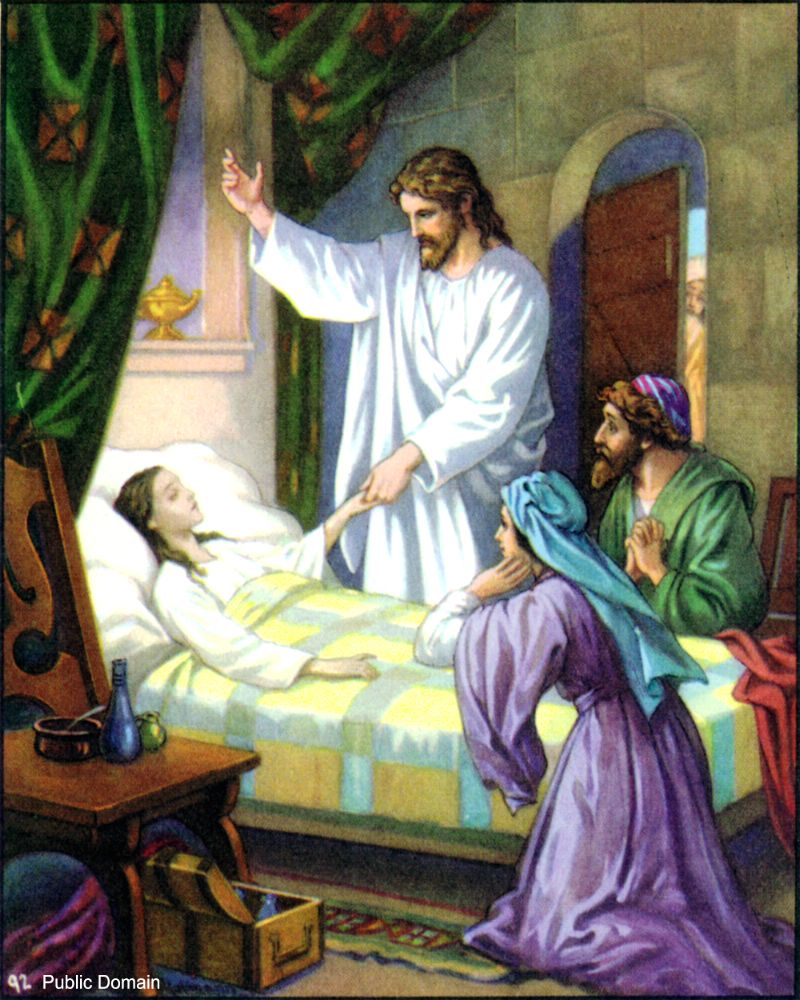
A synagogue leader came and knelt before him and said, “My daughter has just died. But come and put your hand on her, and she will live.” Jesus got up and went with him, and so did his disciples. Just then a woman who had been subject to bleeding for twelve years came up behind him and touched the edge of his cloak. She said to herself, “If I only touch his cloak, I will be healed.” Jesus turned and saw her. “Take heart, daughter,” he said, “your faith has healed you.” And the woman was healed from that moment. When Jesus entered the synagogue leader’s house and saw the noisy crowd and people playing pipes, he said, “Go away. The girl is not dead but asleep.” But they laughed at him. After the crowd had been put outside, he went in and took the girl by the hand, and she got up (Matthew 9:18–25).
Photo: pcstratman on flickr
Utterly desperate, a leader in the synagogue approaches Jesus for help because his daughter has died. Jesus agrees to go to his house, and as they do so a woman touches the hem of Jesus’ cloak, believing that her nonstop bleeding will stop. Jesus responds with compassion: the woman is healed; the girl was only asleep.
Both situations were desperate. Jarius has tried everything but his daughter still died. But he holds out hope that this miracle man can save her. So too the woman who has been bleeding for a dozen years. That’s twelve years of being an outcast from her community, for the bleeding made her unclean. She had tried every type of medical cure available, to no avail.
Jesus has compassion on those at the margins of society. He doesn’t penalize them for coming to him as a last resort but responds quickly and powerfully. His actions signal a new kingdom, one in which grace upon grace is poured on God’s children – all of God’s children, whether women, little girls, the blind or leprous, or the elite of society. May we enter into this grace this day.
Prayer: Lord Jesus, help me to see those who might feel ostracized or lonely, and let me be your agent of love and grace.
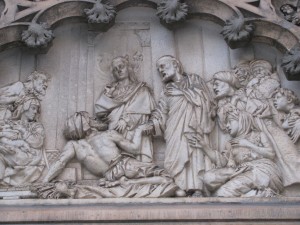
Jesus stepped into a boat, crossed over and came to his own town. Some men brought to him a paralyzed man, lying on a mat. When Jesus saw their faith, he said to the man, “Take heart, son; your sins are forgiven.” At this, some of the teachers of the law said to themselves, “This fellow is blaspheming!” Knowing their thoughts, Jesus said, “Why do you entertain evil thoughts in your hearts? Which is easier: to say, “Your sins are forgiven,” or to say, “Get up and walk”? But I want you to know that the Son of Man has authority on earth to forgive sins.” So he said to the paralyzed man, “Get up, take your mat and go home.” Then the man got up and went home. (Matthew 9:1–7)
News of Jesus’ healing was spreading, so concerned friends of a paralyzed man decide to take him to Jesus for healing. Matthew doesn’t tell us about the extraordinary measures the friends took to get the man to Jesus – lowering him through a hole in the roof – for he wants to focus on the conversation between Jesus and the teachers of the law.
Jesus tells the man that his sins are forgiven, and this immediately sets off alarm bells in the scribes and experts in Judaism. Forgiving sins can only be done by God, they know, which is why they accuse Jesus of blasphemy. Jesus, however, knowing their unspoken evil thoughts, responds. He knows that they believe that people won’t be healed unless their sins are forgiven. A way to show them his power as the Son of Man is to heal the paralyzed man – and to forgive his sins.
Receiving forgiveness can bring about healing, sometimes even physical, but that doesn’t mean that people who are struggling with disease or deformity are riddled with unconfessed sin. We’ll only fully be free when we enter the land of no more tears or crying or death. Until then, may we continue to present ourselves to Jesus, confessing our sins and receiving his cleansing forgiveness.
Prayer: Lord Jesus, what friends that man had to care for him so deeply. Show me this day how I can show love to my friends.
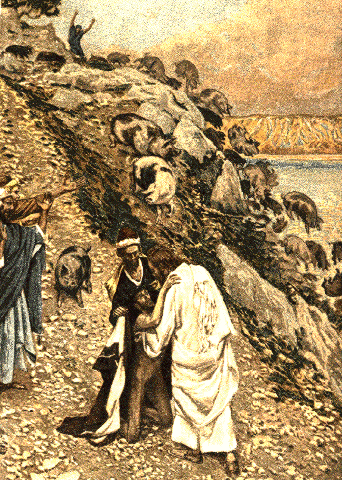
When he arrived at the other side in the region of the Gadarenes, two demon-possessed men coming from the tombs met him. They were so violent that no one could pass that way. “What do you want with us, Son of God?” they shouted. “Have you come here to torture us before the appointed time?” Some distance from them a large herd of pigs was feeding. The demons begged Jesus, “If you drive us out, send us into the herd of pigs.” He said to them, “Go!” So they came out and went into the pigs, and the whole herd rushed down the steep bank into the lake and died in the water. (Matthew 8:28–32)
Sickness, blindness, stormy lakes, and now demons. Jesus and his friends arrive in a Gentile area, which is why a herd of pigs was grazing. Again Matthew cuts out excess details as he points squarely to Jesus’ action of release instead of giving a lot of background information about the possessed men.
The demons knew immediately who they were encountering – the Son of God. They recognized his authority, and pleaded to be released into the pigs (two thousand, according to Mark’s gospel). He tells them to go, and they do so dramatically, sacrificing the pigs in the process. The Jewish people with Jesus wouldn’t have been bothered by this loss, for they so disliked pigs that they would have put them in the same category as the demons. The Gentiles, however, were troubled and asked Jesus to leave. As one commentator says pointedly, “all down the ages the world has been refusing Jesus because it prefers the pigs” (quoted in NIV Application Commentary: Matthew, p. 354).
We can feel bad for the squashed pigs, but if we focus too much on them we’ll miss the point of the story – the authority of the Messiah over demons, and freedom and restoration for troubled men. Also, we can ponder that Jesus allowed the demons to transfer to the pigs because it wasn’t the appointed time. We don’t know why he didn’t eradicate the evil then, but we know that one day he will.
Prayer: Lord Jesus Christ, Son of the living God, have mercy on me, a sinner.
Then he got into the boat and his disciples followed him. Suddenly a furious storm came up on the lake, so that the waves swept over the boat. But Jesus was sleeping. The disciples went and woke him, saying, “Lord, save us! We’re going to drown!” He replied, “You of little faith, why are you so afraid?” Then he got up and rebuked the winds and the waves, and it was completely calm. The men were amazed and asked, “What kind of man is this? Even the winds and the waves obey him!” Matthew 8:23–27
In his account, Matthew shows that Jesus is not only Lord over disease and demons, but over nature too. He is Immanuel, God with us, who rebukes the storm over the seas just as God in the Old Testament made the waters calm – see for instance, Psalm 104:7 (“at your rebuke the waters fled”) or Isaiah 50:2 (“by a mere rebuke I dry up the sea”). At his mere word the seas obey, causing the frightened disciples to wonder just who is in the boat with them. They had witnessed him healing the previously incurable diseases, but they hadn’t reckoned on him controlling nature. Being familiar with the references in the Old Testament mentioned above, they would have realized immediately the weight of Jesus’ actions.
The storm was no ordinary storm. This is hinted at by the Greek word seismos, which usually means an earthquake, or literally, a “shaking” (RT France, Matthew, IVP, 1985, p. 161). A force from outside brought chaos; that is, a squall came upon the lake violently and suddenly. Jesus demonstrates his authority by calming it with a rebuke.
Jesus wants us to believe in his power to still the storms in our lives, whether created from outside or from within. Sometimes they appear suddenly, taking us by surprise and perhaps flattening our faith. As we turn to him in fear or faith, asking him to save us, he brings calm and peace, creating order from disorder.
Prayer: Lord, I confess that when I see the waves leaping at my boat, I react with fear. Come and save me, and increase my faith in your goodness and grace.
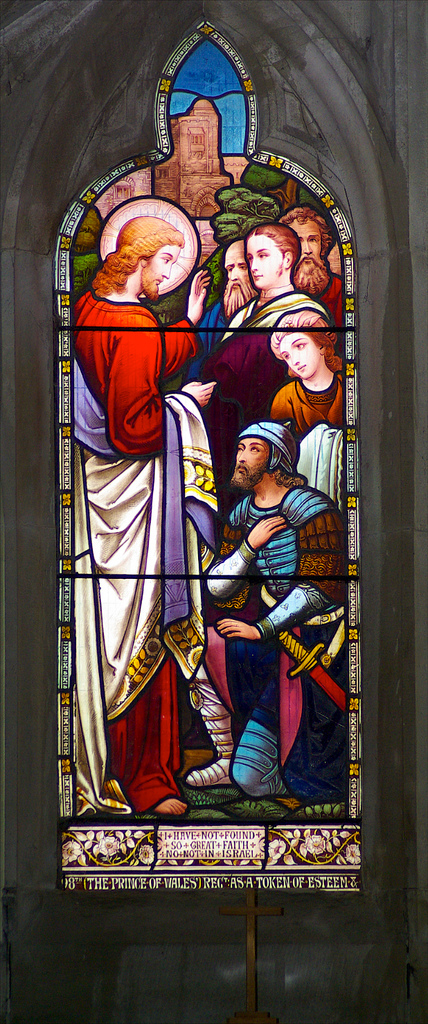
When Jesus had entered Capernaum, a centurion came to him, asking for help. “Lord,” he said, “my servant lies at home paralyzed, suffering terribly.” Jesus said to him, “Shall I come and heal him? The centurion replied, “Lord, I do not deserve to have you come under my roof. But just say the word, and my servant will be healed. For I myself am a man under authority, with soldiers under me. I tell this one, “Go,” and he goes; and that one, “Come,” and he comes. I say to my servant, “Do this,” and he does it.” When Jesus heard this, he was amazed and said to those following him, “Truly I tell you, I have not found anyone in Israel with such great faith…” Then Jesus said to the centurion, “Go! Let it be done just as you believed it would.” And his servant was healed at that very hour. Matthew 8:5–10, 13 (abridged)
Parish Church of St Michael, Mitcheltroy, Window. Credit: Keith Moseley, flickr
Following last week’s opener, Jesus continues to blow apart the people’s preconceptions as he exercises his authority, bringing healing to the Gentiles. When a Roman soldier asks for help, Jesus responds by asking if he should go to his house to heal the man. The soldier, however, wants to avoid Jesus becoming ceremonially unclean from entering a Gentile’s house. So the centurion applies the principles of faith and authority to the situation. As a man under authority who obeys the words of his superiors, and as one who has men serving under him, he believes that if Jesus just says the word, his servant will be healed.
And so it was. This miracle signals that the new kingdom is not limited to Jewish people but is available to Gentiles as well. It is also a stark warning to those in Israel who may have grown complacent in their status as the chosen people. Never, said Jesus, has he found someone of such great faith. Those listening must have felt stunned by this remark.
Do we take our faith for granted? How could you exercise faith this day? And how do you feel about being under authority?
For reflection: “I am not ashamed of the gospel, because it is the power of God that brings salvation to everyone who believes: first to the Jew, then to the Gentile” (Romans 1:5).
When people take the time to write to me about one of my Bible devotions, I read their letter with interest. More than once I’ve been called up over a suspect claim or a disputed point of theology. In fact, at one time I started to dread the letters coming through the door.
But then I wrote a set of notes on the theme of pilgrimage, which seemed to strike a chord, especially with people who were transplanted from their homes. I still receive a lovely card at Thanksgiving from one of the readers, which I find moving.
One letter in particular blows me away. This woman was writing about some notes I wrote for New Daylight on the miracles of Jesus, and the text was Matthew 8:23-27, where Jesus calms the storm.
As I wrote in the notes:
The storm was no ordinary storm. This is hinted at by the Greek word seismos, which usually means an earthquake, or literally, a “shaking” (RT France, Matthew, IVP, 1985, p. 161). A force from outside brought chaos; that is, a squall came upon the lake violently and suddenly. Jesus demonstrates his authority by calming it with a rebuke…. Jesus wants us to believe in his power to still the storms in our lives, whether created from outside or from within. Sometimes they appear suddenly, taking us by surprise and perhaps flattening our faith. As we turn to him in fear or faith, asking him to save us, he brings calm and peace, creating order from disorder.
Here’s her letter (spellings intact):
I am a Brit living in Christchurch, New Zealand. For many years I have used and appreciated the BRF New Daylight series & at the memorial service for the victims of the earthquake today [18 March 2011] we were urged by our bishop to tell our stories. I don’t expect you realise what you wrote on the day of the earthquake, I had been at a small prayer group in the morning & read out the passage for Tuesday 22nd Feb & we talked about it, & related it back to September 4th the day of the first quake.
Fifty minutes after leaving the group we were once again hit by a terrible earthquake & as I took refuge under a rack of clothes in the shop I was passing through, I cried out to the Lord, in fear, to protect & save me & my family. I remembered what I had just read to the group & tried to trust Jesus. The past three weeks have been difficult, & nothing is the same, but all our family are well & this has brought us closer to the Lord.
I was bowled over, to think that the words of the devotional, written probably a year previously, would be so used by God in a place far away.
The power of words and the Word. What words will you speak or write this day, that might bring hope, comfort, or peace?
Today we’re starting a new devotional series, looking at the miracles of Jesus, via Matthew’s gospel. He’s on a mission to reveal the authority of Jesus. First he demonstrates that Jesus is the Son of God through his Sermon of the Mount, which left the crowds amazed. Then he moves from Jesus’ words to his actions, detailing in quick-fire succession miracle after miracle after miracle. Through these mind-blowing acts, Jesus takes authority over nature, sickness, sin, and demons, while pouring out his love and compassion on his people whom he calls “sheep without a shepherd” (Matthew 9:36). If the people were amazed at his teaching, imagine their reaction after witnessing sight restored or a leper cured.
Photo credit: Christ Healing the Sick, Washington Allston
Matthew’s account is concise; he leaves out details in the stories that other gospel writers fill in. With this brevity Matthew hammers home his message about the Son of God on earth who is ushering in God’s kingdom.
Jesus’ miracles tend to fall into three categories: those controlling nature, those eradicating sickness (and even death), and those casting out demons. But contrary to the expectations of the disciples, the teachers of the law, or his Jewish readers, Jesus extends his healing grace to the disaffected and outcast – even to the Gentiles. He stuns them with his words and his works and makes them wonder, ‘Who is this man?’
As I read through Matthew’s account of Jesus’ miracles, I was struck more than once by Jesus’ compassion. When he sees the suffering of the people, he immediately brings peace of body and soul. He then reinforces this with his call to peace, one he still issues: “Come to me, all you who are weary and burdened, and I will give you rest” (Matthew 11:28).
Yes, Jesus works miracles today. Physical healings are spectacular, but emotional healings can also be life-altering, bringing freedom, joy and fulfillment. Do we have the faith to believe that Jesus can and will work in our own hearts and lives? I pray we will encounter the stories of Jesus’ miracles with an attitude of expectancy, reverence and gratitude.
Be Clean
When Jesus came down from the mountainside, large crowds followed him. A man with leprosy came and knelt before him and said, “Lord, if you are willing, you can make me clean.” Jesus reached out his hand and touched the man. “I am willing,” he said. “Be clean!” Immediately he was cleansed of his leprosy. Then Jesus said to him, “See that you don’t tell anyone. But go, show yourself to the priest and offer the gift Moses commanded, as a testimony to them.” Matthew 8:1–4
The crowds were amazed by Jesus’ Sermon on the Mount, and now as he comes down the mountain, they will be bowled over by his works. This first miracle that Matthew recounts brings restoration to one who suffered from leprosy or another skin disease. In Jewish law, those so afflicted would be called “unclean” and would be banished from others to prevent further spreading of the disease. But the leprosy would continue to spread within the sufferers’ bodies, affecting limbs that would eventually fall off, until finally they would die.
So although the other miracles are called healings, this one is called a cleansing, for only Jesus could make the sufferer clean. Perhaps Matthew chose to recount this miracle first to show the Jewish people that Jesus is the fulfilment of the law (Mark and Luke first tell of Jesus driving out a demon in a man in Capernaum). After healing the man, Jesus tells him to show himself to the priest and offer the prescribed gift. By this he is signalling that one greater than Moses has come; he is ushering in a new order.
We could push this healing aside as not affecting us, but the spread of leprosy in a body is similar to the spread of sin in our lives. If we do not present ourselves to Jesus for cleansing, our sin will spread, separating us from each other and from God. Only Jesus can bring the cleansing that releases us into wholeness and makes us clean.
Prayer: Lord Jesus Christ, show me where sin may be lodging, that I may be cleansed by your healing hand.
Therefore, since we are surrounded by such a great cloud of witnesses, let us throw off everything that hinders and the sin that so easily entangles. And let us run with perseverance the race marked out for us, fixing our eyes on Jesus, the pioneer and perfecter of faith. (Hebrews 12:1–3)
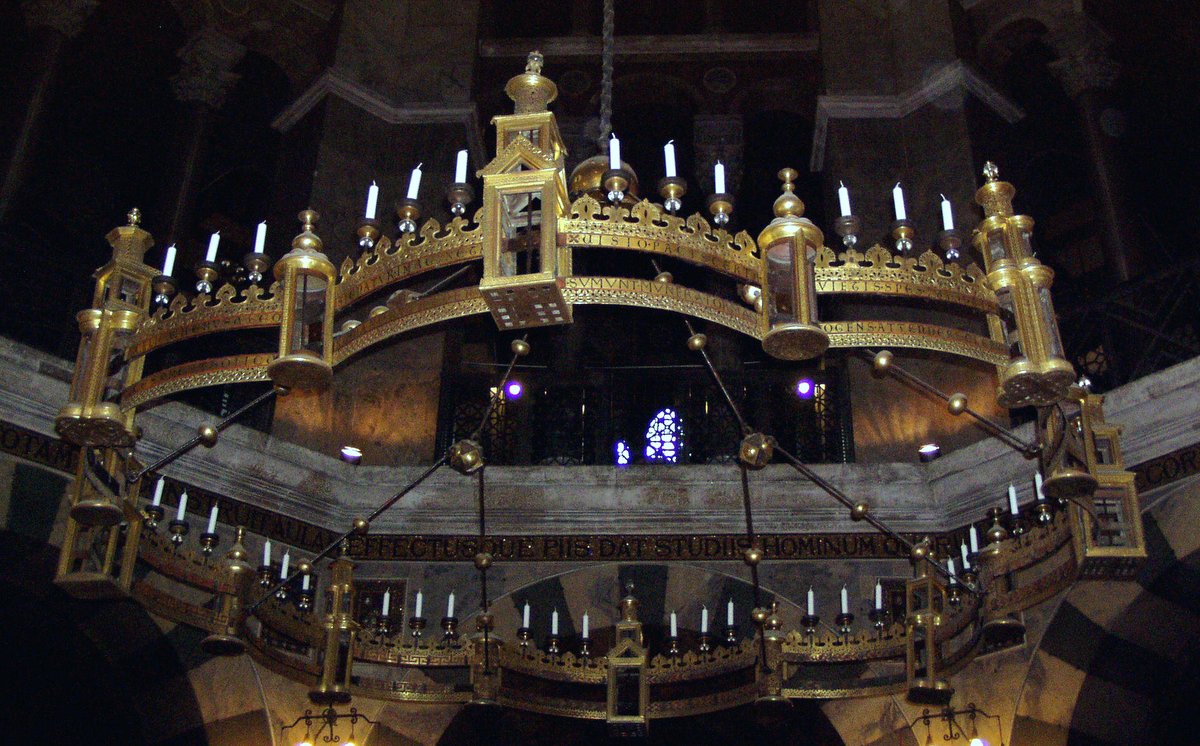
The Carolingian octagon from Aachen Cathedral in Germany. A grand crown indeed, but must pale in comparison with the one that awaits us in heaven…
By faith the saints lived and thrived. By faith they built an ark, made their home in a foreign land, bore a child in old age, left Egypt, passed through the Red Sea, made the walls of Jericho to tumble. All of this build up from Hebrews 11 – the rhetorical device of the “example list,” which ancient writers employed to call their listeners to action – leads to a great “therefore.”
Therefore, says the writer to the Hebrews, let us run our race with perseverance as we fix our eyes on Jesus. He is the ultimate hero of our faith. He is the culmination of the amazing acts and supernatural feats. He endured the shame of the cross to draw us close to his Father, that we might enjoy a life of fruitfulness, joy, and peace.
What race are you running? Perhaps you are young, and you haven’t yet made life-shaping choices – such as travels, marriage, a professional qualification. Maybe you are in midlife, with your path deeply cut in the earth but with many miles yet to traverse. Or perhaps you are nearing the end of your journey, looking back over a life that had its share of potholes but also buried treasure in the road as well.
Wherever we are, may we slough off whatever is keeping us from running with joy and appropriate speed. In times of weariness may we look to Jesus to refresh us in body, mind, and spirit. In times of joy may we share our wonder and gratitude with him, the author and perfecter of our faith. And with the saints of old, may we too finish our race in a way to get the prize, the crown that lasts forever (see 1 Corinthians 9:24-25).
For prayer and reflection: “And when the Chief Shepherd appears, you will receive the crown of glory that will never fade away.” (1 Peter 5:4)
These were all commended for their faith, yet none of them received what had been promised, since God had planned something better for us so that only together with us would they be made perfect. (Hebrews 11:32–40)
Suffering because of skin color. A statue to commemorate the people sold as slaves in Zanzibar, at what is now an Anglican Cathedral but used to be the site of a slave market.
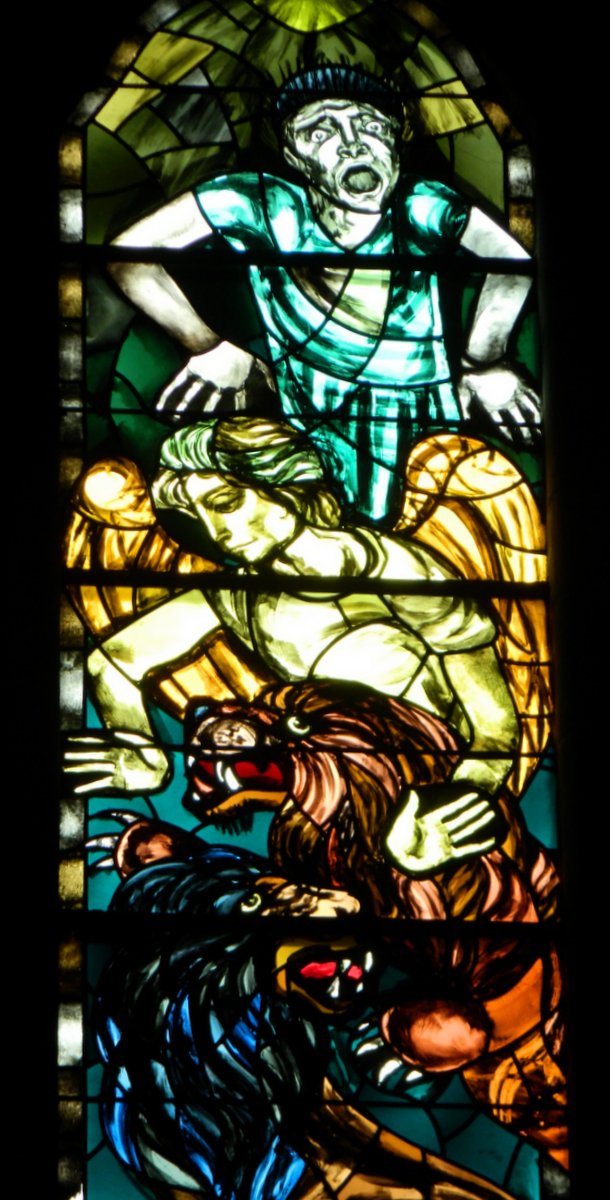
The writer to the Hebrews wraps up his discussion of the heroes of faith in this hodgepodge list of people, triumphs, and tragedies. Through faith they did some amazing feats, such as shutting the mouths of lions and quenching the fury of flames. But they also faced torture, chains, imprisonment, persecution, and mistreatment. And horrible deaths: by stoning, being sawn in two, by the sword.
Not exactly a list of experiences we’re eager to embrace. Nor to advertise to people who are curious about the Christian faith. “Yes, become a Christian and you too could endure ridicule and maltreatment!” Sometimes instead we highlight only the amazing promises of God – that he will never leave us, that when we walk through the river the waves will not submerge us, that he loves us with an everlasting love.
But because we live in a fallen world, which is not as God intended it, we may experience house fires and breast cancer. We may lose our jobs or our spouses to a roving eye and hand. God doesn’t cause these horrible experiences, but he allows them. Why? We just don’t know. At these times, perhaps more than ever, we need to cling to God’s faith-building promises while sinking back into his everlasting arms. And to know that God has something better for us planned, such as our home in heaven.
None of these heroes – Abraham and Moses nor Gideon and David – received what they had been promised. But they welcomed it from a distance. May we who have the gift of the triune God – Father, Son, and Holy Spirit – live in a manner worthy of our callings. May God increase in us our faith, that we too may be heroes who welcome God’s promises, perhaps also at a distance.
For prayer and reflection: “God wants you to understand that it is a life of faith, not a life of emotional enjoyment of his blessings…. Faith by its very nature must be tested and true.” Oswald Chambers
By faith [Moses] left Egypt, not fearing the king’s anger; he persevered because he saw him who is invisible. By faith he kept the Passover and the application of blood, so that the destroyer of the firstborn would not touch the firstborn of Israel. (Hebrews 11:20-31)
A stained-glass window from Galway Cathedral, depicting some of the unseen realm.
A couple of years ago I was praying with a friend, whose father died not long before. She told me how her sister and mother visited a medium and had “called up” her father. Being fairly new in her faith, my friend was unsure whether this was really her father or not.
She and I spoke about the unseen realm, and how Satan uses his powers to make otherwise unexplainable things happen. I warned that things like mediums and horoscopes are his tool. Having edited a book about a woman who nearly committed suicide after being embroiled in the occult, I told my friend of the dark power of these tools, but also of our God’s ultimate victory. (And I know I’m being controversial in making such statements…)
Our passage today reminds us of God’s power in the unseen realm. When God first called Moses to be his leader, Moses was reticent and fearful, saying that Pharaoh wouldn’t listen to him. Over time, Moses’ faith was built strong and firm as he witnessed God’s faithfulness through plague after plague on the Egyptians, when Pharaoh wouldn’t let the Israelites go. Finally by the time of this tenth plague of the firstborn, Moses knew without a doubt that God was real, even though Moses couldn’t see him.
I sometimes wonder why God had to send so many plagues, especially when he kept hardening Pharaoh’s heart time after time. Maybe it was partly to show Moses that he was faithful and in control. To hone Moses’ leadership skills and teach him to follow God so that he could in turn lead God’s people.
My friend’s father loved Jesus, so one day she will be reunited with him in heaven. May she, like Moses, persevere because she sees the one who is invisible. And may our eyes be open to see his face this day.
Have you come in contact with things of the occult? Consider how you can know when spiritual practices are from God or from the evil one.