They will have to give account to him who is ready to judge the living and the dead. 1 Peter 4:5
Some time ago, I was asked to draft, in advance, an obituary for a Christian leader. The task weighed on me, for not only was there no immanent deadline (thankfully, the person was in good health), but I recoiled from summing up the life of another. Finally I dedicated some time to the task and wrote a draft, although later I heard that it wasn’t what they had in mind.
Have you ever thought what you’d like for your obituary? Or what you’d write for one close to you? After my failed attempt, I read a friend’s lively and touching memories of her husband, who had died of cancer. After reading her short account I felt like I knew him, realizing also where my draft of the obituary came up short.
Even more daunting than writing an obituary will be giving our account of our life to God. Do you imagine the scenes flashing before you of every stinging comment, indiscreet action, or prideful boast? I know we will be judged for our sins, but I also know that Jesus will be there standing in our stead, our advocate and ambassador. Yet his redeeming us doesn’t give us license to sin all the more. For as we become more like him, we shrink from that which is unholy as we yearn to bring glory to God.
Prayer: Lord Jesus, may my life’s account be filled with stories of hope and redemption, for your sake. Amen.
For you have spent enough time in the past doing what pagans choose to do… 1 Peter 4:3
Last week we talked about suffering and death being out of fashion in our Western world. So too is judgment. Many Christians today fear making public their views on matters of ethics, thinking they will be branded judgmental or fundamentalist and therefore excluded from the conversation. Others fear sharing their faith and calling people to embrace God, for they don’t want to name another’s sin or selfishness. But Peter, like Paul, calls us to leave our old lives behind.
We become new people at our conversion, but we have to keep putting on these new selves daily as we put on Christ. We can easily be allured back to our old selves – perhaps with drunkenness, or gossip, anger, bitterness… the list goes on. But God doesn’t want us stuck in our former ways of behaving. He lives in us through his Spirit, giving us the power to be transformed. To resist the drink or nasty whisper or hastily exclaimed words of anger. As we ask God to change us, moment by moment, he will. He delights to make us more like him.
Our behavior will speak more loudly than our words to those around us. Like Peter, they will notice that we’ve put our past fully behind us, no longer slaves to detestable practices. Though we may struggle still, the light of Christ living in us will be revealed.
Prayer: Triune God, though you are the judge, you are merciful. Help me to choose life today. Amen.
Time for a new devotional series! Let’s delve into some of Peter’s first letter, written probably around the year 60 by Peter, with the help of Silas. Peter writes to the Jewish and Gentile Christians scattered throughout much of Asia Minor. Over the next weeks we’ll be looking at 1 Peter 4:1–11 in depth:
Therefore, since Christ suffered in his body, arm yourselves also with the same attitude, because whoever suffers in the body is done with sin. 2As a result, they do not live the rest of their earthly lives for evil human desires, but rather for the will of God. 3For you have spent enough time in the past doing what pagans choose to do – living in debauchery, lust, drunkenness, orgies, carousing and detestable idolatry. 4They are surprised that you do not join them in their reckless, wild living, and they heap abuse on you. 5But they will have to give account to him who is ready to judge the living and the dead. 6For this is the reason the gospel was preached even to those who are now dead, so that they might be judged according to human standards in regard to the body, but live according to God in regard to the spirit.
7The end of all things is near. Therefore be alert and of sober mind so that you may pray. 8Above all, love each other deeply, because love covers over a multitude of sins. 9Offer hospitality to one another without grumbling. 10Each of you should use whatever gift you have received to serve others, as faithful stewards of God’s grace in its various forms. 11If anyone speaks, they should do so as one who speaks the very words of God. If anyone serves, they should do so with the strength God provides, so that in all things God may be praised through Jesus Christ. To him be the glory and the power for ever and ever. Amen.
Since Christ suffered in his body, arm yourselves also with the same attitude… 1 Peter 4:1
The sight arrested me. The angels I was used to seeing were cute and cuddly – babies with smiling faces. This angel was no baby, but a skull with wings below it.
My first visit to Rome imparted many rich memories, but the image of that angel made a lasting impression. For in our sanitized Western world, we often are shielded from the realities of suffering and death. For instance, when a member of our family dies, we no longer lay them out in our front rooms. Nor do as many women die from giving birth (thankfully). But all the people I’ve met have suffered in one way or another, and one day we all will die.
So although we run from suffering and death, how can we yet be like Christ? Peter tells us to arm ourselves with Christ’s attitude, that our suffering may be the means of us being done with sin. As we turn to God in our pain and confusion, he transforms us. He may not relieve the situation we find ourselves in, but his loves changes us, including our perspective. He gives us strength and hope to persevere.
How can Christ meet you today in any suffering you might be enduring, whether physical or emotional? Look to him for relief and sustenance.
Prayer: Lord God, we run to you with our fears, hurts and disappointments. When we suffer, relieve us. Amen.
On the 13th of every month I’m blogging over at the Association of Christian Writers’ blog. Here’s a taster of today’s entry. For last month’s, on riffing to Psalm 23, click here.
Photo: le vent le cri, Flickr
“Many have undertaken to draw up an account of the things that have been fulfilled among us… With this in mind, since I myself have carefully investigated everything from the beginning, I too decided to write an orderly account for you … so that you may know the certainty of the things you have been taught” (Luke 1:1-4, NIV, abridged).
My heart felt ripped open when my job as a commissioning editor at a large Christian publisher was eliminated. I loved my work in coaxing writers to pen their creations – books that only they could write – to God’s glory. But the international market couldn’t support my job and so I had to bid it – and my authors – farewell. As I was leaving, the head of publishing said, “You’ll never know how many people’s lives are touched through the books you worked on. They’re God’s ambassadors.”
I’ll never forgot his encouragement, for he gave me perspective during a painful time. And indeed, as writers we’ll never fully grasp the impact of our words. Sometimes a reader will share encouragement, but often we write and press “send,” not knowing if and how God will use our labors. Read the rest.
I believe writing devotionals may be part of my soon-to-be-seriously-begun writing ministry. Have you any helpful tips as I start? I’m retiring at the end of March and although I will be a lay pastor, I will finally be able to give serious time to writing. I’ve read your CWR notes and love them!
Photo: “Bible time,” Brett Jordan, flickr
Hello and thanks for asking! I love, love, love writing Bible reading notes. As I prepare, I read and dream and research and wonder and pray, and then I get down to the writing. Often time seems suspended and I exclaim, “Wow, I love this, Lord!” But I say this acknowledging that not everyone has this experience when crafting devotionals. This kind of writing is my sweet spot; it’s part of how I’ve been made and who I am. And I’ve been writing devotionals since 2008. I haven’t counted up how many I’ve written for some time, but I’m guessing 400 or 500. So please don’t feel bad if you don’t experience the sense of sheer joy in your writing. It may come.
You asked for some tips as you dive in; here you go.
Make your words (characters) count.
“If I had more time, I’d make this shorter.” Writers of devotionals – Bible reading notes – don’t have the luxury of space. Usually the text is limited to around 300 words, so the content needs to matter. A publisher I’m currently writing for designates character (with spaces) counts, so there’s no fudging. You know, like those hyphenated words that only count as one word in a word count (The writer-who-likes-to-cheat Amy? Nope.) Write your first draft and then prune, prune, prune. Employ strong verbs – the passive voice eats up your word count. Delete adjectives and adverbs. And so on. (A read through of the classic Strunk & White can be enlightening before you dive in.)
Gather your thoughts.
In the weeks before your deadline, read through the text you’ve been assigned (or that you’ve chosen) prayerfully, asking God to reveal what he wants you to write. Start a “thoughts” file on your computer/device where you can jot down notes and illustrations that occur to you. Writers train themselves to notice details – it’s as if while we’re experiencing a near car accident, we’re also taking notes on what we were thinking when the car in front of us stopped, the hue of the sky and how the light hit our eyes, the pounding feeling in our chest when our foot reflexively hit the brakes and the car stopped just in time, and the “Thank you, Lord” prayer we exhaled. (Do stop the car before you note these down.)
Photo: Savio Sebastian, flickr
Submit yourself to the text.
I love writing notes that are assigned to me – such as the series I’m going through on my blog on Hosea, or the series on verse by verse of Psalm 18 (start from the bottom of the links). We so often skip over the hard bits in the Bible, and so writing on a chunk of Scripture in a series can be an effective way to avoid this.
But I also mean in submitting ourselves to the text that we seek not to read what we want to read in the Bible, but what God has put there. Do some research and find out the context. Don’t just jump to handy conclusions. Ask God’s Holy Spirit to reveal the meaning. Leading to…
Research.
When I first started writing Bible reading notes, I spent a week or more reading and taking notes on various Bible commentaries. In one sense I needed the help because I hadn’t engaged with the Bible at that level before. (Those of you who preach regularly will have the benefit of this close engagement.) But in another sense I found myself crippled to form my own opinion. In doing so much background reading, I was in danger of merely parroting back the ideas in the commentaries. I had to put my notes aside for several days so that I wasn’t stealing the content of others in what I wrote. (Of course, there’s nothing new under the sun, and we unconsciously share the wisdom of others all the time – along with the inspiration of the Holy Spirit.)
A lovely letter from a reader who sent me a Thanksgiving card for many years.
Journey with the reader.
This probably doesn’t need stating, but you as the writer are a fellow pilgrim, and in the writing of Bible reading notes, you’re often sharing what you’re learning even as you write. So put on the cloak of humility, because wow it’s so amazing to get paid to submerge ourselves in the Bible and to share what we’re gleaning with others!
Yes, you can use the classic formula.
Devotionals often start with an arresting anecdote, which links to the biblical text that the writer delves into, which leads to the application. So that would be
Illustration
Text
Application
Being one who likes to buck the rules, I like to vary things up, sometimes diving straight into the text, for instance. But I do seek to add an application for each reading – after all, we do want to be living under the wisdom of God’s word.
Weave in biblical text.
I love to fold into my reflections various verses from Scripture. I don’t seek to do this slavishly, for that would make it feel forced, but often in the prayer section at the end of the devotional, a verse will stand out to me as suitable for prayer and reflection. (I don’t have the mind of NicTheVic who can name chapter and verse when it comes to Scripture. I have fragments and pieces stored in various levels of my brain, so I find the search facility at BibleGateway a fantastic resource for bringing them to the fore.) Reminding the readers of the great sweep of Scripture can be helpful too, depending on what you’re addressing.
Pray.
This is the most important element of writing devotionals. Pray before you start; pray while you’re writing; pray while you’re rewriting; pray when you send off your work to your editor. We trust that God will inspire us with his word; we yearn for him to bring just the right encouragement for the broken-hearted, the lonely widower, the overwhelmed parent. We oftentimes write a year in advance, so we can’t control the outcome or the effect of what we write. Which makes the sometimes miraculous meetings between devotionals and the reader’s experience so humbling (as I wrote in a blog about some notes that God used during an earthquake in New Zealand).
I can’t explain how sometimes an illustration will pop into my head when I’m writing. Oftentimes I approach the text without seemingly a clue of where I’ll go with it in terms of the illustration and application. But as with so many creative pursuits of collaborating with God, we take the first step and he helps us to continue. As with the Israelites wandering through the desert who had enough food for the day, he provides just enough inspiration for the devotional we’re writing.
A “wow this is humbling” letter.
Try to develop a thick skin.
The first publication I wrote for had an exacting readership. Any theological matter I addressed could be questioned; any uninformed opinion taken to task. I came to dread the letters from readers, for they pointed out where I was lacking. But the readers’ letters made me welcome my editor’s comments all the more, for she knew her readership and was careful to massage my text into a more acceptable format (without asking me to budge on key theological matters). I always took the time to reply to these readers (asking God to let a humble response come through), for they had taken the time to write to me.
Then I wrote a series on being a pilgrim in a foreign land. Bulky packages from the publisher started to pop through my letterbox, and amazingly, this time the readers wrote with their stories of feeling in exile! The publisher said they had never had such a big response in terms of feedback. I heard from other Americans living in the UK or those with connections to other countries. I felt overwhelmed with gratitude at this response, made all the sweeter by my long history of not-so-easy reader letters.
I hope this is helpful; do let me know how you get on. And thanks for your kind words about the CWR notes. I’m humbled when people find my writing helpful or inspiring. Praise God!
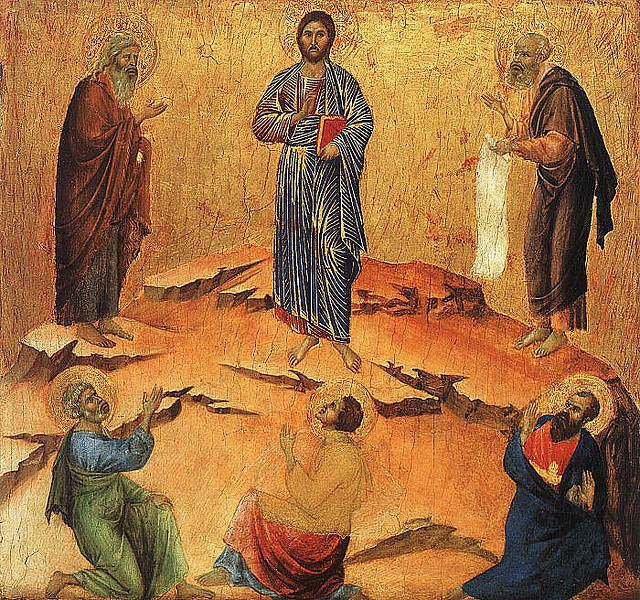
After six days Jesus took with him Peter, James and John the brother of James, and led them up a high mountain by themselves. There he was transfigured before them. His face shone like the sun, and his clothes became as white as the light. Just then there appeared before them Moses and Elijah, talking with Jesus… While he was still speaking, a bright cloud covered them, and a voice from the cloud said, “This is my Son, whom I love; with him I am well pleased. Listen to him!” When the disciples heard this, they fell facedown to the ground, terrified. But Jesus came and touched them. “Get up,” he said. “Don’t be afraid.” (Matthew 17:1–3, 6–8)
Photo: Creative Commons, carulmare. DUCCIO di Buoninsegna Transfiguration, 1308-11
During this series on Jesus’ miracles, we’ve seen Jesus healing the sick, raising the dead, overcoming nature, and exorcising demons. Our final miracle to consider today is the transfiguration, when the divine nature of Jesus is revealed. Whereas the other miracles are ones that Jesus performs, this one is performed on Jesus.
Jesus has taken his inner circle of disciples – those who would be future church leaders – up a mountain to pray. It’s as if the heavens open and the scales fall from their eyes as they glimpse Jesus as God the Son, with his face shining and his clothes as white as light. Then they hear God say that this is his beloved son, and that they should listen to him. As with all mortals who come in contact with the living God, they are terrified. But Jesus touches them, reassuring them. They are changed, but they are to fear not.
“Listen,” says God the Father. Are we listening to Jesus? Do we stop to pause and wait for his words and his directions, in things big and small? Have we aligned our lives in submission to his loving will?
As we do so, Jesus will work miracles in us. As God’s beloved Son he promises to bring reconciliation, healing, and restoration. May we enjoy the new kingdom that he is ushering in to its fullness, sharing his joy and peace with our families and those whom we meet.
For reflection: “For in him we live and move and have our being” (Acts 17:28).
Great crowds came to him, bringing the lame, the blind, the crippled, the mute and many others, and laid them at his feet; and he healed them. The people were amazed when they saw the mute speaking, the crippled made well, the lame walking and the blind seeing. And they praised the God of Israel. Jesus called his disciples to him and said, “I have compassion for these people; they have already been with me three days and have nothing to eat. I do not want to send them away hungry, or they may collapse on the way.” His disciples answered, “Where could we get enough bread in this remote place to feed such a crowd?” “How many loaves do you have?” Jesus asked. “Seven,” they replied, “and a few small fish.” He told the crowd to sit down on the ground. Then he took the seven loaves and the fish, and when he had given thanks, he broke them and gave them to the disciples, and they in turn to the people. They all ate and were satisfied. Afterward the disciples picked up seven basketfuls of broken pieces that were left over. (Matthew 15:30–37)
Photo: Steve Cadman, Creative Commons. Stained glass by Helen Moloney in St Michael’s Creeslough (1971) by Liam McCormick, County Donegal
Jesus has been healing and teaching the crowds in Gentile territory. Seeing that they are tired and hungry, he’s moved with compassion. He wants to meet not only their spiritual needs, but their physical ones too. And although the disciples have already witnessed Jesus feeding the five thousand, they still wonder how Jesus will feed these four thousand men, plus women and children.
Jesus takes what the people give – seven small loaves and two fish – and makes it sufficient for all. He multiplies their meager offering into a feast that satisfies.
Note two things regarding this familiar miracle. First is that Jesus performs it in Gentile territory. Although he came first for the Jewish people, he also yearns that non-Jews would eat and be satisfied with his food.
The second is how Matthew indicates that this miracle hearkens to Jesus’ breaking of the bread during his last supper – Jesus takes, breaks the bread, gives thanks, and offers it to the disciples. They in turn offer it to the people. So too should we offer what we have to Jesus for distribution among his people. It might seem far too small or insignificant for the needs, but as we see here, Jesus has a way of multiplying our bread beyond our wildest imagination.
Prayer: Lord God, we lift before you the needs of hungry people today – in Haiti, South Sudan, the Holy Land. Where we have loaves and fish to offer, let us give that you may multiply.
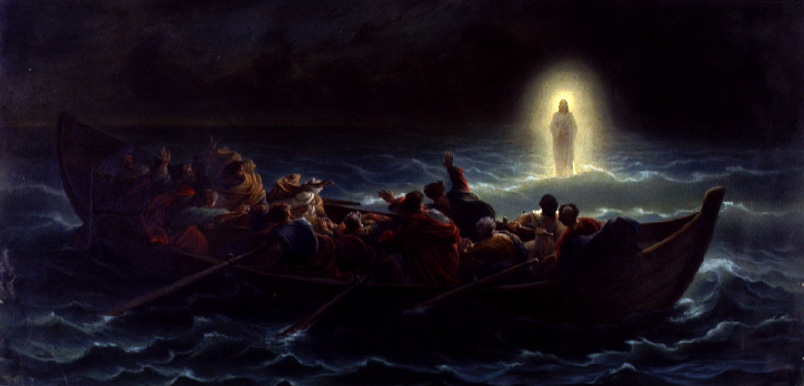
Shortly before dawn Jesus went out to them, walking on the lake. When the disciples saw him walking on the lake, they were terrified. “It’s a ghost,” they said, and cried out in fear. But Jesus immediately said to them: “Take courage! It is I. Don’t be afraid.” “Lord, if it’s you,” Peter replied, “tell me to come to you on the water.” “Come,” he said. Then Peter got down out of the boat, walked on the water and came toward Jesus. But when he saw the wind, he was afraid and, beginning to sink, cried out, “Lord, save me!” Immediately Jesus reached out his hand and caught him. (Matthew 14:25–31)
Painting by Amédée Varint; Creative Commons
Having just fed a hungry crowd of five thousand after a day of teaching, Jesus was exhausted. He sent the disciples to find shelter on the other side of the lake while he went to pray. But the disciples encounter a squall and spend much of the night trying to cross the lake. Whereas Jesus was in the boat when a storm arose previously, this time they are on their own. But by now they know that Jesus is interceding for them, and will come to them.
And he does so in a miraculous way, walking on the water. The disciples are depleted from the day’s ministry and a night of slapping on the waves; in their exhaustion they wonder if they’ve seen an apparition. But Jesus reassures them, and his “It is I” could hearken back to Yahweh’s statement of “I am” from the Hebrew scriptures.
Then Peter asks to walk to Jesus. Jesus commands him to come, and – amazingly – he does. Only when he takes his eyes off Jesus does he realize that this isn’t normal. Then he starts to sinks, but knows immediately to cry out to Jesus for help.
The feeding of the multitude and the amazing aqua balancing act bring forth a unified response from the disciples: “Truly you are the Son of God” (v. 33). Likewise, may we give him the authority and rule in our lives, turning to him when we are exhausted or sinking – or when we are flying high.
Prayer: “I do believe; help me overcome my unbelief!” (Mark 9:24)
Going on from that place, he went into their synagogue, and a man with a shriveled hand was there. Looking for a reason to accuse Jesus, they asked him, “Is it lawful to heal on the Sabbath?” He said to them, “If any of you has a sheep and it falls into a pit on the Sabbath, will you not take hold of it and lift it out? How much more valuable is a human being than a sheep! Therefore it is lawful to do good on the Sabbath.” Then he said to the man, “Stretch out your hand.” So he stretched it out and it was completely restored, just as sound as the other. But the Pharisees went out and plotted how they might kill Jesus. (Matthew 12:9–14)
As we move through Matthew’s gospel during this series on the miracles of Jesus, the clash between the Pharisees and Jesus intensifies. His claims and acts of authority incense the Pharisees. Seeking to trap him, they ask him about healing on the Sabbath and present to him a man with a withered hand. But Jesus again detects their secret thoughts. When he asks about a sheep falling into a pit, he refers to a long debate that the Pharisees were having about what was lawful on the Sabbath.
Jesus shows how he is more concerned with mercy than empty ritual, and with human beings over animals. With one command he tells the man to stretch out his hand. The man had been a pawn of the Pharisees, but Jesus makes all things new.
Of course, the Pharisees aren’t overjoyed. Instead of rejoicing that the man can now use his arm, they plot to kill Jesus. They were probably remembering how God restored Moses’ arm with one command (Exodus 4:6–7), realizing that Jesus with this action was claiming his Messiahship.
Who are we most like in today’s passage? Jesus, blowing preconceptions and healing (and no, I’m not encouraging a Messiah-complex)? The man, argued over and yet restored? Or the experts in the law, who couldn’t overcome their prejudice to see the new work of God?
For reflection: “‘I desire mercy, not sacrifice.’For I have not come to call the righteous, but sinners” (Matthew 9:13).
Jesus went through all the towns and villages, teaching in their synagogues, proclaiming the good news of the kingdom and healing every disease and sickness. When he saw the crowds, he had compassion on them, because they were harassed and helpless, like sheep without a shepherd. Then he said to his disciples, “The harvest is plentiful but the workers are few. Ask the Lord of the harvest, therefore, to send out workers into his harvest field.” (Matthew 9:35–38)
This week in our text we aren’t focusing on one particular miracle, as in past weeks, but rather we’ll look at one of the broad statements about Jesus’ ministry. As we see in Matthew’s gospel, he has come to teach, proclaim, and heal, his ministry fueled by his great compassion on the crowds who clamor to hear him speak and to receive his healing touch. The word in the Greek for compassion indicates a deep feeling in the gut, so strongly does Jesus feel for his people.
Jesus longs to be their shepherd, a common picture in the Old Testament of God to his people. In doing so Jesus will provide protection and sustenance, meeting their voiced and unvoiced needs. He then changes the metaphor to another familiar one from the Hebrew Scriptures, telling his disciples that the harvest is ripe but more workers are needed.
What is our role? One is prayer – “ask the Lord of the harvest.” So often we put prayer low on our list of priorities, sometimes by default due to the busyness of life. But for some amazing and mysterious reason, God wants to hear us cry out to him, and he acts on those prayers. As Lord Alfred Tennyson said, “More things are wrought by prayer than this world dreams of.”
What would intentional prayer look like for you this week? Is someone coming to mind even as you read this, for whom you should pray and perhaps fast? Maybe you could turn on a timer to signal the hours, then pause for a moment and pray for that person. God delights in the cries of his people, however we choose to make them.
For reflection: “Preach the Gospel always, and if necessary, use words.” St. Francis of Assisi
 They will have to give account to him who is ready to judge the living and the dead. 1 Peter 4:5