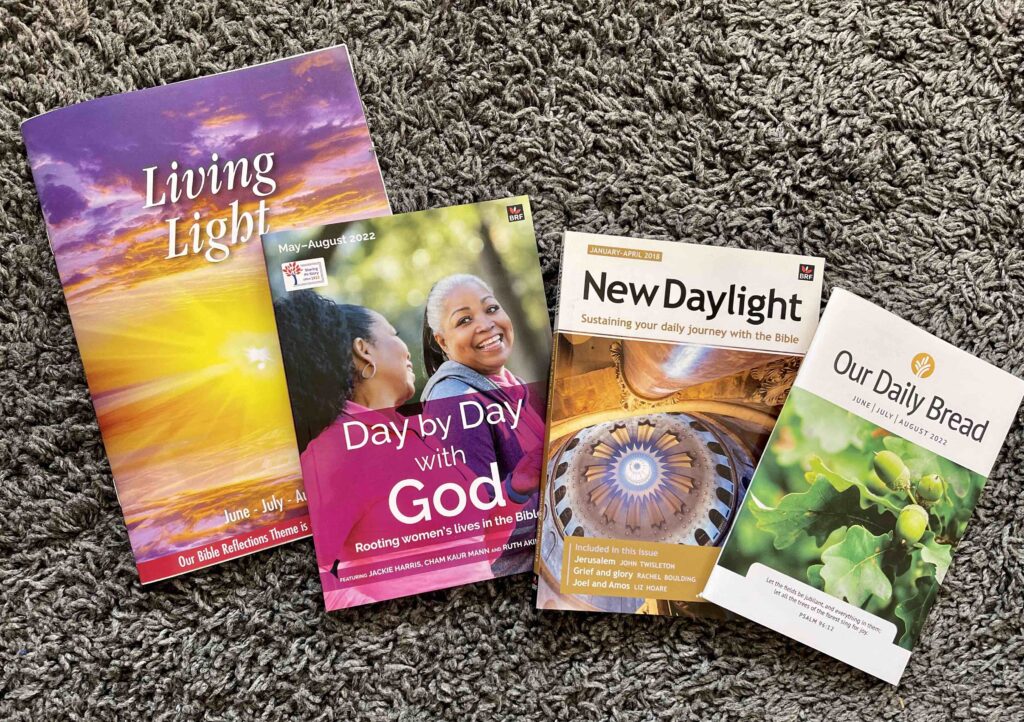
My first writing love is Bible reading notes, in the British parlance (devotionals). When New Daylight asked me to write back in 2008, I soon realized that this was my favorite type of writing. I never tire of it. I love delving into the commentaries and putting together the narrative and then discerning how we can apply God’s word to our life.
All are available worldwide in digital format; printed booklets are also available but postage out of country can be expensive.
You, then, why do you judge your brother or sister? Or why do you treat them with contempt? For we will all stand before God’s judgment seat. Romans 14—15:13 (NIV)
Some friends of ours are Christians who have come to Christ out of their Hindu background. Having been vegetarians their whole lives, they continue the practice of not eating meat – but as one of them says, “Of course, now that we follow Christ we could eat meat if we wanted to.” I appreciate the way he states the matter – although he no longer is under the laws of Hinduism, he now neither is forced to eat meat nor forced to abstain. He has freedom in Christ.
Paul was concerned about the division in the church at Rome,
mainly between the Gentile and Jewish Christians and how the former were
looking down on the latter for sticking to their lifelong practices of
following the Jewish dietary laws. Paul has words of exhortation to both
parties – to the Gentile Christians he says stop showing contempt, and to the
Jewish Christians he says don’t judge those who eat everything. After all, God
alone is our Judge and we should leave the pronouncements to him.
We might find ourselves falling into bad habits of judging in little, subtle ways – perhaps we don’t shop on Sundays but we know other who Christians do. Or we hold to a doctrine of belief that others disagree with, and we’re certain that we are right and they are not. Whatever the matter, we can follow Paul’s instruction to seek the kingdom of God, which is filled with righteousness, peace, and joy in the Holy Spirit (v.17) as we “make every effort to do what leads to peace and to mutual edification” (v.19).
For reflection: “Let the peace of Christ rule in your hearts, since as members of one body you were called to peace. And be thankful” (Colossians 3:15).
The night is nearly over; the day is almost here. So let us put aside the deeds of darkness and put on the armor of light. Romans 13:11–14 (NIV)
Although Paul’s conversion story was dramatic, as we explored last time, we see in his writing that he acknowledges the continuing process of sanctification that followers of Christ engage in throughout their lives. Paul uses the active forms of verbs when describing that we put on the new self and take off the old self in Ephesians 4:22–24, as he does here when saying that the Roman Christians should “clothe themselves with the Lord Jesus Christ” (v.14). Just as we get dressed daily, so should we “put on” the clothes of Christ.
Do you ever consider what these clothes may be? We see in
verse 12 they are described as the “armor of light” that we can don as our
culture becomes increasingly dark and troubled. Paul gives us other images of
Christ’s clothes in his letter to the Colossians, for he says, “Therefore, as
God’s chosen people, holy and dearly loved, clothe yourselves with compassion,
kindness, humility, gentleness and patience” (Colossians 3:12).
Let’s consider some of these. When we put on compassion,
we’re putting ourselves in someone else’s shoes – the roots of the word, after
all, mean “to suffer with.” Kindness is obvious, but easy to withhold, for
example when we fear our act of kindness might be rejected or misunderstood.
Can we wear this virtue without worrying about how it will be perceived? Humility
is neither viewing ourselves as nothing nor as too much – we see that we are
made in God’s image and so are priceless, but we also know we are sinful and
need his grace and mercy every day.
I invite you to wear the most beautiful clothes ever!
Prayer: Lord Jesus, I want to take off the rags of bitterness and anger and put on the royal robe that you give me. I know I am your beloved child; help me to live out of that identity this day.
Be devoted to one another in love. Honor one another above yourselves. Never be lacking in zeal, but keep your spiritual fervor, serving the Lord. Be joyful in hope, patient in affliction, faithful in prayer. Share with the Lord’s people who are in need. Practice hospitality. Romans 12:9–21 (NIV)
When my husband and I were first married, we had some dear friends around for dinner. When I popped to the kitchen to grab the green beans, my husband served Steve some sparkling water. Well, he thought he was pouring sparkling water, for that’s what the bottle said, but when I walked back into the room I exclaimed, “That’s the radiator water!” Our car was old and we needed to carry water with us to top up the radiator; somehow the bottle for the car had made it to the dining-room table. Steve said with a smile, “I see you are heeding Paul’s exhortation to practice hospitality! You may need more practice!”
We all need practice at living well, don’t we (and I hasten
to add that the water we served was clean, although not sparkling). Paul’s
instructions in just these few verses are those we can hold close to our heart
as we seek to live godly lives. He tells us to love each other, honoring our neighbors
above ourselves; to serve the Lord with enthusiasm and passion; to keep our joy
strong and to pray faithfully; to open our homes and share with those who are
in need; to bless, rejoice, mourn, be humble, and to live peacefully with
everyone.
I wonder how our cultures would change if we could implement even a small percentage of these commands. Truly the world would then know we are Christians through our love in action.
Might you choose one or two of Paul’s instructions to practice
today? Perhaps, too, you might be inspired to memorize this passage.
Prayer: Lord God, you give us the resources we need to live well, including these practical instructions. May I take them to heart today, that I might live for your glory.
Do not conform to the pattern of this world, but be transformed by the renewing of your mind. Then you will be able to test and approve what God’s will is – his good, pleasing and perfect will. Romans 12:1–8 (NIV)
In chapter 12 we reach another of Paul’s pivotal words – “therefore”
– and this one is grand for it signifies a change from him exploring the great
theological concepts we’ve seen in this letter to their practical implications.
What does it mean, then, for us as Christians to be sinners saved by grace? How
then shall we live?
To please God we offer our bodies as living sacrifices, and we are not to conform to the world but be transformed by the renewing of our minds. We may know this passage well, but do we fully understand it? One interpretation of offering our bodies has to do with the sacrifices required in the Old Testament. Now with Jesus taking away the curse of our sins, we can present ourselves as living sacrifices in the place of the dead animals once offered up. Part of our humble sacrifice can be made through Paul’s exhortation in verses 3 and following – don’t think more highly of yourself than you ought, and remember that the body has many members who all need each other.
And our transformation begins through the renewing of our minds, for our thoughts and our beliefs shape our behavior. As God’s Spirit lives within us, he ushers in changes to the way we think and approach the world. For example, whereas before we may have been defined by fear or anger, now we can feel comfort and peace. Of course, transformation is a life-long process, and we won’t feel perfect peace all of the time. But moment by moment, bit by bit, the Lord works in our minds, hearts, and souls. As we center our thoughts on him, we are changed.
Prayer: Lord Jesus, mold me and shape me; make me anew. Renew my mind, that I might bring you glory.
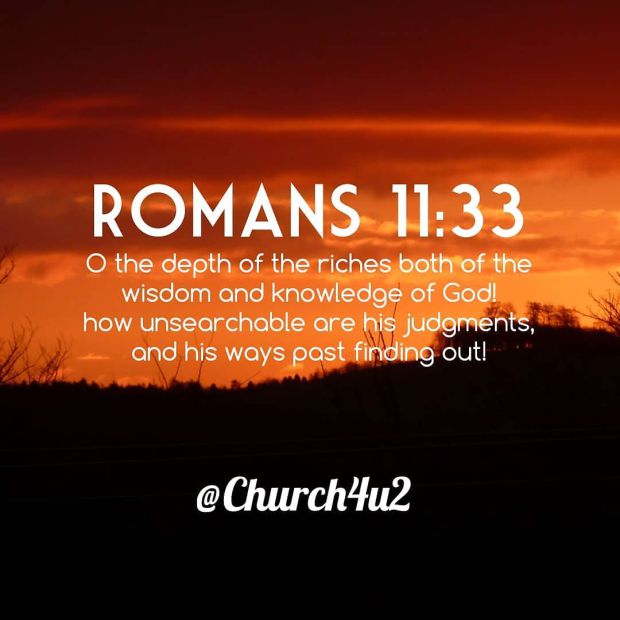
Oh, the depth of the riches of the wisdom and knowledge of God! How unsearchable his judgments, and his paths beyond tracing out! “Who has known the mind of the Lord?” Romans 11:33–36 (NIV)
This learned and wise apostle shows his humility in this
doxology as he concludes his teaching on how Jews and Gentiles are one in
Christ. He quotes from the prophet Isaiah when he poses the questions of who
can know the mind of God or be his counsellor (Isaiah 40:13), and note the
questions he poses in this passage, for they are rhetorical. No one can know
God’s mind – and yet, the Lord has revealed himself through Christ Jesus.
Through him we see an embodiment of God’s wisdom.
I love the writing of Dallas Willard, who was a philosopher
and one concerned deeply with spiritual formation before he died a few years
ago. When giving a talk at a church or at a conference, he would ask audiences
who was the smartest man in the world. People would trot out answers such as
Albert Einstein or other known thinkers, and Dallas would eventually say, “But
why aren’t you saying Jesus?” Dallas wanted to change people’s thinking and
help them to realize that Jesus was and is the smartest person ever, and that
he continues to be our teacher as he dwells within us.
We can become wise through the study of God’s word and world,
and through the indwelling of the Holy Spirit. For the Lord has created us to
think and to exercise our discernment, and he will lead us into all wisdom.
Whether or not we have a university degree doesn’t matter when we know that we
have the best and smartest teacher ever giving us individual tutorials!
Prayer: Father, Son and Holy Spirit, thank you that you teach me how to live. Help me to exercise my mind, that I would think Christianly about the world and my place in it.
For we know that our old self was crucified with him so that the body ruled by sin might be done away with, that we should no longer be slaves to sin – because anyone who has died has been set free from sin. Romans 6:1–23 (NIV)
The apostle Paul speaks often in his letters about the old
self and the new self, as we see here in Romans. It’s not surprising, for his
conversion was so radical – one day he was persecuting the new church to the
point of death, and the next he was blinded while traveling to Damascus as he
encountered the risen Jesus. He turned from a murderous antagonist to the
gospel to one of its biggest proponents.
Paul tells the Roman church that no longer do they need to
be slaves to their old life of sin, but now, empowered by the Holy Spirit, they
can live out of the new self. No longer do they have to be at the mercy of sin
and wickedness, for they live united with the resurrected Jesus.
We might read this and lose heart, thinking that we never
will win the battle with the besetting sin we face, whatever it may be. But God
transforms our character day by day as we seek to live for him, and often we may
not even be aware of the subtle changes that are happening within us. For
example, I remember years ago in my weekly small group when we each named how we
noticed God working in and through the members of the group. I was surprised and
heartened to hear some of the lovely things people said about everyone.
We can be encouraged to know that no longer are we tied to
the things of sin, but that Jesus dwelling within us makes all things new. We
who have been baptized into Christ Jesus live a new life.
For reflection: “You were taught … to put off your old self … to be made new in the attitude of your minds; and to put on the new self, created to be like God in true righteousness” (Ephesians 4:22–24, abridged).
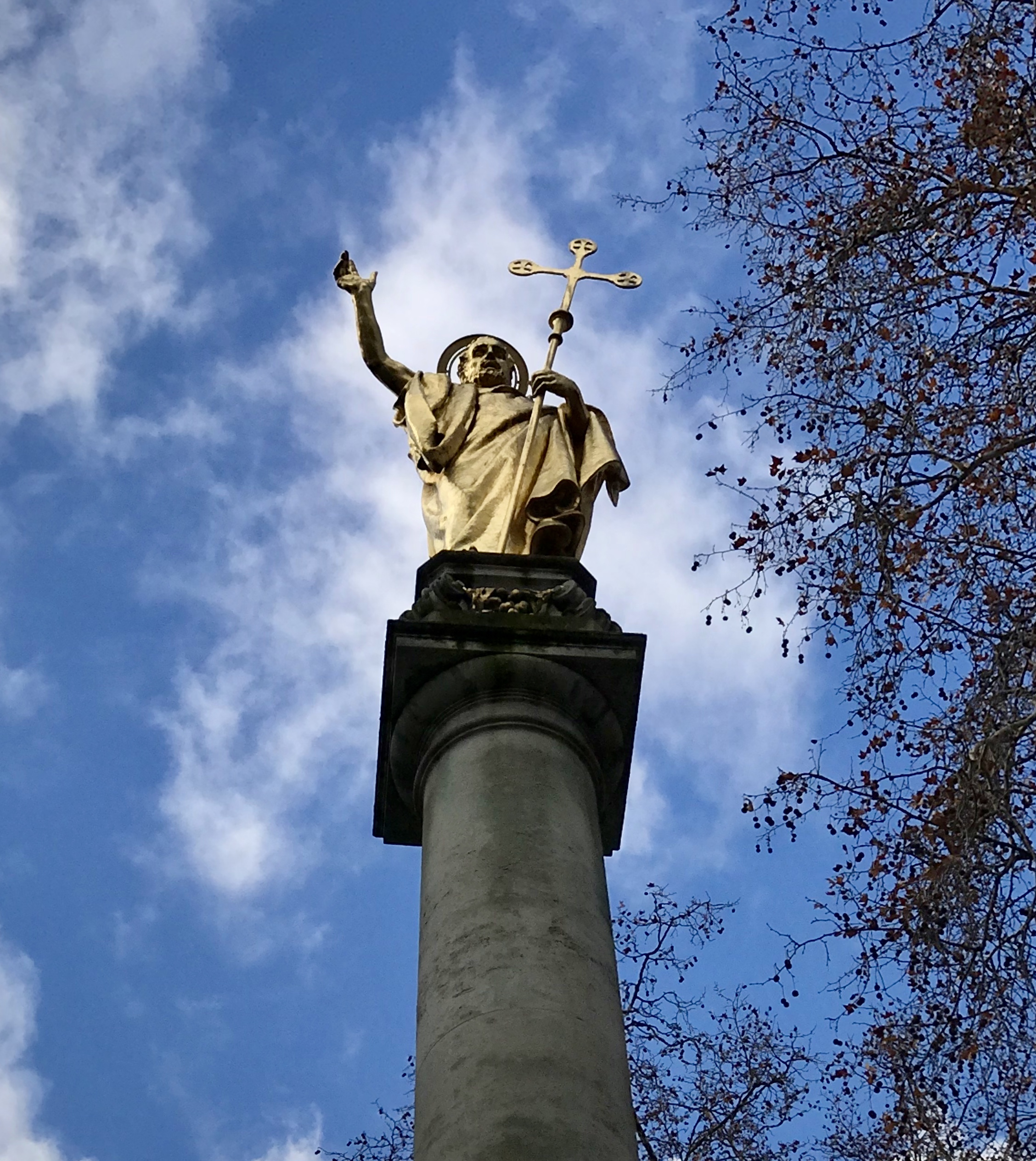
A statue of St Paul at the cathedral in London bearing his name.
This righteousness is given through faith in Jesus Christ to all who believe. There is no difference between Jew and Gentile, for all have sinned and fall short of the glory of God, and all are justified freely by his grace through the redemption that came by Christ Jesus. Romans 3:21–31 (NIV)
In the sixteenth century, Martin Luther read the book of
Romans again and again in his quest to understand God’s grace and the role of
our works in the role of our redemption. In the margin of his Bible he wrote that
this passage was “the chief point, and the very central place of the Epistle,
and of the whole Bible.” We might disagree that this section is the very most
important part of the Bible, but I think we can agree that from it we can learn
so much.
We encounter here the central themes of God’s plan of
salvation (and do read the full section if you have time) – that God sees us as
righteous through Jesus Christ, that we all have sinned and done wrong, that
Jesus atones for this wrongdoing through his blood shed on the cross. To use
more technical language, we are justified by faith in Jesus. That simply means
we have been set free from the consequences of our sin – in the kingdom of God
on earth and in heaven.
The gospel is a wonderful leveler, for as Paul says we all fall short of God’s glory – we all
need Jesus to save us. We cannot think ourselves superior to our family or neighbors,
for we know that our hearts can lead us to temptation and sin just as much as
the person we see caught in a cycle of destruction. We’re led not to pride but
to thanksgiving for the amazing way God sets us free – and we want to share
this good news with others.
Read through the passage again if you can, and try to put it into your own words. Maybe you’ll encounter someone today who needs to hear of God’s love for them.
Prayer: Lord Jesus Christ, I think about your sacrifice of love and mercy on the cross and I am profoundly grateful. May your love mark my going-out and coming-in this day.
Whatever the law says, it says to those who are under the law… Therefore no one will be declared righteous in God’s sight by the works of the law; rather, through the law we become conscious of our sin. Romans 3:9–20 (NIV)
As we saw last week, Paul writes to the Jewish and Gentile Christians in Rome with his radical message of God’s saving plan. No matter what our racial heritage, we all fall under the curse of sin. As Paul says, God’s law reveals our sinful hearts and actions, and we don’t find freedom and grace through observing the law. Rather it shows us how we fall short of God and his standards – and thus how we need a Savior.
We so-called New Testament Christians can misunderstand God’s law, thinking of it as commandments and strictures that the Lord gave in the Old Testament to keep his people in line. But God’s people saw it as a source of life and joy and hope, for through it they found guidance for living life to the full. As the Psalmist cried out, “Oh, how I love your law! I meditate on it all day long” (Psalm 119:97).
I made this mistake when I was writing my BRF Lent book The Living Cross, and was gently corrected by the wonderful writer Michele Guinness, who combines her Jewish roots with her vibrant Christian faith. She showed me how Jesus relieves us from the curse of our sin, not from the law. After all, in Jesus’ greatest commandment, he quotes from the law that God’s people love the Lord with all of their heart, soul and strength (see Mark 12:29–30, in which Jesus references Deuteronomy 6:4–5).
I’m grateful for Michele elucidating this for me, for I’m
reminded that the depth of God’s wisdom is so great that we will keep discovering
it to be a well of living water that cleanses and fortifies us. The law brings
life!
Prayer: Father God, your words help us to walk in your way, and your Spirit leads us into all truth. Show me today how I can follow your life-giving law, that I might be your ambassador of love and peace.
Image from page 40 of “The Epistle of Paul the Apostle to the Romans : with notes, comments, maps, and illustrations ..” (1888). Found on Flickr.
Many Christian figures in history named Romans as their
favorite book of the Bible. For instance, John Stott tells in his commentary
that the great reformer Martin Luther said of Romans that not only “should
every Christian know it word for word, by heart,” but that they should occupy
themselves with it “every day, as the daily bread of the soul.” William
Tyndale, a translator of the Bible, also urged his readers to learn it by heart,
for “the more it is studied, the easier it is; the more it is chewed, the
pleasanter it is.” Others who were affected by reading it were Augustine of
Hippo and John Wesley. (As cited in John Stott, The Message of Romans, IVP, 1994, pp. 19–22.)
Romans has been so important over the centuries because of
the deep and rich theological truths about salvation and sin that Paul shares
in it. And not only that, but the latter part of his letter contains practical
instructions on how to live. We can find much to stretch and encourage us as we
read what the apostle wrote to the church in Rome.
Paul had never visited this church, but heard of the
divisions in it, especially among the Jewish and Gentile believers that formed
it. He desired that they would find unity across their differences, and that
mutual respect and love would mark their lives. After all, they were all sinners in need of Jesus’ grace and
redemption. And they were all one in Christ.
When you read, keep in mind that Paul’s letter is half of
the story. We don’t hear the other side of the conversation – the issues that
he was addressing in the church there in Rome – but we can made an educated
guess. And although he wrote this letter such a long time ago to this
particular context and place, yet we can find God’s truth in it speaking to us
and to our situation.
The wrath of God is being revealed from heaven against all the godlessness and wickedness of people, who suppress the truth by their wickedness, since what may be known about God is plain to them, because God has made it plain to them (Romans 1:16–32 NIV).
The wrath of God – not a very cheery way to open up our set
of readings on Romans, now is it? As modern people, we often shy away from
speaking of God’s wrath, for it feels so hard and final, especially for us who
live in a relativistic society that rails against judgement and black-and-white
truth. But Paul doesn’t hesitate to name the major problem at the heart of the
human condition – we’re all sinners who need God’s redeeming love and grace (as
we will see in Romans 3:23: “for all
have sinned and fall short of the glory of God”). So although this passage can
make for uncomfortable reading, we also can find hope in it, for it names the
truth of what we know through our actions – we fail God and others and need the
Lord’s grace and help.
Paul in this passage explores what happens when people rebel
against God and his laws. When they follow their own desires and refuse to bow
the knee to their Maker, their minds and hearts become darkened and they become
fools (vv. 21–22). No longer are they infused with God’s wisdom and
understanding. As the Lord gives them over to their lusts, they become
imprisoned by these wrongful desires and become filled with wickedness and
evil, as we see in the list in verses 29–30: “envy, murder, strife, deceit and
malice. They are gossips, slanderers, God-haters, insolent, arrogant and
boastful…”
But we can escape the consequences of our sinful actions through Jesus’ sacrificial act on the cross. No longer are we defined as gossips or boasters, but as God’s redeemed who are filled with his Holy Spirit as they spread his love and grace. Thanks be to God!
For reflection: “My hope is built on nothing less, than Jesus’ blood and righteousness. I dare not trust the sweetest frame, but wholly lean on Jesus’ name” (Edward Mote, 1797–1874).