“Heaven will be a grand reunion with people who might have become dear friends, had circumstances/geography/time not limited us.”
So said I to a woman I had only ever met once by email when interviewing her for the Woman Alive Book Club that I run. I had read her spiritual memoir and resonated deeply with her story, and when we exchanged emails I felt that instant knowing of someone who just gets you. Someone with whom you share similar loves and interests (God, books, culture…). Lest you fear I’m some strange stalker, she felt the connection too.
Have you had that experience of an instant soul friendship? Sometimes I’ve thought I should feel this almost inexplicable link with other people who are in similar life circumstances – whether we both work with words or are married to a clergyman or live as an ex-pat. But that’s not always the case. There’s that extra “something” with some other friendships that seems to bind our hearts and minds at a deeper level.
I’m finding it hard to write about these soul connections, because I don’t want to devalue the friendships I have with people who are different from me, who challenge me in ways that someone cut out of more similar cloth might not. Friendship is a gift in whatever its form or depth. Nor do we have time for endless numbers of friends either; we live within boundaries and limitations.
Which takes me back to my opening line about heaven. In heaven I reckon we’ll all have soul connections with each other. We won’t be limited by space or geography or time. We’ll know and be fully known. We’ll look into the eyes of our sisters and brothers and see all that is good and true and beautiful about them. How they are made in the image of God and how they reflect that beauty. And as we feast together – never over-indulging nor worrying about excess calories – we’ll rejoice in unity and communion and that mysterious one-with-God-and-each-otherness.
What about you? Have you had this experience of instantly knowing, at some sort of deep level, someone else?
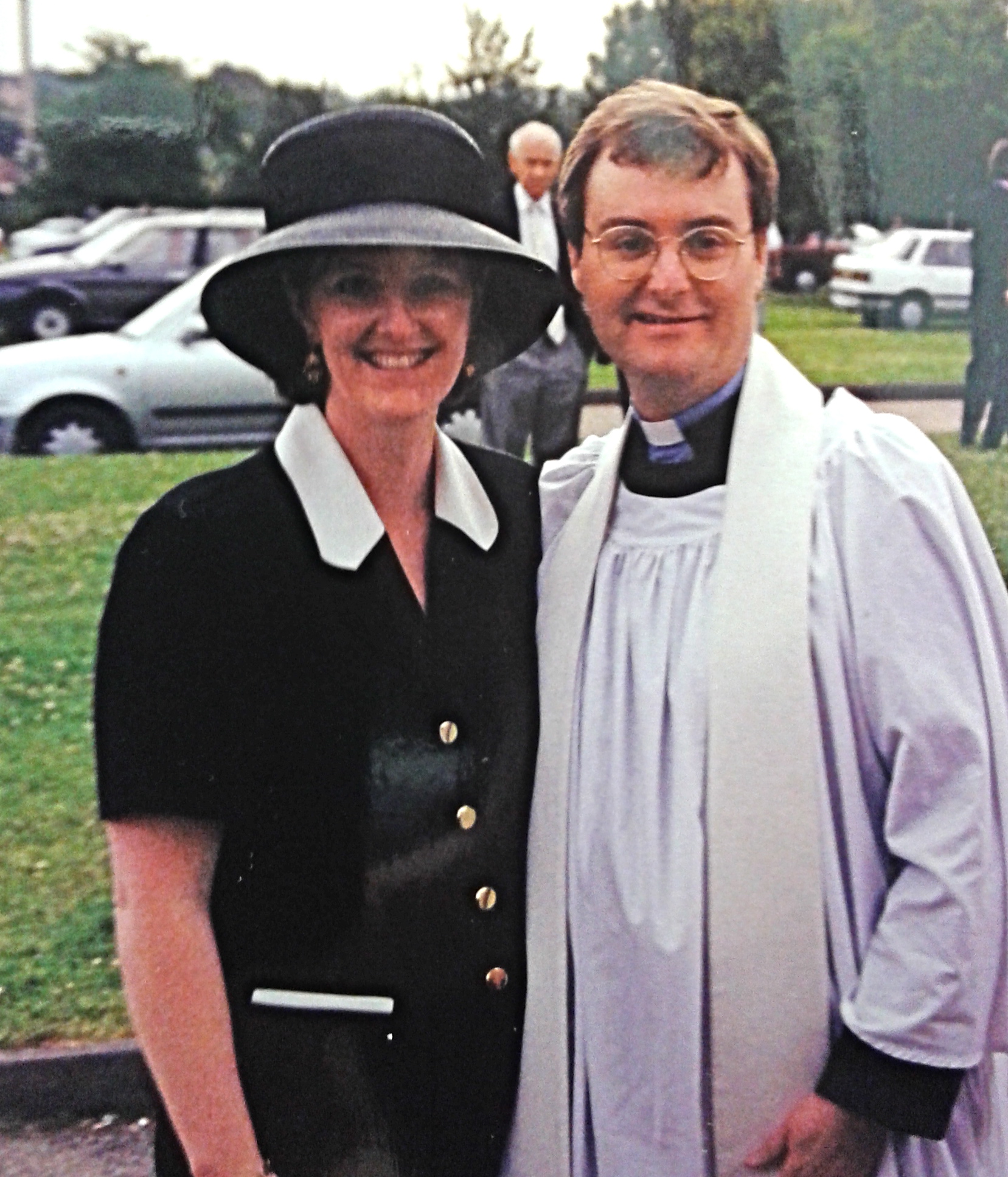
Nicholas’s priesting, which happens a year after being ordained a deacon (who knew it was so complicated?). I know, the hat; what was I thinking? Nice photobomb too.
Today my husband has been ordained a minister in the Church of England for 15 years. I remember the occasion so clearly as I sat in the cavernous Guildford Cathedral with his family and witnessed him making his promises to love, hono(u)r, and serve God and God’s people. As we drove back to Cambridge, I was keenly aware of him wearing his dog collar for the first time when we stopped at a rest stop – I felt like he was broadcasting, “Hey, I’m one of those crazy Christians!”
While Nicholas went on the pre-ordination retreat, I had stayed with some of his friends in Guildford and prepared for the post-ordination meal. This was my first experience of putting on a party for his friends and the church. I remember making salads; this lovely broccoli one was probably quite foreign to Brits then (at that time salads hadn’t reached the level of acceptance as they have now on these shores). A woman from his church, surveying the heaping buffet table, said what a good vicar’s wife I would make. Oh, how I cringed at that. I had hosted the party as a gift of love for my new husband, not out of duty or expectation. Couldn’t she see that?
I’ve learned many a thing through the years of sleeping with the vicar (or curate). Like gently elbow him if he’s snoring and he’ll turn over. Here are two things I offer from my experience as a VW (vicar’s wife) to other clergy spouses. If you’re part of a church, perhaps these points will help you see the minister and spouse (if applicable) in a new light.
Our first home in Surrey.
Be yourself
One of the first people I ever met in Britain was a lovely American who was married to a Brit who was also a vicar. She was originally from Wisconsin (I come from the next-door state, Minnesota). Ah the wealth of advice and love she showered me with. We shared great laughter too.
She told me how on her husband’s induction to his first church as vicar, she wore a T-shirt under her coat emblazoned with the slogan, “I don’t bake cakes!” She had a strong sense of self and was cheerfully and playfully taking on any hidden assumptions from her husband’s new flock.
Now I do bake cakes, and in particular I’m happy to whip up a batch of my famous brownies for church events. In typical convenience-oriented American style, I serve up the amazing Ghirardelli brownies. Yes, from a mix. One of my friends at church was rather crushed to realize I hadn’t made them from scratch!
But there are lots of ministries at the church I don’t feel called to. I believe that if I step into those roles out of sheer duty, I’ll deprive someone else of fulfilling their calling to serve (and I’ll probably have a stonking attitude). Of course there’s a balance here, and we need to pitch in at times when we don’t feel called when the need is great. And sometimes God calls us into areas we might previously have eschewed. For me, children’s ministry is one of those. I find the prospect daunting and deenergizing, as much as I love my kids. But our church needed leaders so I agreed and now find the times I lead the pre-teen group to be filled with joy and good discussion and fulfillment. I’m a better discipler than teacher-of-the-young, which illustrates my heading for this section, “Be yourself.”
Embrace your instant community
When a publishing colleague heard I was marrying Nicholas, he said from his previous experience as a pastor, “You’ll always have community.” Now that that can be a good thing but sometimes a harmful thing too. Yet his comment brought light and clarity to me as I approached the quick succession of churches that Nicholas had roles with in the first half-dozen years of his ordained life (two curacies and then his first vicarship, where we remain nine years later). My friend’s advice echoed the words from the book of Ruth that reverberated through my mind as we drove to Surrey for Nicholas’s first curacy: “Where you go I will go, and where you stay I will stay. Your people will be my people and your God my God” (Ruth 1:16, NIV). These were now my people – warts and all. And I was their people too – warts and all.
In my years as a VW I’ve witnessed episodes of the downside of community: backbiting, gossip, slander… It hasn’t been pretty at times and it can be excruciating to watch from the sidelines, feeling that all I can do is pray (which yes, I know is actually the biggest thing). Or having to gently disappoint people if they have expectations of me (which doesn’t happen often in our multicultural church in London). In Surrey during Nicholas’s first curacy I was working at HarperCollins. I was puzzled when one of the older ladies said to me during the refreshments after church, “I’m so looking forward to seeing you on Thursday!”
“I’m sorry; what do you mean?” I asked, trying to cover up my confusion.
“Nicholas is coming to our over-50s group.”
“Oh, I didn’t know,” I replied. “I work in London during the week so I’m not able to come.”
This photo of a church in the Costwolds illustrates how the church community can be at times. Sometimes with dark clouds; sometimes with fluffy ones; sometimes both at the same time.
Although there can be negatives, community has its upside too, such as my friend’s comment about the instant nature of the potential for relationships in a church. In each of the three churches where my husband has served, I’ve asked God to give me some friends. In Surrey my closest friends were of non-English nationality (not that I sought this out): Scottish, South African, and Irish. In Harrow, Nicholas and I were blessed to have friendships blossom with the two clergy couples and another couple in the church who are now mission partners in Moldova. Here in north London I enjoy a wealth of friends, especially with my female peers. These are the true riches that God bestows on his people.
Unsolicited advice
If you’re part of a church, here’s a bit of advice of how to love your clergy/clergy family (as applies).
Love them as individuals. They will fail at times and soar at others. Love makes it all better and easier.
Hold your criticism of the preacher’s sermon until during the week, and not right after the service when comments can feel more bruising.
If your minister is married, don’t assume the spouse knows everything going on in the church. If the minister is doing the job in the right way, the spouse won’t know the confidences.
Celebrate your church leader when appropriate. They need praise too.
Pray for them. As Alfred, Lord Tennyson, said, “More things are wrought by prayer than the world dreams of.”
And how about you? What advice would you give if you’re part of a clergy setup? If not, what have you observed if you’re part of a church?