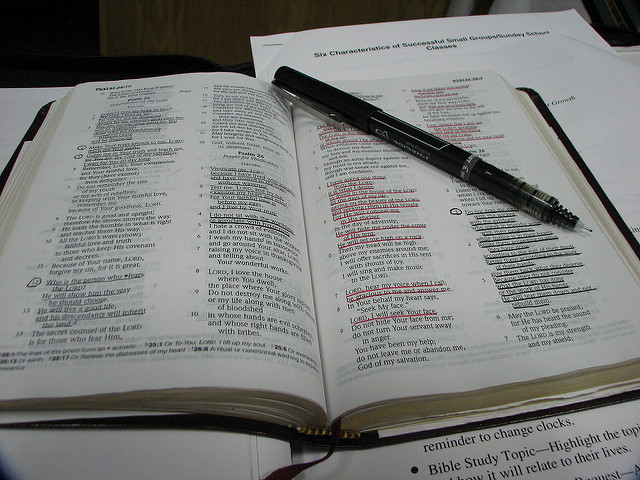
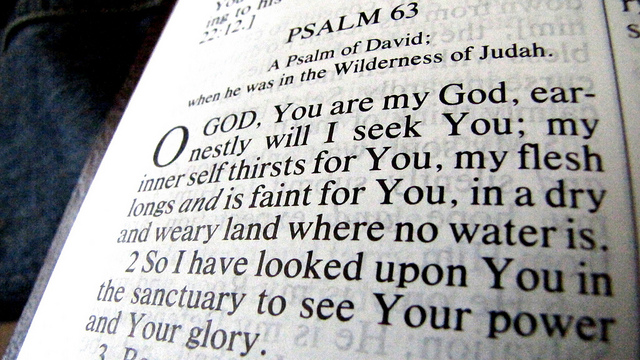
But as for you, continue in what you have learned and have become convinced of, because you know those from whom you learned it, and how from infancy you have known the Holy Scriptures, which are able to make you wise for salvation through faith in Christ Jesus. All Scripture is God-breathed and is useful for teaching, rebuking, correcting and training in righteousness, so that the servant of God may be thoroughly equipped for every good work (2 Timothy 3:14–17).
Many Christians memorize 2 Timothy 3:17, and I can understand why, for it’s the strongest statement about the Bible made in the Bible. But reading this statement on its own, out of the context of Paul’s letters to Timothy, dilutes its impact. As we’ve spent many a week considering these missives, we can gain a sense of the power of Paul’s view of the Bible – this crescendo at the end of the two letters reveals how he knows its worth and necessity in church life, especially when dealing with false teaching.
We can take comfort and courage knowing that Scripture is “God-breathed” and, as Hebrews 4:12 says, “alive and active. Sharper than any double-edged sword, it penetrates even to dividing soul and spirit, joints and marrow…” With the inspiration of the Holy Spirit, when we read the Bible we can hear God speaking to us: words of love and affirmation; words of conviction and direction. As Paul says, we will find teaching there, and sometimes the sense of being rebuked and corrected; through it we will be prepared and given the tools to do the works of God.
Dallas Willard, a renowned writer on the spiritual disciples, prized the practice of memorizing Scripture, and would regularly commit large passages to memory. He even said if one had to choose between a “quiet time” and memorizing, he’d choose the latter. When we do so, we find God’s word more readily available in our hearts and minds.
May we become wise for salvation through faith in Jesus Christ.
Prayer: Lord Jesus Christ, you are the Word made flesh. May you bring us wisdom as we read the Scriptures that we may serve you and reach out to those in need.
Today I have an article on Sacred Reading over at the Kingdom Life Now magazine. Here’s a taste.
Recently I led an exercise of meditative reading of the Bible. Four times I read the passage of Isaiah 43:1-8 with instructions to the women with a different emphasis in engaging with the text each time. About a month later, I was humbled to hear from one woman about how God spoke to her through the exercise. She said how she and her husband had been to Brunei in Southeast Asia a couple of weeks before the conference in Somerset, England, to visit their daughter and family (including three young grandchildren), who have lived there for the last seven years. While there, she learned that her son-in-law decided to apply for teaching jobs in Belgium, Singapore, and Oman. With Belgium being far closer to home, she and her husband were hoping this would be their final destination. She said,
When you read Isaiah to us the only sentences that I heard were verses 5 and 6, where it says, “I will bring your children from the East and your daughters from far-off lands.” How relevant to me were those words and I held onto them as a promise to me from God – that He was telling me that my son-in-law would get the job and my family would come close. I was so convinced that I told others what God was saying. So imagine the great joy when we heard on that he had been offered the job in Belgium and they were to start in September! No more 17 hour flight to see them! God truly had gathered my children from the East and my daughter from a far-off land.
She said that although before my talk she had never heard of lectio divina – a Latin phrase for the act of sacred reading – but now she had come across it several times.
Change Agent
This ancient practice of a slow, contemplative praying of the Scriptures moves what can be a merely rational process deep into one’s heart, for as we chew over a piece of Scripture, it sinks into our being. We begin to slow down, receive, and make a personal response. Continue reading.
I believe writing devotionals may be part of my soon-to-be-seriously-begun writing ministry. Have you any helpful tips as I start? I’m retiring at the end of March and although I will be a lay pastor, I will finally be able to give serious time to writing. I’ve read your CWR notes and love them!
Photo: “Bible time,” Brett Jordan, flickr
Hello and thanks for asking! I love, love, love writing Bible reading notes. As I prepare, I read and dream and research and wonder and pray, and then I get down to the writing. Often time seems suspended and I exclaim, “Wow, I love this, Lord!” But I say this acknowledging that not everyone has this experience when crafting devotionals. This kind of writing is my sweet spot; it’s part of how I’ve been made and who I am. And I’ve been writing devotionals since 2008. I haven’t counted up how many I’ve written for some time, but I’m guessing 400 or 500. So please don’t feel bad if you don’t experience the sense of sheer joy in your writing. It may come.
You asked for some tips as you dive in; here you go.
Make your words (characters) count.
“If I had more time, I’d make this shorter.” Writers of devotionals – Bible reading notes – don’t have the luxury of space. Usually the text is limited to around 300 words, so the content needs to matter. A publisher I’m currently writing for designates character (with spaces) counts, so there’s no fudging. You know, like those hyphenated words that only count as one word in a word count (The writer-who-likes-to-cheat Amy? Nope.) Write your first draft and then prune, prune, prune. Employ strong verbs – the passive voice eats up your word count. Delete adjectives and adverbs. And so on. (A read through of the classic Strunk & White can be enlightening before you dive in.)
Gather your thoughts.
In the weeks before your deadline, read through the text you’ve been assigned (or that you’ve chosen) prayerfully, asking God to reveal what he wants you to write. Start a “thoughts” file on your computer/device where you can jot down notes and illustrations that occur to you. Writers train themselves to notice details – it’s as if while we’re experiencing a near car accident, we’re also taking notes on what we were thinking when the car in front of us stopped, the hue of the sky and how the light hit our eyes, the pounding feeling in our chest when our foot reflexively hit the brakes and the car stopped just in time, and the “Thank you, Lord” prayer we exhaled. (Do stop the car before you note these down.)
Photo: Savio Sebastian, flickr
Submit yourself to the text.
I love writing notes that are assigned to me – such as the series I’m going through on my blog on Hosea, or the series on verse by verse of Psalm 18 (start from the bottom of the links). We so often skip over the hard bits in the Bible, and so writing on a chunk of Scripture in a series can be an effective way to avoid this.
But I also mean in submitting ourselves to the text that we seek not to read what we want to read in the Bible, but what God has put there. Do some research and find out the context. Don’t just jump to handy conclusions. Ask God’s Holy Spirit to reveal the meaning. Leading to…
Research.
When I first started writing Bible reading notes, I spent a week or more reading and taking notes on various Bible commentaries. In one sense I needed the help because I hadn’t engaged with the Bible at that level before. (Those of you who preach regularly will have the benefit of this close engagement.) But in another sense I found myself crippled to form my own opinion. In doing so much background reading, I was in danger of merely parroting back the ideas in the commentaries. I had to put my notes aside for several days so that I wasn’t stealing the content of others in what I wrote. (Of course, there’s nothing new under the sun, and we unconsciously share the wisdom of others all the time – along with the inspiration of the Holy Spirit.)
A lovely letter from a reader who sent me a Thanksgiving card for many years.
Journey with the reader.
This probably doesn’t need stating, but you as the writer are a fellow pilgrim, and in the writing of Bible reading notes, you’re often sharing what you’re learning even as you write. So put on the cloak of humility, because wow it’s so amazing to get paid to submerge ourselves in the Bible and to share what we’re gleaning with others!
Yes, you can use the classic formula.
Devotionals often start with an arresting anecdote, which links to the biblical text that the writer delves into, which leads to the application. So that would be
Illustration
Text
Application
Being one who likes to buck the rules, I like to vary things up, sometimes diving straight into the text, for instance. But I do seek to add an application for each reading – after all, we do want to be living under the wisdom of God’s word.
Weave in biblical text.
I love to fold into my reflections various verses from Scripture. I don’t seek to do this slavishly, for that would make it feel forced, but often in the prayer section at the end of the devotional, a verse will stand out to me as suitable for prayer and reflection. (I don’t have the mind of NicTheVic who can name chapter and verse when it comes to Scripture. I have fragments and pieces stored in various levels of my brain, so I find the search facility at BibleGateway a fantastic resource for bringing them to the fore.) Reminding the readers of the great sweep of Scripture can be helpful too, depending on what you’re addressing.
Pray.
This is the most important element of writing devotionals. Pray before you start; pray while you’re writing; pray while you’re rewriting; pray when you send off your work to your editor. We trust that God will inspire us with his word; we yearn for him to bring just the right encouragement for the broken-hearted, the lonely widower, the overwhelmed parent. We oftentimes write a year in advance, so we can’t control the outcome or the effect of what we write. Which makes the sometimes miraculous meetings between devotionals and the reader’s experience so humbling (as I wrote in a blog about some notes that God used during an earthquake in New Zealand).
I can’t explain how sometimes an illustration will pop into my head when I’m writing. Oftentimes I approach the text without seemingly a clue of where I’ll go with it in terms of the illustration and application. But as with so many creative pursuits of collaborating with God, we take the first step and he helps us to continue. As with the Israelites wandering through the desert who had enough food for the day, he provides just enough inspiration for the devotional we’re writing.
A “wow this is humbling” letter.
Try to develop a thick skin.
The first publication I wrote for had an exacting readership. Any theological matter I addressed could be questioned; any uninformed opinion taken to task. I came to dread the letters from readers, for they pointed out where I was lacking. But the readers’ letters made me welcome my editor’s comments all the more, for she knew her readership and was careful to massage my text into a more acceptable format (without asking me to budge on key theological matters). I always took the time to reply to these readers (asking God to let a humble response come through), for they had taken the time to write to me.
Then I wrote a series on being a pilgrim in a foreign land. Bulky packages from the publisher started to pop through my letterbox, and amazingly, this time the readers wrote with their stories of feeling in exile! The publisher said they had never had such a big response in terms of feedback. I heard from other Americans living in the UK or those with connections to other countries. I felt overwhelmed with gratitude at this response, made all the sweeter by my long history of not-so-easy reader letters.
I hope this is helpful; do let me know how you get on. And thanks for your kind words about the CWR notes. I’m humbled when people find my writing helpful or inspiring. Praise God!