Against all hope, Abraham in hope believed and so became the father of many nations, just as it had been said to him, “So shall your offspring be.” Romans 4:18–25
Abraham and Sarah are two of my favorite characters in the Bible, partly because of what they experienced and felt. For instance, they faced the heartbreak of infertility for years before God promised Abraham that he’d be the father of many nations. Abraham’s biggest point of need – his desire for a son – was right where God met him. And not only met, but exceeded with mind-blowing abundance, for he promised that Abraham would have more descendants than the stars in the sky.
Abraham held on to God’s promise, even when it seemed impossible. In terms of him and Sarah conceiving a son, he believed God even though Sarah was long past her childbearing years. And God delivered; they had Isaac. Then Abraham held on to God’s promises through the heart-wrenching experience of being asked to sacrifice his beloved only son. Abraham knew that God would find a way to keep his promise, perhaps through the resurrection of the dead. For God had never failed him. And indeed, an angel of the Lord provided a ram in the place of Isaac.
Such hope and faith is modeled through a life of listening to and obeying God. As we mature in our faith, we learn to relinquish the requests that may not be of God or may not be for our best. We can ask God to change our hearts to align our desires with his. And our faith will grow as we look back and see how God has answered our prayers. I love reading through my old prayer journals, not only because they immediately and vividly transport me to times past, but because they reveal how faithful and loving is our God.
How might you be persuaded that God has the power to do what he has promised?
For reflection: “By faith Abraham, when called to go to a place he would later receive as his inheritance, obeyed and went, even though he did not know where he was going” (Hebrews 11:8).
“Do not do anything to him. Now I know that you fear God.” Genesis 22:12
Fearing God seems to have fallen out of fashion. We sing love songs to Him; think of Jesus as our best friend; spend times wittering with the Lord (and I hasten to add that I welcome all of these ways of relating to the triune God, for we are blessed to worship a God who communicates with us in many different ways). But do we bow our knees and honor him as the infinite, never-ending, all-powerful, holy, holy, holy God?
Because Abraham feared God, he obeyed him, and this obedience is counted to Abraham as righteousness. Abraham was released from following through on his act of sacrifice – it’s the only time in the Bible that God sends the order to halt proceedings. And so Abraham, as the writer to the Hebrews says, is one of a great cloud of witnesses who surrounds us. We who have the benefit of these great heroes of the faith should therefore throw off the sin that entangles us as we run with perseverance the race marked out before us, setting our eyes on Jesus (12:1).
As Isaac carried the wood on which he would be sacrificed, so did Jesus carry his wood – his cross, enduring its shame. Today, in holy reverence and awe, may we fear the Lord, considering Jesus’ sacrifice that we may not grow weary and lost heart.
Prayer: Lord Jesus Christ, Son of the living God, have mercy on me, a sinner. Amen.
The shock of uprooting and moving and the hidden graces – that’s what Peter Edman so eloquently addresses in his contribution to the “There’s No Place Like Home” series. I’m grateful to hear Peter’s thoughts, not least because they remind me of our many years of working together in the nation’s capital. We were like brother and sister at times, squabbling but with that fraternal love that meant I knew I could call on him when I was stranded at Baltimore airport at midnight and he’d come to rescue me. True friendship to me gives a taste of Home.
One of my acquaintances used to introduce himself to an audience by giving his name and quipping, “I’m from Washington, DC, and I’m here to help you.” He usually got the wry laughter he was expecting. I too used the line over the two-plus decades I made my home in DC and Northern Virginia. Then I was transferred to Philadelphia, and I’ve been a bit wistful at leaving behind that comfortable joke—and a comfortable identity informed by that influential city.
DC is not a homey place, but we found stability and community there. I stayed at the same church and eventually managed to have most of my family close to us. The relocation—four residences and three offices in three years, all three hours farther from grandparents, cousins, and friends—has meant making a new life for myself and my family. It’s meant finding a new home while negotiating pointers, hopes, and compromises. And in a sense, recentering my identity.
The pointers, at least, have been pretty clear. A mandate to move if I was to keep a stable job doing interesting and meaningful work. The discovery of a new church that continues several relationships with our old church. The quick sale of our old house. Creative financing that secured a newly renovated historic house with room for our five children. A new family with kids unexpectedly moving in across the street.
Our new home.
There have been other pointers, even up to this weekend. On Saturday I was preparing for this post and began to think about Hebrews 11. On Sunday it was my turn to read the New Testament lesson at church, and I discovered Hebrews 11 was the assigned passage. “By faith Abraham obeyed the call to leave his home”—in an influential city—“for a land which he was to receive as a possession; he went away without knowing where he was to go” (Hebrews 11:8 REB). I am glimpsing more of its meaning now.
Our hopes have been met in part and redefined in part. We are compromising. After so many years in prosperous suburban settings, we’re still adjusting to the vigilance required in our new, mixed urban neighborhood. We don’t want to afford two cars in the city, but with public transit, my commute is the shortest it’s ever been. Our house renovations were extensive, and we have space for hospitality, but its “architect and builder” (11:10) was not God, and a series of leaks taxes our patience and our budget. We could not afford to live near our new church, but we can host a home group.
The Edman brood.
For introverts it’s hard to reach out and build new friendships, let alone replace missing support structures, but both are happening slowly. Already we know more neighbors here and have more connection with community groups than we did over our years in Virginia. The lack of pretense and the friendly attitude toward our small children in public spaces are refreshing.
The expectations on us are different too. No one asks me what I “do” anymore. I’m not expected to “help,” just to participate, to be a neighbor.
I am reluctantly seeing value in the compromises. My nature is to treat my home as a safe space, a gated community. But Abraham settled as an alien, not as an insider—“living in tents” along with his children and grandchildren (Hebrews 11:9). You can’t depend on tent fabric to keep your possessions safe, and indeed the writer tells us that Abraham was “looking forward to a city with firm foundations” (11:10), “longing for a better country” (11:16). His identity was not dependent on walls, riches, social standing, or citizenship—and yet he is remembered not only for faith but for exploits of hospitality, generosity, even warfare. God took care of his children. But no one now remembers who was king or top socialite back in his hometown. It’s worth reflection.
The joys and flaws of my new city and my new house, along with our increasing awareness of our need for help, offer regular reminders that my home, my citizenship, is not finally here. I can live with my family like resident aliens, offering and receiving hospitality, raising my children, serving those around me, and hopefully living as a pointer to the God who, in spite of all appearances, rewards those who seek him (11:6).
My name is Peter. I’m not here to help you. But perhaps I can remind you to long for a better country.
Peter Edman, an editor, is a quality assurance manager with American Bible Society, where he also manages the product line for trauma healing programs now active for adults and children in more than 80 countries and 150 languages worldwide. He lives with his wife and five children in the Germantown neighborhood of Philadelphia. You can reach him at @pledman.
Then he reached out his hand and took the knife to slay his son. Genesis 22:10
As we read this story in Genesis, it seems like time slows down. Each step as Abraham moves towards the slaying of Isaac feels like it happens in slow motion: they reach the place God told them about; Abraham builds an altar; he arranges the wood; he binds his son; he lays him on the altar… And then (big breath), he reaches out his hand (heart pounding) and takes the knife (hand shaking) to slay his son (“Whatever am I doing?”).
Abraham proves himself worthy of being the father of nations. He doesn’t grasp the promises of God too tightly, nor has he made the promises themselves into an idol. Therefore God is pleased to move forward with his covenant with his people.
Consider how this story, right at the beginning of our Bibles, reveals God the Father’s love for us. As we read the account of Abraham, we sense some of the pain and loss this earthly father must have felt. The Lord God on such a greater scale experienced the depth of this anguish when he sent his only Son to live on the earth and die on behalf of the people who often turn to their own ways.
May we honor our Father whose sacrificial love saves us from despair and the consequences of sin.
Prayer: Heavenly Father, your love never ends. Saving Son, thank you for your sacrifice. Convicting Spirit, we’re sorry for our sins. Amen.
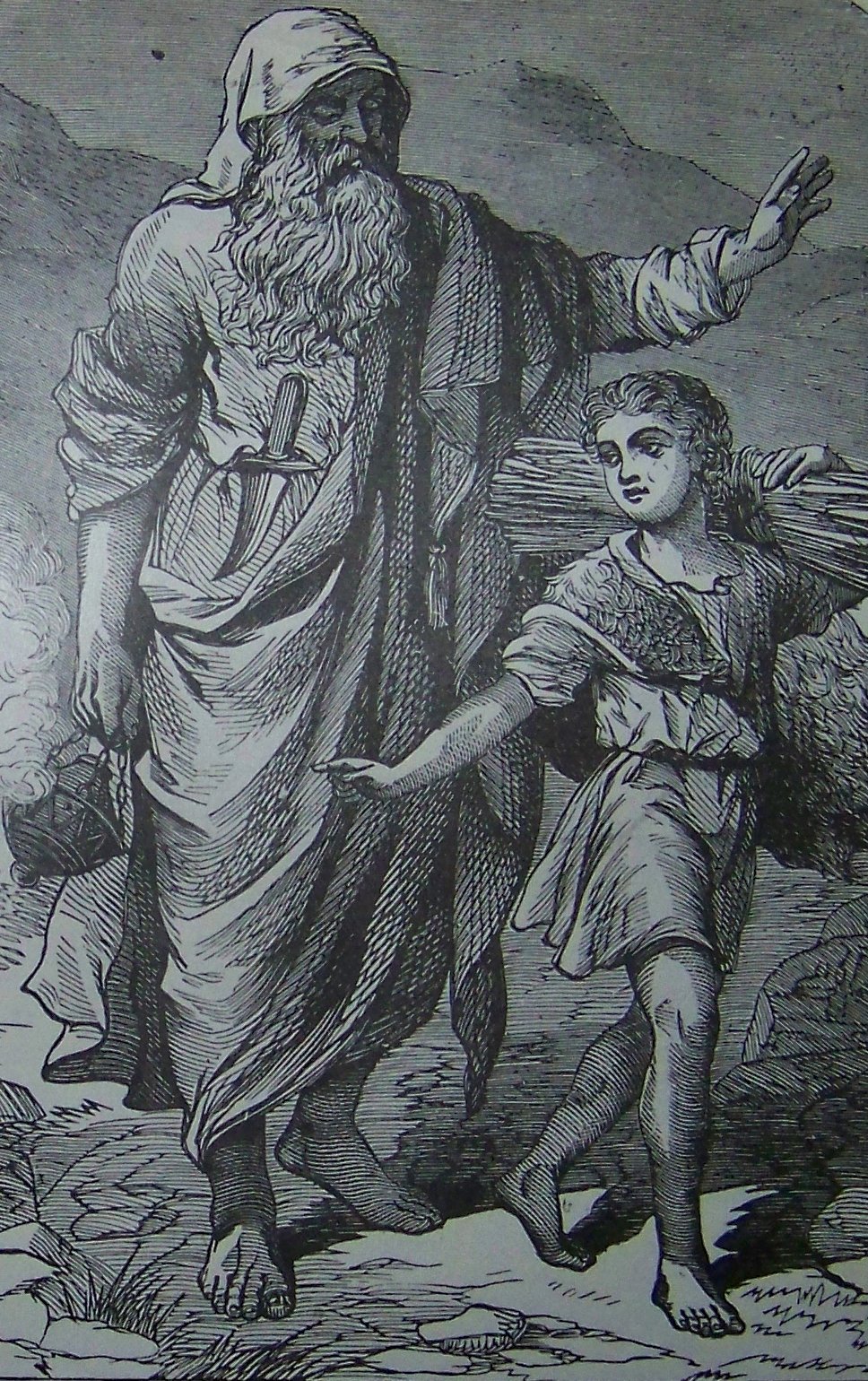
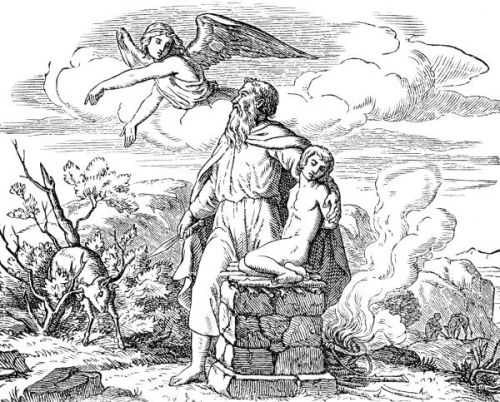
Abraham going up to offer Isaac as a sacrifice, as in Genesis 22, illustration from the 1890 Holman Bible.
“We will worship and then we will come back to you.” Genesis 22:5
Matt Redman’s song “Blessed Be Your Name” has helped many voice the mystery of worshiping God when we’re suffering. Though we feel “pain in the offering,” yet blessed is God’s name. We may croak the words through tears or gritted teeth, but the act of singing can inform our emotions.
Abraham names what he is about to do as worship. He doesn’t know why God would ask him to sacrifice his son, but he trusts in the Lord. Biblical commentators remind us that child sacrifice would not have appeared as shocking to Abraham as it does to us, for back then it was common for deities to demand this as an act of worship – though of course the true and living God is not just any deity.
Note also what Abraham says to his servants: “We will come back to you.” Did he sense that God would stop him from killing his son? We don’t know, but we can marvel at his faith, finding encouragement that a man who once lied to Pharaoh, calling his wife his sister, or who another time tried to fulfill God’s promises through his slave, is now a man of great faith.
How might we worship the Lord today, even if we are walking the road of suffering? May we affirm him as our loving Father who wants the best for us.
Prayer: Lord God, you sacrificed your only son that our slate might be wiped clean. Thank you for your love.
Take your son, your only son, whom you love – Isaac – and go to the region of Moriah. Genesis 22:2
They say losing a child is the hardest thing to experience. One day your hopes and dreams for your son or daughter live and breathe; the next they seem quashed. Your world has changed inexorably, and how God fits into the questions of why can lead to a lifetime of questing. (I write from empathy, not experience.)
The Lord God didn’t require of Abraham something he wasn’t willing to do himself – sacrifice his only beloved son. We see in the Lord’s instructions that he knows what he asks of Abraham – this is Abraham’s only son; the one who will fulfill God’s promises. It seems unthinkable.
Yet Abraham obeys, setting off on the three-day journey to Moriah. Consider what Abraham must have been thinking and feeling. Every step closer to Moriah marked less time with Isaac. Did he battle internally, questioning God? We don’t know, but as we see in Hebrews 11:19, he came to a point of acceptance, for he “reasoned that God could even raise the dead.”
Wrestling with the questions of “why” can eventually be a means of strengthening our faith, as we work through with God the issues that we don’t understand. This side of heaven, we won’t fully comprehend, but I hope the character of God – His goodness, faithfulness and love – will frame our questions and answers.
Prayer: Triune God, there’s so much we can’t fathom; at times our grief feels too much. Show us your great love. Amen.
We embark on a new seven-week series in which we explore a famous story from Genesis. That the Lord would ask Abraham to sacrifice his son may boggle our minds, but we will see what was behind this request as we travel through the passage. We can be inspired and encouraged by Abraham’s obedience to God’s voice, knowing that the Lord of this patriarch is too the God who made us and formed us, and loves us as his own.
Some time later God tested Abraham. He said to him, “Abraham!”
“Here I am,” he replied.
Then God said, “Take your son, your only son, whom you love – Isaac – and go to the region of Moriah. Sacrifice him there as a burnt offering on a mountain I will show you.”
Early the next morning Abraham got up and loaded his donkey. He took with him two of his servants and his son Isaac. When he had cut enough wood for the burnt offering, he set out for the place God had told him about. On the third day Abraham looked up and saw the place in the distance. He said to his servants, “Stay here with the donkey while I and the boy go over there. We will worship and then we will come back to you.”
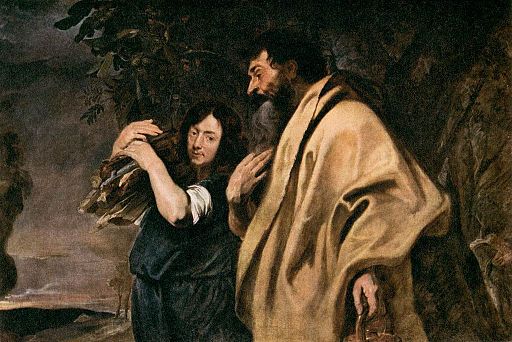
Abraham took the wood for the burnt offering and placed it on his son Isaac, and he himself carried the fire and the knife. As the two of them went on together, Isaac spoke up and said to his father Abraham, “Father?”
“Yes, my son?” Abraham replied.
“The fire and wood are here,” Isaac said, “but where is the lamb for the burnt offering?”
Abraham answered, “God himself will provide the lamb for the burnt offering, my son.” And the two of them went on together.
When they reached the place God had told him about, Abraham built an altar there and arranged the wood on it. He bound his son Isaac and laid him on the altar, on top of the wood. Then he reached out his hand and took the knife to slay his son. But the angel of the Lord called out to him from heaven, “Abraham! Abraham!”
“Here I am,” he replied.
“Do not lay a hand on the boy,” he said. “Do not do anything to him. Now I know that you fear God, because you have not withheld from me your son, your only son.”
Abraham looked up and there in a thicket he saw a ram caught by its horns. He went over and took the ram and sacrificed it as a burnt offering instead of his son.So Abraham called that place The Lord Will Provide. And to this day it is said, “On the mountain of the Lord it will be provided.” Genesis 22:1–14 (NIV)
“From everyone who has been given much, much will be demanded” (Luke 12:48). So said Jesus to his disciples, but this statement could equally apply to Abraham. The man known as the father of the nations was one who obeyed (Hebrews 11:8). Much was given to him, but much was also required.
When we consider the story in our text, however, we may wonder why the Lord would put his servant to the test. We’ll see hints later in our series, but for this week, consider how we respond when we feel tested. Are we like Abraham, who when God calls him, says, “Here I am”? He has learned how to discern the voice of God over time and thus presents himself before him, ready to listen and obey. His trusting relationship with God prepares him to follow his commands.
I don’t believe God will put us to the test in such an extreme way as he did with Abraham, but I’ve seen him allow hard things in life, which tests our faith. One day I asked a friend whose husband and daughter had died about her relationship with God. She said, “Who else can I turn to? He’s my rock.” What a humbling, faith-filled response born out of the crucible of pain and suffering.
May our faith be strengthened, that we may be found ready.
Prayer: Father God, shine your light on the Scriptures, that we might understand and love you more. Amen.
By faith Abraham, when God tested him, offered Isaac as a sacrifice. He who had embraced the promises was about to sacrifice his one and only son, even though God had said to him, “It is through Isaac that your offspring will be reckoned.” (Hebrews 11:13–19)
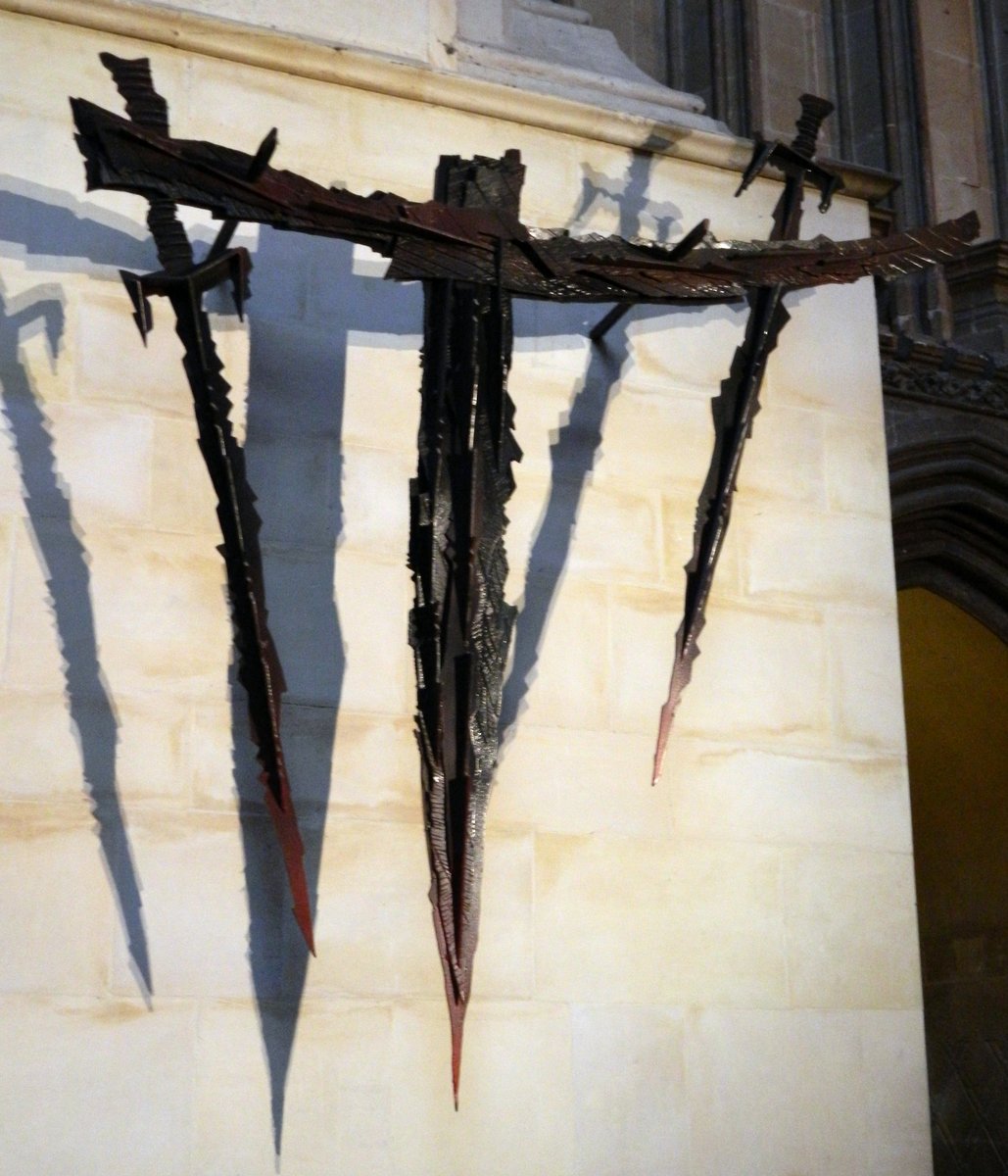
A cross from Canterbury Cathedral, marking the spot where Thomas Becket was murdered. Makes me wonder what sort of implement Abraham held over Isaac. His son was saved, but the Father God’s was not.
Our passage in Hebrews doesn’t gloss over the challenges that the heroes of the faith endured. One of the most moving is Abraham’s test in relinquishing his firstborn son, Isaac. Here God seems to be asking the impossible of Abraham – to sacrifice what Abraham thought fulfilled God’s promises. Abraham couldn’t conceive of how God would rectify matters, but went ahead in building the altar and arranging the wood, and even in binding up Isaac. What fear father and son must have felt when Abraham drew back his knife in obedience.
But God didn’t make Abraham follow through, promising instead that Abraham would have as many descendents as the stars in the sky or the sand on the seashore. By faith Abraham passed God’s test, having followed God for many years. He had learned how to obey God’s instructions, even when he didn’t understand why or how God would make things right.
What about us? Have we learned how to discern God’s voice that we might obey with a willing heart, like Abraham did? What’s our greatest point of need? We might be praying for a wayward child. We might long to marry or have children or grandchildren. We might yearn for some strong and healthy friendships. We might be hoping for a home that will bring peace and refreshment to our family and visitors. We might be seeking paid employment that employs our passions and our gifts.
In all these things God wants to meet our needs, “according to his glorious riches in Christ Jesus” (Philippians 4:19). He might test us to hone our listening skills, that we may hear his voice more clearly. But he will never fail us – he who sacrificed his only son that we might live.
Father God, you didn’t stop your son being slain on the altar, a worthy sacrifice for our sins. Thank you.
By faith Abraham, when called to go to a place he would later receive as his inheritance, obeyed and went, even though he did not know where he was going. By faith he made his home in the promised land like a stranger in a foreign country… (Hebrews 11:8–12)
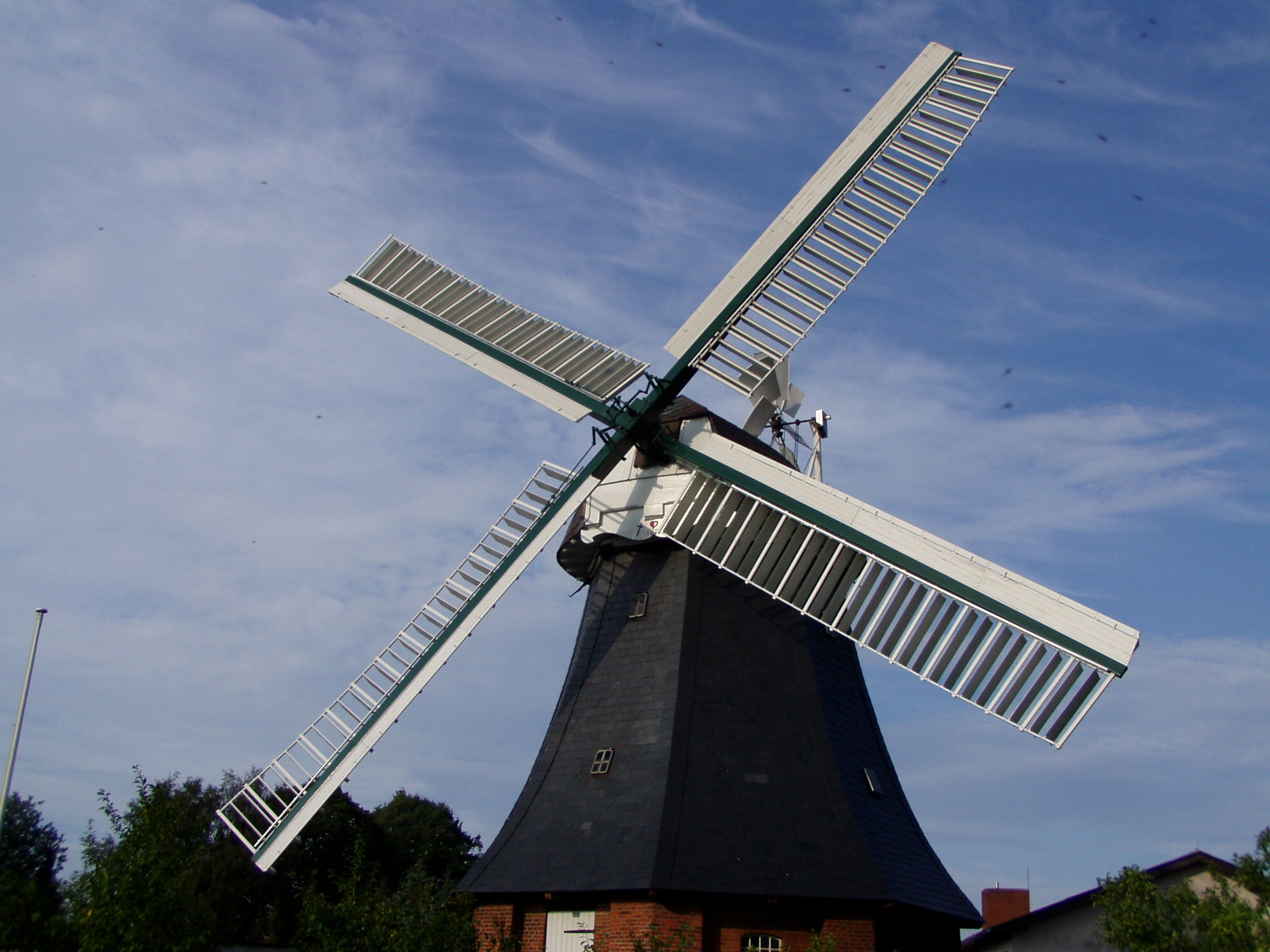
My great-grandfather was a pilgrim to a strange land. In 1898 he left Germany for America, having to renounce his German citizenship. This windmill was built in the village he lived in before he left, which we visited in 2006.
A closeup from the windmill – faith, hope, and love.
One US Independence Day, I was ending a silent retreat at an Anglican convent before traveling back to Washington, DC to watch the fireworks by the Lincoln Memorial. While on retreat God had impressed on my heart the story of Abraham, especially from these verses in the book of Hebrews. Here was one who left his home and became a stranger living in a foreign land.
I felt like the Lord was speaking to me through Abraham’s story. For I had been asking God to confirm whether it was right to marry the Englishman I had been dating. I sensed that the marriage was right, but I was starting to see that it would not be without cost. I also caught the irony – as I was celebrating our nation’s independence from the British, I was also affirming that eventually I would become a subject of the Queen.
Abraham obeyed and went, not knowing where he was going. For me, in my excitement to marry my beau, I hadn’t considered that I might have to obey God in this union. For although I had visited the UK, I didn’t know where we would be living. I would not have guessed that we would move three times in our first five years. Or of the crushing homesickness that I would feel for my family. I didn’t know it then, but by faith I too would need to make my home in this promised land.
And though the UK is now home, I often with Abraham long for the heavenly city. When I’m missing my American people or links, I try to cast my mind on the city where there will be no more mourning or crying or pain, where we will live in amazing unity and joy. Come, Lord Jesus.
Father God, we often feel like strangers here on earth, whether in the country of our birth or another. Take this dissonance and use it for your glory.

 The shock of uprooting and moving and the hidden graces – that’s what Peter Edman so eloquently addresses in his contribution to the “There’s No Place Like Home” series. I’m grateful to hear Peter’s thoughts, not least because they remind me of our many years of working together in the nation’s capital. We were like brother and sister at times, squabbling but with that fraternal love that meant I knew I could call on him when I was stranded at Baltimore airport at midnight and he’d come to rescue me. True friendship to me gives a taste of Home.

 The joys and flaws of my new city and my new house, along with our increasing awareness of our need for help, offer regular reminders that my home, my citizenship, is not finally here. I can live with my family like resident aliens, offering and receiving hospitality, raising my children, serving those around me, and hopefully living as a pointer to the God who, in spite of all appearances, rewards those who seek him (11:6).
 Peter Edman, an editor, is a quality assurance manager with American Bible Society, where he also manages the product line for trauma healing programs now active for adults and children in more than 80 countries and 150 languages worldwide. He lives with his wife and five children in the Germantown neighborhood of Philadelphia. You can reach him at