Tag: 7 Ways to Pray

  • ‘Rummaging For God’ by Penelope Swithinbank: 7 Ways to Pray blog series

    How can we look back with God in order to move forwards? Penelope Swithinbank shares from her years of spiritual direction how she helped someone recalibrate her decision-making process as she discerned her movements towards and away from God through the prayer of examen. I love the hands-on nature of Penelope’s exploration of this prayer practice, which can enrich our lives.
    Laura twisted her fingers and heaved a deep sigh.

    ‘I really don’t know what to do,’ she said. ‘I think my job’s about to be made redundant; my parents aren’t well and maybe I should move closer to them, but I love my job, my church and my home here. How do I know what God’s plans are for me? What if I step out of His plans?’

    As her spiritual director/counsellor, I felt God nudging me to give Laura a challenge. I suggested to her that for the next month, four whole weeks, she should ask herself two questions last thing at night.

    First, a question of consolation. ‘What am I thankful for today?’ ‘Where have I known true joy today?’ Or, ‘Where did I see God at work?’  

    And then a question of desolation. ‘Where did I fail God today?’ ‘Where was I not at peace today?’  ‘When or where was I not content, not filled with God’s Spirit?’

    I suggested Laura jot down her answers to the questions, just briefly, so that in a month’s time she’d notice any patterns, anything important, anything that the Lord wanted to point out or suggest to her.

    These two questions are the basis of the ‘Examen of Conscience,’ a centuries-old way of praying that helps us detect God’s Presence in our lives and discern where He is leading and guiding us. It was used by Ignatius of Loyola, (16th C) who recommended praying it daily – and then twice a day, so that people keep short accounts with God.

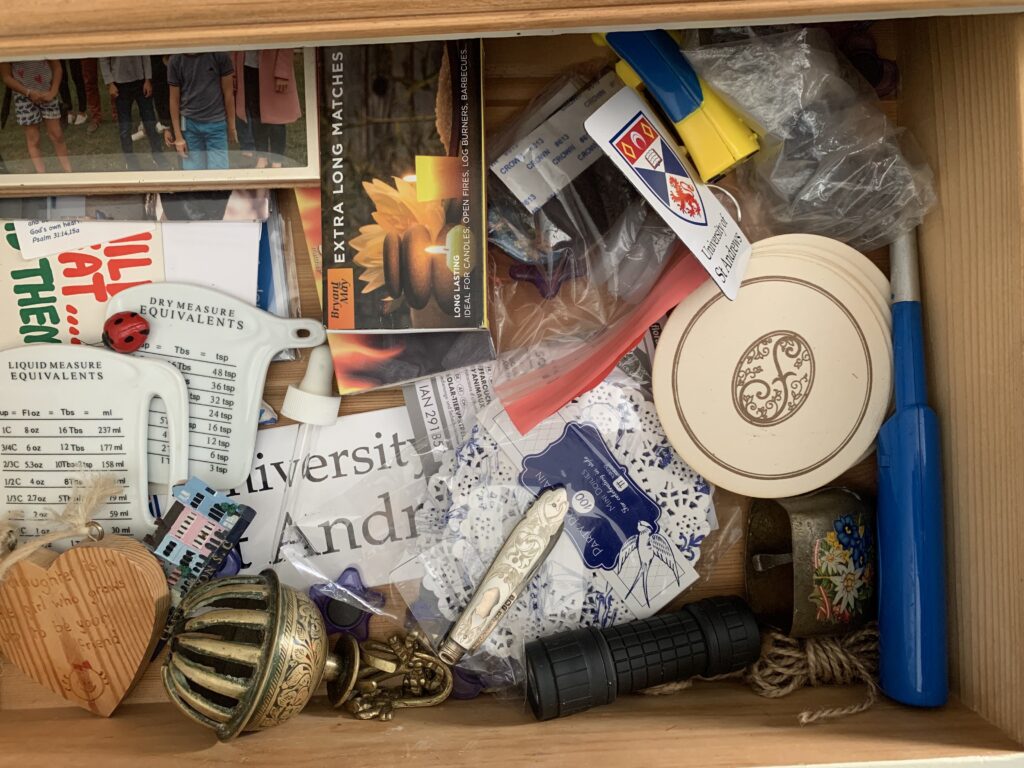
    Dennis Hamm describes it as ‘rummaging for God’ and says it’s like ‘going through a drawer full of stuff, feeling around, looking for something that you are sure must be there.

    It’s a rummaging back through the day, knowing that God was there, and we want to discover and be reminded of just where and how He was with us. A prayerfully going backwards through your day, with God’s help, to discern what’s most important – the things of God.

    We want to hear His voice today, not close our ears, (i) and the Examen is one way to help us to do that. While the traditional name is The Examen of Conscience, which sounds as though you’re just looking for moral failures, the word ‘conscience’ probably had a deeper meaning of ‘consciousness,’ of being alive and acknowledging it mindfully. And of being grateful for the many gifts and blessings of the past twenty-four hours. Who doesn’t like getting gifts – but how often do we give thanks for God’s gifts each day?

    Laura agreed to the challenge – and was very excited to try it. She even bought a lovely new journal for her daily Examen night prayer. Not everyone writes down what happens during the Examen, but I wanted Laura specifically to look for patterns and rhythms as she talked with God. I suggested that she begin each time by inviting the Lord to come and be with her and speak to her; then to ask herself the two questions and talk with Him about her answers, and finally to invite the Lord into what might lie ahead for the following twenty-four hours. (ii)

    A month later, a peaceful Laura reported back. Her earlier worried questions had receded, because she had discovered something far more important than the specific whats and wheres and hows.

    ‘God’s plan is for me to be more like Christ in my everyday life,’ she explained. ‘Where I live or what job I do is secondary. Important but secondary. And going to sleep having rummaged around and put it all to rest, and then invited God into the following day, has not only led to extraordinary peace but a much better night’s sleep!  I’m going to be making some important decisions in the next few weeks but now they’re based on a relationship with God and not on my fears and worries. And that’s made a huge difference to my everyday life.’

    (i) Come and kneel before this Creator-God,
    come and bow before the mighty God, our majestic maker!
    For we are those he cares for, and he is the God we worship.
    So drop everything else and listen to his voice!
    For this is what he’s saying:
    “Today, when I speak,
    don’t even think about turning a deaf ear to me”
    (Ps 95: 6-9, TPT)

    (ii) The five steps of the traditional Examen.

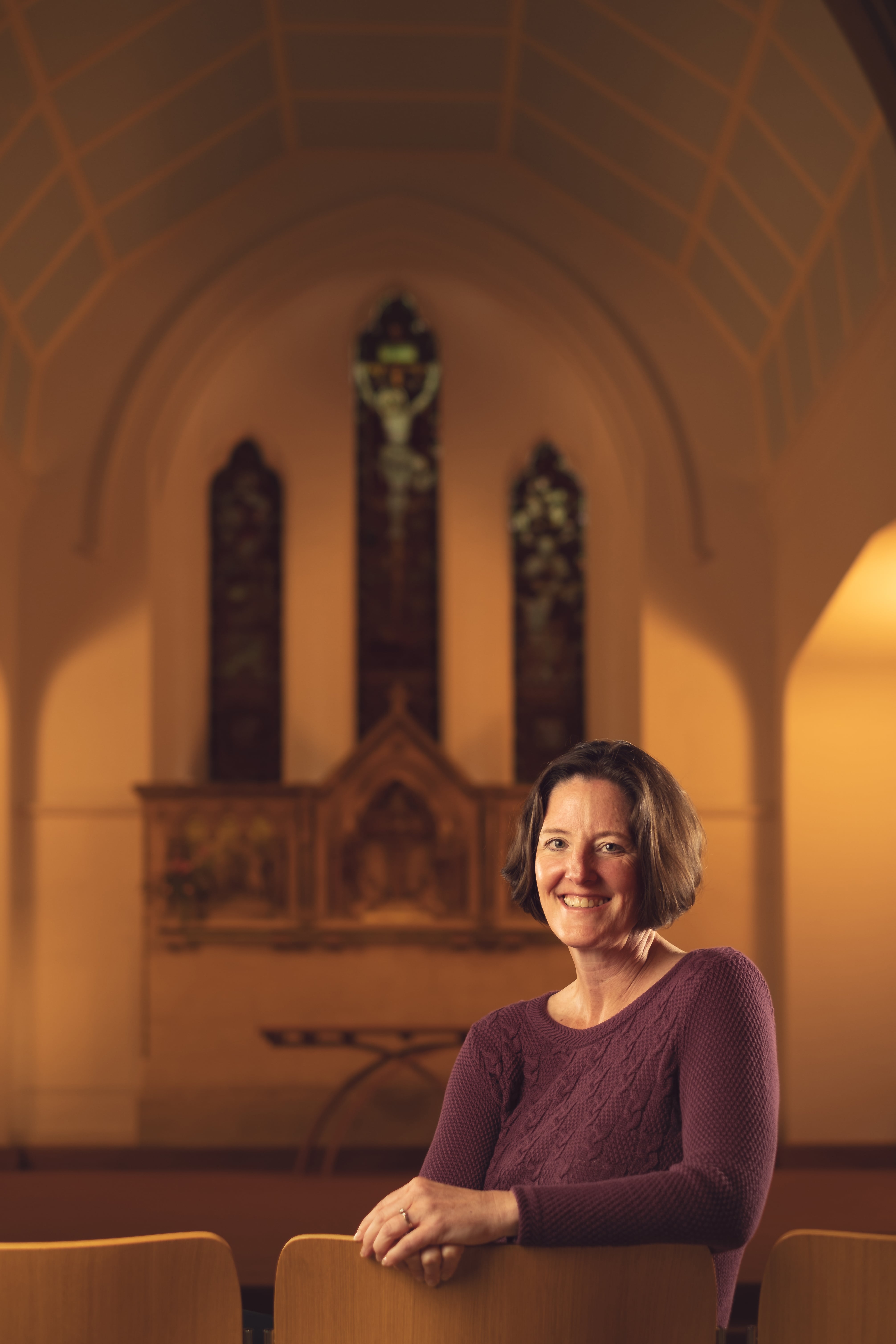
    Penelope Swithinbank is an experienced pilgrimage/retreat leader, conference speaker and Spiritual Counsellor. She has had an international ministry, including churches in America and the UK, and her most special memory is of opening the US Senate in prayer and being guest chaplain for a day. Penelope is an avid walker and spends a lot of her time stomping in the hills and valleys near her home outside Bath. 

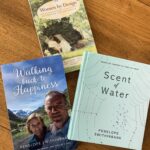
    She is the author of three books, Women by Design and Walking Back to Happiness; her third, Scent of Water, a devotional for times of spiritual bewilderment and grief, has just been published. She is a wife, mother and grandmother and says of the 6 grandchildren that they are so wonderful she should have had them first. www.penelopeswithinbank.com

    Order 7 Ways to Pray here, including in the US, UK, and Australia. The seventh way to pray is the examen, so you can explore this life-giving prayer practice further. You’ll also find lots of resources for small groups – videos and a leader’s guide – here.
  • How to Practice the Presence of God

    How can we fix our minds on Christ? One way to practice the presence of God – to remind ourselves that through his Spirit he lives within those who follow him – is to focus on certain Bible passages.

    Why not set aside a week to engage with this way of praying? Following are seven Scripture texts – you could focus on a different one each day.

    Know that God delights to meet us when we pray.

    • ABIDE – John 15:4: “Remain in me, as I also remain in you. No branch can bear fruit by itself; it must remain in the vine. Neither can you bear fruit unless you remain in me.”
    • SET YOUR HEARTS AND MINDS – Colossians 3:1–2: “Since, then, you have been raised with Christ, set your hearts on things above, where Christ is, seated at the right hand of God. Set your minds on things above, not on earthly things.”
    • DWELL – Philippians 4:8: “…whatever is true, whatever is noble, whatever is right, whatever is pure, whatever is lovely, whatever is admirable—if anything is excellent or praiseworthy—think about such things.”
    • REMEMBER – Isaiah 46:9: “Remember the former things, those of long ago; I am God, and there is no other; I am God, and there is none like me.”
    • REJOICE, PRAY, GIVE THANKS –1 Thessalonians 5:16–18: “Rejoice always, pray continually, give thanks in all circumstances; for this is God’s will for you in Christ Jesus.”
    • WALK – Galatians 5:25: “Since we live by the Spirit, let us keep in step with the Spirit.”
    • KEEP RUNNING – Hebrews 12:1–2: “…let us run with perseverance the race marked out for us, fixing our eyes on Jesus, the pioneer and perfecter of faith.”
  • 7 Faith-Building Interviews with 7 Stellar People

    A snippet of the interview with Sharon Brown, author of the Sensible Shoes books.

    Last week, my new book 7 Ways to Pray released into the world. To support you in your prayer journey, we’ve put together a faith-building set of seven interviews with seven stellar people:

    Each video is between 18-30 minutes long, so brew a cuppa or start a watch party and prepare to encounter God.

    Buy the book! Click here for links to purchase in the UK, the States, and Australia.

  • Why pray? A chat with Lauren Windle to launch 7 Ways to Pray

    Why pray? And how can we pray? What if we can’t hear God? These questions and others are those Lauren Windle and I chat about in our launch-day celebration. Join us as she asks me:

    • What’s prayer, and why is it important?
    • If I find prayer intimidating, how can I start?
    • Is prayer only really easy for monks or other ‘holy’ people?
    • What’s a spiritual director and why might we want one?

    How to buy 7 Ways to Pray.

  • The Problem of Productivity by Elizabeth Neep: 7 Ways to Pray blog series

    As we explore different ways to pray, we realize that sometimes the best practice is simply stopping and resting – or taking time to create, as we hear from my lovely editor, Elizabeth Neep. (And don’t miss last week’s funny and thoughtful contribution from my US editor, Dave Zimmerman.)

    One of Elizabeth’s creations.

    For most people, the global pandemic is synonymous with slowing down. Seemingly overnight, commutes were halted, city streets abandoned, projects and parties postponed. And yet, for me, things were only just getting started.

    After a season of waiting (one that looks shorter and shorter the further away I am from it), I entered this now iconic year with a new job, the opportunity to develop a brand-new imprint for SPCK and seven book deals to honour in my spare time. I don’t say this to show off (if the runaway success of John Mark Comer’s The Ruthless Elimination of Hurry is anything to go by, the glorification of busyness is no longer in vogue anyway!) but to say that, from the outside looking in, I was having my most productive year yet. And I was – professionally.

    The truth is, as ‘productive’ as I like to consider myself, we all have the same twenty-four hours in the day. And, for every moment I have spent advancing in my career, I have not spent my time doing other things: I see necessary life admin as an annoyance and my long-suffering boyfriend has had to be content with the scraps of my time. And the reason? I too often see ‘productivity’ as a linear line graph, a steady climb, countless things I can tick off the to-do list, neat and defined. Thankfully, God doesn’t see things the same way as me.

    I can’t tell you how many times I have come to God with my neatly structured agenda of the things I want to thank him for and say sorry for before swiftly moving on to my requests. I can’t tell you how many times I have asked for specific answers, for guidance, to then get nothing apart from a nebulous ‘just rest’ or ‘just be with me’ or (perhaps most frustratingly of all) ‘why don’t you go and paint?’. But why would I go and paint when I have a thousand jobs people are chasing me for? I don’t need to paint a picture or even know what to paint. And where on earth would I hang it? Time again God reminds me it’s not about the outcome. 

    Where my (perceived) productivity looks like an ascending line graph, God’s productivity looks like a deepening, the gentle sanding of a stone until it is shiny and smooth, a ‘task’ that is never ticked off the to-do list but is even more productive for the fact it’s never ‘done’. It’s the kind of productivity that sees us cultivate deep and long-lasting relationships, not by checking in once every month because we have to but laughing with each other late into the night because we want to. It’s the kind of productivity that brings us back to the pages of the Bible, the one book we can never finish because even though we’ve read the words before, we are invited to enjoy the same lines a million different ways. It’s the kind of productivity that scribbles over my agenda and asks me to paint, precisely because it’s not for anyone, and though I might not even know what I’m painting, God knows that somewhere along the way, I will stop thinking about the end product and just enjoy playing and resting with him.

    Which paradoxically, I am learning (again and again and again…) is the most productive thing we can ever hope to (not) achieve.

    Elizabeth Neep is a Senior Commissioning Editor at SPCK, where she heads up their Form imprint. She is also a novelist writing under her name and Lizzie O’Hagan, a trustee for Kintsugi Hope and can usually be found drinking flat whites around Central London. 

    Find out more about 7 Ways to Pray here, including how to pre-order in the US, UK, and Australia. Publication date is Tuesday!

  • A mountaintop experience by Dave Zimmerman: 7 Ways to Pray blog series

    Welcome to a new series on prayer! As I launch my book 7 Ways to Pray, I’m delighted to share with you each week a blogpost from someone special. One of the things I love about prayer is that we’re all so different and thus enjoy different ways to pray. Shining the spotlight on the experiences of others will be a rich and encouraging experience, as you’ll see from this first post.

    Who better to kick off the series than my editors? I have a huge respect for this breed of individual – having been one previously, I know how fragile the author ego can be, for instance. They bring an added extra to book projects, and the fingerprints of Dave Zimmerman, my US editor, and Elizabeth Neep, my UK one, are all over this project in fantastic ways. Today we hear from Dave – I challenge you not to chuckle (and then ponder deeply) – and next week we’ll hear from Elizabeth. Enjoy!

    Not every editor gets to work for a Big Five publisher (or Big Four these days, as some entities are too big to fail but not too big to be absorbed into something bigger). Not all of us can take the company jet to an author lunch, and order the jumbo shrimp instead of the shrimpy shrimp, and then fly back to the Big Apple to ring the bell at an IPO or accompany their author to a taping of The View. No, some of us do our editing in relative quietude, at the desks of nonprofits, serving as the metaphorical sous-chefs to our authors as they bake the metaphorical bread of their books for us to cast onto the metaphorical waters of the book selling marketplace, with hopes of many happy returns (and very few sad ones).

    Some of us on that end of the editorial spectrum, it should be said, occasionally do get to spend time in a castle. I can’t speak for my colleague Elizabeth Neep, Amy’s British editor for 7 Ways to Pray (although being in England she’s statistically more likely than I to drive past a castle on her commute). But drive past a castle on my commute I do, because tucked away on the front range of the Rocky Mountains of southern Colorado is the Glen Eyrie Castle and Conference Center, which, like NavPress, is a ministry of The Navigators. And every September that castle is opened to myself and my colleagues at The Navigators HQ for a day of prayer. 

    Dave and a colleague at the Glen Eyrie Castle and Conference Center. Photo by Kara Zimmerman.

    We pray for the various ministries of The Navigators. We pray for unity among our diverse and distributed staff. We pray for the needs of our world and our nation and for the resiliency of our shared mission. And we end our day by dispersing into extended periods of time alone with God.

    On one such day of prayer I decided I would take a hike as high into the hills as my little legs and delicate deck shoes would take me. I found a trail and kept on going, chatting with God as I went. The higher I went the thinner the air got, and the sparser the foliage. Eventually the trail leveled off relatively high against the tree line, and I decided to sit a bit and journal. 

    I am not a natural pray-er. Amy’s book has been very good for me in that way. I need prompts and practices to latch onto, because otherwise my mind wanders and my prayers turn to mutters. 

    On occasions like this day of prayer, however, I’m a little better able to focus. Prayer is the point of the day, and our program has primed my pump. I have lots of thoughts, but those thoughts are mostly turned toward God, thanks to the careful curation of my colleagues.

    Photo credit: Kara Zimmerman

    So there I found myself, at the top of a trail, pump primed, a journal in one hand and a pen in the other. I offered a moment of consecration and commenced to drafting a dialogue with God. It was pretty impressive if I do say so myself: earthy but elegant, pious but authentic. I was in some kind of zone.

    Then I got restless, so I started walking again, taking joy in the day. I had a thought and I decided to share it with God as I walked. “You know what would make this time of prayer perfect?” I offered. “I would love to see some wildlife.”

    It’s worth noting here that seeing wildlife on the grounds of the Glen Eyrie Castle and Conference Center is not at all uncommon. We are, after all, up against the Rockies, surrounded by mule deer and bobcats and bears and bighorn sheep. This was not, in my pious mind, an extravagant request.

    Out of the corner of my eye I caught a glimpse of movement. I turned my head and found myself face to face with a dragonfly.

    I turned to my left and saw a squirrel. I turned to my right and saw a bird.

    I turned my attention back to God. “That’s not what I meant.”

    “I know,” I believe God said to me in that moment. “I don’t care.” 

    It can seem like a faith crisis to hear the voice of God tell you he doesn’t care about what you want. I don’t know about you, but I have been steeped for some time in popular theologies that suggest God is actually preoccupied with what we want. The ways that we so often pray reflect that assumption: We list our requests or register our complaints or otherwise offer God a guided tour through our drama.

    That’s one reason why books on prayer abound, why books like Amy’s are so important. As natural and primal as talking to God is, what constitutes a meaningful conversation with God can easily get all jumbled up in our heads. We need guidance. We need a mix of confidence and humility. We need to think about what prayer is. And we need to get over ourselves a little. 

    On that day of prayer I had gotten a bit lofty. I needed to return to earth. In his grace, God gave me a lift.

    When I heard God say he didn’t care about my request, I pictured him smiling as he said it. I don’t have a mental image of what God looks like, for the record, any more than I heard an audible voice deliver me that message. But God made himself manifest to me in that lofty space, during that consecrated time, and I believe he conveyed clearly to me that (1) he was for me and (2) I could maybe take things down a notch. 

    I envisioned myself sharing a chuckle with God, remembering that I am made of the dust of the earth, like the grass that inevitably withers—but also remembering that it was God himself who breathed life into me, and that he made me, and you, a little lower than the angels, in his own image and likeness. 

    I ended my day of prayer shortly after I shared that laugh with the God of the universe. I walked back down the hill to the parking lot of the Glen Eyrie Castle and Conference Center, hopped in my car, and drove home. And I have remembered that divine encounter ever since.

    David Zimmerman is Publisher of NavPress, the publishing arm of The Navigators. He started his editorial career at InterVarsity Press. His Twitter bio says that he’s a “Middle aged middle child in middle management. I work as a publisher of Christian nonfiction. I’m interested in books, music, work, and everyday life.” Find him at Twitter.

    Find out more about 7 Ways to Pray here, including how to pre-order in the US, UK, and Australia.

  • Join me for a seven-week online retreat on 7 Ways to Pray!

    Would you like to explore seven ways to pray, under the guidance of a seasoned retreat leader? Join me in engaging with time-tested prayer practices as outlined in my new book, 7 Ways to Pray. You’ll not only learn more about these ways to pray in a nonthreatening setting, but you’ll have plenty of time to try them out—and thus to encounter our loving God.

    What:

    • 7 sessions on zoom, either joining live or watching later (each session no longer than 60 minutes)
    • An exploration of the prayer practice with plenty of time to try it out, reflect, and share
    • Downloadable resources, including a prayer journal
    • A private FB group for you to get to know the other participants (optional)

    When:

    Two streams, Tuesdays or Saturdays:

    Tuesdays from 8-9pm in the UK (3-4pm, EDT; 12-1pm PDT)
    7, 14, 21, 28 September; 5, 12, 19 October

    Saturdays from 10-11am, Eastern daylight time (7–8am PDT; 3–4pm UK)
    September 11, 18, 25; October 2, 9, 16, 23

    (I’m sorry that these times aren’t very friendly to those in Singapore, Australia, and New Zealand. I know some lovely ones there who might want to join in. I’d love to run a retreat for you if we could get enough people together; let me know if you’re a people-gatherer and can help make this happen.)

    How much:

    The suggested cost is £60/$80, but you’re free to subsidize others or to receive the generosity of others. I’m trying to keep it simple as possible while having some options to give or receive:

    • Sign up in the store if you are paying the suggested cost of £60 in pound sterling.
    • If you are paying the suggested amount in US dollars, please send $80 to me via PayPal through this link (and tick the box you’re receiving a service) and email me to let me know you are coming at amy@amyboucherpye.com.
    • If you want to subsidize others or be subsidized, then send me an email at amy@amyboucherpye.com to confirm that you are attending the course and I will sign you up. You can send money in US dollars to me via PayPal through this link or money in pound sterling to me at this link. (Or email me for bank details for a transfer to avoid PayPal charges.)
    • If finances preclude you coming, please join without paying. Email me at amy@amyboucherpye.com to let me know you are attending.
    • Does your small group want to join together? Be in touch and we can work out a group rate. (See below for more ideas for small groups.)

    Description:

    Week 1
    Praying with the Bible (personalizing Scripture, poetry, and others)

    Week 2
    Praying through the Bible (lectio divina – a four-step way to digest God’s word)

    Week 3
    Practicing the Presence (exploring the indwelling of God and unceasing prayer)

    Week 4
    Hearing God (including learning to discern God’s voice)

    Week 5
    Lament (crying out to God when life doesn’t go as we hoped)

    Week 6
    Imaginative prayer (placing ourselves in the stories of Jesus with our imaginations)

    Week 7
    Examen (looking back to discern how we’re moving toward or away from God)

    Next steps:

    Please sign up! I’ll be in touch in early September to send you the link to the private Facebook group, and you’ll also receive your zoom details and downloadable resources.

    Ideas for small groups:

    Want to join as a small group? Let me know and we can arrange for you to be in break-out rooms together. Also, you could follow the example of a group that will gather via their own zoom link for a half-hour prior to our meeting to catch up and share how the prayer journey is going.

    About your sponsor:

    Coracle, who is generously sponsoring this retreat, is the wonderful organization out of Virginia with whom I’ve just become a spiritual director. They exist to inspire and enable people to be the presence of God in the world by offering spiritual formation and Kingdom action. They help people become who they are in Christ so that through Christ they can bring God’s kingdom to a broken world through their lives, relationships, vocations, service, and risks.

    About your host:

    Amy Boucher Pye is a writer, speaker, retreat leader, and spiritual director. She’s the author of 7 Ways to Pray and other books, including the award-winning Finding Myself in Britain. She loves writing devotional thoughts, including for the globally recognized Our Daily Bread, and runs the Woman Alive book club. She received her MA in Christian spirituality from Heythrop College, University of London. She regularly leads retreats at El Palmeral in Spain, Lee Abbey, Devon, and Penhurst Retreat Centre in East Sussex.

  • When things don’t go to plan

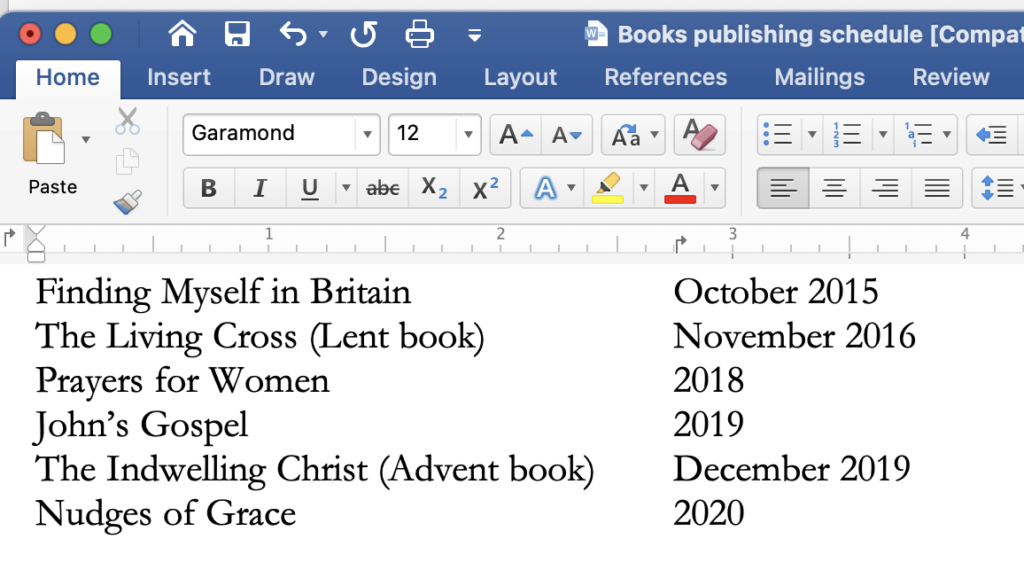
    I recently came across a document filed away in Evernote entitled, “Dream schedule for book writing and publishing,” which I penned initially in late 2016. I had set myself a course of the books I wanted to write—along with the MA in Christian spirituality I was in the thick of then in 2016.

    My dreams haven’t been realized according to that schedule. Although I released a small-group guide last year, I haven’t published a “proper” book for all these five years. I also thought that I wasn’t ready to write my “big” book—that’s the “Nudges of Grace” at the end of the list. I thought I needed to turn to the other books, on what I saw as more niche topics, before I could handle the book on prayer.

    I’ve not kept to my schedule, but I see the grace in those years—the time to think and develop through my master’s degree, the opportunity to recover after spending myself in that academic pursuit along with the other stuff going on in our lives at that time, the other speaking and writing I was able to do. We aren’t machines and we can trust in God’s grace when things don’t go to (our) plan.

    I like to say that God is my Publishing Director, in the phraseology of Psalm 23 (as I write in this blog). I can understand now how I’ve needed that time to develop and grow as a person and as a writer. Now I am ready to release the “Nudges of Grace” book, which will be published as the far better title of 7 Ways to Pray this autumn by NavPress in the States and SPCK/Form in the UK. It incorporates so much of what I learned in the MA, along with my years of leading retreats and prayer exercises.

    I also get to partner with my dad in what I’m seeing as a bonus book, Celebrating Christmas, which is a combo of his fantastic art and my reflections in a beautiful four-color book (also coming this autumn, published here in the UK by BRF). The book was an idea of the lovely people at BRF, and that we can publish a four-colour in the tough times of retail I see as a gift.*

    You might feel anxious, if you’re a writer, to be making progress on your dream publishing schedule. Substitute writer for lots of other situations—for when you can see your far-flung friends and family, when you get that promotion, when you recover from the latest health concern, when you can reopen, and so on. The challenge for us all is to stay present in the moment. For Christians, to abide with Christ right here and right now, practicing his presence and trusting him for the hard stuff while rejoicing with him over the good stuff.

    May you know God’s love and care—wherever you find yourself on your schedule.

    * I’d better use the British spelling to honour my publisher!