Tag: 7 Ways to Pray

  • “Movement and Prayer to Encounter God” by Anna Gilderson: 7 Ways to Pray blog series

    Prayer with movement – I so appreciate how Anna shares different ways for us to engage with God through our bodies. After all, as she notes, we might well be using certain physical motions to pray anyway, such as folding our hands or closing our eyes. I’m looking forward to trying out her ideas, and hope you will too.
    Connecting prayer and movement together can seem out of the box, but we already always use movement in our prayers. Do you close your eyes? Bow your head? Clasp your hands? They are all intentional movements that you do as you come into the presence of God for a conversation.

    I love sharing with others how they can encounter more of God through adding movement to their prayers and relationship with God. At UC Grace, a Christian Dance Company that I run, we define prayer movement as…

    Your body’s reaction to drawing closer to God. The external display of an internal feeling and preparation for a conversation. Its nuances that only you and God know. Fleeting moments when you choose to acknowledge your connection and conversation with God. The reality of moving through life sometimes 100 miles an hour but still always doing the same thing when you choose to pray. To have that conversation and allow intention into the time of response with God.

    Put simply, prayer movement allows us the chance to pray without words, letting movement tell the story instead. Sometimes this can be influenced with music, while other times music isn’t necessary to capture and share what God is speaking through the movement.

    Here are two ways that I have found useful to develop my practice of prayer movement. It can take a while to get into the rhythm of doing it, so give it time and allow God to move and work bit by bit.

    Write it, learn it, move it

    Think about one thing that you would like to pray for currently. Write it down into a simple written prayer. It’s important to use key words that describe what the issue is, any emotions involved, and any encouraging words. Don’t make it complicated.

    Next, take the time to learn that prayer off by heart. This helps it to become ingrained so you can anticipate what is coming next. When you speak, you naturally emphasise certain words, so start to recognise the words that you are emphasising. These are your movement starting points.

    Begin to put specific movements to the words that stand out to you in your prayer and practice them one after the other. The movements can be a literal interpretation of the word or something abstract. Only you know it’s meaning; it doesn’t matter what anyone else thinks it is.

    For example, a prayer I regularly pray is about patience, energy and joy. Three things I can struggle with daily. ‘Father God, equip me with patience to withstand the day, energy to sustain all that I need to do and joy to flow in conversations and relationships.’ I emphasise those three words I mentioned previously doing the following movements –

    • Patience: Standing feet in neutral (hip width apart), inhaling a deep breath and opening my hands out to receive.
    • Energy: Bringing my hands together and rolling them over each other, taking them above my head and then opening them out into a high V shape.
    • Joy: Swinging my arms down from high into a figure of 8 and doing some hops.

    This is my movement prayer. That’s how simply you can build yours. I can spend some time doing this slowly, fast, big, small, anyway I want. Sometimes I will speak the words, other times I won’t. but I treat it as an offering and invitation for a conversation with God.

    Let a song be your prayer dance

    Words in songs can be very powerful. Often you might find yourself either picking up on one or two key phrases or becoming enveloped in the song completely. Worship songs bring a different layer to our prayers. Many are written as heartfelt prayers, words directly from scriptures or specific words from God. This can be a natural way move your prayer.

    Think about some of the songs that you love – what parts of them are your prayer right now. Take some time to respond to those words, and, just like I mentioned above, learn them. Then in those moments when you need to remember that prayer you can simply move it – without the need for music.

    As I’ve journeyed with prayer movement, I’ve experienced a closeness with God that’s hard to describe. Praying can sometimes be hard work. But when I choose to use movement instead, I feel freedom, a change in the atmosphere, and a joy that sparks a desire to keep seeking Jesus.

    I hope you enjoy have the chance to experience this too.

    Anna is dancer, teacher, choreographer and writer. She has two crazy children and a husband in the military. Anna is the author for Jesus for Kids: Teaching Dance and Sharing Faith, and Movement, Prayer and Scripture is due for release at Easter. Anna’s passion is to teach and share her knowledge about the interaction between dance and movement and how that exploration helps us to have a deeper conversation with God. She runs regular trainings, workshops and dance weekends and blogs at www.ucgrace.co.uk/Blog. She loves the outdoors, growing her own food and sewing clothes. You can find her on Instagram, Facebook and at her website.

    Order 7 Ways to Pray here, including in the US, UK, and Australia. You’ll also find lots of resources for small groups – videos and a leader’s guide – here.
  • “From Imaginary Friends to Beautiful Saviour: A Journey in Prayer” by Ruth Leigh: 7 Ways to Pray blog series

    What a moving account by Ruth of moving from a prescribed prayer life to one of freedom and grace. I’m sure you’ll be encouraged by her blogpost. You might consider spending a few moments charting out your own prayer journey, in the fashion she illustrates.

    One of my earliest memories. Two little hands – mine pressed together, my eyes squeezed shut. I’m about three, in Sunday School at prayer time, sitting at the front. I turn round, craning my neck to see my three special friends. They never sit behind me, where all the big children go. They’re always standing together in a group by the wall, ready to come over if I need them.

    No-one else can see them. They are my imaginary friends, Charles, Jenny and Ruth.

    I know all about Jesus, who is also my special friend. I can’t see Him, but there are pictures of Him around the room, His kind face smiling at me. I am glad He loves me and I like singing the songs about Him loving all the children of the world, me included.

    Until the age of fourteen, when I turn my back on church, my prayer life is ordered by others. I’ve been taught that Jesus is always listening, but at home, we parrot the same grace before each meal and say the same prayer before bed every night. Freestyling is not encouraged.

    When I become a Christian aged twenty-six, I renew my acquaintance with Jesus. I start to pray in what I hope is the correct way, thanking him for what he’s done for me, interceding for others and only at the end of my prayer asking Him for what I need. I’m still a child, copying what others do and trying to be good. I haven’t yet realised that He wants me to be extravagant and honest with him, to pour out my heart and invite Him fully in.

    Aged thirty-five, I have a mini-breakdown. I am struggling with undiagnosed depression and my way of dealing with it is to pack my life with achievement. Sitting in my office in London, I burst into tears, overwhelmed by all the things I have to do. Desperate, I consult two close friends at church who suggest that we pray into my unhappiness.

    To my amazement, words of knowledge, verses of scripture and prophecies come pouring from these two ladies. God knows me, He knows what I need and all I have to do is ask.

    Here I am in my new writing studio aged fifty-five. I wake every morning to spend time with my Saviour and I ask Him for protection against the enemy. Fears and anxieties and demons swirl around me but I am safe, covered in prayer. Once upon a time, I would have read these words and been utterly baffled, but now, finally, I know even if I can’t see my Friend, I can feel the warmth of His love through prayer.

    These days, the words that fly up to Heaven are mine and it’s more of a conversation. I hope that the second half of my life is more about freedom in praise and prayer – I don’t put my hands together and squeeze my eyes shut these days, and I haven’t seen my imaginary friends since my sister was born, but the comfort of knowing that I’m never alone nestles deep in my heart.

    Ruth is a novelist and freelance writer. She is married with three children, one husband, assorted poultry and a kitten. She is the author of The Diary of Isabella M Smugge, The Trials of Isabella M Smugge and is currently writing The Continued Times of Isabella M Smugge. She writes for a number of small businesses and charities, reviews books for Reading Between the Lines and blogs at ruthleighwrites.co.uk. Ruth has abnormally narrow sinuses and a morbid fear of raw tomatoes, but has decided not to let this get in the way of a meaningful life. You can find her on Instagram, Facebook, Twitter and TikTok at @ruthleighwrites and at her website.

    Order 7 Ways to Pray here, including in the US, UK, and Australia. You’ll also find lots of resources for small groups – videos and a leader’s guide – here.

  • “Creative Ways to Pray” by Anita Kelly: 7 Ways to Pray blog series

    Anita offers some wonderfully engaging creative ways to pray. I love how she involves her body in praying and worshipping God, and how she outlines the practice of slowing down to pray with a passage of Scripture through coloring. I hope you’re inspired to try something new.

    Being able to go on retreat has really helped me to connect with God on a deeper level, particularly during lockdown. A friend, a member of the Lay Community of St Benedict, leads an annual creative prayer retreat, usually at Worth Abbey. Then lockdown hit, so retreats have moved online instead. These were such a blessing that a monthly online creative prayer group was formed, connecting Christians across the UK and Europe.

    Discovering Worship through Sign Language

    As a visual learner I’ve found signing songs a powerful way to come closer to God in sung worship, particularly when we were unable to sing in church throughout lockdown. It somehow engages my heart more with God’s and adds another dimension, other than my brain, to worship. I’ve only learned a handful of signs (and sometimes made up my own!) but this kind of worship has helped me through the ups and downs of the lockdown. God moves and blesses us as we use our bodies to express ourselves to Him. Some churches have embraced this signing during worship, some long before lockdown began, and not just in the kids’ songs, making church more accessible to all. We’ve also learned how to sign the Lord’s Prayer and the actions can be more thought-provoking and visually expressive than saying the words alone.

    Bible Journalling as a Way to Pray

    Art can also be a way to express our prayers to God, drawing out our praises or what we’re thankful for. As Amy touches upon in her chapter in her book, 7 Ways to Pray, on praying with the Bible, creative Bible journaling has also opened up a new way to meditate and pray through illustrated bible verses. As I colour in the different parts of the pictures, God may show me something new about that word or verse, and the colours I choose may be symbolic of what I see, e.g. red for Jesus’ blood poured out or blue to represent the Holy Spirit.

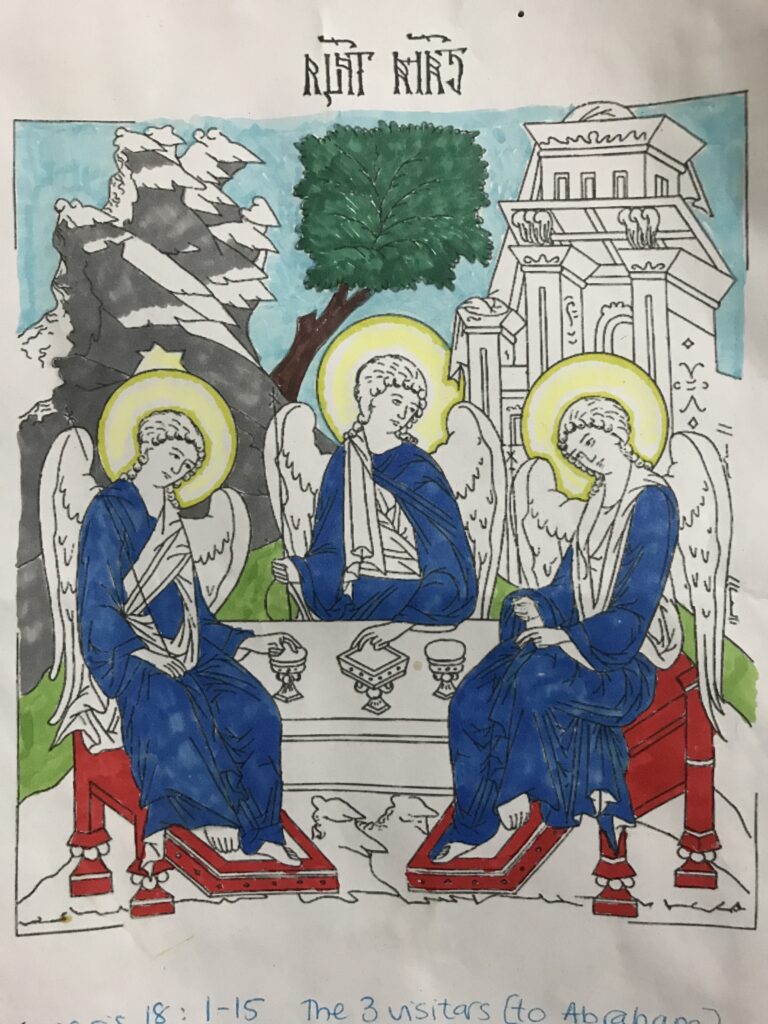
    We were sent some icon pictures to colour in at the 2021 online retreat. The one I was drawn to was Rublev’s icon of the Holy Trinity. Whilst staying at a retreat centre, I was unsure where this story came from in the Bible, so looked it up. Having found a relevant book on this icon, I discovered the passage was from Genesis 18:1-15. Abraham greets 3 strangers who visit his tents and invites them to a meal. It mentions the Lord as one of the visitors, but by inference Rublev interprets them as God the Father, Jesus the Son and the Holy Spirit. The way that each one looks out towards the viewer, invites us to take a seat at the table where they sit. As I contemplated this, I imagined myself sitting there with Them, I poured out my heart to Them, as They listened and talked with me. It was a chance to just sit and be in God’s presence, away from the hubbub of life for a while. An opportunity for some Ignatian prayer, too, as I imagined myself in the picture.

    Today, is there a new way you can be creative in your prayers? YouTube has some signed worship songs, e.g. God Is my Refuge by Kat Mills. Why not choose one to watch and have a go at signing too as you worship? Or try Bible journaling, listening to God as you colour and contemplate His words? You can look online for a relevant Bible journal picture/ words to colour if you don’t have access to a Bible journal.

    Anita Kelly is a mental-health awareness trainer and writing-for-wellbeing facilitator. She lives in North West London and blogs on Christianity and mental-health issues.

    She discovered her love of writing whilst completing an MA at Kings College London and is writing her first book, a mental-health memoir. As a creative, she enjoys writing, doodling and going for walks in nature. 

    Order 7 Ways to Pray here, including in the US, UK, and Australia. You’ll also find lots of resources for small groups – videos and a leader’s guide – here.
  • “Learning to Listen” by Jo Acharya: 7 Ways to Pray blog series

    How can we hear God? Jo Acharya shares helpfully how she’s been making space for God through silence, minute by minute at first. I especially appreciate her explanation of how she’s been learning to discern when it she’s hearing God and when it’s ‘just her’.

    In prayer, as in life, I’m a talker. For as long as I can remember, I’ve had conversations with God – by which I mostly mean one-way monologues from my lips into his endlessly patient ear. There’s some value in this. It’s helpful to process my thoughts in God’s presence. But no relationship can thrive when one person does all the talking. A sheep needs to stop bleating in order to hear her shepherd’s voice.

    God has all kinds of ways to get through to me, of course. But lately I’ve started bringing short times of silence into my time with him, to create intentional space and invite him to speak.

    Silence is hard. In the beginning I only managed two or three minutes. Pitiful, I know, but I found I didn’t know what to do with it. Think about God or not think at all? Accept the thoughts that come to mind or push them out? As I’ve practised it’s become easier, and the time has stretched a little longer. The quiet is like a bath for my mind. A sweet pause, a ‘save and close’ for all the tabs I have open on the computer in my head. I think silence is something I’ve craved without knowing it.

    As I sit, the clutter gradually moves to the sidelines and makes way for something else. For someone else. And the truth is that when I give God my focused attention, just for those few minutes, he usually does speak. Into my mind will come a line from a song, or a snippet of scripture. These are like clues from a treasure hunt. When I read the full passage or lyrics they come from, relevant themes often emerge which guide or answer my prayers.

    Sometimes words or sentences come into my head. These I find difficult to distinguish from my own thoughts, which used to bother me. Are they really from him, or from me? But Paul says in 1 Corinthians 2:16, ‘We have the mind of Christ’. I suppose the longer we walk faithfully with God, the more intertwined our thoughts become. Perhaps in these moments, things I have already learned and absorbed are simply brought to mind by the Holy Spirit at work in me. In his book, How to Pray, Pete Greig suggests evaluating what we hear from God with two questions: ‘Is this like Jesus?’ and ‘What’s the worst that could happen if I got this wrong?’ I find that reassuringly sensible advice.

    But there’s still something unnerving about this process. Dallas Willard observes in his book Hearing God that that many of us ‘fully intend to run our lives on our own… The voice of God would therefore be an unwelcome intrusion into our plans.’ I know that one part of me is nervous of what God might say, and another part is afraid he might not say anything at all. Those twin fears: What if I hear something? What if I don’t? unsettle me each time I sit down to listen, and sometimes they get the better of me.

    And yet I keep going. Because I do want his guidance and his encouragement, his correction and help. So I continue these faltering steps to make space in my busy day and my even busier mind. And I listen for the still, small voice of the one who knows me better than I know myself.

    Jo Acharya is a writer and music therapist who is passionate about inviting God into every part of our everyday lives. She lives with her husband Dan and posts regularly on Facebook and Instagram. You can read more of Jo’s writing at ValleyOfSprings.com, where you can also buy signed copies of her new book, Refresh: a wellness devotional for the whole Christian life, an interactive weekly journal with beautiful photography by Dan.

    Order 7 Ways to Pray here, including in the US, UK, and Australia. You’ll also find many resources for small groups – videos and a leader’s guide – here.

  • “Praying When it Hurts” by Liz Carter: 7 Ways to Pray blog series

    Watching Liz Carter during the pandemic via social media moved me as I wondered how she coped with shielding even from her own family over so many months. How did she not lose hope? One way was praying through worshiping, as she outlines in her powerful post. I’m grateful she shares with us the wisdom gained in the trenches.

    The last couple of years have hurt, haven’t they?

    For some of us, it’s been a time when we’ve felt like God hasn’t been around much. We might have suffered loss: bereavement or poor mental health; sickness or simply sadness at what has been happening around us; the polarised response around us.

    Many of us have found prayer more difficult, with gatherings restricted and the effects of the pandemic on us as individuals. I had to shield for many months, living with long-term lung disease, and I struggled. I knew that prayer upheld me, but it was just hard.

    I’d like to share today one particular way to pray I have found helpful – and transformative. I want to especially commend Amy’s book 7 Ways to Pray, which spoke into my life at a time I was finding prayer more difficult than ever, with some extremely challenging things happening in my own life. If you haven’t read it yet, do!

    Praying through worship

    We often separate worship and prayer. In church services, we have times of worship and times of intercession. But I’ve discovered something incredibly powerful about worship: it can be intercession. Last year, I was trying to pray about a certain situation, but I couldn’t find the words. I simply didn’t have the strength. But one morning, some of the lyrics in a particular worship song spoke clearly into my life:

    ‘I raise a hallelujah, with everything inside of me
    I raise a hallelujah, I will watch the darkness flee…’

    (Raise a Hallelujah, by Bethel Music)

    The song goes on to encourage us to keep singing, even when we are in the middle of the mystery, even in the midst of fear, to sing louder than our unbelief and to see the melody we are singing as a weapon against the darkness around us. For me, these words packed such a punch because I couldn’t see my way out of the darkness and fear, I was trapped in the mystery and prayer left me grasping for words that did not come. I began to sing along, and became aware that I was praying, and my prayer was a deep one. I was praying these words over people I was praying for.

    I continued to do this over the following weeks, finding a new sense of liberation in both worship and prayer. I listened to lyrics in a much more present and focused manner. In a time when I had nothing left, God intervened with a way to pray that not only renewed my prayer life, but also drew me closer to God as I prayed.

    Nothing new under the sun

    Over the centuries many believers have expressed their prayer through worship – from plainsong to the great hymns of praise, from worship choruses to poetic spoken word set to music. The Psalmists prayed with song all the time, and they prayed out all their feelings – their joys and their laments. I’ve always loved the Psalms as a place where we can find such honesty and raw sadness, decisions to remember what God is doing in our lives, and calls to keep praying despite the pain. Psalm 42 is such a song of extremes – lament, remembrance and praise, and for me it is a Psalm that touches the wild depths of me, the places deep down where pain smoulders and tears gather. It’s a Psalm that speaks when I am in great physical or mental anguish, speaking honestly of the writer’s sadness:

    Why, my soul, are you so downcast?
    Why so disturbed within me?

    And then the Psalmist states his intention to keep on putting his hope in God:

    I will yet praise him,
    My Saviour and my God. (v5)

    I’ve found those words ‘I will yet praise’ to be an explosion of power in my own life, and when I apply them within a prayer setting in worship, their potency is all the more vivid. And it’s not only that it feels like a good idea – I’ve seen God answer prayers in some incredible ways, even though they were not even prayers that I created. When we pray with intention through worship we join in with the work of God. We are noticing what God is doing, and then partnering with God in that moment.

    It’s not that singing along to a song will immediately make us feel better. It’s more that, as with the prayer practices Amy shares in her book, we take that moment and make it about connection with God. We find God in what is happening in worship, and we apply that outwards to the situations we are burdened with.

    Finding hope amid pain

    For me, intercessory worship has been a beautifully hopeful part of a life of pain. When I am struggling for breath and bent over with pleurisy, I can’t always find words in myself. But when I listen to a song, I can catch the wider mystery of a God who works through so many different things, who weaves these things through our lives to encourage and uphold us.

    I’d like to finish by sharing a prayer for those of you are finding prayer is hard because you are hurting.

    For those who live under pain and darkness,
    know the hope that is an anchor for your soul.
    For those who live in brokenness,
    know that love stronger than death
    has already shattered the darkness.
    For those who live under hurting and sorrow,
    know that instead of mourning there will be joy,
    instead of despair a garment of praise,
    instead of ashes a crown of beauty. Amen.

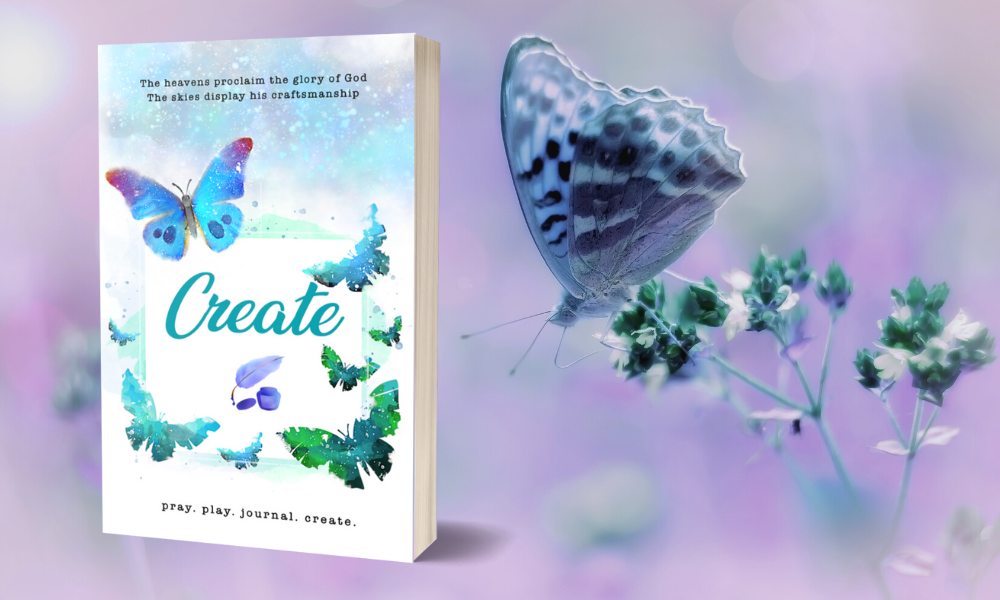
    Liz Carter is an author and poet from Shropshire. She writes about the difficult and painful times in life, and how we can find gold in the mess. Her books Catching Contentment and Treasure in Dark Places are available in online bookstores. You can find her at www.greatadventure.carterclan.me.uk. She’s signed a contract for her next book with The Good Book Company, coming 2023. She’s just brought out a new prayer journal which is filled with verses and poetry about creation.

    Order 7 Ways to Pray here, including in the US, UK, and Australia. You’ll also find many resources for small groups – videos and a leader’s guide – here.

  • “Falling into God” by Keren Dibbens-Wyatt: 7 Ways to Pray blog series

    I simply adore Keren’s description of contemplative prayer. She shares how she’s come to practice centering prayer – focusing on God while giving herself to him. And how he meets her so lovingly in this practice. I love her grace-filled advice about what happens when the mind wanders too. I highly recommend her book, Recital of Love; she carries on the tradition of contemplation from friends such as Teresa of Avila, St. John of the Cross, and Julian of Norwich. It’s a gift for me to share this with you today!

    When I first began giving time to God as an offering, just ten minutes a day to begin with, I had no idea the practice of centering prayer existed, or that it might be Christian. I was simply sick and exhausted by my chronic illness and fed up with coming to God with torrents of words, requests and intercessions. 

    This didn’t seem like the deep or rich relationship that Jesus spoke of. When he asked the Father for something, it was clear that this was because of their relationship, not the sum of it. I wanted that. So, I closed the door, my eyes and my mouth (Matthew 6:6). 

    Centering prayer is essentially about staying still and silent, quieting your mind, letting your thoughts go and focusing on God. One thing many teachers recommend on beginning this practice is to have a prayer word to focus on, or something to bring you back to God when your mind wanders. Whilst this is fine, as is using the Jesus Prayer (Lord Jesus Christ, Son of God, have mercy on me, a sinner) to recalibrate, I would rather advise those starting out simply not to worry about what the mind is doing. It’s going to chatter away, especially to start with. We are not used to being still or quiet. We are not used to not being the focus.  

    As Martin Laird tells us in Into the Silent Land (the first book of his wonderful trilogy about contemplative prayer) to worry about all of that which is passing by is like a mountain being concerned with the weather. Clouds are gonna cloud. Just let them. When we give time to God, he is doing something wonderful whether we know it or not. As with all God things, not much if any of it is down to us. All he needs is your yes.  

    Yes, Lord, this time is yours. Yes, Lord, this heart is yours. Yes, Lord, this will is yours. Do as you please.  

    As my practice has developed, what I have discovered is that no effort beyond setting time aside is required. No concentration. It doesn’t make any difference how tightly I close my eyes. This is not a wishing well. Also, although I’m centering God in this process, his centre is everywhere and circumference is nowhere (as St Bonaventure described it). It makes more sense to me to consider centering as only the beginning of the process, as a gateway into contemplative prayer. It is more like falling than finding a centre. We fall into God.  

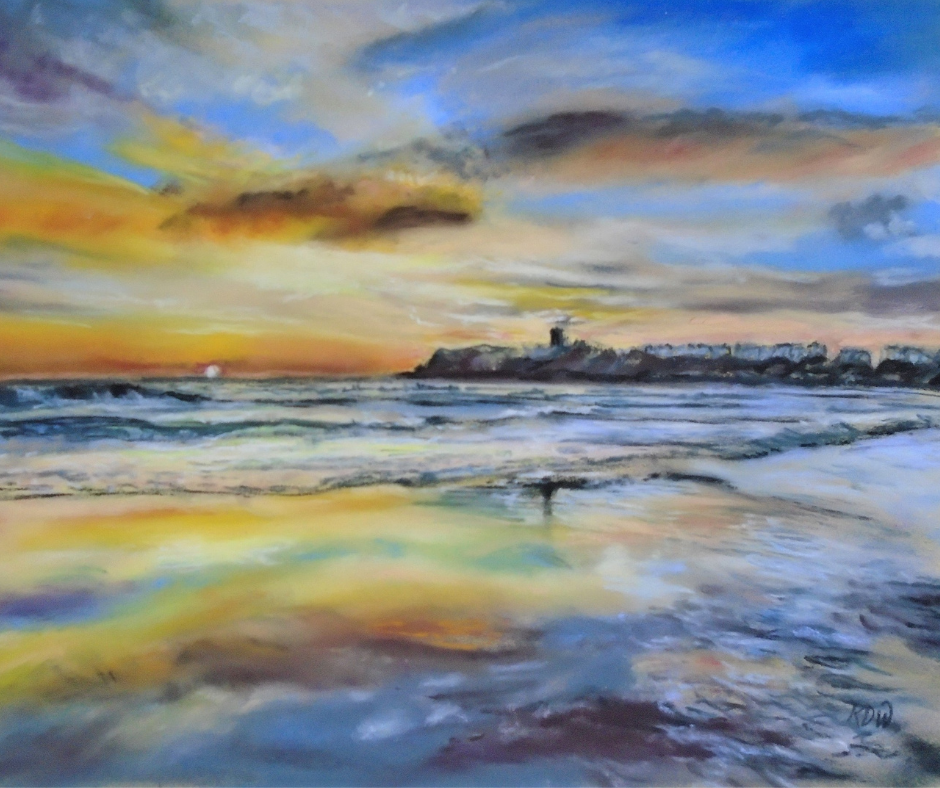
    Keren is a gifted artist, as you can see in her painting, which I share with her permission, “Scarborough Fair”

    A more helpful analogy for me is understanding the presence of God as what St. John of the Cross calls “a sea of love.” God is like water running beneath and through all things, and we let go of ourselves and drop into that deep, vibrant, moving flow.  

    In that contemplative place, we find connection, not only to God and his creation, but to the deepest parts of ourselves, and to others. It is like being part of a synaptic network. We can suddenly sense and see our place in the universe.  

    At the same time as we relinquish our egotism and see our smallness, we discover we are utterly beloved and held close to God’s heart. And that everyone else is too. That we are all together and one in his love. “He (Christ) is before all things, and in him all things hold together.” as Colossians 1:17 puts it. Or as Julian of Norwich wrote, “The love of God creates in us such a oneing that when it is truly seen, no person can separate themselves from another person.” It is wonderfully affirming to know.  

    Spending time in this place means I can be joyful about the success of others, I can hold their pain and suffering before God with more empathic grace, and I can also allow God to nurture my own giftings, knowing they are meant for sharing. In these deep places we are sometimes given visions, seeings, understandings, we might be led into intercession, or gently corrected on our perceptions or behaviours. These things are not so much sought as given. In that place, everything is grace. This deepening prayer connects all of us within that “oneing.”   

    The only thing I regret about giving God those ten minutes a day was that I didn’t begin sooner. And the only thing I would warn others embarking on contemplative prayer about is that you might love it and its source so much, that ten minutes will grow into far more.  

    Keren Dibbens-Wyatt is a chronically-ill contemplative, writer and artist. She has a passion for prayer, poetry, story and colour. Her writing features regularly in literary journals (Fathom, Amethyst Review, The Blue Nib) and on spiritual blogs (Contemplative Light, Godspace). She is the author of the book Recital of Love (Paraclete Press, 2020). Keren lives in England and suffers from M.E., which keeps her housebound and out of the trouble she would doubtless get into otherwise. 

    Order 7 Ways to Pray here, including in the US, UK, and Australia. You’ll also find lots of resources for small groups – videos and a leader’s guide – here.
  • “Learning to Trust Ancient Ways of Praying” by Kathleen McAnear Smith: 7 Ways to Pray blog series

    I’m humbled by Kathleen’s wonderful post about how she’s come to pray with the ancient practices I outline in my book, 7 Ways to Pray. When writing I prayed so much that it would be a means of introducing some of these time-tested practices to people who might not only not have heard of them, but were suspicious of them. What a gift that God has used my book in her life in this way! Whether you’ve prayed in some of these ways for years or are not sure about them, I believe you’ll appreciate hearing more from her.

    My particular Christian denomination used to pride itself on not—no, never—using set prayers. We wouldn’t touch traditional, handed-down-through-the-centuries prayers with anything but disdain. We were smug about it; superiorly smug in our thinking that prayer was just something you did off the top of your head. We were sure we knew all anyone needed to know about prayer.

    Due to travel and relocating overseas I eventually changed denominations, but I happily managed to carry some of that attitude with me. Not for me were the stuffy old ways of prayer, I thought. I’ve had to work hard at staying closed-minded about the beautiful traditions of the ancient church, but denominational prejudice reigned well into my fifties.

    That all changed on an unmentionable birthday when I blessed myself with attending a workshop on prayer. Truthfully, I didn’t pay much attention to the topic, I just wanted to hear the speaker, Amy Boucher Pye. She started the morning with an introduction to the concept of lectio divina. “Lectio what?” I said, remembering childhood teaching about the repetition of words that would put you to sleep. It turned out that not only did I stay awake, but as Amy introduced this new-to-me way of prayer something was coming alive in my spirit. I even acknowledged quietly to myself that often I had used Scripture to prove a point in discussion, just not considered the Word as a basis of praying.

    Deciding to learn more, I attended one of Amy’s online retreats on lament. This was the year I lost a very precious relative and I was beside myself trying to figure out how to pray. Amy’s teaching on lament became art form powerfully pulling me closer to the King of Kings.  She draws you in to the world, the history, and the creativity of prayer. In her book, 7 Ways to Pray Amy introduces the ancient ways in a way that intrigues and you just want to know more and experience more. I was astounded that God really did know what to do with my grief, my anger.

    Yet, as I read this 7 Ways to Pray, I wondered “How can I trust these forms of prayer? What really is a lectio divina? Examen? Who is Ignatius? Won’t I just get bogged down in dark ages faith?” I pondered all this even as I was beginning to see changes in my prayer life. I needed assurance that while I had been taught to disregard tradition from the early days of my childhood, I was heading in a direction that pleased God. It’s hard to stand on tradition when you don’t believe in it.

    In 7 Ways to Pray Amy faces these issues head on with clear guidance as to what prayer does in your life. Amy writes that prayer is meant to bring you closer to Jesus, and that when we pray, we see the “collaboration” and “uniting of our desires with the Holy Spirit”. This seems to be the test of a good prayer. In learning these ancient ways of prayer, you notice if you are coming closer to Jesus.

    As you look at each chapter you are invited to see what draws you closer to your Lord. Creativity? Understanding of the Word of God? As someone who has never journeyed this way before, I found Amy’s writing to be a trusted friend as she shares her own experience of stepping into the ways of saints past who inspire the future. She writes to clarify, to enable the journey of others, not cloak in unrelatable mystery. I suggest you take 7 Ways to Pray and use it as a workbook. This is not a book to sit on a shelf. It’s to be used actively. Get your pencil, get your highlighters out and take note of what sparks your imagination. Write in the margins. Stick tabs on paragraphs that jump out at you. Have a go with one chapter, then the prayer in a next chapter. You will meet prayers that have been developed over the ages right down to this this age and see what happens.

    While “top-of-your-head prayers” will always pop into daily life, I’m glad I’ve given myself the gift not only of the book 7 Ways to Pray, but the time in which to explore the ancient ways of prayer that Amy has made accessible even to a know-it-all like me.

    Kathleen McAnear Smith just launched her website Global Grandmas. She is using what she learned in 7 Ways to Pray to enjoy the adventure of praying for her grandchildren as well as the wider family. Her book Beyond Broken Families encourages prayer for healing 21st century family life. This past year she was appointed as a Director of Families in Global Transition.

    Order 7 Ways to Pray here, including in the US, UK, and Australia. You’ll also find lots of resources for small groups – videos and a leader’s guide – here.

  • ‘Under a Wing and From a Prayer” by Juliet Mitchell: 7 Ways to Pray blog series

    Welcome back to the 7 Ways to Pray blog series! I welcome Juliet Mitchell, who shares a beautiful picture of being safe and secure under God’s wings – whatever happens. Enjoy!

    In 2019 my husband and I decided on a joint 50th birthday journey to New Zealand to visit my brother and cousins. My husband suggested that we take not only our daughter who has learning difficulties but my elderly father too, so that he could see his son. What a journey! We were kept safe despite a near car collision and a landslide that demolished the road we travelled on just an hour before we arrived.

    The prayer practice I used then, and have since reading some of Amy’s book, is lectio divina. This is a 4-step practice of choosing a Bible passage to read, meditating on the passage or a word from the passage, praying asking the Holy Spirit to speak and lastly, listening to hear what the Holy Spirit has to say to us from God’s word. The passage I had dwelt on was from psalm 91:

    ‘He will cover you with His feathers, under His wings you will find refuge.’ Psalm 91:4

    The Lord had shown me in a picture that even the tiniest feather from one of His mighty wings was enough to keep me safe. Enough to cover me, for His wings were huge, immense and powerful. To be in awe of! We were safe.

    Fast-forward a year later to March 2020 and our lands and nations were facing a new threat as well as restriction on life. Nobody was able to make plans to travel to see distant family, certainly not with vulnerable and elderly family members. The Lord knew Coronavirus was coming, and I believe He had enabled our journey the year before. An opportunity to let each other know we loved one another. 

    Our second trip, just recently taken, saw us fly to Spain to visit elderly and poorly family we’d not seen for nearly three years. Again, I was reminded of:

    ‘Under His wings you will find refuge.’ (Psalm 91:4)

    We were kept safe. We flew home a day before the region we were staying in closed to UK travelers, due to the advancing nature of the Omicron variant of Coronavirus. An opportunity again to let those we love know just that. 

    Perhaps I received this picture from this scripture for these two occasions as the Lord in His tender mercy kept safe our family. However, as I dwell again in prayer in this verse, I feel I should stay right beneath even the tiniest feather of His huge wings. Under a wing that more than covers me and those He has given me to love. 

    Juliet Mitchell is a wife and parent-carer who enjoys writing poems and short stories, usually to entertain her daughter. You can find her on Facebook.

    Order 7 Ways to Pray here, including in the US, UK, and Australia. You’ll also find lots of resources for small groups – videos and a leader’s guide – here.
  • Abiding in the Vine: Praying with John 15

    How can we pray with Scripture, trusting that God will meet us through his word? One time-tested practice, about which I write in 7 Ways to Pray, is lectio divina. That’s a bit of jargon but it’s simply Latin for sacred reading (or prayerful reading). It’s a four-step process that helps us to slow down and engage with the text prayerfully. The four steps are:

    • reading
    • reflecting
    • responding
    • resting

    Join me in engaging with a favorite passage out of John 15 in this way of praying. Last week I spoke at Bethel University, my alma mater, and during the talk gave plenty of time for people to try out the four steps. Now you can too – take a mini-retreat, brew a cuppa, and know that God longs to meet with you!

  • “Prayer is like . . .” by Amy Young: 7 Ways to Pray blog series

    So often we wish for clear instructions. If you do this, that will happen. Or a, b, and c will definitely lead to d. But life isn’t like that – as we see with Amy Young’s delightful post. I love American football and I don’t love baseball, but I appreciate her wonderful illustration. Enjoy! (And Go Broncos! Go Vikings!)

    Although I’m grateful for the Lord’s prayer, I wish that the disciples would have asked Jesus another question. In addition to asking Jesus to teach them to pray, I wish they’d also asked Jesus, “How does prayer work?”

    You’ve also probably wondered how prayer works. In my imagination (see Chapter 6 of 7 Ways to Pray), I see a group of us around the table enjoying a meal with Jesus. The conversation weaves around and in a lull I ask Jesus my question: “How does prayer work?”

    Since I’m at the table with Jesus and he is earthy and relatable, I believe he would use sports and parts of modern life in his answer. (If there’s one thing to know about Amy Boucher Pye and me, it’s that we love American football. If you hear loud cheers (or groans) for the Vikings or Broncos, chances are it’s one of us.) Jesus smiles at my question about prayer, leans back, and begins to tell a parable.

    I lean in and this is what Jesus shares.

    Prayer doesn’t work like a vending machine where you insert coin after coin, select D6, and wait expectantly for the candy bar you selected to pop out of the bottom of the machine, virtually guaranteed of the outcome.

    Instead, prayer is like a baseball player who steps up to the plate, bat in hand ready to take his turn at bat. He never knows exactly what will happen, but he knows the rules of the game well enough to know what could happen. He could strike out or he could be walked to first base . . . or better yet, he might get on base with a hit. That same batter doesn’t know when he steps up to the plate the duration, will this be a short at bat that will end disappointingly after only one pitch? Or is he about to engage in a long at-bat in which the exchange between the pitcher and the batter almost seems like a battle?

    Sometimes the batter won’t have to do much and he gets on base and is able to score a run for his team. Other times his turn ends in frustration, even anger at a poor call by the ump. And he stomps off indignity after being treated so unjustly!

    His at-bat could result in getting to first base, which of course is exciting, or he could hit a double or even a homerun. On rare occasions the batter finds himself at a crucial point in the game as he steps up to the plate and the outcome of his at-bat can really affect the game’s outcome.

    It’s not that prayer is a game between you and God or that God is the umpire judging the pitcher and the batter. Instead, prayer is an endeavor that involves the dance between the predicable and the wild. It embodies hope and longing, and the risk that unlike a vending machine, there are no guarantees. Prayer teems with anticipation, the collective holding of the breath of everyone watching, the longing for what could be, and the eruption in celebration when the crack of the bat is heard throughout the ball park.

    You’re not guaranteed a specific result when you bat in a baseball game, but you are guaranteed that something will happen. So it is with prayer; mystery, skill, effort, beauty, and even love mingle together as you take your turn and offer your prayer.

    Jesus looks me full in the eye as he says “and offer your prayer.” He knows in my younger years I played on a youth softball team and wasn’t very good at batting. If prayer is like that, Lord help us, Lord help me, we’re in trouble.

    Jesus continues:

    Amy, when you only think of baseball on the major league level, sure, you see the sport at its highest level, but you don’t see it as its richest. There are little leagues, company teams, and far more who play for the love of the game than because it is their job and they’re professionals. I’m not asking you to be an all-star; I’m inviting you into a relationship.

    I reflect on the conversation as the meal comes to an end. In truth, I offer some of my prayers easily but others with weariness because I’ve been praying them for years. Thrillingly I’ve experienced answers to prayers that go far beyond what I could have imagined. I’ve been confused, frustrated, disappointed, delighted, in awe, and humbled by my prayers and the responses from God. While I wish at times prayer was more like a vending machine, in truth, I don’t actually prayer to be like that because then I’d be in control.

    So, the next time someone asks you, “How does prayer work?”

    You can smile and tell them, “Prayer works like a baseball player who steps up to the plate, bat in hand ready to take his or her turn at bat, never sure exactly what will happen, but willing to take a swing all the same.”

    Lord, help me to be such a baseball player. Amen and amen.

    Amy Young: Life enthusiast. Author. Sports lover. Jesus follower. Equipper of cross-cultural worker. Amy is the founder of Global Trellis, co-founder of Velvet Ashes, hosts reading challenges at The Messy Middle, and is the author of 5 books for Great Commission cross-cultural workers.

    Order 7 Ways to Pray here, including in the US, UK, and Australia. You’ll also find lots of resources for small groups – videos and a leader’s guide – here.