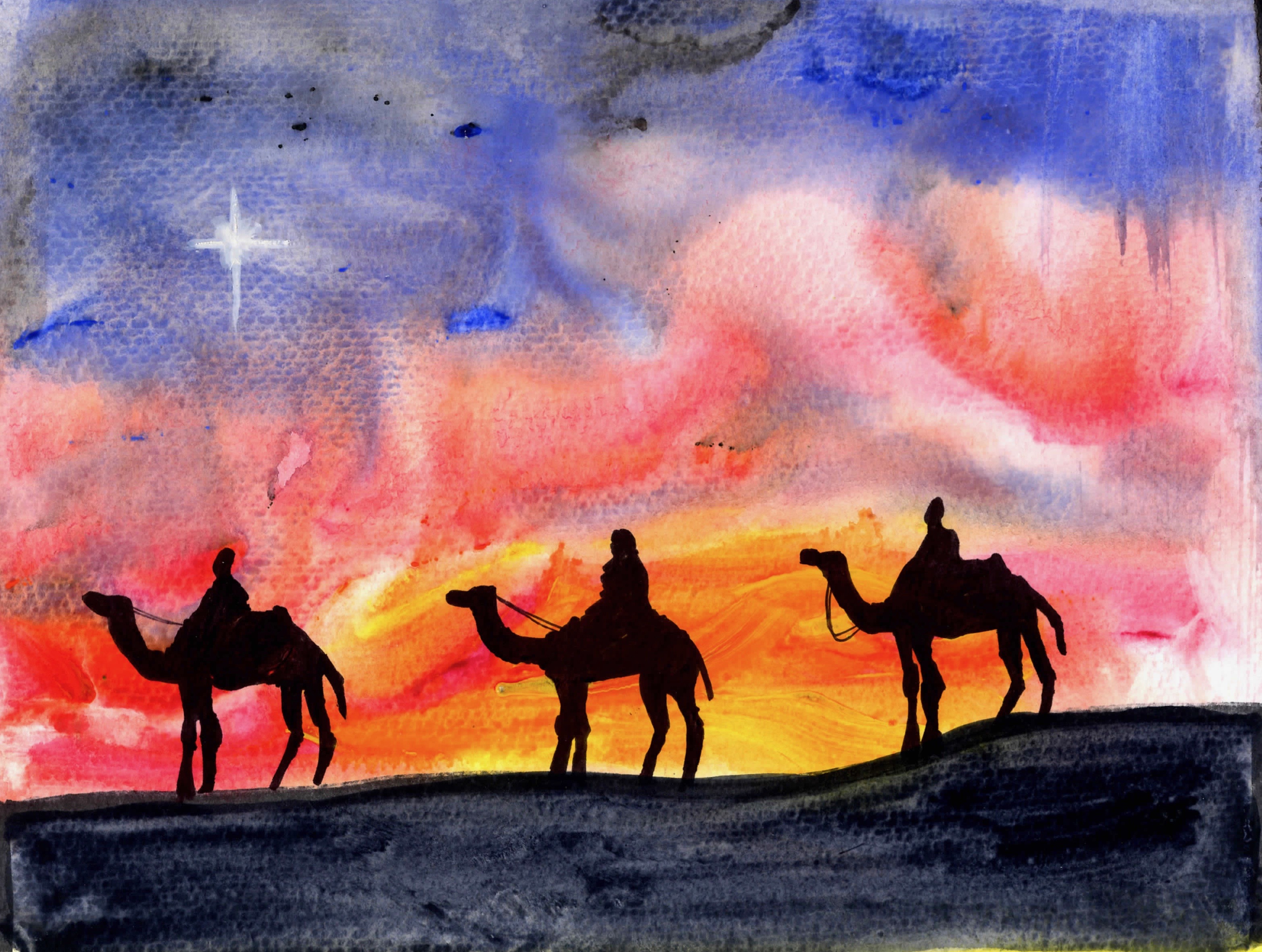
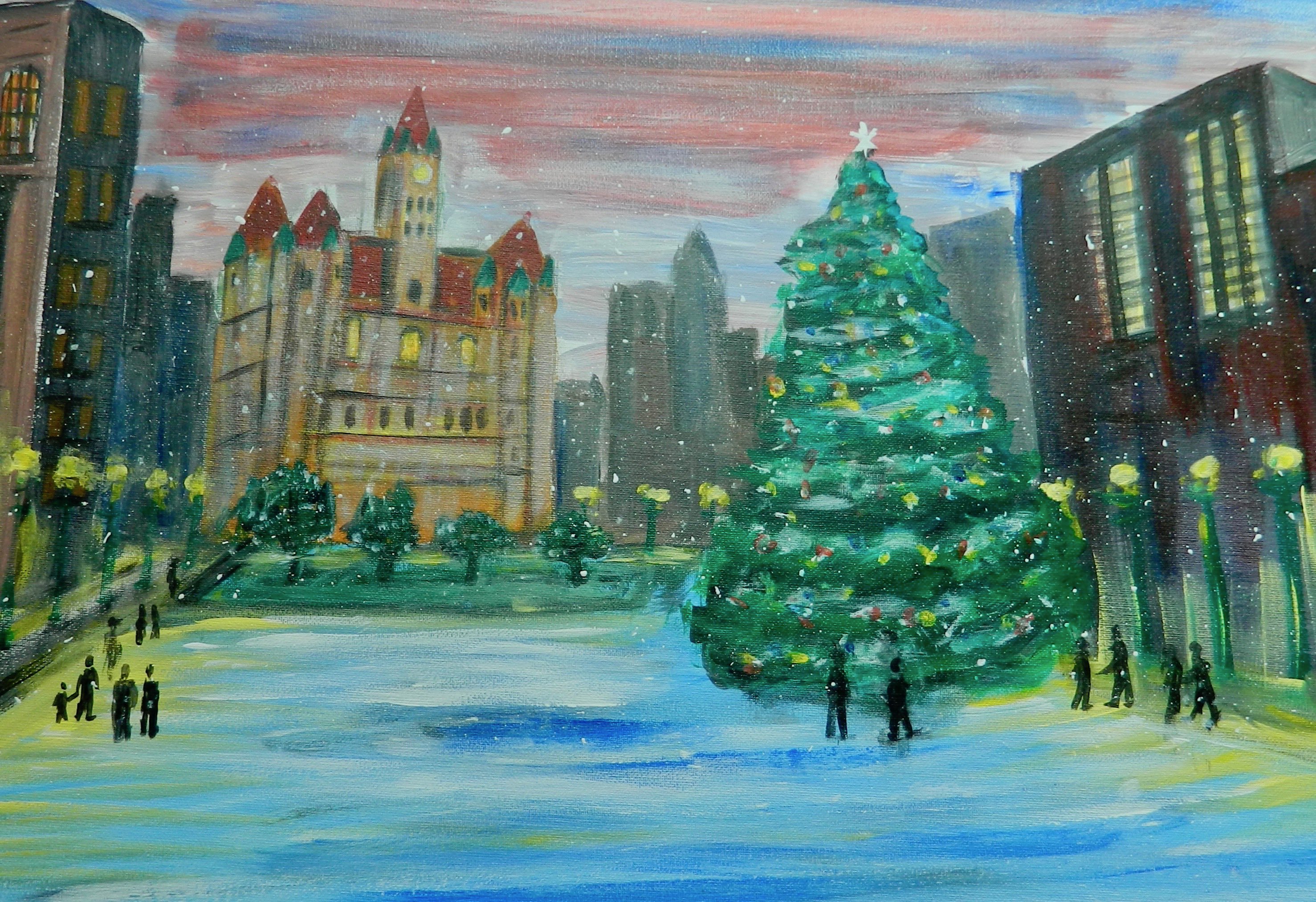
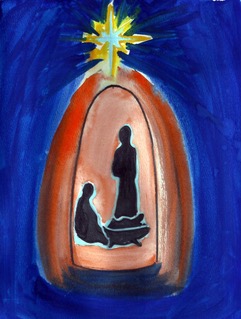
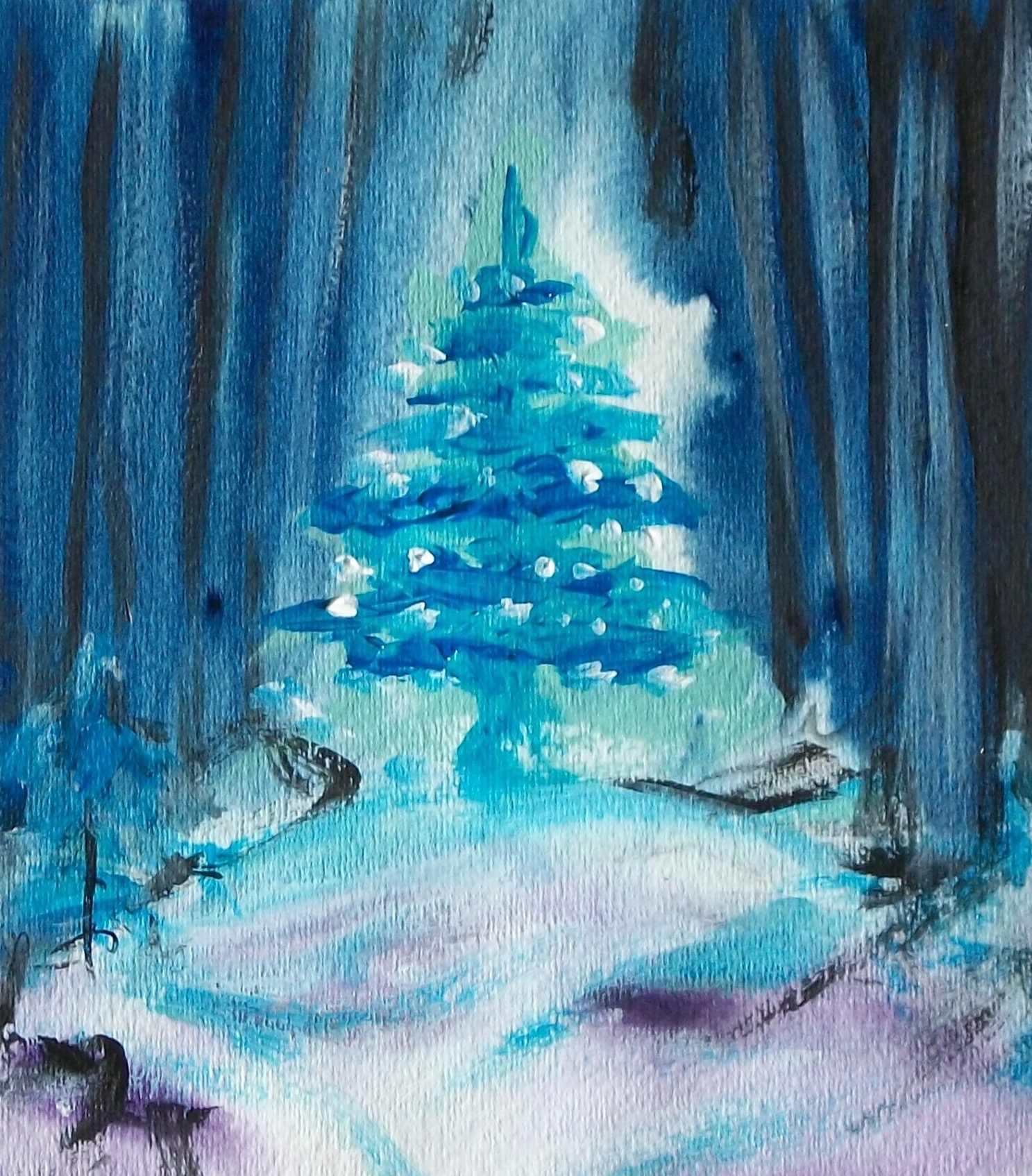
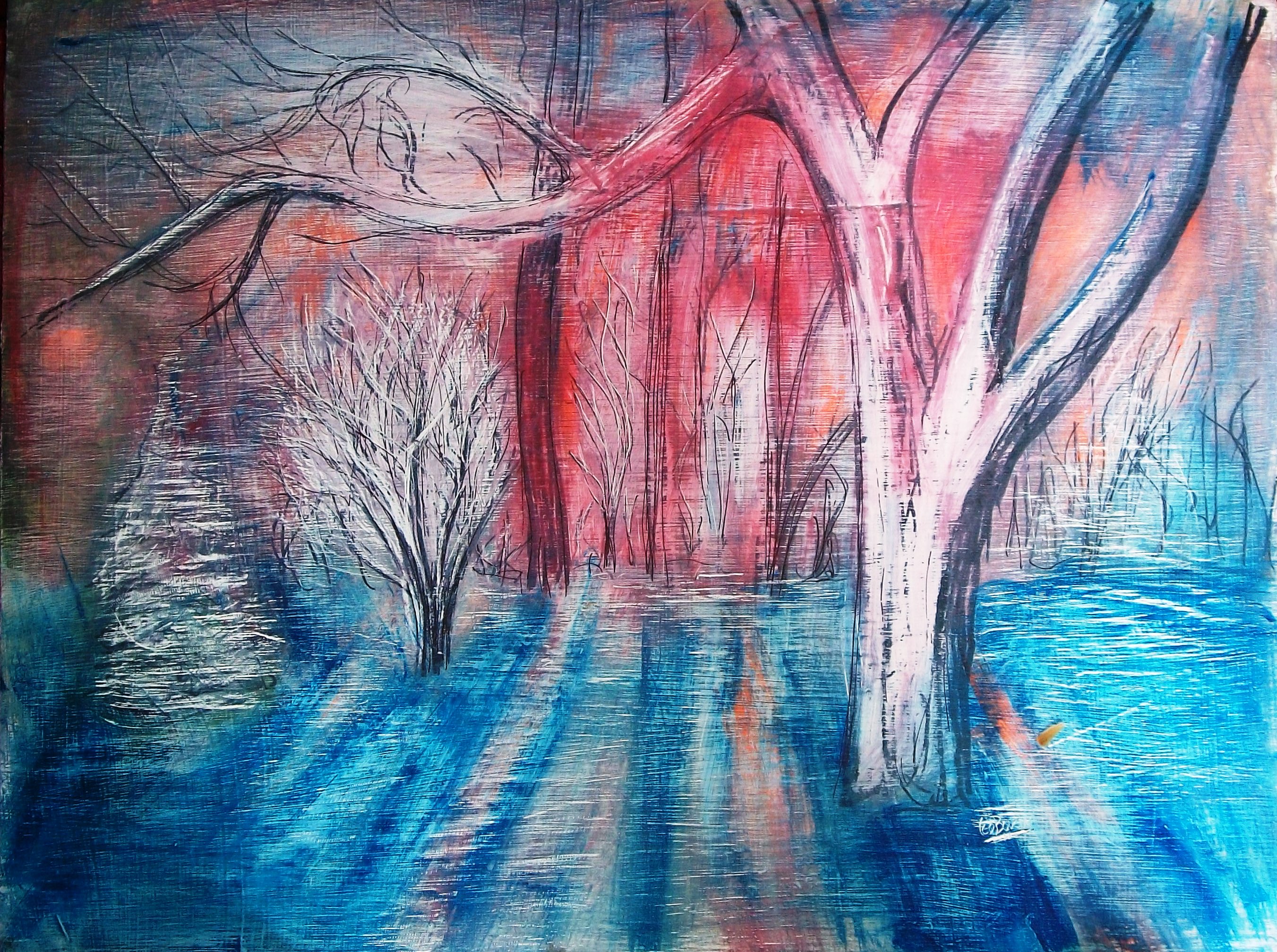
One of my all-time favorite paintings by my dad, Leo Boucher. Used with permission; all rights reserved.
Happy Epiphany!
The wise men have made their journey to the toddler Jesus, bringing their gifts of gold, incense, and myrrh. I learned a few things today from our youth worker’s sermon – the Western Church believes there were three wise men (because of the three gifts they brought), but the Eastern Church says there were twelve. Our preacher also made the good point that these visitors were the first outsiders to visit Jesus, thus marking the God-Made-Man’s mission to reach everyone in the world with his message of love, grace, and forgiveness.
Thank you for journeying with me through the twelve days of
Christmas! I pray you’ll have a blessed and joyous Ephipanytide.
The last day for Christmas decorations, unless you leave yours up until Candlemas (February 2). Painting by Leo Boucher. Used with permission; all rights reserved.
We’ve reached the end of the Christmas season, the twelfth
day of Christmas! Tomorrow is Epiphany, when we mark the arrival of the wise
men bringing their gifts of gold, frankincense, and myrrh to the newborn King.
I’ve been reading about the Twelfth Night parties in England
in years past, finding the practices fascinating. Often servants and their
masters would change places for the evening, with the master serving the
servant. A dried bean or pea would be baked into a spice fruitcake, and whoever
found it in their portion would be crowned king or queen of the party. Some of
the revelry would include games with eggs – the egg and spoon race, and one
that I’d like to try, a “toss the egg” game where a raw egg is thrown between
two people at ever increasing lengths between them.
Spiritually, we can consider what gifts we’d like to give to
Jesus this year. Perhaps a new emphasis on hospitality, or intercession, or
keeping our temper, or increasing our tithing.
Will you celebrate Twelfth Night? If yes, how? What about an Epiphany party? And what gifts would you like to seek to give this year?
I wonder what sorts of scenes Simeon saw in the desert. Maybe some moody sunsets, such as this one by my dad, Leo Boucher (used with permission; all rights reserved).
The eleventh day of Christmas coincides with the feast day of Simeon Stylites (c. 390? – 2 September 459). No, I hadn’t heard of him either. He was zealous for Christ, entering a monastery before he 16 years old. So committed was he to acts of extreme austerity that the other monks asked him to leave.
He decided to live in solitude, fasting completely for Lent and somehow surviving. Crowds of pilgrims searched him out, seeking advice and, I guess, wanting to “catch” some of his holiness. As he tried to escape the attention, he moved on top of a pillar. He went from stone to stone over the years, moving higher and higher as he sought solitude for his prayers and practices, living the rest of his years on a cold stone platform. Thirty-seven years all together.
As Edward Gibbon remarked in History of the Decline and Fall of the Roman Empire,
In this last and lofty station, the Syrian Anachoret resisted the heat of thirty summers, and the cold of as many winters. Habit and exercise instructed him to maintain his dangerous situation without fear or giddiness, and successively to assume the different postures of devotion. He sometimes prayed in an erect attitude, with his outstretched arms in the figure of a cross, but his most familiar practice was that of bending his meagre skeleton from the forehead to the feet…
Before I started my MA in Christian spirituality, I wondered about levels mysticism and these extreme forms of austerity and spiritual practice. Had these anchorites reached the pinnacle of spiritual life? I concluded through my MA readings a strong “no.” Although we can learn from those who withdraw from the world, I don’t believe they have a higher status than those who live in community. Transformation of one’s life – not extreme practices of penance or solitude – is what reveals God at work.
But I don’t want to dismiss Simeon all together. The crowds sought him for his wisdom, meaning that even in the desert he couldn’t escape from engagement with others. And he remained humble and obedient to his fellow monks, for when they wondered if he lived on the pillar out of pride or obedience, they demanded that he come down. He obeyed, and so they decided that he was following God – and they let him stay.
Over to you – what do you think of these extreme practices? Have you ever embraced something like a long fast or a time of solitude? If yes, how did you fare? Did you grow in your faith?
By Leo Boucher. Used with permission; all rights reserved.
On the tenth day of Christmas, some Christian traditions celebrate
the naming of Jesus in the temple (other traditions celebrate this on January
1). When the angel appeared to Joseph, he learned what to name the boy, who was
conceived by the Holy Spirit:
But after he had considered this, an angel of the Lord appeared to him in a dream and said, “Joseph son of David, do not be afraid to take Mary home as your wife, because what is conceived in her is from the Holy Spirit. She will give birth to a son, and you are to give him the name Jesus, because he will save his people from their sins” (Matthew 1:20-21, NIV).
The very name of Jesus shows his calling – to save us from our
sins.
What names come to mind when you think of Jesus? Here are a few you might want to ponder today, as you celebrate during this season of Christmas:
Emmanuel (God with us)
Son of God
Son of man
Son of David
New Adam
The Word
Morning star
Light of the world
King of Kings
Lord of Lords
Lamb of God
Teacher
Bread of life
Advocate
Messiah
Redeemer
Risen Lord
Savior
Rock
True Vine
Lord
Which names of Jesus speak to you most powerfully?
By Leo Boucher. Used with permission; all rights reserved.
Today, on the ninth day of Christmas, it feels countercultural to celebrate the season. Part of me would like to take down the Christmas decorations while cleaning and doing some decluttering. The newness of the year feels like a push toward embracing all things clean and fresh.
So sometimes it feels like a discipline to celebrate and feast. I’m keenly aware of those who are grieving or going through other difficulties, who need God’s grace to get through this season, and are probably finding it hard to celebrate. They may be echoing Psalm 137:4: “How can we sing the songs of the Lord while in a foreign land?” If that’s you, I pray you’ll find a hint of celebration through rest and recovery.
For me, as we only have twelve days of Christmas, I’m going to seek to embrace the gift that they are – while doing a bit of decluttering and vacuuming by the Christmas tree.
How are you approaching celebrating on this ninth day?
We’re still enjoying our Christmas decorations during this season of Christmas. Are you? Painting by Leo Boucher. Used with permission; all rights reserved.
We have reached the final day of 2018. Many people will be grateful to leave behind this year with its acrimony, fear, tragedy, disappointment, and divisiveness. May we find greater unity and joy in 2019.
In the middle of this Christmas season of celebration, and battling a head cold, I lost track of the days and realized with a jolt that today was New Year’s Eve – and the end of 2018. In my blocked-up state I’ve been pondering a bit about my word for 2019 (#myoneword).
Some years ago I joined this movement that embraces a word
for the year instead of making a lot of resolutions that are forgotten after a
few weeks. Keeping one word before us – through a visual representation or a
reminder on our phone – can help us to stay focused on a word that helps us to
live as we wish with God. I usually choose a verse from Scripture to accompany
the word as well.
I’ve blogged about #myoneword previously – you can find all of the posts here. One post that might be helpful is how to hear God on your word for the year. My review of the book that started it all off, My One Word, is here.
The first year I tried out this practice I chose flourish, with Isaiah 55:10–11 as the verses:
As the rain and the snow come down from heaven, and do not return to it without watering the earth and making it bud and flourish, so that it yields seed for the sower and bread for the eater, so is my word that goes out from my mouth: It will not return to me empty, but will accomplish what I desire and achieve the purpose for which I sent it.
I loved the idea of this word and all of its richness, but for
many months forgot about the practice. But in the late spring I remembered it,
and printed out some reminders of the word to keep it before me. As I was more intentional
about praying about how with God I could flourish, I started to get excited
about the possibilities. I saw the word as a promise from God – one that I
could forget and ignore, or one that I could embrace as I joined my hands in
his.
Other words have been train, with the
accompanying verse 2
Timothy 3:16 (about Scripture being God-breathed and useful for
training in righteousness); breathe, which
spoke to me about rest and breathing in the Spirit of God; present, with the lovely meanings of God’s presence, receiving the
present of God’s presence, and the need for me to stay present and in the
moment; and in 2018, replenish, with
the emphasis on resting and rejuvenating after a very busy couple of years.
As I mentioned above, I haven’t yet discerned what my word
will be for 2019. I need to set aside some time to think and pray about this – including
going for a walk, which I find is a wonderful way to ponder and pray and enjoy
creation.
How about you? Do you choose a word for the year? If so, how has the practice helped you? Do you have a word for 2019?
Churches are picturesque, but they can be “middling” places as well! Love this painting by Leo Boucher. Used with permission; all rights reserved.
On the sixth day of Christmas, my true love gave to me…
Can you remember? Six maids a milking? Geese a laying? An
online search says I got it right with the second guess.
My memory for that popular song is murky, just as this point in the Christmas season can feel murky. Many people have taken down their Christmas trees and decorations, ready to move into 2019 with a new purpose. It feels countercultural to keep banging on about the days of Christmas, especially in this messy middle (see the wonderful blog by Amy Young by this name), when the wonder of the first days of Christmas seem long past and the end feels a long way off.
How can you make the sixth day of Christmas feel special?
I love this painting by my dad, Leo Boucher. He painted it onto wood, which explains some of the interesting texture. Stark but colorful and beautiful. (Used with permission; all rights reserved.)
The paradox of feasting while calling to mind the martyrs of days past continues as we celebrate the life of Thomas Becket on the fifth day of Christmas. He was named Archbishop of Canterbury in 1162 by King Henry II, to whom he was a chief minister. Henry hoped that by appointing Thomas as archbishop he would gain control of the church, but Thomas was as zealous for the church as he had been for the state. The king became increasingly incensed over his exclusion from church affairs, so only two years after his appointment, Thomas escaped to France for safety.
Thomas returned to England in 1170, and shortly after, the row intensified even more, with King Henry saying,
“Who will rid me of this troublesome priest?”
With that utterance, four of his knights decided that they’d heard an order to kill Thomas. They did so as Thomas was taking the service of vespers at Canterbury Cathedral.
Thomas was
said to be unafraid in the face of death, echoing Jesus’ words to his disciples
from Matthew’s gospel:
Do not be afraid of those who kill the body but cannot kill the soul. Rather, be afraid of the One who can destroy both soul and body in hell. Are not two sparrows sold for a penny? Yet not one of them will fall to the ground outside your Father’s care. And even the very hairs of your head are all numbered. So don’t be afraid; you are worth more than many sparrows. (Matthew 10:28–31).
Here Jesus instructs the twelve as he sends them out to preach the kingdom of God, heal diseases, and drive out demons. We may lose our bodies in this world, he says, but we need to guard against the one who can kill the body and the soul.
Today, let’s join together to pray for those around the world who endure false accusations or bodily harm because of their faith. Lord, have mercy.
A stark picture fitting for today’s topic. By Leo Boucher. Used with permission; all rights reserved.
The Christmas season is for celebrating, but it doesn’t shy
away from the horrors of this world, such as the slaughter of “holy innocents.”
The day marks the killing of all the boys in Bethlehem under two by Herod, a jealous
and volatile king:
…an angel of the Lord appeared to Joseph in a dream. ‘Get up,’ he said, ‘take the child and his mother and escape to Egypt. Stay there until I tell you, for Herod is going to search for the child to kill him’… When Herod realised that he had been outwitted by the Magi, he was furious, and he gave orders to kill all the boys in Bethlehem and its vicinity who were two years old and under (Matthew 2:13; 16a).
This
massacre of around thirty boys (for Bethlehem was a small village) wasn’t
outside of Herod’s character, for Herod also had his wife and her mother
killed, as well as three of his sons. And when he was dying, he ordered that
all the notable men of Jerusalem be killed in the hippodrome.
Herod may
have been a powerful king, but his plans to eliminate Jesus were foiled. For Joseph
again was warned in a dream, and he obeyed the angel’s direction, trekking into
safe territory in Egypt.
But why did
those sweet little boys have to die? Why all those mothers weeping for their
slain children? We just don’t know, for it is wrapped up in the fall of
humanity and the problem of evil. But we can stand on God’s promises that he
will comfort the comfortless and bring hope to the hopeless. And we know that
he too grieves at the loss of children so young.
Heavenly Father, we don’t understand why you sometimes allow innocent people to die. Strengthen our faith and help us to know more about your character, and comfort all those who mourn today.
By Leo Boucher. Used with permission; all rights reserved.
This morning, one of the participants in the Woman Alive book club Facebook group posted this comment:
“If people want to mark the 12 days of Christmas how do they keep the spirit alive when other people think it’s over? I’m back to work this morning and I’ve already seen one post of Facebook about getting the decorations down!”
Celebrating the full twelve days of Christmas is something I’ve
become more keen about doing in recent years. I confess I don’t observe the
season of Advent properly – for I put up the Christmas tree far earlier than I
should (my excuse is that putting up the tree and decorations takes a long
time). But I do love celebrating the twelve days, marking the full season and
not “getting back to normal” as seems to be the tradition these days shortly
after Christmas day.
One simple thing we do for the twelve days of Christmas in our family is eating our dinner in the dining room, table laden with candles, including the Advent wreath fully ablaze. We can see the Christmas tree in the living room as we eat, and it feels festive and fun.
Another idea is to pray along with the #FollowtheStar prayers produced by the Church of England, which you can find here.
Do you mark the twelve days of Christmas? Why or why not?