The disciples ask Jesus to teach them to pray. He answers with the now-famous Lord’s prayer, and then tells an intriguing story about you needing bread in the middle of the night because of unexpected visitors. You go to your friend and ask, but he can’t be bothered to get out of bed just on the weight of your friendship. But as Jesus says, “Yet because of your shameless audacity he will surely get up and give you as much as you need” (my emphasis, Luke 11:5-8).
You’re in dire straights – visitors to feed and no food – and so you receive what you ask for. The door opens for those who knock. Those who seek will find.
And how much more will our Father in heaven give the Holy Spirit to those who ask him.
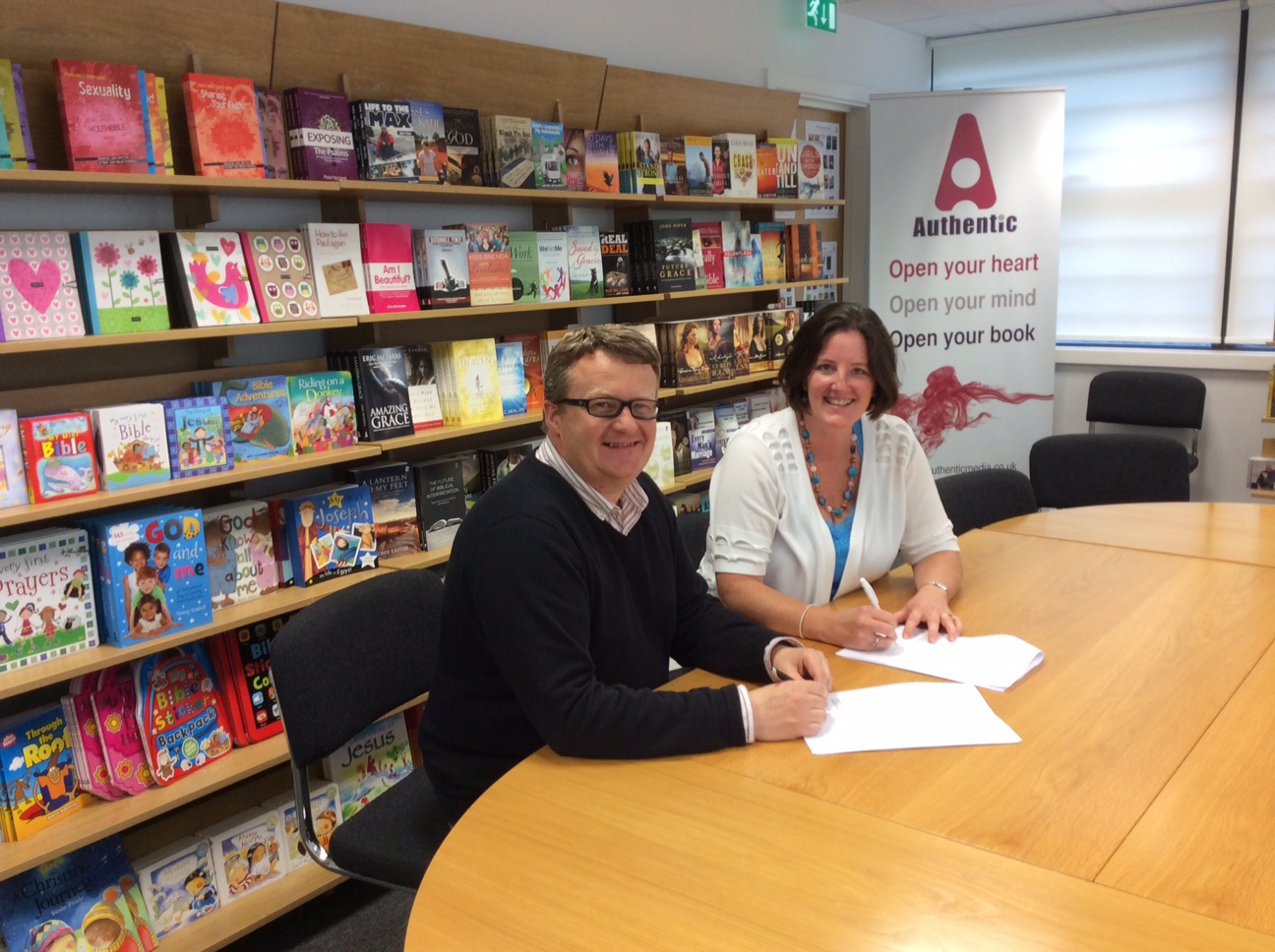
Signing the book contract with Steve Mitchell, MD of Authentic Media. Whoop, whoop!
I’m taking this passage to heart, as I embark on a writing project with a deadline of the end of the year. I’m asking the Lord with shameless audacity for his Holy Spirit, that he may spark ideas and fun and stories to fill this book – that it might be something actually worth reading! (But if it’s trash, I’ll not blame God. I don’t always hear him clearly, and I am trying to train myself away from distractions. Those distractions that could keep me from writing well.)
Oh, what’s the book? I’m glad you asked. Called View from the Vicarage, it’s a loving look at life in my adopted country – tea and all – to be published October 2015.
Do you need a dose of shameless audacity today? What’s your dream that you’ve long wanted to pursue?
How did you first get in to writing professionally? I’m a newbie to the craft, though I have been journaling for years… I have several ideas floating around in my head, but am unsure how to get them from mere ideas to something other people would want to read.
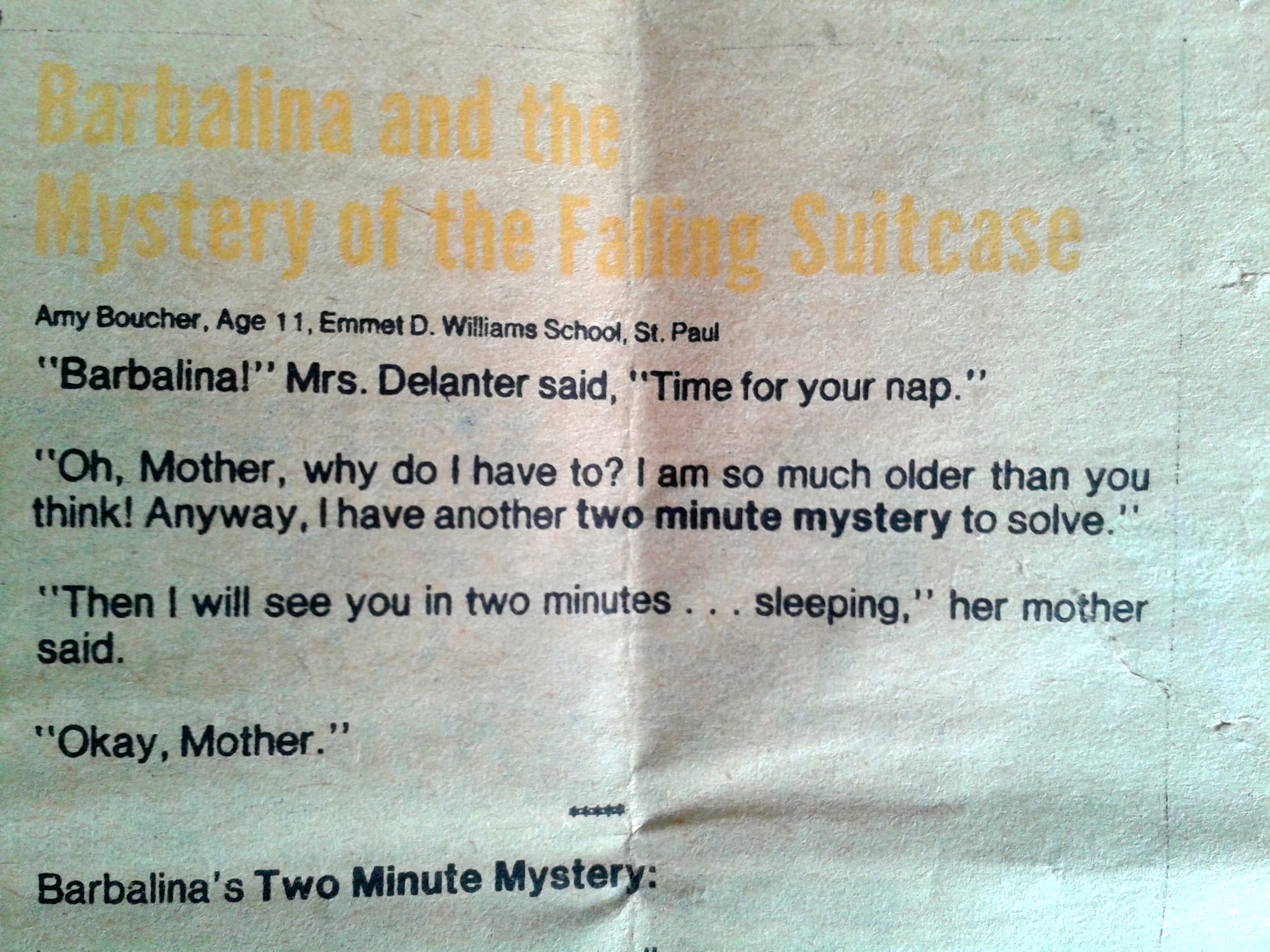
My first story, published in the Minneapolis Star. There’s more to this story than I’m telling here though…
Hello newbie writer friend! Thanks for asking how I got into this writing world. My first story was published in the Minneapolis paper when I was in fourth grade, but my writing journey has been long and filled with some heartbreak but lots of encouragement too. For decades I was afraid to write, instead surrounding myself with writers as I acted as their editor. I don’t regret my editing career, and indeed love my one-day-a-week freelance work with Authentic Media. I learned what great writing is; what is happening in the industry; how to write to meet a felt need (argh; do you dislike that language as much as I do?); and so on and so on and so on.
But how did I move from editor to writer? Through heartbreak, initially. I was the UK editor for one of the largest Christian publishers out there. It was my dream job; I was working with amazing authors – the late Rob Lacey, Adrian Plass, Michele Guinness, Conrad Gempf, to name a few. Then the big conglomerate pulled the plug on UK commissioning and they eliminated my job. I thought my world was ending.
But it was the kick on the rear I needed to pursue my writing dream. God provided freelance editorial work, which paid the bills while I explored writing. I was chuffed to get a monthly column with Christian Marketplace for six years, a now-defunct trade journal for Christian publishing, and to start up the Woman Alivebook club, which I’ve run for eight years now and love to bits. I got my first commission for devotional writing with New Daylight (Bible Reading notes – I write for BRF, CWR, Living Light and Scripture Union), which is one of my great passions. And much later on, I branched out into writing on the Christian life in Woman Alive and Libertimagazine. More on my first book when I sign the contract, hopefully in this month!
Some of the Bible reading notes I’ve written in. These are aimed just at women, but I write for both sexes too.
Everyone’s writing journey is different, but here are some tips as you start your journey.
Write, write, write. Writing is hard work, and the best writing is rewriting, rewriting, rewriting. Ernest Hemingway said in an 1958 interview with the Paris Review that he rewrote the ending of Farewell to Arms thirty-nine times before he was satisfied. The interviewer asked if there was a technical problem; “What was it that stumped you?” He replied, “Getting the words right.”
November is coming up soon, which for writers means Nanowrimo. Do it! I’ve “won” twice and failed once (and no, I didn’t write novels – I wrote whatever came into my head). For me the experience of committing to write 1667 words a day, even if they are crap, was transformative. I found the process (finally) banished my inner editor to the basement. She might knock and scream at the door, but I can more easily ignore her when I’m writing, writing, writing. (She comes in handy later at the all-important rewriting stage, of course.)
Write what only you can. Your unique voice is what will set you apart. Read/watch Neil Gaiman’s “Make Good Art” speech for this point especially. (You can find it free online, but why not splash out for a gorgeous print book, in which the typography itself is a work of art and adds to the engagement with the content.) As he says, “The urge, starting out, is to copy. And that’s not a bad thing. Most of us only find our own voices after we’ve sounded like a lot of other people. But the one thing that you have that nobody else has is you. Your voice, your mind, your story, your vision.”
As a Christian, I find the way God created us all so uniquely, and yet in his image, exciting and mind-blowing. Christ-in-me will result in art that’s different from Christ-in-you, but the universals come through.
Don’t fear failure. Well, you will fear failure, at least I do, but write anyway. Try to develop a thick skin. Not everyone is going to like your type of writing, but hopefully you’ll find your tribe, your clan, who will love to hear what you have to say. Whole websites are devoted to the rejections writers have faced – famous ones included.
Early on when I started to move from editor to writer, I pitched a series of columns for a well-known magazine. Because I was in the industry, I knew the editor and they responded to my initial pitch enthusiastically. I duly cranked out three sample columns and waited with baited breath. The response that came back was crushing, not least because the editor said no; they also said my pieces would fit better in an American magazine that I felt was twee! I nursed my wounds for a bit and then moved on to the writing assignments I did have, which at first were book related (such as book reviews, which I still love writing).
I’ll write about my rejections on the book front later, but know that editors and publishers don’t have super powers to let them know that this piece of writing or that is going to be a big hit. Yes, okay, some things are key, such as great writing, great content, and a huge platform. But books can come out of nowhere and surprise us.
Build your platform. Lots of people address this vital issue in their blogs, so I won’t spend much time here. (Agent blogs are great resources – try Steve Laube,Books & Such,Chip MacGregor.) Discoverability is today’s challenge – how can your readers find you in a crowded marketplace? As an author you need to get out there with social media and in real life, speaking and connecting. In terms of social media, my biggest advice is make it real – people soon tire of authors only selling their wares, who aren’t interested in having a meaningful and two-sided conversation.
Love, love, love running this book club. I get review books for free, get to share my opinions about them, engage with authors and readers, spread the word about great writing… What could be better?
Engage with the pros. Take your craft seriously. You can find a lot of free resources online, but nothing beats one-to-one engagement with an industry pro or a writers’ conference. In the UK, I recommend you join ACW, as mentioned above, which holds regular writers’ days, has an active Facebook group, and a regular magazine. Writers’ Essentials is another resource for courses and a place to hire a wise editor.
Hire an editor, you say? Yes, indeed. I hired a fabulous friend to help me with my failed book project. She helped me see what I couldn’t see, especially in terms of structure and voice. Her help was invaluable, and even though that book won’t see the light of day, I don’t regret the investment for a minute. (And yes, I write that as a professional editor myself with some twenty-five years experience!)
So newbie writer, my friend, I hope this helps. Write, write, and write some more. I trust you will find your voice; I trust you will make the world a better place for having crafted your words into prose, poetry, fiction or other format. Let me know how it goes!
When people take the time to write to me about one of my Bible devotions, I read their letter with interest. More than once I’ve been called up over a suspect claim or a disputed point of theology. In fact, at one time I started to dread the letters coming through the door.
But then I wrote a set of notes on the theme of pilgrimage, which seemed to strike a chord, especially with people who were transplanted from their homes. I still receive a lovely card at Thanksgiving from one of the readers, which I find moving.
One letter in particular blows me away. This woman was writing about some notes I wrote for New Daylight on the miracles of Jesus, and the text was Matthew 8:23-27, where Jesus calms the storm.
As I wrote in the notes:
The storm was no ordinary storm. This is hinted at by the Greek word seismos, which usually means an earthquake, or literally, a “shaking” (RT France, Matthew, IVP, 1985, p. 161). A force from outside brought chaos; that is, a squall came upon the lake violently and suddenly. Jesus demonstrates his authority by calming it with a rebuke…. Jesus wants us to believe in his power to still the storms in our lives, whether created from outside or from within. Sometimes they appear suddenly, taking us by surprise and perhaps flattening our faith. As we turn to him in fear or faith, asking him to save us, he brings calm and peace, creating order from disorder.
Here’s her letter (spellings intact):
I am a Brit living in Christchurch, New Zealand. For many years I have used and appreciated the BRF New Daylight series & at the memorial service for the victims of the earthquake today [18 March 2011] we were urged by our bishop to tell our stories. I don’t expect you realise what you wrote on the day of the earthquake, I had been at a small prayer group in the morning & read out the passage for Tuesday 22nd Feb & we talked about it, & related it back to September 4th the day of the first quake.
Fifty minutes after leaving the group we were once again hit by a terrible earthquake & as I took refuge under a rack of clothes in the shop I was passing through, I cried out to the Lord, in fear, to protect & save me & my family. I remembered what I had just read to the group & tried to trust Jesus. The past three weeks have been difficult, & nothing is the same, but all our family are well & this has brought us closer to the Lord.
I was bowled over, to think that the words of the devotional, written probably a year previously, would be so used by God in a place far away.
The power of words and the Word. What words will you speak or write this day, that might bring hope, comfort, or peace?
Recently a vicar (no, not that vicar) asked me to contribute a sermon on proclaiming the gospel message through writing. Happy to be asked, I said yes. Then I wondered whichever passage I would preach on. “Of the making of books there is no end”? Jeremiah’s “Eat this scroll”? My husband suggested looking at Colossians, for Paul never visited that church but ministered through the written word.
Photo: Written in Gold, Flickr
I remained stuck, asking God for direction. That leading came through Facebook, for when I posed the question on my wall and in a Christian writer’s group, I received enough responses to write a book: Habakkuk 2:2: “Write the vision.” Or John 1, “In the beginning was the Word…” Or Psalm 45:1: “My tongue is the pen of a ready writer.” All rich with possibility, but the passage I settled on was Luke 1:1-4 as suggested by a writer who said it makes “clear that the words are written to communicate Christ to the reader.”
Do you remember that bit at the beginning of the gospel? Luke uses it to tell Theophilus why he’s writing, but he’s also employing a literary convention that historians such as Josephus used to prove their authenticity and merit. So too Luke says that although “many have undertaken to draw up an account,” yet he “too decided to write an orderly account.” Why? Because “I myself have carefully investigated everything from the beginning.” He’s not implying that the earlier accounts were hopeless and thus he needs to pen his own. Rather he wants to build on and enlarge their work through his careful research and eyewitness interviews. Primarily, he wants to reassure Theophilus: “So that you may know the certainty of the things you have been taught.”
Encouragement for us to write too, don’t you think? Of course we won’t be creating Holy Writ. But if we are writing an historical account, for instance, we can follow Luke’s example of careful documentation to produce a trustworthy account. We can share his passion to tell the stories of God transforming lives. We can encourage our readers in the foundations of their faith.
As I looked out on the congregation, clustered at the back in a cavernous and chilly Anglican church, I prayed that my words might spark some interest in the gift and discipline of writing. Conscious that many might not see themselves as writers, I emphasized the numerous ways we can write today, such through letters, emails, texts, social-networking sites, blogs. As we communicate, we can be a transformative presence. For instance, deciding never to act out a conflict over email. Or posting a handwritten letter as a surprise. Or texting a Scripture to encourage.
I spoke about other places to write without seeking publication, such as keeping a prayer journal, which could become a treasured record of God’s working in our lives. Or documenting our family history. Or creating poems as a meaningful gift. And I spoke about writing for publication, such as letters to the editor, features in the local newspaper, writing for a charitable organization. And columns, articles, stories, Bible reading notes, books… the places where we can write are many.
Did my words accomplish what I hoped as I unpacked one short passage in Scripture? Only God knows. I felt slightly disheartened as I glimpsed some frozen faces in the congregation. But God’s breath can bring life and warmth into even a cold church on a rainy day. And just as I don’t know the true effect of that sermon, neither do we of our written words. We ask God for the seeds to sow, and with his strength we fling them as far and wide as we’re able. Then we ask him to provide rain, sunshine, and protection from hungry birds or constricting weeds.
May the Lord refill our stock of seed, that we may help to produce a harvest of righteousness.
As I walked into the converted railway station, I caught my breath. Was this paradise?
People nestled around a crackling fire, gathering their hot drinks and cookies to settle in with a good book. I looked at the shelves, hardly knowing where to stay my gaze, titles vying for my attention. My fleeting glance took in a new biography about Anne Frank. A Second World War book my husband would like. The Kazuo Ishiguro novel I had lent out before reading and never got back.
I ventured past the first room, my senses on overload. Above me was a massive mural of famous authors, commissioned by the owners. On the top of the stacks ran a miniature train, chugging along. Snippets of poetry sang from the walls and on signs between the stacks. I could hardly breathe, trying to take it all in.
Philosophy, religion, biography, fiction. I moved into the main room not knowing where to start. All these volumes, so much love and care poured into their creation, then cast off by their first (or second, or third) owners. Now here to be discovered and loved again. Those from centuries gone by, locked in cabinets, their prices dear. Books from recent years, carefully arranged by category and alphabet.
I wandered throughout the stacks, fingering books, overwhelmed. After jumping from section to section, unable to form a systematic plan of browsing, I came upon an article from the Newcastle Journal featuring the owners of this amazing secondhand bookshop in Alnwick, Northumberland. Reading it filled my craving for setting and character related to this magnificent place, and my heartbeat started to slow.
Barter Books was the brainchild of an American woman and an Englishman – a strikingly good combination, I’d say. Mary and Stuart Manley met on a trans-Atlantic flight when Stuart, captured by the intriguing woman across the way, tried to figure out a way to meet her. He pondered through the first in-flight film and then hatched a plan. He dropped a note in her lap, saying, “If you want to talk to me, raise your hand.” Although she had requested a seat on her own, wanting to spend the time reading, she thought, “This is too good – so I raised my hand.” They talked the whole flight and married three years later.
Stuart’s passion had been for model trains, and he ran a small shop in the old Alnwick rail station for ten years, struggling to stay afloat with issues of cash-flow and never reaching comfortable success. Mary loved books, and on a trip to Lindisfarne to do some voluntary work she came up with the idea of starting a secondhand bookshop. “I thought maybe I could start a secondhand bookshop and call it Barter Books, have a little barter system.”
Spot the train?
They started it in a tiny part of the building, and it soon became apparent that second-hand books were the way to go. They sold off the rail models, which cleared off their overdraft and enabled them to invest in remodeling the railway station – a strategy they have employed since they started the bookshop in 1991. As Mary says, “We’d make a bit of money and then throw it back into the shop. We still do – it’s our pleasure really and it’s good business too.”
The rail station was built in the 1880s and closed in 1968. It’s a massive structure for a small town, brought about by the influence of the Percy family, who have held the title of Duke or Earl of Northumberland since the Middle Ages. Stuart says, “They built this station because of the Duke of Northumberland and to impress visiting royalty and that kind of thing, so that it would be a showpiece for the North East Railway. It was only a 7,000 population town – it hardly merits a wooden hut never mind a twin-barrelled 32,000 square feet railway station.”
The poster, which found fame through word-of-mouth excitement by visitors to Barter Books.
Barter Books not only breathes new life into a disused railway station and feeds booklovers’ obsession, it birthed a modern phenomenon. Early in the millennium, Stuart bought a lot of books at auction. Although the books weren’t worth much, a folded poster in one of them was: the now ubiquitous poster from the Second World War, “Keep Calm and Carry On.” They thought it was wonderful so hung it on the wall, and people started asking where they could buy it. They made copies and it became hugely famous. As Stuart says, “We had no idea when we found it that it was going to grow into such a monster.”
Mary adds, “We haven’t got rich on it because it’s out of copyright. In fact, we’ve learned what sharks there are out there. One man tried to sue us for selling any of it, because he wanted to establish a copyright for himself. You really learn.”
The amazing author mural, which took two years to paint.
Pulse regulated, I was ready to browse the books, on the lookout for gems. I worked from one room to the other, spending the most time in the religion and biography sections. I was bemused to see a compilation book from my division when I was an editor at HarperCollins in the religion stacks, but was disappointed that the books on writing were on the paltry side. (Later, after I had made my purchase and was nearly ready to go, I discovered in a separate room the volumes on bookbinding and typesetting – an area to explore during my next visit.) I toyed with buying an early copy of Cranford by “Mrs Gaskell,” but decided I shouldn’t spend the money and bought the £2 film-tie-in paperback instead.
Your local bookshop might not live in a former railway station, but it too will house gems that only need uncovering. If we don’t support these vital repositories of stories, learning, and enrichment, they will become relics of an age gone by.
Thanks to Mary Manley for permission to include her and Stuart’s quotes from the interview with the Newcastle Journal. I happened upon her in the First Waiting Room during my second visit and enjoyed our conversation, two Midwesterners now living in the UK.
The Lord is my publisher, I lack nothing.
He makes me lie in cozy studies,
he leads me beside quiet waters,
he refreshes my soul.
He guides me along the right paths
for his name’s sake.
Even though I walk
through the valley of rejection,
I will fear no evil,
for you are with me;
your commissions and reviews,
they comfort me.
You prepare a table before me
in the presence of my critics.
You anoint my hand with ink;
my cup overflows.
Surely your goodness and love will follow me
all the days of my life,
and I will dwell in the publishing house of the Lord
forever.
(Inspired by Jonathan Burnside)
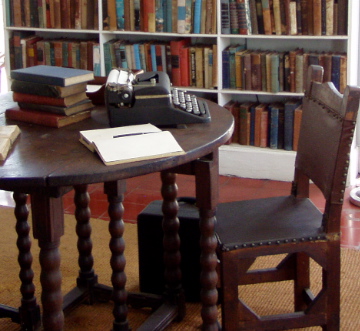
PS Can you guess whose study that is? Pretty sure he wouldn’t have claimed this psalm as his own…
In my university years, I was friends with a man who was intellectually gifted. I enjoyed our times together, but deep down, I never really felt myself with him; I somehow felt I was lacking. Not that I would have ever even named this vague feeling of dis-ease, but I can see it looking back through the lens of time.
We often went on outings in the city where we lived. By mutual never-expressed agreement, neither of us was interested in the other romantically. This made for jaunts to restaurants or cultural happenings that were fun and generally easy. Until he would say something that felt like an underhanded critique.
Such as one day as we were browsing in one of the city’s fine bookstores. As we were exiting, he said, “You know, Amy, maybe one day you could run a bookstore.”
Startled by his pronouncement, I merely said, “You think?”
A selection of my books on writing. Some great ones in there; I especially recommend the one by Eudora Welty (One Writer’s Beginnings) and of course William Zinsser’s is a classic.
His comment stung, because I had a deep-seated desire to be writing the books, not selling them. So I saw his remark as a putdown. I hasten to say that having been in the publishing business for so many years, I have met many a fine bookseller, marked by enquiring minds and wisdom. Now I wouldn’t see his comment as derogatory, even though I still prefer to be part of the creating process.
And the creation of good books is what my career path has focused on. Mainly with me helping other people to write, rather than me being the one to do the writing. Only now – some twenty years later – am I in the process of writing a book that I hope will one day feature in a bookstore.
Another comment by another intelligent man whom I respect (and a writer himself) brought me low a few years ago. When I told him that I wanted to be a writer, he said, “That’s something you can aspire to later on.”
When he said that, I felt he was saying, some day you can try that. Later on, when you’ve learned more and become more wise. He is generous-hearted and probably meant nothing by the comment. But it wounded nonetheless.
But most days I write, and the working days I enjoy most are those penning one thing or another. Part of being a writer – at least for me, with fledgling confidence – is accepting the moniker and growing into it. Knowing that I am a writer because I write; not because I’ve clinched a magical three-book contract (although that would be nice too). God can change my name. Not just Amy, the editor. But Amy, the writer.
How about you? Is there some unaffirmed part of yourself that longs to be expressed? Have you had to grown into a new name?
Last Sunday I led the group for 11-12 year olds at our church. I have to admit that kids’ ministry has never felt like something I’ve been called to. Nothing against kids, of course. I love my two dearly. But I’ve always been so keen on discipleship for adults that I’ve bypassed the younger set.
But these budding nearly teens are a wonderful bunch. Filled with great questions and strong opinions. I have to check my church jargon at the door and remember to keep it real and authentic. And I come away glad to have been a part of their discussions.
So on Sunday we were looking at Acts 4, all about how the once-frightened Peter, who betrayed Jesus those three times, was now bold and winsome and filled with the Holy Spirit as he and John explained their actions to the religious leaders and defended the new thing God was doing. One of our activities was to explore some of the Scripture in rap form, courtesy of Scripture Union. We read the two raps aloud, jiving and moving to the beat. Then, to my surprise, we wrote our own.
Now I should stress that I didn’t think we’d have success in this exercise – group writing and all of that. I thought it would be beyond us. But lo and behold, we put down the first line, and then the next, and the next. And a rap was born. Okay, so it’s more of a lyrical poem than a rap, but here, for your reading pleasure, is the Lord’s Prayer rendered by us (best read aloud):