You know that spine-shrinking feeling you have when you’ve been caught out at something? They have seen your wrongdoing, named it, and there’s no place to run and no place to hide. You feel exposed, ashamed. You have no excuse. I’ve experienced that sensation, and also the great gift of forgiveness extended to me afterward. The feeling of being washed clean of the rags of shame is freeing and liberating.
But too often, I’m the one pointing the finger. I’m the one naming – in my family – the list of shortcomings and failures before them. They don’t reach my high standards, and I’m disappointed. Or I place my frustration in one, such as my husband, on a child, like I did this very morning: “Mom,” she said, looking up at me from the half-landing, “You’re mad at Dad for not getting up and getting ready but you’re taking it out on me.” Yes, she was right – and I had to confess that and ask her to forgive me. She walked up the stairs and gave me a hug before going to school. I was glad.
So what’s our excuse? Pride, self-determination, fear, anger… a whole host of negative and self-focused emotions can lie behind our actions of blaming others or being overly cross when they fail us. But we’re not God; nor does he want us to be taking that rightful place from him. He wants us to extend grace and love with humble hearts. Yes, there’s an added layer of complication when we’re parents and we want to teach our children. But God through his Spirit is the best teacher of all.
That’s a thought that Oswald and Biddy Chambers held onto in their work with the Bible college they set up, and then later with their work with soldiers in Egypt during the First World War. They would seek not to guilt someone into making a decision for God, or to try to convict them about a specific course of action. They fully believed that God would do the work; they would pray and commit the matter to him and to the person. (This week marks the hundred-year anniversary of his death. You can read my short account of his life here.)
Want more? My book The Living Cross shares stories from the Old Testament and the New on the freeing nature of forgiveness in a forty-day devotional format (for Lent, but it can be read at any time).
A pregnant pause.
A companionable silence.
An awkward pause.
The sound of silence.
Silence –
It can be deafening
It can be rich
Or a source of strength
Or a drain of energy
Some crave it
Others run from it
I love a good block of silence in my days. When Mondays come around, I’m delighted to be in my sunny study, writing or answering emails, or pondering. The quiet gives me time to process all that’s going on in my heart and in my head, for my thoughts seem to swirl around and around. I need time alone to catch some of those thoughts and process them. To get them down on paper and to make sense of them before God. To seek his inspiration, help, comfort, and love.
Over the summer, I worked on my dissertation for my master’s in Christian spirituality. I had three weeks in our home basically on my own – first the kids were at camps and my husband was on retreat, and then my husband took them on holiday. During the weekends we’d reconvene, all together in the vicarage, with the noise and hum of daily life once again appearing. And then they’d leave, and I’d be alone.
Me in my sunny, silent study. A happy place – usually.
The first week I relished the silence, thrilled to be able to work uninterrupted as I slogged forth in laying down a first draft.
The second week I made sure I left the house a few times, set up a few video chats with friends, and was glad that my husband was home for a few of the days.
The third week I cried, feeling sorry for myself as I knew I had not only the excruciating work of rewriting my draft, but had to live in what now felt like crushing silence.
I made it through the summer alone. I know now that although in my daily life I yearn for slices of silence, I too need times with others.
A writing friend encouraged me to join the #fiveminutefriday clan with writing for five minutes (yes, it’s self-explanatory) on their prompt. Here are my thoughts on what we need. Have five minutes and want to join in?
What do I think of when I hear the word needs? What pops into my head is felt needs. It’s an awful-sounding buzz phrase in publishing circles, in which products are created to meet someone’s felt needs. The needs we feel. The needs that will make us part with money.
Felt needs.
But what about the unfelt needs? What about the needs that aren’t sexy or those I might miss? The need to love and be loved. The need to love God and be loved by him. The need to make a difference, help people encounter him, serve others. To learn; to grow; to effect change. Those things aren’t necessarily quantifiable or something to be packaged into a saleable form.
What unfelt needs am I aware of today, and how can I see God’s hand in them? What unfelt needs can I call forth in others?
How can my writing meet hidden needs? Needs that might not be heralded or lauded? Can I be brave enough to write something that might be overlooked?
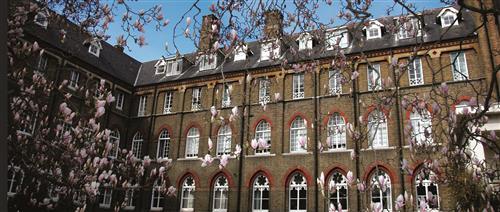
The lovely Heythrop College, part of University of London until next year when it will close.
Some years ago a writing friend shared with me how he liked to personalize Psalm 23 according to the different roles the Lord could play in his life. Thus instead of a Shepherd, I wrote about the Lord being my Publisher. (And here are some examples of other people engaging with this psalm.) Recently after receiving a not-so-stellar book review, I wrote about the Lord being my Reviewer, and this morning, as I struggle to write my penultimate essay for my MA in Christian spirituality, I’ve written about the Lord being my teacher (or I suppose I should say “tutor”).
The Lord is my teacher, I lack nothing.
He makes me rest from my studies,
he leads me beside the bubbling brook,
he refreshes my soul.
He guides me along the right ways of thinking
for his name’s sake.
Even though I trudge
through the valley of low marks
I will fear no evil,
for you are with me;
Your assignments and comments,
they comfort me.
You prepare a place for me
At the academic high table.
You anoint my hands to type;
my ideas overflow.
Surely your goodness and love will follow me
all the days of my life,
and I will dwell in the College of the Lord
forever.
How could you make the beloved Psalm 23 applicable to you today?
A story of how yesterday I was surprised to realize that I’d written over 500 daily Bible reading notes. How did this happen?
Many of you know how losing my lovely Great Big Commissioning (Acquisitions) Editorial Job in 2005 gave me the impetus to start writing, and thus to pursue a deeply buried dream from childhood. I started tentatively, writing a review of so-called Christian fiction for the Church of England Newspaper that I read now and shake my head (for it was filled only with quotations by authors). In 2006 I got the amazing opportunity to start the Woman Alive book club, and I also scored a monthly column with the Christian retailing trade magazine, which was then called Christian Marketplace. Slowly, slowly, I learned to lay down words on a page and to meet deadlines as I searched for my voice.
After a couple of years, in 2008, I had a most exciting invitation from a fellow editor. While also commissioning books for BRF, she oversaw the editorial work for one of their daily Bible reading notes, New Daylight. Would I be interested in contributing a set of notes?
Would I?
I burst out of my study and ran down to tell Nicholas. “Can you believe that Naomi has asked me to write for New Daylight?” I was thrilled down to my toes, for I sensed – as someone who loves the Bible and prayer – that this was something that I’d love to do.
My first set of notes needed a lot of editing as I learned the style and approach, and I had spent weeks researching and then writing the text. Over time I gained confidence, which would then be dented when I’d open a letter from a reader who disagreed with me over a theological point or interpretation. I had to gird my loins, so to speak, and learn from the letters and then keep on keeping on.
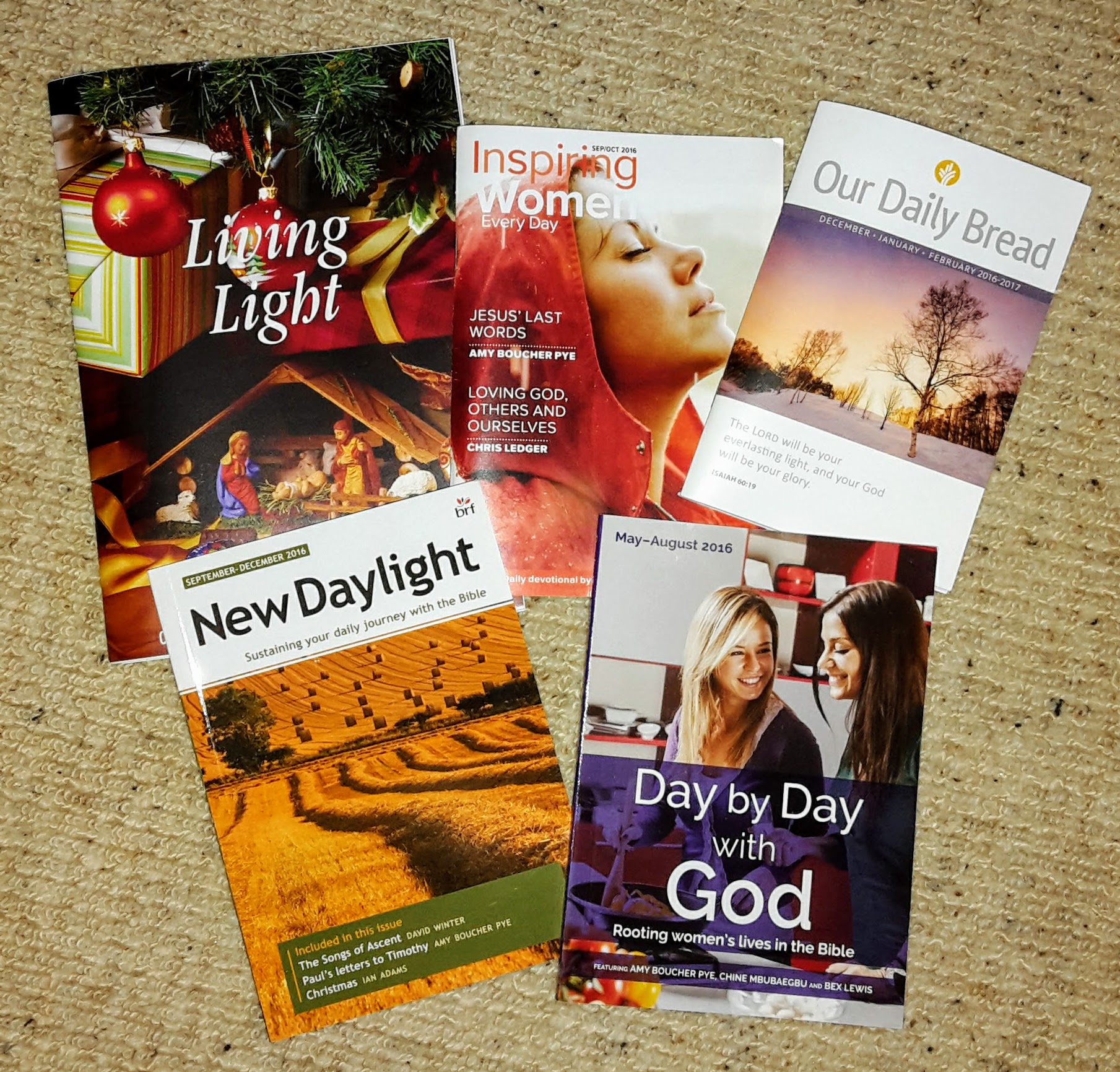
That year I got to write for Day by Day with God, BRF’s publication for women, and eventually for CWR’s Inspiring Women Every Day and NCT’s Living Light. Each commission humbled me, for I’d sit at my desk, poring over the biblical text, thinking, “This is how I get to spend my time! How cool is that!”
A couple of summers ago I had an unexpected invitation from Our Daily Bread (ODB), asking if I’d like to submit some articles to them.
Would I?
I burst with excitement to my family while we were on holiday in Northumberland. I had harbored the unvoiced dream of writing for them for years, for my next-door neighbors growing up always read ODB, and I knew how widely it was loved in the States and around the world. I drafted three articles, observing their particulars for word count and style, and held my breath. We had a lot of discussion back and forth, but eventually they asked me to join their writing team. Wow!
This picture makes me smile, for it’s all the Our Daily Bread and Our Daily Journey authors and team who were able to be at the recent conference.
Bible reading notes (or devotionals, as they are known Stateside), are usually written a year ahead of time. My first article for ODB came out in February 2016, and for the first time in my years of writing devotionals my parents were deluged with phone calls. My mom’s uncle and aunt out in California called to say they recognized the writer that day, and of course our lovely neighbors were thrilled too (in fact, Mrs. Wolleat gets a copy of ODB each time from her church for my parents and puts a sticky note on the day when my articles appear!). It’s been special to be a part of this community, especially when they had their first writers’ conference in October, where I met the team and fellow writers.
Nor do I forget my first publishers, BRF, for they’ve even published my second book, The Living Cross, which extends the daily Bible reading notes format for Lent, on the theme of forgiveness. I continue to write for New Daylight and Day by Day with God, and enjoy the speaking opportunities that come from the BRF/Woman Alive women’s days. And yes, I write still for the others!
A little thing is a little thing, but faithfulness in little things is a great thing… -Hudson Taylor
I share this as an encouragement to you to take that first small step in something you’d like to pursue but perhaps you’re hesitating to do so. Or maybe you’ll receive an invitation, like I did, and you wonder if you should say yes or not. Now I can’t imagine not being able to write daily devotionals; it’s one of the things I love doing most. Even today I need to get back to drafting two weeks on Zechariah for Day by Day with God – goodness, I’m glad to be past the apocalyptic visions!
For if you take the first steps in pursuing your dream, you may find years later (eight years for me), that you reach a milestone such as over 500 devotionals written for traditionally published periodicals. How could the world be different if you went for it?
Over to you – do you have a buried dream you want to pursue? What is keeping you from going for it?
Want to read some of my devotionals? Here’s how.
Each month I have two or three articles that appear in Our Daily Bread. You can have a print copy sent to you by requesting one here. Published around the world!
My next set of UK-published Bible notes will appear:
May 2017 in New Daylight, where I look at Revelation 5 to the end for a fortnight (appearing in May).
May 2017 issue of Day by Day with God, where I spend two weeks with Romans (appearing in July).
Jul/Aug 2017 in Inspiring Women Every Day, where we look at Colossians for the month of July.
Want some advice on how to write a devotional? I share some tips here.
I’ve written a book [for a Christian audience], and know that although you’re probably busy with a zillion things, any guidance or advice with how to begin the publishing process would be very appreciated. Feeling unsure of where to begin…
Dear new author
Well done for taking the plunge into the writing life. Well, I’m guessing that you’ve probably been writing for many years, but now you’ve penned your first book, which is wonderful. Getting the words on the page is a huge accomplishment. Where to begin with the publishing process? Here are a few tips, gleaned from my many years in the business of creating books.
1. Make your manuscript as best as it can be
Whether you land a publisher or choose to go indie, the more you can hone and shape your manuscript, the better. Yours is fiction, which I don’t have as much direct experience with as an editor (although I read voraciously), so I’m not the best person to advise in terms of creating and refining a novel. But aspects of good fiction strike me to focus on, such as strong characters, believable plots, an appropriate amount of tension, and so on. For non-fiction writers, how’s the argument in your book – does it flow? Is it engaging? Life-changing? Are you meeting a felt need in the market (marketing speak, I know)? Are you perceived as an expert in this field?
Whether fiction or nonfiction, your book will benefit from an outside perspective, preferably an editor. With my first book, I spent a chunk of change in engaging an editor to help me craft my proposal and sample chapters. She helped me see what I was blind to and brought clarity and polish. That book never got published, and never will, I think (thankfully!), but that’s another story and not at all related to her role in the acquisitions/commissioning process. I recommend you spend money on an editor.
Maybe not the best way of increasing your platform?
2. Develop your platform
These daysgetting commissioned feels like it’s all about platform. How many Twitter/Facebook/Instagram/etc followers do you have? How often do you blog? Who are your peeps? Publishers receive proposals for wonderful books all the time, and although the publisher may love your concept and execution, you don’t have a following, they may have to turn down your project. “Have to” you ask? Well, of course they could spend a lot of money launching new authors, but resources are limited and with margins becoming more and more squeezed in the industry, investing in this way simply isn’t as possible as it used to be. I should add, however, that nonfiction can demand a more defined platform than fiction.
How to develop your platform? It’s not something that appears overnight, so taking a long view is the best approach. Try to arrange for speaking gigs or magazine articles or blog posts in your chosen field. Blog regularly, if you don’t, and set up a mailing list (advice I need to implement!). Build your community.
3. Determine which publisher you’d love to work with
If you going for a traditional publisher, do some research. Go to a bookstore and look online for other books that are similar to yours. What’s the competition (you’ll need this for your book proposal anyway)? Who is publishing those books? Research and research some more, finding out as much as you can about who the publisher is and what they like to publish, and who their audience is. With so much information online, this is so much easier than it used to be.
If you’d rather go indie, find out who is who. Or maybe you’d like to keep control and set up your own house. Again, there is a lot of information online about how to self-publish (just please, please, please pay for an editor, proofreader, and designer!). In the UK, many of the members of the Association of Christian Writers have experience with indie publishing – if you check out their daily blog, you’ll get a sense of who to approach for advice.
4. Put together your book proposal
You’ll need a book proposal for your work. Novels are different than nonfiction – for fiction, you can write a synopsis, outline, and sample chapters (I believe – as I said earlier, not my specialty!). For nonfiction you’ll need much more. For my first book proposal I included:
Paragraph summary of the book
Author bio
Competition
Target audience
Marketing (what I would be willing to do and what would be natural for me with my platform)
Annotated chapter outline
Sample chapters
I recommend you research this topic more fully, for your book proposal is probably the most important thing to getting published (unless, say, you’re a relative of a publisher!). I used as a guide Michael Hyatt’s how-to create a book proposal (before he created the ebooks he now has available). I’d also recommend perusing Jane Friedman’s website, for she has a lot of resources available, including where to get started on a book proposal.
5. Pray
Yes, we need to work hard to try to land a publisher. But I believe we need to pray hard too, trying to discern God’s nudges and leading. After all, he’s our Author, Publisher – and our Commissioning Editor! May we collaborate with him on works that will spread his kingdom of love and light.
Let me know how you do in your publishing journey!
Do you have any hints on giving a fair and honest review?
I have received books that were not of my choosing written by those of a very different experience and background to me. The genre may not be what I usually would read. I have a few where I haven’t finished. Much work has gone into the writing of these books which may have a message that I was unable to connect with. Without doubt if they reached a person who liked the style they would be enthusiastically received.
Great question, and as someone who has reviewed books for a decade with the Woman Alive Book Club and in places like Christianity magazine, I have given it much thought. It’s easy to write a negative review – just fire off a list of all the things you don’t like about the book or author. It’s also pretty straightforward to write a review about a book you love, because you can share your passion and say what moved you. What’s harder, though, is to write a nuanced review that shares the high points and low points in a fair way.
Photo: Christopher, flickr
When I choose which book to select for the Woman Alive Book Club, some months I flail around, for I want to pass along something that I loved, a work that I think will connect with my readers. So I consciously don’t write hugely negative reviews there. Why waste everyone’s time? But when I’m assigned a book to read and review, such as for Christianity magazine, then I give the negatives and the positives. If you’re blogging and you’ve received the book on condition that you’ll give a review, you’re in the same situation, and so these tips are for you.
1. Say what the book is
I often start off a review with a summary-sentence that describes the book. Here are a few from those published in Christianity magazine a couple of years ago:
A gentle exploration of ageing from one of the giants of our generation, and not only for those in their “golden years” – a phrase which Graham dispels. (Nearing Home by Billy Graham)
HopefulGirl (a pseudonym) reentered the Christian singles market after her fiancé unceremoniously jilted her, and kept a diary of the good, the bad and the ugly from four years of dating (as published in Woman Alive). (Would Like to Meet by HopefulGirl)
As a self-professed “Eeyore,” Kay Warren has penned a book that has emerged out of her struggle to choose joy in the midst of challenge, heartbreak and sadness. (Choose Joy by Kay Warren)
As you describe the book, tell us if the book is a novel or a biography or a self-help book. Is it fantasy or a rom-com or historical fiction or a thriller? Is it a book on how to live the Christian life better? A memoir? A work exploring pastoral theology?
My own first book, Finding Myself in Britain, can be placed in several categories – it’s my story but it’s also cultural commentary and an exploration of spiritual insights. Some reviewers have criticized this multi-category approach, but others see it as a benefit. In contrast, my second book (forthcoming this autumn), The Living Cross, falls neatly into one category, for it’s the BRF Lent book for next year so it’s classified as a devotional.
Photo: Moyan Brenn, flickr
2. Say what you liked—and what you didn’t
This is where the nuance comes in. If you’re sharing something negative about the book, put it in context. For example, you may not be the target market, or you disagree with the author’s views because of x, y, or z, and so on. Here is an example of a review for Christianity in which I said what was good about the book (Lead Me, Holy Spirit by Stormie Omartian), but also what was lacking:
I savour books on hearing God. And I’ve enjoyed The Power of aPraying… books by this author. I wanted to love this book, but it didn’t grip me.
It’s a solid and sound look at the Holy Spirit as found in the Bible, and would be a good resource if you wanted to study this sometimes overlooked member of the Trinity. But I had hoped for more stories interwoven amid the biblical explorations. The few she recounted stuck with me, and made me want to hear more. I also would have appreciated her views on the gifts of the Holy Spirit, which she said were better addressed elsewhere.
Her Prayer Power sections, however, are worth the price of the book, especially if you struggle to find the words to seek God’s leading or empowering in your life.
As you can see, I highlighted what was good about the book – it’s a solid look at the Holy Spirit as rooted in the Bible. But also where I found it wanting.
In describing what you liked and what you didn’t, try to be specific. For instance, if the book is fiction, which characters appealed to you? Did they feel real? How about the plot – were you carried along, your belief suspended? For nonfiction books, did the argument move seamlessly throughout the book? Did it capture your attention? Did reading it change you? How was the writing style?
3. Say who the audience is
Flagging up the intended audience will help the reader understand why you liked (or not) a book. For instance, with Kay Warren’s book that I mentioned above, I said:
I agreed with her and was moved by some of her vulnerable stories. But as I read I wondered why her writing wasn’t really connecting with me. Perhaps because she is, on her Winnie-the-Pooh personality scale, an Eeyore, this serious, melancholy tone seeped through. Which, of course, could make this the perfect book for some other woman.
Although in one sense I should have been the target market for her book (a woman concerned with the Christian life), our personality differences meant I didn’t resonate so much with it. And now, in hindsight years later, I wonder how much of me not clicking with her had to do with her not being able to write openly, for this book came out before the tragedy of her son dying by suicide.
Photo: Alan Levine, flickr
4. Let your personality shine through
What I love most in reading reviews is finding out more about the book reviewer. I try especially in the Woman Alive Book Club to be myself and share from my life, as openness and vulnerability can help build community.
Don’t be afraid to share who you are, and how this book influenced/moved/changed you. When we connect with a reviewer, we allow ourselves to be more persuaded by whether they liked a book or not. The individual quirks and personality traits that shine through in a review make them more likable and compelling.
♥
“Of making many books there is no end” (Ecclesiastes 12:12) – thanks be to God. And I pray too that “of reviewing many books there is no end,” for authors need readers and readers need reviewers. A community coming together to share their love for books. What will you review next?
Having worked in Christian publishing for over two decades as an editor, I’ve had contact with many an author. In my early days I worked with some highly strung first-time ones – those who define the stereotype of oversensitive, defensive, and not wanting to kill their darlings. I’m remembering one whose book I edited in the early days of the internet, when I would plug in the cord into the phone socket and dial in my clunky Mac laptop to download my emails. Each time I opened my emails I’d find another range of missives from him, written with passion and angst as he argued every little change.
I found the experience draining.
When I moved across the pond and started as an editor in the religious books division at one of the huge conglomerates, I was stunned to hear my boss, the publishing director, say, “I only commission authors I enjoy.” Really, I thought? Well that must leave out a lot of people. But as time passed and as I inherited many projects from covering a maternity leave, I could see his wisdom. Those projects where the author and I clicked, where I could see their passion and integrity, were those I loved working on, and which seemed to go swimmingly – even if we had a lot of rewriting and editing to do. Because we trusted each other, the editing process was a conversation – and the book benefited.
Those projects where the author and I didn’t gel so well, however, could suck the life out of me. For instance, I endured many a long, exhausting conversation with one agent, who claimed her author was receiving rotten treatment, that we were failing him, yadda yadda yadda – and this before the book even hit the bookshops! I wonder if she ever realized that she was thwarting her author’s project with the publishers.
And now, after those years as an editor, I finally got to be an author with my first book-baby, Finding Myself in Britain. The process was long and hard, but full of trust and feedback and uncovering my voice. My commissioning editor was Steve Mitchell, the MD of Authentic Media, who came up with the idea for the book. He knew my passions – for prayer and issues of identity in Christ. He also has two decades of retail experience. All of which led him to say, “Write your unique angle as an American in the UK. Make it a through-the-year look at us.”
So I had my marching orders and launched in exactly a year ago, going to Spain to El Palmeral for a week of intense writing, enjoying the sunshine and the hosts and guests – and hearing their stories of Harvest and clergy life and the difference between Yorkshire and, say, Lancaster. When I got back, I sent Steve a bunch of chapters for his feedback, and we continued to work in this back and forth manner, me writing and him assessing, as I created my first draft.
I was stunned by some of his early comments, for he was able to see what I couldn’t – namely how much I missed my family and friends in Minnesota. “I feel like you’re transplanting Minnesota to England,” he said of my early chapters in what was then called View from the Vicarage. “We want to hear what you think of us,” he continued, “not so much what you’ve left behind.”
Ouch. But he was right, and I rewrote, and rewrote some more. Once we were happy with my first draft, I sent it off to 10 reviewers, a mix of friends from the Woman Alive book club and three editor/writer friends. I sent off my manuscript to them on the Friday night and had a 13-page response from one speedy reviewer by Saturday afternoon. I was stunned at her insights and fast response – so stunned I had to take myself to bed, lest I become one of those defensive, irritating first-time authors I mention above.
And next time, dear reader friends, I’ll share how I handled that feedback and what I learned – and how I managed not to alienate my editor-friends!
“I should have written that Lent book.” That was my offhand comment to the wonderful Karen Laister of BRF (Bible Reading Fellowship) at the Woman Alive/BRF women’s day in Woking over the summer. Imagine my surprise when a month or so later I received an invitation to write the 2017 BRF Lent book! I had developed a proposal back in 2011 for a devotional exploration of the theme of forgiveness as rooted in Bible for the season of Lent, but for a bunch of reasons, mainly my misunderstanding of the realities of the Christian publishing scene (read stubbornness), the book was never written or published.
After hearing from BRF, I dusted off the proposal I had previously developed and thought, “Wow, there’s some good stuff to delve into here!” The good stuff being the biblical stories of redemption, healing, and freedom through forgiveness – from Jacob and Esau (Genesis 27 and 32) to Abigail begging King David’s forgiveness on her brute of a husband’s behalf (1 Samuel 25) to the prophets and then to the New Testament, such as Jesus, Jesus, Jesus and the early church and the Spirit coming and the hope of the Resurrection and the Life to come and to live in the here and now.
So this time the peeps at BRF and I came to an agreement, which I signed today. <Woo hoo!> Thank you, Lord! And yes, I’m excited! Although we do need a good title – my provisional one was “Father, Forgive Them.” Open to suggestions!
The winner! Illustrated and designed by Vivian Hansen.
“Don’t judge a book by its cover.”
“A picture tells a thousand words.”
In the case of my first book, I’m happy if you judge it by its cover, because it’s just so darn good. When I first received the design, I loved pulling it up on my phone and watching the person’s face as they saw at it for the first time. Again and again, they would flash a smile and often they’d exclaim in delight. Here’s part one in how the cover came to be.
When I was a commissioning/acquisitions editor at two big corporate publishing houses, we had whole teams of designers working on the covers, designing them and/or hiring out artists or photographers to provide the original artwork and photographs. How many cover designs we’d receive per project would vary – sometimes we’d have three or four variations on a particular cover, but one Stateside designer was known for his huge creativity, giving us ten to fifteen completely different designs.
Times have changed, although I suspect the massive publishers continue in this fashion. But Authentic Media, the publisher of Finding Myself in Britain, didn’t have its own design department in-house, so was able to explore other options. The MD, Steve Mitchell, is innovative and creative, and follows the publishing trends and has a sense of what’s new and what’s possible in this strange new world. I’m so glad I followed his lead throughout the process.
The cover needs to be available about six months before publication, so the design process needs to start at least nine months before. I had previously shown Steve an amazing painting of our church that Steve Bjorkman had carefully crafted in a mind-blowingly rapid manner when he and his wife were visiting the UK one year, and Authentic-Steve wondered if a cover might emerge from it. Here’s one of the covers Authentic-Steve had designed with the painting by Artist-Steve, which although we thought was fun, we knew wasn’t exactly right.
Artwork by Steve Bjorkman. One of his paintings does appear in my book, which delights me.
So Authentic-Steve committed instead to have the design created through 99 Designs. I had heard him speak of the good experience he’d had in the design of other books, such as Chris Juby’s @BibleIntro, so knew a little of how the website works. The publisher signs up for a package – bronze, silver, gold, or platinum. The higher the package, the more expensive (but still reasonable), and the more designs you have to choose from. After the contest starts, any interested designer who is signed up with 99 Designs can submit a design within the 7-day window. When the contest is closed, the publisher/author chooses a design and can ask for tweaks. The winning designer then receives the fee.
I see a lot of benefits of this system, but admittedly they favor the publisher. One is having access to designers from all of the world. Another is the huge number and variety of designs that are submitted with only having to pay for a flat fee. But from the designers’ point of view, it’s a lot of work that you might not get paid for – I did feel bad for the stellar designs created that we didn’t use. Yet it gives designers the access to potential work that they’d otherwise not be considered for. For instance, we’d have never found the winning designer without this website.
My publisher put together the cover brief (you can see it here), which was a short summary of the book (a couple of paragraphs and an outline of the contents) and then for the design elements, he said:
We aren’t looking anything too twee or formulaic e.g. flags.
I wanted to put down more suggestions about what ways to take the cover visually, but Steve rightly pushed back, saying, “You’ve got to trust the process.” This is where authors need good and wise publishers – we think we know what’s best for our book-baby, but we don’t. I’m so glad we weren’t directive, and trusted the designers to do what they’re good at – designing. (And yes, the winning design does employ flags!)
We received 96 designs from 42 designers for the contest. Some of the covers made me cringe – one in particular made me think of 50 Shades of Britain – but many were excellent and a couple were outstanding. Of course, anything to do with art and creation is subjective, so what I thought was fabulous wasn’t always the same as what others thought. But we all agreed on the winning design.
I don’t think I should cut and paste over some of the designs that didn’t get selected because of copyright issues, but you can see examples here and here. Most of the designs have been taken down, but you get a feel for the diversity of options we had. I liked the feel of #92 and #90, but they are more typical of what one would expect for my book; the winner simply outshone them. Several of the people at my publisher liked the cover by LilaM, but I thought it looked twee (US: cringey), and like a woman during the thirties or forties.
In part two on behind the scenes of the cover design, I’ll interview the winner of the contest, Vivian Hansen.
 You know that spine-shrinking feeling you have when you’ve been caught out at something? They have seen your wrongdoing, named it, and there’s no place to run and no place to hide. You feel exposed, ashamed. You have no excuse. I’ve experienced that sensation, and also the great gift of forgiveness extended to me afterward. The feeling of being washed clean of the rags of shame is freeing and liberating.
 A pregnant pause.



 3. Determine which publisher you’d love to work with
 5. Pray