We live in unprecedented times. You may feel you have more space
to engage with God or you might feel overwhelmed. Perhaps you feel both eager
to meet with God and then flat-out tired and listless in the same day.
If you have some time and energy, consider journeying with Abraham and Sarah over a two-week period through my free ebook.* These founders of our faith lived with uncertainty and change as they left their home and their family and community to follow God’s call. We can find hope in God through walking with them.
Each day you are invited to consider part of their story out
of Genesis, followed by some reflections and an interactive prayer exercise.
I hope and pray God will meet you in amazing and comforting
ways as we celebrate Easter and rejoice in God breaking the power of death and
sin through his Son’s sacrifice on the cross and resurrection.
God is with you in these hard and good times!
*Free ebbok when you sign up to my monthly mailing list. You of course will be able to cancel the mailing list if you wish later.
Recently I learned a new word: graduand. It’s the status of one who has earned a degree but not yet been awarded it. And that’s what I was from October, when I heard my results, until yesterday, when I had the joy and honour to receive the piece of paper saying I have an MA in Christian spirituality from Heythrop College, University of London. (Once you’ve been awarded the degree, you become a graduate.)
I’ve not been well with a lingering chest cold, and so at the beginning of the day prayed that I would be fully present to this momentous experience and not feeling like it was one more thing to do in busy December. As I sat down with my fellow graduands after the academic royalty processed in, I was struck in that moment with a deep sense of gratitude. Here I was, a girl from Minnesota, receiving an award from the oldest College in the University of London. I paused to give thanks.
Shaking the hand of the Vice-Chancellor of the University of London
The most moving part of the ceremony came as the queue of robed people lessened as one by one we received our degrees, and one man wearing a suit – no robes – remained. We learned that he was the husband of Magali Nicole, who had died unexpectedly while pursuing her studies, and so the university awarded her a postgraduate diploma. We all applauded robustly, perhaps imagining the journey that gentleman had lived in the last year, while we reflected on issues of life and death.
I was grateful that Nicholas could attend the graduation ceremony with me. I was hoping our snow day of Monday would have extended into day two, so that the kids could come as well, but that was not to be. My family have lived through essays, long reading lists, and many a holiday-without-me in the past two years, and I’m so grateful for their love and support. I toasted them at our celebratory dinner last night.
The day was poignant, as this is the penultimate graduation ceremony of Heythrop College. It was founded in 1614 in Belgium for the education of English Jesuits, moving to London following the wars related to the French Revolution in 1840, just four years after the University of London was established. But it will close in 2018, its Kensington site sold to the company that owns the Shard, with the lovely grounds becoming a posh retirement community.
My years at Heythrop have been rich. Making such lovely friends with my fellow students has been one of the best unexpected gifts. I’ve learned so very much, not only about mystical theology, but about myself. One of the biggest things, I suppose, is that I can do academic work. It was only in my final rewrite of my dissertation, that third week on my own in August when the silence of the vicarage became oppressive, that I found my voice – with the prayers of some close friends, the comments of my readers, and the cheerleading of my writing group.
Lovely Ann, whom I met in my second year.
Selfie smiles with Angela, who managed to do the degree in less than a year!
What next? A period of rest after me being far too busy for the last couple of years, with the MA and my two books having come out in 2015 and 2016. And then, perhaps a one-year practical course starting in September next year to become a spiritual director.
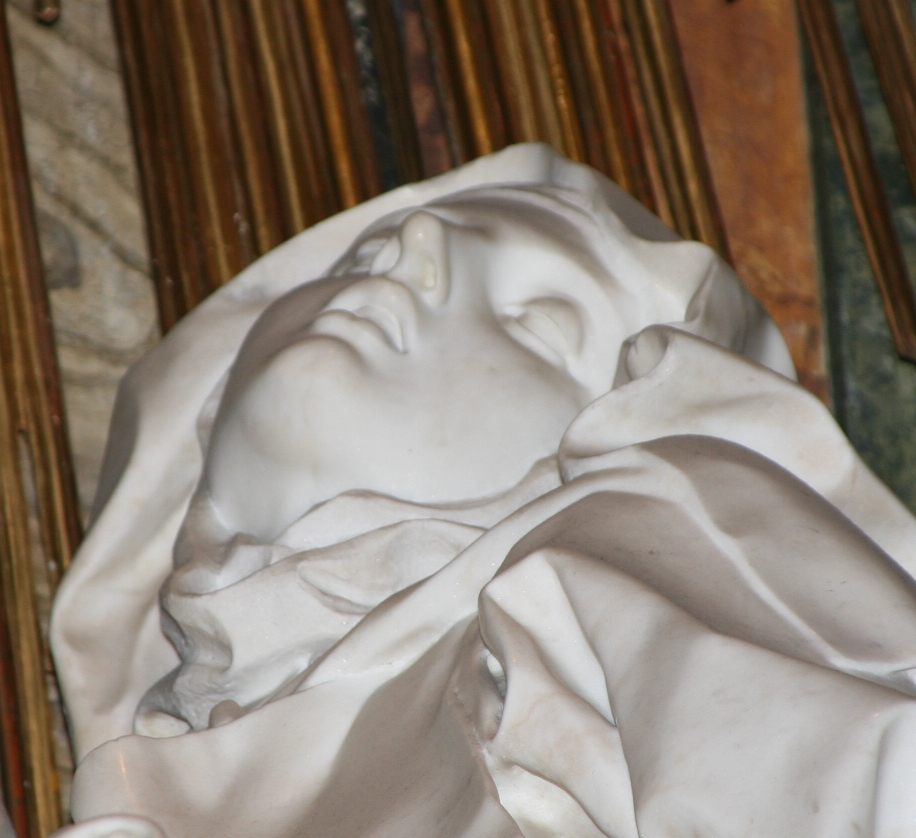
Bernini’s “Ecstasy of Teresa.” Photo: Nina Aldin Thune, flickr
Teresa of Avila gets a bad rap these days, for many people picture her in a state of rapture or levitating. Bernini’s statue in Rome, “The Ecstasy of Teresa,” beautiful though it is, reinforces that view. But visions, ecstasies, and locutions (her word for hearing God) make up only part of Teresa’s spiritual life and shouldn’t be the main focus, for they should act as markers or pointers to the transformation of her soul.
After all, her highest state of union, which she describes in the seventh mansions in The Interior Castle, considered her greatest work, is not rapture but spiritual marriage with the Trinity. She senses in an intellectual vision this union, with each member of the Trinity playing its own role, and her as the beloved. The “favors,” which is what Teresa called the divine revelations of visions and ecstasies, therefore empower the soul to live like Christ, empowered to go out and do good works. Plenty of which Teresa did.
She was deeply concerned for reform within the Carmelites, and set up the Discalced (or Barefoot) Carmelites in the response to the excesses she discerned – social hierarchies in the convents, gossip, wealth… She wanted them to return to the values of simplicity and poverty, and to empower her sisters she wanted to teach them mental prayer (in contrast to vocal prayer, which would be practiced in community). Later she convinced John of the Cross to join the movement (she was thirty years his senior, but for a time he became her confessor).
But this was the time of the Inquisition in Spain (the sixteenth century), for King Ferdinand and Queen Isabella had sought the unity of the country through the Catholic faith. Therefore anyone who didn’t convert – Muslims and Jewish people – were exiled, and those who did convert were assessed as to the purity of their beliefs. The Inquisition viewed mental prayer as dangerous and undermining the institutional church, and writing that promoted it was taken away to be considered and perhaps banned. Teresa’s own copy of The Book of Her Life, her autobiography, was taken and never returned to her. She wanted to teach her fellow nuns so her confessor encouraged her to write new works, which resulted in several books including The Interior Castle.
Her work as a reformer included a keen desire that the nuns under her care would be transformed through union with the triune God through prayer. The journey of love she recounts in The Interior Castle is one of journeying ever closer to God’s heart. May we too live in the mansions God has prepared for us, dwelling with him and enjoying his love.
This blog post comes from thinking I’ve been doing for an essay for the “History of Christian Mysticism to the Reformation” course I’m taking at Heythrop College, University of London. This term I’ve read some amazing and mind-boggling thoughts from people such as Augustine, Origen, Bernard of Clairvaux, Hadewijch, and Teresa and John of the Cross. It’s been fun, intense, hard, and stretching.
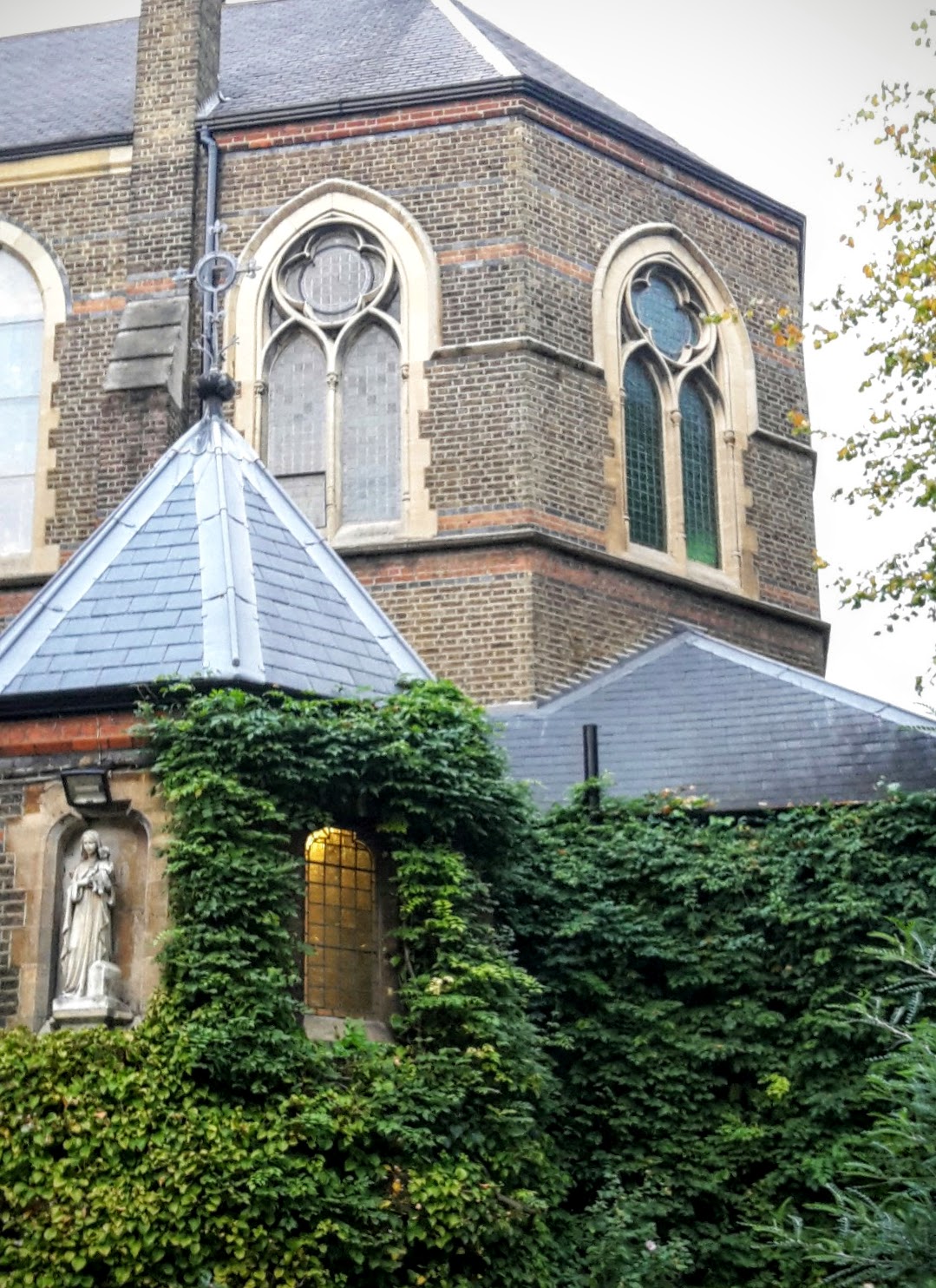
Inside Heythrop College, a delightful area in Kensington, London, that you’d never guess was there if you didn’t know otherwise.
As I take a short break from reading a heavy text – some fifty pages about what a classic is – I consider this new venture of studying and reading in pursuit of a master’s degree in Christian spirituality at Heythrop College, part of the University of London. In one sense I’m not too bothered about the degree in and of itself – who I am at the core won’t change with some letters behind my name. But the degree invites me into the academy, and I’m finding that rather exciting, to my surprise. For as I start to learn the academic language and lingo, I find myself in conversation not only with my fellow MA students, but with the thinkers who make (and made) this their life work. I’m opening the door to another world; a place of conversation and definition and struggle and understanding.
In this first term of study, before we get immersed in primary texts, we’re looking at the definition of what is spirituality. I’ve been itching to get at the classics themselves, but as we go along I’m understanding why we need to spend half of a term on definitions. We all might not agree on what spirituality is, but we all need to have the tools to discuss the subject. And in a university setting, we need publicly available sources with which to have a discussion – we can’t rely on personal experiences. But lest I despair that this is a mere intellectual experience, I’m assured that we can engage personally with these sources; for instance, we can “converse” with Julian of Norwich or Theresa of Avila.
Last week I put our lecturer, Dr Edward Howells (who is fantastic, by the way) on the spot, asking that if he had to make a simple definition of spirituality, what would he say? I like his answer in its simplicity but depth:
A way of seeing all of reality.
What do you think of when you hear the term spirituality? Are you “spiritual but not religious”? Are all people spiritual? How do you express your spirituality?
 Recently I learned a new word: graduand. It’s the status of one who has earned a degree but not yet been awarded it. And that’s what I was from October, when I heard my results, until yesterday, when I had the joy and honour to receive the piece of paper saying I have an MA in Christian spirituality from Heythrop College, University of London. (Once you’ve been awarded the degree, you become a graduate.)
 I was grateful that Nicholas could attend the graduation ceremony with me. I was hoping our snow day of Monday would have extended into day two, so that the kids could come as well, but that was not to be. My family have lived through essays, long reading lists, and many a holiday-without-me in the past two years, and I’m so grateful for their love and support. I toasted them at our celebratory dinner last night.