As we approach Holy Week next week, the culmination of the season of Lent, we can be gentle to ourselves, however we’re feeling, whether tired, weary, hopeful, or perhaps wishing that we’d kept more rigorously to the practices we chose at the start. Whatever has gone before us, know that God welcomes us to journey with Jesus in the here and now. God’s loving invitation to deepen our faith during this holy week stands.
One way to approach this week is to consider what Jesus experienced each day of his life that week. To help imagine what was happening at various moments, I invite you to download an outline of the events, which I’ve adapted from the NIV Application Commentary: Matthew by Michael J. Wilkins (Zondervan, 2004), pp. 709–10.
I also invite you to join me on Tuesday for a half-hour of prayer via zoom as I lead an engagement with Jesus’ journey via Coracle’s Space for God. More information here.
Lord Jesus Christ, as we enter into the events of this Holy Week, I come to you in humility, confessing my wrongdoing and receiving your forgiveness. May the events of this last week of your life be brought alive to me, that I might know you more intimately and be more grateful for your sacrifice, which gives me life. I join the crowds to shout out with joy, “Hosanna to the King of kings! Blessed are you who comes in the name of the Lord! Hosanna in the highest heaven!”
I loved co-leading a “Poetry and Prayer” retreat with Amy Scott Robinson recently at Launde Abbey, learning from Amy as she helped us to explore different forms of poetry. One of those is the biblical poetic form of the refrain, which is a wonderful way to express ourselves to God. And it’s easy to write one; I promise!
As Amy shared, what’s so wonderful about the poetry in the Psalms (ancient Hebrew poetry) is that it doesn’t depend on patterns and rhythms of words, but patterns and rhythms of ideas. It uses synonyms and antonyms, metaphors and refrains, all of which we can see in translation. Isn’t that amazing! We who aren’t able to read Hebrew don’t miss out.
A form of poetry in the Psalms is refrain—a repeated line or phrase that adds emphasis and rhythm in a poem or prayer:
Psalm 136 Give thanks to the Lord, for he is good. His love endures forever. Give thanks to the God of gods. His love endures forever. Give thanks to the Lord of lords: His love endures forever.
Here’s a refrain that I wrote while on the retreat with Amy (and thus I did it in a short space of time). I hope you see how the repeating of lines helps us to consider again the idea – maybe it helps us move more from the head to the heart?
From Job 1:21
The Lord gives and the Lord takes away. Blessed be the name of the Lord.
When sorrow strikes at the season’s end: A call to obey and relinquish… The Lord gives and the Lord takes away.
From a distance I see new gifts to welcome while bidding the familiar farewell. Blessed be the name of the Lord.
The Lord gives and the Lord takes away. Blessed be the name of the Lord.
When I led this prayer exercise recently for Coracle’s Space for God (which happens regularly on a Tuesday), I was delighted with some of the refrains shared at the end of our time together. Here’s one from Jamie:
Identity
You are all fair, my love There is no spot in you.
Created with intention and beauty I see the goodness of God in you You are all fair, my love
Washed clean and made new Clothed in Christ’s righteousness. There is no spot in you
You are all fair, my love There is no spot in you
And here is one by Jerry Herbert, who was one of my teachers some years ago (!) on the American Studies Program in Washington, DC:
Your Word is a lamp to my feet And a light to my path
Your Word is a lamp to my feet A guide in the midst of confusion A help when all is chaos
And a light to my path A spectacle when all is obscure A knife to slice thru the darkness
Your Word is a lamp to my feet And a light to my path
I’d love to invite you to write a refrain! Here’s how:
Take 2 lines of scripture (or a line in two parts)
State them
Separate them with your own lines of context and interpretation
Bring them together again
Suggestions for verses:
Your word is a lamp to my feet and a light to my path (Psalm 119:105)
The Lord bless you and keep you; the Lord make his face shine on you (Numbers 6:24-26)
The Lord is my shepherd. I shall not want. (Psalm 23:1)
The Lord gives and the Lord takes away. Blessed be the name of the Lord (Job 1:21)
The earth with its bars closed behind me forever; yet you brought up my life from the pit (Jonah 2:6)
I love personalizing Psalm 23, and last week led this exercise at Launde Abbey – with these sheep in the background! Here’s the rendition I penned, which you might resonate with?
The Lord is my rest giver, I embrace shalom. He makes me release my projects, he leads me to the restoring waters, he refreshes my soul and my body. He helps me clear my diary for my own good. Even though I trudge through the valley of overcommitment, I will not fret, for you are with me; your tools to say no, they help me. You prepare a feast before me with those whom I’ve disappointed. You shower me with your unfailing love; my heart overflows. Surely your gentle invitations will accompany me all the days of my life, and I’ll live with you forever.
How might you apply this beloved Psalm in your life today?
I thought you might enjoy reading the haiku poems my daughter wrote yesterday as part of her English homework. I love how they express so many emotions in so few words.
Here we are at home Forty-seven days and more Wishing we were out
Stuck at home all day Isolated, alone, sad Apocalyptic
Overwhelmed with work Constantly behind and bored Wishing this was done
Missing friendly laughs Contacting only through screens Wishing you were here
People needing masks Some dying alone, afraid Waiting for the end
Going for a walk Lovely sounds all around me Fresh airs renews me
PJs all we wear Goodbye summer holidays Missing family
The view from where I sit. Many I know will have to miss church today because of this lovely snow.
I had to miss church this morning as our daughter isn’t well, so I spent some time writing an acrostic poem, inspired by Psalm 145. David used all of the letters of the Hebrew alphabet, in order, to sing his praises to God. I’m no King David, but I enjoyed the challenge.
Amazing are you, Lord!
Because of your great love, you’ve given me life.
Can I ever exhaust the wonders of who you are?
Day by day I will sing your praises;
Everything within me gives you thanks,
For you are worthy of praise.
Great are you, Lord; so great are you!
Holy are you; all the earth worships you in wonder,
I will sing and shout from the rooftops!
Joy reverberates throughout me, for you are good.
Keep me as the apple of your eye;
Light my path, that I may forever follow you;
Make my way straight, that I will not veer off course.
No longer do I despair, for you will love me forever;
Oh worship God always and without end!
Praise to you, King of Kings,
Quite how I will restrain myself, I do not know!
Rejoicing I will be as I ponder your greatness,
Singing songs of gladness and praise,
Thanking you for rescuing me from the muck of sin.
Upon you I set my mind that I will not be swayed,
Voicing my worries and anxious thoughts
While wondering at your great mercies.
Xenial you are, welcoming me to your table,
You set a place for me to come and eat and be satisfied.
Zealous will be I about your name; I praise you forever!
Waiting. We all do it, like it or not. Sometimes the waiting is tinged with celebratory anticipation, such as for the birth of a baby. Often it’s surrounded in heartache, with echoes of, “How long, Lord?” Sometimes it surrounds the mundane, such as being stuck in a stifling Tube carriage waiting to exhale.
What are you waiting for?
The sweat
I can feel
Dribbling
Down my back
I can do
Nothing
Can’t dab it
Can’t swab it
Have to let it slide
Trickle
Dribble
Down my neck
And my back
I hold myself in
Trying
Wishing
To make myself smaller
One arm above me
Clutching the handrail
The other hanging
Laden with bags
I suck in my breath
Waiting
Counting the stops
Feeling the sweat
Closed in around me
To the left
To the right
In front of
And behind me
People
One tall and foreboding
One behind me, unseen
But pressing against me
In the crush
The mass of humanity
In this metal container
How long, I wonder
How long
The stops come
And they go
And finally
A few leave
At Green Park
Some space
To air out
To breathe
To exhale
And at last I exit
At last I leave
The final walk home
I suck in the air
London air
How fresh,
I know not
But sweet
To me
This is part of the synchroblog on waiting, to celebrate the release of Those Who Wait: Finding God in Disappointment, Doubt and Delay by Tanya Marlow – out now. See more here and link up to the synchroblog here.
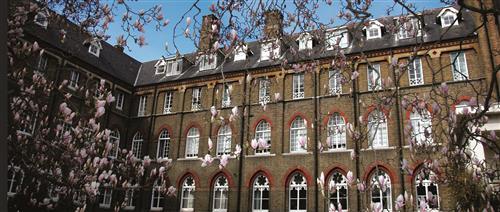
The lovely Heythrop College, part of University of London until next year when it will close.
Some years ago a writing friend shared with me how he liked to personalize Psalm 23 according to the different roles the Lord could play in his life. Thus instead of a Shepherd, I wrote about the Lord being my Publisher. (And here are some examples of other people engaging with this psalm.) Recently after receiving a not-so-stellar book review, I wrote about the Lord being my Reviewer, and this morning, as I struggle to write my penultimate essay for my MA in Christian spirituality, I’ve written about the Lord being my teacher (or I suppose I should say “tutor”).
The Lord is my teacher, I lack nothing.
He makes me rest from my studies,
he leads me beside the bubbling brook,
he refreshes my soul.
He guides me along the right ways of thinking
for his name’s sake.
Even though I trudge
through the valley of low marks
I will fear no evil,
for you are with me;
Your assignments and comments,
they comfort me.
You prepare a place for me
At the academic high table.
You anoint my hands to type;
my ideas overflow.
Surely your goodness and love will follow me
all the days of my life,
and I will dwell in the College of the Lord
forever.
How could you make the beloved Psalm 23 applicable to you today?
Many people memorize this psalm, and I can see why. For us to know the truth that God formed us and loved us transforms the way we see ourselves and those around us. When we’re secure in this foundational knowledge, we’re free to be ourselves – and to be world changers. May we do so today.