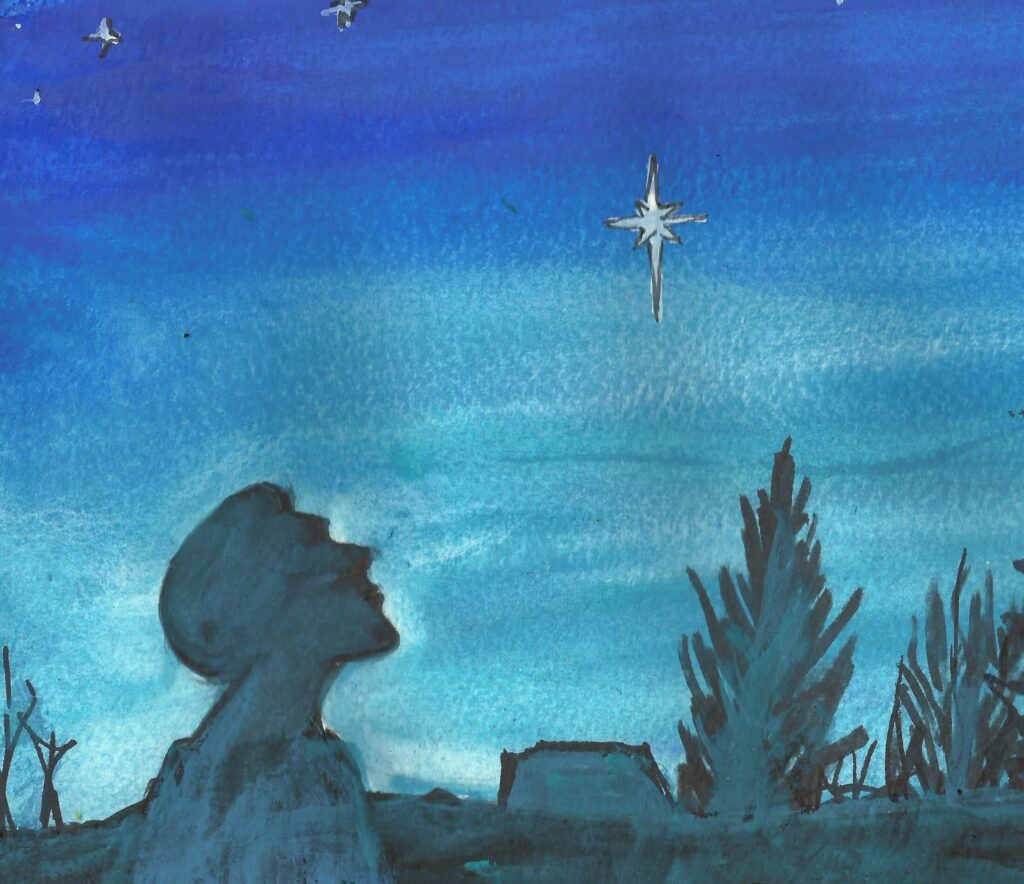
Merry Christmas!
We celebrate the Light coming into the darkness – Jesus, the Son of God who came to live with us. He who brings peace and love amid fears and anxiety.
May the true hope of Christmas fill you during these very different times.
Merry Christmas!
We celebrate the Light coming into the darkness – Jesus, the Son of God who came to live with us. He who brings peace and love amid fears and anxiety.
May the true hope of Christmas fill you during these very different times.

We celebrated Mother’s Day yesterday, and although I was supposed to be in Minnesota with my mom, the lockdown meant I got to celebrate with my family here in London. I was sad that my parents didn’t get to see any of their family on this day as they observe sheltering rules, but we had some good conversations over the weekend.
My mom is a woman of prayer, a ministry that she’s long had, along with her practical, hands-on service, but one that has especially flourished in recent years. Daily she prays for her family and others, and when I consider the potential effects of these prayers, I often think of the well-known saying by Alfred, Lord Tennyson: “More things are wrought by prayer than this world dreams of.”
Some will be breathing a sigh of relief now that the UK and US Mother’s Days are behind us, for they can feel painful for a variety of reasons. I like the social-media post of a friend that says, “I may not be a mother, yet I have mothered many students in my years of teaching.” She plays an important role in their lives, and her love that she pours out on them indeed embodies the grace of mothering.
May you know the love of God who said to his people: “As a mother comforts her child, so will I comfort you…” (Isaiah 66:13, NIV).

On this Good Friday (why is it good?), I share with you some thoughts that I gave at church on a Good Friday past. May you find meaning in your remembering this day.
Mark 15:33–41 (NIV)
At noon, darkness came over the whole land until three in the afternoon. And at three in the afternoon Jesus cried out in a loud voice, “Eloi, Eloi, lema sabachthani?” (which means “My God, my God, why have you forsaken me?”).
When some of those standing near heard this, they said, “Listen, he’s calling Elijah.”
Someone ran, filled a sponge with wine vinegar, put it on a staff, and offered it to Jesus to drink. “Now leave him alone. Let’s see if Elijah comes to take him down,” he said.
With a loud cry, Jesus breathed his last.
The curtain of the temple was torn in two from top to bottom. And when the centurion, who stood there in front of Jesus, saw how he died, he said, “Surely this man was the Son of God!”
Some women were watching from a distance. Among them were Mary Magdalene, Mary the mother of James the younger and of Joseph, and Salome. In Galilee these women had followed him and cared for his needs. Many other women who had come up with him to Jerusalem were also there.
Luke 23:44–49 (NIV)
It was now about noon, and darkness came over the whole land until three in the afternoon, for the sun stopped shining. And the curtain of the temple was torn in two. Jesus called out with a loud voice, “Father, into your hands I commit my spirit.” When he had said this, he breathed his last.
The centurion, seeing what had happened, praised God and said, “Surely this was a righteous man.” When all the people who had gathered to witness this sight saw what took place, they beat their breasts and went away. But all those who knew him, including the women who had followed him from Galilee, stood at a distance, watching these things.
Women, at the time of Jesus,
in the ancient Near East
didn’t have the same standing as men.
They couldn’t even touch the Torah, the Scriptures,
or read it for themselves.
They were taught by their fathers or husbands.
A woman couldn’t serve at a banquet where men were eating—
that was a task for a manservant.
But Jesus valued women.
He went against the cultural practices of the day
because he prized them.
He loved them.
He taught them.

He told Martha of Bethany that her sister Mary
had chosen the one thing necessary—
to sit at his feet and receive from him.
to be his disciple.
 Many women loved and served Jesus.
 Not least his mother
 who as we hear in John’s gospel was there at the cross
 standing next to the beloved disciple, John.

 Even in his hour of pain Jesus loves her, and
 makes sure that she, who was probably a widow,
 would be cared for by John.
 And John would gain a mother as well.

 In Luke and Mark’s account of the cross,
 women watch him die on the barbaric cross;
 this instrument of torture.

 They who have loved the Lord,
 serving him and listening to him,
 following him,
 stand by him.

 As his disciples.

 They braved the potential danger
 and stood by at a distance.

 What danger?
 Friends and families of criminals—
 which is what Jesus was named to be—
 could have been persecuted.
 Not only ridiculed, and
 spit at, just like Jesus was,
 but given the same punishment as he on the cross.

 But these women couldn’t leave him,
 for they loved him.
 They watched from a distance.
 Seeing him suffer.
 Could we too watch our Lord on the cross?


 Think of the women standing there.
 In Mark’s account, we hear of
 Mary Magdalene,
 Mary the mother of James the Younger and of Joseph,
 and of Salome.

 Mary Magdalene is often seen as a prostitute
 but nowhere in the Bible is she named as one.
 She appears in the gospels 14 times—
 she was important to Jesus.
 He cast from her seven demons.

 She, who was literally out of her mind
 with demon possession
 was returned to her right mind by Jesus.
 And now, during his hour of need,
 she stands and keeps watch.

 We don’t know much about Mary,
 the mother of James the Younger and Joseph.
 She may have been the wife of Cleopas,
 a disciple of Jesus or Alphaeus.
 Maybe she was a sister to Mary, Jesus’ aunt.

 We do know that she followed Jesus,
 ministering to him and his disciples in material things,
 so she had a certain amount of wealth.

 She too stood at the cross and watched.
 Later she went to the tomb with spices to anoint his body
 and was told by angels that Jesus was not there.
 She was a faithful follower.

 Along with the two Marys was Salome.
 She was the wife of Zebedee, a fisherman,
 and the mother of James and John,
 two disciples of Jesus.
 Earlier she asked Jesus if her sons
 could sit in places of honor in the kingdom of God.
 A mistaken question.

 But she continued to follow Jesus
 and now she too watches from a distance.
 and later she too would bring spices to Jesus’ tomb
 to anoint his body.
 Can we put ourselves in the place of these women?
 They had been given value by Jesus.
 He saw them.
 He loved them.
 He saved at least one of them from a life of destruction,
 of being an outcast.

 And now, their teacher and lord was nailed to a cross.
 They must have been scared and afraid,
 numb.
 Questioning why…

 Even though Jesus had said
 that he would die and rise again.

 Hearing his words of prediction was one thing,
 but seeing it happen in front of them, another.

 And yet they did not leave.
 They served through their act of presence.
 Through simply being with Jesus in his darkest hour.
 They loved him, even from a distance.

 How about you?
 How about me?

 Can we risk the taunts of those who do not
 understand our faith in Jesus?
 Can we stand together with those who also love Jesus,
 to show how we love him?

 How can we stand with Jesus today?
 How can we love him?
 How can we serve?

 How can we see him suffer
 dying on the cross,
 dying to release us from our sin and shame.
 dying to give us new life—
 life in the kingdom.

 Can we, like the women, stand and watch?
 Can we, like the women, receive his love?

 Lord Jesus Christ,
 You died to save me.
 You allowed yourself to be spit upon.
 Mocked.
 Lied about.
 You didn’t open your mouth.

 And women who loved you watched you die.
 Perhaps they huddled together as you took your last breath
 and the curtain tore in two.
 They loved you from a distance.
 They did not leave you.

 May I too be one who stands with you.
 May I love you, and serve you.
 May I overflow with love for you,
 Knowing that you have saved me from a meaningless life.

 On this holy day, when we remember your death, Lord Jesus,
 May I be encouraged by the example of these women.
 Those not always valued by those in authority
 But those whom you loved.

 Amen.

Soon it will be Christmas!
I so enjoy the Christmas season, when the baking is done, the presents are wrapped and given, the run of church services is over, and we can enjoy time together as a family. As here in the northern hemisphere we’ve passed the shortest day of the year and look forward to the light, more importantly, we celebrate the Light of the world who has come to distill our darkness.
I’m grateful for you all, and appreciate the many of you who get in touch with me. Your encouragement, prayers, and comments so hearten me – thank you.
May you know joy and peace during the Christmas season; may you be renewed in body and spirit as you stop to wonder and marvel at the God who became Man and lived among us.
Happy Christmas!

Thinking of queuing at Wimbledon? Here’s what I learned from our experience last year…
We left the house at 3.45 am to reach Wimbledon by 4.30, traveling through an Uber. What’s your view of Uber? That was only the second time I’ve used it, and our driver was safe and courteous. All very easy.
When we arrived, we were numbers 2073 and 2074, which are too far back for show court tickets (tickets for centre court, court 1 and court 2 go to the first 500 or so). That means we’d be buying grounds passes for £25 each, and court 3, which has mainly unreserved seating, would be our first choice chance for seeing good matches live, especially as an American was playing there third.
Do you need to arrive so early as we did? I don’t think so. You can check @ViewfromtheQ and see what sort of numbers people are posting at which time. As we didn’t score show court tickets, and as there were still plenty of seats on court 3 later, we could have arrived at 6am, when someone got number 3263. Of course all of this depends on who is playing and what day it is. We were there for Manic Monday – the magical time when every remaining player plays, so I think traffic was pretty high. But a Saturday would be crazy busy too. Today, when it’s the women’s quarter finals, I see that someone got number 921 at 5.45am! Not as much demand for women’s tennis in this country, I’m afraid.
I talked with some women on the Tube coming home who had camped. They arrived Sunday morning and were something like 1800 I think. They did actually get onto court 1. They said ear plugs were a must as the tents are right next to each other and you can hear everything, and that sleep is hard to find as the hours of daylight are many at this time of year, and the queue officials start to wake people up around 5am to clear the tents away.
It’s a convivial place, with people to chat with either side. We talked a bit with the Aussies in front of us, but mainly talked with two friends who met while doing their physics PhDs in Switzerland, one Swiss and one from Argentina! My son and I had loads of fun in the queue and even sat with the guys behind us for a while.
I don’t know that we’ll be able to queue this year, but next year when my son has finished his GCSEs, we’ll be there!
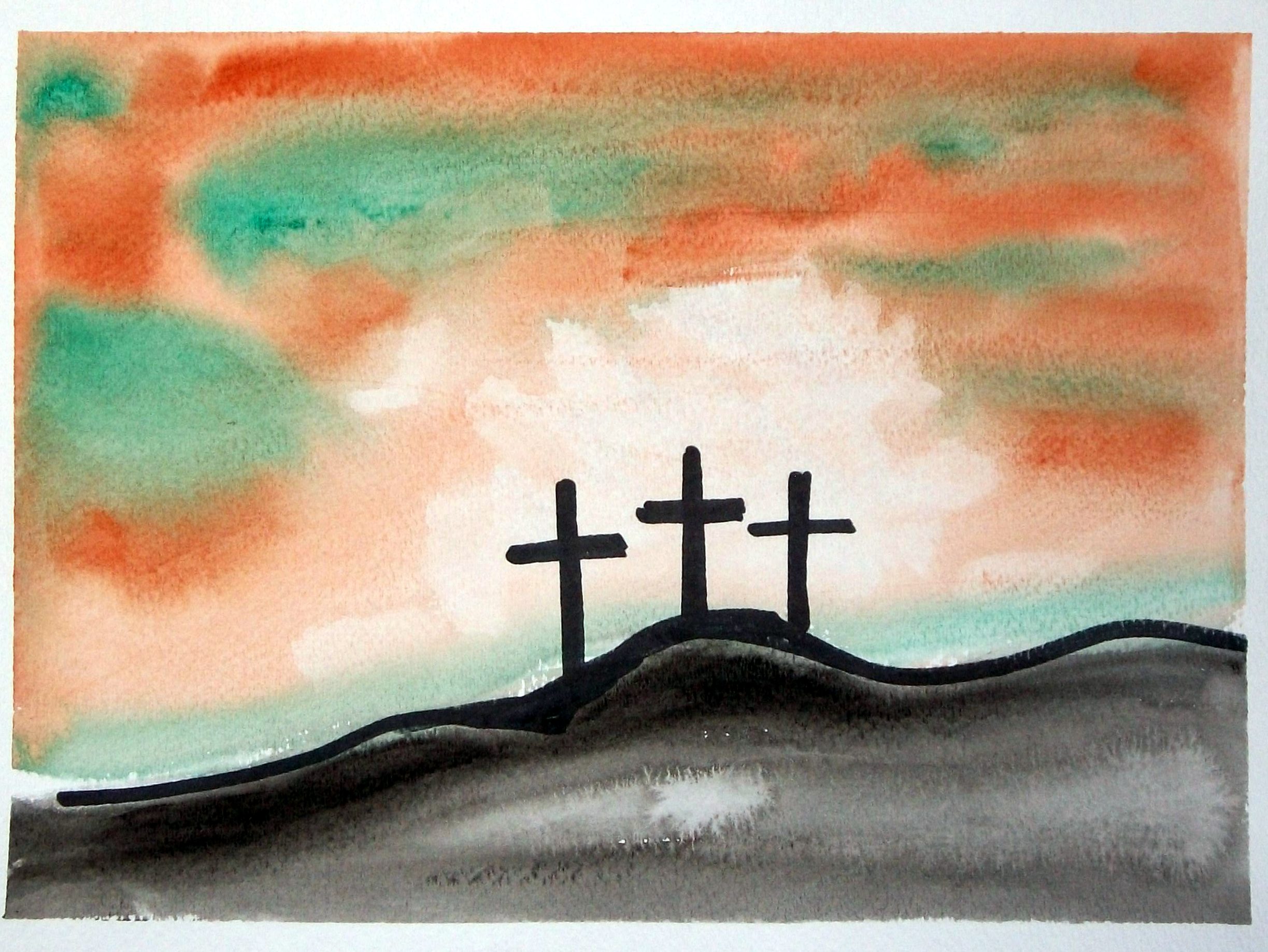
There they crucified him.

 A notice fastened to the cross:
 Jesus of Nazareth;
 King of the Jews.

 But the teachers cried, No!
 Why not, the man who claimed this?

 Pilate in reply:
 What I have written,
 I have written.

 Later,
when everything finished,
 and Scripture fulfilled,
 Jesus said:
 I thirst.

 Receiving the drink,
It is finished.

 With that,
 he bowed his head
 and gave up his spirit.

 After John 19:16-22, 28-30

On this first day of Lent, I’m happy again to post this painting by my dad, which he’s entitled:
Matthew 7:14 “…the way is narrow that leads to life…” Ash Wednesday to Good Friday to Easter
What images in it speak to you? What do you see? What might God be saying to you through it?
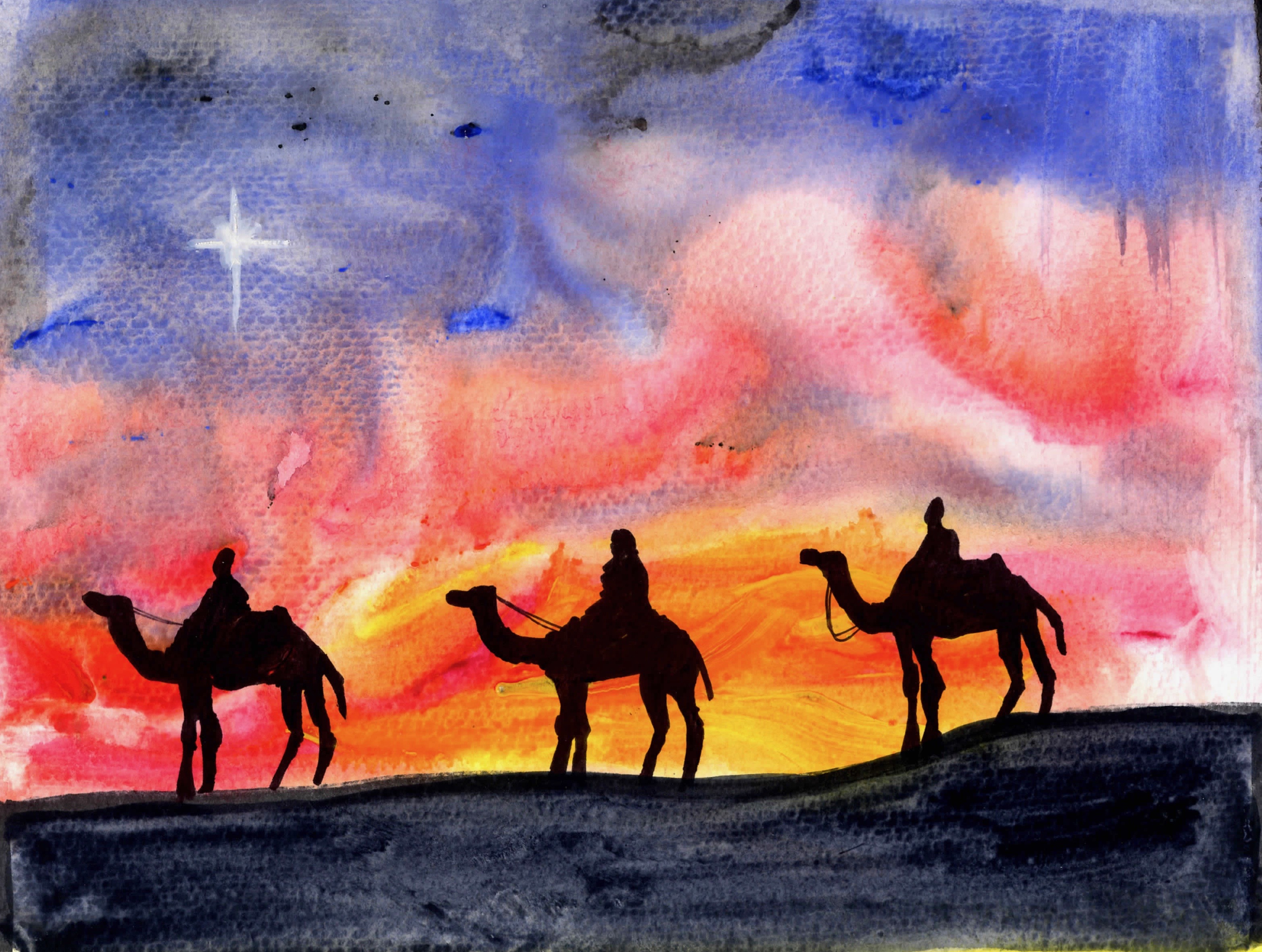
Happy Epiphany!
The wise men have made their journey to the toddler Jesus, bringing their gifts of gold, incense, and myrrh. I learned a few things today from our youth worker’s sermon – the Western Church believes there were three wise men (because of the three gifts they brought), but the Eastern Church says there were twelve. Our preacher also made the good point that these visitors were the first outsiders to visit Jesus, thus marking the God-Made-Man’s mission to reach everyone in the world with his message of love, grace, and forgiveness.
Thank you for journeying with me through the twelve days of Christmas! I pray you’ll have a blessed and joyous Ephipanytide.
I leave you with a prayer adapted from the Church of England liturgy:
The magi came from the east to worship your Son: Father, grant to Christians everywhere the spirit of adoration.
The infant Christ received gifts of gold, incense and myrrh: Father, accept the offering of our hearts and minds at the beginning of this year.
The kingdoms of this world have become the kingdom of our Lord and of his Christ: Father, grant an abundance of peace to your world.
Father, in your unfailing love for us and for all people, hear and answer our prayers through your Son, our Saviour Jesus Christ.
Amen.

We’ve reached the end of the Christmas season, the twelfth day of Christmas! Tomorrow is Epiphany, when we mark the arrival of the wise men bringing their gifts of gold, frankincense, and myrrh to the newborn King.
I’ve been reading about the Twelfth Night parties in England in years past, finding the practices fascinating. Often servants and their masters would change places for the evening, with the master serving the servant. A dried bean or pea would be baked into a spice fruitcake, and whoever found it in their portion would be crowned king or queen of the party. Some of the revelry would include games with eggs – the egg and spoon race, and one that I’d like to try, a “toss the egg” game where a raw egg is thrown between two people at ever increasing lengths between them.
Spiritually, we can consider what gifts we’d like to give to Jesus this year. Perhaps a new emphasis on hospitality, or intercession, or keeping our temper, or increasing our tithing.
Will you celebrate Twelfth Night? If yes, how? What about an Epiphany party? And what gifts would you like to seek to give this year?

The eleventh day of Christmas coincides with the feast day of Simeon Stylites (c. 390? – 2 September 459). No, I hadn’t heard of him either. He was zealous for Christ, entering a monastery before he 16 years old. So committed was he to acts of extreme austerity that the other monks asked him to leave.
He decided to live in solitude, fasting completely for Lent and somehow surviving. Crowds of pilgrims searched him out, seeking advice and, I guess, wanting to “catch” some of his holiness. As he tried to escape the attention, he moved on top of a pillar. He went from stone to stone over the years, moving higher and higher as he sought solitude for his prayers and practices, living the rest of his years on a cold stone platform. Thirty-seven years all together.
As Edward Gibbon remarked in History of the Decline and Fall of the Roman Empire,
In this last and lofty station, the Syrian Anachoret resisted the heat of thirty summers, and the cold of as many winters. Habit and exercise instructed him to maintain his dangerous situation without fear or giddiness, and successively to assume the different postures of devotion. He sometimes prayed in an erect attitude, with his outstretched arms in the figure of a cross, but his most familiar practice was that of bending his meagre skeleton from the forehead to the feet…
Before I started my MA in Christian spirituality, I wondered about levels mysticism and these extreme forms of austerity and spiritual practice. Had these anchorites reached the pinnacle of spiritual life? I concluded through my MA readings a strong “no.” Although we can learn from those who withdraw from the world, I don’t believe they have a higher status than those who live in community. Transformation of one’s life – not extreme practices of penance or solitude – is what reveals God at work.
But I don’t want to dismiss Simeon all together. The crowds sought him for his wisdom, meaning that even in the desert he couldn’t escape from engagement with others. And he remained humble and obedient to his fellow monks, for when they wondered if he lived on the pillar out of pride or obedience, they demanded that he come down. He obeyed, and so they decided that he was following God – and they let him stay.
Over to you – what do you think of these extreme practices? Have you ever embraced something like a long fast or a time of solitude? If yes, how did you fare? Did you grow in your faith?