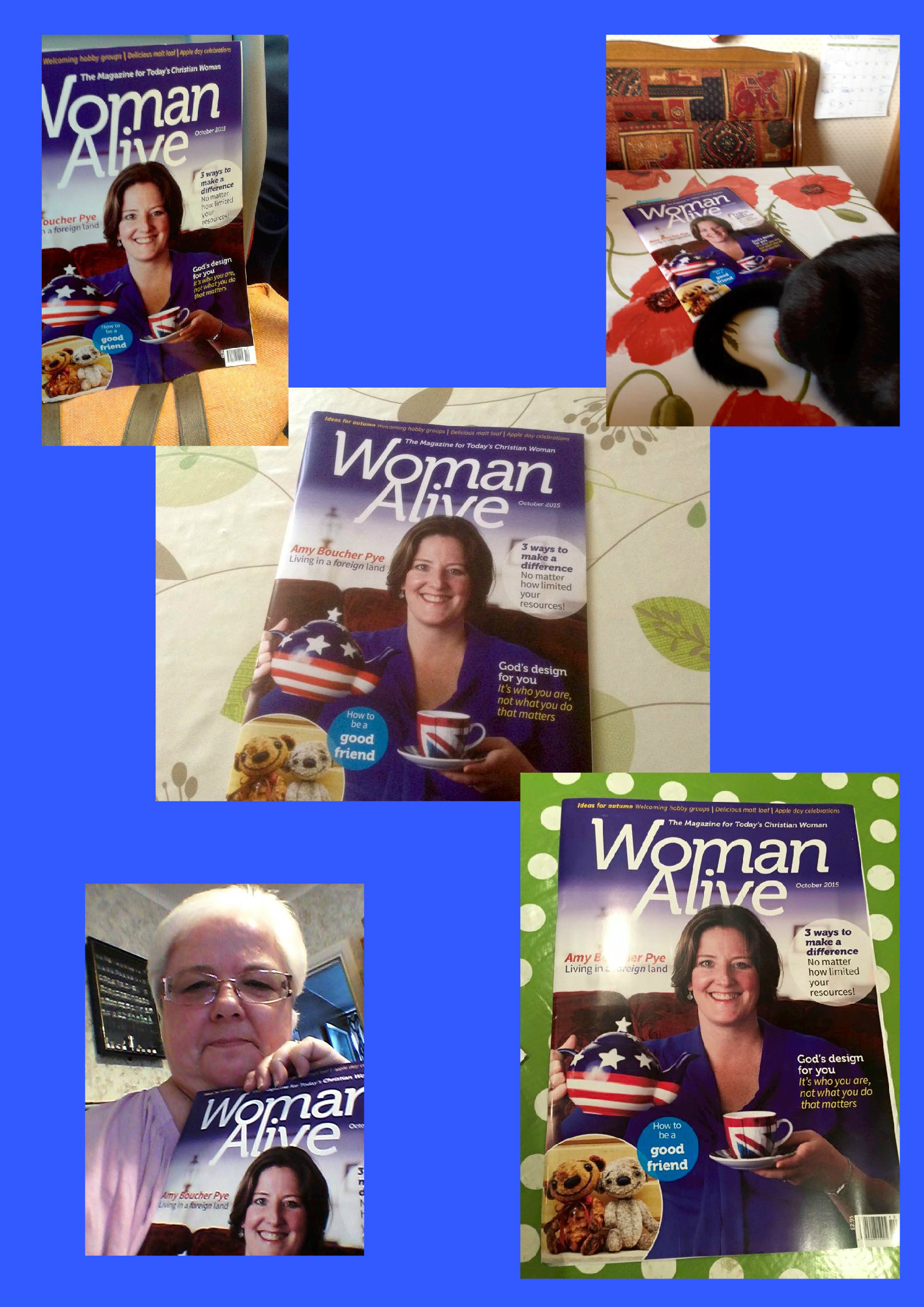
A surreal feeling washed over me when I glimpsed the cover of the October Woman Alive – there under the new logo was me in my living room, pouring a cup of tea out of a Yankee Doodle teapot, sporting a big smile. I knew the cover was happening, but the shock of actually seeing my photo there felt like a jolt. For I’m not your usual “cover girl” material – no size zero here. And yet it’s wonderful to have real people smiling out from the front of a glossy magazine.
I was so moved that people posted their photos of Woman Alive on social media! Such fun!
We know our worth is not in our looks, and that God loves us no matter if we’re gussied up in evening wear or clad in our gym clothes after a workout. But do we believe that we’re worth the cover of a magazine? Even writing this post feels indulgent, like I should be apologizing. Instead, I’m going to give thanks that indeed, I’m a woman who is alive, who is made in God’s image, and who wants to love as she’s loved. To extend grace and peace and hope. And to be forgiven for when I fail.
I never guessed before I moved to the UK those many years ago that I’d ever be pictured on a magazine pouring a cup of tea. Tea was something that I bought on my trip to London when I was 21, which I kept in a decorative Jackson’s of Piccadilly canister but never drank. Nor that I’d write a whole chapter about tea in my soon-to-be published book, Finding Myself in Britain. How fun to live our adventures with God.
Over to you – if you were to be pictured on the cover of a magazine, what would you fancy you’d be doing in the photo? And why? How does God surprise you?
Trigger warning – a post about children and transitions.
Photo: David Schott, flickr
Today is PyelotBoy’s last day of primary school. When I think back to me changing from elementary school to junior high, my memories are fuzzy. I know I was nervous about moving from class to class throughout the day instead of staying in one familiar classroom, but I had the comfort of nearly all of my classmates moving to the same school (the now defunct Capitol View in St. Paul, Minnesota).
Whereas for PyelotBoy, the move to secondary school seems massive. Although half of his classmates are going to the same school, they morph from 60 in their year group to 180. And unlike in the States where we have middle school or junior high, and then high school, for many here, their secondary school will be their home until university.
I only started to realize the import of finding the right secondary school as my kids got older and I’d hear the buzz on that day when secondary schools announce who gets their places each year. (The school where PyelotBoy is going had 1100 applications for 180 places.) Then it was our turn to traipse between open evenings and tutoring sessions and entrance exams. We’re pleased with the school he’ll be going to – another attached to the Church of England – but as we experience the leaving events for him at his primary school, I ponder the meaning of leaving.
I know the job of a parent is to release our children to the big and often scary world, teaching them to cope and hopefully thrive as we keep on letting them go. But it’s difficult. And the emotion can come through the individual moments, such as letting them travel to school on their own or allowing them more electronic devices. We know this is our mission, but sometimes we just want to freeze time.
Parents face these moments of their kids growing up continually. A friend on a social-media site mentioned how hard the transition to a bigger car seat was for her, for it signaled her baby growing up. For another it was when her child moved to a child-facing-front stroller. For me, I remember the strong feelings of loss when I realized that my son was hearing things at school that I had no control over. Or the poignant feelings that arise when I listen to recordings we made with the children years ago, when their voices sound so strikingly different.
So to the adage carpe diem – seize the day – I would add treasure the moments. We can’t freeze time, but we can be present, giving thanks for the gifts we receive, whether it’s our own children or grandchildren or those whom we are close to in the community.
Any pointers or stories on how you’ve handled big transitions in your life, or the life of your children?
This morning I’m digging into one of my favorite activities – writing some Bible reading notes. This will be a set for Inspiring Women Every Day, for the month of November 2015, on the theme of foreigners and strangers. After the Garden of Eden, we’re all strangers now. Here’s a little poem I wrote as I reflected on Psalm 137. Do you feel foreign?
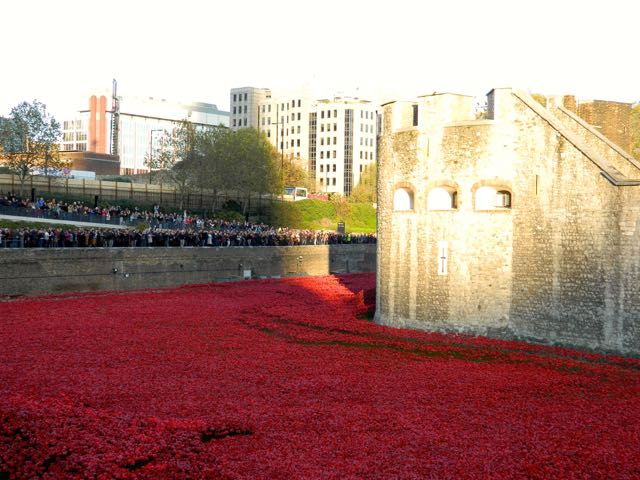
We traipsed to the Tower of London on Sunday – Remembrance Sunday – to see the nearly 900,000 handmade poppies that have been planted to commemorate the start of the First World War. Although we were jostled by the crowds, we were moved by the beauty and pain of the sea of red. Each poppy a life.
NicTheVic and PyelotBoy, along with Charlotte, our wonderful intern at church, have spent a lot of time researching the over 150 men whose names are listed on our two war memorials at church. These were men with connections to Finchley, who died in World War I. The higher the rank of the man, the more information the researchers were able to glean (which usually correlated to their social class).
On this Remembrance Day (Veteran′s Day in the States), as we stop to consider the sacrifice of the people who gave their lives that we might live, I include information as found by the researchers above on one of the soldiers, Frederick Goodyear. Sounds like a man who wouldn’t have chosen to serve if not for the war – he sounds like a creative type; a dreamer. Mr Goodyear, we will remember.
Name: Frederick Goodyear
Rank: Second Lieutenant
Date of Death: 23 May 1917
Age: 30
Regiment: Essex Regiment 2nd Battalion
Cemetery: Aubigny Communal Cemetery Extension which is approximately 15 kms north-west of Arras. From March 1916 to the Armistice, Aubigny was held by Commonwealth troops.
Additional Information: Son of Frederick and Anne Maria Goodyear. B.A., Brasenose College, Oxford Served 1915-17. Died at 1st Canadian Casualty Clearing Station of wounds received in action at Fampoux on 12th May 1917.
Frederick Goodyear was born on the 5th March 1887 at Fallow Comer, North Finchley. His father owned a prosperous coal business and took an active part in public life. Frederick had a sister Edith, later curator at University College London, and a brother, Geoffrey, who served in the Yeomanry, later in the Machine Gun Corps, and who survived the war.
Frederick was educated privately, first by Miss Shoults of Finchley and later at Christ’s College, Finchley. In 1902 he passed on to University College School, where he remained till 1905. His School record lists a great number of achievements and prizes, spanning Chess, Literature, Cricket, Cadet Corps and the Sciences. He was also gifted in languages, speaking and writing French, German, Welsh, Latin and Greek in his adult life in addition to English.
His Housemaster wrote of him:
His striking appearance and incisive manner arrested attention. His interests were literary and artistic, rather than academic…Essentially an eclectic, he found it difficult to concentrate on subjects that bored him… Frederick Goodyear was not a boy who readily followed the crowd. No Housemaster could have had a more capable and loyal House-captain.
In March 1905, Frederick received the Senior Classical Scholarship at Brasenose College, Oxford. He matriculated the following autumn, and his tutors acknowledged him as the ablest man to enter the college in their time. His friend F.W. Leith-Ross, who wrote the biographical foreword of Frederick Goodyear – Letters and Remains in 1920, and recalled:
He could never be persuaded that his reading should be directed into the narrow channels prescribed by the Examining Body, and throughout his time he browsed at large on whatever aspect of literature, art, or philosophy pleased his fancy.
Upon leaving Oxford, Frederick reported cricket for ‘The Field’, as well as contributing essays and other writings to various publications. In 1913, he lived in Paris for some months, writing a long autobiographical novel. Early in 1914 he left journalism and took up the post of temporary Assistant Master at Charterhouse, a public school in Surrey. Upon leaving this post, he agreed to write a series of books on British sports. However, he soon realised that he did not wish to do so and accepted a post with the Oxford University Press in Bombay, primarily to escape his contract.
Within months of his arrival in India, the fighting in Europe broke out, and rapidly spread. Frederick resigned his post as soon as it was possible and sailed back to England in January 1915. He had felt it his duty to enlist with the Artists’ Rifles and did so within days of returning home. His temperament was not particularly conducive to military discipline making a commission difficult to obtain. He did, however, secure a transfer to the Meteorological Service of the Royal Engineers in September 1915, with the rank of Corporal.
For the next year, he remained behind the lines and spent a great deal of time studying the flora and fauna of France and Flanders, as well as his supposed objects of study. In the summer of 1916 he was sent back to England, in order to go through the Cadet course and obtain a commission in the Essex Regiment. On 16th March 1917 he left once more for France.
A few weeks after his return, his battalion went into action near Arras and on the 12th May, during an attack on Fampoux, a shell hit his dugout and he was buried. Though found, his left leg was so damaged that it required amputation. Letters he wrote at this time are clear and cheerful, describing the incident and answering his correspondents’ questions about migratory birds. However, his right leg also required amputation on 22nd May and Frederick died from the effects of shock on his weakened state in the early hours of that morning.
Frederick was a highly committed Christian and his letters are full, not only of news and birdwatching, but of his theological reflections and commentaries on church goings-on. Though in one letter of 1905 he describes himself as ‘as close to atheist as anything else’ and believes that religion will die out leaving only philosophy; by 1911 he writes ‘I am really a Christian’. In letters to his sister he reflects on half-hearted Christianity, Nietzsche’s attitude to religion and the transformation of Indian converts to Christianity.
So said the wise man in Ecclesiastes. And never has that been more true with the explosion of self-publishing, when people can crank out a book in an afternoon, converting to a digital format their academic thesis or that novel buried in a drawer. But who will read all this stuff?
I’ve been asking myself that very question as I bury myself in words as I write my first book. Will anyone care? Do I have anything to say? I’m trying desperately to reserve judgment, or I’ll remain paralyzed.
My journey to book publication has been long and arduous. Sure, I compiled a couple of gift books for Lion Hudson a few years ago, but somehow those don’t seem to count like the First Real Book. You know, the one that deserves capital letters.
About four years ago (or was it even longer?) I set about writing my first book. I wanted to write about learning to see ourselves as God’s beloved, and how that understanding changes everything. I read and researched, went away for some power writing trips to a friend’s house in Eastbourne (thanks Kev), and had no clue how the book would come together. I had a chapter on self-hatred and a chapter on self-acceptance, and bits and pieces of my story. It was a mess.
I was meeting up with the amazing Michele Guinness, she a writing and speaking queen, and I ventured to send her two contrasting chapters to read before our breakfast together. (She in turn sent me early chapters of her marvelous novel Archbishop, which I loved.) As we enjoyed our granola and yogurt, she said, “Amy, why don’t you just tell your story.”
I felt like a light had been switched on. “Wow – just telling my story. Here I am writing about accepting who we are in Christ – who he has made us to be – and I don’t even feel I have the permission to be a writer! To tell my own story!”
I ditched the more prosaic of the chapters and set about ordering my narrative. Wrote and wrote and wrote some more, poring over my journals and reliving some ghastly and funny experiences from my twenties. I dreamed of writing for not only a British audience, but an American one too.
Months later, I knew I was stuck. I enlisted (yes, hired!) the expertise of an editor friend, who helped me to shape and form and put together a proposal. She could see how to phrase things, what the marketing hooks might be, and helped me with a title: Beloved of God.
Research books for Beloved of God.
Finally I was ready to send off my proposal and sample chapters to the literary agent of my choice. Because I’ve worked in Christian publishing for a couple of decades, I’ve had the opportunity to meet more than one of these sometimes hunted-down gatekeepers. I approached the amazing Steve Laube, whom I had connected with some years previously when he was the nonfiction editor at Bethany House and I was an editor at HarperCollins UK. I sent off my stuff to him and was blown away when later he actually said yes, he would represent me.
After a few months of revision and shaping, we sent off my proposal to sixteen publishers, both US and UK. Some of the “no’s” came thick and fast. Others took months to arrive, and some publishers didn’t respond either way (I’m told that’s common these days, but find that hard to stomach). One of the rejections was particularly painful, and I don’t think the writer of the review ever intended for me to see it. Others, however, were constructive. Still hard, of course.
One publisher believed in me, and said yes. When I sat down with their MD (yes, for whom I do freelance publishing work), Steve Mitchell, I said, “Well, I was so aiming for the US market with this book. I don’t have to write it if you want me to write something else.”
I don’t think he’d be a brilliant poker player, for his face revealed all as his eyes shone relief.
Having agreed to ditch my years of efforts, we then had the hard task of finding what book I should write. I wasn’t short of ideas – I’d love to write a book on prayer and a devotional, for instance – but I kept being stymied. I sought the help of an amazing editor friend in the States for direction. She had some wonderful insights, but cultural differences reared their ugly head: What she thought was snarky writing, my British publishing friends thought wasn’t snarky enough. (Snarky? Me, snarky?)
Finally I told my MD that he’d have to be my commissioning editor. I knew I needed the objective outside view of someone like him, who had years of retail experience and now was immersed in the UK publishing scene. We crossed the country to meet in Birmingham, him traveling south and me north, and he set forth the idea that I should pursue: the observations of an American transplanted into the UK.
Research books for View from the Vicarage (much more fun).
As I accepted the writing commission, I realized that I was relinquishing the American market. Okay, we may sell a few copies between those huge shores, but my voice is here in the UK, not there. So I approached my US-dwelling agent, and he graciously agreed to release me. Maybe some years hence we can partner together; who knows?
But for now, I’m relieved not to be reading those angst-ridden journals from my twenties. Instead I’m thinking with love and affection of my adopted people, trying to put into words their quirks and treasures. Why will a cup of tea solve all our problems? Which goes first on a scone, cream or jam? What is the art of queuing? And how can one’s family be kept from gaseous explosions over the Christmas period from all the Christmas cake and pudding?
Lord willing and the creek don’t rise, View from the Vicarage will release October 2015. An unexpected first book. But that reflects our unexpected God. After all, who’d-a-thunk I’d still be living on this small island nearly 17 years after leaving the States?
I woke early this morning, with Scotland on my mind. Would I now not be able to talk about the UK, with it instead being the DK – a Divided Kingdom? What would the result be?
I switched on my computer, hurriedly turning to the BBC website, surprised by my tears. I’m grateful the union is staying together, although I know many hearts are broken today, the thought of going it alone quashed.
The flurry of the past weeks has left me thinking about what it means to be British. I hold a British passport, but I’d never introduce myself as a Brit. The Yankee-Doodle blood just runs too deeply. But I love this country with its quirks and hang-ups and treasures. Facing a fractured union made me realize that all the more.
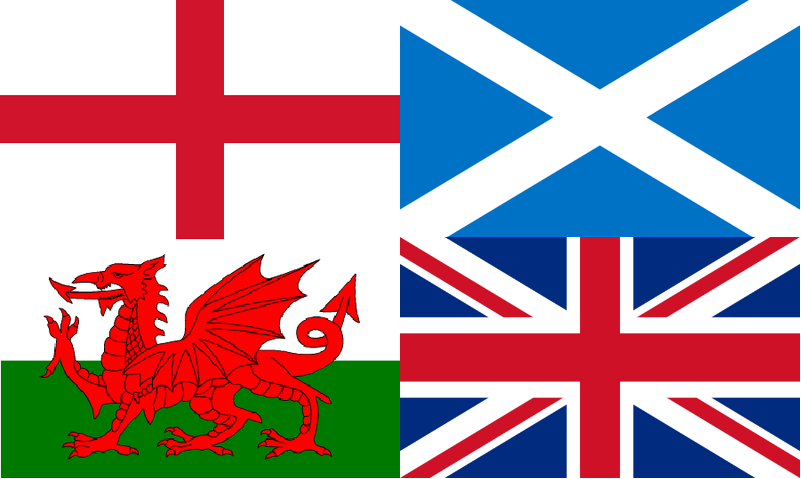
I find the whole question of national identity interesting. If you’re Scottish, Welsh or Irish, you’d introduce yourself according to your country (yes?). But what about the English? If that’s you, do you say you’re English or British? Does a remnant of historical embarrassment over being the ruling people keep the English from owning their identity?
And why don’t we have better holidays in the UK than generic Bank Holidays? Okay, I know each country wouldn’t want to celebrate the other’s saint’s days (fancy St David’s Day, any non-Welsh?). Could we get behind a favorite person from history – Shakespeare? I know that celebrating a monarch simply won’t go down for republicans. (And don’t say you don’t like to celebrate – I saw you at the London Olympics and Silver Jubilee…)
Chime in and tell me what you think, especially if you come from one of the countries of the United Kingdom. Who are you?
Only in America, or so they say. A friend is roadtripping and posted a photo of a heart attack on a plate: a bacon cheeseburger with a huge side of fries. Doesn’t sound too unusual, until you hear that the bun is made of two glazed doughnuts. Seriously. Yep, that’s about 1500 calories in one sitting – if you can manage it.
Only in America – school drills for lockdowns? I heard from a friend that her daughter found the lockdown drills during the first week of school scary. “Lockdown drills?” I asked. Her older daughter said, “You know, if a robber comes into the school.” Oh, that kind of lockdown. I know that the right to bear arms is part of the American identity, but seriously? My heart aches for the reasons behind these new drills. Tornado drills in Minnesota were bad enough for my imagination – I’d picture the wind shattering the glass, us kids rolled into little balls in the hallways. The thought of an armed shooter terrorizing sweet school kids tears me up.
Photo: Curtis Palmer, Creative Commons
I do miss America. I miss my family and friends. I miss the free and easy can-do spirit. I miss chatting at the check-out line without feeling silently judged for speaking. I miss not being the only crazy Yank hooting during a group exercise class. I miss wide spaces and roads you can drive on without feeling the oncoming traffic is heading right for you, the lanes being so narrow. I miss Superbowl parties and fireworks on the Fourth of July. I miss Target and cheap gas and pelting showers and once in awhile, Kraft macaroni and cheese.
But the two examples above show that my home country isn’t perfect. No country is; we live in a fallen world and no society can claim it’s a utopia. I can laugh at the outrageous burger and pray for miracles to keep the kids safe, and remember that “only in America” has its highlights and lowlights.
The start of our local parade with the Stars and Stripes. Very moving.
Just back to the UK from my annual fortnight (US: two weeks) in America, visiting family. As CutiePyeGirl says, seeing grandparents and family only once or twice a year is not enough. I agree.
As I reflect on my time there, I offer a few observations.
Healthcare costs have skyrocketed.
People seem to be increasingly affected by health-care costs, whether in monthly insurance payments, co-payments, or deductibles. I’ve heard stories of someone having a heart attack but not calling an ambulance to save the $200 fee, for instance, or going to a clinic instead of the ER (UK: A&E) because it’s cheaper. The NHS is by no means perfect, but the care we’ve received (especially for PyelotBoy) has been reliable and thorough – and free at the point of use (but of course the bill is footed by high taxes).
Memorabilia from the Kellogg all-class reunion I attended while in Minnesota. Go Chargers!
Pope Francis rocks.
I’ve been impressed by the new head of the Catholic church, and my heart was “strangely warmed,” to employ a Methodist saying, when I saw him in the flesh at St. Peter’s Square with my parents and family. I attended my parents’ Catholic church when Stateside and appreciated the influence he’s already having at the local level.
Land of 10,00 lakes. More shoreline (90,000 miles) than California, Florida, and Hawaii combined.
Minnesotans are nice.
Okay, so not all Minnesotans are nice every moment of every day, but on the whole, nice they are. I had to readjust my social interactions, remembering, for instance, that while out on a walk around the lake, one does actually acknowledge the person walking toward you. Waiters are nice; department store clerks are (usually) nice; of course friends and family are nice. Leading me to…
Learning to cast.
Relationships are the best.
CutiePyeGirl feels the separation from her US family deeply (well, we all do, but she shows it most tangibly). Each night since returning home, she’s been tearful and almost inconsolable about being separated from grandparents, cousins and aunts and uncles. I conveyed to her what a lovely Englishwoman, who lives in America and has a daughter in England and a son in Hong Kong, said to me before I got married, that now I’d have one foot on each side of the Atlantic. Loving deeply means we grieve deeply when separated, but closing ourselves to grief means closing ourselves to love.
Some of the Fantabulous Friends.
I didn’t get to see as many friends as I would have liked to see, but I got to reconnect with my “Fantabulous Friends Forever,” those women with whom I went to high school and whom I’ve stayed close to for so many years. We’ve experienced heartbreak, sorrow, and drama along with experiencing joy, but our friendships have stayed strong through the seasons.
After all, what matters more than people (and the word of God)?
On my last night in Spain a week or so ago, we went out to dinner at the local restaurant and enjoyed a feast of tapas. The plates kept coming, one after another, and the one that stunned me the most was the piping hot goat’s cheese, battered and deep fried. Oh. My. Word. Was I in Spain, or transported to the Minnesota State Fair, where I’d just been parceled out some of their famous cheese curds by a sweaty teenager? I tried not to be too greedy. I did try.
What hit me, however, was how at that dinner I was no longer the translator-in-a-foreign country, but the one needing help. When I ordered my drink, I asked for a Diet Coke, to which the waiter looked at me blankly. The Brit-married-to-a-South-African-living-in-Spain sitting across from me quickly explained to the waiter that I wanted a Coca-Cola Light.
Ah, so often I play that role, when Americans come to visit and I count out their “play money” at the till (US: cash register) or warn them not to admire someone’s pants. Or tell my children that when we’re in America they use erasers on their pencils… So when in Spain, I was jolted into humility. We’re all foreigners somewhere.
Foreigners and strangers, longing for home. Longing for a place where you don’t need to translate. Where you’re understood and known and accepted. Where you belong.
Why does a nation so filled with great achievements and peoples not celebrate? Why is a national day off simply called a Bank Holiday?
Photo credit: Creative Commons, MikeDixson
Though I’ve lived on this small island for many a year now, I’ve taken a long time to understand what is behind this reticence. But my opening sentence gives a hint, for which nation am I talking about? The United Kingdom, after all, is a grouping of nations – the technical terms is, “the United Kingdom of Great Britain and Northern Ireland.”
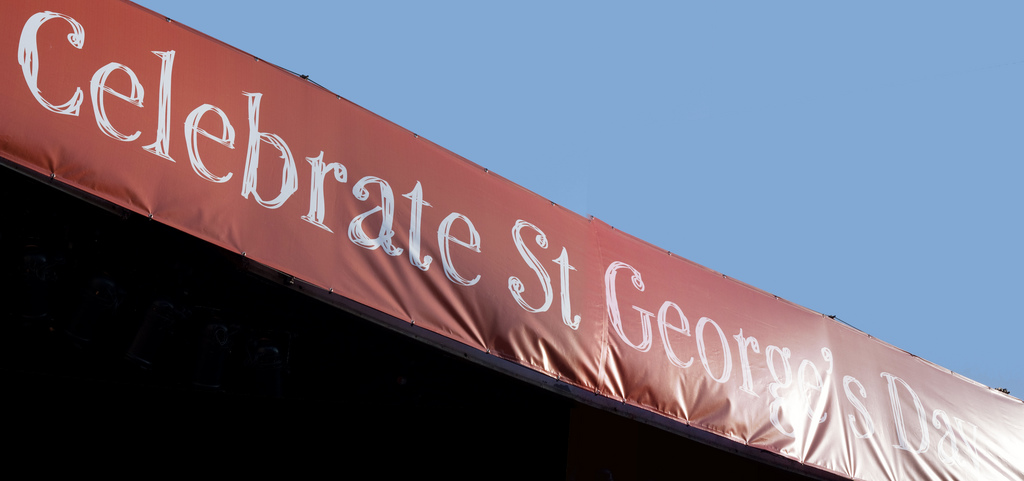
And I suppose the English are most reticent of all to celebrate their patron saint’s day, which is today – St George. For they have been seen as the oppressor. And to be English means to be understated; not to flaunt one’s accomplishments or achievements, lest one is seen as bragging.
But times may be changing, and even Downing Street is today flying St George’s flag, alongside the Union Jack. Celebrations are taking place around the country, including a great feast in Trafalgar Square. Why we don’t have a massive celebration of the Bard today I do not know though – after all, it’s Shakespeare’s 450th birthday.
If you’re English, are you reticent to fly St George’s flag or celebrate your Englishness? Why or why not?
 I never guessed before I moved to the UK those many years ago that I’d ever be pictured on a magazine pouring a cup of tea. Tea was something that I bought on my trip to London when I was 21, which I kept in a decorative Jackson’s of Piccadilly canister but never drank. Nor that I’d write a whole chapter about tea in my soon-to-be published book, Finding Myself in Britain. How fun to live our adventures with God.