Recently I came across a poem I wrote nearly 18 years ago to the day, just 10 days after I had moved to the UK. Part of me was sad I hadn’t found it when I was writing Finding Myself in Britain! But mostly I experienced a rush of poignancy, feeling for that person I was, so new to the UK and feeling stunned with the massive pruning I was undergoing. Everything seemed so strange and hard and different, and knowing that I was here to stay made me aware that I was going to have to send down roots and make this my home.
The poem is based on olive tree – mind you, I’d probably never yet even seen an olive tree – from Psalm 52:8–9: “But I am like an olive tree flourishing in the house of God; I trust in God’s unfailing love for ever and ever. I will praise you for ever for what you have done.”
When I look back at growing up in Minnesota, I think of the BLTs my mom made me for breakfast, or the chicken-noodle soup we’d have for Christmas Eve (which I still make – recipe in Finding Myself in Britain), or Iowa-fried chicken cooked in my grandma’s cast-iron pan, or my mom’s cinnamon rolls and homemade rye bread (yep, recipes for those too in the book). They call macaroni and cheese “comfort food” for a reason.
Photo: cyclonebill, Flickr
I knew that food plays an important role in memory and emotions (comfort eating, anyone?), but recently I was taken aback by just how powerful is the absence of loved and familiar foods for people away from their country of origin. I realized this when I raised a question in several Facebook groups for American ex-pats in the UK, having come in contact with one of the key buyers of the American food section at a massive grocery chain. Intrigued with the idea of influencing this chain and their selection American products, I posted these questions to my fellow expats: “What foods do you miss? What do you wish this grocery-store chain would stock?”
I posted and left for my gym class, and when I came back a couple of hours later I was stunned at the rapid response. In that short amount of time, one group had 92 replies; another had 48; another 32. I clearly had hit a nerve.
I loved scrolling down the comments, for some foods that others hankered after I forgot about, such as pizza rolls. Other entries I could understand the draw of, although they didn’t apply to me, such as coffee creamer (I don’t drink coffee). Some items kept popping up again and again, such as real dill pickles (no sugar added, please) and real bacon (streaky, that is).
Real pickles don’t have sugar. Photo: Maggie Mudd, Flickr
I saw lots of cracker type longings: graham crackers (digestive biscuits just aren’t the same), saltine crackers, Cheez-its, Wheat Thins, Goldfish, and especially Triscuits, as evidenced by this comment: “For the love of all that is holy, they have one-thousand types of ‘cracker’-type products, but nothing I have found that approaches the taste or texture of a TRISCUIT.” Amen.
The mighty Triscuit. Photo: Yasmeen, flickr
And Velveeta and Kraft macaroni and cheese (which many supermarkets stock, but at 3 quid a pop I can’t justify it – the equivalent to 5 bucks a box, which only costs a dollar Stateside) and Old Bay seasoning and Jiffy cornbread mix and Cool Whip and Miracle Whip and Eggo waffles (PyelotBoy heartily agrees) and, again and again, Hidden Valley ranch packets.
A British person reading this list might think, huh? That sounds like a lot of processed food – why would they miss it? But we do. These foods scream memories or convenience or form the missing ingredient in a favorite recipe (Fritos for Frito pie, anyone?). Food can signify home to us because of the people we’ve eaten our feasts with; the memories we’ve created; the conversation, love, and sense of knowing and being known.
Kashi! Photo: Heidi Smith, flickr
For many years, I brought back boxes of Kashi GoLean Crunch, a cereal filled with protein and that satisfying tooth-filling-defying crunch. I think one summer I brought back 22 bags of the stuff, hoarding it in the cupboard under the stairs, grudgingly sharing it with my children. I even made five of my high-school friends bring a couple of bags with them as their “payment” for staying at the vicarage, calling them my Kashi mules. But eventually I tired of it, switching my allegiance to oatmeal (UK: porridge) with a dollop of almond butter to make it rich and nutty. Yet recently, I was cleaning out that cupboard under the stairs and I came upon a crusty old bag of that Kashi GoLean Crunch. How I would have loved it years previously when it was fresh, but now all it was suitable for was the trash.
So what foods would you bring back in a suitcase if you lived away from your country of origin? What screams home to you?
Today Tanya Marlow, a wonderful person – writer, thinker, feeler, Bible-delver, and one who suffers from a severe form of ME – has interviewed me on her blog, “Thorns and Gold.” She asked probing questions that I answered while partly wondering if I was sharing too much! I so appreciate her on many levels. She’s also hosting a giveaway of Finding Myself in Britain via her blog – instructions at the end.
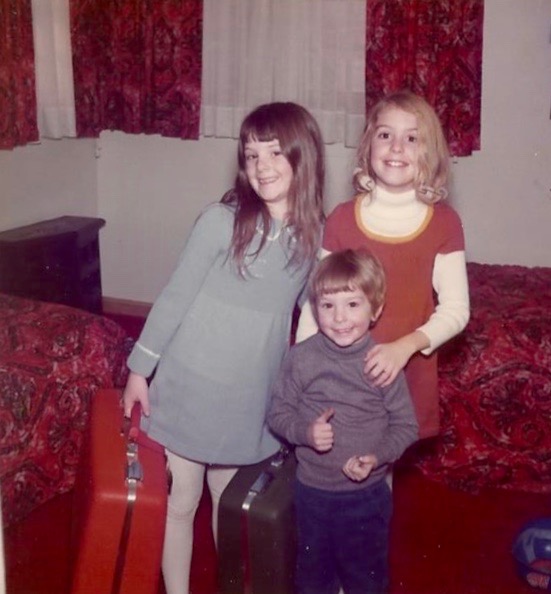
Me with my sister and brother. The traveling bug seems to be planted early!
Hi, Amy – tell us a bit about you!
Hi! Well, I’m married to an English vicar and we live in a lovely but draughty vicarage with our two wonderful kids. I’m a writer and speaker with a long history in editing; I love writing devotional thoughts and running the Woman Alive book club.
I grew up in Minnesota – the land of 10,000 lakes and hearty people who survive the shockingly cold winters. I’ve now lived longer outside than inside of Minnesota, however, for when I was at university I went to Washington, DC, for a studies program – and ended up staying 10 years! When there, working with a wonderful Englishman-in-America, Os Guinness, I met a visiting Englishman who was studying abroad as he trained to be a vicar. We fell in love and married and I moved to the UK nearly two decades ago – a mind-boggling amount of time.
Something you might be surprised to know is that I’m a (lapsed) aerobics teacher. I love going to the gym and enjoying group exercise with my friends.
Read the rest of the interview at Tanya’s blog here.
Last year we remembered the 100th anniversary of the start to World War 1 – the war that was to end all wars. London became a focal point as the art installation at the Tower of London slowly caught the public attention and eventually their heart as poppy by poppy was planted, turning into a sea of red. One for each life lost, eventually the last of the 888,246 ceramic flowers was planted a year ago today on Remembrance Day (Armistice Day, or in the States, Veteran’s Day).
As I tell in Finding Myself in Britain, we visited the Tower on that Remembrance Sunday – we and a few thousand others. Though we only gazed at the sea of red for a short time, jostled by the crowds, the sight moved us. Not least because 152 of those poppies stood for men whose names appear on the two war memorials in our church.
Nicholas and PyelotBoy, lovers of history both, dug up information about these men on the memorials, scouring websites about ancestry and that of the Commonwealth War Graves Commission for clues. What were the backgrounds and interests of these men? How did they die? Our intrepid researchers even took a field trip to the London Metropolitan Archives to search out the original church documents and revel in such items as the 1920 invoice for our church’s north transept stained-glass window, entitled “Saints in Glory,” installed to commemorate the fallen soldiers, sailors, and airmen.
On Remembrance Sunday, both last year and this year, at our church a group of people young and old read out the 152 names, while members of the congregation placed a poppy for each person at the foot of the cross. Direct descendants of the men on the memorial were invited to the service – some came from Sussex, Kent, and even Australia – as well as the occupants of the homes where the men lived before going to war.
All this research brought home the personal nature of the sacrifice of these men. No longer were they just statistics of those who died, but fathers, brothers, sons, husbands; writers and bricklayers, police constables and trainee architects, dentists and regulars in the military; two men who died in the same German prison camp; at least three sets of brothers. The youngest man was aged 17, the eldest 48. I told the story last year of one of the men, who captured my imagination. Frederick Goodyear, who was born locally in North Finchley and who died at the age of 30 in France. I had included his story in my book in an early draft, but alas, it got chopped at the cutting table as it changed the flow and tone too much. Still, a fascinating thing to enter into his life – a dreamer who would have been better suited to the academy than as life as a soldier.
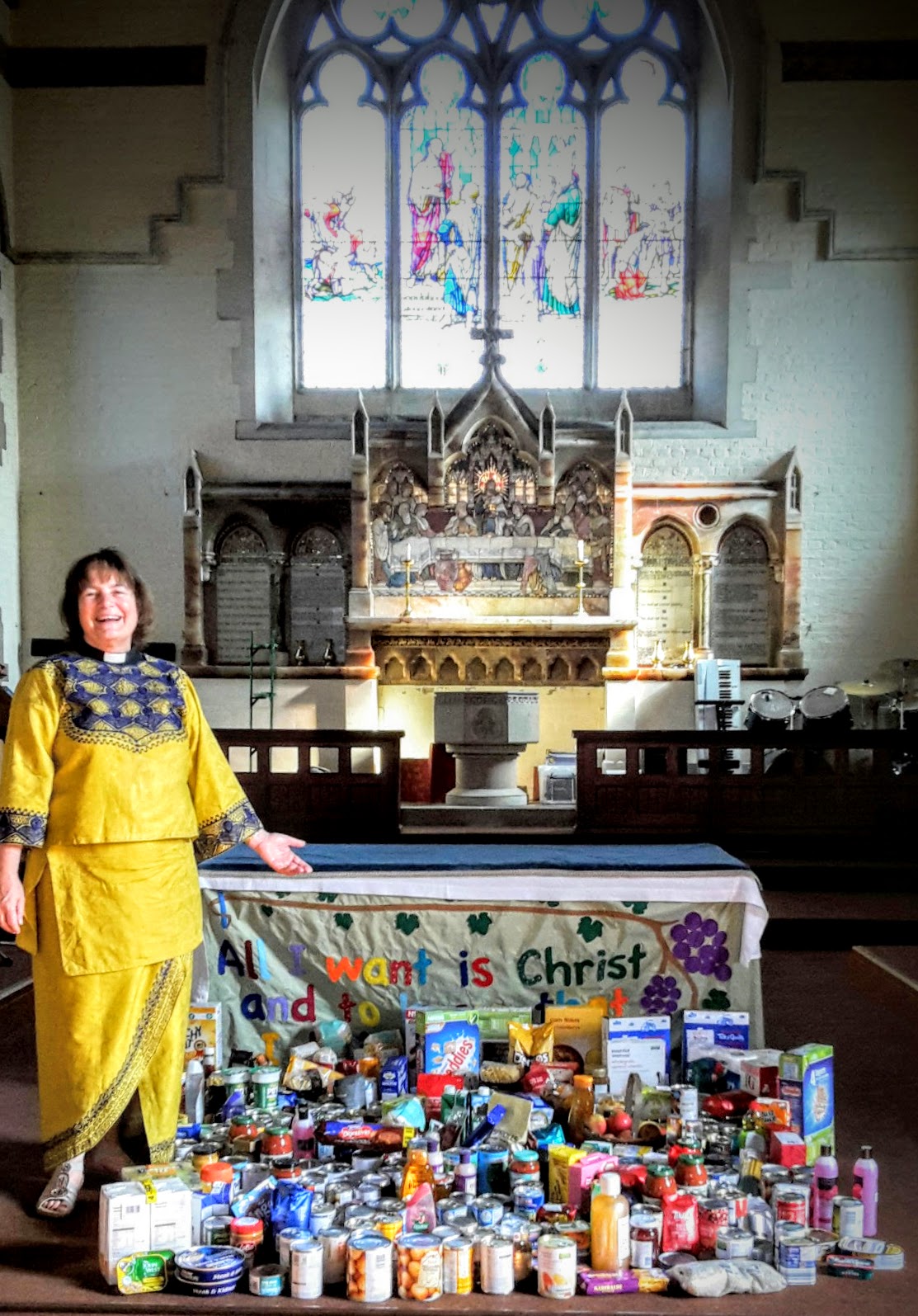
Revd Mavis Crispin, our associate rector, with the Harvest gifts.
“Tell her about the flower wars,” she said to her fiancé.
He paused, looking thoughtful, and shared the antics related to flowers and the church.
A big wedding took place in a church in Jersey, and a local group – which had won awards at the Chelsea Flower Show – arranged the flowers. They created gorgeous displays of white lilies and roses; flowers eminently suitable for a wedding. When the former head of the Women’s Institute (WI) entered the church, she determined that the lilies and roses should stay for the following week – even though fourteen different individuals and groups were already planning their arrangements, because the following week was none other than Harvest, one of the big festivals in the church calendar.
But the former head of the WI was not actually in charge of the flowers, and in handing down this edict, was stepping on toes. Feelings were hurt as the words flew between various parties, with the rector getting roped into sorting through the mess. He ended up spending an hour every day that week before Harvest with pastoral visits and phone calls as he tried to mop up the pieces and satisfy the warring factions.
A compromise was reached, but it was less than satisfactory. The lilies and roses stayed, but wilted after a week of war. The amateur flower-arrangers added bits and bobs to the wedding scene, trying to make it more harvesty. It was, admitted one, “A mess.”
Harvest wasn’t a festival I was familiar with before coming to the UK, and it took me many years to realize the obvious – in the States, we celebrate Thanksgiving as the adapted Harvest celebration (after all, the Pilgrims were stopping to feast and give thanks for the harvest).
We celebrated our Harvest festival a few weeks ago in church, and as you can see in the photograph, we received a bounty of food to pass along to our local food bank, whose stores had been depleted.
But writer Tanya Marlow wonders if we’ve got it wrong when it comes to celebrating Harvest. Have we started off with good intentions – such as the former WI leader in Jersey – but what results is less than satisfactory, or worse? In a wonderfully provocative piece for the Christianity magazine blog, she says:
I wonder if in our Western schools and churches, Harvest Festival should be a festival of repentance, not thanksgiving. We should be weeping for the gluttonous plenty we have while workers around the world die in unsafe factories making our bargain clothes, and children are deprived of schooling because they are growing crops for our under-priced food.
Read her piece; what do you think? Or what about the idea of author Marion Stroud, who recently died and must be enjoying the biggest Harvest ever:
Why don’t we, though, think in spiritual terms about the church and the harvest, in terms of what we’ve seen God bring to fruition and what seeds we want to plant in the coming year?
Finding Myself in Britain contains a chapter that looks at Harvest and Thanksgiving, as well as some of my favorite recipes for the Thanksgiving feast.
I didn’t know that the fairy tale would be so hard. After all, my dreams had come true – I had finally found my prince, a man who loved the Lord and loved me. The courtship and engagement whirled past in a rush of plans and excitement. I knew I’d have to quit my job and leave America to join him in his native Britain, where he was studying to become a minister, but I figured, how hard would that be?
Turns out, harder than I could have guessed. After the flight and drive from Heathrow, with me recovering from the flattening case of flu I caught while on honeymoon, we made it to our tiny student accommodation in Cambridge (called “The White House,” no less). I excitedly unpacked my bulky desktop computer, wanting to connect with people back in the States (this was before the ubiquity of smartphones or even wireless internet). But after I pressed the power button, I heard a whoosh. In an instant, my Macintosh died, the victim of different power supplies and me not switching a button at the back between 110 and 220 voltage. I collapsed into floods of tears.
Losing my computer started off me on a tough transition into my life in the UK. I was with the man I loved, living in a charming part of England with the boats floating down the River Cam, evensong at King’s College under the famous fan-vaulting ceiling, and a daily market with the fruit-and-veg sellers calling me “love.” But I felt rocked at the center of my being.
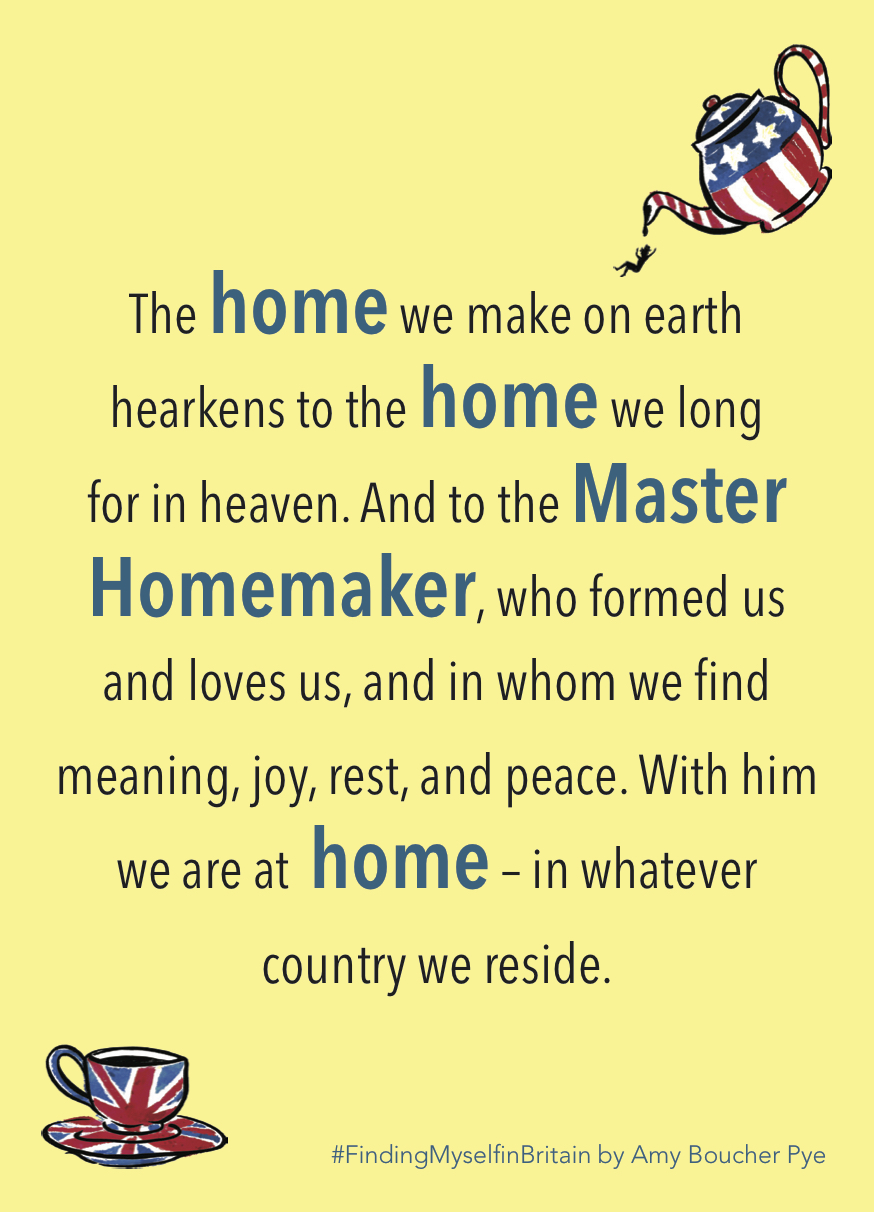
A recurring theme in Finding Myself in Britain is the longing for home. What is home? How do we find or create it? What do we define as home?
When Nicholas and I first married, we agreed to call the place where we were living “home.” Not only did this help us in the biblical injunction of “leaving and cleaving,” (leaving one’s family of origin as a new family is created) but it aided us emotionally. If someone asked me, a newcomer to the UK, when I was “going home,” I’d say, “I am home! But I have a trip to the States planned in…” The words we use can help us define our emotions – we sometimes have to educate our feelings.
Home is a lovely concept – I think of my parents’ home in Minnesota, which although isn’t my home any longer does feel like home, with its lack of clutter and ultra clean space to feel comfortable in while chatting to my family, or the screened-in porch in which to sit and watch the passing deer and wild turkeys (yes in the suburbs of St. Paul!). Or I think of the top floor of a house in Philadelphia where dear friends lived while studying at Westminster Theological Seminary, where I spent many a Thanksgiving. It was only two rooms – and the dishes were washed in the bathtub – but the rafters reverberated with refrains of songs and laughter. Or I remember the historic (for America) house I worked out of for many years and the lovely family who dwelled there, complete with my favorite black lab/golden retriever. On this side of the Atlantic, I picture the homes of dear friends and the meals shared around their tables.
I could continue in my list, but these places are personal and won’t evoke the feelings of home in you that they do in me. But a common theme of these places where I’ve felt at home lies in the people who make them homey – their welcome, love, grace, and open hearts. They who follow the Master Homemaker bring his kingdom to earth in the homes they create here.
Yesterday I so enjoyed being interviewed on Premier Christian Radio. I was a guest on the Inspirational Breakfast show (you can hear my portion of the show here) with host John Pantry, who (amazingly) has been with Premier as long as I’ve been in the UK – 18 years! I loved hearing his stories in the break about living in California for a year when their children were young. He said how they were given so many provisions, such as a car. And one woman gave them all of her furniture, for she believed the Lord was returning soon and very soon and so she didn’t need it! (I wonder how long it took her to admit she’d got the timing of the Second Coming wrong before replacing the furniture she gave away?).
One of our callers yesterday recounted being in the States and trying to buy some stationery products and his amazement at being laughed at by the young women salesclerks when he asked for a rubber! It made me think of the story I tell in the book in the chapter “By Their Accent Shall Ye Know Them,” excerpted here:
On one of my yearly trips back to the States to visit family and friends, the kids and I made a pilgrimage to our favourite chic-but-cheap retailer, Target. The very first Target store was opened in 1962 in Roseville, Minnesota, and was “my” store growing up. When there I stock up on things I can’t get in Britain or buy items that are less expensive, to haul back to the UK. We were standing at the check-out line, placing the items on the conveyer belt as we waited for our turn. When I took out a Dr Seuss-related item, in a package of six, Jessica exclaimed, “You’re buying rubbers!”
The man ahead of us in line flinched but I said, “Yes, they’re for your birthday party.” I added quickly, “But in America, we call these erasers.”
She remained blissfully unaware of what must have been going through the mind of the man in front (for rubbers in the States are condoms). Differences in language can make for some interesting exchanges.
In the interview, John Pantry asked what were the listeners’ favo(u)rite British quirks and customs. What are yours?
The day I came home from the school run to find my book had been delivered was a sunny, joyful day. All that hard work of writing and rewriting, and here it was in its beautiful matte finish and gorgeous heavy paper stock. Wow and wow!
Nerves on high alert, stomach tight, trying to breathe deeply, I hear the words from the presenter, “We’re live.”
I love doing live radio – I feel the rush of adrenaline and the wonder of being able to speak to people dotted around in their homes up and down the country. But there’s definitely the rush of emotions and the reaction of the body with an increased pulse and the feeling of expectancy as we go on air.
I feel like that now as my book-baby lands into the world this weekend. On Sunday at our church we’re having a book launch for friends and the church family, and I’m overwhelmed by the number of people who are coming – those lifelong friends who have walked with us for decades, some lovely social-media friends I’ve not yet met in person, and people representing my amazing publisher, Authentic Media. I’m humbled and grateful and just might burst either into tears or song, or both!
The book has now also landed into (many of – post times vary) the hands of those who endorsed it and gave editorial feedback. And I’ve seen this morning that the copies to bloggers and media are shooting into offices and letter boxes around the country and soon across the Pond as well.
With my sense of expectancy and joy lies the undercurrent of fear. Will people like the writing? What if they disagree? What if I’ve got it all wrong? And yet, as a book editor and reviewer, I’ve dished out plenty of feedback and critiques over the years, and I know that not everyone will like Finding Myself in Britain. For instance, I try and try but I still can’t read works of fantasy – yep, I’ve still not read the Lord of the Rings. So I push down the fear and know that whatever the likes or dislikes, now is the time to give thanks and enjoy the moment.
Thank you family. Thank you friends. Thank you wonderful publisher. To God be the Glory!
And Houston, we have lift off.
PS – have now figured out Paypal so am happy to sell you a copy. Message me if you’re interested: amy@amyboucherpye.com. I discount but postage is crazy outside of the UK.
 Recently I came across a poem I wrote nearly 18 years ago to the day, just 10 days after I had moved to the UK. Part of me was sad I hadn’t found it when I was writing Finding Myself in Britain! But mostly I experienced a rush of poignancy, feeling for that person I was, so new to the UK and feeling stunned with the massive pruning I was undergoing. Everything seemed so strange and hard and different, and knowing that I was here to stay made me aware that I was going to have to send down roots and make this my home.