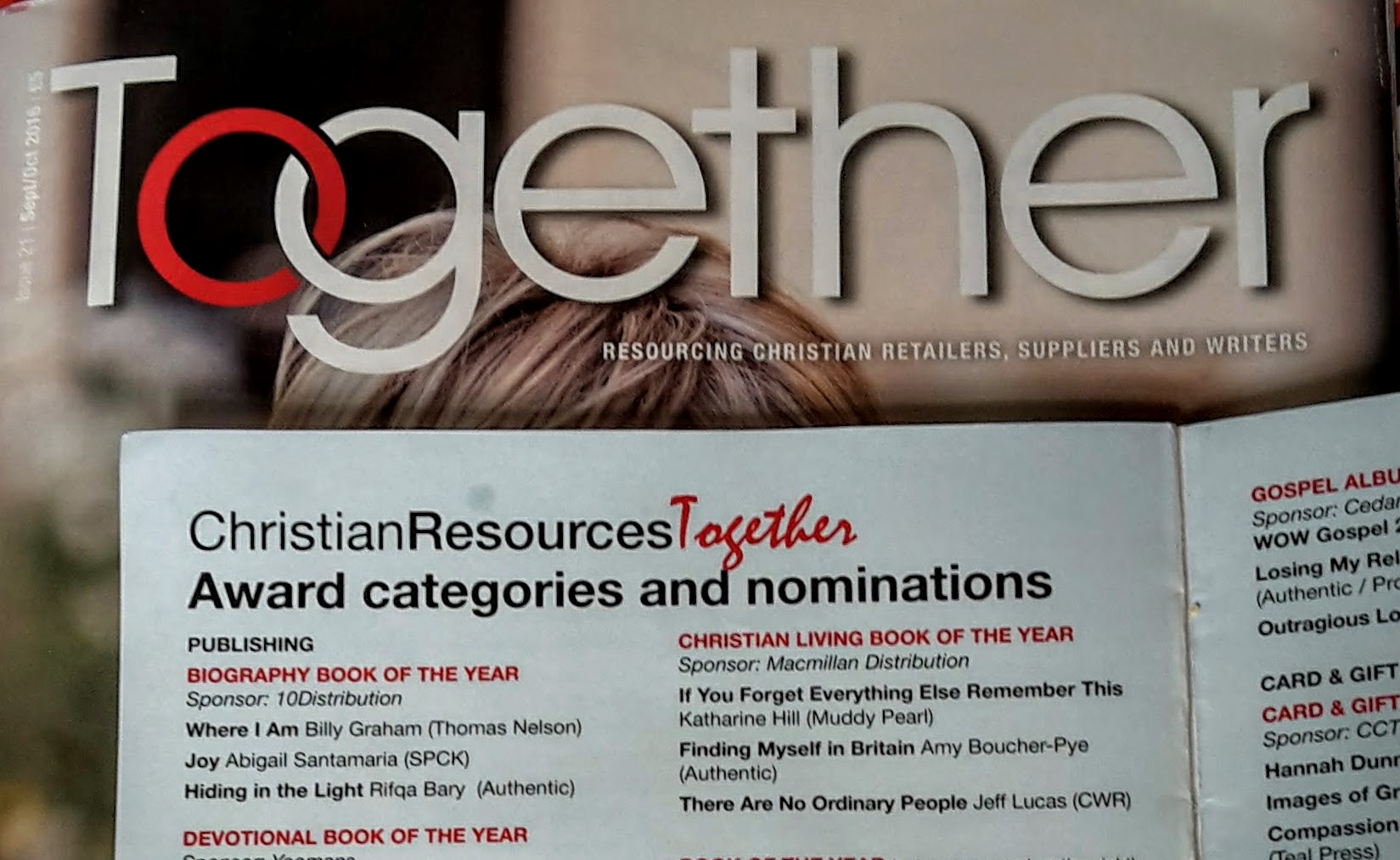
Last week I sat in a darkened room, heart pounding. The setting was familiar, for I had attended the Christian Resources Together gathering many a year previously in an editorial capacity, sometimes thrilled when “my” authors would win awards in the various categories, and sometimes gutted when they were passed over. Last week, however, I wasn’t an editor but an author. And my Finding Myself in Britain: Our Search for Faith, Home & True Identity was up for the Christian living book of the year.
Alexandra McDonald from Macmillan Distribution presented the award, and as she announced the three shortlisted books I feared those next to me could hear my heart beating. “And the nominees are… There Are no Ordinary People by Jeff Lucas, published by CWR,” she said, and I thought, Jeff, Jeff, he’s an amazing, fantastic author and speaker. I will smile when they call his name. She continued, “Finding Myself in Britain by Amy Boucher Pye, published by Authentic Media, which you received last year.” Oh, I thought, she remembered how each participant found a book in their room! She continued, “And Katharine Hill, If You Forget Everything Else Remember This, published by Muddy Pearl.” Ah, I thought, another strong contender – Katharine’s work with Care for the Family is so important, and Muddy Pearl is a great little publisher.
And the winner is…
As we waited, both Rachael Franklin next to me from Authentic and I noticed that Alexandra looked like she was mouthing, “Finding…” I thought in the split second, Could it be? Could my book really have won? Oh Lord I can hardly believe it…
“Finding Myself in Britain by Amy Boucher Pye, published by Authentic Media!”
Donna Harris, who runs Authentic Media, grabbed my hand and up we went to receive the award. She said a few words, and I tried to garble out my thanks. With so much adrenaline pumping, and the lights so bright, I was not terribly articulate – I have empathy for Gwyneth!
With Donna Harris, I am here amazed and stunned and grateful.
What I wanted to share was how Steve Mitchell and the folks at Authentic Media were the only ones willing to take me on as an author. I had a fantastic US agent who had shopped around an idea for my first book to 16 publishers – but 15 said no. And Steve and the team said yes, and thankfully he and I soon said “goodbye” to my original proposal. With his many years of retailing experience, he advised me to write a through-the-year account of life in Britain as an American. A sort of Michele Guinness-meets-Bill Bryson. My marching orders complete, I set about writing it.
Most of the Authentic team, current and previous.
The writing and rewriting wasn’t all smooth sailing. I would draft a chapter and send it to Steve (by the way, not an editorial practice I necessarily recommend because of flow and voice, but with our tight timeframe and the trust we’d built previously it worked for us). He read them and give me loads of feedback, such as, “Hey, I feel like you’re trying to import Minnesota to England. I know you miss it, but…”
When he and I finished going through the chapters, I sent it to about ten beta reviewers, three of whom were writers/editors. I’ve written elsewhere about my hide-under-my-duvet response after the first thirteen-page response! But my reviewers were so right in their comments, and I was thrilled that one of the reviewers became my editor, Jennie Pollock. She helped me sift through not only the editorial feedback, but she pushed me to find my voice and go deeper. That she’s a lovely Englishwoman who spent several years in the States only added to the experience.
And then to the design and cover art and copyedit (with a few tears by me over British style – yep, really) and boom, it was time to think about marketing and sales. With the market changing so much and the UK losing probably 150 Christian bookshops over the past five years or so, the author can’t expect the publisher to be their only means of spreading the word about books. I had a wonderful marketing team headed up by Kate Beaton. My publisher was so fantastic with the campaign, not only, for instance, providing point-of-sale materials to bookshops but creating bookmarks and laminated recipe cards as well as giving me a huge sign for the book for my speaking engagements.
For a real joy over the last year was getting to speak at events at bookshops; I loved meeting people around the country and hearing a few of their stories. Ali Caesar at Quench in Wokingham hosted the first launch, with the next-door coffee shop, The Grange, filled with people chortling over the US/UK quiz she arranged. I was so grateful to go to Streatham and Marlborough and Hove and up to Glasgow on these jaunts.
With one of the best reps in the business, Lawrie Stenhouse.
It’s been an amazing journey and as I look back over the past year my heart fills with gratitude to God and to all those who have helped with the publishing and distribution and the getting-the-books-into-people’s-hands. And of course to those of you who have read it! I love how readers become friends as we share in finding ourselves wherever God has placed us.
What a great pleasure it is for me to welcome Steve Mitchell to my blog today. He’s a visionary, mentor, and encourager, and has probably the strongest and deepest understanding of the UK Christian retail market out there. I owe him a deep debt, for without him, my book would never have been published.
So you have a couple decades of experience with retail, and specially Christian bookshops. How did you get into bookselling? What do you love about the business?
I have always loved books. I grew up as one of those kids who used to read under the covers with a torch – books were always going to be an important part of my life. I fell into retailing as a career, and following a conversation about life with a friend of the family whilst on holiday, we ended up opening a Christian bookshop in Kingston-upon-Thames. I spent 15 years in retail and was inextricably drawn into publishing a few years ago.
My passion in life is to help people go deeper. I love it when we learn new things about God, life and ourselves and become better for it, and books are an amazing tool for deep change. Whether it’s teaching, or an amazing novel that pulls you into another world, a turn of phrase that you can’t let go, a piece of poetry that expresses a feeling that we can’t put words to, all of these are found in text. I love the tactile pleasure of the container of all these words…“a book”. Yep, I’m self-confessed book geek.
A look into Steve’s retail store, back in the day.
How does your history and experience inform your publishing?
Having spent so many hours behind the counter in a bookshop, my approach to publishing starts with thinking, “What should I recommend to my next customer? What is her outlook on life, her mind-set, hopes and dreams? What is the story she is telling herself about her life, and what can I offer her in a book that resonates enough with her to lead her to change that mind-set and her life?” So for me it starts with the reader but ends with the writer. Understanding the interplay between the two creates the dynamic of a deeply engaging book. I hope that my publishing is shaped by the knowledge, intuition, stories and lives of the writer and the hopes, dreams and needs of the readers.
An early example of Chapter and Verse being an internet bookstore. Hmmm…. perhaps they should have stuck with that!
When I came to you as a potential author, you could tell that I was muddled in what project I should pursue (having been turned down through my agent by 15 publishers). Tell us about our meeting in Birmingham and how you approached advising me on what would be the best first book for me to write. What sorts of things sparked your thinking and ideas?
Ok, are you prepared to be brave Amy? This is your blog! My initial response to your first autobiographical proposal was that it was interesting but wasn’t going to give readers enough value to stick with it all the way through. I could see immediately that you wrote beautifully, you had some amazing stories, some engaging and original ideas, but also that there wasn’t a strong enough hook. I also warmed to the way that you were very open to input, used your own editorial experience to be objective but held your author passion closely. So that gave me plenty of depth to work with.
I can’t put my finger on exactly what prompted the ideas, but have learnt over time to fall back on my character type which is introverted intuition, in Myers-Briggs typology, INTJ. This means if I give myself enough time and space to reflect on the questions in your writing, I can connect up enough parts to make a better whole.
As you had lots of great chapters, the challenge was to find a structure for the book that was fun and engaging. That creativity continued through each edit, even towards the end when you suggested adding the recipes, which was a fantastic addition for the reader. [Amy adds – actually, that was a recommendation of Michele Guinness.]
So for you, I never had the question of whether or not you could write a book, but finding the book that reflected what God had uniquely shaped you to write.Finding Myself in Britain was that book.
How did you come up with the “Michele Guinness meets Bill Bryson” in a through-the-year approach?
I’m not sure that I did, it may well have been you! The dialogue between an author and publisher should be open, honest and creative, so in our conversations I can’t remember who articulated what but I know it was the creativity of the process that drew out the best we both could offer. The hook of MG meets BB was a line that we could offer to booksellers to help them share the style, genre and heart of the book.
I believe all authors should drill down the concept of their books into a memorable phrase that is sticky and shareable. It also means that as the author writes and re-writes, that they keep the main thrust of the book front of mind. Too many books try to do too much and the connection with the reader is lost.
My advice to writers is to write for a person that you know, and that you think needs to hear what you have to say or will enjoy the subject that you are writing on. If you try to please everyone then you’ll fail and disappoint most readers.
So in the editing process as we talked about your life, stories and your hopes for how you wanted your readers lives to be impacted, it seemed to me that your journey from your beloved homeland into a strange different world offered unique insights into life faith and culture. If we could capture those insights in an interesting and inspiring framework which guided the reader to greater confidence in God rather than where they live and their home culture, then we would have a book that was unique, fun to read, and yet get gave the reader some meaning and value to their life.
As I laid down my first draft, I sent you chapters to read and give feedback on. What surprised you by this process?
I think it was how much of me that I had to put into the process. I had to walk the journey with you, feel what you were feeling, connect with the why as well of the what of the stories.
Then later on, after I’d written my manuscript several times, we had a discussion about spelling and punctuation that resulted me in floods of tears. Did you ever think someone would take these matters so deeply to heart?
I knew you would be passionate about the words, a pain about grammar and language, stubborn about certain sections … yes I’m talking about the chapter on plumbing here. And oh yes … the discussion about spelling and punctuation, which was of course, not about spelling and punctuation at all. You had been so vulnerable about relocating from the US to the UK, and in that moment popped up the thought, “Hey what if this move is permanent? So how do I hang onto part of my old life … I know, words. Right, Mr Publisher, I want American spellings!”
At that point in the writing you allowed yourself to think and react to the deepest of questions. The spellings were just the outward reflection of this. This was you going first on the journey that you were taking your readers through. To your great credit, you allowed yourself as an author and person to take the harder route.
Best book tower ever! #FindingMyselfInBritain
You’re brilliant at advising and envisioning authors/content creators. In closing, what advice do you have for them in an age where discoverability is such a challenge?
Well, thank you. With all my Britishness it doesn’t feel like that. I’m just muddling through.
For our writer friends, the world of writing is more open, exciting, scary and challenging than ever before. It is so easy to put your writing out into the world, but so difficult for those words to be found or to stand out. Writers, I believe, need to think first about their readers, and to consider the impact that they want their words to have. Then they need to structure their writing and profile to their audience. Ask yourself, what value will my book add to my reader? Why should they choose to invest their time in my words?
Be clear about the response you want from your book. Think deeply about your ideas and concept – make them as original and unique as you can. Improve your skill and craft as a writer, read lots of good literature, take your time to write the best that you can.
Get objective outside help: Send your writing to ten friends, and if they then pass it on to ten of their friends then you know that you’ve got something. If they don’t, then go back and work harder at it.
Be realistic about your reach. If you want your writing to go further than friends and family, then you need to build a platform for you and your message. If you want to be a voice of influence then you have to show up thoughtfully, respectfully, engagingly and, I strongly believe, consistently in their lives. Only then will you be given the permission by readers to allow your words into their life.
Above all, keep writing. The world will be a better place with great books and there is no reason why that can’t be your writing. Keep writing, growing personally and developing your craft – and even if it doesn’t result a large number of readers, you’ll still have added value to the world and helped some people.
Steve Mitchell is a lover of books and music, preferably served with great coffee. He is on a mission to help people live a deep and fulfilled life. To that end, he publishes books for IVP and loves coaching and mentoring. To relax he’ll pick up his beloved bass and jam along to some blues. He’s a Londoner living in Cumbria with no plans to return. The older he gets the more he enjoys learning, and having completed a Master’s degree, he is now working on persuading his family to let him to a PhD.
To read other posts in the Behind the Publishing Scenes series, click here.
To buy the fruit of our labo(u)rs,Finding Myself in Britain, you can find it at Christian bookshops, from me, or online at Eden or Amazon. If you’ve read it, please I beg you, write a review online. Word of mouth matters. Thank you!
What strikes you about the vision process in producing a book?
Me with Kate Beaton and Becky Fawcett, she of editorial fame, at my book launch, September 2015.
I’m delighted to welcome Kate Beaton to the blog today to talk all things marketing. She is an amazing person – one who feels things deeply with a huge gift of empathy, and one whose passion to connect readers with great Christian content has shaped much of her professional life. At the end of the year, she moved from Authentic Media to a position at World Vision, where she’s exercising her skills in a slightly different area – but still focused on connecting people with great ideas and causes. Join me in finding out more about her heartbeat behind how she spends her days.
ABP: Tell us a bit about yourself, Kate. How did your interest in marketing develop?
KB: I’m Chaos Manager at my home which I’m blessed to share with two children, aged 3 and 7, and my husband Kenny, a louder-than-life 6’1 Scot who works in the local prison where he brings light and life. We’re part of the congregation at Stony Stratford Community Church.
My publishing adventure began 18 years ago when I left the tranquility of East Devon for Milton Keynes, knowing only one person in my soon-to-be home but having a very clear sense of God going before me.
My interest in marketing has always been about people. I have always loved connecting people with others and sharing ideas. For me, marketing is about connections and adding value to people’s lives through great products, which in the world of Christian publishing has been a dream and a privilege.
Kate and Kenny, her gregarious Scotsman husband.
ABP: I knew of you when I worked at Zondervan and you were at Authentic Media – I remember thinking that you were a firecracker of a marketer, and I was secretly jealous of Authentic and your work there. Imagine my surprise when we were reunited to work together later at Authentic! Tell us about your work at Authentic and then Scripture Union and then Authentic again.
KB: Funny that you say that as I remember thinking the same of you! I came to work at Word Entertainment selling advertising space in Premier Magazine and then moved in to a Marketing and PR role. One of the stand-out campaigns I remember was lead singer of Irish group Clannad, Maire Brennan’s album ‘Perfect Time’. I then moved into the role of Marketing Manager and was with Authentic until my role was made redundant in 2007. That was a tough time and a stark reminder that who we are as people is more important than the job titles we do or don’t have.
I moved on to Scripture Union where I had the joy of being involved in the launch of their digital suite of products, WordLive and LightLive and their strong portfolio of published products. I loved being part of a mission organization full of gifted passionate people and was there for over 6 years before Authentic came knocking on my door!
ABP: I’d love to hear more from you about what is behind what you do in marketing. What do you hope to achieve?
KB: For me, relationship is at the heart of marketing. That is, knowing the audience you seek to serve in terms of their needs and communicating the benefits that your product will provide. In an increasingly noisy world where the average person is said to be exposed to over 350 marketing messages a day, it’s sometimes really tough to get your message heard. But the old advertising mnemonic AIDA is still relevant: build Attention of a product, capture Interest, create Desire, lead to Action.
The marketing process follows through from the inspiration and work of the author as we the publisher seek to build their voice to connect with the type of reader they had in mind. Of course, the author has to be a part of the marketing effort to deliver this.
At the heart of any good marketing campaign is a great product, and we are privileged to work in shaping campaigns that have already been inspired by the Holy Spirit as writers and artists have tuned in to God and what he is asking them to craft and create.
I’m sure many authors can relate that golden moment when they hear from a reader about the positive impact that their book has made in the reader’s life. We serve the ultimate Creator so it’s fantastic to be involved in a process which has creativity at its heart (and if you want to be inspired about releasing your creativity, watch this great poem written and performed by Fusion’s effervescent Miriam Swaffield).
Kate’s creative handiwork at the book launch. She taught CutiePyeGirl how to make a stunning book tower.
ABP: I was touched at my book launch how you saw potential in CutiePyeGirl to be a marketer someday. What qualities does someone need to be successful? What sorts of things did you see in her? (She now insists on creating any book tower wherever I go when selling my book – and she does so very well, under your tutelage!)
KB: Your second question first! In CutiePyeGirl I saw a gregarious, confident, people-loving girl who wanted to help shape a fantastic book-launch experience for all involved. Her creative spark was plain to see and her instant engagement with the building of the book tower was lovely to watch. All the natural ingredients of a marketer-in-the-making (which may answer your first question)! I wanted to verbalize what I saw to encourage her, as I know how powerful a well-placed God-inspired word can be for us all, whatever age we are.
A publisher’s lunch with Kate and Steve Mitchell, then MD of Authentic.
ABP: Many authors are disgruntled with their publishers, saying that they don’t get enough attention (not a complaint, mind you, that I would lodge). Why do authors need to be so involved in spreading the word today? What advice would you give to authors?
KB: In this noisier, digital world we are closer to each other. And people are searching for authenticity and truth. The author’s voice is powerful and readers develop a relationship with an author through reading their words. And these days people expect to be able to have – if they want it – interaction with writers and speakers, whether that is to follow their blog posts or tweets or watch their videos.
People follow people so at Authentic we have been working with our authors to help with this process as best we can. I understand that it can be scary for authors to see themselves as marketers, but when a book is published, that really is Day 1 of its life. There comes a lot of hard graft after that!
It’s not a question of having to be all things to all people, but it is a challenge to see how what you have carefully crafted in the pages of your book can be ‘repackaged’ and served up to add value to people’s lives across multiple platforms, including TV, radio, speaking engagements and last but not least social media which is where many of us spend time looking for inspiring content. Publishers will help you do this as they have a vested interest to do so!
So think about your target reader and how you can engage with them and continue to add value to their lives in a time-bound realistic way for you; perhaps that’s blogging once a week about a topic that you are passionate about and relates back to your book. Remember this isn’t about meaningless, soul-less marketing; it’s about relationship building, understanding your reader who is closer than ever before and bringing the message that God has given you and giving it away to others for his glory.
“Yes, Amy, this is a book. You read it by looking at the words on the page and turning them, one by one, to move along through it…”
ABP: Your time at Authentic is ending as you move to World Vision. I hear you’re passionate about this new venture; please share with us what you’ll be doing and what you hope to be able to achieve.
KB: Milton Keynes is home to many Christian charities. World Vision is an organization I’ve always deeply admired in terms of their work in child sponsorship, community development and disaster response. I know a lot of fantastic people who work there.
I will be joining the Supporter Experience team who connect with World Vision child sponsors and seek to enrich the relationship they have with their sponsored child through relevant timely communication. I’m looking forward to being part of a large marketing team and hope to be able to help World Vision grow its impact and awareness in the UK through child sponsorship. Ultimately it’s about God’s people using the resources we have to answer the call to bring about God’s will on earth as in heaven; sharing our resources and praying to make it possible to live in a world where every child is free from fear.
The gifts I’ve received in the publishing process for Finding Myself in Britain have been breathtaking. Such as how the cover came about – I share the story of finding our designer, Vivian Hansen, in part one of this series. Only when I received Vivian’s email as she responded to my questions did I learn that she and I share our Christian faith – and a love of travel. How amazing to connect with this talented young artist! Read to the bottom of the post to see how to get in contact with her (especially if you’re involved in publishing) and to see more of her varied art – she works with oils, watercolors, sketching with pencil and others. In her words:
I have been drawing as long as I can remember. When I was a child, I wrote and illustrated many stories, always loving how people would react and engage with the little worlds I created. I later enjoyed it as a kind of escape, much like reading a book. But to be honest, it wasn’t until I was about 17 that I realized I had a particular talent in art. I had a deep wanderlust throughout my youth (fueled by the mountains of books I lived inside of), which eventually led me to leave my tiny country town in southern Mississippi and go to live with a family in Ireland. It didn’t take long for the art professor there to find me drawing, and he invited me into his art class – the first I’d ever been in. He taught me the basics, and I delved into a whole universe that had been waiting for me. By the time I graduated, my mind was set on pursuing a creative career. It has been a long and winding road, but I am very thankful to have had the opportunity to study illustration.
I was finishing up my last bit of art school when I found the contest for your book cover design. A friend of mine told me about the site, so I took a look around. Contest sites typically have a shady reputation in the professional art community for taking advantage of artists, and even reputable sites like 99Designs should be approached with caution. But as soon as I read the brief for Finding Myself in Britain, I had a rush of ideas. I picked up a pencil and started sketching. It’s a big risk to spend a great deal of time and effort on work that may not be fruitful, so I approached it with the idea of using it as a creative exercise. The brief was inspiring for me as a traveler, a bibliophile, a Christian, and a designer who likes a good challenge. It was clear that you were looking for something different, so I was happy to oblige!
I was really surprised and delighted to learn that I’d won the contest! I called my mom right away and told some of my classmates, including the one who had introduced me to the site. I’ve had my work published in small things before, but this was going to be the most widely published work of mine to date. Most of all, I was so grateful for the opportunity to use my God-given talents on a faith based project. What a joy it is to use the talent and opportunity I’ve been blessed with to do the Lord’s work! I hope to contribute again to Christian publishing and continue to be a vessel for His work.
My first thoughts when I started sketching were about focusing on a more conceptual design than a decorative one. Book covers featuring original artwork in a clever way stand out in a sea of stock images, so I knew I wanted a strong image with meaning. At first I considered what it feels like to be “different” while in another country and how I might represent that in a unique way. I ended up with a drawing of a sunflower growing from a rose bush; the flower clearly isn’t native to that plot, but it stands out in a bright, bold, happy way. Other ideas centered around place. One that I was fond of featured lots of different shapes and styles of windows you might see around the world, with a little cartoon Amy perched happily in a window resembling a stone church.
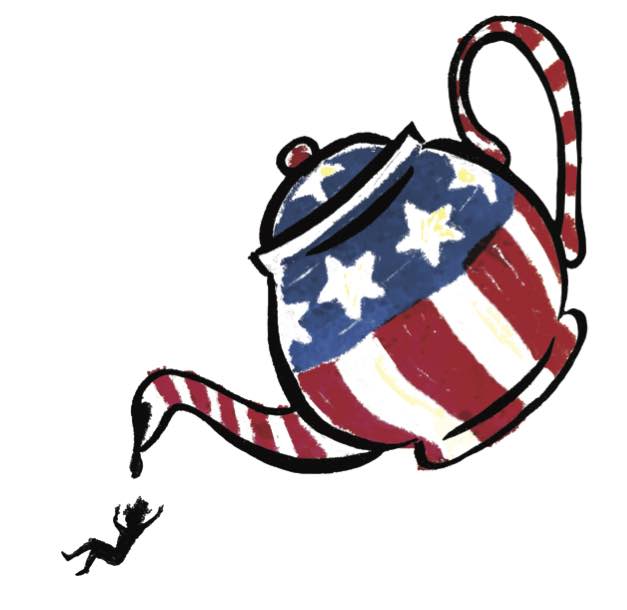
Inthe end, I was most drawn to a very simple but iconic image of a teapot with an American flag motif pouring Amy into a teacup decorated with the British flag. I think it presents the idea of instant immersion, maybe even culture shock, but in a funny, positive way (especially with help of the bright, playful colors). I hope it will draw readers in enough for them to read the back and discover what it’s all about – and from there, I’m sure they’ll be hooked!
Literature and travel are still a big part of my life. I’m a big dreamer and adventurer, and it directly affects and inspires my work. I graduated at the end of summer and started making plans for my next journey, which has brought me to Spain. I travel cheaply by flying stand-by and finding unique accommodation; this time, I’m working part-time at the front desk of a hostel in Madrid in exchange for room and partial board. It’s an amazing way to get to know a place in a real way. After two months of travel, I’ll return to the U.S. for Thanksgiving and then pack my bags again for Costa Rica, where I’ll be visiting my boyfriend’s family for the first time. Each place I visit is full of treasures for the eye as well as stories to take with me. I have lived in Ireland, Japan, France, and now for a while in Spain, and each place leaves a huge mark on me. I change and grow a bit each time and share my own stories, culture, and experiences with the people I meet.
By the start of 2016 I hope to start campaigning for greater amounts of freelance work. Where will I be? I have no idea. That’s the beauty of it. I’m at a peculiar time in my life that allows for these opportunities and, while I look forward to someday building my own family and having a place I call home, for now I am thankful for the chance to see the world and share it with others through my stories and art works.
How can people connect with me? When I am based in the U.S., I open up my Etsy shop to sell prints of my work and occasionally original art work and other handmade things, and in early 2016 I will launch a Kickstarter campaign to get my children’s book published. I also have my website, a Facebook page and an Instagram account where I post things I’m working on currently, including my travel drawings. The best thing about being an artist is simply sharing my work with others, so I am glad for any platform I can use to connect with people!
A Christmas card created by Vivian. Check out her process on her website – fascinating.I love the variety in her art.Art in motion – watercolors at Lower Yellowstone Falls.Wonderfully fabulous Valentine’s Day card.
Having worked in Christian publishing for over two decades as an editor, I’ve had contact with many an author. In my early days I worked with some highly strung first-time ones – those who define the stereotype of oversensitive, defensive, and not wanting to kill their darlings. I’m remembering one whose book I edited in the early days of the internet, when I would plug in the cord into the phone socket and dial in my clunky Mac laptop to download my emails. Each time I opened my emails I’d find another range of missives from him, written with passion and angst as he argued every little change.
I found the experience draining.
When I moved across the pond and started as an editor in the religious books division at one of the huge conglomerates, I was stunned to hear my boss, the publishing director, say, “I only commission authors I enjoy.” Really, I thought? Well that must leave out a lot of people. But as time passed and as I inherited many projects from covering a maternity leave, I could see his wisdom. Those projects where the author and I clicked, where I could see their passion and integrity, were those I loved working on, and which seemed to go swimmingly – even if we had a lot of rewriting and editing to do. Because we trusted each other, the editing process was a conversation – and the book benefited.
Those projects where the author and I didn’t gel so well, however, could suck the life out of me. For instance, I endured many a long, exhausting conversation with one agent, who claimed her author was receiving rotten treatment, that we were failing him, yadda yadda yadda – and this before the book even hit the bookshops! I wonder if she ever realized that she was thwarting her author’s project with the publishers.
And now, after those years as an editor, I finally got to be an author with my first book-baby, Finding Myself in Britain. The process was long and hard, but full of trust and feedback and uncovering my voice. My commissioning editor was Steve Mitchell, the MD of Authentic Media, who came up with the idea for the book. He knew my passions – for prayer and issues of identity in Christ. He also has two decades of retail experience. All of which led him to say, “Write your unique angle as an American in the UK. Make it a through-the-year look at us.”
So I had my marching orders and launched in exactly a year ago, going to Spain to El Palmeral for a week of intense writing, enjoying the sunshine and the hosts and guests – and hearing their stories of Harvest and clergy life and the difference between Yorkshire and, say, Lancaster. When I got back, I sent Steve a bunch of chapters for his feedback, and we continued to work in this back and forth manner, me writing and him assessing, as I created my first draft.
I was stunned by some of his early comments, for he was able to see what I couldn’t – namely how much I missed my family and friends in Minnesota. “I feel like you’re transplanting Minnesota to England,” he said of my early chapters in what was then called View from the Vicarage. “We want to hear what you think of us,” he continued, “not so much what you’ve left behind.”
Ouch. But he was right, and I rewrote, and rewrote some more. Once we were happy with my first draft, I sent it off to 10 reviewers, a mix of friends from the Woman Alive book club and three editor/writer friends. I sent off my manuscript to them on the Friday night and had a 13-page response from one speedy reviewer by Saturday afternoon. I was stunned at her insights and fast response – so stunned I had to take myself to bed, lest I become one of those defensive, irritating first-time authors I mention above.
And next time, dear reader friends, I’ll share how I handled that feedback and what I learned – and how I managed not to alienate my editor-friends!
The winner! Illustrated and designed by Vivian Hansen.
“Don’t judge a book by its cover.”
“A picture tells a thousand words.”
In the case of my first book, I’m happy if you judge it by its cover, because it’s just so darn good. When I first received the design, I loved pulling it up on my phone and watching the person’s face as they saw at it for the first time. Again and again, they would flash a smile and often they’d exclaim in delight. Here’s part one in how the cover came to be.
When I was a commissioning/acquisitions editor at two big corporate publishing houses, we had whole teams of designers working on the covers, designing them and/or hiring out artists or photographers to provide the original artwork and photographs. How many cover designs we’d receive per project would vary – sometimes we’d have three or four variations on a particular cover, but one Stateside designer was known for his huge creativity, giving us ten to fifteen completely different designs.
Times have changed, although I suspect the massive publishers continue in this fashion. But Authentic Media, the publisher of Finding Myself in Britain, didn’t have its own design department in-house, so was able to explore other options. The MD, Steve Mitchell, is innovative and creative, and follows the publishing trends and has a sense of what’s new and what’s possible in this strange new world. I’m so glad I followed his lead throughout the process.
The cover needs to be available about six months before publication, so the design process needs to start at least nine months before. I had previously shown Steve an amazing painting of our church that Steve Bjorkman had carefully crafted in a mind-blowingly rapid manner when he and his wife were visiting the UK one year, and Authentic-Steve wondered if a cover might emerge from it. Here’s one of the covers Authentic-Steve had designed with the painting by Artist-Steve, which although we thought was fun, we knew wasn’t exactly right.
Artwork by Steve Bjorkman. One of his paintings does appear in my book, which delights me.
So Authentic-Steve committed instead to have the design created through 99 Designs. I had heard him speak of the good experience he’d had in the design of other books, such as Chris Juby’s @BibleIntro, so knew a little of how the website works. The publisher signs up for a package – bronze, silver, gold, or platinum. The higher the package, the more expensive (but still reasonable), and the more designs you have to choose from. After the contest starts, any interested designer who is signed up with 99 Designs can submit a design within the 7-day window. When the contest is closed, the publisher/author chooses a design and can ask for tweaks. The winning designer then receives the fee.
I see a lot of benefits of this system, but admittedly they favor the publisher. One is having access to designers from all of the world. Another is the huge number and variety of designs that are submitted with only having to pay for a flat fee. But from the designers’ point of view, it’s a lot of work that you might not get paid for – I did feel bad for the stellar designs created that we didn’t use. Yet it gives designers the access to potential work that they’d otherwise not be considered for. For instance, we’d have never found the winning designer without this website.
My publisher put together the cover brief (you can see it here), which was a short summary of the book (a couple of paragraphs and an outline of the contents) and then for the design elements, he said:
We aren’t looking anything too twee or formulaic e.g. flags.
I wanted to put down more suggestions about what ways to take the cover visually, but Steve rightly pushed back, saying, “You’ve got to trust the process.” This is where authors need good and wise publishers – we think we know what’s best for our book-baby, but we don’t. I’m so glad we weren’t directive, and trusted the designers to do what they’re good at – designing. (And yes, the winning design does employ flags!)
We received 96 designs from 42 designers for the contest. Some of the covers made me cringe – one in particular made me think of 50 Shades of Britain – but many were excellent and a couple were outstanding. Of course, anything to do with art and creation is subjective, so what I thought was fabulous wasn’t always the same as what others thought. But we all agreed on the winning design.
I don’t think I should cut and paste over some of the designs that didn’t get selected because of copyright issues, but you can see examples here and here. Most of the designs have been taken down, but you get a feel for the diversity of options we had. I liked the feel of #92 and #90, but they are more typical of what one would expect for my book; the winner simply outshone them. Several of the people at my publisher liked the cover by LilaM, but I thought it looked twee (US: cringey), and like a woman during the thirties or forties.
In part two on behind the scenes of the cover design, I’ll interview the winner of the contest, Vivian Hansen.
So said the wise man in Ecclesiastes. And never has that been more true with the explosion of self-publishing, when people can crank out a book in an afternoon, converting to a digital format their academic thesis or that novel buried in a drawer. But who will read all this stuff?
I’ve been asking myself that very question as I bury myself in words as I write my first book. Will anyone care? Do I have anything to say? I’m trying desperately to reserve judgment, or I’ll remain paralyzed.
My journey to book publication has been long and arduous. Sure, I compiled a couple of gift books for Lion Hudson a few years ago, but somehow those don’t seem to count like the First Real Book. You know, the one that deserves capital letters.
About four years ago (or was it even longer?) I set about writing my first book. I wanted to write about learning to see ourselves as God’s beloved, and how that understanding changes everything. I read and researched, went away for some power writing trips to a friend’s house in Eastbourne (thanks Kev), and had no clue how the book would come together. I had a chapter on self-hatred and a chapter on self-acceptance, and bits and pieces of my story. It was a mess.
I was meeting up with the amazing Michele Guinness, she a writing and speaking queen, and I ventured to send her two contrasting chapters to read before our breakfast together. (She in turn sent me early chapters of her marvelous novel Archbishop, which I loved.) As we enjoyed our granola and yogurt, she said, “Amy, why don’t you just tell your story.”
I felt like a light had been switched on. “Wow – just telling my story. Here I am writing about accepting who we are in Christ – who he has made us to be – and I don’t even feel I have the permission to be a writer! To tell my own story!”
I ditched the more prosaic of the chapters and set about ordering my narrative. Wrote and wrote and wrote some more, poring over my journals and reliving some ghastly and funny experiences from my twenties. I dreamed of writing for not only a British audience, but an American one too.
Months later, I knew I was stuck. I enlisted (yes, hired!) the expertise of an editor friend, who helped me to shape and form and put together a proposal. She could see how to phrase things, what the marketing hooks might be, and helped me with a title: Beloved of God.
Research books for Beloved of God.
Finally I was ready to send off my proposal and sample chapters to the literary agent of my choice. Because I’ve worked in Christian publishing for a couple of decades, I’ve had the opportunity to meet more than one of these sometimes hunted-down gatekeepers. I approached the amazing Steve Laube, whom I had connected with some years previously when he was the nonfiction editor at Bethany House and I was an editor at HarperCollins UK. I sent off my stuff to him and was blown away when later he actually said yes, he would represent me.
After a few months of revision and shaping, we sent off my proposal to sixteen publishers, both US and UK. Some of the “no’s” came thick and fast. Others took months to arrive, and some publishers didn’t respond either way (I’m told that’s common these days, but find that hard to stomach). One of the rejections was particularly painful, and I don’t think the writer of the review ever intended for me to see it. Others, however, were constructive. Still hard, of course.
One publisher believed in me, and said yes. When I sat down with their MD (yes, for whom I do freelance publishing work), Steve Mitchell, I said, “Well, I was so aiming for the US market with this book. I don’t have to write it if you want me to write something else.”
I don’t think he’d be a brilliant poker player, for his face revealed all as his eyes shone relief.
Having agreed to ditch my years of efforts, we then had the hard task of finding what book I should write. I wasn’t short of ideas – I’d love to write a book on prayer and a devotional, for instance – but I kept being stymied. I sought the help of an amazing editor friend in the States for direction. She had some wonderful insights, but cultural differences reared their ugly head: What she thought was snarky writing, my British publishing friends thought wasn’t snarky enough. (Snarky? Me, snarky?)
Finally I told my MD that he’d have to be my commissioning editor. I knew I needed the objective outside view of someone like him, who had years of retail experience and now was immersed in the UK publishing scene. We crossed the country to meet in Birmingham, him traveling south and me north, and he set forth the idea that I should pursue: the observations of an American transplanted into the UK.
Research books for View from the Vicarage (much more fun).
As I accepted the writing commission, I realized that I was relinquishing the American market. Okay, we may sell a few copies between those huge shores, but my voice is here in the UK, not there. So I approached my US-dwelling agent, and he graciously agreed to release me. Maybe some years hence we can partner together; who knows?
But for now, I’m relieved not to be reading those angst-ridden journals from my twenties. Instead I’m thinking with love and affection of my adopted people, trying to put into words their quirks and treasures. Why will a cup of tea solve all our problems? Which goes first on a scone, cream or jam? What is the art of queuing? And how can one’s family be kept from gaseous explosions over the Christmas period from all the Christmas cake and pudding?
Lord willing and the creek don’t rise, View from the Vicarage will release October 2015. An unexpected first book. But that reflects our unexpected God. After all, who’d-a-thunk I’d still be living on this small island nearly 17 years after leaving the States?
 Last week I sat in a darkened room, heart pounding. The setting was familiar, for I had attended the Christian Resources Together gathering many a year previously in an editorial capacity, sometimes thrilled when “my” authors would win awards in the various categories, and sometimes gutted when they were passed over. Last week, however, I wasn’t an editor but an author. And my Finding Myself in Britain: Our Search for Faith, Home & True Identity was up for the Christian living book of the year.

 And then to the design and cover art and copyedit (with a few tears by me over British style – yep, really) and boom, it was time to think about marketing and sales. With the market changing so much and the UK losing probably 150 Christian bookshops over the past five years or so, the author can’t expect the publisher to be their only means of spreading the word about books. I had a wonderful marketing team headed up by Kate Beaton. My publisher was so fantastic with the campaign, not only, for instance, providing point-of-sale materials to bookshops but creating bookmarks and laminated recipe cards as well as giving me a huge sign for the book for my speaking engagements.
 It’s been an amazing journey and as I look back over the past year my heart fills with gratitude to God and to all those who have helped with the publishing and distribution and the getting-the-books-into-people’s-hands. And of course to those of you who have read it! I love how readers become friends as we share in finding ourselves wherever God has placed us.